Central American
 Rainforest

By: Lucila Vivas, Macarena Vergara, Martina D’Orazio,
Martina Renata Giarmaná, Sofía García Mansilla and Sol
Scarpa.
What’s a Biome?

The Rainforest are Biomes and the biomes are large geographical
area characterized by certain types of plants and animals. A biome
is defined by complex interactions of plants and animal with the
climate, geology, soil types, water resources, and latitude of an
area.
What is a TROPICAL RAINFOREST?

Rainforest are de earth’s oldest living ecosystem. These incredible
places cover only 6% of the earth’s surface but yet contain MORE
THAN ½ of the world’s plants and animals species.
 The reason it is called a “Rain” Forest is because of the high
amount of rainfall it gets per year.
 It is, also, called a Tropical Rainforest because it is located in the
tropic’s zone.
Central American Rainforest
Location:

The Central American Rainforest covers:
 Belize
 Costa Rica
 El Salvador
 Guatemala
 Honduras
 Mexico
 Nicaragua
 Panama
Climate
The Tropical Rainforest has two seasons: the wet
season and the driest season.
The climate of a the rain forest is very hot and humid
so the animals and the plants that exist there most
learn to adapt to this climate.
Is about 80°F (26°C) and has little daily or seasonal
variation in temperature. In addition, tropical
rainforests have an average of 100 inches (254 cm)
of precipitation annually. This occur in equatorial
regions near 25 degrees north and south latitude.
Flora                             &              Fauna
                                        Insects: morphobutterfly, Julia
                                        butterfly, Monarch
There are different types of            butterfly, and millions of other
trees, lianas, orchids.
                                        insects.
 Vines: mahogany, rosewood,
durian, cassia and palms are            Mammals:
some of the trees that habit            jaguar, ocelot, opossums, sloth,
there.                                   spider monkey, etc.
Bromeliads are an important             Birds:
part of the rainforest                  quetzal, , curassows, hoatzins,
ecosystem, providing food and           hummingbirds, eagles, ovenbir
shelter to a wide variety of
wildlife.                               ds, antbirds, flycatchers, touca
                                        ns, and many more.
 Orchids have a rare feature
among plants, in that they have         Reptiles:
developed a method of                   anaconda, caiman, iguanas, liza
maintaining water by only               rd, boas and coral snakes, etc.
opening the stomata (small
holes) in their leaves at night.        Amphibians: poison frogs and
This helps to prevent                   many different types of frogs
evaporation of water within the         from different species and
plant during the hottest parts of
the day.                                animals.


                                        Fish: electric eel, piranha, and
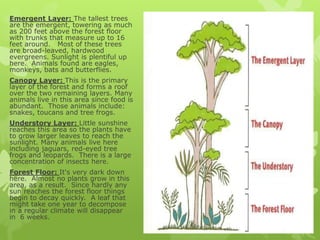
Emergent Layer: The tallest trees
are the emergent, towering as much
as 200 feet above the forest floor
with trunks that measure up to 16
feet around. Most of these trees
are broad-leaved, hardwood
evergreens. Sunlight is plentiful up
here. Animals found are eagles,
monkeys, bats and butterflies.
Canopy Layer: This is the primary
layer of the forest and forms a roof
over the two remaining layers. Many
animals live in this area since food is
abundant. Those animals include:
snakes, toucans and tree frogs.
Understory Layer: Little sunshine
reaches this area so the plants have
to grow larger leaves to reach the
sunlight. Many animals live here
including jaguars, red-eyed tree
frogs and leopards. There is a large
concentration of insects here.
Forest Floor: It's very dark down
here. Almost no plants grow in this
area, as a result. Since hardly any
sun reaches the forest floor things
begin to decay quickly. A leaf that
might take one year to decompose
in a regular climate will disappear
in 6 weeks.
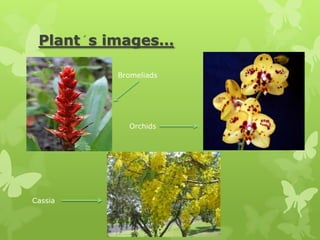
Plant s images…

         Bromeliads


           Orchids


Cassia
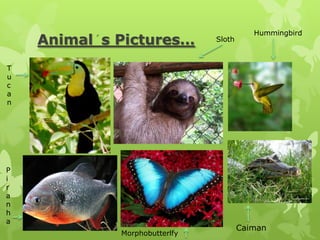
Hummingbird
    Animal s Pictures…         Sloth


T
u
c
a
n


P
i
r
a
n
h
a
                                       Caiman
             Morphobutterlfy
Human Impact
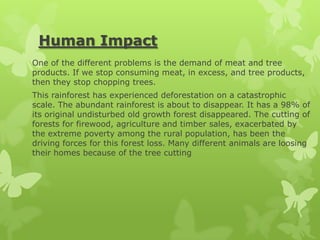
One of the different problems is the demand of meat and tree
products. If we stop consuming meat, in excess, and tree products,
then they stop chopping trees.
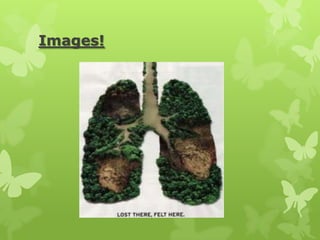
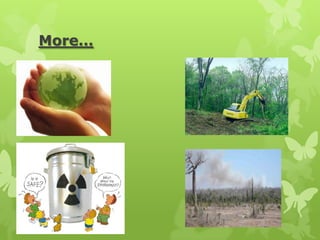
This rainforest has experienced deforestation on a catastrophic
scale. The abundant rainforest is about to disappear. It has a 98% of
its original undisturbed old growth forest disappeared. The cutting of
forests for firewood, agriculture and timber sales, exacerbated by
the extreme poverty among the rural population, has been the
driving forces for this forest loss. Many different animals are loosing
their homes because of the tree cutting
Images!
More…
This are the pages we use…

www.lizasreef.com
www.srl.caltech.edu
Thanks for watching us!


 We hope you like it!

Central america final

  • 1.
    Central American Rainforest By:Lucila Vivas, Macarena Vergara, Martina D’Orazio, Martina Renata Giarmaná, Sofía García Mansilla and Sol Scarpa.
  • 2.
    What’s a Biome? TheRainforest are Biomes and the biomes are large geographical area characterized by certain types of plants and animals. A biome is defined by complex interactions of plants and animal with the climate, geology, soil types, water resources, and latitude of an area.
  • 3.
    What is aTROPICAL RAINFOREST? Rainforest are de earth’s oldest living ecosystem. These incredible places cover only 6% of the earth’s surface but yet contain MORE THAN ½ of the world’s plants and animals species. The reason it is called a “Rain” Forest is because of the high amount of rainfall it gets per year. It is, also, called a Tropical Rainforest because it is located in the tropic’s zone.
  • 4.
  • 5.
    Location: The Central AmericanRainforest covers:  Belize  Costa Rica  El Salvador  Guatemala  Honduras  Mexico  Nicaragua  Panama
  • 6.
    Climate The Tropical Rainforesthas two seasons: the wet season and the driest season. The climate of a the rain forest is very hot and humid so the animals and the plants that exist there most learn to adapt to this climate. Is about 80°F (26°C) and has little daily or seasonal variation in temperature. In addition, tropical rainforests have an average of 100 inches (254 cm) of precipitation annually. This occur in equatorial regions near 25 degrees north and south latitude.
  • 7.
    Flora & Fauna Insects: morphobutterfly, Julia butterfly, Monarch There are different types of butterfly, and millions of other trees, lianas, orchids. insects. Vines: mahogany, rosewood, durian, cassia and palms are Mammals: some of the trees that habit jaguar, ocelot, opossums, sloth, there. spider monkey, etc. Bromeliads are an important Birds: part of the rainforest quetzal, , curassows, hoatzins, ecosystem, providing food and hummingbirds, eagles, ovenbir shelter to a wide variety of wildlife. ds, antbirds, flycatchers, touca ns, and many more. Orchids have a rare feature among plants, in that they have Reptiles: developed a method of anaconda, caiman, iguanas, liza maintaining water by only rd, boas and coral snakes, etc. opening the stomata (small holes) in their leaves at night. Amphibians: poison frogs and This helps to prevent many different types of frogs evaporation of water within the from different species and plant during the hottest parts of the day. animals. Fish: electric eel, piranha, and
  • 8.
    Emergent Layer: Thetallest trees are the emergent, towering as much as 200 feet above the forest floor with trunks that measure up to 16 feet around. Most of these trees are broad-leaved, hardwood evergreens. Sunlight is plentiful up here. Animals found are eagles, monkeys, bats and butterflies. Canopy Layer: This is the primary layer of the forest and forms a roof over the two remaining layers. Many animals live in this area since food is abundant. Those animals include: snakes, toucans and tree frogs. Understory Layer: Little sunshine reaches this area so the plants have to grow larger leaves to reach the sunlight. Many animals live here including jaguars, red-eyed tree frogs and leopards. There is a large concentration of insects here. Forest Floor: It's very dark down here. Almost no plants grow in this area, as a result. Since hardly any sun reaches the forest floor things begin to decay quickly. A leaf that might take one year to decompose in a regular climate will disappear in 6 weeks.
  • 9.
    Plant s images… Bromeliads Orchids Cassia
  • 10.
    Hummingbird Animal s Pictures… Sloth T u c a n P i r a n h a Caiman Morphobutterlfy
  • 11.
    Human Impact One ofthe different problems is the demand of meat and tree products. If we stop consuming meat, in excess, and tree products, then they stop chopping trees. This rainforest has experienced deforestation on a catastrophic scale. The abundant rainforest is about to disappear. It has a 98% of its original undisturbed old growth forest disappeared. The cutting of forests for firewood, agriculture and timber sales, exacerbated by the extreme poverty among the rural population, has been the driving forces for this forest loss. Many different animals are loosing their homes because of the tree cutting
  • 12.
  • 13.
  • 14.
    This are thepages we use… www.lizasreef.com www.srl.caltech.edu
  • 15.
    Thanks for watchingus! We hope you like it!