Tropical Dry Forest By:  Kenneth Gutierrez Marlon Amador  Eli Gonzalez  Stephanie M.
Location Tropical dry forests are to be found north and south of the equatorial forest belt. There are two main places to find them between 10° and 20°N latitude and the other between 10° and 20°S latitude .  The most diverse tropical dry forest are in southern Mexico and Bolivian lowlands. The most known tropical dry forest are located in: parts  of Africa, South and Central America, Mexico, India, Australia, and tropical islands
Climate The Temperatures are high all year. Hard dry seasons last several months. Better developed dry season than in the tropical rain forest. Receives about several hundreds centimeters of rain per year.
Plant Life Trees and plants must be able to survive periods of low precipitation and moisture. Most of the trees are deciduous. Most plant life in dry season will drop their leaves in order to reduce the water needs in them and to able to conserve what's left of it. In order to survive trees have thicker, more ridged, bark; deeper roots, much more variable leaves; and more types with thorns.
Animal Life  Tropical dry forest has a lot of wide variety of wildlife from the Gray Wolf to the African Lion. Mammalian biomass tends to be higher in dry forest than in rain forest. Most animals have to do adaptations in order to survive the dry weather since dry seasons are extremely long. The dominant wild life is tigers; monkeys; herbivores such as elephants, Indian rhinoceros, hog deer; birds such as great pied hornbill, pied harrier, and spot-billed pelican; insects such as termites; reptiles such as snakes and monitor lizards.
Abiotic and Biotic Factors Abiotic: Generally warm year-round; alternating wet and dry seasons; rich soils subject to erosion. Abiotic: Rocks, soil, sunlight, and dense foliage. Biotic: Wild plant and animal life.
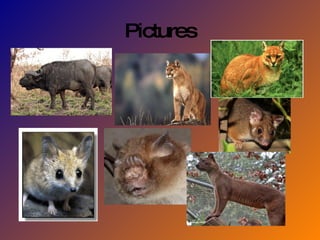
Pictures

Tropical Dry Forest Biome

  • 1.
    Tropical Dry ForestBy: Kenneth Gutierrez Marlon Amador Eli Gonzalez Stephanie M.
  • 2.
    Location Tropical dryforests are to be found north and south of the equatorial forest belt. There are two main places to find them between 10° and 20°N latitude and the other between 10° and 20°S latitude . The most diverse tropical dry forest are in southern Mexico and Bolivian lowlands. The most known tropical dry forest are located in: parts of Africa, South and Central America, Mexico, India, Australia, and tropical islands
  • 3.
    Climate The Temperaturesare high all year. Hard dry seasons last several months. Better developed dry season than in the tropical rain forest. Receives about several hundreds centimeters of rain per year.
  • 4.
    Plant Life Treesand plants must be able to survive periods of low precipitation and moisture. Most of the trees are deciduous. Most plant life in dry season will drop their leaves in order to reduce the water needs in them and to able to conserve what's left of it. In order to survive trees have thicker, more ridged, bark; deeper roots, much more variable leaves; and more types with thorns.
  • 5.
    Animal Life Tropical dry forest has a lot of wide variety of wildlife from the Gray Wolf to the African Lion. Mammalian biomass tends to be higher in dry forest than in rain forest. Most animals have to do adaptations in order to survive the dry weather since dry seasons are extremely long. The dominant wild life is tigers; monkeys; herbivores such as elephants, Indian rhinoceros, hog deer; birds such as great pied hornbill, pied harrier, and spot-billed pelican; insects such as termites; reptiles such as snakes and monitor lizards.
  • 6.
    Abiotic and BioticFactors Abiotic: Generally warm year-round; alternating wet and dry seasons; rich soils subject to erosion. Abiotic: Rocks, soil, sunlight, and dense foliage. Biotic: Wild plant and animal life.
  • 7.