TEMPERATE RAINFOREST

Jenny L
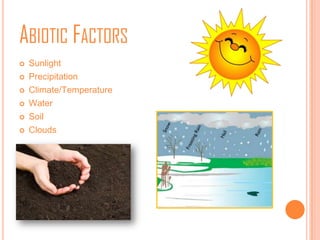
ABIOTIC FACTORS







Sunlight
Precipitation
Climate/Temperature
Water
Soil
Clouds
COMMON PLANTS & ANIMALS


Big coniferous trees



Deer

Douglas fir
Western red cedar
Mountain hemlock
Western hemlock
Sitka spruce
Lodgepole pine



Bears



Coyotes



Slugs



Birds



Elk



Fish



Squirrels










Deciduous trees in warmer spots


Big-leaf maple



Mosses



Chipmunks



Lichens



Wolves



Stinging Nettle



Foxes



Fireweed



Snakes



Salmonberry



Frogs
CLIMATE








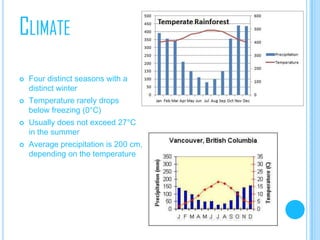
Four distinct seasons with a
distinct winter
Temperature rarely drops
below freezing (0°C)
Usually does not exceed 27°C
in the summer
Average precipitation is 200 cm,
depending on the temperature
WORLD DISTRIBUTION





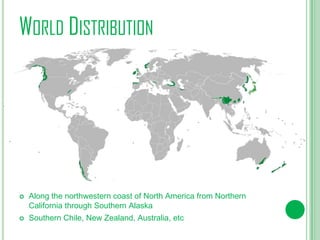
Along the northwestern coast of North America from Northern
California through Southern Alaska
Southern Chile, New Zealand, Australia, etc
BIOACCUMULATION


Climate change



Pollution



Alien species (invasive)



Humans
INTRUSIVE SPECIES


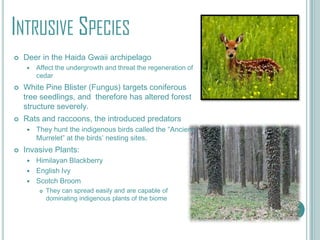
Deer in the Haida Gwaii archipelago






White Pine Blister (Fungus) targets coniferous
tree seedlings, and therefore has altered forest
structure severely.
Rats and raccoons, the introduced predators




Affect the undergrowth and threat the regeneration of
cedar

They hunt the indigenous birds called the “Ancient
Murrelet” at the birds’ nesting sites.

Invasive Plants:
Himilayan Blackberry
 English Ivy
 Scotch Broom




They can spread easily and are capable of
dominating indigenous plants of the biome
ENERGY FLOW


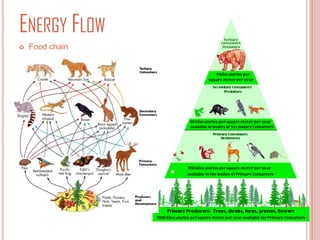
Food chain
SYMBIOSIS




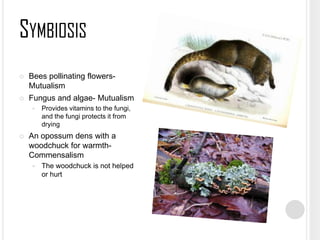
Bees pollinating flowersMutualism
Fungus and algae- Mutualism




Provides vitamins to the fungi,
and the fungi protects it from
drying

An opossum dens with a
woodchuck for warmthCommensalism


The woodchuck is not helped
or hurt
SUCCESSION


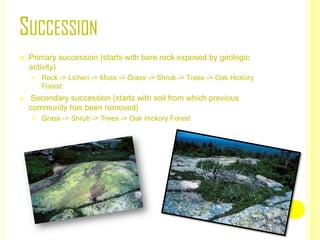
Primary succession (starts with bare rock exposed by geologic
activity)




Rock -> Lichen -> Moss -> Grass -> Shrub -> Trees -> Oak Hickory
Forest

Secondary succession (starts with soil from which previous
community has been removed)


Grass -> Shrub -> Trees -> Oak Hickory Forest
PREDATOR-PREY


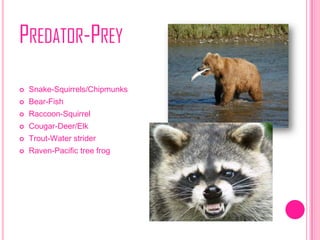
Snake-Squirrels/Chipmunks



Bear-Fish



Raccoon-Squirrel



Cougar-Deer/Elk



Trout-Water strider



Raven-Pacific tree frog

Science biome project