TRIGONOMETRIC
FUNCTIONS.
By.
Mr.sadiq
Hussain.
Definition;
 Functions of an angle of a triangle.i.e.
the relationship between the angle and side
of a triangle.
Note; Trigonometric functions are also
known
as a circular function.
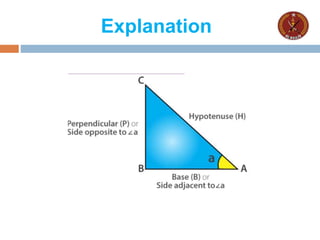
Explanation
Sine Function
 Sine function of an angle is the ratio
between the opposite side length to that of
the hypotenuse. From the above diagram,
the value of sin will be:
 Sin a =Opposite/Hypotenuse = CB/CA
Cos Function
 Cos of an angle is the ratio of the length of
the adjacent side to the length of the
hypotenuse. From the above diagram,
the cos function will be derived as follows.
 Cos a = Adjacent/Hypotenuse = AB/CA
Tan Function
 The tangent function is the ratio of the
length of the opposite side to that of the
adjacent side. It should be noted that the
tan can also be represented in terms of
sine and cos as their ratio. From the
diagram taken above, the tan function will
be the following.
 Tan a = Opposite/Adjacent = CB/BA
 Also, in terms of sine and cos, tan can be
represented as:
 Tan a = sin a/cos a
Secant, Cosecant and Cotangent
Functions
 Secant, cosecant (csc) and cotangent are
the three additional functions which are
derived from the primary functions of sine,
cos, and tan. The reciprocal of sine, cos,
and tan are cosecant (csc), secant (sec),
and cotangent (cot) respectively. The
formula of each of these functions are
given as:
Mathematical Ratio
 Sec a = 1/(cos a) = Hypotenuse/Adjacent =
CA/AB
 Cosec a = 1/(sin a) = Hypotenuse/Opposite
= CA/CB
 cot a = 1/(tan a) = Adjacent/Opposite =
BA/CB
Note: Inverse trigonometric
functions are used to obtain an angle from
any of the angle’s trigonometric ratios.
Basically, inverses of the sine, cosine,
tangent, cotangent, secant, and cosecant
functions are represented as arcsine,
arccosine, arctangent, arc cotangent, arc
secant, and arc cosecant.
THANK YOU

Trigonometric functions

  • 1.
  • 2.
    Definition;  Functions ofan angle of a triangle.i.e. the relationship between the angle and side of a triangle. Note; Trigonometric functions are also known as a circular function.
  • 3.
  • 4.
    Sine Function  Sinefunction of an angle is the ratio between the opposite side length to that of the hypotenuse. From the above diagram, the value of sin will be:  Sin a =Opposite/Hypotenuse = CB/CA
  • 5.
    Cos Function  Cosof an angle is the ratio of the length of the adjacent side to the length of the hypotenuse. From the above diagram, the cos function will be derived as follows.  Cos a = Adjacent/Hypotenuse = AB/CA
  • 6.
    Tan Function  Thetangent function is the ratio of the length of the opposite side to that of the adjacent side. It should be noted that the tan can also be represented in terms of sine and cos as their ratio. From the diagram taken above, the tan function will be the following.  Tan a = Opposite/Adjacent = CB/BA  Also, in terms of sine and cos, tan can be represented as:  Tan a = sin a/cos a
  • 7.
    Secant, Cosecant andCotangent Functions  Secant, cosecant (csc) and cotangent are the three additional functions which are derived from the primary functions of sine, cos, and tan. The reciprocal of sine, cos, and tan are cosecant (csc), secant (sec), and cotangent (cot) respectively. The formula of each of these functions are given as:
  • 8.
    Mathematical Ratio  Seca = 1/(cos a) = Hypotenuse/Adjacent = CA/AB  Cosec a = 1/(sin a) = Hypotenuse/Opposite = CA/CB  cot a = 1/(tan a) = Adjacent/Opposite = BA/CB
  • 9.
    Note: Inverse trigonometric functionsare used to obtain an angle from any of the angle’s trigonometric ratios. Basically, inverses of the sine, cosine, tangent, cotangent, secant, and cosecant functions are represented as arcsine, arccosine, arctangent, arc cotangent, arc secant, and arc cosecant.
  • 10.