Topic – Introduction to
Trigonometry
By : Ravikumar D
Msc(Mathematics).
Introduction to Trigonometry
• Branch of Mathematics that deals with the
triangles, mostly with right triangles, used
in finding relationship between sides &
angles.
Definition
• Branch of mathematics that studies
relationships involving lengths
and angles of triangles.
Origin & Purpose of Trigonometry
Name - Hipparchus, known as father of
trigonometry
Place - Turkey
Year -140BC
Need - To find the motion of the planets, and the
solar and lunar eclipses
Overview
Trigonometric Functions
There are three basic trigonometric functions
which are :-
1. Sine Function (Sin)
2. Cosine Function (Cos)
3. Tangent Function (Tan)
Terminology
Hypotenuse
The hypotenuse of a right triangle
is always the side opposite the
right angle. It is the longest side
in a right triangle.
.
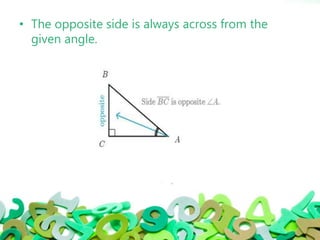
• The opposite side is always across from the
given angle.
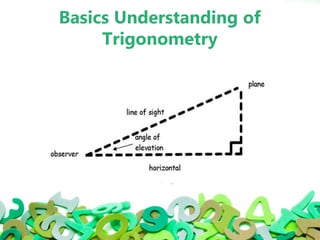
• Angle of elevation
• The angle of elevation of an object as seen by an
observer is the angle between the horizontal and
the line from the object to the observer's eye
(the line of sight).
Basics Understanding of
Trigonometry
Sine Function
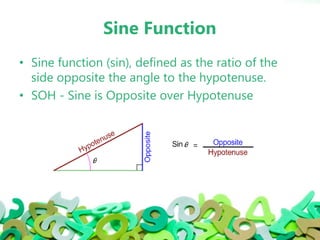
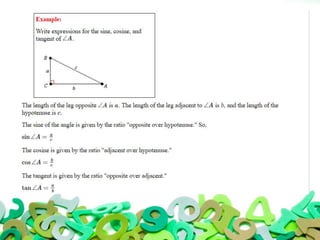
• Sine function (sin), defined as the ratio of the
side opposite the angle to the hypotenuse.
• SOH - Sine is Opposite over Hypotenuse
Cosine Function
• Cosine function (cos), defined as the ratio of
the adjacent leg to the hypotenuse.
• CAH - Cosine is Adjacent over Hypotenuse
Tangent Function (Tan)
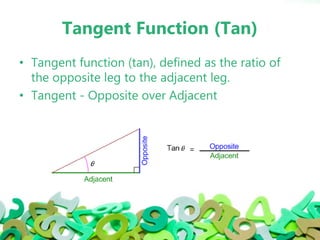
• Tangent function (tan), defined as the ratio of
the opposite leg to the adjacent leg.
• Tangent - Opposite over Adjacent
Reciprocal Functions
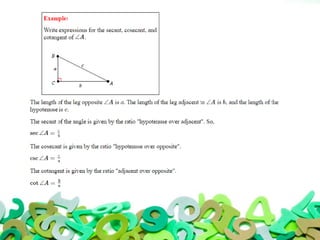
• The cosecant or cosec(A), is the reciprocal of
sin(A); i.e. the ratio of the length of the
hypotenuse to the length of the opposite side
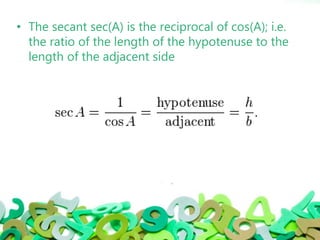
• The secant sec(A) is the reciprocal of cos(A); i.e.
the ratio of the length of the hypotenuse to the
length of the adjacent side
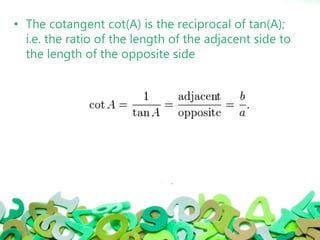
• The cotangent cot(A) is the reciprocal of tan(A);
i.e. the ratio of the length of the adjacent side to
the length of the opposite side
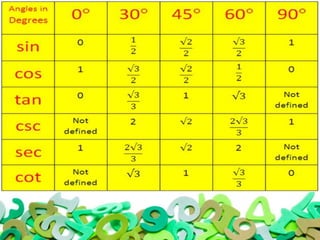
Finding the value of Trigonometric
Functions
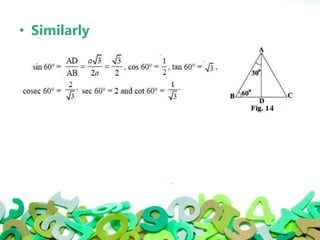
• Similarly
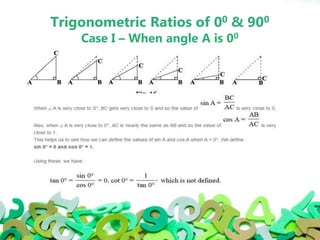
Trigonometric Ratios of 00 & 900
Case I – When angle A is 00
Case II – When angle A is 900
Example :-
In Δ PQR, right-angled at Q, PQ = 3 cm and PR = 6 cm. Determine ∠
QPR and ∠ PRQ.
Solution :-
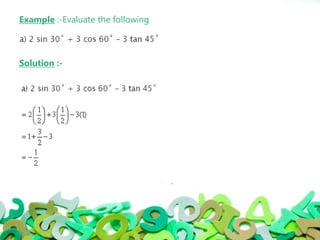
Example :-Evaluate the following
Solution :-
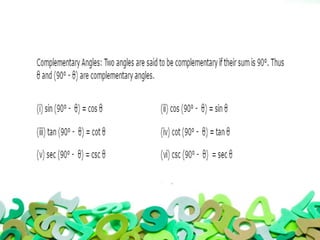
Trigonometrical Ratios
of Complementary
Angles
Example
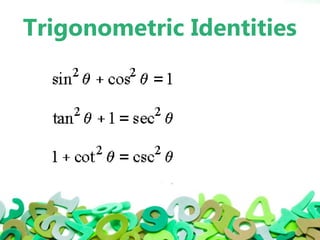
Trigonometric Identities
Example
Applications in Real Life
• In ancient time it was used for astronomy
in finding distance of stars
• Finding radius of earth
• Finding height of hills, buildings, trees
• Navigation – Airplane, Ships etc.
• Defense

Trigonometry ppt.pptx