Trigger Points
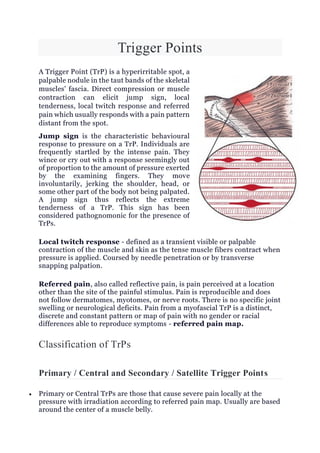
A Trigger Point (TrP) is a hyperirritable spot, a
palpable nodule in the taut bands of the skeletal
muscles' fascia. Direct compression or muscle
contraction can elicit jump sign, local
tenderness, local twitch response and referred
pain which usually responds with a pain pattern
distant from the spot.
Jump sign is the characteristic behavioural
response to pressure on a TrP. Individuals are
frequently startled by the intense pain. They
wince or cry out with a response seemingly out
of proportion to the amount of pressure exerted
by the examining fingers. They move
involuntarily, jerking the shoulder, head, or
some other part of the body not being palpated.
A jump sign thus reflects the extreme
tenderness of a TrP. This sign has been
considered pathognomonic for the presence of
TrPs.
Local twitch response - defined as a transient visible or palpable
contraction of the muscle and skin as the tense muscle fibers contract when
pressure is applied. Coursed by needle penetration or by transverse
snapping palpation.
Referred pain, also called reflective pain, is pain perceived at a location
other than the site of the painful stimulus. Pain is reproducible and does
not follow dermatomes, myotomes, or nerve roots. There is no specific joint
swelling or neurological deficits. Pain from a myofascial TrP is a distinct,
discrete and constant pattern or map of pain with no gender or racial
differences able to reproduce symptoms - referred pain map.
Classification of TrPs
Primary / Central and Secondary / Satellite Trigger Points
 Primary or Central TrPs are those that cause severe pain locally at the
pressure with irradiation according to referred pain map. Usually are based
around the center of a muscle belly.
 Secondary or Satellite TrPs arise in response to existing central trigger
points in surrounding muscles. They usually spontaneously withdraw when
the central TrP is healed. Can be present in the form of a cluster.
Active and Inactive /Latent Trigger Points
 Active TrP is any point that causes tenderness and referral pain pattern on
palpation. Almost always central TrPs are active and some satellite TrPs
are also active (but not necessarily all of them). Inactive TrPs can
eventually become active if there is a provocative factor.
 Inactive or Latent TrPs can develop in anywhere and under fingertips feel
like lumps, but are not painful. Can increase a stiffness of the muscles.
Diffuse Trigger Points
 Commonly happen in case of severe postural deformity where initially
primary TrPs are multiple, so secondary multiple TrPs are only a response
of a mechanism, called diffuse.
Attachment Trigger Points
 Arise in tendo-osseous junctions which become very tender. If not treated,
degenerative processes of an adjacent joint can spring up.
Ligamentous Trigger Points
 Even ligaments can develop trigger points. Presence of TrPs in the anterior
longitudinal ligament of the spine can result in neck instability. Some knee
pain syndromes are successfully healed when treated ligamentum patellae
and fibular collateral ligament.
Examination
Firstly, the exact location and right TrP should be palpated. What we look
for are nodules (small or big ones) or lumps (one or several of them next to
each other) in the muscles/fascias, with sometimes a temperature change
in the zone of active TrPs ( skin warmer or cooler). Other signs to check up
to be sure we are at the proper spot are:
1. The initial onset of pain and the recurrence of pain are of muscular
origin.
2. Reproducible spot tenderness occurs in the muscle at the site of the trigger
point pain.
3. Pain is referred locally or at a distance on mechanical stimulation of the
trigger point. This referred pain and tenderness projects in a pattern
characteristic of that muscle and reproduce part of the patient’s complaint.
4. There are a muscle stiffness and a palpable hardening of a taut
band of muscle fibers passing through the tender spot in a shortened
muscle (like a string of a guitar),
5. A local twitch response of the taut muscle and jump sign occur when the
trigger point is stimulated
Examination through palpation can be performed standing, sitting or lying
down. There also have to be performed the ROM examination as well as
postural examination.
Physical Therapy Management
 If possible, everyday-life factors that arouse the emergence of a TrPs must
be eliminated or reduced,
 Posture training and education about postures and lifestyle,
 Passive stretching and/or Foam Roller stretching, few times a day,
 Self-massage, few times a day, and especially Deep Stroking Massage, done
rhythmically and in only one direction,
 Strengthening: initially only isometric and then isotonic exercises,
 Ischemic Compression Technique - the term has been used to describe
treatment in which ischemia is induced in the TrPt zone by applying
sustained pressure. However, this principle is questionable, since the
nucleus of the TrP intrinsically presents important hypoxia. Simons
described a similar treatment modality, though without the need to induce
additional ischemia in the TrP zone (TrP Pressure Release). The aim of this
technique is to free the contracted sarcomeres within the TrP. The amount
of pressure applied should suffice to produce gradual relaxation of the
tension within the TrP zone, without causing pain. Yet both techniques
show imitate significant improvement of the ROM after treatment
 Taping Technique,
 Spray and Stretch Technique by using ethyl chloride spray,
 Manual Lymphatic Drainage (MLD), since the presence of TrPs obstacle
lymphatic flow,
 Other proprioceptive neuromuscular techniques: Reciprocal Inhibition
(RI), Post-Isometric Relaxation (PIR), Contract-Relax/Hold-Relax
(CRHR), Contract-Relax/Antagonist Contract (CRAC),
 Some specific techniques like Neuromuscular Technique(NMT), Muscle
Energy Technique (MET) and Myotherapy (MT),
 Ultrasonography, Hot and Cold packs, Diathermy- Tecar therapy, Laser,
Ionophoresis
Tender Points
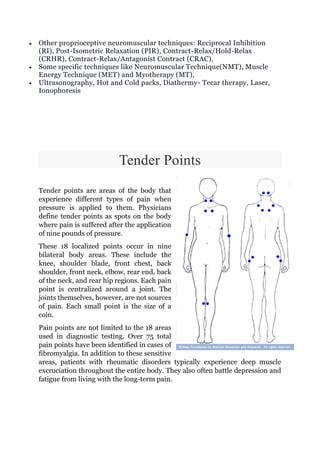
Tender points are areas of the body that
experience different types of pain when
pressure is applied to them. Physicians
define tender points as spots on the body
where pain is suffered after the application
of nine pounds of pressure.
These 18 localized points occur in nine
bilateral body areas. These include the
knee, shoulder blade, front chest, back
shoulder, front neck, elbow, rear end, back
of the neck, and rear hip regions. Each pain
point is centralized around a joint. The
joints themselves, however, are not sources
of pain. Each small point is the size of a
coin.
Pain points are not limited to the 18 areas
used in diagnostic testing. Over 75 total
pain points have been identified in cases of
fibromyalgia. In addition to these sensitive
areas, patients with rheumatic disorders typically experience deep muscle
excruciation throughout the entire body. They also often battle depression and
fatigue from living with the long-term pain.
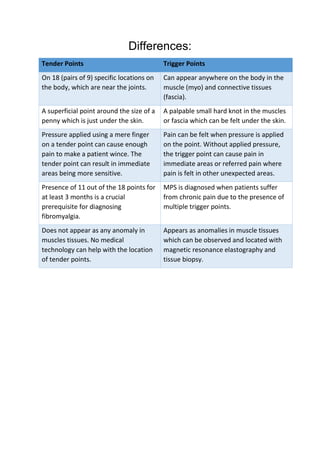
Differences:
Tender Points Trigger Points
On 18 (pairs of 9) specific locations on
the body, which are near the joints.
Can appear anywhere on the body in the
muscle (myo) and connective tissues
(fascia).
A superficial point around the size of a
penny which is just under the skin.
A palpable small hard knot in the muscles
or fascia which can be felt under the skin.
Pressure applied using a mere finger
on a tender point can cause enough
pain to make a patient wince. The
tender point can result in immediate
areas being more sensitive.
Pain can be felt when pressure is applied
on the point. Without applied pressure,
the trigger point can cause pain in
immediate areas or referred pain where
pain is felt in other unexpected areas.
Presence of 11 out of the 18 points for
at least 3 months is a crucial
prerequisite for diagnosing
fibromyalgia.
MPS is diagnosed when patients suffer
from chronic pain due to the presence of
multiple trigger points.
Does not appear as any anomaly in
muscles tissues. No medical
technology can help with the location
of tender points.
Appears as anomalies in muscle tissues
which can be observed and located with
magnetic resonance elastography and
tissue biopsy.

Trigger points & Tender Points

  • 1.
    Trigger Points A TriggerPoint (TrP) is a hyperirritable spot, a palpable nodule in the taut bands of the skeletal muscles' fascia. Direct compression or muscle contraction can elicit jump sign, local tenderness, local twitch response and referred pain which usually responds with a pain pattern distant from the spot. Jump sign is the characteristic behavioural response to pressure on a TrP. Individuals are frequently startled by the intense pain. They wince or cry out with a response seemingly out of proportion to the amount of pressure exerted by the examining fingers. They move involuntarily, jerking the shoulder, head, or some other part of the body not being palpated. A jump sign thus reflects the extreme tenderness of a TrP. This sign has been considered pathognomonic for the presence of TrPs. Local twitch response - defined as a transient visible or palpable contraction of the muscle and skin as the tense muscle fibers contract when pressure is applied. Coursed by needle penetration or by transverse snapping palpation. Referred pain, also called reflective pain, is pain perceived at a location other than the site of the painful stimulus. Pain is reproducible and does not follow dermatomes, myotomes, or nerve roots. There is no specific joint swelling or neurological deficits. Pain from a myofascial TrP is a distinct, discrete and constant pattern or map of pain with no gender or racial differences able to reproduce symptoms - referred pain map. Classification of TrPs Primary / Central and Secondary / Satellite Trigger Points  Primary or Central TrPs are those that cause severe pain locally at the pressure with irradiation according to referred pain map. Usually are based around the center of a muscle belly.
  • 2.
     Secondary orSatellite TrPs arise in response to existing central trigger points in surrounding muscles. They usually spontaneously withdraw when the central TrP is healed. Can be present in the form of a cluster. Active and Inactive /Latent Trigger Points  Active TrP is any point that causes tenderness and referral pain pattern on palpation. Almost always central TrPs are active and some satellite TrPs are also active (but not necessarily all of them). Inactive TrPs can eventually become active if there is a provocative factor.  Inactive or Latent TrPs can develop in anywhere and under fingertips feel like lumps, but are not painful. Can increase a stiffness of the muscles. Diffuse Trigger Points  Commonly happen in case of severe postural deformity where initially primary TrPs are multiple, so secondary multiple TrPs are only a response of a mechanism, called diffuse. Attachment Trigger Points  Arise in tendo-osseous junctions which become very tender. If not treated, degenerative processes of an adjacent joint can spring up. Ligamentous Trigger Points  Even ligaments can develop trigger points. Presence of TrPs in the anterior longitudinal ligament of the spine can result in neck instability. Some knee pain syndromes are successfully healed when treated ligamentum patellae and fibular collateral ligament. Examination Firstly, the exact location and right TrP should be palpated. What we look for are nodules (small or big ones) or lumps (one or several of them next to each other) in the muscles/fascias, with sometimes a temperature change
  • 3.
    in the zoneof active TrPs ( skin warmer or cooler). Other signs to check up to be sure we are at the proper spot are: 1. The initial onset of pain and the recurrence of pain are of muscular origin. 2. Reproducible spot tenderness occurs in the muscle at the site of the trigger point pain. 3. Pain is referred locally or at a distance on mechanical stimulation of the trigger point. This referred pain and tenderness projects in a pattern characteristic of that muscle and reproduce part of the patient’s complaint. 4. There are a muscle stiffness and a palpable hardening of a taut band of muscle fibers passing through the tender spot in a shortened muscle (like a string of a guitar), 5. A local twitch response of the taut muscle and jump sign occur when the trigger point is stimulated Examination through palpation can be performed standing, sitting or lying down. There also have to be performed the ROM examination as well as postural examination. Physical Therapy Management  If possible, everyday-life factors that arouse the emergence of a TrPs must be eliminated or reduced,  Posture training and education about postures and lifestyle,  Passive stretching and/or Foam Roller stretching, few times a day,  Self-massage, few times a day, and especially Deep Stroking Massage, done rhythmically and in only one direction,  Strengthening: initially only isometric and then isotonic exercises,  Ischemic Compression Technique - the term has been used to describe treatment in which ischemia is induced in the TrPt zone by applying sustained pressure. However, this principle is questionable, since the nucleus of the TrP intrinsically presents important hypoxia. Simons described a similar treatment modality, though without the need to induce additional ischemia in the TrP zone (TrP Pressure Release). The aim of this technique is to free the contracted sarcomeres within the TrP. The amount of pressure applied should suffice to produce gradual relaxation of the tension within the TrP zone, without causing pain. Yet both techniques show imitate significant improvement of the ROM after treatment  Taping Technique,  Spray and Stretch Technique by using ethyl chloride spray,  Manual Lymphatic Drainage (MLD), since the presence of TrPs obstacle lymphatic flow,
  • 4.
     Other proprioceptiveneuromuscular techniques: Reciprocal Inhibition (RI), Post-Isometric Relaxation (PIR), Contract-Relax/Hold-Relax (CRHR), Contract-Relax/Antagonist Contract (CRAC),  Some specific techniques like Neuromuscular Technique(NMT), Muscle Energy Technique (MET) and Myotherapy (MT),  Ultrasonography, Hot and Cold packs, Diathermy- Tecar therapy, Laser, Ionophoresis Tender Points Tender points are areas of the body that experience different types of pain when pressure is applied to them. Physicians define tender points as spots on the body where pain is suffered after the application of nine pounds of pressure. These 18 localized points occur in nine bilateral body areas. These include the knee, shoulder blade, front chest, back shoulder, front neck, elbow, rear end, back of the neck, and rear hip regions. Each pain point is centralized around a joint. The joints themselves, however, are not sources of pain. Each small point is the size of a coin. Pain points are not limited to the 18 areas used in diagnostic testing. Over 75 total pain points have been identified in cases of fibromyalgia. In addition to these sensitive areas, patients with rheumatic disorders typically experience deep muscle excruciation throughout the entire body. They also often battle depression and fatigue from living with the long-term pain.
  • 5.
    Differences: Tender Points TriggerPoints On 18 (pairs of 9) specific locations on the body, which are near the joints. Can appear anywhere on the body in the muscle (myo) and connective tissues (fascia). A superficial point around the size of a penny which is just under the skin. A palpable small hard knot in the muscles or fascia which can be felt under the skin. Pressure applied using a mere finger on a tender point can cause enough pain to make a patient wince. The tender point can result in immediate areas being more sensitive. Pain can be felt when pressure is applied on the point. Without applied pressure, the trigger point can cause pain in immediate areas or referred pain where pain is felt in other unexpected areas. Presence of 11 out of the 18 points for at least 3 months is a crucial prerequisite for diagnosing fibromyalgia. MPS is diagnosed when patients suffer from chronic pain due to the presence of multiple trigger points. Does not appear as any anomaly in muscles tissues. No medical technology can help with the location of tender points. Appears as anomalies in muscle tissues which can be observed and located with magnetic resonance elastography and tissue biopsy.