
``welcome``
Seminar on CLEFT LIP AND PALATE
CLEFT LIP: Cleft lip is a birth defect that results in a unilateral or bilateral opening in the upper lip between the mouth and nose.  CLEFT PALATE: Cleft palate is a birth defect characterized by an opening in the roof of the mouth caused by a lack of tissue development.
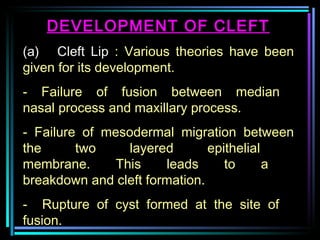
DEVELOPMENT OF CLEFT (a)  Cleft Lip  : Various theories have been given for its development.  - Failure of fusion between median  nasal process and maxillary process.  - Failure of mesodermal migration between the two layered epithelial  membrane. This leads to a  breakdown and cleft formation. -  Rupture of cyst formed at the site of  fusion.
(b)  Cleft Palate  : Various theories have    been given for its development.  - Alteration in intrinsic palatal shelf force  - Failure of tongue to drop down  - Non fusion of shelves - Failure of mesodermal migration  - Rupture of cyst formed at the site      Of fusion.
ETIOLOGY  Genetic factors Nutritional disturbances during development  Physiologic, Emotional or traumatic stresses during development Defective vascular supply to the area involved  A mechanical disturbance where the size of the tongue may prevent the union of parts  Various environmental factors like infections  (e.g. Rubella), exposure to radiation, drugs like thalidomide, antiepileptic durgs, hormonal pills, quinine etc.  Maternal consumption of alcohol and smoking
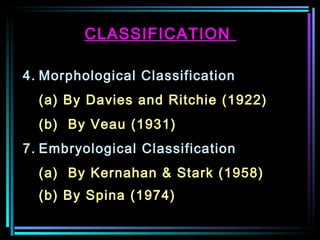
CLASSIFICATION  Morphological Classification  (a) By Davies and Ritchie (1922) (b)  By Veau (1931)  Embryological Classification  (a)  By Kernahan & Stark (1958) (b) By Spina (1974)
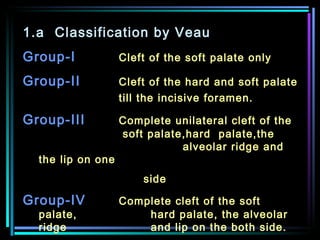
1.a Classification by Veau  Group-I   Cleft of the soft palate only   Group-II Cleft of the hard and soft palate  till the incisive foramen.   Group-III   Complete unilateral cleft of the   soft palate,hard  palate,the  alveolar ridge and the lip on one  side Group-IV Complete cleft of the soft palate,  hard palate, the alveolar ridge  and lip on the both side.
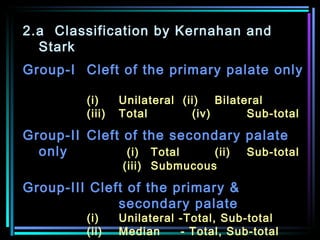
2.a Classification by Kernahan and Stark  Group-I Cleft of the primary palate only   (i) Unilateral (ii)  Bilateral    (iii)  Total  (iv)  Sub-total  Group-II Cleft of the secondary palate only   (i) Total  (ii) Sub-total    (iii) Submucous Group-III Cleft of the primary &  secondary palate   (i) Unilateral -Total, Sub-total    (ii)  Median  - Total, Sub-total    (iii) Bilateral  -Total, Sub-total
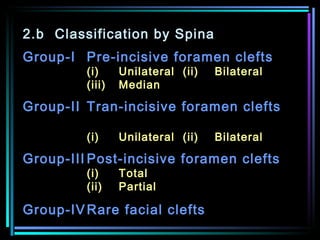
2.b Classification by Spina Group-I Pre-incisive foramen clefts  (i) Unilateral (ii)  Bilateral  (iii) Median  Group-II Tran-incisive foramen clefts   (i) Unilateral  (ii) Bilateral Group-III Post-incisive foramen clefts    (i) Total    (ii) Partial Group-IV Rare facial clefts
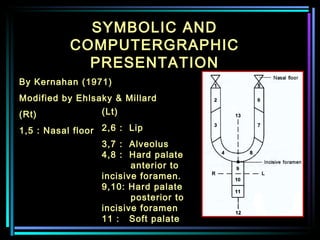
SYMBOLIC AND COMPUTERGRAPHIC PRESENTATION By Kernahan (1971)  Modified by Ehlsaky & Millard (Rt)    1,5 : Nasal floor  (Lt) 2,6 :  Lip  3,7 :  Alveolus  4,8 :  Hard palate    anterior to incisive foramen.  9,10: Hard palate    posterior to incisive foramen  11 :  Soft palate
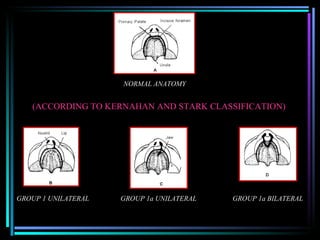
NORMAL ANATOMY (ACCORDING TO KERNAHAN AND STARK CLASSIFICATION) GROUP 1 UNILATERAL GROUP 1a UNILATERAL GROUP 1a BILATERAL
(CONTD.) GROUP II COMPLETE GROUP III UNILATERAL GROUP III BILATERAL
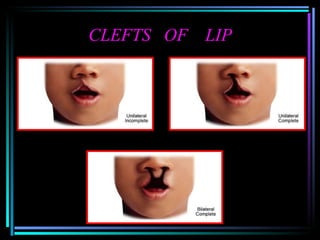
CLEFTS  OF  LIP
BILATERAL COMPLETE CLEFT PALATE
INCOMPLETE CLEFT PALATE
BILATERAL CLEFT LIP AND PALATE
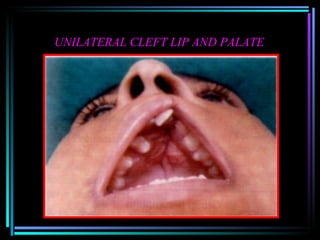
UNILATERAL CLEFT LIP AND PALATE
INCIDENCE  Among different races     Whites    -  One out of 800     Blacks    - One out of 2000     Japanese or Indians  - One out of 500 (b) Of different clefts     Cleft lip alone  - 25%    Cleft palate alone  - 25%     Cleft lip and palate both  - 50%  (c) Males > Females (for combined cleft lip & palate)  Females > Males (for cleft palate only)  (d) Unilateral defects > Bilateral defects  (e) Left sided defects > Right sided defects (f)  Increase in parental age    increase risk of producing    affected child.
CLINICAL FEATURES FACIAL DEFORMITY – NOSE TIP DEVIATED TO NORMAL SIDE, ALA ON CLEFT SIDE FLARED, NOSTRIL HORIZONTALLY ORIENTED, LIP DEFORMITY, HYPOPLASTIC AND A COLLAPSED MAXILLA ON SIDE OF THE CLEFT AND THE CLEFT PALATE . - FOR BILATERAL CLEFTS ADDITIONAL FEATURES LIKE PROTRUDED PRE-MAXILLA, SMALL PRO-LABIUM, ABSENT COLUMELLA AND SHALLOW GINGIVOLABIAL SULCUS. INABILITY TO SUCK MOTHER’S MILK NASAL INTONATION FOR CLEFT PALATE NASAL REGURGITATION (CONTD.)
TOOTH DEFECTS – WHICH MAY BE SUPER NUMERARY TEETH CONGENITALLY MISSING TEETH T- CINGULUM PEG LATERALS THICK CURVED HYPOPLASTIC INCISORS NATAL TEETH GERMINATION  DELAYED ERUPTION OF PERMANENT TEETH HYPOPLASTIC INCISORS NEXT TO ALVEOLAR DEFECTS ASSOCIATED SYNDROMES – CLEFT LIP MAY BE ASSOCIATED WITH FOLLOWING SYNDROMES DOWN’S SYNDROME WARDEN BURG’S SYNDROME VANDERWOUDE’S SYNDROME ORO-FACIAL DIGITAL SYNDROME TREACHER COLLIN’S SYNDROME PIERRE ROBIN’S SYNDROME KLIPPEL FEIL’S SYNDROME
REFERENCES: 1.  TEXTBOOK OF PEDODONTICS: SHOBHA TANDON 2.  DENTISTRY FOR CHILDHOOD AND ADOLESCENT: McDONALD, AVERY
THANK YOU

cleft-lip-palate

  • 1.
  • 2.
    Seminar on CLEFTLIP AND PALATE
  • 3.
    CLEFT LIP: Cleftlip is a birth defect that results in a unilateral or bilateral opening in the upper lip between the mouth and nose. CLEFT PALATE: Cleft palate is a birth defect characterized by an opening in the roof of the mouth caused by a lack of tissue development.
  • 4.
    DEVELOPMENT OF CLEFT(a) Cleft Lip : Various theories have been given for its development. - Failure of fusion between median nasal process and maxillary process. - Failure of mesodermal migration between the two layered epithelial membrane. This leads to a breakdown and cleft formation. - Rupture of cyst formed at the site of fusion.
  • 5.
    (b) CleftPalate : Various theories have been given for its development. - Alteration in intrinsic palatal shelf force - Failure of tongue to drop down - Non fusion of shelves - Failure of mesodermal migration - Rupture of cyst formed at the site Of fusion.
  • 6.
    ETIOLOGY Geneticfactors Nutritional disturbances during development Physiologic, Emotional or traumatic stresses during development Defective vascular supply to the area involved A mechanical disturbance where the size of the tongue may prevent the union of parts Various environmental factors like infections (e.g. Rubella), exposure to radiation, drugs like thalidomide, antiepileptic durgs, hormonal pills, quinine etc. Maternal consumption of alcohol and smoking
  • 7.
    CLASSIFICATION MorphologicalClassification (a) By Davies and Ritchie (1922) (b) By Veau (1931) Embryological Classification (a) By Kernahan & Stark (1958) (b) By Spina (1974)
  • 8.
    1.a Classification byVeau Group-I Cleft of the soft palate only Group-II Cleft of the hard and soft palate till the incisive foramen. Group-III Complete unilateral cleft of the soft palate,hard palate,the alveolar ridge and the lip on one side Group-IV Complete cleft of the soft palate, hard palate, the alveolar ridge and lip on the both side.
  • 9.
    2.a Classification byKernahan and Stark Group-I Cleft of the primary palate only (i) Unilateral (ii) Bilateral (iii) Total (iv) Sub-total Group-II Cleft of the secondary palate only (i) Total (ii) Sub-total (iii) Submucous Group-III Cleft of the primary & secondary palate (i) Unilateral -Total, Sub-total (ii) Median - Total, Sub-total (iii) Bilateral -Total, Sub-total
  • 10.
    2.b Classification bySpina Group-I Pre-incisive foramen clefts (i) Unilateral (ii) Bilateral (iii) Median Group-II Tran-incisive foramen clefts (i) Unilateral (ii) Bilateral Group-III Post-incisive foramen clefts (i) Total (ii) Partial Group-IV Rare facial clefts
  • 11.
    SYMBOLIC AND COMPUTERGRAPHICPRESENTATION By Kernahan (1971) Modified by Ehlsaky & Millard (Rt) 1,5 : Nasal floor (Lt) 2,6 : Lip 3,7 : Alveolus 4,8 : Hard palate anterior to incisive foramen. 9,10: Hard palate posterior to incisive foramen 11 : Soft palate
  • 12.
    NORMAL ANATOMY (ACCORDINGTO KERNAHAN AND STARK CLASSIFICATION) GROUP 1 UNILATERAL GROUP 1a UNILATERAL GROUP 1a BILATERAL
  • 13.
    (CONTD.) GROUP IICOMPLETE GROUP III UNILATERAL GROUP III BILATERAL
  • 14.
  • 15.
  • 16.
  • 17.
  • 18.
  • 19.
    INCIDENCE Amongdifferent races  Whites - One out of 800  Blacks - One out of 2000  Japanese or Indians - One out of 500 (b) Of different clefts  Cleft lip alone - 25%  Cleft palate alone - 25%  Cleft lip and palate both - 50% (c) Males > Females (for combined cleft lip & palate) Females > Males (for cleft palate only) (d) Unilateral defects > Bilateral defects (e) Left sided defects > Right sided defects (f) Increase in parental age  increase risk of producing affected child.
  • 20.
    CLINICAL FEATURES FACIALDEFORMITY – NOSE TIP DEVIATED TO NORMAL SIDE, ALA ON CLEFT SIDE FLARED, NOSTRIL HORIZONTALLY ORIENTED, LIP DEFORMITY, HYPOPLASTIC AND A COLLAPSED MAXILLA ON SIDE OF THE CLEFT AND THE CLEFT PALATE . - FOR BILATERAL CLEFTS ADDITIONAL FEATURES LIKE PROTRUDED PRE-MAXILLA, SMALL PRO-LABIUM, ABSENT COLUMELLA AND SHALLOW GINGIVOLABIAL SULCUS. INABILITY TO SUCK MOTHER’S MILK NASAL INTONATION FOR CLEFT PALATE NASAL REGURGITATION (CONTD.)
  • 21.
    TOOTH DEFECTS –WHICH MAY BE SUPER NUMERARY TEETH CONGENITALLY MISSING TEETH T- CINGULUM PEG LATERALS THICK CURVED HYPOPLASTIC INCISORS NATAL TEETH GERMINATION DELAYED ERUPTION OF PERMANENT TEETH HYPOPLASTIC INCISORS NEXT TO ALVEOLAR DEFECTS ASSOCIATED SYNDROMES – CLEFT LIP MAY BE ASSOCIATED WITH FOLLOWING SYNDROMES DOWN’S SYNDROME WARDEN BURG’S SYNDROME VANDERWOUDE’S SYNDROME ORO-FACIAL DIGITAL SYNDROME TREACHER COLLIN’S SYNDROME PIERRE ROBIN’S SYNDROME KLIPPEL FEIL’S SYNDROME
  • 22.
    REFERENCES: 1. TEXTBOOK OF PEDODONTICS: SHOBHA TANDON 2. DENTISTRY FOR CHILDHOOD AND ADOLESCENT: McDONALD, AVERY
  • 23.