Trigeminal neuralgia
Moderated by: Dr. Vidhi Rathi
Presented by: Gauri Bargoti
NEURALGIA
Pain of severe throbbing or stabbing
character in the course of distribution of a
nerve.
TRIGEMINAL NEURALGIA
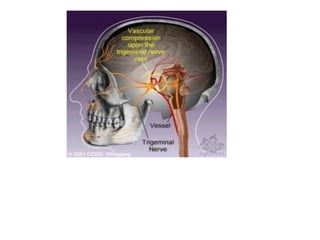
• Trigeminal neuralgia (TN) is sudden,
usually unilateral, severe, brief, stabbing,
recurrent episodes of pain in the
distribution of one or more branches of
the trigeminal nerve.
SYNONYMS
• Trifacial neuralgia
• Fothergill’s disease
• Tic-doloureux (painful jerking)
ETOIOLOGY
• INTRACRANIAL CAUSES
1. Petrous ridge compression-internal carotid artey
pulsations
2. Multiple sclerosis
3. Intracranial tumors- at the cerebellopontine angle
4. Intracranial vascular abnormalities-basilar artery
aneurysm, superior cerebellar artery abnormality
• EXTRACRANIAL CAUSES
1. Vascular factors
2. Dental etiology
3. Post traumatic neuralgia
4. Infections
5. Viral etiology
• Neuralgias and neuritis
• Syphilis
• Tuberculosis
• Tumor of the brain
• Basilar meningitis
• Pontine diseases .
• Skull fracture
• Aneurysm of the carotid
artery or circle of willis
• Psychoneuroses,and
• Cavernous sinus
thrombosis
Other disorders that may affect the trigeminal
nerve include :
TYPES OF TRIGEMINAL
NEURALGIA
• Pre Trigeminal neuralgia
• Idiopathic Trigeminal neuralgia
• Symptomatic neuralgia
• Pre trigeminal neuralgia: dull aching
pain usually observed before appearance
of trigeminal neuralgia
• Idopathic neuralgia: where the etiology
remains unknown
• Symptomatic neuralgia: the type in
which the etiology is known
CLINICAL FEATURES
• Incidence : 4 in 1,00,000
• Age : 4th to 5th decade
• Sex : F>M
• 60% on the right side, 3%
bilateral.
• Mean age of onset-52-58yrs
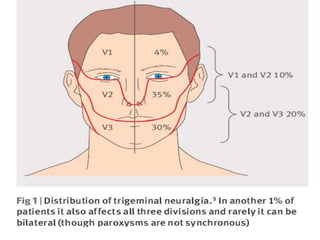
Involvement : maxillary-60%
mandibular-49%
ophthalmic-16%
all 3 divisions-1%
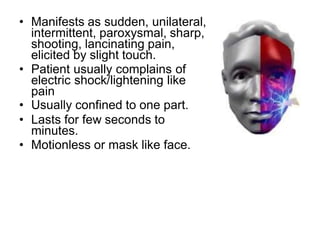
• Manifests as sudden, unilateral,
intermittent, paroxysmal, sharp,
shooting, lancinating pain,
elicited by slight touch.
• Patient usually complains of
electric shock/lightening like
pain
• Usually confined to one part.
• Lasts for few seconds to
minutes.
• Motionless or mask like face.
• Rarely crosses the midline.
• Trigger points - Spontaneous attack or
triggered by trigger zone or movement of the
face as in chewing, talking, brushing or
yawning
• This leads patient frequently go unshaven or
unwashed
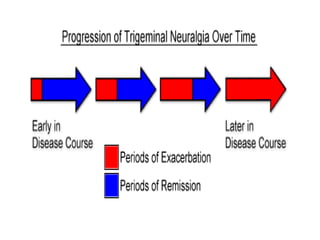
• Paroxysms occur in cycles.
• Depression and weight loss
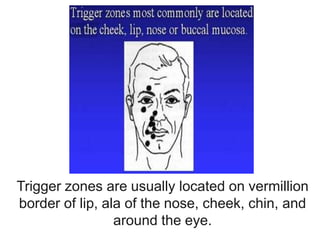
Trigger zones are usually located on vermillion
border of lip, ala of the nose, cheek, chin, and
around the eye.
• There is generally no evidence of sensory
or motor impairment
• Apart from pain the other features are
itching & sensitivity of the face
• Rarely trigeminal neuralgia is associated
with hemi facial spasm- a condition called
TIC CONVULSIF that involves both V &
VII cranial nerves
DIAGNOSIS
•
•
•
•
•
•
History
Trigeminal nerve examination
Diagnostic nerve blocking
MRI (brain)
EEG
Microneurography
DIFFERENTIAL DIAGNOSIS
•
•
•
•
•
•
•
•
•
Post herpetic neuralgia
Dental pain
Post traumatic neuralgia
Multiple sclerosis
Glossopharyngeal neuralgia
Migraine
SUNCT syndrome (sudden unilateral neuralgia type of
pain with conjunctival involvement)
Migraine
Tumors of nasopharynx( trotter`s syndrome)
MANAGEMENT
• PHARMACOLOGICAL
• SURGICAL
• OTHERS
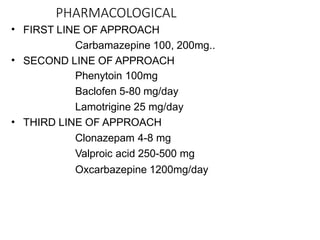
PHARMACOLOGICAL
•
•
•
FIRST LINE OF APPROACH
Carbamazepine 100, 200mg..
SECOND LINE OF APPROACH
Phenytoin 100mg
Baclofen 5-80 mg/day
Lamotrigine 25 mg/day
THIRD LINE OF APPROACH
Clonazepam 4-8 mg
Valproic acid 250-500 mg
Oxcarbazepine 1200mg/day
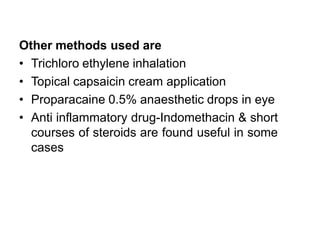
Other methods used are
• Trichloro ethylene inhalation
• Topical capsaicin cream application
• Proparacaine 0.5% anaesthetic drops in eye
• Anti inflammatory drug-Indomethacin & short
courses of steroids are found useful in some
cases

trigeminal neuralgia

  • 1.
    Trigeminal neuralgia Moderated by:Dr. Vidhi Rathi Presented by: Gauri Bargoti
  • 2.
    NEURALGIA Pain of severethrobbing or stabbing character in the course of distribution of a nerve.
  • 3.
    TRIGEMINAL NEURALGIA • Trigeminalneuralgia (TN) is sudden, usually unilateral, severe, brief, stabbing, recurrent episodes of pain in the distribution of one or more branches of the trigeminal nerve.
  • 4.
    SYNONYMS • Trifacial neuralgia •Fothergill’s disease • Tic-doloureux (painful jerking)
  • 5.
    ETOIOLOGY • INTRACRANIAL CAUSES 1.Petrous ridge compression-internal carotid artey pulsations 2. Multiple sclerosis 3. Intracranial tumors- at the cerebellopontine angle 4. Intracranial vascular abnormalities-basilar artery aneurysm, superior cerebellar artery abnormality
  • 6.
    • EXTRACRANIAL CAUSES 1.Vascular factors 2. Dental etiology 3. Post traumatic neuralgia 4. Infections 5. Viral etiology
  • 7.
    • Neuralgias andneuritis • Syphilis • Tuberculosis • Tumor of the brain • Basilar meningitis • Pontine diseases . • Skull fracture • Aneurysm of the carotid artery or circle of willis • Psychoneuroses,and • Cavernous sinus thrombosis Other disorders that may affect the trigeminal nerve include :
  • 10.
    TYPES OF TRIGEMINAL NEURALGIA •Pre Trigeminal neuralgia • Idiopathic Trigeminal neuralgia • Symptomatic neuralgia
  • 11.
    • Pre trigeminalneuralgia: dull aching pain usually observed before appearance of trigeminal neuralgia • Idopathic neuralgia: where the etiology remains unknown • Symptomatic neuralgia: the type in which the etiology is known
  • 12.
    CLINICAL FEATURES • Incidence: 4 in 1,00,000 • Age : 4th to 5th decade • Sex : F>M • 60% on the right side, 3% bilateral. • Mean age of onset-52-58yrs
  • 13.
  • 14.
    • Manifests assudden, unilateral, intermittent, paroxysmal, sharp, shooting, lancinating pain, elicited by slight touch. • Patient usually complains of electric shock/lightening like pain • Usually confined to one part. • Lasts for few seconds to minutes. • Motionless or mask like face.
  • 15.
    • Rarely crossesthe midline. • Trigger points - Spontaneous attack or triggered by trigger zone or movement of the face as in chewing, talking, brushing or yawning • This leads patient frequently go unshaven or unwashed • Paroxysms occur in cycles. • Depression and weight loss
  • 16.
    Trigger zones areusually located on vermillion border of lip, ala of the nose, cheek, chin, and around the eye.
  • 18.
    • There isgenerally no evidence of sensory or motor impairment • Apart from pain the other features are itching & sensitivity of the face • Rarely trigeminal neuralgia is associated with hemi facial spasm- a condition called TIC CONVULSIF that involves both V & VII cranial nerves
  • 19.
  • 20.
    DIFFERENTIAL DIAGNOSIS • • • • • • • • • Post herpeticneuralgia Dental pain Post traumatic neuralgia Multiple sclerosis Glossopharyngeal neuralgia Migraine SUNCT syndrome (sudden unilateral neuralgia type of pain with conjunctival involvement) Migraine Tumors of nasopharynx( trotter`s syndrome)
  • 21.
  • 22.
    PHARMACOLOGICAL • • • FIRST LINE OFAPPROACH Carbamazepine 100, 200mg.. SECOND LINE OF APPROACH Phenytoin 100mg Baclofen 5-80 mg/day Lamotrigine 25 mg/day THIRD LINE OF APPROACH Clonazepam 4-8 mg Valproic acid 250-500 mg Oxcarbazepine 1200mg/day
  • 23.
    Other methods usedare • Trichloro ethylene inhalation • Topical capsaicin cream application • Proparacaine 0.5% anaesthetic drops in eye • Anti inflammatory drug-Indomethacin & short courses of steroids are found useful in some cases