Caldwell Luc
Surgery
1
CONTENTS
• Introduction
• Indications
• Contraindications
• Procedure
• Complications
2
INTRODUCTION
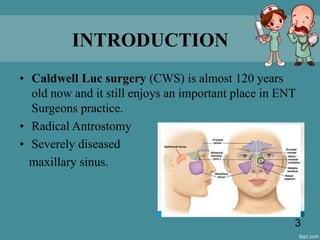
• Caldwell Luc surgery (CWS) is almost 120 years
old now and it still enjoys an important place in ENT
Surgeons practice.
• Radical Antrostomy
• Severely diseased
maxillary sinus.
3
INDICATIONS
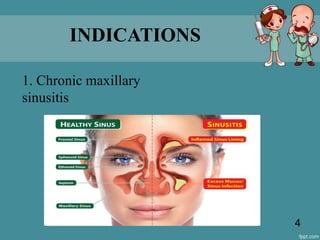
1. Chronic maxillary
sinusitis
4
Indications - Continued
2. Cystic Condition: ex. Removal of Antral Polyps and Cysts &
Antro-Choanal polyps
3. Neoplastic Condition: Benign and Malignant Lesions.
A. Benign lesion:
· Odontogenic: Ameloblastoma & Adenomatoid Odontogenic
Tumor.
· Non-Odontogenic: Osteoma & Polyp.
B. Malignant Lesion:
· Squamous Cell Ca
· Minor salivary Gland Tumor
· Adenoid Cystic Ca 5
Indications - Continued
4. Miscellaneous:
· Removal of any root fragments or, Antrolith
· Zygomatico-maxillary fracture involving the floor of the orbit &
anterior wall of maxillary sinus
· Management of hematoma in the maxillary sinus· Closure of
mouth-sinus communications (oro-antral fistulæ)
·
6
• Removal of antral mucocoeles
· A route to the ethmoid and sphenoid sinuses.
· Visualisation of the orbital floor for decompression.
· Vidian (nerve of the Pterygoid Canal) neurectomy.
· Access to the pterygo-maxillary fossa
7
CONTRAINDICATIONS
• It is rarely done in children as damage to
secondary dentition may occur.
• Acute infections
8
PROCEDURE
1. Anesthesia: GA preferred.
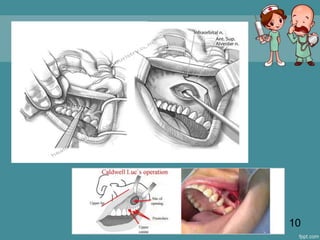
2. Incision of anterior wall of maxilla especially over the canine
fossae, the incision should be semi lunar or, U shaped.
3. Removal of bone & window creation, the breadth of the
window should be not less than the diameter of an index finger.
4. With the help of a periosteal elevator & curator, the whole
lining of the antrum will be excised along with the lesion
(depending upon the type of lesion, fresh bone may need to cut)
9
10
5. Debridement.
6. Irrigation with normal saline.
7. Drainage by naso antral tube, this is called antrostomy
8. Ribbon gauze impregnated with antibiotic solution or, paste is
placed & removed gradually (within -5 days) to facilitate healing.
11
12
Post operative protocol
• Postoperative antibiotics + 5 days with analgesic.
• Patient in head end up position and to be instructed not to blow
nose for 2 weeks.
• Pack - removal after 48 h followed by decongestant nasal
drops for 5 days.
• Saline packing — after pack removal.
• Patient was asked to come for regular follow ups at weekly
intervals for 15 days and at 3rd and 6th month.
13
COMPLICATIONS
• Common Complications:
1- Facial (cheek) swelling
2- numbness of the face (due to effect on infra-
orbital n.). This is numbness of the cheek
and not weakness, which always occurs
temporarily but rarely persists.
3- numbness (temporary / permanent) of the
upper teeth and the associated Gingivae. 14
• Less Common Complications:
1- Oro-Antral Communication / Fistula)
2- Post-Operative Nosebleeds (Epistaxis)
3- Overflow of Tears (Epiphora) due to blockage
of the tear duct.
4- Tooth root injury leading to tooth death
(Devitalisation) & Tooth Discoloration
15
16

Caldwell luc surgery

  • 1.
  • 2.
    CONTENTS • Introduction • Indications •Contraindications • Procedure • Complications 2
  • 3.
    INTRODUCTION • Caldwell Lucsurgery (CWS) is almost 120 years old now and it still enjoys an important place in ENT Surgeons practice. • Radical Antrostomy • Severely diseased maxillary sinus. 3
  • 4.
  • 5.
    Indications - Continued 2.Cystic Condition: ex. Removal of Antral Polyps and Cysts & Antro-Choanal polyps 3. Neoplastic Condition: Benign and Malignant Lesions. A. Benign lesion: · Odontogenic: Ameloblastoma & Adenomatoid Odontogenic Tumor. · Non-Odontogenic: Osteoma & Polyp. B. Malignant Lesion: · Squamous Cell Ca · Minor salivary Gland Tumor · Adenoid Cystic Ca 5
  • 6.
    Indications - Continued 4.Miscellaneous: · Removal of any root fragments or, Antrolith · Zygomatico-maxillary fracture involving the floor of the orbit & anterior wall of maxillary sinus · Management of hematoma in the maxillary sinus· Closure of mouth-sinus communications (oro-antral fistulæ) · 6
  • 7.
    • Removal ofantral mucocoeles · A route to the ethmoid and sphenoid sinuses. · Visualisation of the orbital floor for decompression. · Vidian (nerve of the Pterygoid Canal) neurectomy. · Access to the pterygo-maxillary fossa 7
  • 8.
    CONTRAINDICATIONS • It israrely done in children as damage to secondary dentition may occur. • Acute infections 8
  • 9.
    PROCEDURE 1. Anesthesia: GApreferred. 2. Incision of anterior wall of maxilla especially over the canine fossae, the incision should be semi lunar or, U shaped. 3. Removal of bone & window creation, the breadth of the window should be not less than the diameter of an index finger. 4. With the help of a periosteal elevator & curator, the whole lining of the antrum will be excised along with the lesion (depending upon the type of lesion, fresh bone may need to cut) 9
  • 10.
  • 11.
    5. Debridement. 6. Irrigationwith normal saline. 7. Drainage by naso antral tube, this is called antrostomy 8. Ribbon gauze impregnated with antibiotic solution or, paste is placed & removed gradually (within -5 days) to facilitate healing. 11
  • 12.
  • 13.
    Post operative protocol •Postoperative antibiotics + 5 days with analgesic. • Patient in head end up position and to be instructed not to blow nose for 2 weeks. • Pack - removal after 48 h followed by decongestant nasal drops for 5 days. • Saline packing — after pack removal. • Patient was asked to come for regular follow ups at weekly intervals for 15 days and at 3rd and 6th month. 13
  • 14.
    COMPLICATIONS • Common Complications: 1-Facial (cheek) swelling 2- numbness of the face (due to effect on infra- orbital n.). This is numbness of the cheek and not weakness, which always occurs temporarily but rarely persists. 3- numbness (temporary / permanent) of the upper teeth and the associated Gingivae. 14
  • 15.
    • Less CommonComplications: 1- Oro-Antral Communication / Fistula) 2- Post-Operative Nosebleeds (Epistaxis) 3- Overflow of Tears (Epiphora) due to blockage of the tear duct. 4- Tooth root injury leading to tooth death (Devitalisation) & Tooth Discoloration 15
  • 16.