
REFERENCE
 Text of Oral and Maxillofacial surgery
-Neelima Anil Malik
Trigeminal neuralgia
TN
1
2
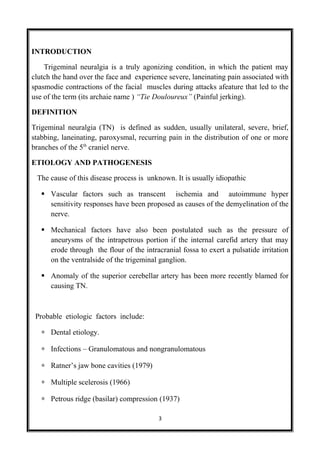
INTRODUCTION
Trigeminal neuralgia is a truly agonizing condition, in which the patient may
clutch the hand over the face and experience severe, laneinating pain associated with
spasmodie contractions of the facial muscles during attacks afeature that led to the
use of the term (its archaie name ) “Tie Douloureux” (Painful jerking).
DEFINITION
Trigeminal neuralgia (TN) is defined as sudden, usually unilateral, severe, brief,
stabbing, laneinating, paroxysmal, recurring pain in the distribution of one or more
branches of the 5th
craniel nerve.
ETIOLOGY AND PATHOGENESIS
The cause of this disease process is unknown. It is usually idiopathic
 Vascular factors such as transcent ischemia and autoimmune hyper
sensitivity responses have been proposed as causes of the demyelination of the
nerve.
 Mechanical factors have also been postulated such as the pressure of
aneurysms of the intrapetrous portion if the internal carefid artery that may
erode through the flour of the intracranial fossa to exert a pulsatide irritation
on the ventralside of the trigeminal ganglion.
 Anomaly of the superior cerebellar artery has been more recently blamed for
causing TN.
Probable etiologic factors include:
∗ Dental etiology.
∗ Infections – Granulomatous and nongranulomatous
∗ Ratner’s jaw bone cavities (1979)
∗ Multiple scelerosis (1966)
∗ Petrous ridge (basilar) compression (1937)
3
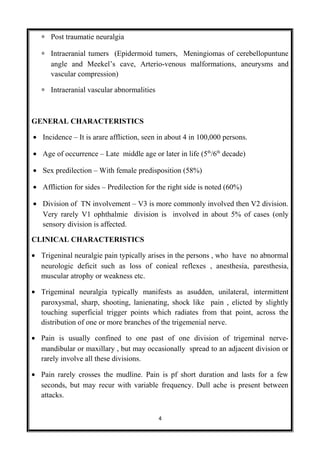
∗ Post traumatie neuralgia
∗ Intraeranial tumers (Epidermoid tumers, Meningiomas of cerebellopuntune
angle and Meekel’s cave, Arterio-venous malformations, aneurysms and
vascular compression)
∗ Intraeranial vascular abnormalities
GENERAL CHARACTERISTICS
• Incidence – It is arare affliction, seen in about 4 in 100,000 persons.
• Age of occurrence – Late middle age or later in life (5th
/6th
decade)
• Sex predilection – With female predisposition (58%)
• Affliction for sides – Predilection for the right side is noted (60%)
• Division of TN involvement – V3 is more commonly involved then V2 division.
Very rarely V1 ophthalmie division is involved in about 5% of cases (only
sensory division is affected.
CLINICAL CHARACTERISTICS
• Trigeninal neuralgie pain typically arises in the persons , who have no abnormal
neurologic deficit such as loss of conieal reflexes , anesthesia, paresthesia,
muscular atrophy or weakness etc.
• Trigeminal neuralgia typically manifests as asudden, unilateral, intermittent
paroxysmal, sharp, shooting, lanienating, shock like pain , elicted by slightly
touching superficial trigger points which radiates from that point, across the
distribution of one or more branches of the trigemenial nerve.
• Pain is usually confined to one past of one division of trigeminal nerve-
mandibular or maxillary , but may occasionally spread to an adjacent division or
rarely involve all these divisions.
• Pain rarely crosses the mudline. Pain is pf short duration and lasts for a few
seconds, but may recur with variable frequency. Dull ache is present between
attacks.
4
• Patient may avoid shaving or brushing teeth.
• The paroxysms occur in cycles,each cycle lasting for weeks or months and with
time, the cycles appears closer and closer.
• In extreme cases, patients will have a motionless face “The frozen or mask like
face”.
• Presence of an intraoral or extraoral ‘triggerpoints’ provocable by obivious
stimuli is seen in TN.
Trigger zone is an area of facial skin or oral muersa, where low intensity
mechanical stimulation such as light, touch, an airpuff, or even touching face at a
particular site or by chewing or even by speaking or smiling , brushing,shaving or
even washing the face etc can elict a typical pain attack.
 The location of the trigger points depends on which division of trigeminal nerve
is involved.
 It is characteristic of the disorder that attacks donot occur during sleep.
 Many patients lead a poor quality of life, because of excruciating pain.
 It is very common for those patients to undergo indiscriminate dental extractions
on the affected side without any relief from pains, because the pain of the
triggerzone and painfiber distributions often mimic pain of odontogenic origin.
 More than 50% of patients experience early remissions of greater than 6 months
before return of activepain.
DIAGNOSIS
The diagnosis of TN rests on the clinican”s ability in recognising a distinctive
series of signs and symptoms that define this order. Although the hallmark findings
of TN were known for centuries, white and sweet made a significant contribution by
articulatory precise diagnostic criteria for TN.
Sweet criteria are used worldwide:
5
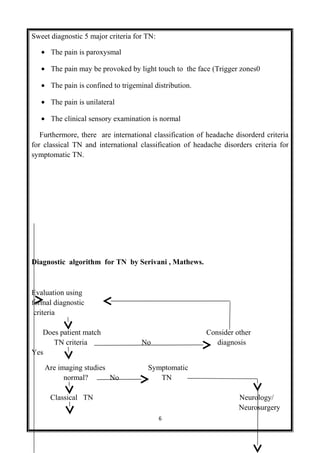
Sweet diagnostic 5 major criteria for TN:
• The pain is paroxysmal
• The pain may be provoked by light touch to the face (Trigger zones0
• The pain is confined to trigeminal distribution.
• The pain is unilateral
• The clinical sensory examination is normal
Furthermore, there are international classification of headache disorderd criteria
for classical TN and international classification of headache disorders criteria for
symptomatic TN.
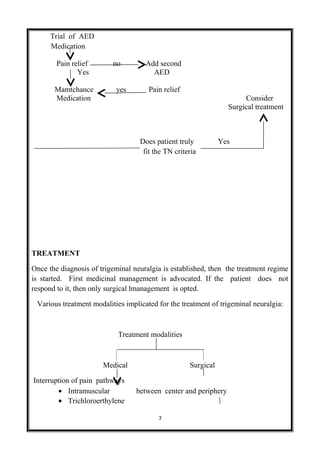
Diagnostic algorithm for TN by Serivani , Mathews.
Evaluation using
formal diagnostic
criteria
Does patient match Consider other
TN criteria No diagnosis
Yes
Are imaging studies Symptomatic
normal? No TN
Classical TN Neurology/
Neurosurgery
6
Trial of AED
Medication
Pain relief no Add second
Yes AED
Mamtchance yes Pain relief
Medication Consider
Surgical treatment
Does patient truly Yes
fit the TN criteria
TREATMENT
Once the diagnosis of trigeminal neuralgia is established, then the treatment regime
is started. First medicinal management is advocated. If the patient does not
respond to it, then only surgical lmanagement is opted.
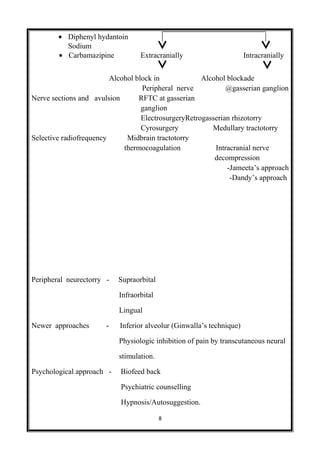
Various treatment modalities implicated for the treatment of trigeminal neuralgia:
Treatment modalities
Medical Surgical
Interruption of pain pathways
• Intramuscular between center and periphery
• Trichloroerthylene
7
• Diphenyl hydantoin
Sodium
• Carbamazipine Extracranially Intracranially
Alcohol block in Alcohol blockade
Peripheral nerve @gasserian ganglion
Nerve sections and avulsion RFTC at gasserian
ganglion
ElectrosurgeryRetrogasserian rhizotorry
Cyrosurgery Medullary tractotorry
Selective radiofrequency Midbrain tractotorry
thermocoagulation Intracranial nerve
decompression
-Jameeta’s approach
-Dandy’s approach
Peripheral neurectorry - Supraorbital
Infraorbital
Lingual
Newer approaches - Inferior alveolur (Ginwalla’s technique)
Physiologic inhibition of pain by transcutaneous neural
stimulation.
Psychological approach - Biofeed back
Psychiatric counselling
Hypnosis/Autosuggestion.
8
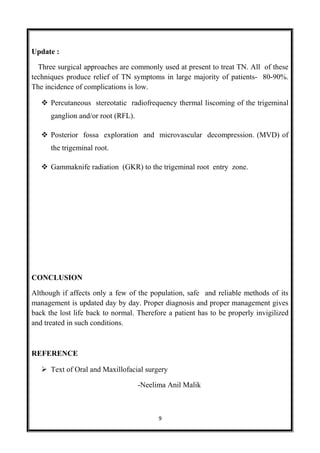
Update :
Three surgical approaches are commonly used at present to treat TN. All of these
techniques produce relief of TN symptoms in large majority of patients- 80-90%.
The incidence of complications is low.
 Percutaneous stereotatic radiofrequency thermal liscoming of the trigeminal
ganglion and/or root (RFL).
 Posterior fossa exploration and microvascular decompression. (MVD) of
the trigeminal root.
 Gammaknife radiation (GKR) to the trigeminal root entry zone.
CONCLUSION
Although if affects only a few of the population, safe and reliable methods of its
management is updated day by day. Proper diagnosis and proper management gives
back the lost life back to normal. Therefore a patient has to be properly invigilized
and treated in such conditions.
REFERENCE
 Text of Oral and Maxillofacial surgery
-Neelima Anil Malik
9
Update :
Three surgical approaches are commonly used at present to treat TN. All of these
techniques produce relief of TN symptoms in large majority of patients- 80-90%.
The incidence of complications is low.
 Percutaneous stereotatic radiofrequency thermal liscoming of the trigeminal
ganglion and/or root (RFL).
 Posterior fossa exploration and microvascular decompression. (MVD) of
the trigeminal root.
 Gammaknife radiation (GKR) to the trigeminal root entry zone.
CONCLUSION
Although if affects only a few of the population, safe and reliable methods of its
management is updated day by day. Proper diagnosis and proper management gives
back the lost life back to normal. Therefore a patient has to be properly invigilized
and treated in such conditions.
REFERENCE
 Text of Oral and Maxillofacial surgery
-Neelima Anil Malik
9

Trigeminal neuralgia

  • 1.
    REFERENCE  Text ofOral and Maxillofacial surgery -Neelima Anil Malik Trigeminal neuralgia TN 1
  • 2.
  • 3.
    INTRODUCTION Trigeminal neuralgia isa truly agonizing condition, in which the patient may clutch the hand over the face and experience severe, laneinating pain associated with spasmodie contractions of the facial muscles during attacks afeature that led to the use of the term (its archaie name ) “Tie Douloureux” (Painful jerking). DEFINITION Trigeminal neuralgia (TN) is defined as sudden, usually unilateral, severe, brief, stabbing, laneinating, paroxysmal, recurring pain in the distribution of one or more branches of the 5th craniel nerve. ETIOLOGY AND PATHOGENESIS The cause of this disease process is unknown. It is usually idiopathic  Vascular factors such as transcent ischemia and autoimmune hyper sensitivity responses have been proposed as causes of the demyelination of the nerve.  Mechanical factors have also been postulated such as the pressure of aneurysms of the intrapetrous portion if the internal carefid artery that may erode through the flour of the intracranial fossa to exert a pulsatide irritation on the ventralside of the trigeminal ganglion.  Anomaly of the superior cerebellar artery has been more recently blamed for causing TN. Probable etiologic factors include: ∗ Dental etiology. ∗ Infections – Granulomatous and nongranulomatous ∗ Ratner’s jaw bone cavities (1979) ∗ Multiple scelerosis (1966) ∗ Petrous ridge (basilar) compression (1937) 3
  • 4.
    ∗ Post traumatieneuralgia ∗ Intraeranial tumers (Epidermoid tumers, Meningiomas of cerebellopuntune angle and Meekel’s cave, Arterio-venous malformations, aneurysms and vascular compression) ∗ Intraeranial vascular abnormalities GENERAL CHARACTERISTICS • Incidence – It is arare affliction, seen in about 4 in 100,000 persons. • Age of occurrence – Late middle age or later in life (5th /6th decade) • Sex predilection – With female predisposition (58%) • Affliction for sides – Predilection for the right side is noted (60%) • Division of TN involvement – V3 is more commonly involved then V2 division. Very rarely V1 ophthalmie division is involved in about 5% of cases (only sensory division is affected. CLINICAL CHARACTERISTICS • Trigeninal neuralgie pain typically arises in the persons , who have no abnormal neurologic deficit such as loss of conieal reflexes , anesthesia, paresthesia, muscular atrophy or weakness etc. • Trigeminal neuralgia typically manifests as asudden, unilateral, intermittent paroxysmal, sharp, shooting, lanienating, shock like pain , elicted by slightly touching superficial trigger points which radiates from that point, across the distribution of one or more branches of the trigemenial nerve. • Pain is usually confined to one past of one division of trigeminal nerve- mandibular or maxillary , but may occasionally spread to an adjacent division or rarely involve all these divisions. • Pain rarely crosses the mudline. Pain is pf short duration and lasts for a few seconds, but may recur with variable frequency. Dull ache is present between attacks. 4
  • 5.
    • Patient mayavoid shaving or brushing teeth. • The paroxysms occur in cycles,each cycle lasting for weeks or months and with time, the cycles appears closer and closer. • In extreme cases, patients will have a motionless face “The frozen or mask like face”. • Presence of an intraoral or extraoral ‘triggerpoints’ provocable by obivious stimuli is seen in TN. Trigger zone is an area of facial skin or oral muersa, where low intensity mechanical stimulation such as light, touch, an airpuff, or even touching face at a particular site or by chewing or even by speaking or smiling , brushing,shaving or even washing the face etc can elict a typical pain attack.  The location of the trigger points depends on which division of trigeminal nerve is involved.  It is characteristic of the disorder that attacks donot occur during sleep.  Many patients lead a poor quality of life, because of excruciating pain.  It is very common for those patients to undergo indiscriminate dental extractions on the affected side without any relief from pains, because the pain of the triggerzone and painfiber distributions often mimic pain of odontogenic origin.  More than 50% of patients experience early remissions of greater than 6 months before return of activepain. DIAGNOSIS The diagnosis of TN rests on the clinican”s ability in recognising a distinctive series of signs and symptoms that define this order. Although the hallmark findings of TN were known for centuries, white and sweet made a significant contribution by articulatory precise diagnostic criteria for TN. Sweet criteria are used worldwide: 5
  • 6.
    Sweet diagnostic 5major criteria for TN: • The pain is paroxysmal • The pain may be provoked by light touch to the face (Trigger zones0 • The pain is confined to trigeminal distribution. • The pain is unilateral • The clinical sensory examination is normal Furthermore, there are international classification of headache disorderd criteria for classical TN and international classification of headache disorders criteria for symptomatic TN. Diagnostic algorithm for TN by Serivani , Mathews. Evaluation using formal diagnostic criteria Does patient match Consider other TN criteria No diagnosis Yes Are imaging studies Symptomatic normal? No TN Classical TN Neurology/ Neurosurgery 6
  • 7.
    Trial of AED Medication Painrelief no Add second Yes AED Mamtchance yes Pain relief Medication Consider Surgical treatment Does patient truly Yes fit the TN criteria TREATMENT Once the diagnosis of trigeminal neuralgia is established, then the treatment regime is started. First medicinal management is advocated. If the patient does not respond to it, then only surgical lmanagement is opted. Various treatment modalities implicated for the treatment of trigeminal neuralgia: Treatment modalities Medical Surgical Interruption of pain pathways • Intramuscular between center and periphery • Trichloroerthylene 7
  • 8.
    • Diphenyl hydantoin Sodium •Carbamazipine Extracranially Intracranially Alcohol block in Alcohol blockade Peripheral nerve @gasserian ganglion Nerve sections and avulsion RFTC at gasserian ganglion ElectrosurgeryRetrogasserian rhizotorry Cyrosurgery Medullary tractotorry Selective radiofrequency Midbrain tractotorry thermocoagulation Intracranial nerve decompression -Jameeta’s approach -Dandy’s approach Peripheral neurectorry - Supraorbital Infraorbital Lingual Newer approaches - Inferior alveolur (Ginwalla’s technique) Physiologic inhibition of pain by transcutaneous neural stimulation. Psychological approach - Biofeed back Psychiatric counselling Hypnosis/Autosuggestion. 8
  • 9.
    Update : Three surgicalapproaches are commonly used at present to treat TN. All of these techniques produce relief of TN symptoms in large majority of patients- 80-90%. The incidence of complications is low.  Percutaneous stereotatic radiofrequency thermal liscoming of the trigeminal ganglion and/or root (RFL).  Posterior fossa exploration and microvascular decompression. (MVD) of the trigeminal root.  Gammaknife radiation (GKR) to the trigeminal root entry zone. CONCLUSION Although if affects only a few of the population, safe and reliable methods of its management is updated day by day. Proper diagnosis and proper management gives back the lost life back to normal. Therefore a patient has to be properly invigilized and treated in such conditions. REFERENCE  Text of Oral and Maxillofacial surgery -Neelima Anil Malik 9
  • 10.
    Update : Three surgicalapproaches are commonly used at present to treat TN. All of these techniques produce relief of TN symptoms in large majority of patients- 80-90%. The incidence of complications is low.  Percutaneous stereotatic radiofrequency thermal liscoming of the trigeminal ganglion and/or root (RFL).  Posterior fossa exploration and microvascular decompression. (MVD) of the trigeminal root.  Gammaknife radiation (GKR) to the trigeminal root entry zone. CONCLUSION Although if affects only a few of the population, safe and reliable methods of its management is updated day by day. Proper diagnosis and proper management gives back the lost life back to normal. Therefore a patient has to be properly invigilized and treated in such conditions. REFERENCE  Text of Oral and Maxillofacial surgery -Neelima Anil Malik 9