Presenter Name 
Presentation Date
•Thales 
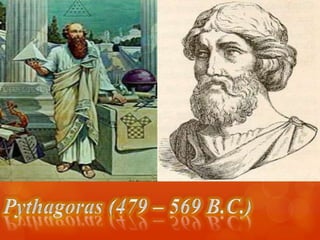
•Pythagoras 
•Triangle 
•Triangle Properties 
• Similarity And Congruence 
• Key words 
• Similar Figure 
• Similarity Of Triangle 
•BPT 
•Converse Of BPT 
•Criteria For Similarity Of Triangle
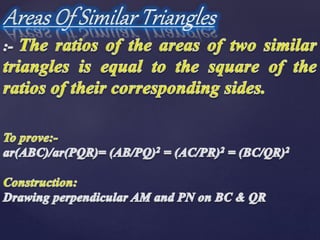
*Area Of Similar Triangle 
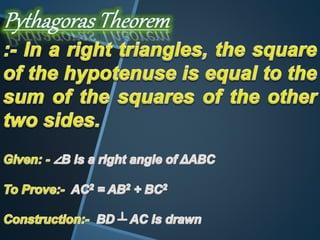
*Pythagoras Theorem 
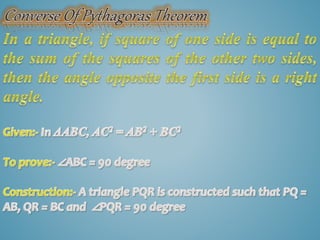
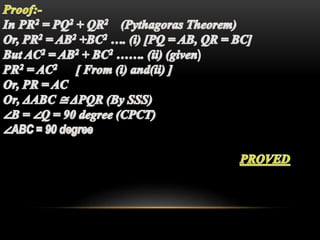
*Converse Of Pythagoras Theorem
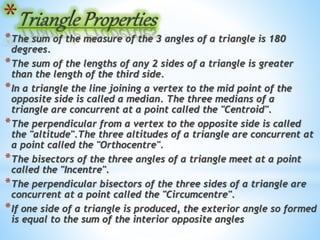
*The sum of the measure of the 3 angles of a triangle is 180 
degrees. 
*The sum of the lengths of any 2 sides of a triangle is greater 
than the length of the third side. 
*In a triangle the line joining a vertex to the mid point of the 
opposite side is called a median. The three medians of a 

triangle are concurrent at a point called the "Centroid". 
*The perpendicular from a vertex to the opposite side is called 
the "altitude".The three altitudes of a triangle are concurrent at 
a point called the "Orthocentre". 
*The bisectors of the three angles of a triangle meet at a point 
called the "Incentre". 
*The perpendicular bisectors of the three sides of a triangle are 
concurrent at a point called the "Circumcentre". 
*If one side of a triangle is produced, the exterior angle so formed 
is equal to the sum of the interior opposite angles
1) Similarity:- 
I. Two triangles are said to be similar if every angle of one 
triangle has the same measure as the corresponding 
angle in the other triangle. 
II. The corresponding sides of similar triangles have lengths 
that are in the same proportion, and this property is also 
sufficient to establish similarity. 
2) Congruence :- 
I. Two triangles that are congruent have exactly the same 
size and shape all pairs of corresponding interior angles 
are equal in measure, and all pairs of corresponding 
sides have the same length.
• Median of a triangle:- A median of a triangle is a line 
joining a vertex to the mid point of the opposite side. 
• Equiangular Triangles:- If corresponding angles of two 
triangles are equal, then they are known as equiangular 
triangles. 
• Scale factor or Representative fraction:- The same ratio 
of the corresponding sides of two polygons is known as 
the scale factor or the representative fraction for the 
polygons. 
• Angle bisector of a triangle:- The angle bisector of a 
triangle is a line segment that bisects one of the vertex 
angle of a triangle.
• Altitude of a triangle:- The altitude of a triangle is a line 
that extends from one vertex of a triangle and 
perpendicular to the opposite side. 
• Angle of elevation of the Sun:- The angle of elevation of 
the Sun is the angle between the direction of the geometric 
center of the sun’s apparent disc and the horizontal level.
Two polygons of the same number of sides 
are similar, if 
i) Their corresponding angles are equal, 
and 
ii) Their corresponding sides are in the 
same ratios (or proportion).
:- If a line is drawn parallel to one side of 
a triangle to intersect the other two sides 
in distinct points, the other two sides are 
divided in the same ratio.
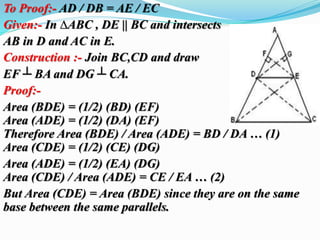
To Proof:- AD / DB = AE / EC 
Given:- In ΔABC , DE || BC and intersects 
AB in D and AC in E. 
Construction :- Join BC,CD and draw 
EF ┴ BA and DG ┴ CA. 
Proof:- 
Area (BDE) = (1/2) (BD) (EF) 
Area (ADE) = (1/2) (DA) (EF) 
Therefore Area (BDE) / Area (ADE) = BD / DA … (1) 
Area (CDE) = (1/2) (CE) (DG) 
Area (ADE) = (1/2) (EA) (DG) 
Area (CDE) / Area (ADE) = CE / EA … (2) 
But Area (CDE) = Area (BDE) since they are on the same 
base between the same parallels.
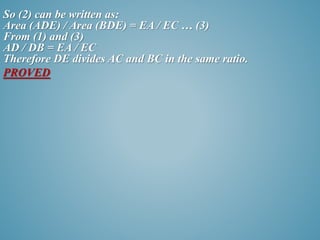
So (2) can be written as: 
Area (ADE) / Area (BDE) = EA / EC … (3) 
From (1) and (3) 
AD / DB = EA / EC 
Therefore DE divides AC and BC in the same ratio. 
PROVED
i) If in two triangles, corresponding angles are 
equal, then their corresponding sides are in the 
same ratio (or proportion) and hence the two 
triangles are similar. 
Given: Triangles ABC and DEF such that A = D; B 
= E; C = F 
To Prove: Δ ABC ~ Δ DEF 
Construction: We mark point P on the line DE and 
Q on the line DF such that AB = DP and AC = DQ, 
we join PQ.
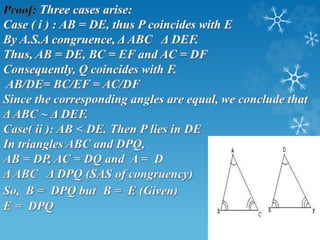
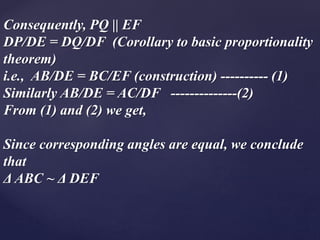
Consequently, PQ || EF 
DP/DE = DQ/DF (Corollary to basic proportionality 
theorem) 
i.e., AB/DE = BC/EF (construction) ---------- (1) 
Similarly AB/DE = AC/DF --------------(2) 
From (1) and (2) we get, 
Since corresponding angles are equal, we conclude 
that 
Δ ABC ~ Δ DEF
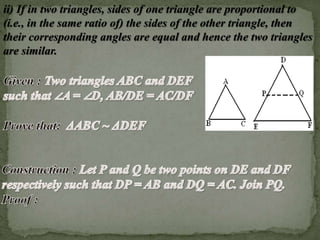
ii) If in two triangles, sides of one triangle are proportional to 
(i.e., in the same ratio of) the sides of the other triangle, then 
their corresponding angles are equal and hence the two triangles 
are similar.
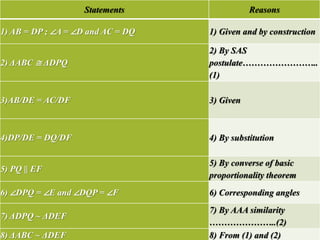
Statements Reasons 
1) AB = DP ; ∠A = ∠D and AC = DQ 1) Given and by construction 
2) ΔABC ≅ ΔDPQ 
2) By SAS 
postulate…………………….. 
(1) 
3)AB/DE = AC/DF 3) Given 
4)DP/DE = DQ/DF 4) By substitution 
5) PQ || EF 
5) By converse of basic 
proportionality theorem 
6) ∠DPQ = ∠E and ∠DQP = ∠F 6) Corresponding angles 
7) ΔDPQ ~ ΔDEF 
7) By AAA similarity 
…………………..(2) 
8) ΔABC ~ ΔDEF 8) From (1) and (2)
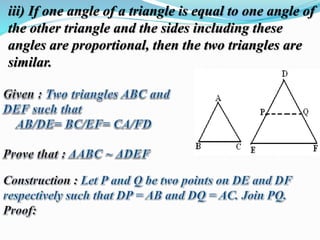
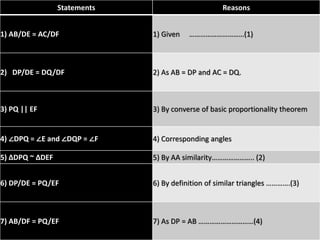
iii) If one angle of a triangle is equal to one angle of 
the other triangle and the sides including these 
angles are proportional, then the two triangles are 
similar.
Statements Reasons 
1) AB/DE = AC/DF 1) Given …………………………(1) 
2) DP/DE = DQ/DF 2) As AB = DP and AC = DQ. 
3) PQ || EF 3) By converse of basic proportionality theorem 
4) ∠DPQ = ∠E and ∠DQP = ∠F 4) Corresponding angles 
5) ΔDPQ ~ ΔDEF 5) By AA similarity………………….. (2) 
6) DP/DE = PQ/EF 6) By definition of similar triangles ………….(3) 
7) AB/DF = PQ/EF 7) As DP = AB …………………………(4)
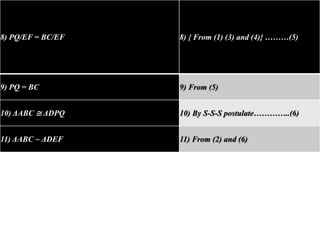
8) PQ/EF = BC/EF 8) { From (1) (3) and (4)} ………(5) 
9) PQ = BC 9) From (5) 
10) ΔABC ≅ ΔDPQ 10) By S-S-S postulate…………..(6) 
11) ΔABC ~ ΔDEF 11) From (2) and (6)
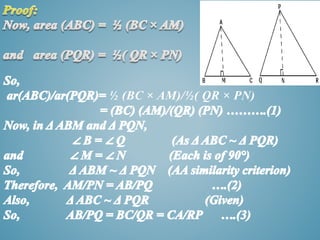
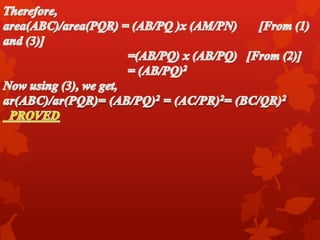
½ (BC × AM)/½( QR × PN)
:- If a perpendicular is drawn from 
the vertex of the right angle of a right 
triangle to the hypotenuse then 
triangles on both sides of the 
perpendicular are similar to the whole 
triangle and to each other.
Triangles
Triangles
Triangles
Triangles
Triangles

Triangles

  • 1.
  • 2.
    •Thales •Pythagoras •Triangle •Triangle Properties • Similarity And Congruence • Key words • Similar Figure • Similarity Of Triangle •BPT •Converse Of BPT •Criteria For Similarity Of Triangle
  • 3.
    *Area Of SimilarTriangle *Pythagoras Theorem *Converse Of Pythagoras Theorem
  • 11.
    *The sum ofthe measure of the 3 angles of a triangle is 180 degrees. *The sum of the lengths of any 2 sides of a triangle is greater than the length of the third side. *In a triangle the line joining a vertex to the mid point of the opposite side is called a median. The three medians of a triangle are concurrent at a point called the "Centroid". *The perpendicular from a vertex to the opposite side is called the "altitude".The three altitudes of a triangle are concurrent at a point called the "Orthocentre". *The bisectors of the three angles of a triangle meet at a point called the "Incentre". *The perpendicular bisectors of the three sides of a triangle are concurrent at a point called the "Circumcentre". *If one side of a triangle is produced, the exterior angle so formed is equal to the sum of the interior opposite angles
  • 12.
    1) Similarity:- I.Two triangles are said to be similar if every angle of one triangle has the same measure as the corresponding angle in the other triangle. II. The corresponding sides of similar triangles have lengths that are in the same proportion, and this property is also sufficient to establish similarity. 2) Congruence :- I. Two triangles that are congruent have exactly the same size and shape all pairs of corresponding interior angles are equal in measure, and all pairs of corresponding sides have the same length.
  • 13.
    • Median ofa triangle:- A median of a triangle is a line joining a vertex to the mid point of the opposite side. • Equiangular Triangles:- If corresponding angles of two triangles are equal, then they are known as equiangular triangles. • Scale factor or Representative fraction:- The same ratio of the corresponding sides of two polygons is known as the scale factor or the representative fraction for the polygons. • Angle bisector of a triangle:- The angle bisector of a triangle is a line segment that bisects one of the vertex angle of a triangle.
  • 14.
    • Altitude ofa triangle:- The altitude of a triangle is a line that extends from one vertex of a triangle and perpendicular to the opposite side. • Angle of elevation of the Sun:- The angle of elevation of the Sun is the angle between the direction of the geometric center of the sun’s apparent disc and the horizontal level.
  • 15.
    Two polygons ofthe same number of sides are similar, if i) Their corresponding angles are equal, and ii) Their corresponding sides are in the same ratios (or proportion).
  • 17.
    :- If aline is drawn parallel to one side of a triangle to intersect the other two sides in distinct points, the other two sides are divided in the same ratio.
  • 18.
    To Proof:- AD/ DB = AE / EC Given:- In ΔABC , DE || BC and intersects AB in D and AC in E. Construction :- Join BC,CD and draw EF ┴ BA and DG ┴ CA. Proof:- Area (BDE) = (1/2) (BD) (EF) Area (ADE) = (1/2) (DA) (EF) Therefore Area (BDE) / Area (ADE) = BD / DA … (1) Area (CDE) = (1/2) (CE) (DG) Area (ADE) = (1/2) (EA) (DG) Area (CDE) / Area (ADE) = CE / EA … (2) But Area (CDE) = Area (BDE) since they are on the same base between the same parallels.
  • 19.
    So (2) canbe written as: Area (ADE) / Area (BDE) = EA / EC … (3) From (1) and (3) AD / DB = EA / EC Therefore DE divides AC and BC in the same ratio. PROVED
  • 22.
    i) If intwo triangles, corresponding angles are equal, then their corresponding sides are in the same ratio (or proportion) and hence the two triangles are similar. Given: Triangles ABC and DEF such that A = D; B = E; C = F To Prove: Δ ABC ~ Δ DEF Construction: We mark point P on the line DE and Q on the line DF such that AB = DP and AC = DQ, we join PQ.
  • 24.
    Consequently, PQ ||EF DP/DE = DQ/DF (Corollary to basic proportionality theorem) i.e., AB/DE = BC/EF (construction) ---------- (1) Similarly AB/DE = AC/DF --------------(2) From (1) and (2) we get, Since corresponding angles are equal, we conclude that Δ ABC ~ Δ DEF
  • 25.
    ii) If intwo triangles, sides of one triangle are proportional to (i.e., in the same ratio of) the sides of the other triangle, then their corresponding angles are equal and hence the two triangles are similar.
  • 26.
    Statements Reasons 1)AB = DP ; ∠A = ∠D and AC = DQ 1) Given and by construction 2) ΔABC ≅ ΔDPQ 2) By SAS postulate…………………….. (1) 3)AB/DE = AC/DF 3) Given 4)DP/DE = DQ/DF 4) By substitution 5) PQ || EF 5) By converse of basic proportionality theorem 6) ∠DPQ = ∠E and ∠DQP = ∠F 6) Corresponding angles 7) ΔDPQ ~ ΔDEF 7) By AAA similarity …………………..(2) 8) ΔABC ~ ΔDEF 8) From (1) and (2)
  • 27.
    iii) If oneangle of a triangle is equal to one angle of the other triangle and the sides including these angles are proportional, then the two triangles are similar.
  • 28.
    Statements Reasons 1)AB/DE = AC/DF 1) Given …………………………(1) 2) DP/DE = DQ/DF 2) As AB = DP and AC = DQ. 3) PQ || EF 3) By converse of basic proportionality theorem 4) ∠DPQ = ∠E and ∠DQP = ∠F 4) Corresponding angles 5) ΔDPQ ~ ΔDEF 5) By AA similarity………………….. (2) 6) DP/DE = PQ/EF 6) By definition of similar triangles ………….(3) 7) AB/DF = PQ/EF 7) As DP = AB …………………………(4)
  • 29.
    8) PQ/EF =BC/EF 8) { From (1) (3) and (4)} ………(5) 9) PQ = BC 9) From (5) 10) ΔABC ≅ ΔDPQ 10) By S-S-S postulate…………..(6) 11) ΔABC ~ ΔDEF 11) From (2) and (6)
  • 31.
    ½ (BC ×AM)/½( QR × PN)
  • 33.
    :- If aperpendicular is drawn from the vertex of the right angle of a right triangle to the hypotenuse then triangles on both sides of the perpendicular are similar to the whole triangle and to each other.