Mathematics Secondary Course358
Notes
MODULE - 3
Geometry
Similarity of Triangles
14
SIMILARITY OF TRIANGLES
Looking around you will see many objects which are of the same shape but of same or
different sizes. For examples, leaves of a tree have almost the same shape but same or
differentsizes.Similarly,photographsofdifferentsizesdevelopedfromthesamenegative
are of same shape but different sizes, the miniature model of a building and the building
itself are of same shape but different sizes. All those objects which have the same
shape but not necessarily the same size are called similar objects.
Letusexaminethesimilarityofplanefigures(Fig.14.1):
(i) Twoline-segmentsofthesamelengtharecongruentaswellassimilarandofdifferent
lengthsaresimilarbutnotcongruent.
Fig. 14.1 (i)
(ii) Twocirclesofthesameradiusarecongurentaswellassimilarandcirclesofdifferent
radiiaresimilarbutnotcongruent.
Fig. 14.1 (ii)
(iii) Twoequilateraltrianglesofdifferentsidesaresimilarbutnotcongruent.
Fig. 14.1 (iii)
Mathematics Secondary Course 359
Similarity of Triangles
Notes
MODULE - 3
Geometry
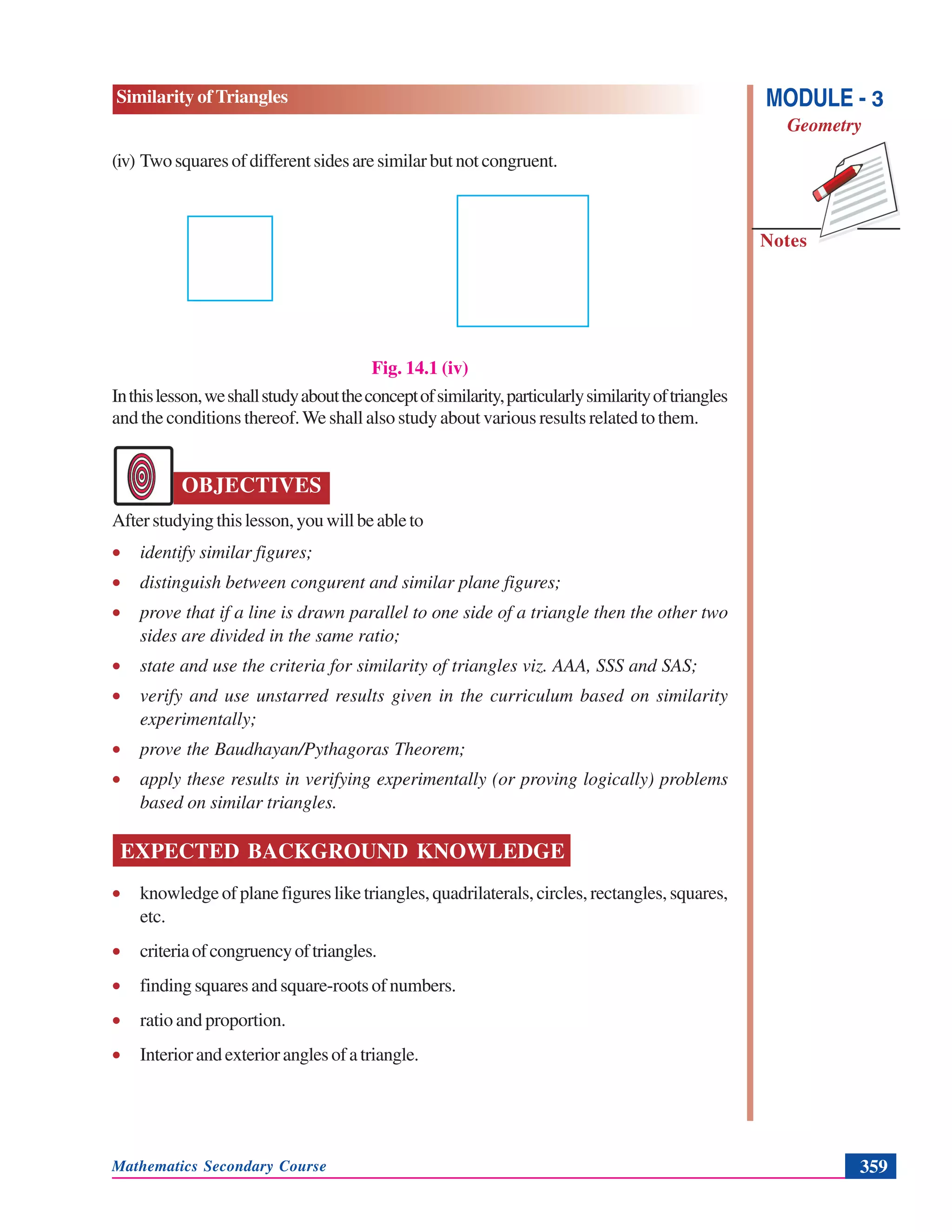
(iv) Twosquares of different sides are similar but not congruent.
Fig. 14.1 (iv)
Inthislesson,weshallstudyabouttheconceptofsimilarity,particularlysimilarityoftriangles
and the conditions thereof.We shall also study about various results related to them.
OBJECTIVES
Afterstudyingthislesson,youwillbeableto
• identify similar figures;
• distinguish between congurent and similar plane figures;
• prove that if a line is drawn parallel to one side of a triangle then the other two
sides are divided in the same ratio;
• state and use the criteria for similarity of triangles viz. AAA, SSS and SAS;
• verify and use unstarred results given in the curriculum based on similarity
experimentally;
• prove the Baudhayan/Pythagoras Theorem;
• apply these results in verifying experimentally (or proving logically) problems
based on similar triangles.
EXPECTED BACKGROUND KNOWLEDGE
• knowledge of plane figures like triangles, quadrilaterals, circles, rectangles, squares,
etc.
• criteriaofcongruencyoftriangles.
• finding squares and square-roots of numbers.
• ratio and proportion.
• Interiorandexterioranglesofatriangle.
Mathematics Secondary Course360
Notes
MODULE - 3
Geometry
Similarity of Triangles
14.1 SIMILAR PLANE FIGURES
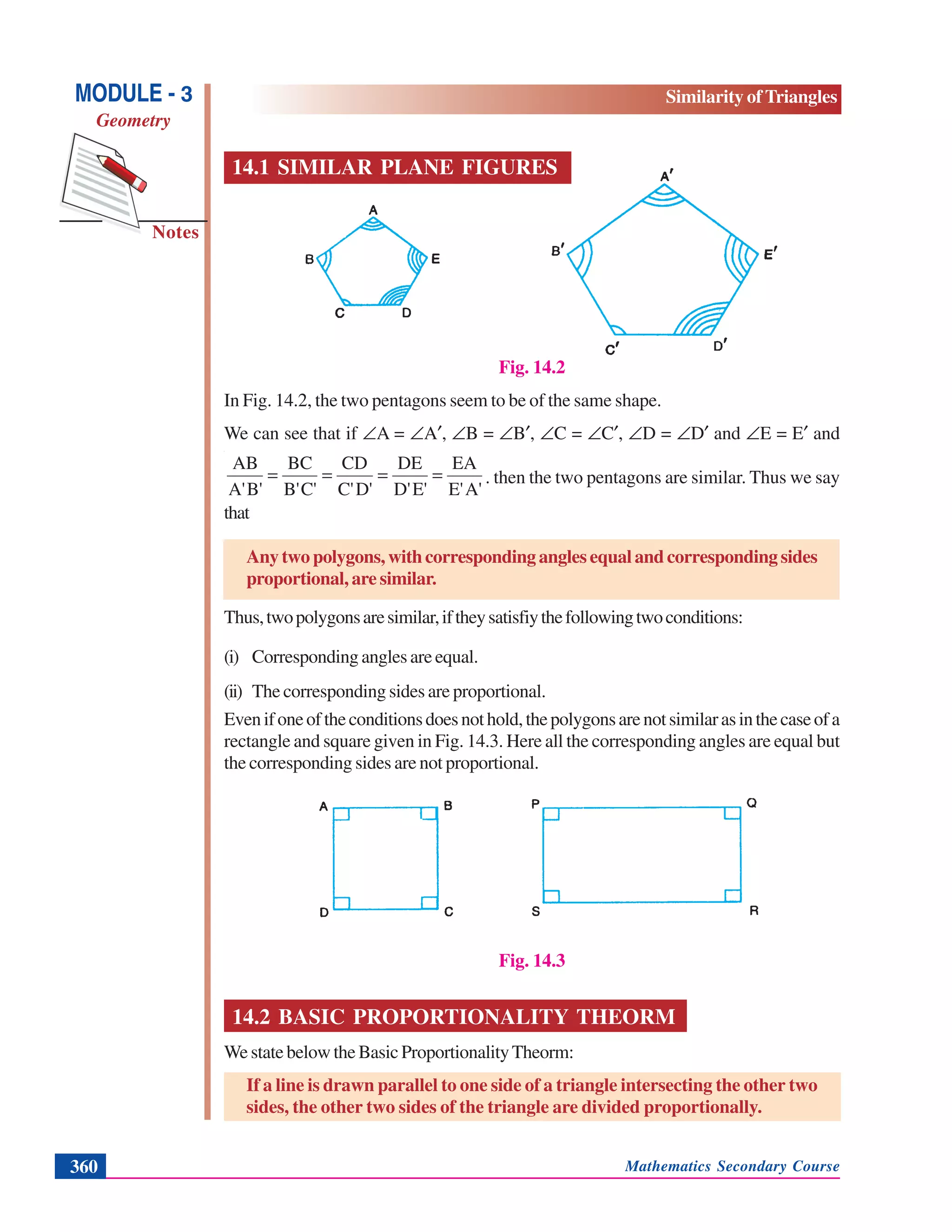
Fig. 14.2
In Fig. 14.2, the two pentagons seem to be of the same shape.
We can see that if ∠A = ∠A′, ∠B = ∠B′, ∠C = ∠C′, ∠D = ∠D′ and ∠E = E′ and
A'E'
EA
E'D'
DE
D'C'
CD
C'B'
BC
B'A'
AB
==== . then the two pentagons are similar. Thus we say
that
Any two polygons, with corresponding angles equal and corresponding sides
proportional, are similar.
Thus,twopolygonsaresimilar,iftheysatisfiythefollowingtwoconditions:
(i) Corresponding angles are equal.
(ii) The corresponding sides are proportional.
Evenifoneoftheconditionsdoesnothold,thepolygonsarenotsimilarasinthecaseofa
rectangle and square given in Fig. 14.3. Here all the corresponding angles are equal but
the corresponding sides are not proportional.
Fig. 14.3
14.2 BASIC PROPORTIONALITY THEORM
We state below the Basic ProportionalityTheorm:
If a line is drawn parallel to one side of a triangle intersecting the other two
sides, the other two sides of the triangle are divided proportionally.
Mathematics Secondary Course 361
Similarity of Triangles
Notes
MODULE - 3
Geometry
Thus, in Fig. 14.4, DE || BC,According to the above result
EC
AE
DB
AD
=
We can easily verify this by measuringAD, DB,AE and
EC.Youwillfindthat
EC
AE
DB
AD
=
We state the converse of the above result as follows:
If a line divides any two sides of a triangle in the same ratio, the line is parallel to
third side of the triangle.
Thus, in Fig 14.4, if DE divides sideAB andAC of ΔABC such that
EC
AE
DB
AD
= , then
DE || BC.
Wecanverifythisbymeasuring∠ADEand∠ABCandfindingthat
∠ADE = ∠ABC
These being corresponding angles, the line DE and BC are parallel.
Wecanverifytheabovetworesultsbytakingdifferenttriangles.
Let us solve some examples based on these.
Example 14.1: In Fig. 14.5, DE || BC. If AD = 3 cm, DB = 5 cm and AE = 6 cm, find
AC.
Solution: DE || BC (Given). Let EC = x
∴
EC
AE
DB
AD
=
∴
x
6
5
3
=
⇒ 3 x = 30
⇒ x = 10
∴ EC = 10 cm
∴ AC = AE + EC = 16 cm
Example 14.2: In Fig. 14.6, AD = 4 cm, DB = 5 cm, AE = 4.5 cm and EC =
8
5
5 cm.
Is DE || BC? Given reasons for your answer.
Fig. 14.4
Fig. 14.5
Mathematics Secondary Course362
Notes
MODULE - 3
Geometry
Similarity of Triangles
Solution: We are given thatAD = 4 cm and DB = 5 cm
∴
5
4
DB
AD
=
Similarly, 5
4
45
8
2
9
8
45
4.5
EC
AE
=×==
∴
EC
AE
DB
AD
=
∴According to converse of Basic ProportionalityTheorem
DE || BC
CHECK YOUR PROGRESS 14.1
1. In Fig. 14.7 (i) and (ii), PQ || BC. Find the value of x in each case.
(i) (ii)
Fig. 14.7
2. InFig.14.8[(i)],findwhetherDE||BCisparalleltoBCornot?Givereasonsforyour
answer.
(i)
Fig. 14.8
Fig. 14.6
Mathematics Secondary Course 363
Similarity of Triangles
Notes
MODULE - 3
Geometry
14.3 BISECTOR OF AN ANGLE OF A TRIANGLE
We now state an important result as given below:
The bisector of an interior angle of a triangle divides the opposite side in
the ratio of sides containing the angle.
According to the above result, ifAD is the internal
bisector of ∠A of ΔABC, then
AC
AB
DC
BD
= (Fig. 14.9)
WecaneasilyverifythisbymeasuringBD,DC,AB
andACandfindingtheratios.Wewillfindthat
AC
AB
DC
BD
=
Repeatingthesameactivitywithothertriangles,wemayverifytheresult.
Letussolvesomeexamplestoillustratethis.
Example14.3:ThesidesABandACofatriangleareoflength6cmand8cmrespectively.
The bisectorAD of ∠Aintersects the opposite side BC in D such that BD = 4.5 cm (Fig.
14.10). Find the length of segment CD.
Solution: According to the above result, we have
AC
AB
DC
BD
=
( Q AD is internal bisector of ∠Aof ΔABC)
or
8
6
x
4.5
=
⇒ 6x = 4.5 × 8
x = 6
i.e., the length of line-segment CD = 6 cm.
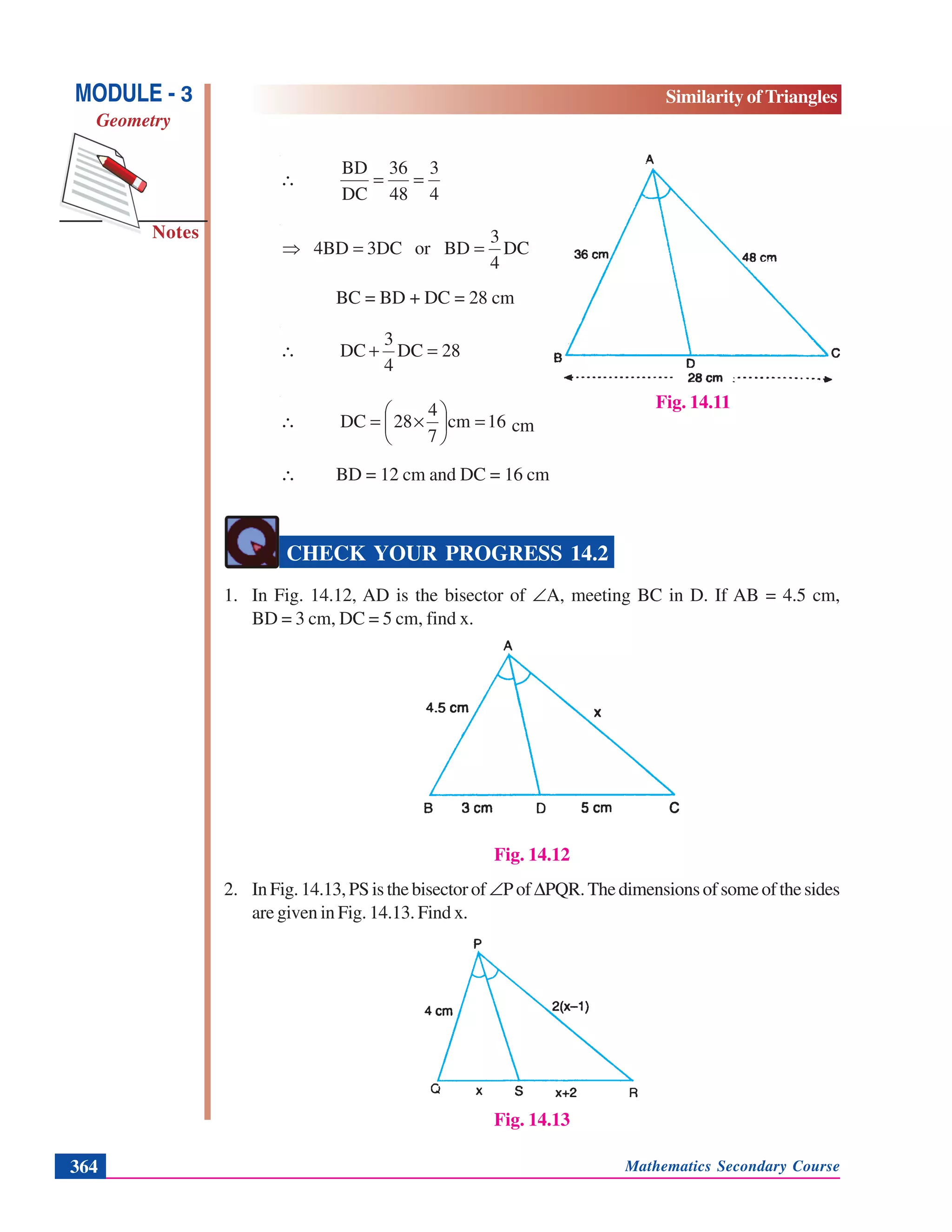
Example 14.4: The sides of a triangle are 28 cm, 36 cm and 48 cm. Find the lengths of
theline-segmentsintowhichthesmallestsideisdividedbythebisectoroftheangleopposite
to it.
Solution: Thesmallestsideisoflength28cmandthesidesforming∠Aoppositetoitare
36 cm and 48 cm. Let the angle bisectorAD meet BC in D (Fig. 14.11).
Fig. 14.9
Fig. 14.10
Mathematics Secondary Course364
Notes
MODULE - 3
Geometry
Similarity of Triangles
4
3
48
36
DC
BD
==∴
DC
4
3
BDor3DC4BD ==⇒
BC = BD + DC = 28 cm
28DC
4
3
DC =+∴
16cm
7
4
28DC =⎟
⎠
⎞
⎜
⎝
⎛
×=∴ cm
∴ BD = 12 cm and DC = 16 cm
CHECK YOUR PROGRESS 14.2
1. In Fig. 14.12, AD is the bisector of ∠A, meeting BC in D. If AB = 4.5 cm,
BD = 3 cm, DC = 5 cm, find x.
Fig. 14.12
2. InFig.14.13,PSisthebisectorof ∠PofΔPQR.Thedimensionsofsomeofthesides
are given in Fig. 14.13. Find x.
Fig. 14.13
Fig. 14.11
Mathematics Secondary Course 365
Similarity of Triangles
Notes
MODULE - 3
Geometry
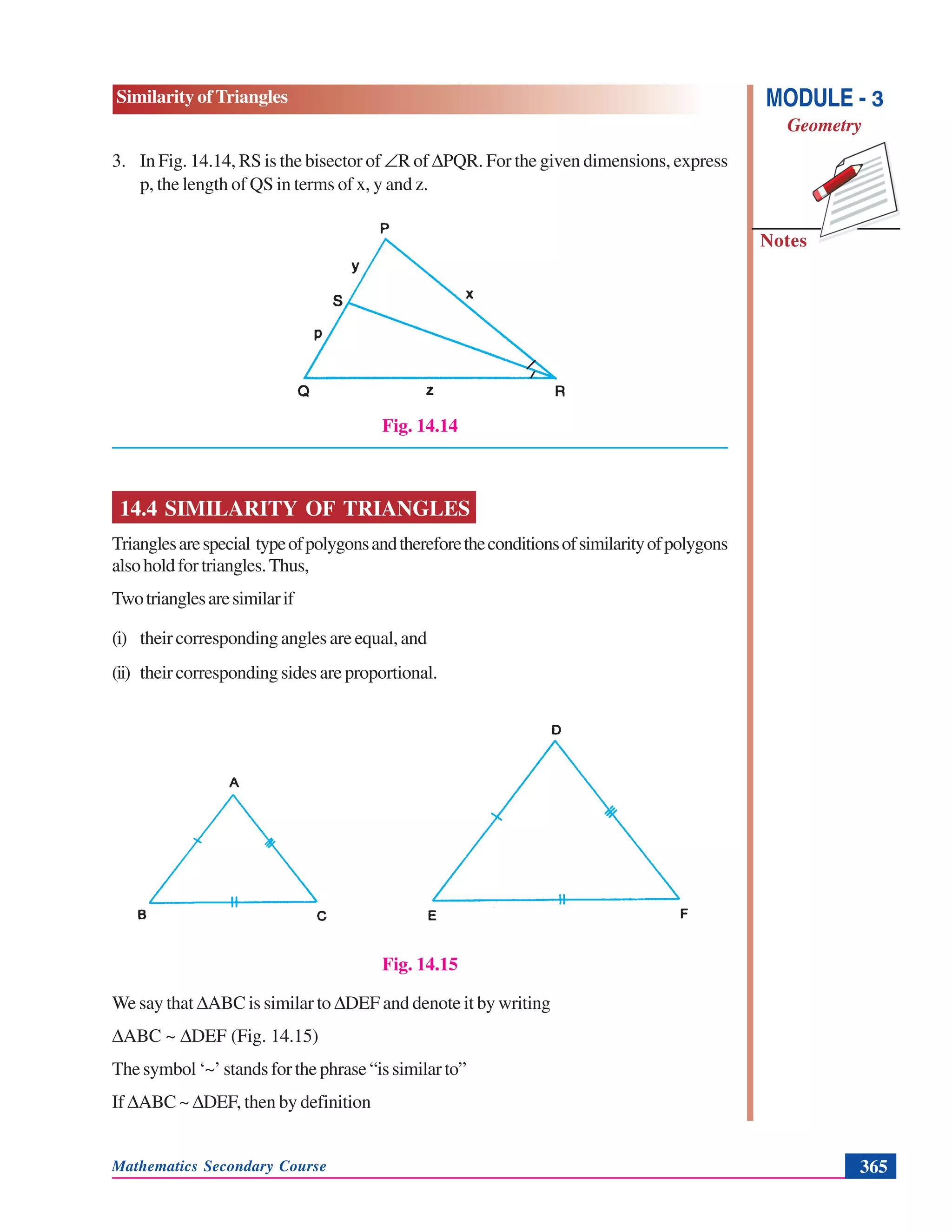
3. In Fig. 14.14, RS is the bisector of ∠R of ΔPQR. For the given dimensions, express
p, the length of QS in terms of x, y and z.
Fig. 14.14
14.4 SIMILARITY OF TRIANGLES
Trianglesarespecial typeofpolygonsandthereforetheconditionsofsimilarityofpolygons
alsoholdfortriangles.Thus,
Twotrianglesaresimilarif
(i) their corresponding angles are equal, and
(ii) their corresponding sides are proportional.
Fig. 14.15
We say that ΔABC is similar to ΔDEF and denote it by writing
ΔABC ~ ΔDEF (Fig. 14.15)
Thesymbol‘~’standsforthephrase“issimilarto”
If ΔABC ~ ΔDEF, then by definition
Mathematics Secondary Course366
Notes
MODULE - 3
Geometry
Similarity of Triangles
∠A = ∠D, ∠B = ∠E, ∠C = ∠F and
FD
CA
EF
BC
DE
AB
== .
14.4.1AAACriterion for Similarity
Weshallshowthatinthecaseoftrianglesifeitheroftheabovetwoconditionsissatisfied
thentheotherautomaticallyholds.
Letusperformthefollowingexperiment.
Construct two Δ’sABC and PQR in which ∠P= ∠A, ∠Q= ∠B and ∠R= ∠C as shown
in Fig. 14.16.
Fig. 14.16
Measure the sidesAB, BC and CAof the ΔABC and also measure the sides PQ, QR and
RP of ΔPQR.
Now find the ratio .
RP
CA
and
QR
BC
,
PQ
AB
Whatdoyoufind?Youwillfindthatallthethreeratiosareequalandthereforethetriangles
aresimilar.
Try this with different triangles with equal corresponding angles.You will find the same
result.
Thus, we can say that:
If in two triangles, the corresponding angles are equal the triangles are similar
ThisiscalledAAAsimilaritycriterion.
14.4.2 SSS Criterion for Similarity
Letusnowperformthefollowingexperiment:
Mathematics Secondary Course 367
Similarity of Triangles
Notes
MODULE - 3
Geometry
Draw a triangleABC withAB = 3 cm, BC = 4.5 cm and CA= 3.5 cm [Fig. 14.17 (i)].
(i) (ii)
Fig. 14.17
Draw another ΔPQR as shown in Fig. 14.17(ii), with PQ = 6 cm, QR = 9 cm and
PR = 7 cm.
We can see that
PR
AC
QR
BC
PQ
AB
==
i.e., the sides of the two triangles are proportional.
Now measure ∠A, ∠B and ∠C of ΔABC and ∠P, ∠Q and ∠R of ΔPQR.
You will find that ∠A= ∠P, ∠B = ∠Q and ∠C = ∠R.
Repeattheexperimentwithanothertwotriangleshavingcorrespondingsidesproportional,
youwillfindthatthecorrespondinganglesareequalandsothetrianglesaresimilar.
Thus, we can say that
If the corresponding sides of two triangles are proportional the triangles
are similar.
14.4.3 SAS Criterian for Similarity
Letusconductthefollowingexperiment.
Take a lineAB = 3 cm and atAconstruct an angle of 60o
. Cut offAC = 4.5 cm. Join BC.
Fig. 14.18
P
Q R
Mathematics Secondary Course368
Notes
MODULE - 3
Geometry
Similarity of Triangles
Now take PQ = 6 cm.At P, draw an angle of 60o
and cut off PR = 9 cm (Fig. 14.18) and
joinQR.
Measure ∠B, ∠C, ∠Q and ∠R. We shall find that ∠B = ∠Q and ∠C = ∠R
Thus, ΔABC ~ ΔPQR
Thus, we conclude that
If one angle of a triangle is equal to one angle of the other triangle and the sides
containing these angles are proportional, the triangles are similar.
Thus,wehavethreeimportantcriteriaforthesimilarityoftriangles.Theyaregivenbelow:
(i) If in two triangles, the corresponding angles are equal, the triangles are similar.
(ii) If the corresponding sides of two triangles are proportional, the triangles are
similar.
(iii)If one angle of a triangle is equal to one angle of the other triangle and the
sides containing these angles are proportional, the triangles are similar.
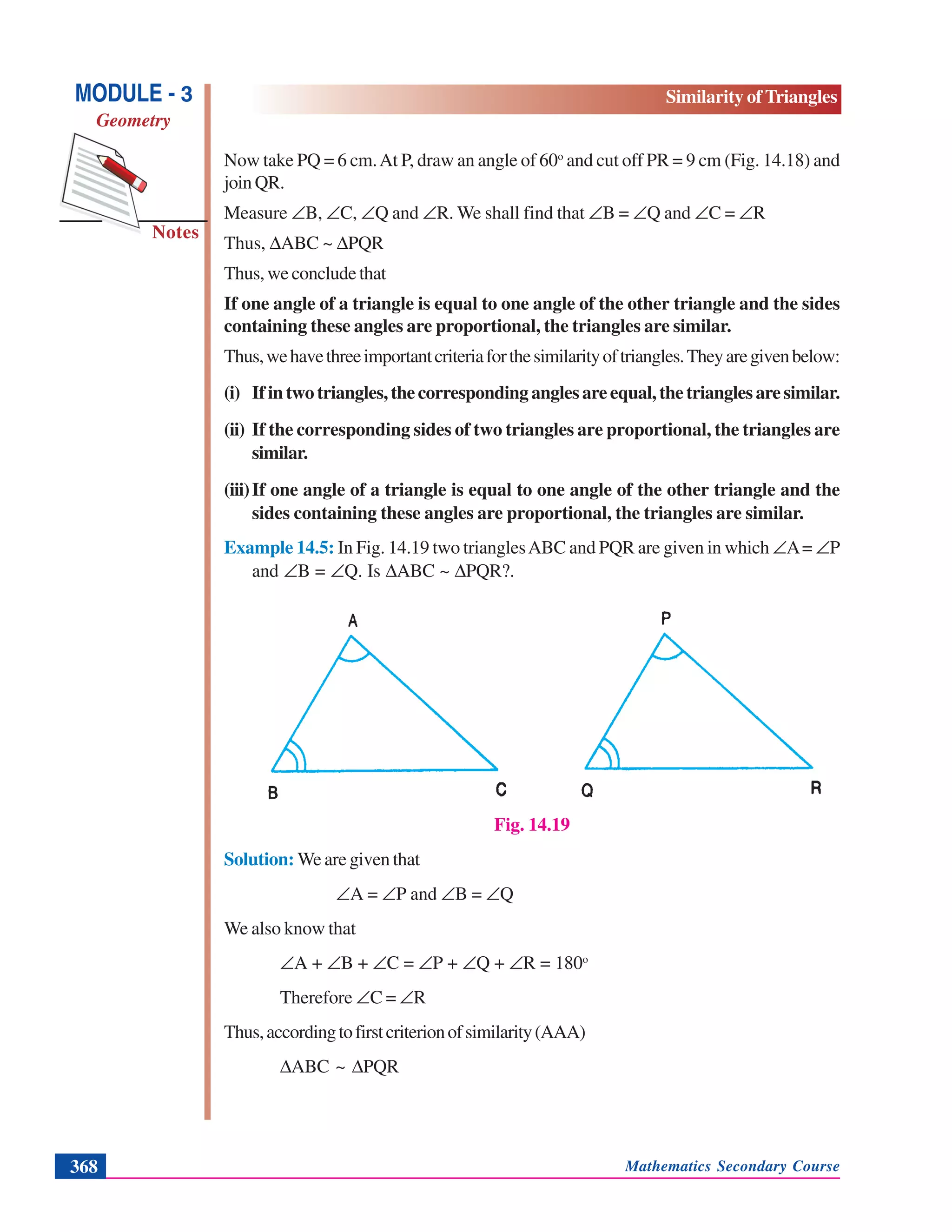
Example 14.5: In Fig. 14.19 two trianglesABC and PQR are given in which ∠A= ∠P
and ∠B = ∠Q. Is ΔABC ~ ΔPQR?.
Fig. 14.19
Solution: We are given that
∠A = ∠P and ∠B = ∠Q
We also know that
∠A + ∠B + ∠C = ∠P + ∠Q + ∠R = 180o
Therefore ∠C = ∠R
Thus,accordingtofirstcriterionofsimilarity(AAA)
ΔABC ~ ΔPQR
Mathematics Secondary Course 369
Similarity of Triangles
Notes
MODULE - 3
Geometry
Example 14.6: In Fig. 14.20, ΔABC ~ ΔPQR. If AC = 4.8 cm, AB = 4 cm and
PQ = 9 cm, find PR.
Fig. 14.20
Solution: It is given that ΔABC ~ ΔPQR
PR
AC
PQ
AB
=∴
Let PR = x cm
x
4.8
9
4
=∴
⇒ 4 x = 9 × 4.8
⇒ x = 10.8
i.e., PR = 10.8 cm.
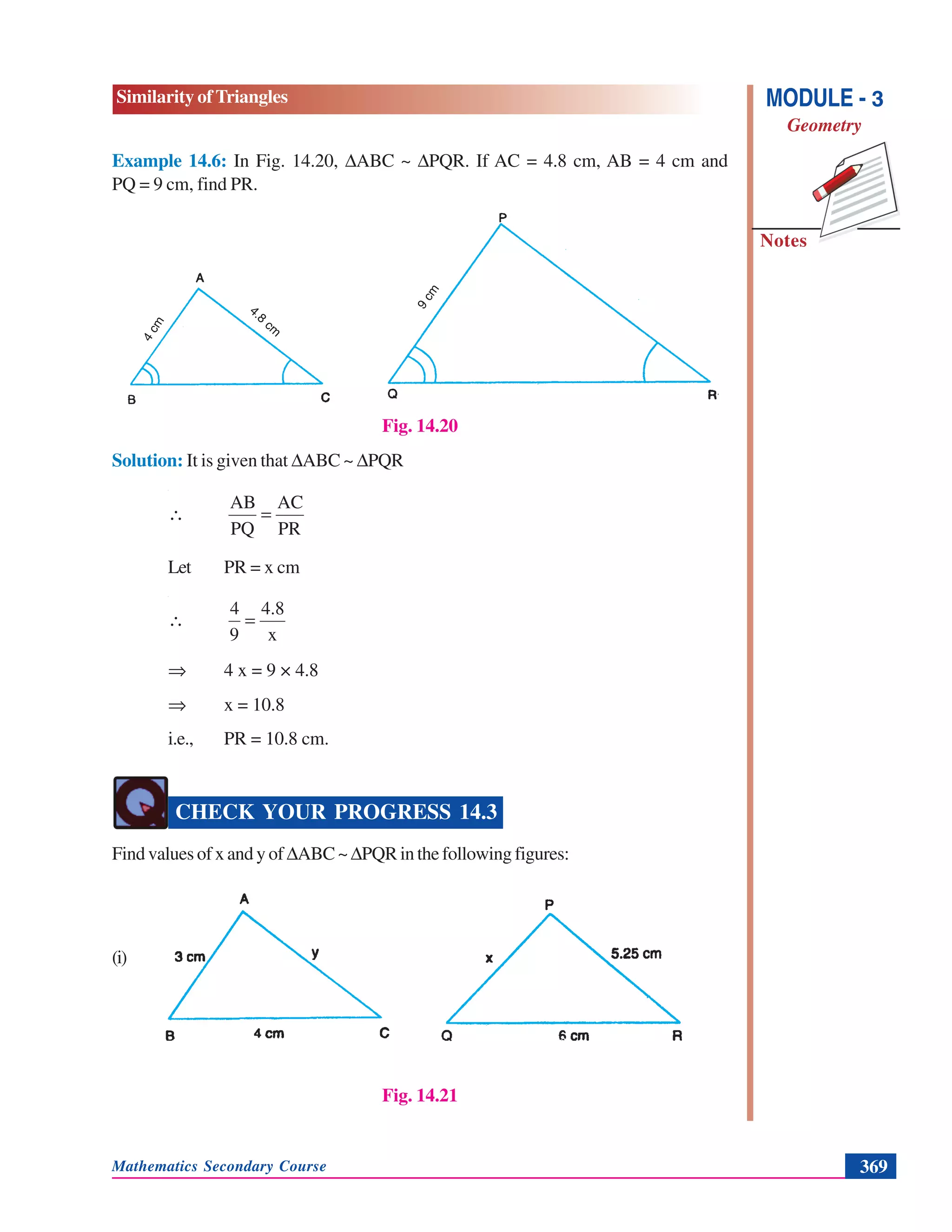
CHECK YOUR PROGRESS 14.3
Find values of x and y of ΔABC~ΔPQR in the following figures:
(i)
Fig. 14.21
4cm
4.8
cm
9cm
Mathematics Secondary Course370
Notes
MODULE - 3
Geometry
Similarity of Triangles
(ii)
Fig. 14.22
(iii)
Fig. 14.23
14.5 SOME MORE IMPORTANT RESULTS
Letusstudyanotherimportantresultonsimilarityinconnectionwitharighttriangleandthe
perpendicularfromthevertexofrightangletotheoppositeside.Westatetheresultbelow
and try to verify the same.
If a perpendicualr is drawn from the vertex of the right angle of a right
triangle to the hypotenuse, the triangles on each side of the perpendicular
are similar to each other and to the original triangle.
Letustrytoverifythisbyanactivity.
Draw a ΔABC, right angled atA. DrawAD ⊥ to
thehypoenuseBC,meetingitinD.
Let ∠DBA = α,
As ∠ADB = 90o
, ∠BAD = 90o
– α
As ∠BAC = 90o
and ∠BAD = 90o
– α
Therefore ∠DAC = α
Similarly ∠DCA = 90o
– α
∴ ΔADB and ΔCDAare similar, as it has all the corresponding angles equal.
Fig. 14.24
Mathematics Secondary Course 371
Similarity of Triangles
Notes
MODULE - 3
Geometry
Also, the angles B,Aand C of ΔBAC are α, 90o
and 90o
– α respectively.
∴ ΔADB ~ ΔCDA ~ ΔCAB
Anotherimportantresultisaboutrelationbetweencorrespondingsidesandareasofsimilar
triangles.
It states that
The ratio of the areas of two similar triangles is equal to the ratio of the
squares of their corresponding sides.
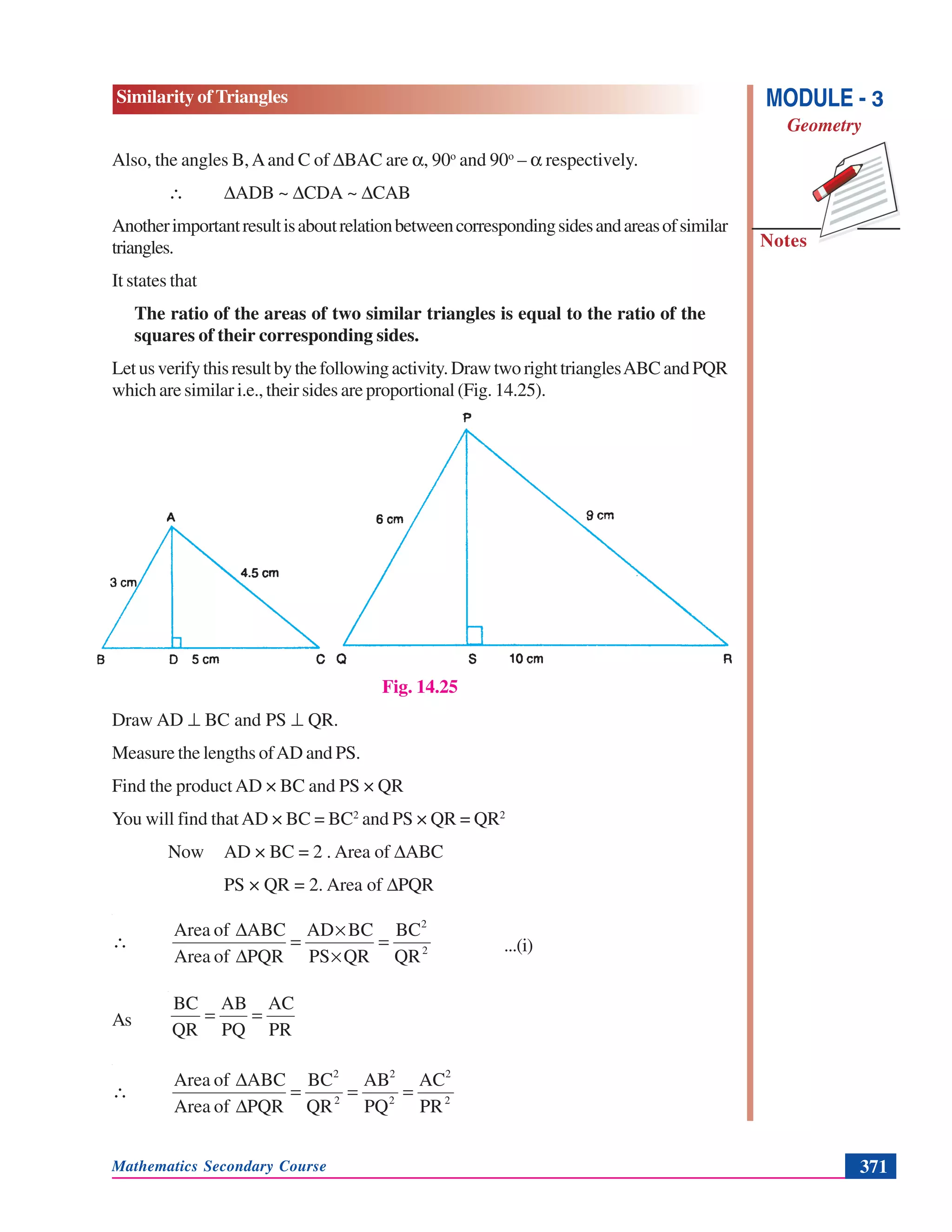
Letusverifythisresultbythefollowingactivity.DrawtworighttrianglesABCandPQR
which are similar i.e., their sides are proportional (Fig. 14.25).
Fig. 14.25
Draw AD ⊥ BC and PS ⊥ QR.
Measure the lengths ofAD and PS.
Find the product AD × BC and PS × QR
You will find thatAD × BC = BC2
and PS × QR = QR2
Now AD × BC = 2 . Area of ΔABC
PS × QR = 2. Area of ΔPQR
2
2
QR
BC
QRPS
BCAD
PQRofArea
ABCofArea
=
×
×
=
Δ
Δ
∴ ...(i)
As
PR
AC
PQ
AB
QR
BC
==
2
2
2
2
2
2
PR
AC
PQ
AB
QR
BC
PQRofArea
ABCofArea
===
Δ
Δ
∴
Mathematics Secondary Course372
Notes
MODULE - 3
Geometry
Similarity of Triangles
Theactivitymayberepeatedbytakingdifferentpairsofsimilartriangles.
Letusillustratetheseresultswiththehelpofexamples.
Example 14.7: Find the ratio of the area of two similar triangles if one pair of their
corresponding sides are 2.5 cm and 5.0 cm.
Solution: Let the two triangles beABC and PQR
Let BC = 2.5 cm and QR = 5.0 cm
( )
( )
( )
( ) 4
1
5.0
2.5
QR
BC
PQRArea
ABCArea
2
2
2
2
===
Δ
Δ
Example 14.8: In a ΔABC, PQ || BC and intersectsAB andAC at Pand Q respectively.
If
3
2
BP
AP
= find the ratio of areas ΔAPQ and ΔABC.
Solution: In Fig 14.26
PQ || BC
3
2
QC
AQ
BP
AP
==∴
2
3
AQ
QC
AP
BP
==∴
2
5
2
3
1
AQ
QC
1
AP
BP
1 =+=+=+∴
5
2
AC
AQ
AB
AP
2
5
AQ
AC
AP
AB
==⇒==⇒
∴ ΔAPQ ~ ΔABC
( )
( )
( )ΔABC~ΔAPQ
25
4
5
2
AB
AP
AB
AP
ΔABCArea
ΔAPQArea
22
2
2
Q=⎟
⎠
⎞
⎜
⎝
⎛
=⎟
⎠
⎞
⎜
⎝
⎛
==∴
CHECK YOUR PROGRESS 14.4
1. In Fig. 14.27,ABC is a right triangle withA= 90o
and C = 30o
. Show that ΔDAB ~
ΔDCA ~ ΔACB.
Fig. 14.26
Mathematics Secondary Course 373
Similarity of Triangles
Notes
MODULE - 3
Geometry
Fig. 14.27
2. Find the ratio of the areas of two similar triangles if two of their corresponding sides
are of length 3 cm and 5 cm.
3. In Fig. 14.28,ABC is a triangle in which DE || BC. IfAB = 6 cm andAD = 2 cm, find
the ratio of the areas of ΔADC and trapezium DBCE.
Fig. 14.28
4. P, QandRarerespectivelythemid-pointsofthesidesAB,BCandCAofthe ΔABC.
Show that the area of ΔPQR is one-fourth the area of ΔABC.
5. In two similar trianglesABC and PQR, if the corresponding altitudesAD and PS are
in the ratio of 4 : 9, find the ratio of the areas of ΔABC and ΔPQR.
⎥
⎦
⎤
⎢
⎣
⎡
===
PR
CA
QR
BC
PS
AD
PQ
AB
Use:Hint
6. If the ratio of the areas of two similar triangles is 16 : 25, find the ratio of their
correspondingsides.
14.6 BAUDHYAN/PYTHAGORAS THEOREM
Wenowproveanimportanttheorem,calledBaudhayan/PhythagorasTheoremusingthe
conceptofsimilarity.
Theorem: In a right triangle, the square on the hypotenuse is equal to sum
of the squares on the other two sides.
Given: Aright triangleABC, in which ∠B = 90o
.
Mathematics Secondary Course374
Notes
MODULE - 3
Geometry
Similarity of Triangles
To Prove: AC2
= AB2
+ BC2
Construction: From B, draw BD ⊥ AC (See Fig. 14.29)
Proof: BD ⊥ AC
∴ ΔADB ~ ΔABC ...(i)
and ΔBDC ~ ΔABC ...(ii)
From (i), we get
AB
AD
AC
AB
=
⇒ AB2
= AC . AD ...(X)
From (ii), we get
BC
DC
AC
BC
=
⇒ BC2
= AC . DC ...(Y)
Adding (X) and (Y), we get
AB2
+ BC2
= AC (AD + DC)
= AC . AC = AC2
The theorem is known after the name of famous Greek Mathematician Pythagoras. This
was originally stated by the Indian mathematician Baudhayan about 200 years before
Pythagoras in about 800 BC.
14.6.1 Converse of Pythagoras Theorem
The conserve of the above theorem states:
In a triangle, if the square on one side is equal to sum of the squares on the
other two sides, the angle opposite to first side is a right angle.
Thisresultcanbeverifiedbythefollowingactivity.
Draw a triangleABC with side 3 cm, 4 cm and 5 cm.
i.e., AB = 3 cm, BC = 4 cm
and AC = 5 cm (Fig. 14.30)
You can see that AB2
+ BC2
= (3)2
+ (4)2
= 9 + 16 = 25
AC2
= (5)2
= 25
∴ AB2
+ BC2
= AC2
The triangle in Fig. 14.30 satisfies the
conditionoftheaboveresult.
Fig. 14.29
Fig. 14.30
Mathematics Secondary Course 375
Similarity of Triangles
Notes
MODULE - 3
Geometry
Measure∠ABC,youwillfindthat∠ABC=90o
.Constructtrianglesofsides5cm,12cm
and 13 cm, and of sides 7 cm, 24 cm, 25 cm.You will again find that the angles opposite
to side of length 13 cm and 25 cm are 90o
in each case.
Example 14.9: In a right triangle, the sides containing the right angle are of length 5 cm
and 12 cm. Find the length of the hypotenuse.
Solution: LetABC be the right triangle, right angled at B.
∴ AB = 5 cm, BC = 12 cm
Also, AC2
= BC2
+ AB2
= (12)2
+ (5)2
= 144 + 125
= 169
∴ AC = 13
i.e., the length of the hypotenuse is 13 cm.
Example 14.10: Findthelengthofdiagonalofarectanglethelengthsofwhosesidesare
3 cm and 4 cm.
Solution: In Fig. 14.31, is a rectangle ABCD.
JointhediagonalBD.NowDCBisarighttriangle.
∴ BD2
= BC2
+ CD2
= 42
+ 32
= 16 + 9 = 25
BD = 5
i.e., the length of diagonal of rectangleABCD is 5 cm.
Example14.11:Inanequilateraltriangle,verifythatthreetimesthesquareononesideis
equal to four times the square on its altitude.
Solution: The altitudeAD ⊥ BC
and BD = CD (Fig. 14.32)
Let AB = BC = CA = 2a
and BD = CD = a
Let AD = x
∴ x2
= (2a)2
– (a)2
= 3a2
3. (Side)2
= 3. (2a)2
= 12 a2
4. (Altitude)2
= 4. 3a2
= 12a2
Hence the result. Fig. 14.32
Fig. 14.31
Mathematics Secondary Course376
Notes
MODULE - 3
Geometry
Similarity of Triangles
Example14.12:ABCisarighttriangle,rightangledatC.IfCD,thelengthofperpendicular
from C on AB is p, BC = a,AC = b and AB = c (Fig. 14.33), show that:
(i) pc = ab
(ii) 222
b
1
a
1
p
1
+=
Solution: (i) CD ⊥ AB
∴ ΔABC ~ ΔACD
p
a
b
c
=∴
⇒ pc = ab
(ii) AB2
= AC2
+ BC2
or c2
= b2
+ a2
22
2
ab
p
ab
+=⎟⎟
⎠
⎞
⎜⎜
⎝
⎛
or 2222
22
2
b
1
a
1
ba
ba
p
1
+=
+
=
CHECK YOUR PROGRESS 14.5
1. The sides of certain triangles are given below. Determine which of them are right
triangles: [AB = c, BC = a, CA = b]
(i) a = 4 cm, b = 5 cm, c = 3 cm
(ii) a = 1.6 cm, b = 3.8 cm, c = 4 cm
(iii) a = 9 cm, b = 16 cm, c = 18 cm
(iv) a = 7 cm, b = 24 cm, c = 25 cm
2. Two poles of height 6 m and 11 m, stand on a plane ground. If the distance between
their feet is 12 m, find the distance between their tops.
3. Find the length of the diagonal of a square of side 10 cm.
Fig. 14.33
Mathematics Secondary Course 377
Similarity of Triangles
Notes
MODULE - 3
Geometry
4. In Fig. 14.34, ∠C is acute andAD ⊥ BC. Show thatAB2
=AC2
+ BC2
– 2 BC. DC.
Fig. 14.34
5. L and M are the mid-points of the sides AB and AC of ΔABC, right angled at B.
Show that 4LC2
= AB2
+ 4 BC2
6. P and Q are points on the sides CA and CB respectively of ΔABC, right angled at C
Prove that AQ2
+ BP2
= AB2
+ PQ2
7. PQR is an isosceles right triangle with ∠Q = 90o
. Prove that PR2
= 2PQ2
.
8. A ladder is placed against a wall such that its top reaches upto a height of 4 m of the
wall. If the foot of the ladder is 3 m away from the wall, find the length of the ladder.
LET US SUM UP
• Objectswhichhavethesameshapebutdifferentorsamesizesarecalledsimilarobjects.
• Any two polygons, with corresponding angles equal and corresponding sides
proportionalaresimilar.
• If a line is drawn parallel to one-side of a triangle, it divides the other two sides in the
same ratio and its converse.
• The bisector of an interior angle of a triangle divides the opposite side in the ratio of
sidescontainingtheangle.
• Twotrianglesaresaidtobesimilar,if
(a) theircorrespondinganglesareequal and
(b) their corresponding sides are proportional
• Criteriaofsimilarity
-AAAcriterion
- SSS criterion
- SAS criterion
Mathematics Secondary Course378
Notes
MODULE - 3
Geometry
Similarity of Triangles
• Ifaperpendicularisdrawnfromthevertexoftherightangleofarightangledtriangle
to the hypotenuse, the triangles so formed are similar to each other and to the given
triangle.
• The ratio of the areas of two similar triangles is equal to the ratio of squares of their
correspondingsides.
• In a right triangle, the square on the hypotenuse is equal to sum of the squares on the
remainingtwosides–(BaudhayanPythagorasTheorem).
• In a triangle, if the square on one side is equal to the sum of the squares on the
remainingtwosides,thentheangleoppositetothefirstsideisarightangle–converse
of(Baudhayan)PythagorasTheorem.
TERMINAL EXERCISE
1. Writethecriteriaforthesimilarityoftwopolygons.
2. Enumeratedifferentcriteriaforthesimilarityofthetwotriangles.
3. In which of the following cases, Δ’sABC and PQR are similar.
(i) ∠A = 40o
, ∠B = 60o
, ∠C = 80o
, ∠P = 40o
, ∠Q = 60o
and ∠R = 80o
(ii) ∠A = 50o
, ∠B = 70o
, ∠C = 60o
, ∠P = 50o
, ∠Q = 60o
and ∠R = 70o
(iii) AB = 2.5 cm, BC = 4.5 cm, CA = 3.5 cm
PQ = 5.0 cm, QR = 9.0 cm, RP = 7.0 cm
(iv) AB = 3 cm, QR = 7.5 cm, RP = 5.0 cm
PQ = 4.5 cm, QR = 7.5 cm, RP = 6.0 cm.
4. In Fig. 14.35,AD = 3 cm,AE = 4.5 cm, DB = 4.0 cm, find CE, give that DE || BC.
Fig. 14.35 Fig. 14.36
5. In Fig. 14.36, DE ||AC. From the dimensions given in the figure, find the value of x.
Mathematics Secondary Course 379
Similarity of Triangles
Notes
MODULE - 3
Geometry
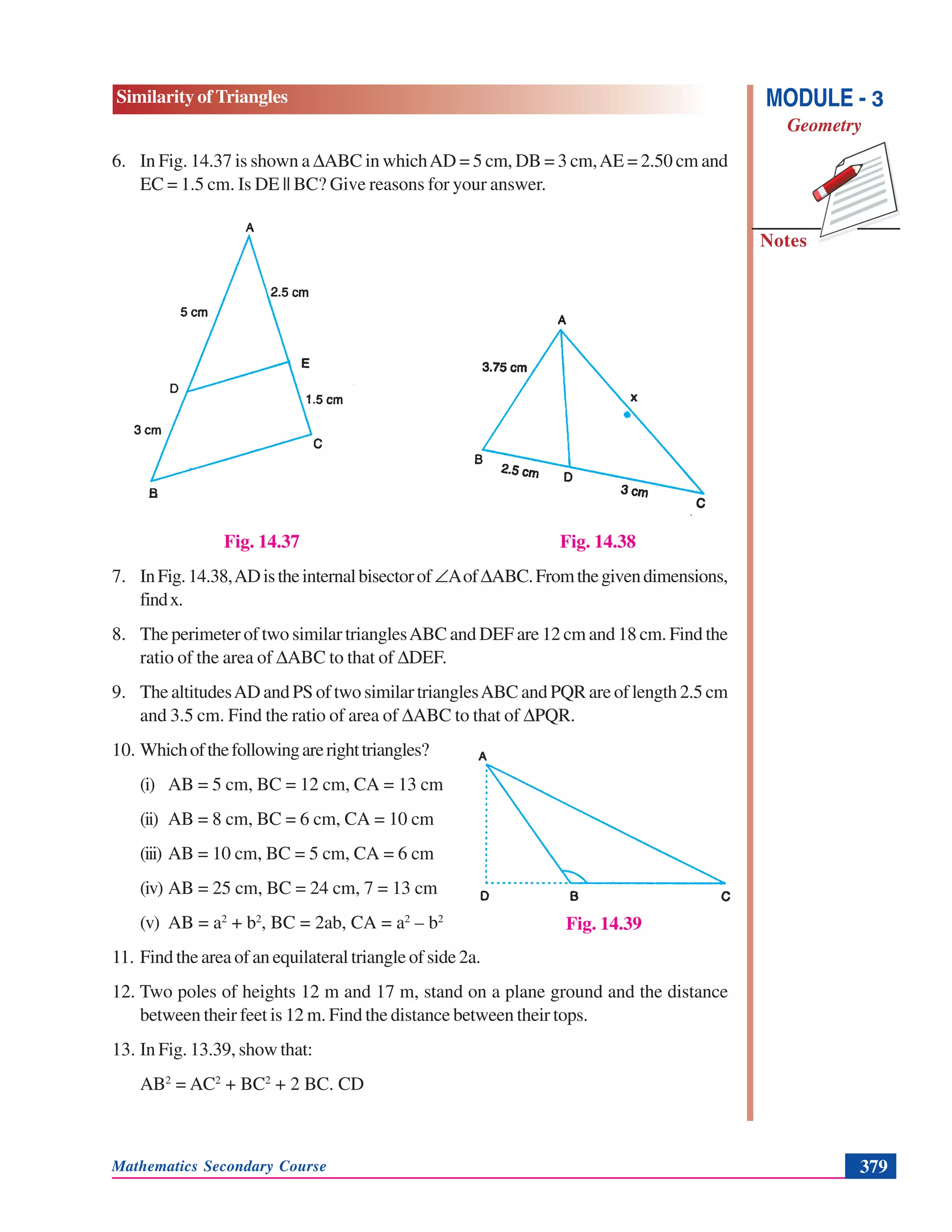
6. In Fig. 14.37 is shown a ΔABC in whichAD = 5 cm, DB = 3 cm,AE = 2.50 cm and
EC = 1.5 cm. Is DE || BC? Give reasons for your answer.
Fig. 14.37 Fig. 14.38
7. InFig.14.38,ADistheinternalbisectorof∠AofΔABC.Fromthegivendimensions,
findx.
8. The perimeter of two similar trianglesABC and DEF are 12 cm and 18 cm. Find the
ratio of the area of ΔABC to that of ΔDEF.
9. The altitudesAD and PS of two similar trianglesABC and PQR are of length 2.5 cm
and 3.5 cm. Find the ratio of area of ΔABC to that of ΔPQR.
10. Whichofthefollowingarerighttriangles?
(i) AB = 5 cm, BC = 12 cm, CA = 13 cm
(ii) AB = 8 cm, BC = 6 cm, CA = 10 cm
(iii) AB = 10 cm, BC = 5 cm, CA = 6 cm
(iv) AB = 25 cm, BC = 24 cm, 7 = 13 cm
(v) AB = a2
+ b2
, BC = 2ab, CA = a2
– b2
11. Find the area of an equilateral triangle of side 2a.
12. Two poles of heights 12 m and 17 m, stand on a plane ground and the distance
between their feet is 12 m. Find the distance between their tops.
13. In Fig. 13.39, show that:
AB2
= AC2
+ BC2
+ 2 BC. CD
Fig. 14.39
Mathematics Secondary Course380
Notes
MODULE - 3
Geometry
Similarity of Triangles
14. Aladderisplacedagainstawallanditstopreachesapointataheightof8mfromthe
ground.Ifthedistancebetweenthewallandfootoftheladderis6m,findthelengthof
the ladder.
15. In an equilateral triangle, show that three times the square of a side equals four times
the square of medians.
ANSWERS TO CHECK YOUR PROGRESS
14.1
1. (i) 6 (ii)6 (iii)10cm
2. (i) No (ii)Yes (iii)Yes
14.2
1. 7.5 cm 2. 4 cm
3.
x
yz
(x = –1 is not possible)
14.3
1. (i) x = 4.5, y = 3.5 (ii) x = 70, y = 50 (iii) x = 2 cm, y = 7 cm
14.4
2. 9 : 25 3. 1 : 8 5. 16 : 81 6. 4 : 5
14.5
1. (i)Yes (ii)No (iii)No (iv)Yes
2. 13 m 3. 10 2 cm 8. 5 m
ANSWERS TO TERMINAL EXERCISE
3. (i)and(iii) 4. 6 cm 5. 4.5 cm 6. Yes :
EC
AE
DB
AD
=
7. 4.5 cm 8. 4 : 9 9. 25 : 49 10. (i), (ii), (iv) and (v)
11. 3 a2
12. 13 m 14. 10 m

Similarity of triangles -GEOMETRY

  • 1.
    Mathematics Secondary Course358 Notes MODULE- 3 Geometry Similarity of Triangles 14 SIMILARITY OF TRIANGLES Looking around you will see many objects which are of the same shape but of same or different sizes. For examples, leaves of a tree have almost the same shape but same or differentsizes.Similarly,photographsofdifferentsizesdevelopedfromthesamenegative are of same shape but different sizes, the miniature model of a building and the building itself are of same shape but different sizes. All those objects which have the same shape but not necessarily the same size are called similar objects. Letusexaminethesimilarityofplanefigures(Fig.14.1): (i) Twoline-segmentsofthesamelengtharecongruentaswellassimilarandofdifferent lengthsaresimilarbutnotcongruent. Fig. 14.1 (i) (ii) Twocirclesofthesameradiusarecongurentaswellassimilarandcirclesofdifferent radiiaresimilarbutnotcongruent. Fig. 14.1 (ii) (iii) Twoequilateraltrianglesofdifferentsidesaresimilarbutnotcongruent. Fig. 14.1 (iii)
  • 2.
    Mathematics Secondary Course359 Similarity of Triangles Notes MODULE - 3 Geometry (iv) Twosquares of different sides are similar but not congruent. Fig. 14.1 (iv) Inthislesson,weshallstudyabouttheconceptofsimilarity,particularlysimilarityoftriangles and the conditions thereof.We shall also study about various results related to them. OBJECTIVES Afterstudyingthislesson,youwillbeableto • identify similar figures; • distinguish between congurent and similar plane figures; • prove that if a line is drawn parallel to one side of a triangle then the other two sides are divided in the same ratio; • state and use the criteria for similarity of triangles viz. AAA, SSS and SAS; • verify and use unstarred results given in the curriculum based on similarity experimentally; • prove the Baudhayan/Pythagoras Theorem; • apply these results in verifying experimentally (or proving logically) problems based on similar triangles. EXPECTED BACKGROUND KNOWLEDGE • knowledge of plane figures like triangles, quadrilaterals, circles, rectangles, squares, etc. • criteriaofcongruencyoftriangles. • finding squares and square-roots of numbers. • ratio and proportion. • Interiorandexterioranglesofatriangle.
  • 3.
    Mathematics Secondary Course360 Notes MODULE- 3 Geometry Similarity of Triangles 14.1 SIMILAR PLANE FIGURES Fig. 14.2 In Fig. 14.2, the two pentagons seem to be of the same shape. We can see that if ∠A = ∠A′, ∠B = ∠B′, ∠C = ∠C′, ∠D = ∠D′ and ∠E = E′ and A'E' EA E'D' DE D'C' CD C'B' BC B'A' AB ==== . then the two pentagons are similar. Thus we say that Any two polygons, with corresponding angles equal and corresponding sides proportional, are similar. Thus,twopolygonsaresimilar,iftheysatisfiythefollowingtwoconditions: (i) Corresponding angles are equal. (ii) The corresponding sides are proportional. Evenifoneoftheconditionsdoesnothold,thepolygonsarenotsimilarasinthecaseofa rectangle and square given in Fig. 14.3. Here all the corresponding angles are equal but the corresponding sides are not proportional. Fig. 14.3 14.2 BASIC PROPORTIONALITY THEORM We state below the Basic ProportionalityTheorm: If a line is drawn parallel to one side of a triangle intersecting the other two sides, the other two sides of the triangle are divided proportionally.
  • 4.
    Mathematics Secondary Course361 Similarity of Triangles Notes MODULE - 3 Geometry Thus, in Fig. 14.4, DE || BC,According to the above result EC AE DB AD = We can easily verify this by measuringAD, DB,AE and EC.Youwillfindthat EC AE DB AD = We state the converse of the above result as follows: If a line divides any two sides of a triangle in the same ratio, the line is parallel to third side of the triangle. Thus, in Fig 14.4, if DE divides sideAB andAC of ΔABC such that EC AE DB AD = , then DE || BC. Wecanverifythisbymeasuring∠ADEand∠ABCandfindingthat ∠ADE = ∠ABC These being corresponding angles, the line DE and BC are parallel. Wecanverifytheabovetworesultsbytakingdifferenttriangles. Let us solve some examples based on these. Example 14.1: In Fig. 14.5, DE || BC. If AD = 3 cm, DB = 5 cm and AE = 6 cm, find AC. Solution: DE || BC (Given). Let EC = x ∴ EC AE DB AD = ∴ x 6 5 3 = ⇒ 3 x = 30 ⇒ x = 10 ∴ EC = 10 cm ∴ AC = AE + EC = 16 cm Example 14.2: In Fig. 14.6, AD = 4 cm, DB = 5 cm, AE = 4.5 cm and EC = 8 5 5 cm. Is DE || BC? Given reasons for your answer. Fig. 14.4 Fig. 14.5
  • 5.
    Mathematics Secondary Course362 Notes MODULE- 3 Geometry Similarity of Triangles Solution: We are given thatAD = 4 cm and DB = 5 cm ∴ 5 4 DB AD = Similarly, 5 4 45 8 2 9 8 45 4.5 EC AE =×== ∴ EC AE DB AD = ∴According to converse of Basic ProportionalityTheorem DE || BC CHECK YOUR PROGRESS 14.1 1. In Fig. 14.7 (i) and (ii), PQ || BC. Find the value of x in each case. (i) (ii) Fig. 14.7 2. InFig.14.8[(i)],findwhetherDE||BCisparalleltoBCornot?Givereasonsforyour answer. (i) Fig. 14.8 Fig. 14.6
  • 6.
    Mathematics Secondary Course363 Similarity of Triangles Notes MODULE - 3 Geometry 14.3 BISECTOR OF AN ANGLE OF A TRIANGLE We now state an important result as given below: The bisector of an interior angle of a triangle divides the opposite side in the ratio of sides containing the angle. According to the above result, ifAD is the internal bisector of ∠A of ΔABC, then AC AB DC BD = (Fig. 14.9) WecaneasilyverifythisbymeasuringBD,DC,AB andACandfindingtheratios.Wewillfindthat AC AB DC BD = Repeatingthesameactivitywithothertriangles,wemayverifytheresult. Letussolvesomeexamplestoillustratethis. Example14.3:ThesidesABandACofatriangleareoflength6cmand8cmrespectively. The bisectorAD of ∠Aintersects the opposite side BC in D such that BD = 4.5 cm (Fig. 14.10). Find the length of segment CD. Solution: According to the above result, we have AC AB DC BD = ( Q AD is internal bisector of ∠Aof ΔABC) or 8 6 x 4.5 = ⇒ 6x = 4.5 × 8 x = 6 i.e., the length of line-segment CD = 6 cm. Example 14.4: The sides of a triangle are 28 cm, 36 cm and 48 cm. Find the lengths of theline-segmentsintowhichthesmallestsideisdividedbythebisectoroftheangleopposite to it. Solution: Thesmallestsideisoflength28cmandthesidesforming∠Aoppositetoitare 36 cm and 48 cm. Let the angle bisectorAD meet BC in D (Fig. 14.11). Fig. 14.9 Fig. 14.10
  • 7.
    Mathematics Secondary Course364 Notes MODULE- 3 Geometry Similarity of Triangles 4 3 48 36 DC BD ==∴ DC 4 3 BDor3DC4BD ==⇒ BC = BD + DC = 28 cm 28DC 4 3 DC =+∴ 16cm 7 4 28DC =⎟ ⎠ ⎞ ⎜ ⎝ ⎛ ×=∴ cm ∴ BD = 12 cm and DC = 16 cm CHECK YOUR PROGRESS 14.2 1. In Fig. 14.12, AD is the bisector of ∠A, meeting BC in D. If AB = 4.5 cm, BD = 3 cm, DC = 5 cm, find x. Fig. 14.12 2. InFig.14.13,PSisthebisectorof ∠PofΔPQR.Thedimensionsofsomeofthesides are given in Fig. 14.13. Find x. Fig. 14.13 Fig. 14.11
  • 8.
    Mathematics Secondary Course365 Similarity of Triangles Notes MODULE - 3 Geometry 3. In Fig. 14.14, RS is the bisector of ∠R of ΔPQR. For the given dimensions, express p, the length of QS in terms of x, y and z. Fig. 14.14 14.4 SIMILARITY OF TRIANGLES Trianglesarespecial typeofpolygonsandthereforetheconditionsofsimilarityofpolygons alsoholdfortriangles.Thus, Twotrianglesaresimilarif (i) their corresponding angles are equal, and (ii) their corresponding sides are proportional. Fig. 14.15 We say that ΔABC is similar to ΔDEF and denote it by writing ΔABC ~ ΔDEF (Fig. 14.15) Thesymbol‘~’standsforthephrase“issimilarto” If ΔABC ~ ΔDEF, then by definition
  • 9.
    Mathematics Secondary Course366 Notes MODULE- 3 Geometry Similarity of Triangles ∠A = ∠D, ∠B = ∠E, ∠C = ∠F and FD CA EF BC DE AB == . 14.4.1AAACriterion for Similarity Weshallshowthatinthecaseoftrianglesifeitheroftheabovetwoconditionsissatisfied thentheotherautomaticallyholds. Letusperformthefollowingexperiment. Construct two Δ’sABC and PQR in which ∠P= ∠A, ∠Q= ∠B and ∠R= ∠C as shown in Fig. 14.16. Fig. 14.16 Measure the sidesAB, BC and CAof the ΔABC and also measure the sides PQ, QR and RP of ΔPQR. Now find the ratio . RP CA and QR BC , PQ AB Whatdoyoufind?Youwillfindthatallthethreeratiosareequalandthereforethetriangles aresimilar. Try this with different triangles with equal corresponding angles.You will find the same result. Thus, we can say that: If in two triangles, the corresponding angles are equal the triangles are similar ThisiscalledAAAsimilaritycriterion. 14.4.2 SSS Criterion for Similarity Letusnowperformthefollowingexperiment:
  • 10.
    Mathematics Secondary Course367 Similarity of Triangles Notes MODULE - 3 Geometry Draw a triangleABC withAB = 3 cm, BC = 4.5 cm and CA= 3.5 cm [Fig. 14.17 (i)]. (i) (ii) Fig. 14.17 Draw another ΔPQR as shown in Fig. 14.17(ii), with PQ = 6 cm, QR = 9 cm and PR = 7 cm. We can see that PR AC QR BC PQ AB == i.e., the sides of the two triangles are proportional. Now measure ∠A, ∠B and ∠C of ΔABC and ∠P, ∠Q and ∠R of ΔPQR. You will find that ∠A= ∠P, ∠B = ∠Q and ∠C = ∠R. Repeattheexperimentwithanothertwotriangleshavingcorrespondingsidesproportional, youwillfindthatthecorrespondinganglesareequalandsothetrianglesaresimilar. Thus, we can say that If the corresponding sides of two triangles are proportional the triangles are similar. 14.4.3 SAS Criterian for Similarity Letusconductthefollowingexperiment. Take a lineAB = 3 cm and atAconstruct an angle of 60o . Cut offAC = 4.5 cm. Join BC. Fig. 14.18 P Q R
  • 11.
    Mathematics Secondary Course368 Notes MODULE- 3 Geometry Similarity of Triangles Now take PQ = 6 cm.At P, draw an angle of 60o and cut off PR = 9 cm (Fig. 14.18) and joinQR. Measure ∠B, ∠C, ∠Q and ∠R. We shall find that ∠B = ∠Q and ∠C = ∠R Thus, ΔABC ~ ΔPQR Thus, we conclude that If one angle of a triangle is equal to one angle of the other triangle and the sides containing these angles are proportional, the triangles are similar. Thus,wehavethreeimportantcriteriaforthesimilarityoftriangles.Theyaregivenbelow: (i) If in two triangles, the corresponding angles are equal, the triangles are similar. (ii) If the corresponding sides of two triangles are proportional, the triangles are similar. (iii)If one angle of a triangle is equal to one angle of the other triangle and the sides containing these angles are proportional, the triangles are similar. Example 14.5: In Fig. 14.19 two trianglesABC and PQR are given in which ∠A= ∠P and ∠B = ∠Q. Is ΔABC ~ ΔPQR?. Fig. 14.19 Solution: We are given that ∠A = ∠P and ∠B = ∠Q We also know that ∠A + ∠B + ∠C = ∠P + ∠Q + ∠R = 180o Therefore ∠C = ∠R Thus,accordingtofirstcriterionofsimilarity(AAA) ΔABC ~ ΔPQR
  • 12.
    Mathematics Secondary Course369 Similarity of Triangles Notes MODULE - 3 Geometry Example 14.6: In Fig. 14.20, ΔABC ~ ΔPQR. If AC = 4.8 cm, AB = 4 cm and PQ = 9 cm, find PR. Fig. 14.20 Solution: It is given that ΔABC ~ ΔPQR PR AC PQ AB =∴ Let PR = x cm x 4.8 9 4 =∴ ⇒ 4 x = 9 × 4.8 ⇒ x = 10.8 i.e., PR = 10.8 cm. CHECK YOUR PROGRESS 14.3 Find values of x and y of ΔABC~ΔPQR in the following figures: (i) Fig. 14.21 4cm 4.8 cm 9cm
  • 13.
    Mathematics Secondary Course370 Notes MODULE- 3 Geometry Similarity of Triangles (ii) Fig. 14.22 (iii) Fig. 14.23 14.5 SOME MORE IMPORTANT RESULTS Letusstudyanotherimportantresultonsimilarityinconnectionwitharighttriangleandthe perpendicularfromthevertexofrightangletotheoppositeside.Westatetheresultbelow and try to verify the same. If a perpendicualr is drawn from the vertex of the right angle of a right triangle to the hypotenuse, the triangles on each side of the perpendicular are similar to each other and to the original triangle. Letustrytoverifythisbyanactivity. Draw a ΔABC, right angled atA. DrawAD ⊥ to thehypoenuseBC,meetingitinD. Let ∠DBA = α, As ∠ADB = 90o , ∠BAD = 90o – α As ∠BAC = 90o and ∠BAD = 90o – α Therefore ∠DAC = α Similarly ∠DCA = 90o – α ∴ ΔADB and ΔCDAare similar, as it has all the corresponding angles equal. Fig. 14.24
  • 14.
    Mathematics Secondary Course371 Similarity of Triangles Notes MODULE - 3 Geometry Also, the angles B,Aand C of ΔBAC are α, 90o and 90o – α respectively. ∴ ΔADB ~ ΔCDA ~ ΔCAB Anotherimportantresultisaboutrelationbetweencorrespondingsidesandareasofsimilar triangles. It states that The ratio of the areas of two similar triangles is equal to the ratio of the squares of their corresponding sides. Letusverifythisresultbythefollowingactivity.DrawtworighttrianglesABCandPQR which are similar i.e., their sides are proportional (Fig. 14.25). Fig. 14.25 Draw AD ⊥ BC and PS ⊥ QR. Measure the lengths ofAD and PS. Find the product AD × BC and PS × QR You will find thatAD × BC = BC2 and PS × QR = QR2 Now AD × BC = 2 . Area of ΔABC PS × QR = 2. Area of ΔPQR 2 2 QR BC QRPS BCAD PQRofArea ABCofArea = × × = Δ Δ ∴ ...(i) As PR AC PQ AB QR BC == 2 2 2 2 2 2 PR AC PQ AB QR BC PQRofArea ABCofArea === Δ Δ ∴
  • 15.
    Mathematics Secondary Course372 Notes MODULE- 3 Geometry Similarity of Triangles Theactivitymayberepeatedbytakingdifferentpairsofsimilartriangles. Letusillustratetheseresultswiththehelpofexamples. Example 14.7: Find the ratio of the area of two similar triangles if one pair of their corresponding sides are 2.5 cm and 5.0 cm. Solution: Let the two triangles beABC and PQR Let BC = 2.5 cm and QR = 5.0 cm ( ) ( ) ( ) ( ) 4 1 5.0 2.5 QR BC PQRArea ABCArea 2 2 2 2 === Δ Δ Example 14.8: In a ΔABC, PQ || BC and intersectsAB andAC at Pand Q respectively. If 3 2 BP AP = find the ratio of areas ΔAPQ and ΔABC. Solution: In Fig 14.26 PQ || BC 3 2 QC AQ BP AP ==∴ 2 3 AQ QC AP BP ==∴ 2 5 2 3 1 AQ QC 1 AP BP 1 =+=+=+∴ 5 2 AC AQ AB AP 2 5 AQ AC AP AB ==⇒==⇒ ∴ ΔAPQ ~ ΔABC ( ) ( ) ( )ΔABC~ΔAPQ 25 4 5 2 AB AP AB AP ΔABCArea ΔAPQArea 22 2 2 Q=⎟ ⎠ ⎞ ⎜ ⎝ ⎛ =⎟ ⎠ ⎞ ⎜ ⎝ ⎛ ==∴ CHECK YOUR PROGRESS 14.4 1. In Fig. 14.27,ABC is a right triangle withA= 90o and C = 30o . Show that ΔDAB ~ ΔDCA ~ ΔACB. Fig. 14.26
  • 16.
    Mathematics Secondary Course373 Similarity of Triangles Notes MODULE - 3 Geometry Fig. 14.27 2. Find the ratio of the areas of two similar triangles if two of their corresponding sides are of length 3 cm and 5 cm. 3. In Fig. 14.28,ABC is a triangle in which DE || BC. IfAB = 6 cm andAD = 2 cm, find the ratio of the areas of ΔADC and trapezium DBCE. Fig. 14.28 4. P, QandRarerespectivelythemid-pointsofthesidesAB,BCandCAofthe ΔABC. Show that the area of ΔPQR is one-fourth the area of ΔABC. 5. In two similar trianglesABC and PQR, if the corresponding altitudesAD and PS are in the ratio of 4 : 9, find the ratio of the areas of ΔABC and ΔPQR. ⎥ ⎦ ⎤ ⎢ ⎣ ⎡ === PR CA QR BC PS AD PQ AB Use:Hint 6. If the ratio of the areas of two similar triangles is 16 : 25, find the ratio of their correspondingsides. 14.6 BAUDHYAN/PYTHAGORAS THEOREM Wenowproveanimportanttheorem,calledBaudhayan/PhythagorasTheoremusingthe conceptofsimilarity. Theorem: In a right triangle, the square on the hypotenuse is equal to sum of the squares on the other two sides. Given: Aright triangleABC, in which ∠B = 90o .
  • 17.
    Mathematics Secondary Course374 Notes MODULE- 3 Geometry Similarity of Triangles To Prove: AC2 = AB2 + BC2 Construction: From B, draw BD ⊥ AC (See Fig. 14.29) Proof: BD ⊥ AC ∴ ΔADB ~ ΔABC ...(i) and ΔBDC ~ ΔABC ...(ii) From (i), we get AB AD AC AB = ⇒ AB2 = AC . AD ...(X) From (ii), we get BC DC AC BC = ⇒ BC2 = AC . DC ...(Y) Adding (X) and (Y), we get AB2 + BC2 = AC (AD + DC) = AC . AC = AC2 The theorem is known after the name of famous Greek Mathematician Pythagoras. This was originally stated by the Indian mathematician Baudhayan about 200 years before Pythagoras in about 800 BC. 14.6.1 Converse of Pythagoras Theorem The conserve of the above theorem states: In a triangle, if the square on one side is equal to sum of the squares on the other two sides, the angle opposite to first side is a right angle. Thisresultcanbeverifiedbythefollowingactivity. Draw a triangleABC with side 3 cm, 4 cm and 5 cm. i.e., AB = 3 cm, BC = 4 cm and AC = 5 cm (Fig. 14.30) You can see that AB2 + BC2 = (3)2 + (4)2 = 9 + 16 = 25 AC2 = (5)2 = 25 ∴ AB2 + BC2 = AC2 The triangle in Fig. 14.30 satisfies the conditionoftheaboveresult. Fig. 14.29 Fig. 14.30
  • 18.
    Mathematics Secondary Course375 Similarity of Triangles Notes MODULE - 3 Geometry Measure∠ABC,youwillfindthat∠ABC=90o .Constructtrianglesofsides5cm,12cm and 13 cm, and of sides 7 cm, 24 cm, 25 cm.You will again find that the angles opposite to side of length 13 cm and 25 cm are 90o in each case. Example 14.9: In a right triangle, the sides containing the right angle are of length 5 cm and 12 cm. Find the length of the hypotenuse. Solution: LetABC be the right triangle, right angled at B. ∴ AB = 5 cm, BC = 12 cm Also, AC2 = BC2 + AB2 = (12)2 + (5)2 = 144 + 125 = 169 ∴ AC = 13 i.e., the length of the hypotenuse is 13 cm. Example 14.10: Findthelengthofdiagonalofarectanglethelengthsofwhosesidesare 3 cm and 4 cm. Solution: In Fig. 14.31, is a rectangle ABCD. JointhediagonalBD.NowDCBisarighttriangle. ∴ BD2 = BC2 + CD2 = 42 + 32 = 16 + 9 = 25 BD = 5 i.e., the length of diagonal of rectangleABCD is 5 cm. Example14.11:Inanequilateraltriangle,verifythatthreetimesthesquareononesideis equal to four times the square on its altitude. Solution: The altitudeAD ⊥ BC and BD = CD (Fig. 14.32) Let AB = BC = CA = 2a and BD = CD = a Let AD = x ∴ x2 = (2a)2 – (a)2 = 3a2 3. (Side)2 = 3. (2a)2 = 12 a2 4. (Altitude)2 = 4. 3a2 = 12a2 Hence the result. Fig. 14.32 Fig. 14.31
  • 19.
    Mathematics Secondary Course376 Notes MODULE- 3 Geometry Similarity of Triangles Example14.12:ABCisarighttriangle,rightangledatC.IfCD,thelengthofperpendicular from C on AB is p, BC = a,AC = b and AB = c (Fig. 14.33), show that: (i) pc = ab (ii) 222 b 1 a 1 p 1 += Solution: (i) CD ⊥ AB ∴ ΔABC ~ ΔACD p a b c =∴ ⇒ pc = ab (ii) AB2 = AC2 + BC2 or c2 = b2 + a2 22 2 ab p ab +=⎟⎟ ⎠ ⎞ ⎜⎜ ⎝ ⎛ or 2222 22 2 b 1 a 1 ba ba p 1 += + = CHECK YOUR PROGRESS 14.5 1. The sides of certain triangles are given below. Determine which of them are right triangles: [AB = c, BC = a, CA = b] (i) a = 4 cm, b = 5 cm, c = 3 cm (ii) a = 1.6 cm, b = 3.8 cm, c = 4 cm (iii) a = 9 cm, b = 16 cm, c = 18 cm (iv) a = 7 cm, b = 24 cm, c = 25 cm 2. Two poles of height 6 m and 11 m, stand on a plane ground. If the distance between their feet is 12 m, find the distance between their tops. 3. Find the length of the diagonal of a square of side 10 cm. Fig. 14.33
  • 20.
    Mathematics Secondary Course377 Similarity of Triangles Notes MODULE - 3 Geometry 4. In Fig. 14.34, ∠C is acute andAD ⊥ BC. Show thatAB2 =AC2 + BC2 – 2 BC. DC. Fig. 14.34 5. L and M are the mid-points of the sides AB and AC of ΔABC, right angled at B. Show that 4LC2 = AB2 + 4 BC2 6. P and Q are points on the sides CA and CB respectively of ΔABC, right angled at C Prove that AQ2 + BP2 = AB2 + PQ2 7. PQR is an isosceles right triangle with ∠Q = 90o . Prove that PR2 = 2PQ2 . 8. A ladder is placed against a wall such that its top reaches upto a height of 4 m of the wall. If the foot of the ladder is 3 m away from the wall, find the length of the ladder. LET US SUM UP • Objectswhichhavethesameshapebutdifferentorsamesizesarecalledsimilarobjects. • Any two polygons, with corresponding angles equal and corresponding sides proportionalaresimilar. • If a line is drawn parallel to one-side of a triangle, it divides the other two sides in the same ratio and its converse. • The bisector of an interior angle of a triangle divides the opposite side in the ratio of sidescontainingtheangle. • Twotrianglesaresaidtobesimilar,if (a) theircorrespondinganglesareequal and (b) their corresponding sides are proportional • Criteriaofsimilarity -AAAcriterion - SSS criterion - SAS criterion
  • 21.
    Mathematics Secondary Course378 Notes MODULE- 3 Geometry Similarity of Triangles • Ifaperpendicularisdrawnfromthevertexoftherightangleofarightangledtriangle to the hypotenuse, the triangles so formed are similar to each other and to the given triangle. • The ratio of the areas of two similar triangles is equal to the ratio of squares of their correspondingsides. • In a right triangle, the square on the hypotenuse is equal to sum of the squares on the remainingtwosides–(BaudhayanPythagorasTheorem). • In a triangle, if the square on one side is equal to the sum of the squares on the remainingtwosides,thentheangleoppositetothefirstsideisarightangle–converse of(Baudhayan)PythagorasTheorem. TERMINAL EXERCISE 1. Writethecriteriaforthesimilarityoftwopolygons. 2. Enumeratedifferentcriteriaforthesimilarityofthetwotriangles. 3. In which of the following cases, Δ’sABC and PQR are similar. (i) ∠A = 40o , ∠B = 60o , ∠C = 80o , ∠P = 40o , ∠Q = 60o and ∠R = 80o (ii) ∠A = 50o , ∠B = 70o , ∠C = 60o , ∠P = 50o , ∠Q = 60o and ∠R = 70o (iii) AB = 2.5 cm, BC = 4.5 cm, CA = 3.5 cm PQ = 5.0 cm, QR = 9.0 cm, RP = 7.0 cm (iv) AB = 3 cm, QR = 7.5 cm, RP = 5.0 cm PQ = 4.5 cm, QR = 7.5 cm, RP = 6.0 cm. 4. In Fig. 14.35,AD = 3 cm,AE = 4.5 cm, DB = 4.0 cm, find CE, give that DE || BC. Fig. 14.35 Fig. 14.36 5. In Fig. 14.36, DE ||AC. From the dimensions given in the figure, find the value of x.
  • 22.
    Mathematics Secondary Course379 Similarity of Triangles Notes MODULE - 3 Geometry 6. In Fig. 14.37 is shown a ΔABC in whichAD = 5 cm, DB = 3 cm,AE = 2.50 cm and EC = 1.5 cm. Is DE || BC? Give reasons for your answer. Fig. 14.37 Fig. 14.38 7. InFig.14.38,ADistheinternalbisectorof∠AofΔABC.Fromthegivendimensions, findx. 8. The perimeter of two similar trianglesABC and DEF are 12 cm and 18 cm. Find the ratio of the area of ΔABC to that of ΔDEF. 9. The altitudesAD and PS of two similar trianglesABC and PQR are of length 2.5 cm and 3.5 cm. Find the ratio of area of ΔABC to that of ΔPQR. 10. Whichofthefollowingarerighttriangles? (i) AB = 5 cm, BC = 12 cm, CA = 13 cm (ii) AB = 8 cm, BC = 6 cm, CA = 10 cm (iii) AB = 10 cm, BC = 5 cm, CA = 6 cm (iv) AB = 25 cm, BC = 24 cm, 7 = 13 cm (v) AB = a2 + b2 , BC = 2ab, CA = a2 – b2 11. Find the area of an equilateral triangle of side 2a. 12. Two poles of heights 12 m and 17 m, stand on a plane ground and the distance between their feet is 12 m. Find the distance between their tops. 13. In Fig. 13.39, show that: AB2 = AC2 + BC2 + 2 BC. CD Fig. 14.39
  • 23.
    Mathematics Secondary Course380 Notes MODULE- 3 Geometry Similarity of Triangles 14. Aladderisplacedagainstawallanditstopreachesapointataheightof8mfromthe ground.Ifthedistancebetweenthewallandfootoftheladderis6m,findthelengthof the ladder. 15. In an equilateral triangle, show that three times the square of a side equals four times the square of medians. ANSWERS TO CHECK YOUR PROGRESS 14.1 1. (i) 6 (ii)6 (iii)10cm 2. (i) No (ii)Yes (iii)Yes 14.2 1. 7.5 cm 2. 4 cm 3. x yz (x = –1 is not possible) 14.3 1. (i) x = 4.5, y = 3.5 (ii) x = 70, y = 50 (iii) x = 2 cm, y = 7 cm 14.4 2. 9 : 25 3. 1 : 8 5. 16 : 81 6. 4 : 5 14.5 1. (i)Yes (ii)No (iii)No (iv)Yes 2. 13 m 3. 10 2 cm 8. 5 m ANSWERS TO TERMINAL EXERCISE 3. (i)and(iii) 4. 6 cm 5. 4.5 cm 6. Yes : EC AE DB AD = 7. 4.5 cm 8. 4 : 9 9. 25 : 49 10. (i), (ii), (iv) and (v) 11. 3 a2 12. 13 m 14. 10 m