Chapter 2
Triangles
CHAPTER 2 : TRIANGLES
2.1 Introduction
2.2 Sum of the angles of a triangle
2.3 Types of triangles
2.4 Altitude, Median and Angle Bisector
2.5 Congruence of triangles
2.6 Sides opposite congruent angles
CHAPTER 2 : TRIANGLES
• 2.1 Introduction
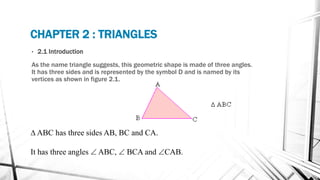
As the name triangle suggests, this geometric shape is made of three angles.
It has three sides and is represented by the symbol D and is named by its
vertices as shown in figure 2.1.
D ABC has three sides AB, BC and CA.
It has three angles  ABC,  BCA and CAB.
2.2 Sum of the angles of a triangle
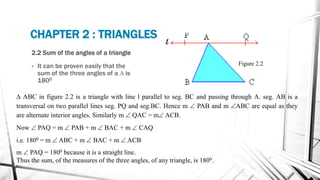
• It can be proven easily that the
sum of the three angles of a D is
1800
CHAPTER 2 : TRIANGLES
Figure 2.2
D ABC in figure 2.2 is a triangle with line l parallel to seg. BC and passing through A. seg. AB is a
transversal on two parallel lines seg. PQ and seg.BC. Hence m  PAB and m ABC are equal as they
are alternate interior angles. Similarly m  QAC = m ACB.
Now  PAQ = m  PAB + m  BAC + m  CAQ
i.e. 1800 = m  ABC + m  BAC + m  ACB
m  PAQ = 1800 because it is a straight line.
Thus the sum, of the measures of the three angles, of any triangle, is 1800.
2.3 Types of triangles
• Triangles are classified into
various types, using two different
parameters - the lengths of their
sides and the measure of their
angles.
• Length of the Side
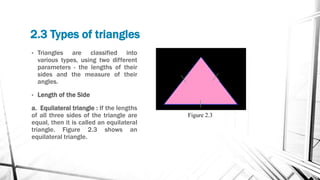
a. Equilateral triangle : If the lengths
of all three sides of the triangle are
equal, then it is called an equilateral
triangle. Figure 2.3 shows an
equilateral triangle.
Figure 2.3
Length of the Side
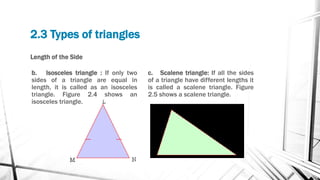
b. Isosceles triangle : If only two
sides of a triangle are equal in
length, it is called as an isosceles
triangle. Figure 2.4 shows an
isosceles triangle.
c. Scalene triangle: If all the sides
of a triangle have different lengths it
is called a scalene triangle. Figure
2.5 shows a scalene triangle.
2.3 Types of triangles
Angles
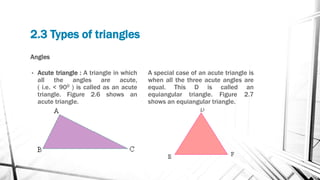
• Acute triangle : A triangle in which
all the angles are acute,
( i.e. < 900 ) is called as an acute
triangle. Figure 2.6 shows an
acute triangle.
A special case of an acute triangle is
when all the three acute angles are
equal. This D is called an
equiangular triangle. Figure 2.7
shows an equiangular triangle.
2.3 Types of triangles
Angles
b. Obtuse triangle : A triangle in
which one of the angles is obtuse is
called as an obtuse triangle. Figure
2.8 shows an obtuse triangle.
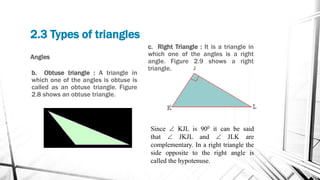
c. Right Triangle : It is a triangle in
which one of the angles is a right
angle. Figure 2.9 shows a right
triangle.
Since  KJL is 900 it can be said
that  JKJL and  JLK are
complementary. In a right triangle the
side opposite to the right angle is
called the hypotenuse.
2.4 Altitude, Median and Angle Bisector
Altitude
• An altitude is a perpendicular
dropped from one vertex to the
side ( or its extension ) opposite to
the vertex. It measures the
distance between the vertex and
the line which is the opposite side.
Since every triangle has three
vertices it has three altitudes.
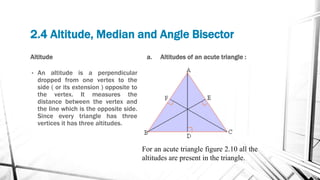
a. Altitudes of an acute triangle :
For an acute triangle figure 2.10 all the
altitudes are present in the triangle.
2.4 Altitude, Median and Angle Bisector
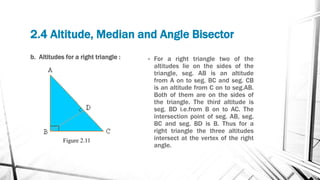
b. Altitudes for a right triangle : • For a right triangle two of the
altitudes lie on the sides of the
triangle, seg. AB is an altitude
from A on to seg. BC and seg. CB
is an altitude from C on to seg.AB.
Both of them are on the sides of
the triangle. The third altitude is
seg. BD i.e.from B on to AC. The
intersection point of seg. AB, seg.
BC and seg. BD is B. Thus for a
right triangle the three altitudes
intersect at the vertex of the right
angle.
Figure 2.11
2.4 Altitude, Median and Angle Bisector
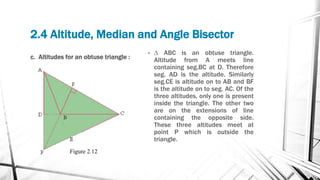
c. Altitudes for an obtuse triangle :
• D ABC is an obtuse triangle.
Altitude from A meets line
containing seg.BC at D. Therefore
seg. AD is the altitude. Similarly
seg.CE is altitude on to AB and BF
is the altitude on to seg. AC. Of the
three altitudes, only one is present
inside the triangle. The other two
are on the extensions of line
containing the opposite side.
These three altitudes meet at
point P which is outside the
triangle.
Figure 2.12
2.4 Altitude, Median and Angle Bisector
Median
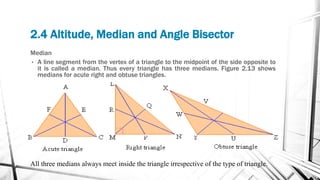
• A line segment from the vertex of a triangle to the midpoint of the side opposite to
it is called a median. Thus every triangle has three medians. Figure 2.13 shows
medians for acute right and obtuse triangles.
All three medians always meet inside the triangle irrespective of the type of triangle.
2.4 Altitude, Median and Angle Bisector
Angle Bisector
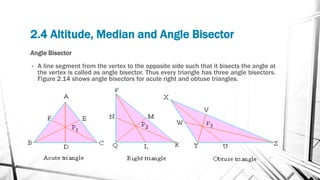
• A line segment from the vertex to the opposite side such that it bisects the angle at
the vertex is called as angle bisector. Thus every triangle has three angle bisectors.
Figure 2.14 shows angle bisectors for acute right and obtuse triangles.
2.5 Congruence of triangles
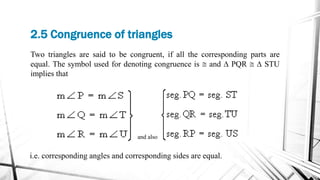
Two triangles are said to be congruent, if all the corresponding parts are
equal. The symbol used for denoting congruence is @ and D PQR @ D STU
implies that
and also
i.e. corresponding angles and corresponding sides are equal.
2.5 Congruence of triangles
S S S Postulate
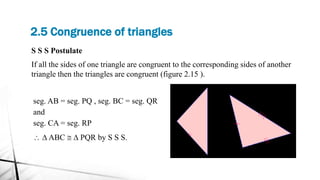
If all the sides of one triangle are congruent to the corresponding sides of another
triangle then the triangles are congruent (figure 2.15 ).
seg. AB = seg. PQ , seg. BC = seg. QR
and
seg. CA = seg. RP
 D ABC @ D PQR by S S S.
2.5 Congruence of triangles
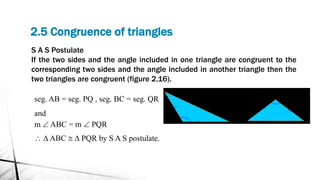
S A S Postulate
If the two sides and the angle included in one triangle are congruent to the
corresponding two sides and the angle included in another triangle then the
two triangles are congruent (figure 2.16).
seg. AB = seg. PQ , seg. BC = seg. QR
and
m  ABC = m  PQR
 D ABC @ D PQR by S A S postulate.
2.5 Congruence of triangles
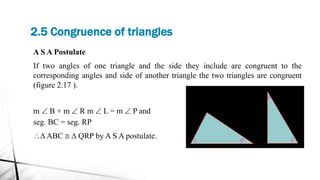
A S A Postulate
If two angles of one triangle and the side they include are congruent to the
corresponding angles and side of another triangle the two triangles are congruent
(figure 2.17 ).
m  B + m  R m  L = m  P and
seg. BC = seg. RP
D ABC @ D QRP by A S A postulate.
2.5 Congruence of triangles
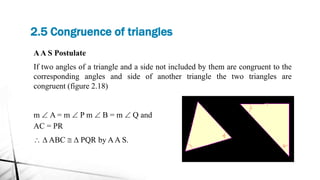
AA S Postulate
If two angles of a triangle and a side not included by them are congruent to the
corresponding angles and side of another triangle the two triangles are
congruent (figure 2.18)
m  A = m  P m  B = m  Q and
AC = PR
 D ABC @ D PQR by AA S.
2.5 Congruence of triangles
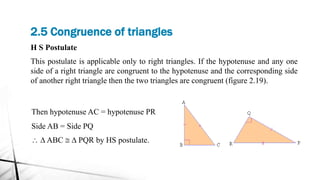
H S Postulate
This postulate is applicable only to right triangles. If the hypotenuse and any one
side of a right triangle are congruent to the hypotenuse and the corresponding side
of another right triangle then the two triangles are congruent (figure 2.19).
Then hypotenuse AC = hypotenuse PR
Side AB = Side PQ
 D ABC @ D PQR by HS postulate.
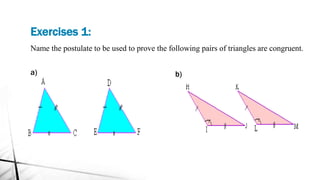
Exercises 1:
Name the postulate to be used to prove the following pairs of triangles are congruent.
a) b)
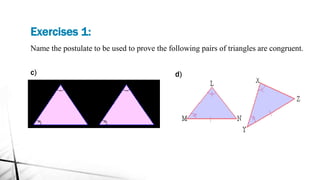
Exercises 1:
Name the postulate to be used to prove the following pairs of triangles are congruent.
c) d)
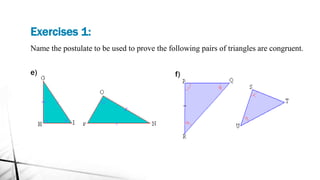
Exercises 1:
Name the postulate to be used to prove the following pairs of triangles are congruent.
e) f)
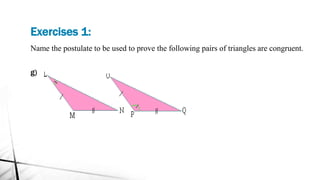
Exercises 1:
Name the postulate to be used to prove the following pairs of triangles are congruent.
g)
Example 1
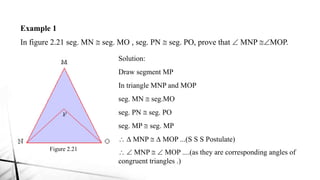
In figure 2.21 seg. MN @ seg. MO , seg. PN @ seg. PO, prove that  MNP @MOP.
Figure 2.21
Solution:
Draw segment MP
In triangle MNP and MOP
seg. MN @ seg.MO
seg. PN @ seg. PO
seg. MP @ seg. MP
 D MNP @ D MOP ...(S S S Postulate)
  MNP @  MOP ....(as they are corresponding angles of
congruent triangles .)
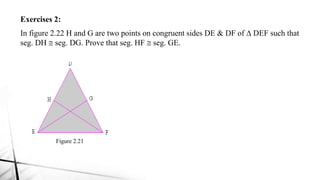
Figure 2.21
Exercises 2:
In figure 2.22 H and G are two points on congruent sides DE & DF of D DEF such that
seg. DH @ seg. DG. Prove that seg. HF @ seg. GE.
2.6 Sides opposite congruent angles
Theorem : If two sides of a triangle are equal, then the angles opposite
them are also equal. This can be proven as follows :
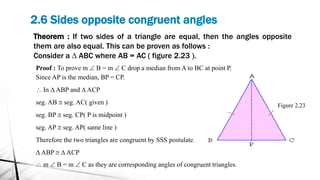
Consider a D ABC where AB = AC ( figure 2.23 ).
Figure 2.23
Proof : To prove m  B = m  C drop a median from A to BC at point P.
Since AP is the median, BP = CP.
 In D ABP and D ACP
seg. AB @ seg. AC( given )
seg. BP @ seg. CP( P is midpoint )
seg. AP @ seg. AP( same line )
Therefore the two triangles are congruent by SSS postulate.
D ABP @ D ACP
 m  B = m  C as they are corresponding angles of congruent triangles.
2.6 Sides opposite congruent angles
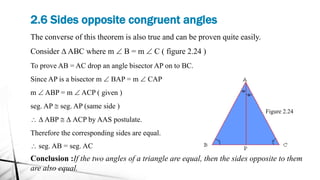
Figure 2.24
The converse of this theorem is also true and can be proven quite easily.
Consider D ABC where m  B = m  C ( figure 2.24 )
To prove AB = AC drop an angle bisector AP on to BC.
Since AP is a bisector m  BAP = m  CAP
m  ABP = m  ACP ( given )
seg. AP @ seg. AP (same side )
 D ABP @ D ACP by AAS postulate.
Therefore the corresponding sides are equal.
 seg. AB = seg. AC
Conclusion :If the two angles of a triangle are equal, then the sides opposite to them
are also equal.
 end 

C2.0 Triangles

  • 1.
  • 2.
    CHAPTER 2 :TRIANGLES 2.1 Introduction 2.2 Sum of the angles of a triangle 2.3 Types of triangles 2.4 Altitude, Median and Angle Bisector 2.5 Congruence of triangles 2.6 Sides opposite congruent angles
  • 3.
    CHAPTER 2 :TRIANGLES • 2.1 Introduction As the name triangle suggests, this geometric shape is made of three angles. It has three sides and is represented by the symbol D and is named by its vertices as shown in figure 2.1. D ABC has three sides AB, BC and CA. It has three angles  ABC,  BCA and CAB.
  • 4.
    2.2 Sum ofthe angles of a triangle • It can be proven easily that the sum of the three angles of a D is 1800 CHAPTER 2 : TRIANGLES Figure 2.2 D ABC in figure 2.2 is a triangle with line l parallel to seg. BC and passing through A. seg. AB is a transversal on two parallel lines seg. PQ and seg.BC. Hence m  PAB and m ABC are equal as they are alternate interior angles. Similarly m  QAC = m ACB. Now  PAQ = m  PAB + m  BAC + m  CAQ i.e. 1800 = m  ABC + m  BAC + m  ACB m  PAQ = 1800 because it is a straight line. Thus the sum, of the measures of the three angles, of any triangle, is 1800.
  • 5.
    2.3 Types oftriangles • Triangles are classified into various types, using two different parameters - the lengths of their sides and the measure of their angles. • Length of the Side a. Equilateral triangle : If the lengths of all three sides of the triangle are equal, then it is called an equilateral triangle. Figure 2.3 shows an equilateral triangle. Figure 2.3
  • 6.
    Length of theSide b. Isosceles triangle : If only two sides of a triangle are equal in length, it is called as an isosceles triangle. Figure 2.4 shows an isosceles triangle. c. Scalene triangle: If all the sides of a triangle have different lengths it is called a scalene triangle. Figure 2.5 shows a scalene triangle. 2.3 Types of triangles
  • 7.
    Angles • Acute triangle: A triangle in which all the angles are acute, ( i.e. < 900 ) is called as an acute triangle. Figure 2.6 shows an acute triangle. A special case of an acute triangle is when all the three acute angles are equal. This D is called an equiangular triangle. Figure 2.7 shows an equiangular triangle. 2.3 Types of triangles
  • 8.
    2.3 Types oftriangles Angles b. Obtuse triangle : A triangle in which one of the angles is obtuse is called as an obtuse triangle. Figure 2.8 shows an obtuse triangle. c. Right Triangle : It is a triangle in which one of the angles is a right angle. Figure 2.9 shows a right triangle. Since  KJL is 900 it can be said that  JKJL and  JLK are complementary. In a right triangle the side opposite to the right angle is called the hypotenuse.
  • 9.
    2.4 Altitude, Medianand Angle Bisector Altitude • An altitude is a perpendicular dropped from one vertex to the side ( or its extension ) opposite to the vertex. It measures the distance between the vertex and the line which is the opposite side. Since every triangle has three vertices it has three altitudes. a. Altitudes of an acute triangle : For an acute triangle figure 2.10 all the altitudes are present in the triangle.
  • 10.
    2.4 Altitude, Medianand Angle Bisector b. Altitudes for a right triangle : • For a right triangle two of the altitudes lie on the sides of the triangle, seg. AB is an altitude from A on to seg. BC and seg. CB is an altitude from C on to seg.AB. Both of them are on the sides of the triangle. The third altitude is seg. BD i.e.from B on to AC. The intersection point of seg. AB, seg. BC and seg. BD is B. Thus for a right triangle the three altitudes intersect at the vertex of the right angle. Figure 2.11
  • 11.
    2.4 Altitude, Medianand Angle Bisector c. Altitudes for an obtuse triangle : • D ABC is an obtuse triangle. Altitude from A meets line containing seg.BC at D. Therefore seg. AD is the altitude. Similarly seg.CE is altitude on to AB and BF is the altitude on to seg. AC. Of the three altitudes, only one is present inside the triangle. The other two are on the extensions of line containing the opposite side. These three altitudes meet at point P which is outside the triangle. Figure 2.12
  • 12.
    2.4 Altitude, Medianand Angle Bisector Median • A line segment from the vertex of a triangle to the midpoint of the side opposite to it is called a median. Thus every triangle has three medians. Figure 2.13 shows medians for acute right and obtuse triangles. All three medians always meet inside the triangle irrespective of the type of triangle.
  • 13.
    2.4 Altitude, Medianand Angle Bisector Angle Bisector • A line segment from the vertex to the opposite side such that it bisects the angle at the vertex is called as angle bisector. Thus every triangle has three angle bisectors. Figure 2.14 shows angle bisectors for acute right and obtuse triangles.
  • 14.
    2.5 Congruence oftriangles Two triangles are said to be congruent, if all the corresponding parts are equal. The symbol used for denoting congruence is @ and D PQR @ D STU implies that and also i.e. corresponding angles and corresponding sides are equal.
  • 15.
    2.5 Congruence oftriangles S S S Postulate If all the sides of one triangle are congruent to the corresponding sides of another triangle then the triangles are congruent (figure 2.15 ). seg. AB = seg. PQ , seg. BC = seg. QR and seg. CA = seg. RP D ABC @ D PQR by S S S.
  • 16.
    2.5 Congruence oftriangles S A S Postulate If the two sides and the angle included in one triangle are congruent to the corresponding two sides and the angle included in another triangle then the two triangles are congruent (figure 2.16). seg. AB = seg. PQ , seg. BC = seg. QR and m  ABC = m  PQR D ABC @ D PQR by S A S postulate.
  • 17.
    2.5 Congruence oftriangles A S A Postulate If two angles of one triangle and the side they include are congruent to the corresponding angles and side of another triangle the two triangles are congruent (figure 2.17 ). m  B + m  R m  L = m  P and seg. BC = seg. RP D ABC @ D QRP by A S A postulate.
  • 18.
    2.5 Congruence oftriangles AA S Postulate If two angles of a triangle and a side not included by them are congruent to the corresponding angles and side of another triangle the two triangles are congruent (figure 2.18) m  A = m  P m  B = m  Q and AC = PR D ABC @ D PQR by AA S.
  • 19.
    2.5 Congruence oftriangles H S Postulate This postulate is applicable only to right triangles. If the hypotenuse and any one side of a right triangle are congruent to the hypotenuse and the corresponding side of another right triangle then the two triangles are congruent (figure 2.19). Then hypotenuse AC = hypotenuse PR Side AB = Side PQ D ABC @ D PQR by HS postulate.
  • 20.
    Exercises 1: Name thepostulate to be used to prove the following pairs of triangles are congruent. a) b)
  • 21.
    Exercises 1: Name thepostulate to be used to prove the following pairs of triangles are congruent. c) d)
  • 22.
    Exercises 1: Name thepostulate to be used to prove the following pairs of triangles are congruent. e) f)
  • 23.
    Exercises 1: Name thepostulate to be used to prove the following pairs of triangles are congruent. g)
  • 24.
    Example 1 In figure2.21 seg. MN @ seg. MO , seg. PN @ seg. PO, prove that  MNP @MOP. Figure 2.21 Solution: Draw segment MP In triangle MNP and MOP seg. MN @ seg.MO seg. PN @ seg. PO seg. MP @ seg. MP D MNP @ D MOP ...(S S S Postulate)  MNP @  MOP ....(as they are corresponding angles of congruent triangles .)
  • 25.
    Figure 2.21 Exercises 2: Infigure 2.22 H and G are two points on congruent sides DE & DF of D DEF such that seg. DH @ seg. DG. Prove that seg. HF @ seg. GE.
  • 26.
    2.6 Sides oppositecongruent angles Theorem : If two sides of a triangle are equal, then the angles opposite them are also equal. This can be proven as follows : Consider a D ABC where AB = AC ( figure 2.23 ). Figure 2.23 Proof : To prove m  B = m  C drop a median from A to BC at point P. Since AP is the median, BP = CP. In D ABP and D ACP seg. AB @ seg. AC( given ) seg. BP @ seg. CP( P is midpoint ) seg. AP @ seg. AP( same line ) Therefore the two triangles are congruent by SSS postulate. D ABP @ D ACP m  B = m  C as they are corresponding angles of congruent triangles.
  • 27.
    2.6 Sides oppositecongruent angles Figure 2.24 The converse of this theorem is also true and can be proven quite easily. Consider D ABC where m  B = m  C ( figure 2.24 ) To prove AB = AC drop an angle bisector AP on to BC. Since AP is a bisector m  BAP = m  CAP m  ABP = m  ACP ( given ) seg. AP @ seg. AP (same side ) D ABP @ D ACP by AAS postulate. Therefore the corresponding sides are equal. seg. AB = seg. AC Conclusion :If the two angles of a triangle are equal, then the sides opposite to them are also equal.
  • 28.