Polygons
Chapter 3 Polygons
3.1 Definition
3.2 Terminology
3.3 Sum Of Interior Angles Of A Polygon
3.4 Sum Of Exterior Angles Of A Polygon
3.5 Diagonals in one vertex of any Polygon
3.6 Diagonals in any vertices of a Polygon
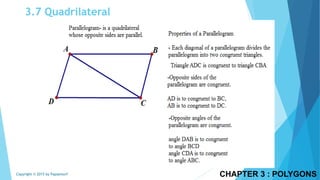
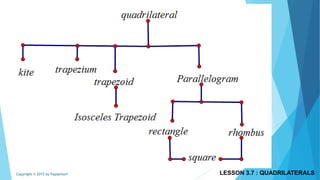
3.7 Quadrilaterals
Copyright © 2015 by Papasmurf
Polygons
3.1 Definition
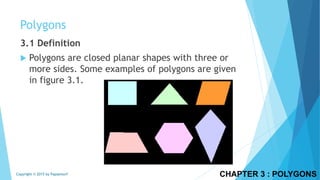
 Polygons are closed planar shapes with three or
more sides. Some examples of polygons are given
in figure 3.1.
CHAPTER 3 : POLYGONSCopyright © 2015 by Papasmurf
3.2 Terminology
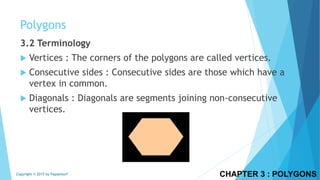
 Vertices : The corners of the polygons are called vertices.
 Consecutive sides : Consecutive sides are those which have a
vertex in common.
 Diagonals : Diagonals are segments joining non-consecutive
vertices.
CHAPTER 3 : POLYGONSCopyright © 2015 by Papasmurf
Polygons
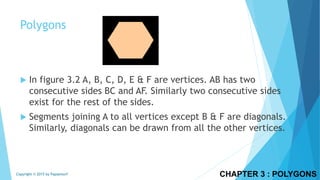
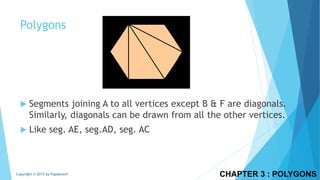
 In figure 3.2 A, B, C, D, E & F are vertices. AB has two
consecutive sides BC and AF. Similarly two consecutive sides
exist for the rest of the sides.
 Segments joining A to all vertices except B & F are diagonals.
Similarly, diagonals can be drawn from all the other vertices.
CHAPTER 3 : POLYGONSCopyright © 2015 by Papasmurf
Polygons
CHAPTER 3 : POLYGONSCopyright © 2015 by Papasmurf
 Segments joining A to all vertices except B & F are diagonals.
Similarly, diagonals can be drawn from all the other vertices.
 Like seg. AE, seg.AD, seg. AC
Polygons
3.3 Sum of Interior angles of a Polygon
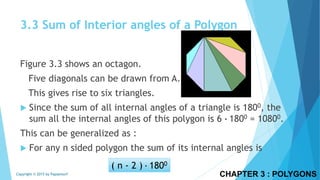
Figure 3.3 shows an octagon.
Five diagonals can be drawn from A.
This gives rise to six triangles.
 Since the sum of all internal angles of a triangle is 1800, the
sum all the internal angles of this polygon is 6 ∙ 1800 = 10800.
This can be generalized as :
 For any n sided polygon the sum of its internal angles is
CHAPTER 3 : POLYGONSCopyright © 2015 by Papasmurf
( n - 2 ) ∙ 1800
3.4 Sum of exterior angles of a Polygon
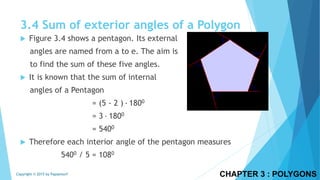
 Figure 3.4 shows a pentagon. Its external
angles are named from a to e. The aim is
to find the sum of these five angles.
 It is known that the sum of internal
angles of a Pentagon
= (5 - 2 ) ∙ 1800
= 3 ∙ 1800
= 5400
 Therefore each interior angle of the pentagon measures
5400 / 5 = 1080
CHAPTER 3 : POLYGONSCopyright © 2015 by Papasmurf
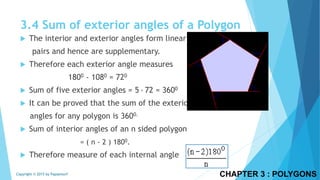
 The interior and exterior angles form linear
pairs and hence are supplementary.
 Therefore each exterior angle measures
1800 - 1080 = 720
 Sum of five exterior angles = 5 ∙ 72 = 3600
 It can be proved that the sum of the exterior a
angles for any polygon is 3600.
 Sum of interior angles of an n sided polygon
= ( n - 2 ) 1800.
 Therefore measure of each internal angle
CHAPTER 3 : POLYGONSCopyright © 2015 by Papasmurf
3.4 Sum of exterior angles of a Polygon
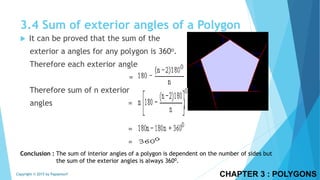
 It can be proved that the sum of the
exterior a angles for any polygon is 360o.
Therefore each exterior angle
=
Therefore sum of n exterior
angles =
=
=
CHAPTER 3 : POLYGONSCopyright © 2015 by Papasmurf
3.4 Sum of exterior angles of a Polygon
Conclusion : The sum of interior angles of a polygon is dependent on the number of sides but
the sum of the exterior angles is always 3600.
Example 1
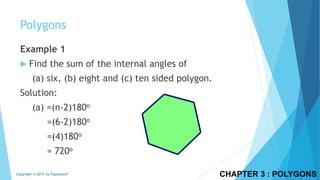
 Find the sum of the internal angles of
(a) six, (b) eight and (c) ten sided polygon.
Solution:
(a) =(n-2)180o
=(6-2)180o
=(4)180o
= 720o
CHAPTER 3 : POLYGONSCopyright © 2015 by Papasmurf
Polygons
CHAPTER 3 : POLYGONSCopyright © 2015 by Papasmurf
Example 1
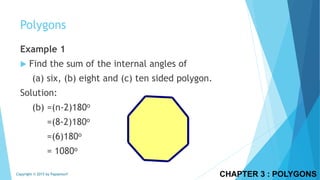
 Find the sum of the internal angles of
(a) six, (b) eight and (c) ten sided polygon.
Solution:
(b) =(n-2)180o
=(8-2)180o
=(6)180o
= 1080o
Polygons
CHAPTER 3 : POLYGONSCopyright © 2015 by Papasmurf
Example 1
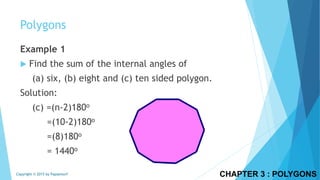
 Find the sum of the internal angles of
(a) six, (b) eight and (c) ten sided polygon.
Solution:
(c) =(n-2)180o
=(10-2)180o
=(8)180o
= 1440o
Polygons
CHAPTER 3 : POLYGONSCopyright © 2015 by Papasmurf
Example 2
 Find the sum of the external angles of a twelve
sided polygon.
 Answer
360o.
Note: The sum of the exterior angles of any n-sided polygon
is always 3600.
CHAPTER 3 : POLYGONSCopyright © 2015 by Papasmurf
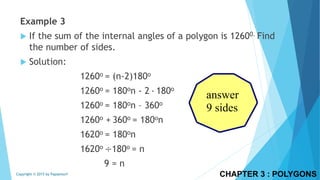
Example 3
 If the sum of the internal angles of a polygon is 12600. Find
the number of sides.
 Solution:
1260o = (n-2)180o
1260o = 180on - 2 ∙ 180o
1260o = 180on – 360o
1260o + 360o = 180on
1620o = 180on
1620o ÷180o = n
9 = n
answer
9 sides
CHAPTER 3 : POLYGONSCopyright © 2015 by Papasmurf
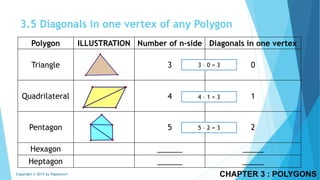
3.5 Diagonals in one vertex of any Polygon
Polygon ILLUSTRATION Number of n-side Diagonals in one vertex
Triangle 3 0
Quadrilateral 4 1
Pentagon 5 2
Hexagon ______ _____
Heptagon ______ _____
3 – 0 = 3
4 – 1 = 3
5 – 2 = 3
CHAPTER 3 : POLYGONSCopyright © 2015 by Papasmurf
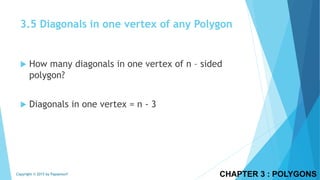
 How many diagonals in one vertex of n – sided
polygon?
 Diagonals in one vertex = n - 3
3.5 Diagonals in one vertex of any Polygon
CHAPTER 3 : POLYGONSCopyright © 2015 by Papasmurf
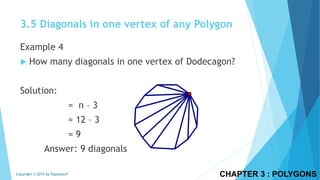
Example 4
 How many diagonals in one vertex of Dodecagon?
Solution:
= n – 3
= 12 – 3
= 9
Answer: 9 diagonals
3.5 Diagonals in one vertex of any Polygon
CHAPTER 3 : POLYGONSCopyright © 2015 by Papasmurf
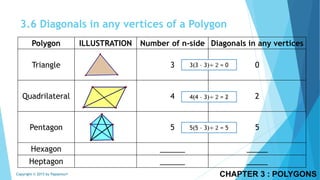
3.6 Diagonals in any vertices of a Polygon
Polygon ILLUSTRATION Number of n-side Diagonals in any vertices
Triangle 3 0
Quadrilateral 4 2
Pentagon 5 5
Hexagon ______ _____
Heptagon ______ _____
3(3 – 3)÷ 2 = 0
4(4 – 3)÷ 2 = 2
5(5 – 3)÷ 2 = 5
CHAPTER 3 : POLYGONSCopyright © 2015 by Papasmurf
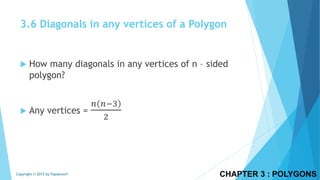
 How many diagonals in any vertices of n – sided
polygon?
 Any vertices =
𝑛 𝑛−3
2
3.6 Diagonals in any vertices of a Polygon
CHAPTER 3 : POLYGONSCopyright © 2015 by Papasmurf
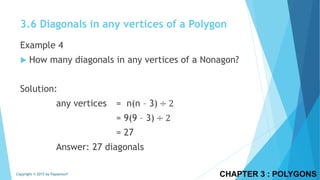
Example 4
 How many diagonals in any vertices of a Nonagon?
Solution:
any vertices = n(n – 3) ÷ 2
= 9(9 – 3) ÷ 2
= 27
Answer: 27 diagonals
3.6 Diagonals in any vertices of a Polygon
CHAPTER 3 : POLYGONSCopyright © 2015 by Papasmurf
3.7 Quadrilateral
LESSON 3.7 : QUADRILATERALSCopyright © 2015 by Papasmurf
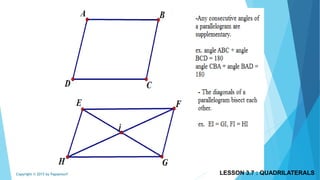
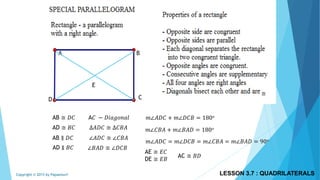
A B
CD
AB ≅ 𝐷𝐶
AD ≅ 𝐵𝐶
AB ∥ 𝐷𝐶
AD ∥ 𝐵𝐶
A𝐶 − 𝐷𝑖𝑎𝑔𝑜𝑛𝑎𝑙
∆𝐴𝐷𝐶 ≅ ∆𝐶𝐵𝐴
∠𝐴𝐷𝐶 ≅ ∠𝐶𝐵𝐴
∠𝐵𝐴𝐷 ≅ ∠𝐷𝐶𝐵
≅
𝑚∠𝐴𝐷𝐶 + 𝑚∠𝐷𝐶𝐵 = 180 𝑜
𝑚∠𝐶𝐵𝐴 + 𝑚∠𝐵𝐴𝐷 = 180 𝑜
𝑚∠𝐴𝐷𝐶 = 𝑚∠𝐷𝐶𝐵 = 𝑚∠𝐶𝐵𝐴 = 𝑚∠𝐵𝐴𝐷 = 90 𝑜
E
AE ≅ 𝐸𝐶
DE ≅ 𝐸𝐵
AC ≅ 𝐵𝐷
LESSON 3.7 : QUADRILATERALSCopyright © 2015 by Papasmurf
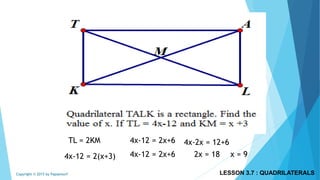
TL = 2KM
4x-12 = 2(x+3)
4x-12 = 2x+6
4x-12 = 2x+6
4x-2x = 12+6
2x = 18 x = 9
LESSON 3.7 : QUADRILATERALSCopyright © 2015 by Papasmurf
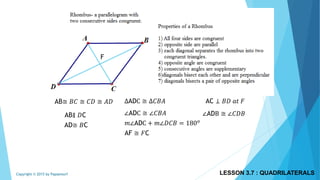
AB≅ 𝐵𝐶 ≅ 𝐶𝐷 ≅ 𝐴𝐷
AB∥ 𝐷C
AD≅ 𝐵C
ΔADC ≅ Δ𝐶𝐵𝐴
∠ADC ≅ ∠𝐶𝐵𝐴
𝑚∠ADC + 𝑚∠𝐷𝐶𝐵 = 180 𝑜
F
AF ≅ 𝐹C
AC ⊥ 𝐵𝐷 𝑎𝑡 𝐹
∠ADB ≅ ∠𝐶𝐷𝐵
LESSON 3.7 : QUADRILATERALSCopyright © 2015 by Papasmurf
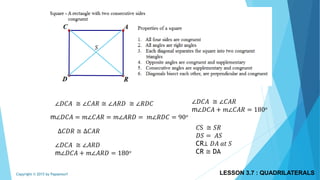
∠𝐷𝐶𝐴 ≅ ∠𝐶𝐴𝑅 ≅ ∠𝐴𝑅𝐷 ≅ ∠𝑅𝐷𝐶
m∠𝐷𝐶𝐴 = 𝑚∠𝐶𝐴𝑅 = 𝑚∠𝐴𝑅𝐷 = 𝑚∠𝑅𝐷𝐶 = 90 𝑜
∆𝐶𝐷𝑅 ≅ ∆𝐶𝐴𝑅
∠𝐷𝐶𝐴 ≅ ∠𝐶𝐴𝑅
m∠𝐷𝐶𝐴 + 𝑚∠𝐶𝐴𝑅 = 180 𝑜
∠𝐷𝐶𝐴 ≅ ∠𝐴𝑅𝐷
m∠𝐷𝐶𝐴 + 𝑚∠𝐴𝑅𝐷 = 180 𝑜
𝐶S ≅ 𝑆𝑅
𝐷𝑆 = 𝐴𝑆
CR⊥ 𝐷𝐴 𝑎𝑡 𝑆
CR ≅ DA
𝑆
LESSON 3.7 : QUADRILATERALSCopyright © 2015 by Papasmurf
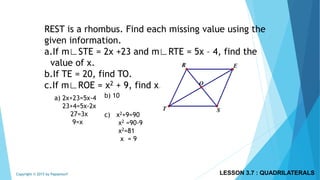
REST is a rhombus. Find each missing value using the
given information.
a.If m∟STE = 2x +23 and m∟RTE = 5x – 4, find the
value of x.
b.If TE = 20, find TO.
c.If m∟ROE = x2 + 9, find x.
a) 2x+23=5x-4
23+4=5x-2x
27=3x
9=x
b) 10
c) x2+9=90
x2 =90-9
x2=81
x = 9
LESSON 3.7 : QUADRILATERALSCopyright © 2015 by Papasmurf
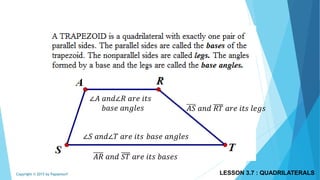
𝐴𝑅 𝑎𝑛𝑑 𝑆𝑇 𝑎𝑟𝑒 𝑖𝑡𝑠 𝑏𝑎𝑠𝑒𝑠
𝐴𝑆 𝑎𝑛𝑑 𝑅𝑇 𝑎𝑟𝑒 𝑖𝑡𝑠 𝑙𝑒𝑔𝑠
∠𝐴 𝑎𝑛𝑑∠𝑅 𝑎𝑟𝑒 𝑖𝑡𝑠
𝑏𝑎𝑠𝑒 𝑎𝑛𝑔𝑙𝑒𝑠
∠𝑆 𝑎𝑛𝑑∠𝑇 𝑎𝑟𝑒 𝑖𝑡𝑠 𝑏𝑎𝑠𝑒 𝑎𝑛𝑔𝑙𝑒𝑠
LESSON 3.7 : QUADRILATERALSCopyright © 2015 by Papasmurf
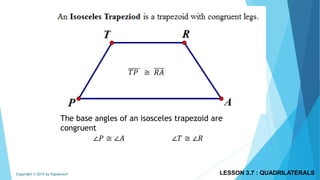
The base angles of an isosceles trapezoid are
congruent
𝑇𝑃 ≅ 𝑅𝐴
∠𝑃 ≅ ∠𝐴 ∠𝑇 ≅ ∠𝑅
LESSON 3.7 : QUADRILATERALSCopyright © 2015 by Papasmurf
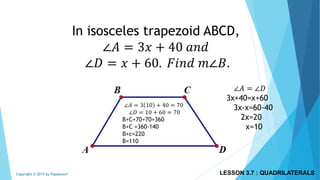
In isosceles trapezoid ABCD,
∠𝐴 = 3𝑥 + 40 𝑎𝑛𝑑
∠𝐷 = 𝑥 + 60. 𝐹𝑖𝑛𝑑 𝑚∠𝐵.
∠𝐴 = ∠𝐷
3x+40=x+60
3x-x=60-40
2x=20
x=10
∠𝐴 = 3 10 + 40 = 70
∠𝐷 = 10 + 60 = 70
B+C+70+70=360
B+C =360-140
B+c=220
B=110
LESSON 3.7 : QUADRILATERALSCopyright © 2015 by Papasmurf
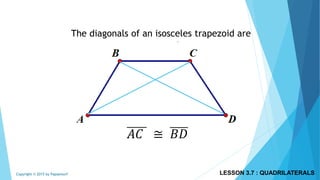
The diagonals of an isosceles trapezoid are
congruent.
𝐴𝐶 ≅ 𝐵𝐷
LESSON 3.7 : QUADRILATERALSCopyright © 2015 by Papasmurf
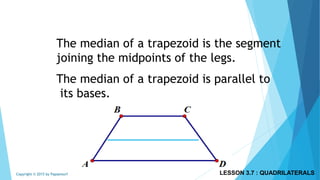
The median of a trapezoid is the segment
joining the midpoints of the legs.
The median of a trapezoid is parallel to
its bases.
LESSON 3.7 : QUADRILATERALSCopyright © 2015 by Papasmurf
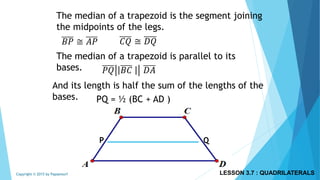
The median of a trapezoid is the segment joining
the midpoints of the legs.
The median of a trapezoid is parallel to its
bases.
P Q
𝐵𝑃 ≅ 𝐴𝑃 𝐶𝑄 ≅ 𝐷𝑄
𝑃𝑄 𝐵𝐶 𝐷𝐴
And its length is half the sum of the lengths of the
bases. PQ = ½ (BC + AD )
LESSON 3.7 : QUADRILATERALSCopyright © 2015 by Papasmurf
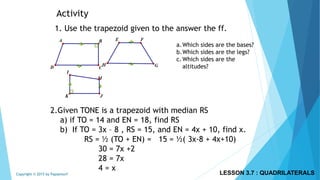
Activity
1. Use the trapezoid given to the answer the ff.
a.Which sides are the bases?
b.Which sides are the legs?
c.Which sides are the
altitudes?
2.Given TONE is a trapezoid with median RS
a) if TO = 14 and EN = 18, find RS
b) If TO = 3x – 8 , RS = 15, and EN = 4x + 10, find x.
RS = ½ (TO + EN) = 15 = ½( 3x-8 + 4x+10)
30 = 7x +2
28 = 7x
4 = x
LESSON 3.7 : QUADRILATERALSCopyright © 2015 by Papasmurf
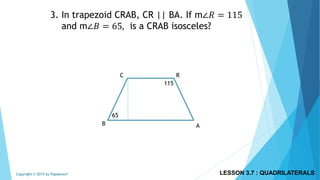
3. In trapezoid CRAB, CR || BA. If m∠𝑅 = 115
and m∠𝐵 = 65, is a CRAB isosceles?
C R
B A
115
65
LESSON 3.7 : QUADRILATERALSCopyright © 2015 by Papasmurf
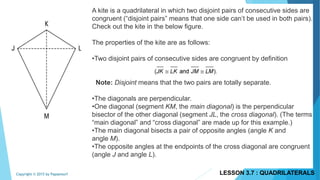
A kite is a quadrilateral in which two disjoint pairs of consecutive sides are
congruent (“disjoint pairs” means that one side can’t be used in both pairs).
Check out the kite in the below figure.
The properties of the kite are as follows:
•Two disjoint pairs of consecutive sides are congruent by definition
Note: Disjoint means that the two pairs are totally separate.
•The diagonals are perpendicular.
•One diagonal (segment KM, the main diagonal) is the perpendicular
bisector of the other diagonal (segment JL, the cross diagonal). (The terms
“main diagonal” and “cross diagonal” are made up for this example.)
•The main diagonal bisects a pair of opposite angles (angle K and
angle M).
•The opposite angles at the endpoints of the cross diagonal are congruent
(angle J and angle L).
LESSON 3.7 : QUADRILATERALSCopyright © 2015 by Papasmurf
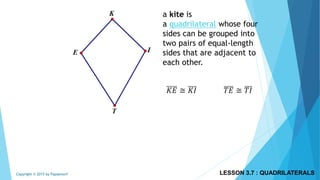
a kite is
a quadrilateral whose four
sides can be grouped into
two pairs of equal-length
sides that are adjacent to
each other.
𝐾𝐸 ≅ 𝐾𝐼 𝑇𝐸 ≅ 𝑇𝐼
LESSON 3.7 : QUADRILATERALSCopyright © 2015 by Papasmurf

Polygons

  • 1.
    Polygons Chapter 3 Polygons 3.1Definition 3.2 Terminology 3.3 Sum Of Interior Angles Of A Polygon 3.4 Sum Of Exterior Angles Of A Polygon 3.5 Diagonals in one vertex of any Polygon 3.6 Diagonals in any vertices of a Polygon 3.7 Quadrilaterals Copyright © 2015 by Papasmurf
  • 2.
    Polygons 3.1 Definition  Polygonsare closed planar shapes with three or more sides. Some examples of polygons are given in figure 3.1. CHAPTER 3 : POLYGONSCopyright © 2015 by Papasmurf
  • 3.
    3.2 Terminology  Vertices: The corners of the polygons are called vertices.  Consecutive sides : Consecutive sides are those which have a vertex in common.  Diagonals : Diagonals are segments joining non-consecutive vertices. CHAPTER 3 : POLYGONSCopyright © 2015 by Papasmurf Polygons
  • 4.
     In figure3.2 A, B, C, D, E & F are vertices. AB has two consecutive sides BC and AF. Similarly two consecutive sides exist for the rest of the sides.  Segments joining A to all vertices except B & F are diagonals. Similarly, diagonals can be drawn from all the other vertices. CHAPTER 3 : POLYGONSCopyright © 2015 by Papasmurf Polygons
  • 5.
    CHAPTER 3 :POLYGONSCopyright © 2015 by Papasmurf  Segments joining A to all vertices except B & F are diagonals. Similarly, diagonals can be drawn from all the other vertices.  Like seg. AE, seg.AD, seg. AC Polygons
  • 6.
    3.3 Sum ofInterior angles of a Polygon Figure 3.3 shows an octagon. Five diagonals can be drawn from A. This gives rise to six triangles.  Since the sum of all internal angles of a triangle is 1800, the sum all the internal angles of this polygon is 6 ∙ 1800 = 10800. This can be generalized as :  For any n sided polygon the sum of its internal angles is CHAPTER 3 : POLYGONSCopyright © 2015 by Papasmurf ( n - 2 ) ∙ 1800
  • 7.
    3.4 Sum ofexterior angles of a Polygon  Figure 3.4 shows a pentagon. Its external angles are named from a to e. The aim is to find the sum of these five angles.  It is known that the sum of internal angles of a Pentagon = (5 - 2 ) ∙ 1800 = 3 ∙ 1800 = 5400  Therefore each interior angle of the pentagon measures 5400 / 5 = 1080 CHAPTER 3 : POLYGONSCopyright © 2015 by Papasmurf
  • 8.
     The interiorand exterior angles form linear pairs and hence are supplementary.  Therefore each exterior angle measures 1800 - 1080 = 720  Sum of five exterior angles = 5 ∙ 72 = 3600  It can be proved that the sum of the exterior a angles for any polygon is 3600.  Sum of interior angles of an n sided polygon = ( n - 2 ) 1800.  Therefore measure of each internal angle CHAPTER 3 : POLYGONSCopyright © 2015 by Papasmurf 3.4 Sum of exterior angles of a Polygon
  • 9.
     It canbe proved that the sum of the exterior a angles for any polygon is 360o. Therefore each exterior angle = Therefore sum of n exterior angles = = = CHAPTER 3 : POLYGONSCopyright © 2015 by Papasmurf 3.4 Sum of exterior angles of a Polygon Conclusion : The sum of interior angles of a polygon is dependent on the number of sides but the sum of the exterior angles is always 3600.
  • 10.
    Example 1  Findthe sum of the internal angles of (a) six, (b) eight and (c) ten sided polygon. Solution: (a) =(n-2)180o =(6-2)180o =(4)180o = 720o CHAPTER 3 : POLYGONSCopyright © 2015 by Papasmurf Polygons
  • 11.
    CHAPTER 3 :POLYGONSCopyright © 2015 by Papasmurf Example 1  Find the sum of the internal angles of (a) six, (b) eight and (c) ten sided polygon. Solution: (b) =(n-2)180o =(8-2)180o =(6)180o = 1080o Polygons
  • 12.
    CHAPTER 3 :POLYGONSCopyright © 2015 by Papasmurf Example 1  Find the sum of the internal angles of (a) six, (b) eight and (c) ten sided polygon. Solution: (c) =(n-2)180o =(10-2)180o =(8)180o = 1440o Polygons
  • 13.
    CHAPTER 3 :POLYGONSCopyright © 2015 by Papasmurf Example 2  Find the sum of the external angles of a twelve sided polygon.  Answer 360o. Note: The sum of the exterior angles of any n-sided polygon is always 3600.
  • 14.
    CHAPTER 3 :POLYGONSCopyright © 2015 by Papasmurf Example 3  If the sum of the internal angles of a polygon is 12600. Find the number of sides.  Solution: 1260o = (n-2)180o 1260o = 180on - 2 ∙ 180o 1260o = 180on – 360o 1260o + 360o = 180on 1620o = 180on 1620o ÷180o = n 9 = n answer 9 sides
  • 15.
    CHAPTER 3 :POLYGONSCopyright © 2015 by Papasmurf 3.5 Diagonals in one vertex of any Polygon Polygon ILLUSTRATION Number of n-side Diagonals in one vertex Triangle 3 0 Quadrilateral 4 1 Pentagon 5 2 Hexagon ______ _____ Heptagon ______ _____ 3 – 0 = 3 4 – 1 = 3 5 – 2 = 3
  • 16.
    CHAPTER 3 :POLYGONSCopyright © 2015 by Papasmurf  How many diagonals in one vertex of n – sided polygon?  Diagonals in one vertex = n - 3 3.5 Diagonals in one vertex of any Polygon
  • 17.
    CHAPTER 3 :POLYGONSCopyright © 2015 by Papasmurf Example 4  How many diagonals in one vertex of Dodecagon? Solution: = n – 3 = 12 – 3 = 9 Answer: 9 diagonals 3.5 Diagonals in one vertex of any Polygon
  • 18.
    CHAPTER 3 :POLYGONSCopyright © 2015 by Papasmurf 3.6 Diagonals in any vertices of a Polygon Polygon ILLUSTRATION Number of n-side Diagonals in any vertices Triangle 3 0 Quadrilateral 4 2 Pentagon 5 5 Hexagon ______ _____ Heptagon ______ _____ 3(3 – 3)÷ 2 = 0 4(4 – 3)÷ 2 = 2 5(5 – 3)÷ 2 = 5
  • 19.
    CHAPTER 3 :POLYGONSCopyright © 2015 by Papasmurf  How many diagonals in any vertices of n – sided polygon?  Any vertices = 𝑛 𝑛−3 2 3.6 Diagonals in any vertices of a Polygon
  • 20.
    CHAPTER 3 :POLYGONSCopyright © 2015 by Papasmurf Example 4  How many diagonals in any vertices of a Nonagon? Solution: any vertices = n(n – 3) ÷ 2 = 9(9 – 3) ÷ 2 = 27 Answer: 27 diagonals 3.6 Diagonals in any vertices of a Polygon
  • 21.
    CHAPTER 3 :POLYGONSCopyright © 2015 by Papasmurf 3.7 Quadrilateral
  • 22.
    LESSON 3.7 :QUADRILATERALSCopyright © 2015 by Papasmurf
  • 23.
    LESSON 3.7 :QUADRILATERALSCopyright © 2015 by Papasmurf
  • 24.
    A B CD AB ≅𝐷𝐶 AD ≅ 𝐵𝐶 AB ∥ 𝐷𝐶 AD ∥ 𝐵𝐶 A𝐶 − 𝐷𝑖𝑎𝑔𝑜𝑛𝑎𝑙 ∆𝐴𝐷𝐶 ≅ ∆𝐶𝐵𝐴 ∠𝐴𝐷𝐶 ≅ ∠𝐶𝐵𝐴 ∠𝐵𝐴𝐷 ≅ ∠𝐷𝐶𝐵 ≅ 𝑚∠𝐴𝐷𝐶 + 𝑚∠𝐷𝐶𝐵 = 180 𝑜 𝑚∠𝐶𝐵𝐴 + 𝑚∠𝐵𝐴𝐷 = 180 𝑜 𝑚∠𝐴𝐷𝐶 = 𝑚∠𝐷𝐶𝐵 = 𝑚∠𝐶𝐵𝐴 = 𝑚∠𝐵𝐴𝐷 = 90 𝑜 E AE ≅ 𝐸𝐶 DE ≅ 𝐸𝐵 AC ≅ 𝐵𝐷 LESSON 3.7 : QUADRILATERALSCopyright © 2015 by Papasmurf
  • 25.
    TL = 2KM 4x-12= 2(x+3) 4x-12 = 2x+6 4x-12 = 2x+6 4x-2x = 12+6 2x = 18 x = 9 LESSON 3.7 : QUADRILATERALSCopyright © 2015 by Papasmurf
  • 26.
    AB≅ 𝐵𝐶 ≅𝐶𝐷 ≅ 𝐴𝐷 AB∥ 𝐷C AD≅ 𝐵C ΔADC ≅ Δ𝐶𝐵𝐴 ∠ADC ≅ ∠𝐶𝐵𝐴 𝑚∠ADC + 𝑚∠𝐷𝐶𝐵 = 180 𝑜 F AF ≅ 𝐹C AC ⊥ 𝐵𝐷 𝑎𝑡 𝐹 ∠ADB ≅ ∠𝐶𝐷𝐵 LESSON 3.7 : QUADRILATERALSCopyright © 2015 by Papasmurf
  • 27.
    ∠𝐷𝐶𝐴 ≅ ∠𝐶𝐴𝑅≅ ∠𝐴𝑅𝐷 ≅ ∠𝑅𝐷𝐶 m∠𝐷𝐶𝐴 = 𝑚∠𝐶𝐴𝑅 = 𝑚∠𝐴𝑅𝐷 = 𝑚∠𝑅𝐷𝐶 = 90 𝑜 ∆𝐶𝐷𝑅 ≅ ∆𝐶𝐴𝑅 ∠𝐷𝐶𝐴 ≅ ∠𝐶𝐴𝑅 m∠𝐷𝐶𝐴 + 𝑚∠𝐶𝐴𝑅 = 180 𝑜 ∠𝐷𝐶𝐴 ≅ ∠𝐴𝑅𝐷 m∠𝐷𝐶𝐴 + 𝑚∠𝐴𝑅𝐷 = 180 𝑜 𝐶S ≅ 𝑆𝑅 𝐷𝑆 = 𝐴𝑆 CR⊥ 𝐷𝐴 𝑎𝑡 𝑆 CR ≅ DA 𝑆 LESSON 3.7 : QUADRILATERALSCopyright © 2015 by Papasmurf
  • 28.
    REST is arhombus. Find each missing value using the given information. a.If m∟STE = 2x +23 and m∟RTE = 5x – 4, find the value of x. b.If TE = 20, find TO. c.If m∟ROE = x2 + 9, find x. a) 2x+23=5x-4 23+4=5x-2x 27=3x 9=x b) 10 c) x2+9=90 x2 =90-9 x2=81 x = 9 LESSON 3.7 : QUADRILATERALSCopyright © 2015 by Papasmurf
  • 29.
    𝐴𝑅 𝑎𝑛𝑑 𝑆𝑇𝑎𝑟𝑒 𝑖𝑡𝑠 𝑏𝑎𝑠𝑒𝑠 𝐴𝑆 𝑎𝑛𝑑 𝑅𝑇 𝑎𝑟𝑒 𝑖𝑡𝑠 𝑙𝑒𝑔𝑠 ∠𝐴 𝑎𝑛𝑑∠𝑅 𝑎𝑟𝑒 𝑖𝑡𝑠 𝑏𝑎𝑠𝑒 𝑎𝑛𝑔𝑙𝑒𝑠 ∠𝑆 𝑎𝑛𝑑∠𝑇 𝑎𝑟𝑒 𝑖𝑡𝑠 𝑏𝑎𝑠𝑒 𝑎𝑛𝑔𝑙𝑒𝑠 LESSON 3.7 : QUADRILATERALSCopyright © 2015 by Papasmurf
  • 30.
    The base anglesof an isosceles trapezoid are congruent 𝑇𝑃 ≅ 𝑅𝐴 ∠𝑃 ≅ ∠𝐴 ∠𝑇 ≅ ∠𝑅 LESSON 3.7 : QUADRILATERALSCopyright © 2015 by Papasmurf
  • 31.
    In isosceles trapezoidABCD, ∠𝐴 = 3𝑥 + 40 𝑎𝑛𝑑 ∠𝐷 = 𝑥 + 60. 𝐹𝑖𝑛𝑑 𝑚∠𝐵. ∠𝐴 = ∠𝐷 3x+40=x+60 3x-x=60-40 2x=20 x=10 ∠𝐴 = 3 10 + 40 = 70 ∠𝐷 = 10 + 60 = 70 B+C+70+70=360 B+C =360-140 B+c=220 B=110 LESSON 3.7 : QUADRILATERALSCopyright © 2015 by Papasmurf
  • 32.
    The diagonals ofan isosceles trapezoid are congruent. 𝐴𝐶 ≅ 𝐵𝐷 LESSON 3.7 : QUADRILATERALSCopyright © 2015 by Papasmurf
  • 33.
    The median ofa trapezoid is the segment joining the midpoints of the legs. The median of a trapezoid is parallel to its bases. LESSON 3.7 : QUADRILATERALSCopyright © 2015 by Papasmurf
  • 34.
    The median ofa trapezoid is the segment joining the midpoints of the legs. The median of a trapezoid is parallel to its bases. P Q 𝐵𝑃 ≅ 𝐴𝑃 𝐶𝑄 ≅ 𝐷𝑄 𝑃𝑄 𝐵𝐶 𝐷𝐴 And its length is half the sum of the lengths of the bases. PQ = ½ (BC + AD ) LESSON 3.7 : QUADRILATERALSCopyright © 2015 by Papasmurf
  • 35.
    Activity 1. Use thetrapezoid given to the answer the ff. a.Which sides are the bases? b.Which sides are the legs? c.Which sides are the altitudes? 2.Given TONE is a trapezoid with median RS a) if TO = 14 and EN = 18, find RS b) If TO = 3x – 8 , RS = 15, and EN = 4x + 10, find x. RS = ½ (TO + EN) = 15 = ½( 3x-8 + 4x+10) 30 = 7x +2 28 = 7x 4 = x LESSON 3.7 : QUADRILATERALSCopyright © 2015 by Papasmurf
  • 36.
    3. In trapezoidCRAB, CR || BA. If m∠𝑅 = 115 and m∠𝐵 = 65, is a CRAB isosceles? C R B A 115 65 LESSON 3.7 : QUADRILATERALSCopyright © 2015 by Papasmurf
  • 37.
    A kite isa quadrilateral in which two disjoint pairs of consecutive sides are congruent (“disjoint pairs” means that one side can’t be used in both pairs). Check out the kite in the below figure. The properties of the kite are as follows: •Two disjoint pairs of consecutive sides are congruent by definition Note: Disjoint means that the two pairs are totally separate. •The diagonals are perpendicular. •One diagonal (segment KM, the main diagonal) is the perpendicular bisector of the other diagonal (segment JL, the cross diagonal). (The terms “main diagonal” and “cross diagonal” are made up for this example.) •The main diagonal bisects a pair of opposite angles (angle K and angle M). •The opposite angles at the endpoints of the cross diagonal are congruent (angle J and angle L). LESSON 3.7 : QUADRILATERALSCopyright © 2015 by Papasmurf
  • 38.
    a kite is aquadrilateral whose four sides can be grouped into two pairs of equal-length sides that are adjacent to each other. 𝐾𝐸 ≅ 𝐾𝐼 𝑇𝐸 ≅ 𝑇𝐼 LESSON 3.7 : QUADRILATERALSCopyright © 2015 by Papasmurf

Editor's Notes

  • #27 AB≅𝐵𝐶≅𝐶𝐷≅𝐴𝐷
  • #37 90+25=115 360-115-115-65=65 A=65 B=65 C=115 R=115