EDWARD LEE THORNDIKE
(1874-1949)
 American Psychologist
 Pioneer in Comparative Psychology
 Ph. D ( Columbia U-1898)
 “Animal Intelligence: An Experimental
Study of the Associative Processes in
Animals”
“experimental approach is the only
way to understand learning”
CONNECTIONISM THEORY
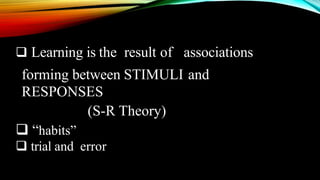
 Learning is the result of associations
forming between STIMULI and
RESPONSES
(S-R Theory)
 “habits”
 trial and error
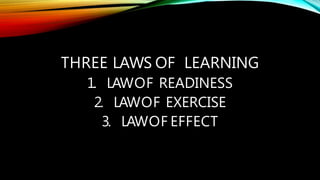
THREE LAWS OF LEARNING
1. LAWOF READINESS
2. LAWOF EXERCISE
3. LAWOF EFFECT
LAW OF READINESS
 “Law of Action Tendency”
 preparation of action
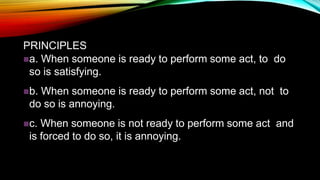
PRINCIPLES
a. When someone is ready to perform some act, to do
so is satisfying.
b. When someone is ready to perform some act, not to
do so is annoying.
c. When someone is not ready to perform some act and
is forced to do so, it is annoying.
LAW OF EXERCISE
 two parts: (a) the law of use (stronger)
(b) the law of disuse (weaker)
 “repetition”
 “Practice makes perfect”
Practice makes ______________, not
________________ UNLESS the task is taught
correctly.
Revision:
 Practice without feedback does not
necessarily mean enhance performance
 Practice alone is not enough for
improvement.
LAW OF EFFECT
 satisfying or annoying
 strengthened or weakened
S
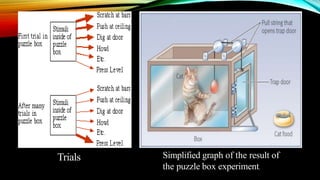
Trials Simplified graph of the result of
the puzzle box experiment.
ADDITIONAL LAWSAND
PRINCIPLES OF THORNDIKE'S
LEARNING THEORY
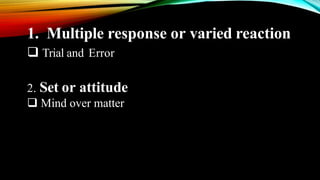
1. Multiple response or varied reaction
 Trial and Error
2. Set or attitude
 Mind over matter
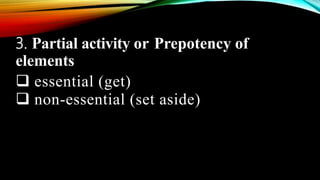
3. Partial activity or Prepotency of
elements
 essential (get)
 non-essential (set aside)
4. Law of Response by Analogy
 “from past to present”
5. Law of Associative Shifting
 “being capable to response”
IMPLICATIONS
1) According to this theory the task can be started from
the easier aspect towards its difficult side. This approach
will benefit the weaker and backward children.
2) A small child learns some skills through trial and error
method only such as sitting, standing, walking, running etc.
In teaching also the child rectifies the writing after
committing mistakes.
3) In this theory more emphasis has been laid on
motivation. Thus, before starting teaching in the
the students should be properly motivated.
4. Practice leads a man towards maturity. Practice is the
main feature oftrial and error method. Practice helps in
reducing the errors committed by the child in learning any
concept.
5. Habits are formed as a result of repetition. With the
help of this theory the wrong habits of the children can be
modified and the good habits strengthened.
6. The effects of rewards and punishment also affect the
learning of the child. Thus, the theory lays emphasis on the
use of reward and punishment in the class by the teacher.
7. The theory may be found quite helpful in changing the
behavior of the delinquent children. The teacher should cure such
children making use of this theory.
8. With the help of this theory the teacher can control the
negative emotions of the children such as anger, jealousy etc.
9. The teacher can improve his teaching methods making use of
this theory. He must observe the effects of his teaching methods on
the students and should not hesitate to make necessary changes in
them, if required.
10. The theory pays more emphasis on oral drill work. Thus, a
teacher should conduct oral drill of the taught contents. This help in
strengthening the learning more.
MAJOR CONTRIBUTIONS
 Edward Thorndike published about 500 books and
articles as learning in fish, methods of statistical
analysis and the elements of aesthetic quality in
urban life.
 He studied animal intelligence... known for his
'cats in a puzzle box' experiments on Trial and
Error.
 He applied animal to human educational
experience; he was once the leader in this field.
Thorndike's Connectionism Theory

Thorndike's Connectionism Theory

  • 1.
  • 2.
     American Psychologist Pioneer in Comparative Psychology  Ph. D ( Columbia U-1898)  “Animal Intelligence: An Experimental Study of the Associative Processes in Animals”
  • 3.
    “experimental approach isthe only way to understand learning”
  • 4.
  • 5.
     Learning isthe result of associations forming between STIMULI and RESPONSES (S-R Theory)  “habits”  trial and error
  • 6.
    THREE LAWS OFLEARNING 1. LAWOF READINESS 2. LAWOF EXERCISE 3. LAWOF EFFECT
  • 7.
    LAW OF READINESS “Law of Action Tendency”  preparation of action
  • 8.
    PRINCIPLES a. When someoneis ready to perform some act, to do so is satisfying. b. When someone is ready to perform some act, not to do so is annoying. c. When someone is not ready to perform some act and is forced to do so, it is annoying.
  • 9.
    LAW OF EXERCISE two parts: (a) the law of use (stronger) (b) the law of disuse (weaker)  “repetition”  “Practice makes perfect”
  • 10.
    Practice makes ______________,not ________________ UNLESS the task is taught correctly.
  • 11.
    Revision:  Practice withoutfeedback does not necessarily mean enhance performance  Practice alone is not enough for improvement.
  • 12.
    LAW OF EFFECT satisfying or annoying  strengthened or weakened
  • 13.
    S Trials Simplified graphof the result of the puzzle box experiment.
  • 14.
    ADDITIONAL LAWSAND PRINCIPLES OFTHORNDIKE'S LEARNING THEORY
  • 15.
    1. Multiple responseor varied reaction  Trial and Error 2. Set or attitude  Mind over matter
  • 16.
    3. Partial activityor Prepotency of elements  essential (get)  non-essential (set aside)
  • 17.
    4. Law ofResponse by Analogy  “from past to present” 5. Law of Associative Shifting  “being capable to response”
  • 18.
    IMPLICATIONS 1) According tothis theory the task can be started from the easier aspect towards its difficult side. This approach will benefit the weaker and backward children. 2) A small child learns some skills through trial and error method only such as sitting, standing, walking, running etc. In teaching also the child rectifies the writing after committing mistakes. 3) In this theory more emphasis has been laid on motivation. Thus, before starting teaching in the the students should be properly motivated.
  • 19.
    4. Practice leadsa man towards maturity. Practice is the main feature oftrial and error method. Practice helps in reducing the errors committed by the child in learning any concept. 5. Habits are formed as a result of repetition. With the help of this theory the wrong habits of the children can be modified and the good habits strengthened. 6. The effects of rewards and punishment also affect the learning of the child. Thus, the theory lays emphasis on the use of reward and punishment in the class by the teacher.
  • 20.
    7. The theorymay be found quite helpful in changing the behavior of the delinquent children. The teacher should cure such children making use of this theory. 8. With the help of this theory the teacher can control the negative emotions of the children such as anger, jealousy etc. 9. The teacher can improve his teaching methods making use of this theory. He must observe the effects of his teaching methods on the students and should not hesitate to make necessary changes in them, if required. 10. The theory pays more emphasis on oral drill work. Thus, a teacher should conduct oral drill of the taught contents. This help in strengthening the learning more.
  • 21.
  • 22.
     Edward Thorndikepublished about 500 books and articles as learning in fish, methods of statistical analysis and the elements of aesthetic quality in urban life.  He studied animal intelligence... known for his 'cats in a puzzle box' experiments on Trial and Error.  He applied animal to human educational experience; he was once the leader in this field.