TWO REVIEW ARTICLES
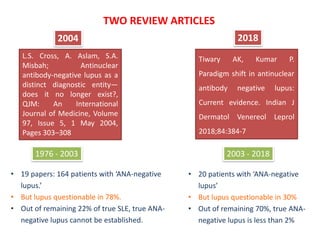
L.S. Cross, A. Aslam, S.A.
Misbah; Antinuclear
antibody-negative lupus as a
distinct diagnostic entity—
does it no longer exist?,
QJM: An International
Journal of Medicine, Volume
97, Issue 5, 1 May 2004,
Pages 303–308
Tiwary AK, Kumar P.
Paradigm shift in antinuclear
antibody negative lupus:
Current evidence. Indian J
Dermatol Venereol Leprol
2018;84:384-7
2004 2018
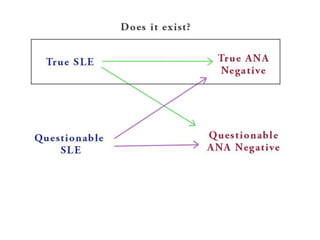
• 19 papers: 164 patients with ‘ANA-negative
lupus.’
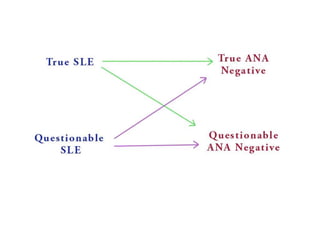
• But lupus questionable in 78%.
• Out of remaining 22% of true SLE, true ANA-
negative lupus cannot be established.
1976 - 2003 2003 - 2018
• 20 patients with ‘ANA-negative
lupus’
• But lupus questionable in 30%
• Out of remaining 70%, true ANA-
negative lupus is less than 2%
QUESTIONABLE ANA-NEGATIVE LUPUS
• Technical issues
• Confounding factors
TECHNICAL ISSUES
• Requires consistent nomenclature and reporting format:
Describes whether the test result is negative or positive at the
cut‐off dilution and if positive, a description of the fluorescence
patterns observed, intensity of fluorescent staining and the
end‐point titre at which a discernible pattern of fluorescence is
observed.
• Standard reference range
Each laboratory should set its own reference intervals
to report and interpret the laboratory results.
TECHNICAL ISSUES (Contd.)
• Personnel qualification
• Competency assessment
• Quality control
• Proficiency testing
• Specimen collection and storage
• Substrate slides (acetone or alcohol fixed)
• Anti‐IG conjugate
• Working dilution
• reference sera
CONFOUNDERS IN ANA-NEGATIVE LUPUS
1. Antigen deficient substrate
2. Concomitant Immunosuppressive drugs
3. Protinuria due to nephritis
ANTIGEN DEFICIENT SUBSTRATE
• Most important and critical factor in antinuclear antibody test is
the substrate used for it.
• Inadequacy or deficiency of the antigen due to poor choice of
the substrate can lead to false‐negative antinuclear antibody
results.
• It is possible that an antinuclear antibody negative patient may
become antinuclear antibody positive if the substrate is
changed from rat liver to human epithelial cell line.
• Use of alcohol as fixative will lead to deficiency of antigens for
anti-Ro antibodies. Hence Hep-2 cells are fixed with acetone.
IMMUNOSUPPRESSIVE DRUGS & NEPHRITIS
• Patients on systemic corticosteroid treatment can have ANA-
negative result or ANA-positive result.
• It will depend on the temporal relation between treatment and
testing.
• ANA-negativity before initiating treatment can be due to loss of
antibodies along with protein loss in urine. In such cases, pleural
fluid can be used for testing.
• ANA-positivity after initiating treatment could be due to
improvement in nephritis causing retention of antibodies in serum.
STILL MORE PARADOXES
• Positive Ds-DNA, but negative ANA on Hep-2 IF method..!
Could be due to IVIG administration causing false positive Ds-DNA
• Initially ANA negative, later ANA positive…!
Happens in about 10% patients and could be due to seroconversion
and hence needs serial testing
CONCLUSION
• When the technical issues and confounding factors are
corrected, current evidence from the literature suggests that
true ANA-negative lupus is an extremely rare event (<2%).
• It is now predominantly a historical phenomenon.
REFERENCES
1. L.S. Cross, A. Aslam, S.A. Misbah; Antinuclear antibody-negative lupus as a
distinct diagnostic entity—does it no longer exist?, QJM: An International
Journal of Medicine, Volume 97, Issue 5, 1 May 2004, Pages 303–308.
2. Tiwary AK, Kumar P. Paradigm shift in antinuclear antibody negative lupus:
Current evidence. Indian J Dermatol Venereol Leprol 2018;84:384-7.
3. Arthur Kavanaugh, Russell Tomar, John Reveille, Daniel H. Solomon, and
Henry A. Homburger (2000) Guidelines for Clinical Use of the Antinuclear
Antibody Test and Tests for Specific Autoantibodies to Nuclear Antigens.
Archives of Pathology & Laboratory Medicine: January 2000, Vol. 124, No. 1,
pp. 71-81.
4. Rook’s Textbook of Dermatology.
5. Bolognia’s Dermatology.

ANA Negative Lupus

  • 2.
    TWO REVIEW ARTICLES L.S.Cross, A. Aslam, S.A. Misbah; Antinuclear antibody-negative lupus as a distinct diagnostic entity— does it no longer exist?, QJM: An International Journal of Medicine, Volume 97, Issue 5, 1 May 2004, Pages 303–308 Tiwary AK, Kumar P. Paradigm shift in antinuclear antibody negative lupus: Current evidence. Indian J Dermatol Venereol Leprol 2018;84:384-7 2004 2018 • 19 papers: 164 patients with ‘ANA-negative lupus.’ • But lupus questionable in 78%. • Out of remaining 22% of true SLE, true ANA- negative lupus cannot be established. 1976 - 2003 2003 - 2018 • 20 patients with ‘ANA-negative lupus’ • But lupus questionable in 30% • Out of remaining 70%, true ANA- negative lupus is less than 2%
  • 6.
    QUESTIONABLE ANA-NEGATIVE LUPUS •Technical issues • Confounding factors
  • 7.
    TECHNICAL ISSUES • Requiresconsistent nomenclature and reporting format: Describes whether the test result is negative or positive at the cut‐off dilution and if positive, a description of the fluorescence patterns observed, intensity of fluorescent staining and the end‐point titre at which a discernible pattern of fluorescence is observed. • Standard reference range Each laboratory should set its own reference intervals to report and interpret the laboratory results.
  • 8.
    TECHNICAL ISSUES (Contd.) •Personnel qualification • Competency assessment • Quality control • Proficiency testing • Specimen collection and storage • Substrate slides (acetone or alcohol fixed) • Anti‐IG conjugate • Working dilution • reference sera
  • 9.
    CONFOUNDERS IN ANA-NEGATIVELUPUS 1. Antigen deficient substrate 2. Concomitant Immunosuppressive drugs 3. Protinuria due to nephritis
  • 10.
    ANTIGEN DEFICIENT SUBSTRATE •Most important and critical factor in antinuclear antibody test is the substrate used for it. • Inadequacy or deficiency of the antigen due to poor choice of the substrate can lead to false‐negative antinuclear antibody results. • It is possible that an antinuclear antibody negative patient may become antinuclear antibody positive if the substrate is changed from rat liver to human epithelial cell line. • Use of alcohol as fixative will lead to deficiency of antigens for anti-Ro antibodies. Hence Hep-2 cells are fixed with acetone.
  • 11.
    IMMUNOSUPPRESSIVE DRUGS &NEPHRITIS • Patients on systemic corticosteroid treatment can have ANA- negative result or ANA-positive result. • It will depend on the temporal relation between treatment and testing. • ANA-negativity before initiating treatment can be due to loss of antibodies along with protein loss in urine. In such cases, pleural fluid can be used for testing. • ANA-positivity after initiating treatment could be due to improvement in nephritis causing retention of antibodies in serum.
  • 12.
    STILL MORE PARADOXES •Positive Ds-DNA, but negative ANA on Hep-2 IF method..! Could be due to IVIG administration causing false positive Ds-DNA • Initially ANA negative, later ANA positive…! Happens in about 10% patients and could be due to seroconversion and hence needs serial testing
  • 13.
    CONCLUSION • When thetechnical issues and confounding factors are corrected, current evidence from the literature suggests that true ANA-negative lupus is an extremely rare event (<2%). • It is now predominantly a historical phenomenon.
  • 14.
    REFERENCES 1. L.S. Cross,A. Aslam, S.A. Misbah; Antinuclear antibody-negative lupus as a distinct diagnostic entity—does it no longer exist?, QJM: An International Journal of Medicine, Volume 97, Issue 5, 1 May 2004, Pages 303–308. 2. Tiwary AK, Kumar P. Paradigm shift in antinuclear antibody negative lupus: Current evidence. Indian J Dermatol Venereol Leprol 2018;84:384-7. 3. Arthur Kavanaugh, Russell Tomar, John Reveille, Daniel H. Solomon, and Henry A. Homburger (2000) Guidelines for Clinical Use of the Antinuclear Antibody Test and Tests for Specific Autoantibodies to Nuclear Antigens. Archives of Pathology & Laboratory Medicine: January 2000, Vol. 124, No. 1, pp. 71-81. 4. Rook’s Textbook of Dermatology. 5. Bolognia’s Dermatology.

Editor's Notes

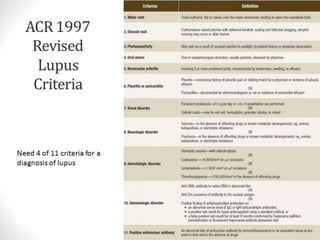
  • #4 4 or more of ACR criteria fulfilment will classify as true SLE
  • #6 LE cells are positive in 80% patients, and suggestive of drug induced LE. These are are neutrophils that have engulfed the nuclear material from degenerative white cells in the presence of an anti- body to deoxyribonucleoprotein (the LE cell factor) Scl 70 is topoisomerase 1.
  • #9 Anti-Ro antibody detection needs acetone fixation
  • #15 With use of the HEp-2 substrate, approximately 20% of normal persons have an ANA titer of 1:40 or higher, and approximately 5% have an ANA titer of 1:160 or higher.