

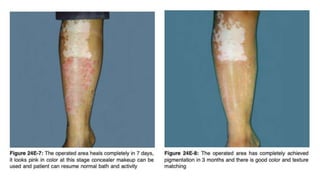
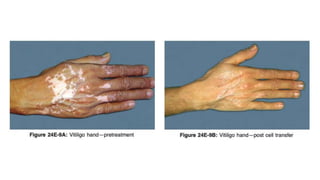
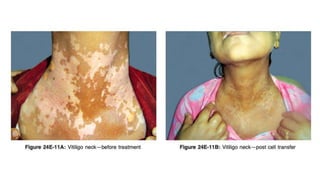
INTRODUCTION
• Vitiligo - common acquired depigmenting disorder
• HPE - Absence of melanocytes in epidermis
• Medical & physical therapies for treatment
• Surgery for resistant areas
• Objective - produce cosmetically acceptable repigmentation
• Principle - introduce melanocytes into the lesional skin
VITILIGO SURGERIES
Choice depends on:
1. Type of vitiligo
2. Extent
3. Site of lesions
4. Availability of equipment
5. Expertise of surgeon
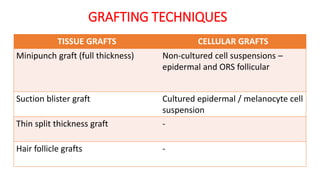
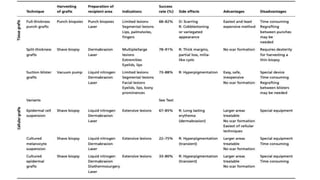
TISSUE GRAFTS CELLULAR GRAFTS
Minipunch graft (full thickness) Non-cultured cell suspensions –
epidermal and ORS follicular
Suction blister graft Cultured epidermal / melanocyte cell
suspension
Thin split thickness graft -
Hair follicle grafts -
GRAFTING TECHNIQUES
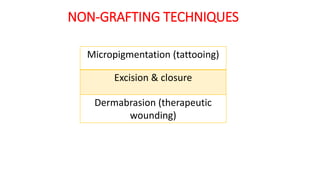
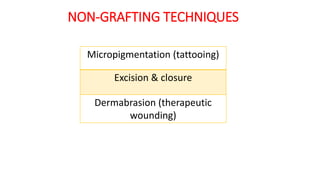
Micropigmentation (tattooing)
Excision & closure
Dermabrasion (therapeutic
wounding)
NON-GRAFTING TECHNIQUES
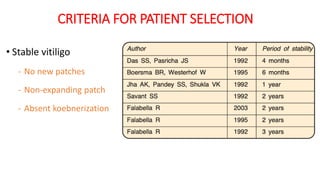
CRITERIA FOR PATIENT SELECTION
• Stable vitiligo
- No new patches
- Non-expanding patch
- Absent koebnerization
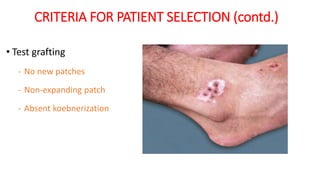
CRITERIA FOR PATIENT SELECTION (contd.)
• Test grafting
- No new patches
- Non-expanding patch
- Absent koebnerization
CRITERIA FOR PATIENT SELECTION (contd.)
• Preferrable
- Younger patients
- Face, trunk and proximal extremities
- Vitiligo vulgaris, localized or segmental vitiligo
CONTRAINDICATIONS
• Unrealistic expectations
• Unstable vitiligo
• Bleeding diathesis
• Severe liver disease
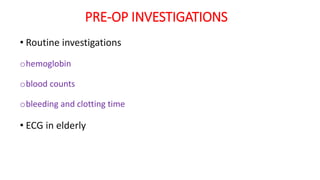
PRE-OP INVESTIGATIONS
• Routine investigations
ohemoglobin
oblood counts
obleeding and clotting time
• ECG in elderly
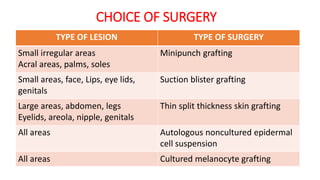
CHOICE OF SURGERY
TYPE OF LESION TYPE OF SURGERY
Small irregular areas
Acral areas, palms, soles
Minipunch grafting
Small areas, face, Lips, eye lids,
genitals
Suction blister grafting
Large areas, abdomen, legs
Eyelids, areola, nipple, genitals
Thin split thickness skin grafting
All areas Autologous noncultured epidermal
cell suspension
All areas Cultured melanocyte grafting
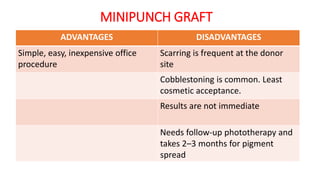
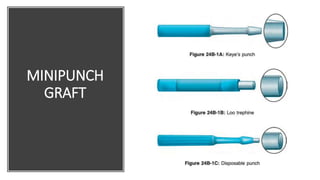
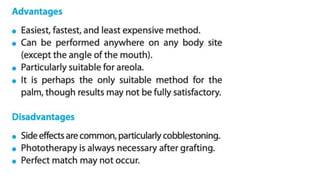
MINIPUNCH GRAFT
ADVANTAGES DISADVANTAGES
Simple, easy, inexpensive office
procedure
Scarring is frequent at the donor
site
Cobblestoning is common. Least
cosmetic acceptance.
Results are not immediate
Needs follow-up phototherapy and
takes 2–3 months for pigment
spread
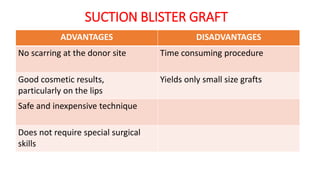
SUCTION BLISTER GRAFT
ADVANTAGES DISADVANTAGES
No scarring at the donor site Time consuming procedure
Good cosmetic results,
particularly on the lips
Yields only small size grafts
Safe and inexpensive technique
Does not require special surgical
skills
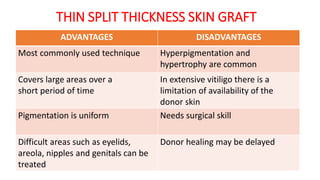
THIN SPLIT THICKNESS SKIN GRAFT
ADVANTAGES DISADVANTAGES
Most commonly used technique Hyperpigmentation and
hypertrophy are common
Covers large areas over a
short period of time
In extensive vitiligo there is a
limitation of availability of the
donor skin
Pigmentation is uniform Needs surgical skill
Difficult areas such as eyelids,
areola, nipples and genitals can be
treated
Donor healing may be delayed
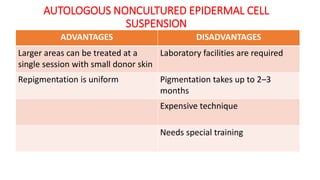
AUTOLOGOUS NONCULTURED EPIDERMAL CELL
SUSPENSION
ADVANTAGES DISADVANTAGES
Larger areas can be treated at a
single session with small donor skin
Laboratory facilities are required
Repigmentation is uniform Pigmentation takes up to 2–3
months
Expensive technique
Needs special training
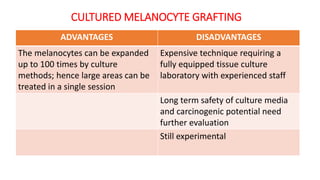
CULTURED MELANOCYTE GRAFTING
ADVANTAGES DISADVANTAGES
The melanocytes can be expanded
up to 100 times by culture
methods; hence large areas can be
treated in a single session
Expensive technique requiring a
fully equipped tissue culture
laboratory with experienced staff
Long term safety of culture media
and carcinogenic potential need
further evaluation
Still experimental
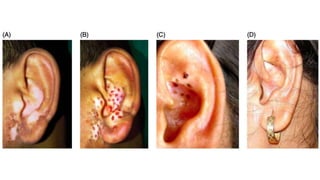
MINIPUNCH
GRAFT
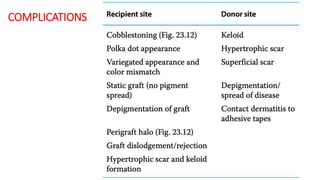
COMPLICATIONS
MINIPUNCH
GRAFT
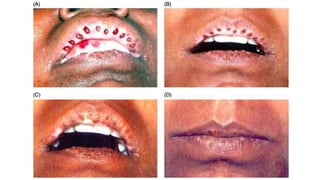
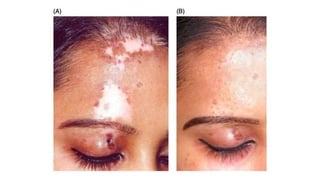
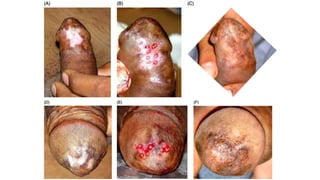
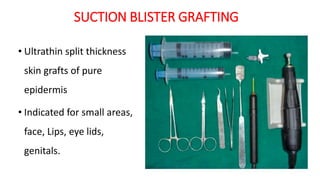
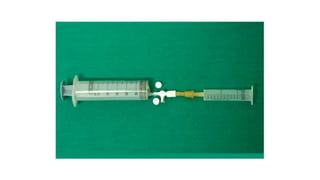
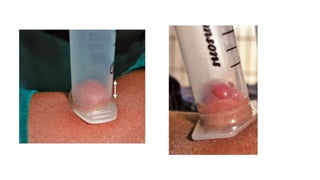
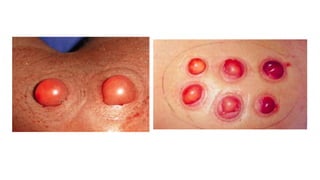
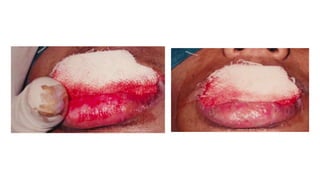
SUCTION BLISTER GRAFTING
• Ultrathin split thickness
skin grafts of pure
epidermis
• Indicated for small areas,
face, Lips, eye lids,
genitals.
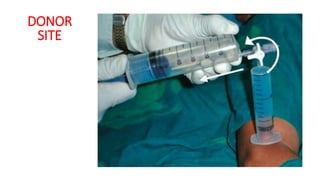
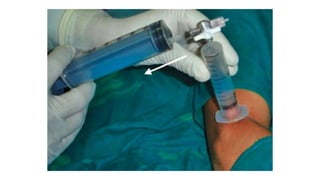
DONOR
SITE
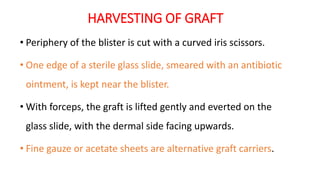
HARVESTING OF GRAFT
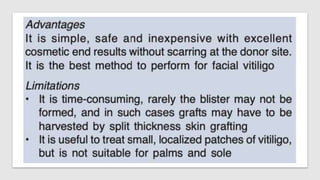
• Periphery of the blister is cut with a curved iris scissors.
• One edge of a sterile glass slide, smeared with an antibiotic
ointment, is kept near the blister.
• With forceps, the graft is lifted gently and everted on the
glass slide, with the dermal side facing upwards.
• Fine gauze or acetate sheets are alternative graft carriers.
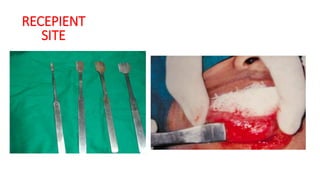
RECEPIENT
SITE
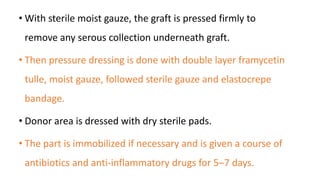
• With sterile moist gauze, the graft is pressed firmly to
remove any serous collection underneath graft.
• Then pressure dressing is done with double layer framycetin
tulle, moist gauze, followed sterile gauze and elastocrepe
bandage.
• Donor area is dressed with dry sterile pads.
• The part is immobilized if necessary and is given a course of
antibiotics and anti-inflammatory drugs for 5–7 days.
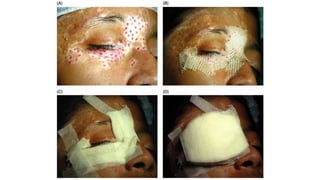
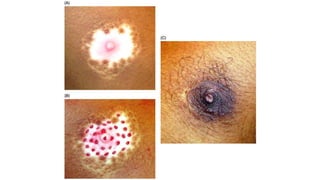
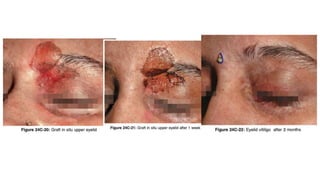
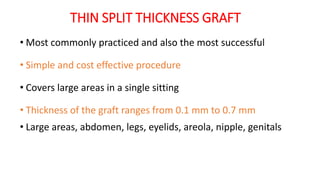
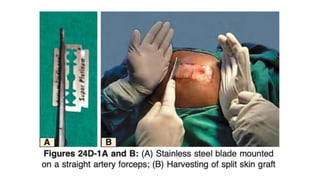
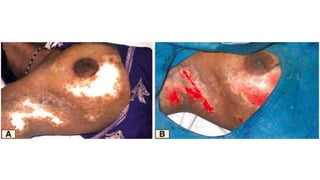
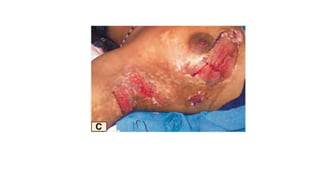
THIN SPLIT THICKNESS GRAFT
• Most commonly practiced and also the most successful
• Simple and cost effective procedure
• Covers large areas in a single sitting
• Thickness of the graft ranges from 0.1 mm to 0.7 mm
• Large areas, abdomen, legs, eyelids, areola, nipple, genitals
• First dressing change is done preferably after 24 hours, to
check for formation of any seroma or hematoma
• Dressing is subsequently changed after 1 week by which time
the graft is usually taken up and healing is complete.
• Donor site dressing is also changed after 1 week.
ADVANTAGES & DISADVANTAGES
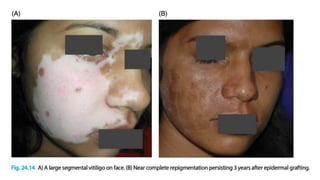
• Pigmentation is uniform and cobbleston- ing, which is
common with minigrafting, does not occur.
• Difficult areas such as the eyelids, inner can- thus of eyes,
areola, nipples, and genitals are easier to treat.
• Color‐ and texture‐matching can take time.
• When large areas need to be covered, limitation of the donor
site is a disadvantage.
HAIR FOLLICLE GRAFTS
• vv
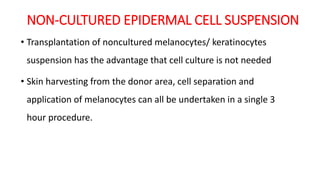
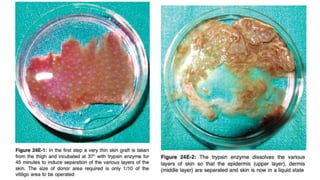
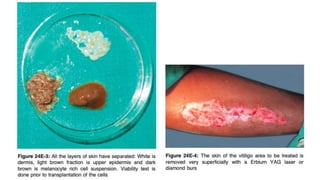
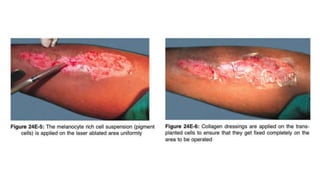
NON-CULTURED EPIDERMAL CELL SUSPENSION
• Transplantation of noncultured melanocytes/ keratinocytes
suspension has the advantage that cell culture is not needed
• Skin harvesting from the donor area, cell separation and
application of melanocytes can all be undertaken in a single 3
hour procedure.
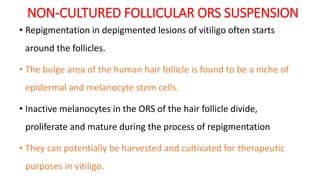
NON-CULTURED FOLLICULAR ORS SUSPENSION
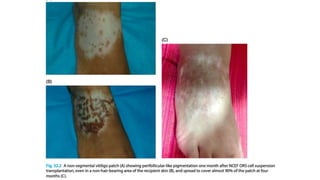
• Repigmentation in depigmented lesions of vitiligo often starts
around the follicles.
• The bulge area of the human hair follicle is found to be a niche of
epidermal and melanocyte stem cells.
• Inactive melanocytes in the ORS of the hair follicle divide,
proliferate and mature during the process of repigmentation
• They can potentially be harvested and cultivated for therapeutic
purposes in vitiligo.
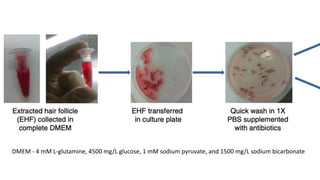
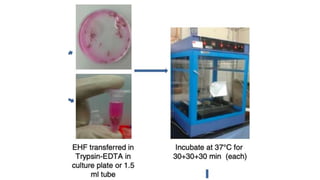
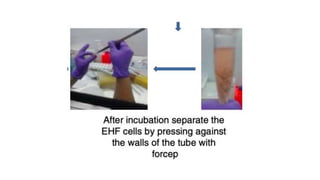
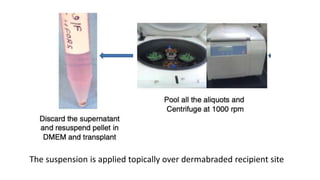
DMEM - 4 mM L-glutamine, 4500 mg/L glucose, 1 mM sodium pyruvate, and 1500 mg/L sodium bicarbonate
The suspension is applied topically over dermabraded recipient site
ADVANTAGES
• Advantage over intact hair follicle transplant –
• Minimal risk of scarring
• Good cosmetic acceptability on non‐hair‐ bearing skin as hair
follicles are not transplanted
• Larger patches of vitiligo can be covered
ADVANTAGES
• Advantage over non-cultured epidermal suspension –
• Donor site is hidden in the hairy scalp (no need large
split‐thickness skin grafts from the buttocks or thighs)
• Donor site does not require postoperative dressing
• Follicular cell suspension may contain a higher concentration
of melanocytes and melanocyte stem cells compared to
epidermal cell suspension
DISADVANTAGES
• FUE procedure is time‐consuming and requires skills
• Cell separation and the preparation of suspension is also
slightly more difficult and time‐consuming
• Costly
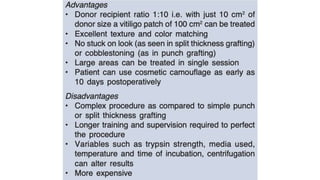
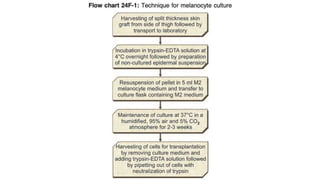
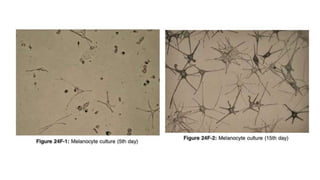
CULTURED MELANOCYTE TRANSPLANTATION
• Cultured melanocytes have a donor to recipient area of around 1:100
and hence a very small donor graft is adequate to cover a very large area.
• Donor skin has variously been obtained using biopsy (punch biopsy/split
thickness skin graft/full thickness skin grafts) or suction/cryoinduced
blisters.
• Several methods have been used to prepare the recipient
site including dermabrasion, suction/cryoinduced blisters, or
lasers (Er:YAG or CO2).
• Relatively new technique – no standardization
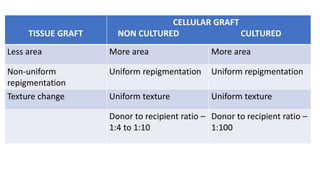
TISSUE GRAFT
CELLULAR GRAFT
NON CULTURED CULTURED
Less area More area More area
Non-uniform
repigmentation
Uniform repigmentation Uniform repigmentation
Texture change Uniform texture Uniform texture
Donor to recipient ratio –
1:4 to 1:10
Donor to recipient ratio –
1:100
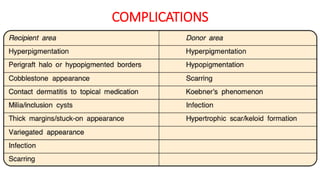
COMPLICATIONS
Micropigmentation (tattooing)
Excision & closure
Dermabrasion (therapeutic
wounding)
NON-GRAFTING TECHNIQUES
REFERENCES
1. ACSI Textbook of Cutaneous and Aesthetic Surgery
2. Vitiligo - Medical and Surgical Treatment (Wiley Blackwell,
2018)

Vitiligo Surgeries

  • 2.
    INTRODUCTION • Vitiligo -common acquired depigmenting disorder • HPE - Absence of melanocytes in epidermis • Medical & physical therapies for treatment • Surgery for resistant areas • Objective - produce cosmetically acceptable repigmentation • Principle - introduce melanocytes into the lesional skin
  • 3.
    VITILIGO SURGERIES Choice dependson: 1. Type of vitiligo 2. Extent 3. Site of lesions 4. Availability of equipment 5. Expertise of surgeon
  • 4.
    TISSUE GRAFTS CELLULARGRAFTS Minipunch graft (full thickness) Non-cultured cell suspensions – epidermal and ORS follicular Suction blister graft Cultured epidermal / melanocyte cell suspension Thin split thickness graft - Hair follicle grafts - GRAFTING TECHNIQUES
  • 5.
    Micropigmentation (tattooing) Excision &closure Dermabrasion (therapeutic wounding) NON-GRAFTING TECHNIQUES
  • 6.
    CRITERIA FOR PATIENTSELECTION • Stable vitiligo - No new patches - Non-expanding patch - Absent koebnerization
  • 7.
    CRITERIA FOR PATIENTSELECTION (contd.) • Test grafting - No new patches - Non-expanding patch - Absent koebnerization
  • 8.
    CRITERIA FOR PATIENTSELECTION (contd.) • Preferrable - Younger patients - Face, trunk and proximal extremities - Vitiligo vulgaris, localized or segmental vitiligo
  • 9.
    CONTRAINDICATIONS • Unrealistic expectations •Unstable vitiligo • Bleeding diathesis • Severe liver disease
  • 10.
    PRE-OP INVESTIGATIONS • Routineinvestigations ohemoglobin oblood counts obleeding and clotting time • ECG in elderly
  • 11.
    CHOICE OF SURGERY TYPEOF LESION TYPE OF SURGERY Small irregular areas Acral areas, palms, soles Minipunch grafting Small areas, face, Lips, eye lids, genitals Suction blister grafting Large areas, abdomen, legs Eyelids, areola, nipple, genitals Thin split thickness skin grafting All areas Autologous noncultured epidermal cell suspension All areas Cultured melanocyte grafting
  • 12.
    MINIPUNCH GRAFT ADVANTAGES DISADVANTAGES Simple,easy, inexpensive office procedure Scarring is frequent at the donor site Cobblestoning is common. Least cosmetic acceptance. Results are not immediate Needs follow-up phototherapy and takes 2–3 months for pigment spread
  • 13.
    SUCTION BLISTER GRAFT ADVANTAGESDISADVANTAGES No scarring at the donor site Time consuming procedure Good cosmetic results, particularly on the lips Yields only small size grafts Safe and inexpensive technique Does not require special surgical skills
  • 14.
    THIN SPLIT THICKNESSSKIN GRAFT ADVANTAGES DISADVANTAGES Most commonly used technique Hyperpigmentation and hypertrophy are common Covers large areas over a short period of time In extensive vitiligo there is a limitation of availability of the donor skin Pigmentation is uniform Needs surgical skill Difficult areas such as eyelids, areola, nipples and genitals can be treated Donor healing may be delayed
  • 15.
    AUTOLOGOUS NONCULTURED EPIDERMALCELL SUSPENSION ADVANTAGES DISADVANTAGES Larger areas can be treated at a single session with small donor skin Laboratory facilities are required Repigmentation is uniform Pigmentation takes up to 2–3 months Expensive technique Needs special training
  • 16.
    CULTURED MELANOCYTE GRAFTING ADVANTAGESDISADVANTAGES The melanocytes can be expanded up to 100 times by culture methods; hence large areas can be treated in a single session Expensive technique requiring a fully equipped tissue culture laboratory with experienced staff Long term safety of culture media and carcinogenic potential need further evaluation Still experimental
  • 17.
  • 26.
  • 27.
    MINIPUNCH GRAFT SUCTION BLISTER GRAFTING •Ultrathin split thickness skin grafts of pure epidermis • Indicated for small areas, face, Lips, eye lids, genitals.
  • 29.
  • 33.
    HARVESTING OF GRAFT •Periphery of the blister is cut with a curved iris scissors. • One edge of a sterile glass slide, smeared with an antibiotic ointment, is kept near the blister. • With forceps, the graft is lifted gently and everted on the glass slide, with the dermal side facing upwards. • Fine gauze or acetate sheets are alternative graft carriers.
  • 34.
  • 36.
    • With sterilemoist gauze, the graft is pressed firmly to remove any serous collection underneath graft. • Then pressure dressing is done with double layer framycetin tulle, moist gauze, followed sterile gauze and elastocrepe bandage. • Donor area is dressed with dry sterile pads. • The part is immobilized if necessary and is given a course of antibiotics and anti-inflammatory drugs for 5–7 days.
  • 40.
    THIN SPLIT THICKNESSGRAFT • Most commonly practiced and also the most successful • Simple and cost effective procedure • Covers large areas in a single sitting • Thickness of the graft ranges from 0.1 mm to 0.7 mm • Large areas, abdomen, legs, eyelids, areola, nipple, genitals
  • 44.
    • First dressingchange is done preferably after 24 hours, to check for formation of any seroma or hematoma • Dressing is subsequently changed after 1 week by which time the graft is usually taken up and healing is complete. • Donor site dressing is also changed after 1 week.
  • 45.
    ADVANTAGES & DISADVANTAGES •Pigmentation is uniform and cobbleston- ing, which is common with minigrafting, does not occur. • Difficult areas such as the eyelids, inner can- thus of eyes, areola, nipples, and genitals are easier to treat. • Color‐ and texture‐matching can take time. • When large areas need to be covered, limitation of the donor site is a disadvantage.
  • 46.
  • 47.
    NON-CULTURED EPIDERMAL CELLSUSPENSION • Transplantation of noncultured melanocytes/ keratinocytes suspension has the advantage that cell culture is not needed • Skin harvesting from the donor area, cell separation and application of melanocytes can all be undertaken in a single 3 hour procedure.
  • 55.
    NON-CULTURED FOLLICULAR ORSSUSPENSION • Repigmentation in depigmented lesions of vitiligo often starts around the follicles. • The bulge area of the human hair follicle is found to be a niche of epidermal and melanocyte stem cells. • Inactive melanocytes in the ORS of the hair follicle divide, proliferate and mature during the process of repigmentation • They can potentially be harvested and cultivated for therapeutic purposes in vitiligo.
  • 56.
    DMEM - 4mM L-glutamine, 4500 mg/L glucose, 1 mM sodium pyruvate, and 1500 mg/L sodium bicarbonate
  • 59.
    The suspension isapplied topically over dermabraded recipient site
  • 61.
    ADVANTAGES • Advantage overintact hair follicle transplant – • Minimal risk of scarring • Good cosmetic acceptability on non‐hair‐ bearing skin as hair follicles are not transplanted • Larger patches of vitiligo can be covered
  • 62.
    ADVANTAGES • Advantage overnon-cultured epidermal suspension – • Donor site is hidden in the hairy scalp (no need large split‐thickness skin grafts from the buttocks or thighs) • Donor site does not require postoperative dressing • Follicular cell suspension may contain a higher concentration of melanocytes and melanocyte stem cells compared to epidermal cell suspension
  • 63.
    DISADVANTAGES • FUE procedureis time‐consuming and requires skills • Cell separation and the preparation of suspension is also slightly more difficult and time‐consuming • Costly
  • 64.
    CULTURED MELANOCYTE TRANSPLANTATION •Cultured melanocytes have a donor to recipient area of around 1:100 and hence a very small donor graft is adequate to cover a very large area. • Donor skin has variously been obtained using biopsy (punch biopsy/split thickness skin graft/full thickness skin grafts) or suction/cryoinduced blisters.
  • 68.
    • Several methodshave been used to prepare the recipient site including dermabrasion, suction/cryoinduced blisters, or lasers (Er:YAG or CO2). • Relatively new technique – no standardization
  • 69.
    TISSUE GRAFT CELLULAR GRAFT NONCULTURED CULTURED Less area More area More area Non-uniform repigmentation Uniform repigmentation Uniform repigmentation Texture change Uniform texture Uniform texture Donor to recipient ratio – 1:4 to 1:10 Donor to recipient ratio – 1:100
  • 70.
  • 72.
    Micropigmentation (tattooing) Excision &closure Dermabrasion (therapeutic wounding) NON-GRAFTING TECHNIQUES
  • 73.
    REFERENCES 1. ACSI Textbookof Cutaneous and Aesthetic Surgery 2. Vitiligo - Medical and Surgical Treatment (Wiley Blackwell, 2018)

Editor's Notes

  • #27 Repigmentation between 2-6 weeks
  • #37 The dressing is removed after 5–7 days. Redressing for another 2–3 days is required. Final dressing is removed around 10th day and the patient can go for regular bathing.
  • #57 dulbecco’s modified eagle's medium