TREMATODE INFECTIONS 
Pratap Sagar Tiwari 
Rajeev Shah 
Prakash Naag 
Residents, Internal Medicine, NGMC
TOPICS 
• Introduction 
• Classification 
• Life cycle 
• Clinical manifestaions 
• Investigations 
• Management
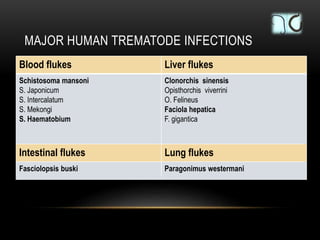
MAJOR HUMAN TREMATODE INFECTIONS 
Blood flukes Liver flukes 
Schistosoma mansoni 
S. Japonicum 
S. Intercalatum 
S. Mekongi 
S. Haematobium 
Clonorchis sinensis 
Opisthorchis viverrini 
O. Felineus 
Faciola hepatica 
F. gigantica 
Intestinal flukes Lung flukes 
Fasciolopsis buski Paragonimus westermani
LIFE CYCLE OF SCHISTOSOMAS
CLINICAL MANIFESTATIONS: SCHISTOSOMIASIS 
Acute manifestations 
• Cercarial dermatitis (summer’s itch):is an allergic reaction caused by the 
penetration of cercariae in persons who have been exposed to cercariae in 
salt water or fresh water. 
• Swimmer’s itch most often occurs in S .mansoni and S. japonicum. 
• Manifested as petechial hemorrhage with edema and pruritus followed by 
maculopapular rashes and sometimes vesicular. 
• It is self limiting
CLINICAL MANIFESTATIONS: SCHISTOSOMIASIS 
Acute manifestations 
• Katayama syndrome: This syndrome is caused by high worm load and egg 
antigen stimuli that result from immune complex formation and leads to a 
serum sickness–like illness. 
• This is the most severe form and is most common in persons with S 
mansoni and S japonicum infections. 
• Symptoms include high fever, chills, headache, hepatosplenomegaly, 
lymphadenopathy, eosinophilia, and dysentery.
CLINICAL MANIFESTATIONS: SCHISTOSOMIASIS 
Chronic manifestations 
• Symptoms depend on the Schistosoma species that causes the infection, the 
duration and severity of the infection, and the immune response of the host 
to the egg antigens. 
• Terminal hematuria, dysuria, and frequent urination . 
• The earliest bladder sign is pseudotubercle, but, in longstanding infection, 
radiography reveals nests of calcified ova (sandy patches) surrounded by 
fibrous tissue in the submucosa.
CNS SCHISTOSOMIASIS 
• Headache, seizures (both generalized and focal), myeloradiculopathy with 
lower limb and back pain, paresthesia, and urinary bladder dysfunction are 
the noted symptoms of CNS schistosomiasis due to S japonicum infection. 
• Neuroschistosomiasis is a severe manifestation of schistosomal infection. 
The neurological symptoms result from the inflammatory response of the 
host to the deposition of eggs in the brain and spinal cord. 
• Myelopathy is the most common neurological complication of S. 
mansoni infection.
SUMMARY OF MANIFESTATIONS 
Organisms Symptoms 
Blood flukes 
S. mansoni, S. japonicum Dermatitis, abdominal pain, bloody stool, peri-portal 
fibrosis, hepato-splenomegaly, ascites, CNS 
Schistosoma hematobium Dermatitis, urogenital cystitis, urethritis and bladder 
carcinoma 
Liver flukes 
C. sinensis, 
O. felinus, or O. viverini 
Inflammation and deformation of bile duct, hepatitis, 
anemia and edema 
Fasciola hepatica fever, anemia, hepatobiliary manifestations (colicky pain, 
jaundice), and secondary bacterial infections are present.
SUMMARY OF MANIFESTATIONS 
Intestinal flukes 
Fasciolopsis buski Epigastric pain, nausea, diarrhea, edema, ascites 
Lung flukes 
Paragonimus 
westermani 
Cough (dry / rusty brown sputum), pulmonary pain, 
pleurisy, tuberculosis-like features.
SCHISTOSOMIASIS
Investigation, Diagnosis and 
Management
INVESTIGATION /DIAGNOSIS 
• Blood:PBS 
• Microscopy:stool/urine/sputum 
• Serology: detecting antibodies/antigens 
• Imaging
TREATMENT
PREVENTION 
• Information, education and communication on safe food practices. 
• Improved sanitation, aimed at decreasing contamination of freshwater 
streams with human faeces. 
• Control or containment of the intermediate snail hosts. 
• Preventive chemotherapy ?? 
• Vaccination ??
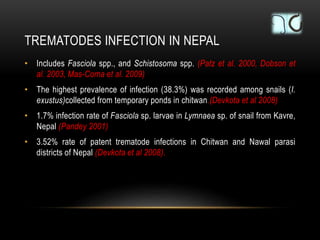
TREMATODES INFECTION IN NEPAL 
• Includes Fasciola spp., and Schistosoma spp. (Patz et al. 2000, Dobson et 
al. 2003, Mas-Coma et al. 2009) 
• The highest prevalence of infection (38.3%) was recorded among snails (I. 
exustus)collected from temporary ponds in chitwan.(Devkota et al 2008) 
• 1.7% infection rate of Fasciola sp. larvae in Lymnaea sp. of snail from Kavre, 
Nepal (Pandey 2001) 
• 3.52% rate of patent trematode infections in Chitwan and Nawal parasi 
districts of Nepal (Devkota et al 2008).
Thankyou 
References: 
• Harrison’s principles of internal medicine 18h ed 
• Davidson Principles & Practice of medicine 
• Uptodate 19.3 
• Emedicine.com last update sept 2012
WATERCRESS /SIM RAYO
WATER CHESTNUTS/ MAKHAN
LIFE CYCLE OF SCHISTOSOMAS
LIFE CYCLE OF INTESTINAL FLUKES
LIFE CYCLE OF LUNG FLUKES :PARAGONIMUS
• Thankyou

Trematode infections

  • 1.
    TREMATODE INFECTIONS PratapSagar Tiwari Rajeev Shah Prakash Naag Residents, Internal Medicine, NGMC
  • 2.
    TOPICS • Introduction • Classification • Life cycle • Clinical manifestaions • Investigations • Management
  • 3.
    MAJOR HUMAN TREMATODEINFECTIONS Blood flukes Liver flukes Schistosoma mansoni S. Japonicum S. Intercalatum S. Mekongi S. Haematobium Clonorchis sinensis Opisthorchis viverrini O. Felineus Faciola hepatica F. gigantica Intestinal flukes Lung flukes Fasciolopsis buski Paragonimus westermani
  • 4.
    LIFE CYCLE OFSCHISTOSOMAS
  • 5.
    CLINICAL MANIFESTATIONS: SCHISTOSOMIASIS Acute manifestations • Cercarial dermatitis (summer’s itch):is an allergic reaction caused by the penetration of cercariae in persons who have been exposed to cercariae in salt water or fresh water. • Swimmer’s itch most often occurs in S .mansoni and S. japonicum. • Manifested as petechial hemorrhage with edema and pruritus followed by maculopapular rashes and sometimes vesicular. • It is self limiting
  • 6.
    CLINICAL MANIFESTATIONS: SCHISTOSOMIASIS Acute manifestations • Katayama syndrome: This syndrome is caused by high worm load and egg antigen stimuli that result from immune complex formation and leads to a serum sickness–like illness. • This is the most severe form and is most common in persons with S mansoni and S japonicum infections. • Symptoms include high fever, chills, headache, hepatosplenomegaly, lymphadenopathy, eosinophilia, and dysentery.
  • 7.
    CLINICAL MANIFESTATIONS: SCHISTOSOMIASIS Chronic manifestations • Symptoms depend on the Schistosoma species that causes the infection, the duration and severity of the infection, and the immune response of the host to the egg antigens. • Terminal hematuria, dysuria, and frequent urination . • The earliest bladder sign is pseudotubercle, but, in longstanding infection, radiography reveals nests of calcified ova (sandy patches) surrounded by fibrous tissue in the submucosa.
  • 8.
    CNS SCHISTOSOMIASIS •Headache, seizures (both generalized and focal), myeloradiculopathy with lower limb and back pain, paresthesia, and urinary bladder dysfunction are the noted symptoms of CNS schistosomiasis due to S japonicum infection. • Neuroschistosomiasis is a severe manifestation of schistosomal infection. The neurological symptoms result from the inflammatory response of the host to the deposition of eggs in the brain and spinal cord. • Myelopathy is the most common neurological complication of S. mansoni infection.
  • 9.
    SUMMARY OF MANIFESTATIONS Organisms Symptoms Blood flukes S. mansoni, S. japonicum Dermatitis, abdominal pain, bloody stool, peri-portal fibrosis, hepato-splenomegaly, ascites, CNS Schistosoma hematobium Dermatitis, urogenital cystitis, urethritis and bladder carcinoma Liver flukes C. sinensis, O. felinus, or O. viverini Inflammation and deformation of bile duct, hepatitis, anemia and edema Fasciola hepatica fever, anemia, hepatobiliary manifestations (colicky pain, jaundice), and secondary bacterial infections are present.
  • 10.
    SUMMARY OF MANIFESTATIONS Intestinal flukes Fasciolopsis buski Epigastric pain, nausea, diarrhea, edema, ascites Lung flukes Paragonimus westermani Cough (dry / rusty brown sputum), pulmonary pain, pleurisy, tuberculosis-like features.
  • 11.
  • 12.
  • 13.
    INVESTIGATION /DIAGNOSIS •Blood:PBS • Microscopy:stool/urine/sputum • Serology: detecting antibodies/antigens • Imaging
  • 14.
  • 15.
    PREVENTION • Information,education and communication on safe food practices. • Improved sanitation, aimed at decreasing contamination of freshwater streams with human faeces. • Control or containment of the intermediate snail hosts. • Preventive chemotherapy ?? • Vaccination ??
  • 16.
    TREMATODES INFECTION INNEPAL • Includes Fasciola spp., and Schistosoma spp. (Patz et al. 2000, Dobson et al. 2003, Mas-Coma et al. 2009) • The highest prevalence of infection (38.3%) was recorded among snails (I. exustus)collected from temporary ponds in chitwan.(Devkota et al 2008) • 1.7% infection rate of Fasciola sp. larvae in Lymnaea sp. of snail from Kavre, Nepal (Pandey 2001) • 3.52% rate of patent trematode infections in Chitwan and Nawal parasi districts of Nepal (Devkota et al 2008).
  • 17.
    Thankyou References: •Harrison’s principles of internal medicine 18h ed • Davidson Principles & Practice of medicine • Uptodate 19.3 • Emedicine.com last update sept 2012
  • 18.
  • 19.
  • 20.
    LIFE CYCLE OFSCHISTOSOMAS
  • 21.
    LIFE CYCLE OFINTESTINAL FLUKES
  • 22.
    LIFE CYCLE OFLUNG FLUKES :PARAGONIMUS
  • 23.

Editor's Notes

  • #2 Respected professor,senirs n colleghes Trematodes,flatworms or commonly called as flukes are heterogenous group of organisms that belong to the phylum platyhelmenthis.human infections with trematodes occurs in many geographic areas worldwide inclding nepal.The victim of the infections are either the travellers to the endemic areas or the habitants of that area. today myself,rajeev shah and prakash naag are doing a combine seminar preseentation on this topic.
  • #3 I will b talking about introduction,classification and clinical features regarding trematodes infections .prakaas naag will brief on its transmission and life cycle and rajeev shah will tell about its investigation,diagnosis and management. The trematodes or flukes are estimated to include 18,000[1] to 24,000[2] species, and Nearly all trematodes are parasites of mollusks and  vertebrates., For clinical purposes,significant trematode infections of humans are divided according to the tissues they invade.blood ,intestinnes, lunhs and livern the biliary tree.
  • #4 So thus the major trematode infections in humans can be summarised as blood flukes, liver flukes, intestinal flukes and the lung flukes. Among the blood flukes the major ones with clinical importance are s mansoni and s hematobium. Among the liver flukes are the clonorchis sines and faciola hepatica. Among the intestinal flukes are fasciolopsis buski And among the lung fluke is paragonimus westermani. The schistosoma infections or better termed as schistosomiasis are different from the other flukes in the senese that all the other flukes are hermaphrodite ie each fluke has both male and female organs but schistosomas are digenetic means they are of separate sexes. The other point is schistosomas enter he host body thro skin penetration while the other are ingested by the host which will be explained in setail by prakash naag. Almost all flukes have intermediate host as snails and definitive host as humans.and Almost all flukes are excreted in stool except the s haematobium whose ova/adults are excreted in urine and in the lung flukes it is excreted in sputum as well. Schistosomiasis affects about 200 million people worldwide, and more than 650 million people live in endemic areas. Worldwide, more than 250 million people in 74 countries are infected.  Clonorchiasis is believed to be the third most prevalent worm parasite disease in the world. It is endemic to Japan, China, Taiwan, and South Asia and is currently infecting an estimated 30,000,000 humans. A host cell is a living cell in which a virus reproduces.[1] A primary host or definitive host is a host in which the parasite reaches maturity and, if possible, reproduces sexually. A secondary host or intermediate host is a host that harbors the parasite only for a short transition period, during which (usually) some developmental stage is completed Trematodiasis: Infestation or infection with trematodes, often caused by ingestion of inadequately cooked food.
  • #5 Eggs are eliminated with feces or urine(1) .  Under optimal conditions the eggs hatch and release miracidia (2), which swim and penetrate specific snail intermediate hosts(3) .  The stages in the snail include 2 generations of sporocysts (4) and the production of cercariae(5) .  Upon release from the snail, the infective cercariae swim, penetrate the skin of the human host(6) , and shed their forked tail, becoming schistosomulae(7) .  The schistosomulae migrate through several tissues and stages to their residence in the veins (8,9 ).  Adult worms in humans reside in the mesenteric venules in various locations, which at times seem to be specific for each species(10) .  For instance, S. japonicum is more frequently found in the superior mesenteric veins draining the small intestine(a) , andS. mansoni occurs more often in the superior mesenteric veins draining the large intestine(b) .  However, both species can occupy either location, and they are capable of moving between sites, so it is not possible to state unequivocally that one species only occurs in one location.  S. haematobium most often occurs in the venous plexus of bladder(c) , but it can also be found in the rectal venules.  The females (size 7 to 20 mm; males slightly smaller) deposit eggs in the small venules of the  portal and perivesical systems.  The eggs are moved progressively toward the lumen of the intestine (S. mansoni and S. japonicum) and of the bladder and ureters (S. haematobium), and are eliminated with feces or urine, respectively(1) .  Pathology of S. mansoni and S. japonicum schistosomiasis includes: Katayama fever, presinusoidal egg granulomas, Symmers’ pipe stem periportal fibrosis, portal hypertension, and occasional embolic egg granulomas in brain or spinal cord.
  • #6 Because of the large numbers of people infected worldwide, trematode infections can cause considerable morbidity. Many of the trematode infections, such as schistosomiasis, clonorchiasis, and pulmonary paragonimiasis, can be fatal if left untreated. Infection with intestinal trematodes is rarely fatal. No racial predisposition to trematode infections is apparent. Most trematode infections have no sexual predisposition. Most trematode infections affect people of all ages equally. However, with intestinal trematode infections, children are affected more severely, as are children and adolescents with schistosomiasis. Schistosomiasis Acute manifestations Cercarial dermatitis, also known as swimmer's itch, is an allergic reaction caused by the penetration of cercariae in persons who have been exposed to cercariae in salt water or fresh water. Cercarial dermatitis manifests as petechial hemorrhages with edema and pruritus, followed by maculopapular rash, which may become vesicular. Katayama syndrome corresponds to maturation of the fluke and the beginning of oviposition. This syndrome is caused by high worm load and egg antigen stimuli that result from immune complex formation and leads to a serum sickness–like illness. This is the most severe form and is most common in persons with S mansoni and S japonicum infections. Symptoms include high fever, chills, headache, hepatosplenomegaly, lymphadenopathy, eosinophilia, and dysentery.
  • #8 Chronic manifestations Symptoms depend on the Schistosoma species that causes the infection, the duration and severity of the infection, and the immune response of the host to the egg antigens. Terminal hematuria, dysuria, and frequent urination are the main clinical symptoms of urinary schistosomiasis. The earliest bladder sign is pseudotubercle, but, in longstanding infection, radiography reveals nests of calcified ova (sandy patches) surrounded by fibrous tissue in the submucosa. Dysentery, diarrhea, weakness, and abdominal pain are the major symptoms of intestinal schistosomiasis. A reaction to schistosomal eggs in the liver causes a periportal fibrotic reaction termed Symmers clay pipestem fibrosis. Hemoptysis, palpitation, and dyspnea upon exertion are the symptoms of schistosomal cor pulmonale that develops as a complication of hepatic schistosomiasis.
  • #9 Headache, seizures (both generalized and focal), myeloradiculopathy with lower limb and back pain, paresthesia, and urinary bladder dysfunction are the noted symptoms of CNS schistosomiasis due to S japonicum infection. Neuroschistosomiasis is a severe manifestation of schistosomal infection. The neurological symptoms result from the inflammatory response of the host to the deposition of eggs in the brain and spinal cord. Myelopathy is the most common neurological complication of Smansoni infection.[
  • #16  Vaccine studies for faciola hepatica in animal models have shown reduction in worm burdens and egg production of approximately 70 percent, but vaccines for human use are not yet available Faciola hepatics : nitazoxanide, artesunate, Bithionol (in the past) Praziquental: there is experimental evidence that praziquantel increases the permeability of the membranes of schistosome cells towards calcium ions. The drug thereby induces contraction of the parasites, resulting in paralysis in the contracted state. The dying parasites are dislodged from their site of action in the host organism and may enter systemic circulation or may be destroyed by host immune reaction (phagocytosis). Intestinal fluke;fasciolopsiasis;bamboo shoot,water cress(sim rayo), water chestnuts(makhan)
  • #17 The highest prevalence of infection (38.3%) was recorded among snails collected from temporary ponds in chitwan. This potentially includes Fasciola spp., Schistosoma spp. and Paramphistomum spp. in Nepal Patz et al. 2000, Dobson et al. 2003, Mas-Coma et al. 2009
  • #21 Eggs are eliminated with feces or urine(1) .  Under optimal conditions the eggs hatch and release miracidia (2), which swim and penetrate specific snail intermediate hosts(3) .  The stages in the snail include 2 generations of sporocysts (4) and the production of cercariae(5) .  Upon release from the snail, the infective cercariae swim, penetrate the skin of the human host(6) , and shed their forked tail, becoming schistosomulae(7) .  The schistosomulae migrate through several tissues and stages to their residence in the veins (8,9 ).  Adult worms in humans reside in the mesenteric venules in various locations, which at times seem to be specific for each species(10) .  For instance, S. japonicum is more frequently found in the superior mesenteric veins draining the small intestine(a) , andS. mansoni occurs more often in the superior mesenteric veins draining the large intestine(b) .  However, both species can occupy either location, and they are capable of moving between sites, so it is not possible to state unequivocally that one species only occurs in one location.  S. haematobium most often occurs in the venous plexus of bladder(c) , but it can also be found in the rectal venules.  The females (size 7 to 20 mm; males slightly smaller) deposit eggs in the small venules of the  portal and perivesical systems.  The eggs are moved progressively toward the lumen of the intestine (S. mansoni and S. japonicum) and of the bladder and ureters (S. haematobium), and are eliminated with feces or urine, respectively(1) .  Pathology of S. mansoni and S. japonicum schistosomiasis includes: Katayama fever, presinusoidal egg granulomas, Symmers’ pipe stem periportal fibrosis, portal hypertension, and occasional embolic egg granulomas in brain or spinal cord.