Welcome everyone!
Linear programming:
Transportation model
1.the Definition
What is Transportation model?
deals with a special class of linear programming
problem in which the objective is to transport a
homogenous commodity from various origins or
factories to different destinations or markets at a
total minimum cost.
4
2. concept
- addresses the concept of moving a thing
from one place to another, without change
- used to analyze transportation systems and
find the most efficient route
6
3. terminologies
✘ Destination – a point of demand in
transportation problem
Terminologies used in transportation problem:
✘ Origin – the source or supply location
in transportation.
8
Terminologies used in transportation problem:
✘ Unused Squares –
squares which
represents routes
where no quantity is
shipped between a
source and destination
✘ Stone Squares –
used squares in
transportation
problem.
✘ Opportunity Cost
– cost of the
opportunities that
are sacrificed in
order to take a
certain action.
9
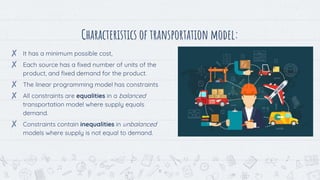
4. characteristics
✘ It has a minimum possible cost,
✘ Each source has a fixed number of units of the
product, and fixed demand for the product.
✘ The linear programming model has constraints
✘ All constraints are equalities in a balanced
transportation model where supply equals
demand.
✘ Constraints contain inequalities in unbalanced
models where supply is not equal to demand.
11
Characteristics of transportation model:
5. Two (2) phases of
solution using
transportation model
1.1 North-West Corner Rule (NWCR)
The North-West Corner Rule is a method adopted to
compute the initial feasible solution of the transportation
problem. The name North-west corner is given to this method
because the basic variables are selected from the extreme
left corner.
13
PHASE I: Initial Basic Feasible Solution
1.2 Least Cost Method (AKA Minimum Cost Method or Greedy
Method)
The Least Cost Method is another method used to obtain the initial
feasible solution for the transportation problem. Here, the allocation
begins with the cell which has the minimum cost. The lower cost cells
are chosen over the higher-cost cell with the objective to have the
least cost of transportation.
14
PHASE I: Initial Basic Feasible Solution
1.3 Vogel’s Approximation Method (VAM)
The Vogel’s Approximation Method or VAM is an
iterative procedure calculated to find out the initial
feasible solution of the transportation problem. Like
Least cost Method, here also the shipping cost is taken
into consideration, but in a relative sense.
15
PHASE II: Optimal Basic Solution
2.1 Stepping Stone Method
The Stepping Stone Method is used to check the optimality of the initial
feasible solution determined by using any of the method Viz. North-
West Corner, Least Cost Method or Vogel’s Approximation Method.
Thus, the stepping stone method is a procedure for finding the potential
of any non-basic variables (empty cells) in terms of the objective
function.
16
PHASE II: Optimal Basic Solution
2.2 Modified Distribution Method (MODI)
The modified distribution method, is also known as
MODI method or (u - v) method provides a minimum cost
solution to the transportation problems. ... The objectives
are to develop and review an integral transportation
schedule that meets all demands from the inventory at a
minimum total transportation cost.
17
“education is the passport to the
future, for tomorrow belongs to
those who prepare for it today.”
18
Thank you so much for
listening! 
19

Transportation model

  • 1.
  • 2.
  • 3.
  • 4.
    What is Transportationmodel? deals with a special class of linear programming problem in which the objective is to transport a homogenous commodity from various origins or factories to different destinations or markets at a total minimum cost. 4
  • 5.
  • 6.
    - addresses theconcept of moving a thing from one place to another, without change - used to analyze transportation systems and find the most efficient route 6
  • 7.
  • 8.
    ✘ Destination –a point of demand in transportation problem Terminologies used in transportation problem: ✘ Origin – the source or supply location in transportation. 8
  • 9.
    Terminologies used intransportation problem: ✘ Unused Squares – squares which represents routes where no quantity is shipped between a source and destination ✘ Stone Squares – used squares in transportation problem. ✘ Opportunity Cost – cost of the opportunities that are sacrificed in order to take a certain action. 9
  • 10.
  • 11.
    ✘ It hasa minimum possible cost, ✘ Each source has a fixed number of units of the product, and fixed demand for the product. ✘ The linear programming model has constraints ✘ All constraints are equalities in a balanced transportation model where supply equals demand. ✘ Constraints contain inequalities in unbalanced models where supply is not equal to demand. 11 Characteristics of transportation model:
  • 12.
    5. Two (2)phases of solution using transportation model
  • 13.
    1.1 North-West CornerRule (NWCR) The North-West Corner Rule is a method adopted to compute the initial feasible solution of the transportation problem. The name North-west corner is given to this method because the basic variables are selected from the extreme left corner. 13 PHASE I: Initial Basic Feasible Solution
  • 14.
    PHASE I: InitialBasic Feasible Solution 1.2 Least Cost Method (AKA Minimum Cost Method or Greedy Method) The Least Cost Method is another method used to obtain the initial feasible solution for the transportation problem. Here, the allocation begins with the cell which has the minimum cost. The lower cost cells are chosen over the higher-cost cell with the objective to have the least cost of transportation. 14
  • 15.
    PHASE I: InitialBasic Feasible Solution 1.3 Vogel’s Approximation Method (VAM) The Vogel’s Approximation Method or VAM is an iterative procedure calculated to find out the initial feasible solution of the transportation problem. Like Least cost Method, here also the shipping cost is taken into consideration, but in a relative sense. 15
  • 16.
    PHASE II: OptimalBasic Solution 2.1 Stepping Stone Method The Stepping Stone Method is used to check the optimality of the initial feasible solution determined by using any of the method Viz. North- West Corner, Least Cost Method or Vogel’s Approximation Method. Thus, the stepping stone method is a procedure for finding the potential of any non-basic variables (empty cells) in terms of the objective function. 16
  • 17.
    PHASE II: OptimalBasic Solution 2.2 Modified Distribution Method (MODI) The modified distribution method, is also known as MODI method or (u - v) method provides a minimum cost solution to the transportation problems. ... The objectives are to develop and review an integral transportation schedule that meets all demands from the inventory at a minimum total transportation cost. 17
  • 18.
    “education is thepassport to the future, for tomorrow belongs to those who prepare for it today.” 18
  • 19.
    Thank you somuch for listening!  19

Editor's Notes