MODI Method To Find Least
Transportation Cost
LDC INSTITUTE OF TECHNICAL STDIES, SORAON PRAYAGRAJ
BY
Dr. Mrinal Kanti Manik
Director
LDC Institute of Technical studies
Soraon, Allahabad, India
mrinalmanik64@gmail.com
Transportation Problem (MODI
Method – UV Method)
 There are two phases to solve the transportation
problem.
 In the first phase. The initial basic feasible
solution has to be found.
 The second phase involves optimization of the
initial basic feasible solution to be obtained .
 There are Four methods for finding an initial basic
feasible solution.
• Northwest Corner Method
• Row minima and Column minima Method
• Least Cost Cell Method
• Vogel’s Approximation Method
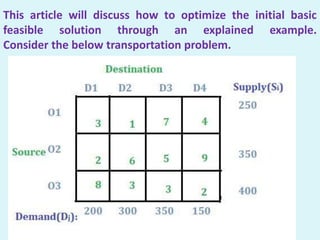
This article will discuss how to optimize the initial basic
feasible solution through an explained example.
Consider the below transportation problem.
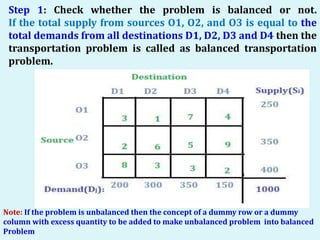
Step 1: Check whether the problem is balanced or not.
If the total supply from sources O1, O2, and O3 is equal to the
total demands from all destinations D1, D2, D3 and D4 then the
transportation problem is called as balanced transportation
problem.
Note: If the problem is unbalanced then the concept of a dummy row or a dummy
column with excess quantity to be added to make unbalanced problem into balanced
Problem
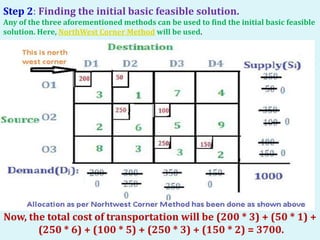
Step 2: Finding the initial basic feasible solution.
Any of the three aforementioned methods can be used to find the initial basic feasible
solution. Here, NorthWest Corner Method will be used.
Now, the total cost of transportation will be (200 * 3) + (50 * 1) +
(250 * 6) + (100 * 5) + (250 * 3) + (150 * 2) = 3700.
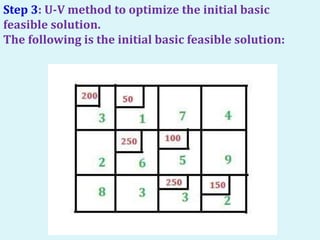
Step 3: U-V method to optimize the initial basic
feasible solution.
The following is the initial basic feasible solution:
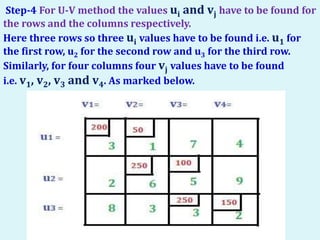
Step-4 For U-V method the values ui and vj have to be found for
the rows and the columns respectively.
Here three rows so three ui values have to be found i.e. u1 for
the first row, u2 for the second row and u3 for the third row.
Similarly, for four columns four vj values have to be found
i.e. v1, v2, v3 and v4. As marked below.
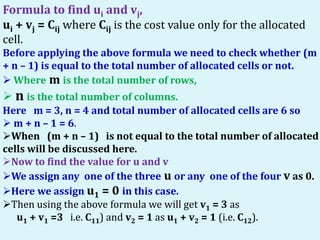
Formula to find ui and vj,
ui + vj = Cij where Cij is the cost value only for the allocated
cell.
Before applying the above formula we need to check whether (m
+ n – 1) is equal to the total number of allocated cells or not.
 Where m is the total number of rows,
 n is the total number of columns.
Here m = 3, n = 4 and total number of allocated cells are 6 so
 m + n – 1 = 6.
When (m + n – 1) is not equal to the total number of allocated
cells will be discussed here.
Now to find the value for u and v
We assign any one of the three u or any one of the four v as 0.
Here we assign u1 = 0 in this case.
Then using the above formula we will get v1 = 3 as
u1 + v1 =3 i.e. C11) and v2 = 1 as u1 + v2 = 1 (i.e. C12).
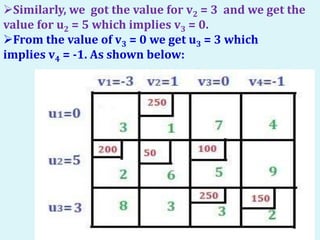
Similarly, we got the value for v2 = 3 and we get the
value for u2 = 5 which implies v3 = 0.
From the value of v3 = 0 we get u3 = 3 which
implies v4 = -1. As shown below:
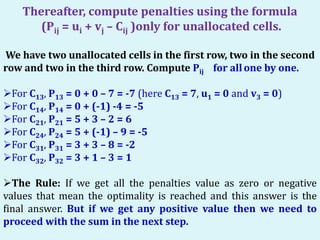
Thereafter, compute penalties using the formula
(Pij = ui + vj – Cij )only for unallocated cells.
We have two unallocated cells in the first row, two in the second
row and two in the third row. Compute Pij for allone by one.
For C13, P13 = 0 + 0 – 7 = -7 (here C13 = 7, u1 = 0 and v3 = 0)
For C14, P14 = 0 + (-1) -4 = -5
For C21, P21 = 5 + 3 – 2 = 6
For C24, P24 = 5 + (-1) – 9 = -5
For C31, P31 = 3 + 3 – 8 = -2
For C32, P32 = 3 + 1 – 3 = 1
The Rule: If we get all the penalties value as zero or negative
values that mean the optimality is reached and this answer is the
final answer. But if we get any positive value then we need to
proceed with the sum in the next step.
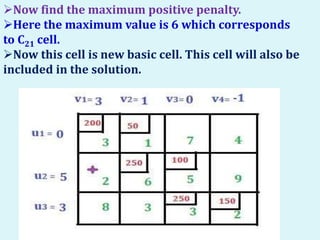
Now find the maximum positive penalty.
Here the maximum value is 6 which corresponds
to C21 cell.
Now this cell is new basic cell. This cell will also be
included in the solution.
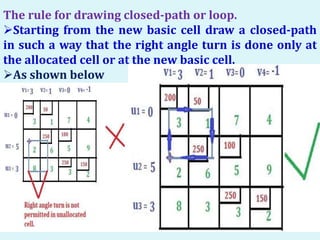
The rule for drawing closed-path or loop.
Starting from the new basic cell draw a closed-path
in such a way that the right angle turn is done only at
the allocated cell or at the new basic cell.
As shown below
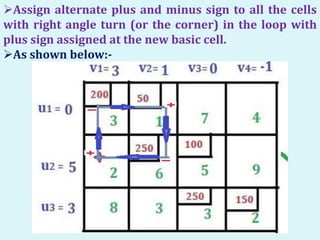
Assign alternate plus and minus sign to all the cells
with right angle turn (or the corner) in the loop with
plus sign assigned at the new basic cell.
As shown below:-
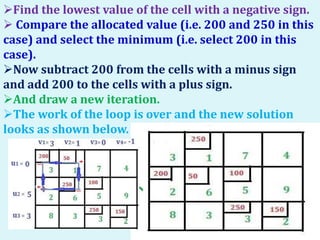
Find the lowest value of the cell with a negative sign.
 Compare the allocated value (i.e. 200 and 250 in this
case) and select the minimum (i.e. select 200 in this
case).
Now subtract 200 from the cells with a minus sign
and add 200 to the cells with a plus sign.
And draw a new iteration.
The work of the loop is over and the new solution
looks as shown below.
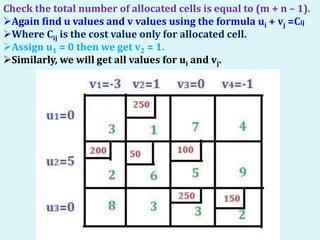
Check the total number of allocated cells is equal to (m + n – 1).
Again find u values and v values using the formula ui + vj =Cij
Where Cij is the cost value only for allocated cell.
Assign u1 = 0 then we get v2 = 1.
Similarly, we will get all values for ui and vj.
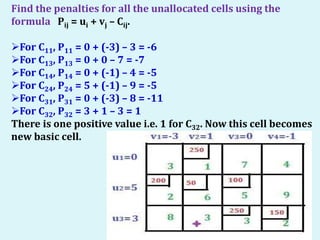
Find the penalties for all the unallocated cells using the
formula Pij = ui + vj – Cij.
For C11, P11 = 0 + (-3) – 3 = -6
For C13, P13 = 0 + 0 – 7 = -7
For C14, P14 = 0 + (-1) – 4 = -5
For C24, P24 = 5 + (-1) – 9 = -5
For C31, P31 = 0 + (-3) – 8 = -11
For C32, P32 = 3 + 1 – 3 = 1
There is one positive value i.e. 1 for C32. Now this cell becomes
new basic cell.
Now draw a loop starting from the new basic cell.
Assign alternate plus and minus sign with new basic
cell assigned as a plus sign.
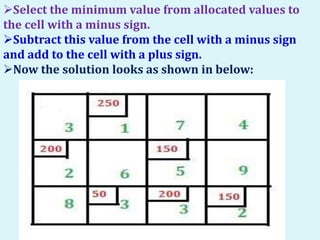
Select the minimum value from allocated values to
the cell with a minus sign.
Subtract this value from the cell with a minus sign
and add to the cell with a plus sign.
Now the solution looks as shown in below:
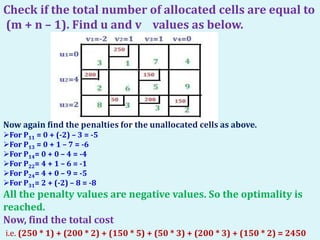
Check if the total number of allocated cells are equal to
(m + n – 1). Find u and v values as below.
Now again find the penalties for the unallocated cells as above.
For P11 = 0 + (-2) – 3 = -5
For P13 = 0 + 1 – 7 = -6
For P14= 0 + 0 – 4 = -4
For P22= 4 + 1 – 6 = -1
For P24= 4 + 0 – 9 = -5
For P31= 2 + (-2) – 8 = -8
All the penalty values are negative values. So the optimality is
reached.
Now, find the total cost
i.e. (250 * 1) + (200 * 2) + (150 * 5) + (50 * 3) + (200 * 3) + (150 * 2) = 2450
Thank you

Modi Method to find least cost in Trasportation Problem

  • 1.
    MODI Method ToFind Least Transportation Cost LDC INSTITUTE OF TECHNICAL STDIES, SORAON PRAYAGRAJ BY Dr. Mrinal Kanti Manik Director LDC Institute of Technical studies Soraon, Allahabad, India mrinalmanik64@gmail.com
  • 2.
    Transportation Problem (MODI Method– UV Method)  There are two phases to solve the transportation problem.  In the first phase. The initial basic feasible solution has to be found.  The second phase involves optimization of the initial basic feasible solution to be obtained .  There are Four methods for finding an initial basic feasible solution. • Northwest Corner Method • Row minima and Column minima Method • Least Cost Cell Method • Vogel’s Approximation Method
  • 3.
    This article willdiscuss how to optimize the initial basic feasible solution through an explained example. Consider the below transportation problem.
  • 4.
    Step 1: Checkwhether the problem is balanced or not. If the total supply from sources O1, O2, and O3 is equal to the total demands from all destinations D1, D2, D3 and D4 then the transportation problem is called as balanced transportation problem. Note: If the problem is unbalanced then the concept of a dummy row or a dummy column with excess quantity to be added to make unbalanced problem into balanced Problem
  • 5.
    Step 2: Findingthe initial basic feasible solution. Any of the three aforementioned methods can be used to find the initial basic feasible solution. Here, NorthWest Corner Method will be used. Now, the total cost of transportation will be (200 * 3) + (50 * 1) + (250 * 6) + (100 * 5) + (250 * 3) + (150 * 2) = 3700.
  • 6.
    Step 3: U-Vmethod to optimize the initial basic feasible solution. The following is the initial basic feasible solution:
  • 7.
    Step-4 For U-Vmethod the values ui and vj have to be found for the rows and the columns respectively. Here three rows so three ui values have to be found i.e. u1 for the first row, u2 for the second row and u3 for the third row. Similarly, for four columns four vj values have to be found i.e. v1, v2, v3 and v4. As marked below.
  • 8.
    Formula to findui and vj, ui + vj = Cij where Cij is the cost value only for the allocated cell. Before applying the above formula we need to check whether (m + n – 1) is equal to the total number of allocated cells or not.  Where m is the total number of rows,  n is the total number of columns. Here m = 3, n = 4 and total number of allocated cells are 6 so  m + n – 1 = 6. When (m + n – 1) is not equal to the total number of allocated cells will be discussed here. Now to find the value for u and v We assign any one of the three u or any one of the four v as 0. Here we assign u1 = 0 in this case. Then using the above formula we will get v1 = 3 as u1 + v1 =3 i.e. C11) and v2 = 1 as u1 + v2 = 1 (i.e. C12).
  • 9.
    Similarly, we gotthe value for v2 = 3 and we get the value for u2 = 5 which implies v3 = 0. From the value of v3 = 0 we get u3 = 3 which implies v4 = -1. As shown below:
  • 10.
    Thereafter, compute penaltiesusing the formula (Pij = ui + vj – Cij )only for unallocated cells. We have two unallocated cells in the first row, two in the second row and two in the third row. Compute Pij for allone by one. For C13, P13 = 0 + 0 – 7 = -7 (here C13 = 7, u1 = 0 and v3 = 0) For C14, P14 = 0 + (-1) -4 = -5 For C21, P21 = 5 + 3 – 2 = 6 For C24, P24 = 5 + (-1) – 9 = -5 For C31, P31 = 3 + 3 – 8 = -2 For C32, P32 = 3 + 1 – 3 = 1 The Rule: If we get all the penalties value as zero or negative values that mean the optimality is reached and this answer is the final answer. But if we get any positive value then we need to proceed with the sum in the next step.
  • 11.
    Now find themaximum positive penalty. Here the maximum value is 6 which corresponds to C21 cell. Now this cell is new basic cell. This cell will also be included in the solution.
  • 12.
    The rule fordrawing closed-path or loop. Starting from the new basic cell draw a closed-path in such a way that the right angle turn is done only at the allocated cell or at the new basic cell. As shown below
  • 13.
    Assign alternate plusand minus sign to all the cells with right angle turn (or the corner) in the loop with plus sign assigned at the new basic cell. As shown below:-
  • 14.
    Find the lowestvalue of the cell with a negative sign.  Compare the allocated value (i.e. 200 and 250 in this case) and select the minimum (i.e. select 200 in this case). Now subtract 200 from the cells with a minus sign and add 200 to the cells with a plus sign. And draw a new iteration. The work of the loop is over and the new solution looks as shown below.
  • 15.
    Check the totalnumber of allocated cells is equal to (m + n – 1). Again find u values and v values using the formula ui + vj =Cij Where Cij is the cost value only for allocated cell. Assign u1 = 0 then we get v2 = 1. Similarly, we will get all values for ui and vj.
  • 16.
    Find the penaltiesfor all the unallocated cells using the formula Pij = ui + vj – Cij. For C11, P11 = 0 + (-3) – 3 = -6 For C13, P13 = 0 + 0 – 7 = -7 For C14, P14 = 0 + (-1) – 4 = -5 For C24, P24 = 5 + (-1) – 9 = -5 For C31, P31 = 0 + (-3) – 8 = -11 For C32, P32 = 3 + 1 – 3 = 1 There is one positive value i.e. 1 for C32. Now this cell becomes new basic cell.
  • 17.
    Now draw aloop starting from the new basic cell. Assign alternate plus and minus sign with new basic cell assigned as a plus sign.
  • 18.
    Select the minimumvalue from allocated values to the cell with a minus sign. Subtract this value from the cell with a minus sign and add to the cell with a plus sign. Now the solution looks as shown in below:
  • 19.
    Check if thetotal number of allocated cells are equal to (m + n – 1). Find u and v values as below. Now again find the penalties for the unallocated cells as above. For P11 = 0 + (-2) – 3 = -5 For P13 = 0 + 1 – 7 = -6 For P14= 0 + 0 – 4 = -4 For P22= 4 + 1 – 6 = -1 For P24= 4 + 0 – 9 = -5 For P31= 2 + (-2) – 8 = -8 All the penalty values are negative values. So the optimality is reached. Now, find the total cost i.e. (250 * 1) + (200 * 2) + (150 * 5) + (50 * 3) + (200 * 3) + (150 * 2) = 2450
  • 20.