Transport layer protocols:
Simple Protocol , Stop and Wait Protocol , Go-Back-N Protocol (GBN) ,
Selective-Repeat Protocol , Timer , Piggybacking
Simple Protocol
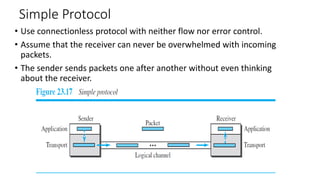
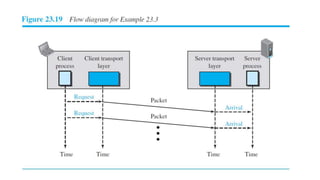
• Use connectionless protocol with neither flow nor error control.
• Assume that the receiver can never be overwhelmed with incoming
packets.
• The sender sends packets one after another without even thinking
about the receiver.
Stop and Wait Protocol
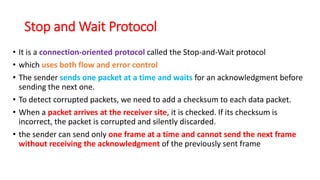
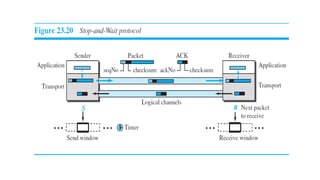
• It is a connection-oriented protocol called the Stop-and-Wait protocol
• which uses both flow and error control
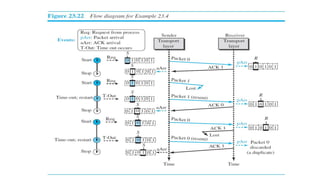
• The sender sends one packet at a time and waits for an acknowledgment before
sending the next one.
• To detect corrupted packets, we need to add a checksum to each data packet.
• When a packet arrives at the receiver site, it is checked. If its checksum is
incorrect, the packet is corrupted and silently discarded.
• the sender can send only one frame at a time and cannot send the next frame
without receiving the acknowledgment of the previously sent frame
Stop and Wait Protocol
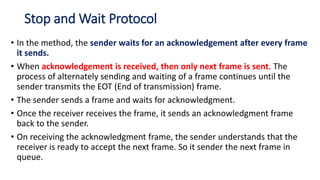
• In the method, the sender waits for an acknowledgement after every frame
it sends.
• When acknowledgement is received, then only next frame is sent. The
process of alternately sending and waiting of a frame continues until the
sender transmits the EOT (End of transmission) frame.
• The sender sends a frame and waits for acknowledgment.
• Once the receiver receives the frame, it sends an acknowledgment frame
back to the sender.
• On receiving the acknowledgment frame, the sender understands that the
receiver is ready to accept the next frame. So it sender the next frame in
queue.
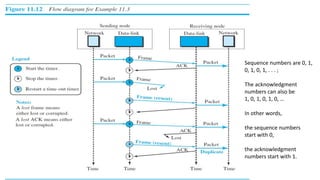
Sequence numbers are 0, 1,
0, 1, 0, 1, . . . ;
The acknowledgment
numbers can also be
1, 0, 1, 0, 1, 0, …
In other words,
the sequence numbers
start with 0,
the acknowledgment
numbers start with 1.
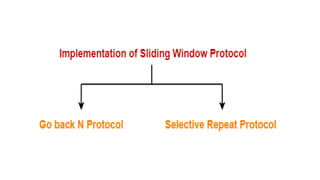
Go-Back-N Protocol (GBN)
• the multiple frames can be sent at a time.
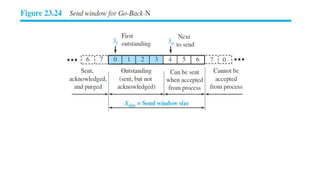
• N is the sender's window size.
• Suppose we say that Go-Back-3, which means that the three frames
can be sent at a time before expecting the acknowledgment from the
receiver.
• If the size of the sender's window is 4 then the sequence number will
be 0,1,2,3,0,1,2,3,0,1,2, and so on.
• several data packets and acknowledgments can be in the channel at
the same time.
Working of Go-Back-N ARQ
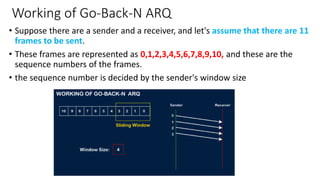
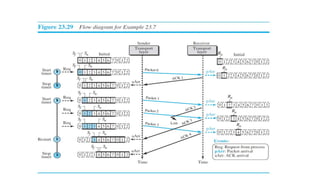
• Suppose there are a sender and a receiver, and let's assume that there are 11
frames to be sent.
• These frames are represented as 0,1,2,3,4,5,6,7,8,9,10, and these are the
sequence numbers of the frames.
• the sequence number is decided by the sender's window size
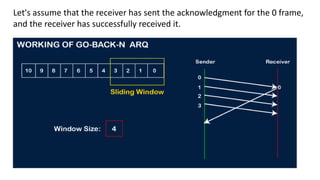
Let's assume that the receiver has sent the acknowledgment for the 0 frame,
and the receiver has successfully received it.
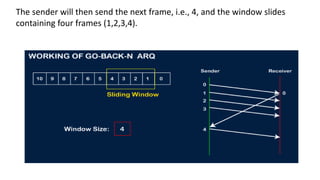
The sender will then send the next frame, i.e., 4, and the window slides
containing four frames (1,2,3,4).
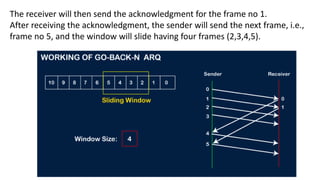
The receiver will then send the acknowledgment for the frame no 1.
After receiving the acknowledgment, the sender will send the next frame, i.e.,
frame no 5, and the window will slide having four frames (2,3,4,5).
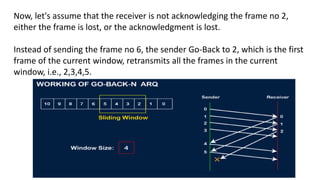
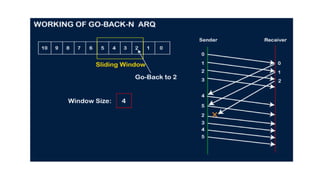
Now, let's assume that the receiver is not acknowledging the frame no 2,
either the frame is lost, or the acknowledgment is lost.
Instead of sending the frame no 6, the sender Go-Back to 2, which is the first
frame of the current window, retransmits all the frames in the current
window, i.e., 2,3,4,5.
Go back N
• Receiver maintains an acknowledgement timer.
• Each time the receiver receives a new frame, it starts a new
acknowledgement timer.
• After the timer expires, receiver sends the cumulative
acknowledgement for all the frames that are unacknowledged at that
moment.
• A new acknowledgement timer does not start after the expiry of old
acknowledgement timer.
• It starts after a new frame is received.
Important points related to Go-Back-N ARQ:
• In Go-Back-N, N determines the sender's window size, and the size
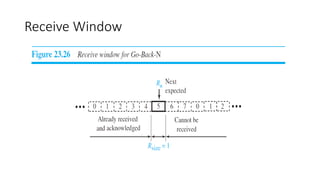
of the receiver's window is always 1.
• It does not consider the corrupted frames and simply discards
them.
• It does not accept the frames which are out of order and discards
them.
• If the sender does not receive the acknowledgment, it leads to the
retransmission of all the current window frames.
Receive Window
Go-Back-N Protocol (GBN)
• This protocol improves the efficiency of stop and wait protocol by
allowing multiple frames to be transmitted before receiving an
acknowledgment.
• Both the sender and the receiver has finite sized buffers called
windows. The sender and the receiver agrees upon the number of
frames to be sent based upon the buffer size.
• The sender sends multiple frames in a sequence, without waiting for
acknowledgment.
• When its sending window is filled, it waits for acknowledgment. On
receiving acknowledgment, it advances the window and transmits
the next frames, according to the number of acknowledgments
received.
Go-Back-N versus Stop-and-Wait
• The Go-Back-N protocol simplifies the process at the receiver.
• The receiver keeps track of only one variable, and there is no need to
buffer out-of-order packets; they are simply discarded.
• this protocol is inefficient
• Each time a single packet is lost or corrupted, the sender resends all
outstanding packets
Selective-Repeat Protocol
• Selective Repeat attempts to retransmit only those packets that are
actually lost (due to errors)
• In this protocol, the size of the sender window is always equal to the
size of the receiver window.
• If the receiver receives a corrupt frame, it does not directly discard it.
• It sends a negative acknowledgment to the sender.
• The sender sends that frame again as soon as on the receiving
negative acknowledgment. There is no waiting for any time-out to
send that frame.
Timer
•Selective-Repeat uses one timer for each outstanding
packet.
•When a timer expires, only the corresponding packet is
resent.
•GBN treats outstanding packets as a group;
•SR treats them individually.
•However, most transport-layer protocols that implement
SR use only a single timer. For this reason, we use only
one timer.
Difference between the Go-Back-N ARQ and Selective Repeat ARQ?
Go-Back-N ARQ Selective Repeat ARQ
If a frame is corrupted or lost in it,
all subsequent frames have to be sent
again.
In this, only the frame is sent again, which is
corrupted or lost.
If it has a high error rate, it wastes a lot
of bandwidth.
There is a loss of low bandwidth.
It is less complex. It is more complex because it has to do sorting
and searching as well. And it also requires more
storage.
Piggybacking
• data packets flow in only one direction and acknowledgments travel
in the other direction.
• In real life, data packets are normally flowing in both directions:
from client to server and from server to client. This means that
acknowledgments also need to flow in both directions. A technique
called piggybacking
• It is used to improve the efficiency of the bidirectional protocols.
• When a packet is carrying data from A to B, it can also carry
acknowledgment feedback about arrived packets from B; when a
packet is carrying data from B to A, it can also carry acknowledgment
feedback about the arrived packets from A
• Piggybacking is a method of attaching acknowledgment to
the outgoing data packet.

Transport layer protocols : Simple Protocol , Stop and Wait Protocol , Go-Back-N Protocol (GBN) , Selective-Repeat Protocol , Timer , Piggybacking

  • 1.
    Transport layer protocols: SimpleProtocol , Stop and Wait Protocol , Go-Back-N Protocol (GBN) , Selective-Repeat Protocol , Timer , Piggybacking
  • 2.
    Simple Protocol • Useconnectionless protocol with neither flow nor error control. • Assume that the receiver can never be overwhelmed with incoming packets. • The sender sends packets one after another without even thinking about the receiver.
  • 4.
    Stop and WaitProtocol • It is a connection-oriented protocol called the Stop-and-Wait protocol • which uses both flow and error control • The sender sends one packet at a time and waits for an acknowledgment before sending the next one. • To detect corrupted packets, we need to add a checksum to each data packet. • When a packet arrives at the receiver site, it is checked. If its checksum is incorrect, the packet is corrupted and silently discarded. • the sender can send only one frame at a time and cannot send the next frame without receiving the acknowledgment of the previously sent frame
  • 5.
    Stop and WaitProtocol • In the method, the sender waits for an acknowledgement after every frame it sends. • When acknowledgement is received, then only next frame is sent. The process of alternately sending and waiting of a frame continues until the sender transmits the EOT (End of transmission) frame. • The sender sends a frame and waits for acknowledgment. • Once the receiver receives the frame, it sends an acknowledgment frame back to the sender. • On receiving the acknowledgment frame, the sender understands that the receiver is ready to accept the next frame. So it sender the next frame in queue.
  • 6.
    Sequence numbers are0, 1, 0, 1, 0, 1, . . . ; The acknowledgment numbers can also be 1, 0, 1, 0, 1, 0, … In other words, the sequence numbers start with 0, the acknowledgment numbers start with 1.
  • 10.
    Go-Back-N Protocol (GBN) •the multiple frames can be sent at a time. • N is the sender's window size. • Suppose we say that Go-Back-3, which means that the three frames can be sent at a time before expecting the acknowledgment from the receiver. • If the size of the sender's window is 4 then the sequence number will be 0,1,2,3,0,1,2,3,0,1,2, and so on. • several data packets and acknowledgments can be in the channel at the same time.
  • 11.
    Working of Go-Back-NARQ • Suppose there are a sender and a receiver, and let's assume that there are 11 frames to be sent. • These frames are represented as 0,1,2,3,4,5,6,7,8,9,10, and these are the sequence numbers of the frames. • the sequence number is decided by the sender's window size
  • 12.
    Let's assume thatthe receiver has sent the acknowledgment for the 0 frame, and the receiver has successfully received it.
  • 13.
    The sender willthen send the next frame, i.e., 4, and the window slides containing four frames (1,2,3,4).
  • 14.
    The receiver willthen send the acknowledgment for the frame no 1. After receiving the acknowledgment, the sender will send the next frame, i.e., frame no 5, and the window will slide having four frames (2,3,4,5).
  • 15.
    Now, let's assumethat the receiver is not acknowledging the frame no 2, either the frame is lost, or the acknowledgment is lost. Instead of sending the frame no 6, the sender Go-Back to 2, which is the first frame of the current window, retransmits all the frames in the current window, i.e., 2,3,4,5.
  • 17.
    Go back N •Receiver maintains an acknowledgement timer. • Each time the receiver receives a new frame, it starts a new acknowledgement timer. • After the timer expires, receiver sends the cumulative acknowledgement for all the frames that are unacknowledged at that moment. • A new acknowledgement timer does not start after the expiry of old acknowledgement timer. • It starts after a new frame is received.
  • 18.
    Important points relatedto Go-Back-N ARQ: • In Go-Back-N, N determines the sender's window size, and the size of the receiver's window is always 1. • It does not consider the corrupted frames and simply discards them. • It does not accept the frames which are out of order and discards them. • If the sender does not receive the acknowledgment, it leads to the retransmission of all the current window frames.
  • 21.
  • 22.
    Go-Back-N Protocol (GBN) •This protocol improves the efficiency of stop and wait protocol by allowing multiple frames to be transmitted before receiving an acknowledgment. • Both the sender and the receiver has finite sized buffers called windows. The sender and the receiver agrees upon the number of frames to be sent based upon the buffer size. • The sender sends multiple frames in a sequence, without waiting for acknowledgment. • When its sending window is filled, it waits for acknowledgment. On receiving acknowledgment, it advances the window and transmits the next frames, according to the number of acknowledgments received.
  • 26.
    Go-Back-N versus Stop-and-Wait •The Go-Back-N protocol simplifies the process at the receiver. • The receiver keeps track of only one variable, and there is no need to buffer out-of-order packets; they are simply discarded. • this protocol is inefficient • Each time a single packet is lost or corrupted, the sender resends all outstanding packets
  • 27.
    Selective-Repeat Protocol • SelectiveRepeat attempts to retransmit only those packets that are actually lost (due to errors) • In this protocol, the size of the sender window is always equal to the size of the receiver window. • If the receiver receives a corrupt frame, it does not directly discard it. • It sends a negative acknowledgment to the sender. • The sender sends that frame again as soon as on the receiving negative acknowledgment. There is no waiting for any time-out to send that frame.
  • 29.
    Timer •Selective-Repeat uses onetimer for each outstanding packet. •When a timer expires, only the corresponding packet is resent. •GBN treats outstanding packets as a group; •SR treats them individually. •However, most transport-layer protocols that implement SR use only a single timer. For this reason, we use only one timer.
  • 31.
    Difference between theGo-Back-N ARQ and Selective Repeat ARQ? Go-Back-N ARQ Selective Repeat ARQ If a frame is corrupted or lost in it, all subsequent frames have to be sent again. In this, only the frame is sent again, which is corrupted or lost. If it has a high error rate, it wastes a lot of bandwidth. There is a loss of low bandwidth. It is less complex. It is more complex because it has to do sorting and searching as well. And it also requires more storage.
  • 32.
    Piggybacking • data packetsflow in only one direction and acknowledgments travel in the other direction. • In real life, data packets are normally flowing in both directions: from client to server and from server to client. This means that acknowledgments also need to flow in both directions. A technique called piggybacking • It is used to improve the efficiency of the bidirectional protocols. • When a packet is carrying data from A to B, it can also carry acknowledgment feedback about arrived packets from B; when a packet is carrying data from B to A, it can also carry acknowledgment feedback about the arrived packets from A
  • 33.
    • Piggybacking isa method of attaching acknowledgment to the outgoing data packet.