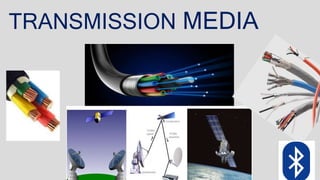
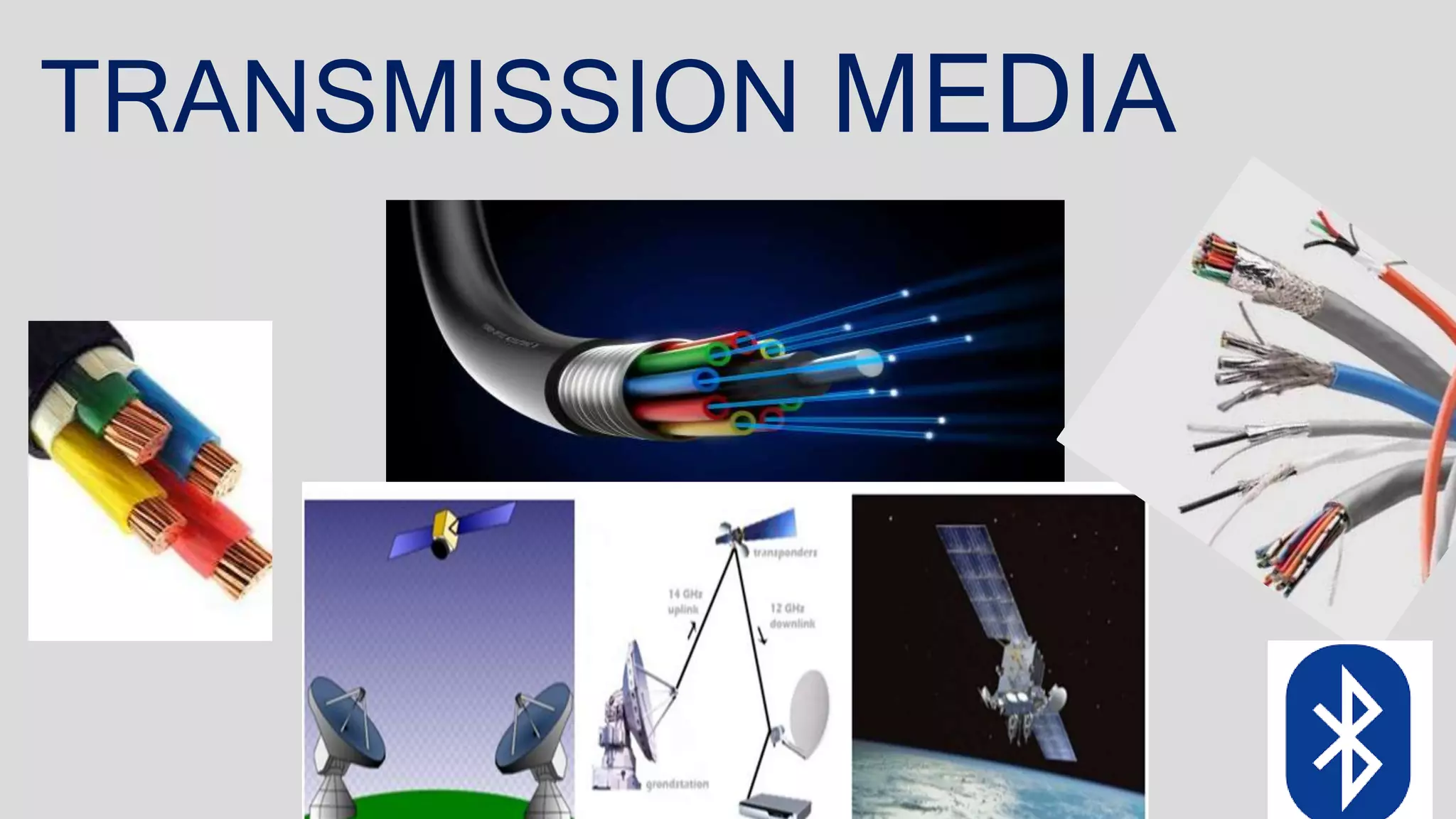
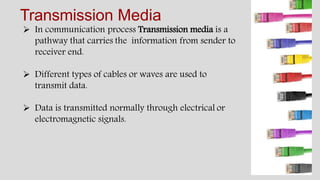

TRANSMISSION MEDIA
Transmission Media
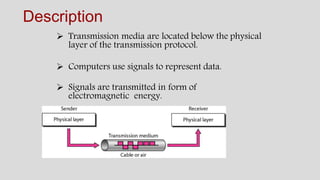
 In communication process Transmission media is a
pathway that carries the information from sender to
receiver end.
 Different types of cables or waves are used to
transmit data.
 Data is transmitted normally through electrical or
electromagnetic signals.
Description
 Transmission media are located below the physical
layer of the transmission protocol.
 Computers use signals to represent data.
 Signals are transmitted in form of
electromagnetic energy.
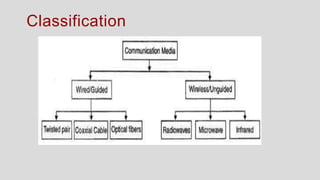
Classification
TWISTED PAIR CABLE
Advantages
Disadvantages
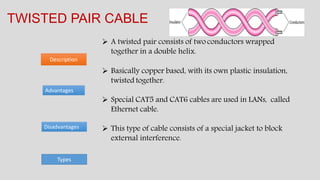
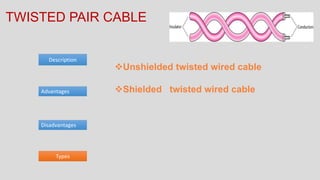
 A twisted pair consists of two conductors wrapped
together in a double helix.
 Basically copper based, with its own plastic insulation,
twisted together.
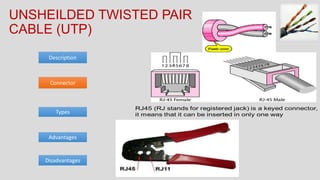
 Special CAT5 and CAT6 cables are used in LANs, called
Ethernet cable.
 This type of cable consists of a special jacket to block
external interference.
Description
Types
Advantages
Disadvantages
TWISTED PAIR CABLE
Types
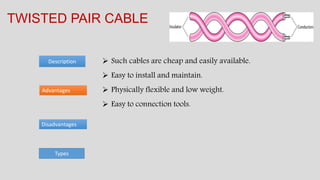
Description  Such cables are cheap and easily available.
 Easy to install and maintain.
 Physically flexible and low weight.
 Easy to connection tools.
Advantages
Disadvantages
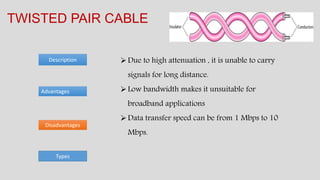
Description Due to high attenuation , it is unable to carry
signals for long distance.
Low bandwidth makes it unsuitable for
broadband applications
Data transfer speed can be from 1 Mbps to 10
Mbps.
TWISTED PAIR CABLE
Types
Advantages
Disadvantages
Description
TWISTED PAIR CABLE
Types
Unshielded twisted wired cable
Shielded twisted wired cable
Types
Advantages
Description
UNSHEILDED TWISTED PAIR
CABLE (UTP)
Disadvantages
Connector
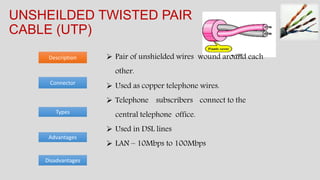
 Pair of unshielded wires wound around each
other.
 Used as copper telephone wires.
 Telephone subscribers connect to the
central telephone office.
 Used in DSL lines
 LAN – 10Mbps to 100Mbps
Types
Advantages
Description
UNSHEILDED TWISTED PAIR
CABLE (UTP)
Disadvantages
Connector
Types
Advantages
Description
UNSHEILDED TWISTED PAIR
CABLE (UTP)
Disadvantages
Connector
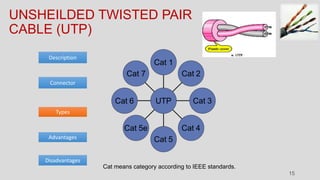
Cat 6
Cat 5e
Cat 5
Cat 4
Cat 3
Cat 1
Cat 7 Cat 2
UTP
Cat means category according to IEEE standards.
15
Types
Advantages
Description
UNSHEILDED TWISTED PAIR
CABLE (UTP)
Disadvantages
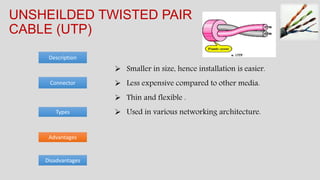
 Smaller in size, hence installation is easier.
 Less expensive compared to other media.
 Thin and flexible .
 Used in various networking architecture.
Connector
Types
Advantages
Description
UNSHEILDED TWISTED PAIR
CABLE (UTP)
Disadvantages
Connector
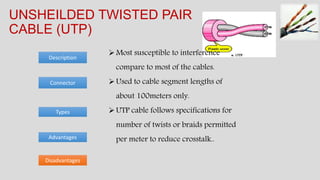
Most susceptible to interference
compare to most of the cables.
Used to cable segment lengths of
about 100meters only.
UTP cable follows specifications for
number of twists or braids permitted
per meter to reduce crosstalk..
Types
Advantages
Description
SHEILDED TWISTED PAIR CABLE
(STP)
Disadvantages
Connector
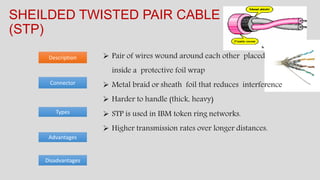
 Pair of wires wound around each other placed
inside a protective foil wrap
 Metal braid or sheath foil that reduces interference
 Harder to handle (thick, heavy)
 STP is used in IBM token ring networks.
 Higher transmission rates over longer distances.
Types
Advantages
Description
SHEILDED TWISTED PAIR CABLE
(STP)
Disadvantages
Connector
Types
Advantages
Description
SHEILDED TWISTED PAIR CABLE
(STP)
Disadvantages
Connector
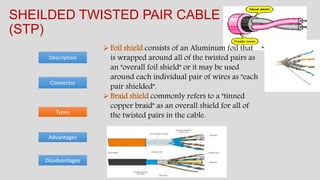
Foil shield consists of an Aluminum foil that
is wrapped around all of the twisted pairs as
an "overall foil shield" or it may be used
around each individual pair of wires as "each
pair shielded".
Braid shield commonly refers to a "tinned
copper braid" as an overall shield for all of
the twisted pairs in the cable.
Types
Advantages
Description
SHEILDED TWISTED PAIR CABLE
(STP)
Disadvantages
Connector
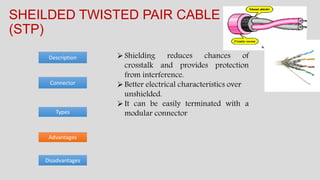
Shielding reduces chances of
crosstalk and provides protection
from interference.
Better electrical characteristics over
unshielded.
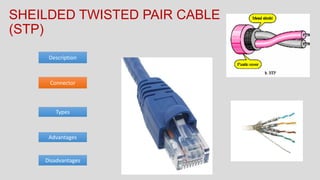
It can be easily terminated with a
modular connector
Types
Advantages
Description
SHEILDED TWISTED PAIR CABLE
(STP)
Disadvantages
Connector
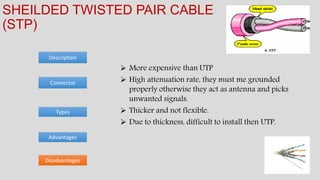
 More expensive than UTP
 High attenuation rate, they must me grounded
properly otherwise they act as antenna and picks
unwanted signals.
 Thicker and not flexible.
 Due to thickness, difficult to install then UTP.
Categories
Advantages
Description
CO-AXIAL CABLE
Disadvantages
Connectors
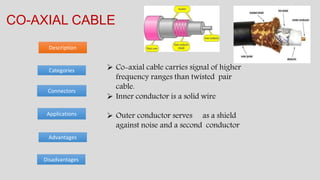
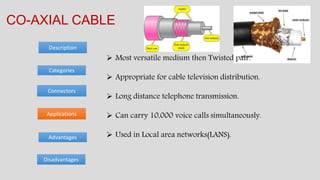
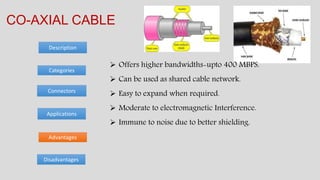
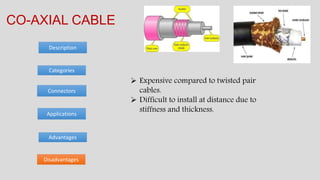
 Co-axial cable carries signal of higher
frequency ranges than twisted pair
cable.
 Inner conductor is a solid wire
 Outer conductor serves as a shield
against noise and a second conductor
Applications
Categories
Advantages
Description
CO-AXIAL CABLE
Disadvantages
Connectors
Applications
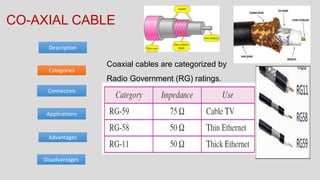
Coaxial cables are categorized by
Radio Government (RG) ratings.
Categories
Advantages
Description
CO-AXIAL CABLE
Disadvantages
Connectors
Applications
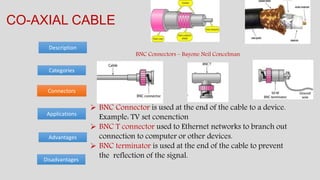
 BNC Connector is used at the end of the cable to a device.
Example: TV set conenction
 BNC T connector used to Ethernet networks to branch out
connection to computer or other devices.
 BNC terminator is used at the end of the cable to prevent
the reflection of the signal.
BNC Connectors – Bayone Neil Concelman
Categories
Advantages
Description
CO-AXIAL CABLE
Disadvantages
Connectors
Applications
 Most versatile medium then Twisted pair.
 Appropriate for cable television distribution.
 Long distance telephone transmission.
 Can carry 10,000 voice calls simultaneously.
 Used in Local area networks(LANS).
Categories
Advantages
Description
CO-AXIAL CABLE
Disadvantages
Connectors
Applications
 Offers higher bandwidths-upto 400 MBPS.
 Can be used as shared cable network.
 Easy to expand when required.
 Moderate to electromagnetic Interference.
 Immune to noise due to better shielding.
Categories
Advantages
Description
CO-AXIAL CABLE
Disadvantages
Connectors
Applications
 Expensive compared to twisted pair
cables.
 Difficult to install at distance due to
stiffness and thickness.
Cable
Advantages
Description
OPTICAL FIBER CABLE
Disadvantages
Connectors
Applications
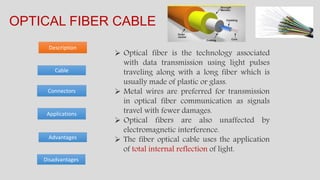
 Optical fiber is the technology associated
with data transmission using light pulses
traveling along with a long fiber which is
usually made of plastic or glass.
 Metal wires are preferred for transmission
in optical fiber communication as signals
travel with fewer damages.
 Optical fibers are also unaffected by
electromagnetic interference.
 The fiber optical cable uses the application
of total internal reflection of light.
Cable
Advantages
Description
OPTICAL FIBER CABLE
Disadvantages
Types
Applications
Categories
Advantages
Description
OPTICAL FIBER CABLE
Disadvantages
Types
Applications
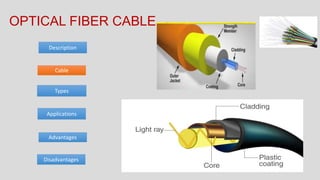
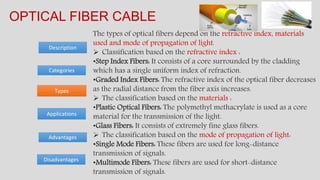
The types of optical fibers depend on the refractive index, materials
used and mode of propagation of light.
 Classification based on the refractive index :
•Step Index Fibers: It consists of a core surrounded by the cladding
which has a single uniform index of refraction.
•Graded Index Fibers: The refractive index of the optical fiber decreases
as the radial distance from the fiber axis increases.
 The classification based on the materials :
•Plastic Optical Fibers: The polymethyl methacrylate is used as a core
material for the transmission of the light.
•Glass Fibers: It consists of extremely fine glass fibers.
 The classification based on the mode of propagation of light:
•Single Mode Fibers: These fibers are used for long-distance
transmission of signals.
•Multimode Fibers: These fibers are used for short-distance
transmission of signals.
Categories
Advantages
Description
OPTICAL FIBER CABLE
Disadvantages
Types
Applications
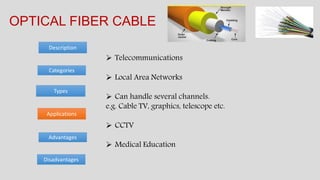
 Telecommunications
 Local Area Networks
 Can handle several channels.
e.g. Cable TV, graphics, telescope etc.
 CCTV
 Medical Education
Categories
Advantages
Description
OPTICAL FIBER CABLE
Disadvantages
Connectors
Applications
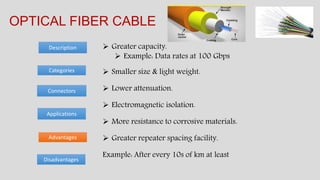
 Greater capacity.
 Example: Data rates at 100 Gbps
 Smaller size & light weight.
 Lower attenuation.
 Electromagnetic isolation.
 More resistance to corrosive materials.
 Greater repeater spacing facility.
Example: After every 10s of km at least
Categories
Advantages
Description
OPTICAL FIBER CABLE
Disadvantages
Connectors
Applications
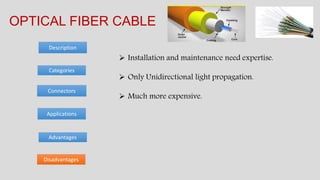
 Installation and maintenance need expertise.
 Only Unidirectional light propagation.
 Much more expensive.
Description
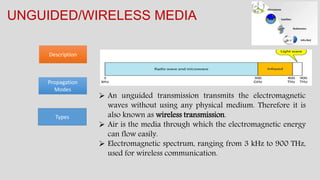
 An unguided transmission transmits the electromagnetic
waves without using any physical medium. Therefore it is
also known as wireless transmission.
 Air is the media through which the electromagnetic energy
can flow easily.
 Electromagnetic spectrum, ranging from 3 kHz to 900 THz,
used for wireless communication.
UNGUIDED/WIRELESS MEDIA
Types
Propagation
Modes
Description
UNGUIDED/WIRELESS MEDIA
Types
Propagation
Modes
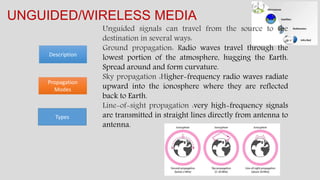
Unguided signals can travel from the source to the
destination in several ways:
Ground propagation: Radio waves travel through the
lowest portion of the atmosphere, hugging the Earth.
Spread around and form curvature.
Sky propagation :Higher-frequency radio waves radiate
upward into the ionosphere where they are reflected
back to Earth.
Line-of-sight propagation :very high-frequency signals
are transmitted in straight lines directly from antenna to
antenna.
Description
UNGUIDED/WIRELESS MEDIA
Types
Propagation
Modes
1.Radio waves
2.Micro waves
3.Infrared waves
Description
RADIO WAVES
Advantages
Applications
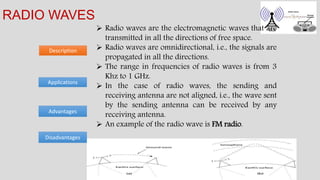
 Radio waves are the electromagnetic waves that are
transmitted in all the directions of free space.
 Radio waves are omnidirectional, i.e., the signals are
propagated in all the directions.
 The range in frequencies of radio waves is from 3
Khz to 1 GHz.
 In the case of radio waves, the sending and
receiving antenna are not aligned, i.e., the wave sent
by the sending antenna can be received by any
receiving antenna.
 An example of the radio wave is FM radio.
Disadvantages
Description
RADIO WAVES
Advantages
Applications
Disadvantages
 A Radio wave is useful for
multicasting when there is one
sender and many receivers.
 An FM radio, television, cordless
phones are examples of a radio wave.
Description
RADIO WAVES
Advantages
Applications
Disadvantages
 Radio transmission is mainly used for wide area
networks and mobile cellular phones.
 Radio waves cover a large area, and they can
penetrate the walls.
 Radio transmission provides a higher
transmission rate.
Description
RADIO WAVES
Advantages
Applications
Disadvantages
It is a very insecure communication.
Propagation is susceptible to weather effects
like rains, thunder storms.
Description
MICRO WAVES
Advantages
Applications
Disadvantages
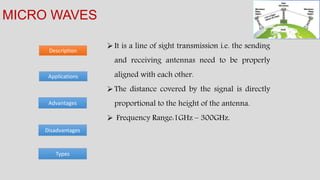
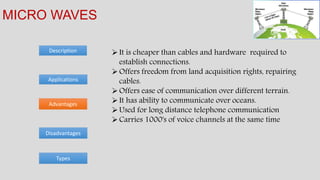
It is a line of sight transmission i.e. the sending
and receiving antennas need to be properly
aligned with each other.
The distance covered by the signal is directly
proportional to the height of the antenna.
 Frequency Range:1GHz – 300GHz.
Types
Description
MICRO WAVES
Advantages
Applications
Disadvantages
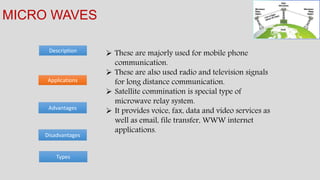
 These are majorly used for mobile phone
communication.
 These are also used radio and television signals
for long distance communication.
 Satellite commination is special type of
microwave relay system.
 It provides voice, fax, data and video services as
well as email, file transfer, WWW internet
applications.
Types
Description
MICRO WAVES
Advantages
Applications
Disadvantages
It is cheaper than cables and hardware required to
establish connections.
Offers freedom from land acquisition rights, repairing
cables.
Offers ease of communication over different terrain.
It has ability to communicate over oceans.
Used for long distance telephone communication
Carries 1000's of voice channels at the same time
Types
Description
MICRO WAVES
Advantages
Applications
Disadvantages
Types
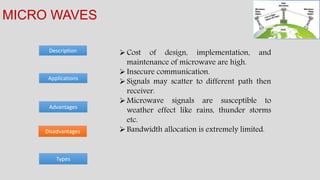
Cost of design, implementation, and
maintenance of microwave are high.
Insecure communication.
Signals may scatter to different path then
receiver.
Microwave signals are susceptible to
weather effect like rains, thunder storms
etc.
Bandwidth allocation is extremely limited.
Description
MICRO WAVES
Advantages
Applications
Disadvantages
Types
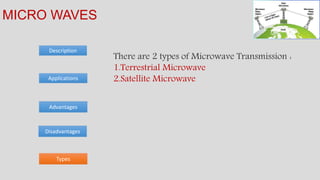
There are 2 types of Microwave Transmission :
1.Terrestrial Microwave
2.Satellite Microwave
Description
MICRO WAVES
Advantages
Applications
Disadvantages
Types
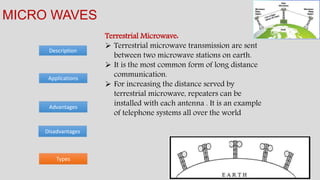
Terrestrial Microwave:
 Terrestrial microwave transmission are sent
between two microwave stations on earth.
 It is the most common form of long distance
communication.
 For increasing the distance served by
terrestrial microwave, repeaters can be
installed with each antenna . It is an example
of telephone systems all over the world
Description
MICRO WAVES
Advantages
Applications
Disadvantages
Types
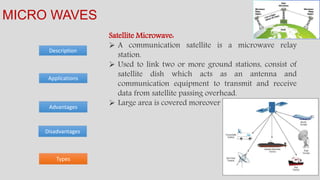
Satellite Microwave:
 A communication satellite is a microwave relay
station.
 Used to link two or more ground stations, consist of
satellite dish which acts as an antenna and
communication equipment to transmit and receive
data from satellite passing overhead.
 Large area is covered moreover intercontinental.
Description
INFRA RED
Advantages
Applications
Disadvantages
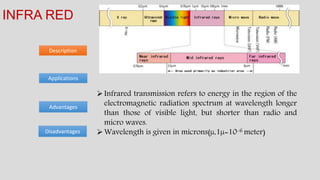
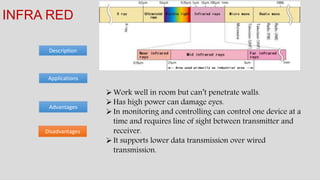
Infrared transmission refers to energy in the region of the
electromagnetic radiation spectrum at wavelength longer
than those of visible light, but shorter than radio and
micro waves.
Wavelength is given in microns(µ,1µ=10-6 meter)
Description
INFRA RED
Advantages
Applications
Disadvantages
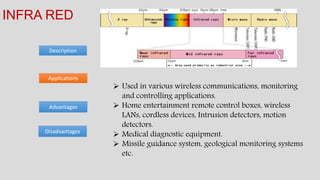
 Used in various wireless communications, monitoring
and controlling applications.
 Home entertainment remote control boxes, wireless
LANs, cordless devices, Intrusion detectors, motion
detectors.
 Medical diagnostic equipment.
 Missile guidance system, geological monitoring systems
etc.
Description
INFRA RED
Advantages
Applications
Disadvantages
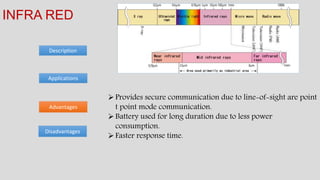
Provides secure communication due to line-of-sight are point
t point mode communication.
Battery used for long duration due to less power
consumption.
Faster response time.
Description
INFRA RED
Advantages
Applications
Disadvantages
Work well in room but can’t penetrate walls.
Has high power can damage eyes.
In monitoring and controlling can control one device at a
time and requires line of sight between transmitter and
receiver.
It supports lower data transmission over wired
transmission.
Other Unguided Media
Laser Transmission
Bluetooth
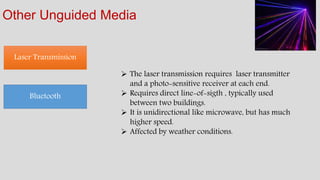
 The laser transmission requires laser transmitter
and a photo-sensitive receiver at each end.
 Requires direct line-of-sigth , typically used
between two buildings.
 It is unidirectional like microwave, but has much
higher speed.
 Affected by weather conditions.
Other Unguided Media
Laser Transmission
Bluetooth
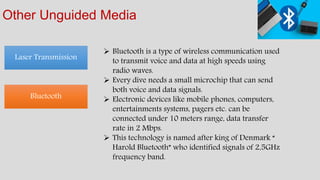
 Bluetooth is a type of wireless communication used
to transmit voice and data at high speeds using
radio waves.
 Every dive needs a small microchip that can send
both voice and data signals.
 Electronic devices like mobile phones, computers,
entertainments systems, pagers etc. can be
connected under 10 meters range, data transfer
rate in 2 Mbps.
 This technology is named after king of Denmark “
Harold Bluetooth” who identified signals of 2,5GHz
frequency band.
Transmission Media

Transmission Media