 Process State
 Process Control Block
 Operations on Processes
 Process Scheduling
 Process Synchronisation
 Interprocess Communication
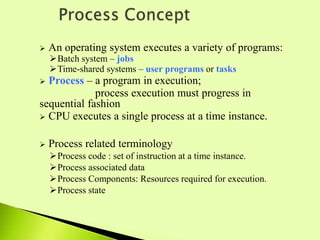
 An operating system executes a variety of programs:
Batch system – jobs
Time-shared systems – user programs or tasks
 Process – a program in execution;
process execution must progress in
sequential fashion
 CPU executes a single process at a time instance.
 Process related terminology
Process code : set of instruction at a time instance.
Process associated data
Process Components: Resources required for execution.
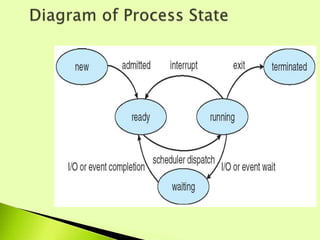
Process state
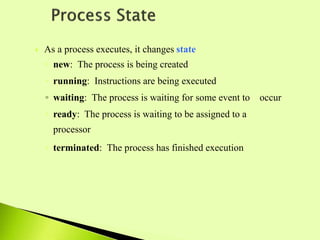
 As a process executes, it changes state
◩ new: The process is being created
◩ running: Instructions are being executed
◩ waiting: The process is waiting for some event to occur
◩ ready: The process is waiting to be assigned to a
processor
◩ terminated: The process has finished execution
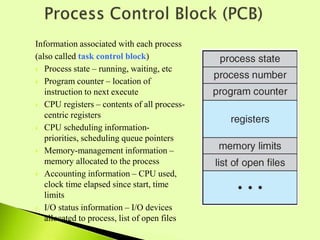
Information associated with each process
(also called task control block)
 Process state – running, waiting, etc
 Program counter – location of
instruction to next execute
 CPU registers – contents of all process-
centric registers
 CPU scheduling information-
priorities, scheduling queue pointers
 Memory-management information –
memory allocated to the process
 Accounting information – CPU used,
clock time elapsed since start, time
limits
 I/O status information – I/O devices
allocated to process, list of open files
 Maximize CPU use, quickly switch processes onto CPU
for time sharing
 Process scheduler selects among available processes for
next execution on CPU
 Maintains scheduling queues of processes
◩ Job queue – set of all processes in the system
◩ Ready queue – set of all processes residing in main
memory, ready and waiting to execute
◩ Device queues – set of processes waiting for an I/O
device
◩ Processes migrate among the various queues
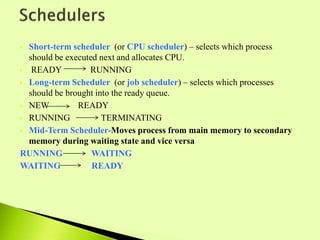
 Short-term scheduler (or CPU scheduler) – selects which process
should be executed next and allocates CPU.
 READY RUNNING
 Long-term Scheduler (or job scheduler) – selects which processes
should be brought into the ready queue.
 NEW READY
 RUNNING TERMINATING
 Mid-Term Scheduler-Moves process from main memory to secondary
memory during waiting state and vice versa
RUNNING WAITING
WAITING READY
 System must provide mechanisms for:
◩ process creation,
◩ process termination,
◩ and so on as detailed next
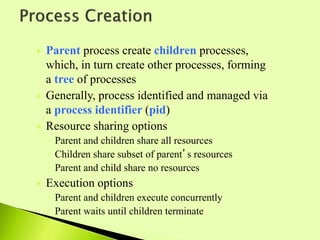
 Parent process create children processes,
which, in turn create other processes, forming
a tree of processes
 Generally, process identified and managed via
a process identifier (pid)
 Resource sharing options
◩ Parent and children share all resources
◩ Children share subset of parent’s resources
◩ Parent and child share no resources
 Execution options
◩ Parent and children execute concurrently
◩ Parent waits until children terminate
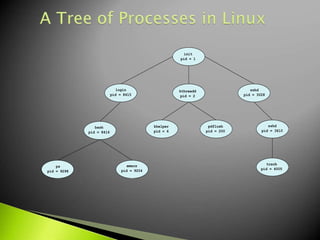
init
pid = 1
sshd
pid = 3028
login
pid = 8415
kthreadd
pid = 2
sshd
pid = 3610
pdflush
pid = 200
khelper
pid = 6
tcsch
pid = 4005
emacs
pid = 9204
bash
pid = 8416
ps
pid = 9298
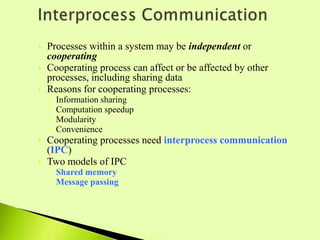
 Processes within a system may be independent or
cooperating
 Cooperating process can affect or be affected by other
processes, including sharing data
 Reasons for cooperating processes:
◩ Information sharing
◩ Computation speedup
◩ Modularity
◩ Convenience
 Cooperating processes need interprocess communication
(IPC)
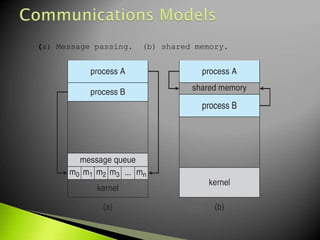
 Two models of IPC
◩ Shared memory
◩ Message passing
(a) Message passing. (b) shared memory.
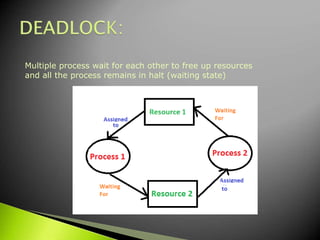
Multiple process wait for each other to free up resources
and all the process remains in halt (waiting state)

L-5 BCEProcess management.ppt

  • 2.
     Process State Process Control Block  Operations on Processes  Process Scheduling  Process Synchronisation  Interprocess Communication
  • 3.
     An operatingsystem executes a variety of programs: Batch system – jobs Time-shared systems – user programs or tasks  Process – a program in execution; process execution must progress in sequential fashion  CPU executes a single process at a time instance.  Process related terminology Process code : set of instruction at a time instance. Process associated data Process Components: Resources required for execution. Process state
  • 4.
     As aprocess executes, it changes state ◩ new: The process is being created ◩ running: Instructions are being executed ◩ waiting: The process is waiting for some event to occur ◩ ready: The process is waiting to be assigned to a processor ◩ terminated: The process has finished execution
  • 6.
    Information associated witheach process (also called task control block)  Process state – running, waiting, etc  Program counter – location of instruction to next execute  CPU registers – contents of all process- centric registers  CPU scheduling information- priorities, scheduling queue pointers  Memory-management information – memory allocated to the process  Accounting information – CPU used, clock time elapsed since start, time limits  I/O status information – I/O devices allocated to process, list of open files
  • 7.
     Maximize CPUuse, quickly switch processes onto CPU for time sharing  Process scheduler selects among available processes for next execution on CPU  Maintains scheduling queues of processes ◩ Job queue – set of all processes in the system ◩ Ready queue – set of all processes residing in main memory, ready and waiting to execute ◩ Device queues – set of processes waiting for an I/O device ◩ Processes migrate among the various queues
  • 8.
     Short-term scheduler(or CPU scheduler) – selects which process should be executed next and allocates CPU.  READY RUNNING  Long-term Scheduler (or job scheduler) – selects which processes should be brought into the ready queue.  NEW READY  RUNNING TERMINATING  Mid-Term Scheduler-Moves process from main memory to secondary memory during waiting state and vice versa RUNNING WAITING WAITING READY
  • 9.
     System mustprovide mechanisms for: ◩ process creation, ◩ process termination, ◩ and so on as detailed next
  • 10.
     Parent processcreate children processes, which, in turn create other processes, forming a tree of processes  Generally, process identified and managed via a process identifier (pid)  Resource sharing options ◩ Parent and children share all resources ◩ Children share subset of parent’s resources ◩ Parent and child share no resources  Execution options ◩ Parent and children execute concurrently ◩ Parent waits until children terminate
  • 11.
    init pid = 1 sshd pid= 3028 login pid = 8415 kthreadd pid = 2 sshd pid = 3610 pdflush pid = 200 khelper pid = 6 tcsch pid = 4005 emacs pid = 9204 bash pid = 8416 ps pid = 9298
  • 12.
     Processes withina system may be independent or cooperating  Cooperating process can affect or be affected by other processes, including sharing data  Reasons for cooperating processes: ◩ Information sharing ◩ Computation speedup ◩ Modularity ◩ Convenience  Cooperating processes need interprocess communication (IPC)  Two models of IPC ◩ Shared memory ◩ Message passing
  • 13.
    (a) Message passing.(b) shared memory.
  • 14.
    Multiple process waitfor each other to free up resources and all the process remains in halt (waiting state)