Regular Expressions
 Can be viewed as a way to specify:
 Search patterns over text string
 Design of a particular kind of machine,
called a Finite State Automaton (FSA)
 These are really equivalent
1
Uses of Regular Expressions in NLP
 As grep, perl: Simple but powerful tools for large
corpus analysis and ‘shallow’ processing
 What word is most likely to begin a sentence?
 What word is most likely to begin a question?
 In your own email, are you more or less polite than the
people you correspond with?
 With other unix tools, allow us to
 Obtain word frequency and co-occurrence statistics
 Build simple interactive applications (e.g., Eliza)
 Regular expressions define regular languages or sets
2
Regular Expressions
 Regular Expression: Formula in algebraic notation
for specifying a set of strings
 String: Any sequence of alphanumeric characters
 Letters, numbers, spaces, tabs, punctuation marks
 Regular Expression Search
 Pattern: specifying the set of strings we want to
search for
 Corpus: the texts we want to search through
3
Simple Example
 Sequence of simple characters:
4
RE DESCRIPTION USES
/This/ Matches the string
“This”
Finding the word “this”
starting a sentence
/this/ Matches the string
“this”
Finding the word “this”
internal to a sentence.
/[Tt]his/ Matches either “This” or
“this” -- disjunction
Finding the word “this”
anywhere in a sentence.
Some Examples
RE Description Uses
/./ Wild card; Any
char except <cr>
A non-blank line?
/a/ Any ‘a’ Line with words?
/[ab]/ A choice
/[a-z]/ l.c. char (range) Common noun?
/[A-Z]/ u.c. char Proper noun?
/[^?.!]/ Neg of set Not S-final punc
5
6
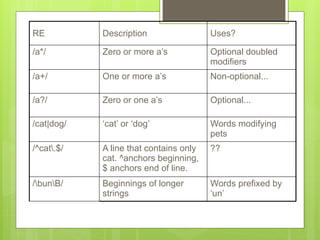
RE Description Uses?
/a*/ Zero or more a’s Optional doubled
modifiers
/a+/ One or more a’s Non-optional...
/a?/ Zero or one a’s Optional...
/cat|dog/ ‘cat’ or ‘dog’ Words modifying
pets
/^cat.$/ A line that contains only
cat. ^anchors beginning,
$ anchors end of line.
??
/bunB/ Beginnings of longer
strings
Words prefixed by
‘un’
7
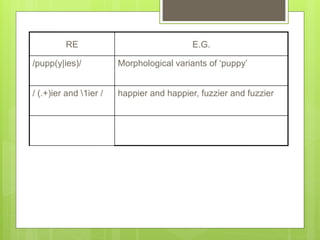
happier and happier, fuzzier and fuzzier
/ (.+)ier and 1ier /
Morphological variants of ‘puppy’
/pupp(y|ies)/
E.G.
RE
Optionality and Repetition
 /[Ww]oodchucks?/ matches
woodchucks,
Woodchucks, woodchuck, Woodchuck
 /colou?r/ matches color or colour
 /he{3}/ matches heee
 /(he){3}/ matches hehehe
 /(he){3,} matches a sequence of at least
3 he’s
8
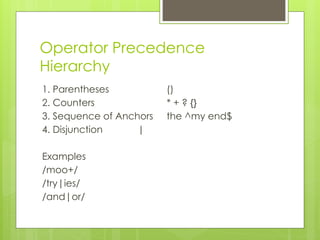
Operator Precedence
Hierarchy
1. Parentheses ()
2. Counters * + ? {}
3. Sequence of Anchors the ^my end$
4. Disjunction |
Examples
/moo+/
/try|ies/
/and|or/
9
A Simple Exercise
 Write a regular expression to find all
instances of the determiner “the”:
/the/
/[tT]he/
/b[tT]heb/
/(^|[^a-zA-Z][tT]he[^a-zA-Z]/
The recent attempt by the police to retain
their current rates of pay has not
gathered much favor with the southern
factions.
10
A Simple Exercise
 Write a regular expression to find all
instances of the determiner “the”:
/the/
/[tT]he/
/b[tT]heb/
/(^|[^a-zA-Z][tT]he[^a-zA-Z]/
The recent attempt by the police to retain
their current rates of pay has not
gathered much favor with
southern factions.
11
A Simple Exercise
 Write a regular expression to find all
instances of the determiner “the”:
/the/
/[tT]he/
/b[tT]heb/
/(^|[^a-zA-Z][tT]he[^a-zA-Z]/
The recent attempt by the police to retain
their current rates of pay has not
gathered much favor with the southern
factions.
12
A Simple Exercise
 Write a regular expression to find all
instances of the determiner “the”:
/the/
/[tT]he/
/b[tT]heb/
/(^|[^a-zA-Z][tT]he[^a-zA-Z]/
The recent attempt by the police to retain
their current rates of pay has not gathered
much favor with the southern factions.
13
A Simple Exercise
 Write a regular expression to find all
instances of the determiner “the”:
/the/
/[tT]he/
/b[tT]heb/
/(^|[^a-zA-Z][tT]he[^a-zA-Z]/
The recent attempt by the police to retain
their current rates of pay has not
gathered much favor with the southern
factions.
14
A Simple Exercise
 Write a regular expression to find all
instances of the determiner “the”:
/the/
/[tT]he/
/b[tT]heb/
/(^|[^a-zA-Z])[tT]he[^a-zA-Z]/
The recent attempt by the police to retain
their current rates of pay has not
gathered much favor with the southern
factions.
15
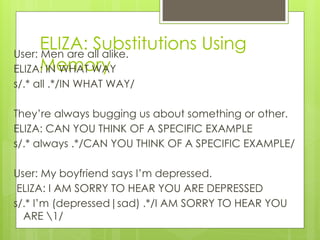
ELIZA: Substitutions Using
Memory
User: Men are all alike.
ELIZA: IN WHAT WAY
s/.* all .*/IN WHAT WAY/
They’re always bugging us about something or other.
ELIZA: CAN YOU THINK OF A SPECIFIC EXAMPLE
s/.* always .*/CAN YOU THINK OF A SPECIFIC EXAMPLE/
User: My boyfriend says I’m depressed.
ELIZA: I AM SORRY TO HEAR YOU ARE DEPRESSED
s/.* I’m (depressed|sad) .*/I AM SORRY TO HEAR YOU
ARE 1/
16
Using RE’s: Examples
 Predictions from a news corpus:
 Which candidate for Governor of California is
mentioned most often in the news? Is going to
win?
 What stock should you buy?
 Which White House advisers have the most power?
 Language use:
 Which form of comparative is more frequent:
‘oftener’ or ‘more often’?
 Which pronouns are conjoined most often?
 How often do sentences end with infinitival ‘to’?
 What words most often begin and end sentences?
 What’s the most common word in your email? Is it
different from your neighbor?
17
 Personality profiling:
 Are you more or less polite than the people you
correspond with?
 With labeled data, which words signal friendly
messages vs. unfriendly ones?
18
Finite State Automata
 Regular Expressions (REs) can be viewed
as a way to describe machines called
Finite State Automata (FSA, also known as
automata, finite automata).
 FSAs and their close variants are a
theoretical foundation of much of the
field of NLP.
19
Finite State Automata
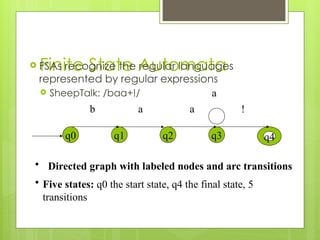
 FSAs recognize the regular languages
represented by regular expressions
 SheepTalk: /baa+!/
20
q0 q4
q1 q2 q3
b a
a
a !
• Directed graph with labeled nodes and arc transitions
• Five states: q0 the start state, q4 the final state, 5
transitions
Formally
 FSA is a 5-tuple consisting of
 Q: set of states {q0,q1,q2,q3,q4}
 : an alphabet of symbols {a,b,!}
 q0: a start state
 F: a set of final states in Q {q4}
 (q,i): a transition function mapping Q x  to Q
21
q0 q4
q1 q2 q3
b a
a
a !
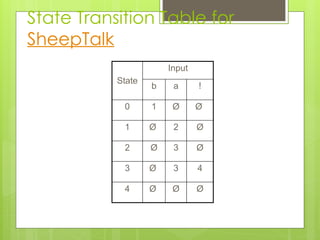
State Transition Table for
SheepTalk
State
Input
b a !
0 1 Ø Ø
1 Ø 2 Ø
2 Ø 3 Ø
3 Ø 3 4
4 Ø Ø Ø
22
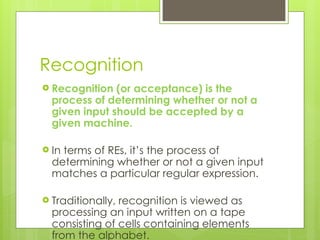
Recognition
 Recognition (or acceptance) is the
process of determining whether or not a
given input should be accepted by a
given machine.
 In terms of REs, it’s the process of
determining whether or not a given input
matches a particular regular expression.
 Traditionally, recognition is viewed as
processing an input written on a tape
consisting of cells containing elements
from the alphabet.
23
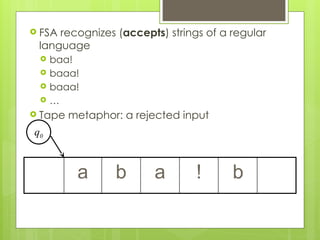
 FSA recognizes (accepts) strings of a regular
language
 baa!
 baaa!
 baaa!
 …
 Tape metaphor: a rejected input
24
b
!
a
b
a
q0
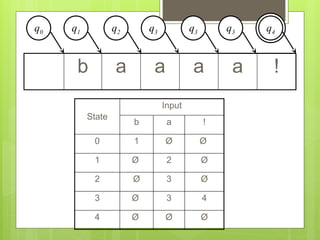
State
Input
b a !
0 1 Ø Ø
1 Ø 2 Ø
2 Ø 3 Ø
3 Ø 3 4
4 Ø Ø Ø
25
b a a a a !
q0 q3 q3 q4
q1 q2 q3
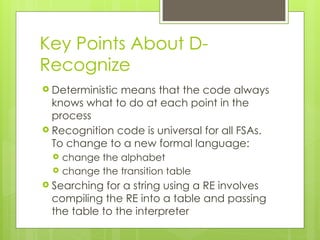
Key Points About D-
Recognize
 Deterministic means that the code always
knows what to do at each point in the
process
 Recognition code is universal for all FSAs.
To change to a new formal language:
 change the alphabet
 change the transition table
 Searching for a string using a RE involves
compiling the RE into a table and passing
the table to the interpreter
26
Determinism and Non-
Determinism
 Deterministic: There is at most one
transition that can be taken given a
current state and input symbol.
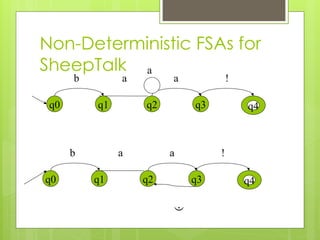
 Non-deterministic: There is a choice of
several transitions that can be taken
given a current state and input symbol.
(The machine doesn’t specify how to
make the choice.)
27
Non-Deterministic FSAs for
SheepTalk
28
q0 q4
q1 q2 q3
b a
a
a !
q0 q4
q1 q2 q3
b a a !

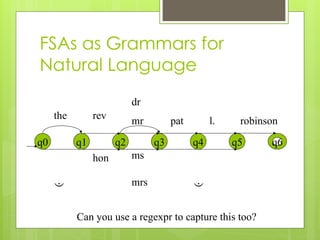
FSAs as Grammars for
Natural Language
29
q2 q4 q5
q0 q3
q1 q6
the rev mr
dr
hon
pat l. robinson
ms
mrs 

Can you use a regexpr to capture this too?
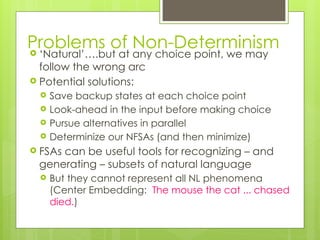
Problems of Non-Determinism
 ‘Natural’….but at any choice point, we may
follow the wrong arc
 Potential solutions:
 Save backup states at each choice point
 Look-ahead in the input before making choice
 Pursue alternatives in parallel
 Determinize our NFSAs (and then minimize)
 FSAs can be useful tools for recognizing – and
generating – subsets of natural language
 But they cannot represent all NL phenomena
(Center Embedding: The mouse the cat ... chased
died.)
30

Regular-expressions in NLP and regular expression with example

  • 1.
    Regular Expressions  Canbe viewed as a way to specify:  Search patterns over text string  Design of a particular kind of machine, called a Finite State Automaton (FSA)  These are really equivalent 1
  • 2.
    Uses of RegularExpressions in NLP  As grep, perl: Simple but powerful tools for large corpus analysis and ‘shallow’ processing  What word is most likely to begin a sentence?  What word is most likely to begin a question?  In your own email, are you more or less polite than the people you correspond with?  With other unix tools, allow us to  Obtain word frequency and co-occurrence statistics  Build simple interactive applications (e.g., Eliza)  Regular expressions define regular languages or sets 2
  • 3.
    Regular Expressions  RegularExpression: Formula in algebraic notation for specifying a set of strings  String: Any sequence of alphanumeric characters  Letters, numbers, spaces, tabs, punctuation marks  Regular Expression Search  Pattern: specifying the set of strings we want to search for  Corpus: the texts we want to search through 3
  • 4.
    Simple Example  Sequenceof simple characters: 4 RE DESCRIPTION USES /This/ Matches the string “This” Finding the word “this” starting a sentence /this/ Matches the string “this” Finding the word “this” internal to a sentence. /[Tt]his/ Matches either “This” or “this” -- disjunction Finding the word “this” anywhere in a sentence.
  • 5.
    Some Examples RE DescriptionUses /./ Wild card; Any char except <cr> A non-blank line? /a/ Any ‘a’ Line with words? /[ab]/ A choice /[a-z]/ l.c. char (range) Common noun? /[A-Z]/ u.c. char Proper noun? /[^?.!]/ Neg of set Not S-final punc 5
  • 6.
    6 RE Description Uses? /a*/Zero or more a’s Optional doubled modifiers /a+/ One or more a’s Non-optional... /a?/ Zero or one a’s Optional... /cat|dog/ ‘cat’ or ‘dog’ Words modifying pets /^cat.$/ A line that contains only cat. ^anchors beginning, $ anchors end of line. ?? /bunB/ Beginnings of longer strings Words prefixed by ‘un’
  • 7.
    7 happier and happier,fuzzier and fuzzier / (.+)ier and 1ier / Morphological variants of ‘puppy’ /pupp(y|ies)/ E.G. RE
  • 8.
    Optionality and Repetition /[Ww]oodchucks?/ matches woodchucks, Woodchucks, woodchuck, Woodchuck  /colou?r/ matches color or colour  /he{3}/ matches heee  /(he){3}/ matches hehehe  /(he){3,} matches a sequence of at least 3 he’s 8
  • 9.
    Operator Precedence Hierarchy 1. Parentheses() 2. Counters * + ? {} 3. Sequence of Anchors the ^my end$ 4. Disjunction | Examples /moo+/ /try|ies/ /and|or/ 9
  • 10.
    A Simple Exercise Write a regular expression to find all instances of the determiner “the”: /the/ /[tT]he/ /b[tT]heb/ /(^|[^a-zA-Z][tT]he[^a-zA-Z]/ The recent attempt by the police to retain their current rates of pay has not gathered much favor with the southern factions. 10
  • 11.
    A Simple Exercise Write a regular expression to find all instances of the determiner “the”: /the/ /[tT]he/ /b[tT]heb/ /(^|[^a-zA-Z][tT]he[^a-zA-Z]/ The recent attempt by the police to retain their current rates of pay has not gathered much favor with southern factions. 11
  • 12.
    A Simple Exercise Write a regular expression to find all instances of the determiner “the”: /the/ /[tT]he/ /b[tT]heb/ /(^|[^a-zA-Z][tT]he[^a-zA-Z]/ The recent attempt by the police to retain their current rates of pay has not gathered much favor with the southern factions. 12
  • 13.
    A Simple Exercise Write a regular expression to find all instances of the determiner “the”: /the/ /[tT]he/ /b[tT]heb/ /(^|[^a-zA-Z][tT]he[^a-zA-Z]/ The recent attempt by the police to retain their current rates of pay has not gathered much favor with the southern factions. 13
  • 14.
    A Simple Exercise Write a regular expression to find all instances of the determiner “the”: /the/ /[tT]he/ /b[tT]heb/ /(^|[^a-zA-Z][tT]he[^a-zA-Z]/ The recent attempt by the police to retain their current rates of pay has not gathered much favor with the southern factions. 14
  • 15.
    A Simple Exercise Write a regular expression to find all instances of the determiner “the”: /the/ /[tT]he/ /b[tT]heb/ /(^|[^a-zA-Z])[tT]he[^a-zA-Z]/ The recent attempt by the police to retain their current rates of pay has not gathered much favor with the southern factions. 15
  • 16.
    ELIZA: Substitutions Using Memory User:Men are all alike. ELIZA: IN WHAT WAY s/.* all .*/IN WHAT WAY/ They’re always bugging us about something or other. ELIZA: CAN YOU THINK OF A SPECIFIC EXAMPLE s/.* always .*/CAN YOU THINK OF A SPECIFIC EXAMPLE/ User: My boyfriend says I’m depressed. ELIZA: I AM SORRY TO HEAR YOU ARE DEPRESSED s/.* I’m (depressed|sad) .*/I AM SORRY TO HEAR YOU ARE 1/ 16
  • 17.
    Using RE’s: Examples Predictions from a news corpus:  Which candidate for Governor of California is mentioned most often in the news? Is going to win?  What stock should you buy?  Which White House advisers have the most power?  Language use:  Which form of comparative is more frequent: ‘oftener’ or ‘more often’?  Which pronouns are conjoined most often?  How often do sentences end with infinitival ‘to’?  What words most often begin and end sentences?  What’s the most common word in your email? Is it different from your neighbor? 17
  • 18.
     Personality profiling: Are you more or less polite than the people you correspond with?  With labeled data, which words signal friendly messages vs. unfriendly ones? 18
  • 19.
    Finite State Automata Regular Expressions (REs) can be viewed as a way to describe machines called Finite State Automata (FSA, also known as automata, finite automata).  FSAs and their close variants are a theoretical foundation of much of the field of NLP. 19
  • 20.
    Finite State Automata FSAs recognize the regular languages represented by regular expressions  SheepTalk: /baa+!/ 20 q0 q4 q1 q2 q3 b a a a ! • Directed graph with labeled nodes and arc transitions • Five states: q0 the start state, q4 the final state, 5 transitions
  • 21.
    Formally  FSA isa 5-tuple consisting of  Q: set of states {q0,q1,q2,q3,q4}  : an alphabet of symbols {a,b,!}  q0: a start state  F: a set of final states in Q {q4}  (q,i): a transition function mapping Q x  to Q 21 q0 q4 q1 q2 q3 b a a a !
  • 22.
    State Transition Tablefor SheepTalk State Input b a ! 0 1 Ø Ø 1 Ø 2 Ø 2 Ø 3 Ø 3 Ø 3 4 4 Ø Ø Ø 22
  • 23.
    Recognition  Recognition (oracceptance) is the process of determining whether or not a given input should be accepted by a given machine.  In terms of REs, it’s the process of determining whether or not a given input matches a particular regular expression.  Traditionally, recognition is viewed as processing an input written on a tape consisting of cells containing elements from the alphabet. 23
  • 24.
     FSA recognizes(accepts) strings of a regular language  baa!  baaa!  baaa!  …  Tape metaphor: a rejected input 24 b ! a b a q0
  • 25.
    State Input b a ! 01 Ø Ø 1 Ø 2 Ø 2 Ø 3 Ø 3 Ø 3 4 4 Ø Ø Ø 25 b a a a a ! q0 q3 q3 q4 q1 q2 q3
  • 26.
    Key Points AboutD- Recognize  Deterministic means that the code always knows what to do at each point in the process  Recognition code is universal for all FSAs. To change to a new formal language:  change the alphabet  change the transition table  Searching for a string using a RE involves compiling the RE into a table and passing the table to the interpreter 26
  • 27.
    Determinism and Non- Determinism Deterministic: There is at most one transition that can be taken given a current state and input symbol.  Non-deterministic: There is a choice of several transitions that can be taken given a current state and input symbol. (The machine doesn’t specify how to make the choice.) 27
  • 28.
    Non-Deterministic FSAs for SheepTalk 28 q0q4 q1 q2 q3 b a a a ! q0 q4 q1 q2 q3 b a a ! 
  • 29.
    FSAs as Grammarsfor Natural Language 29 q2 q4 q5 q0 q3 q1 q6 the rev mr dr hon pat l. robinson ms mrs   Can you use a regexpr to capture this too?
  • 30.
    Problems of Non-Determinism ‘Natural’….but at any choice point, we may follow the wrong arc  Potential solutions:  Save backup states at each choice point  Look-ahead in the input before making choice  Pursue alternatives in parallel  Determinize our NFSAs (and then minimize)  FSAs can be useful tools for recognizing – and generating – subsets of natural language  But they cannot represent all NL phenomena (Center Embedding: The mouse the cat ... chased died.) 30

Editor's Notes

  • #4 Note the // are part of perl – not part of the regular expression. – also assuming pattern is going to return an entire string.
  • #5 Note: [^ - is not – i.e., at the beginning of a disjunction. Later in the disjunction it really means the ^.
  • #6 Note: yet another use of ^ but this time in a different context… it means to start a line! \b matches a word boundary; \B matches a word-non-boundary – a word is a sequence of digits, underscores, letters
  • #9 Because counters have a higher precidence than sequence, this matches mooooooo. The second one probably does not do what is expected – would match try or ies, but not tries. The third does work as expected.
  • #15 The \b counts words as any sequence of digits, undercores, or letters. Suppose you wanted to find “the” in the context of _the or the28. Could you write that one. Last one: either it starts a line, or the thing in front of it is not a letter; followed by either t or T; followed by he where the following character is not a letter.
  • #26 So, the determinism has nothing to do with the code – it has to do with the transition table. In particular, there is exactly 1 entry in the table in each cell (and there are no empty moves).