Michelle Post, Ph.D.
Elliott Masie (2006) states,
 “All learning is blended learning.”
 “Great learning is blended.”


                             ©Michelle Post, Ph.D.   10/12/2012   2
   Definition of Blended Learning
   Why Blended Learning
   Importance of Blended Learning
   Six Issues of Blended Learning
   Advantages / Disadvantages of Blended
    Learning
   Different Levels of Blended Learning
   Categories of Blended Learning
   Pedagogical Techniques for eLearning

                           ©Michelle Post, Ph.D.   10/12/2012   3
   Transitioning Faculty to Blended Learning
   Hoffman’s BL Train-the Trainer Training
    Agenda
   Tools for Faculty Teaching in a Blended
    Learning Format
   What Does the Future Hold for Blended
    Learning
   Emerging Technologies for eLearning
   Future Trends in Blended Learning
   References
   Resources

                              ©Michelle Post, Ph.D.   10/12/2012   4
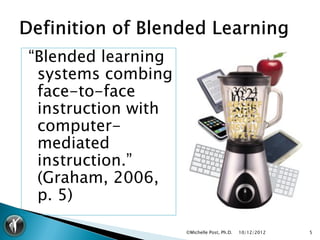
“Blended learning
 systems combing
 face-to-face
 instruction with
 computer-
 mediated
 instruction.”
 (Graham, 2006,
 p. 5)

                    ©Michelle Post, Ph.D.   10/12/2012   5
Per Osguthorpe and Graham (2003) there are
  six reasons for the use of blended learning.
1. Pedagogical richness
2. Access to knowledge
3. Social interaction
4. Personal agency
5. Cost-effectiveness
6. Ease of revision


                            ©Michelle Post, Ph.D.   10/12/2012   6
   “American Society for Training and
    Development identified blended learning as
    one of the top ten trends to emerge in the
    knowledge delivery industry” (Rooney, 2003
    as cited in Bonk & Graham, 2006, p. 3)
   The President of Pennsylvania State University
    was quoted as saying, “that the convergence
    between online and residential instruction
    was the single-greatest unrecognized trend
    in higher education today” (Young, 2002, as
    cited in Bonk & Graham, 2006, p. 3)

                              ©Michelle Post, Ph.D.   10/12/2012   7
1.   The role of live interaction
2.   The role of learner choice and self-
     regulation
3.   Models for support and training
4.   Finding balance between innovation and
     production
5.   Cultural adaptation
6.   Dealing with the digital divide (Graham,
     2006, p. 14)


                             ©Michelle Post, Ph.D.   10/12/2012   8
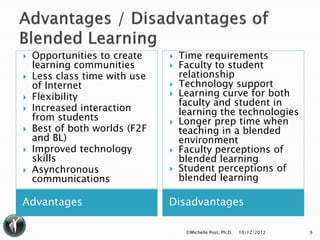
   Opportunities to create       Time requirements
    learning communities          Faculty to student
   Less class time with use       relationship
    of Internet                   Technology support
   Flexibility                   Learning curve for both
                                   faculty and student in
   Increased interaction          learning the technologies
    from students                 Longer prep time when
   Best of both worlds (F2F       teaching in a blended
    and BL)                        environment
   Improved technology           Faculty perceptions of
    skills                         blended learning
   Asynchronous                  Student perceptions of
    communications                 blended learning

Advantages                     Disadvantages

                                    ©Michelle Post, Ph.D.   10/12/2012   9
Graham (2006) identify four levels of blended
  learning
1. Activity-Level Blending – this level occurs
    “when a learning activity contains both
    face-to-face and computer-mediated (CM)
    elements.”
2. Course-Level Blending – this level is the
    most common way to blend and is a
    “combination of distinct face-to-face and
    CM activities used as part of a course.”


                            ©Michelle Post, Ph.D.   10/12/2012   10
3.   Program-Level Blending – blending at this
     level could be one of two models: (1) a
     learner chooses a mix in his/her program of
     face-to-face with online, or (2) the learner’s
     program is prescribed with a mixture of
     face-to-face and online already.
4.   Institutional-Level Blending – this model is
     where the institution has chosen to blend
     its course offerings in a blended model with
     face-to-face and CM instruction.


                              ©Michelle Post, Ph.D.   10/12/2012   11
   Enabling blends – focuses on addressing
    issues of access and convenience
   Enhancing blends – focuses on incremental
    changes to the pedagogy but do not radically
    change the way teaching and learning occurs
   Transforming blends – focuses on a radical
    transformation of the pedagogy (Graham,
    2006, p. 13)


                             ©Michelle Post, Ph.D.   10/12/2012   12
Bonk, Kim, & Zeng (2006) identified the
  following 12 pedagogical techniques.
1. Group problem-solving and collaborative
    tasks
2. Problem-based learning
3. Discussion
4. Case-based strategies
5. Simulation or role play
6. Student-generated content


                          ©Michelle Post, Ph.D.   10/12/2012   13
7.    Coaching and mentoring
8.    Guided learning
9.    Exploratory or discovery
10.   Lecturing or teacher-directed activities
11.   Modeling of the solution process
12.   Socratic questioning


                               ©Michelle Post, Ph.D.   10/12/2012   14
   The Organization (Support) – Has the budget and staff to
    support blended learning development. The organization
    needs to view a move to blended learning as a change
    initiative. The organization needs to be ready, willing, and
    able to make the change to a blended learning
    environment. (Hofmann, 2006, p. 39)
   The Course Designers – “Blending technologies that take
    advantage of learning styles, learner convenience, and the
    best practices of instructional design enable course
    developers to create programs that engage the learner and
    maximize learning retention” (Hofmann, 2006, p. 29).
   Faculty - “. . . The entire blended learning experience,
    including the self-directed components, is instructor led”
    (Hofmann, 2006, p. 35).
   Learners (customers) – Learners can aid in the creation of
    life long relationships through blended learning


                                      ©Michelle Post, Ph.D.   10/12/2012   15
   Facilitators need to approach a blended
    environment just as they would a traditional
    teaching environment
   Facilitators need to learn from their mistakes ---
    and not be afraid to make mistakes
   Facilitators need to participate in as many
    blended learning opportunities as possible
   Facilitators need to learn ALL of the technologies
    of a blended learning environment
   Facilitators need to know how to facilitate each
    individual technologies
   Practice, Practice, Practice

                                 ©Michelle Post, Ph.D.   10/12/2012   16
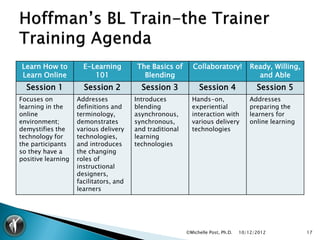
Learn How to          E-Learning        The Basics of        Collaboratory!           Ready, Willing,
Learn Online             101              Blending                                      and Able
  Session 1           Session 2           Session 3            Session 4                Session 5
Focuses on          Addresses           Introduces          Hands-on,                 Addresses
learning in the     definitions and     blending            experiential              preparing the
online              terminology,        asynchronous,       interaction with          learners for
environment;        demonstrates        synchronous,        various delivery          online learning
demystifies the     various delivery    and traditional     technologies
technology for      technologies,       learning
the participants    and introduces      technologies
so they have a      the changing
positive learning   roles of
                    instructional
                    designers,
                    facilitators, and
                    learners


                                                          ©Michelle Post, Ph.D.   10/12/2012            17
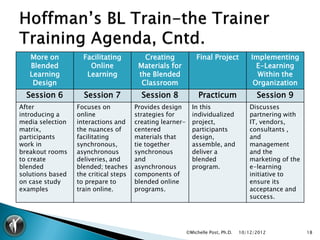
More on          Facilitating          Creating             Final Project           Implementing
   Blended            Online            Materials for                                    E-Learning
   Learning          Learning           the Blended                                      Within the
    Design                               Classroom                                      Organization
  Session 6         Session 7            Session 8              Practicum                Session 9
After             Focuses on           Provides design       In this                   Discusses
introducing a     online               strategies for        individualized            partnering with
media selection   interactions and     creating learner-     project,                  IT, vendors,
matrix,           the nuances of       centered              participants              consultants ,
participants      facilitating         materials that        design,                   and
work in           synchronous,         tie together          assemble, and             management
breakout rooms    asynchronous         synchronous           deliver a                 and the
to create         deliveries, and      and                   blended                   marketing of the
blended           blended; teaches     asynchronous          program.                  e-learning
solutions based   the critical steps   components of                                   initiative to
on case study     to prepare to        blended online                                  ensure its
examples          train online.        programs.                                       acceptance and
                                                                                       success.


                                                           ©Michelle Post, Ph.D.   10/12/2012             18
Dr. Post (2012) Suggests:
   “There is no limitation on the tools to aid a faculty in the
    teaching of a blended learning course.
   The number of potential tools that can be incorporated into a
    blended learning course is only limited by the faculty’s
    imagination and experience.
   The best tool a faculty member can use for a blended
    learning course is their own willingness to learn about a
    variety of technologies, play with the technologies, and then
    try a technology in their course (one at a time). Not all
    technologies will work in a blended learning course.
   There are so many resources available from books, blogs,
    websites, and more. A faculty member just needs to take at
    least one hour a week to research ways to enhance the
    blended learning course.”
   See the Resource slide for some websites and blogs to review.


                                       ©Michelle Post, Ph.D.   10/12/2012   19
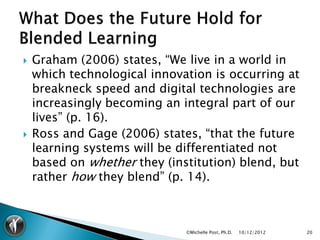
   Graham (2006) states, “We live in a world in
    which technological innovation is occurring at
    breakneck speed and digital technologies are
    increasingly becoming an integral part of our
    lives” (p. 16).
   Ross and Gage (2006) states, “that the future
    learning systems will be differentiated not
    based on whether they (institution) blend, but
    rather how they blend” (p. 14).


                              ©Michelle Post, Ph.D.   10/12/2012   20
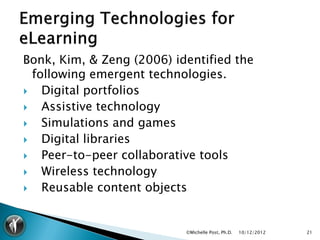
Bonk, Kim, & Zeng (2006) identified the
  following emergent technologies.
   Digital portfolios
   Assistive technology
   Simulations and games
   Digital libraries
   Peer-to-peer collaborative tools
   Wireless technology
   Reusable content objects


                           ©Michelle Post, Ph.D.   10/12/2012   21
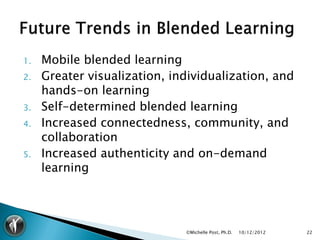
1.   Mobile blended learning
2.   Greater visualization, individualization, and
     hands-on learning
3.   Self-determined blended learning
4.   Increased connectedness, community, and
     collaboration
5.   Increased authenticity and on-demand
     learning


                              ©Michelle Post, Ph.D.   10/12/2012   22
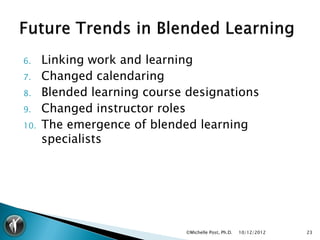
6.    Linking work and learning
7.    Changed calendaring
8.    Blended learning course designations
9.    Changed instructor roles
10.   The emergence of blended learning
      specialists


                             ©Michelle Post, Ph.D.   10/12/2012   23
Bonk, C. J., & Graham, C. R. (2006). The handbook of blended
  learning: Global perspectives, local designs. San Francisco, CA:
  John Wiley & Sons.
Bonk, C. J., Kim, K., & Zeng, T. (2006). Future directions of blended
  learning in higher education and workplace learning settings. In
  C. J. Bonk & C. R. Graham, The handbook of blended learning:
  Global perspectives, local designs. San Francisco, CA: John Wiley
  & Sons.
Dziuban, C., Moskal, P., & Hartman, J. (n.d.). Higher education,
  blended learning and the generations: Knowledge is power no
  more. Orlando, FL: University of Central Florida.
Hoffman, J. (2006). Why blended learning hasn’t (yet) fulfilled its
  promises: Answers to those questions that keep you up at night.
  In C. J. Bonk & C. R. Graham, The handbook of blended learning:
  Global perspectives, local designs. San Francisco, CA: John Wiley
  & Sons.


                                        ©Michelle Post, Ph.D.   10/12/2012   24
Masie, E. (2006). The blended learning imperative. In C. J. Bonk &
  C. R. Graham, The handbook of blended learning: Global
  perspectives, local designs. San Francisco, CA: John Wiley & Sons.
Osguthorpe, R. T., & Graham, C. R. (2003). Blended learning
  systems: Definitions and directions. Quarterly Review of Distance
  Education, 4(3), 227-234.
Rooney, J. E. (2003). Blending learning opportunities to enhance
  educational programming and meetings. Association
  Management, 55(5), 26-32.
Ross, B., & Gage, K. (2006). Global perspectives on blending
  learning: Inside from WebCT and our customers in higher
  education. In C. J. Bonk & C. R. Graham, The handbook of
  blended learning: Global perspectives, local designs. San
  Francisco, CA: John Wiley & Sons.
Young, J. R. (2002, March 22). “Hybrid” teaching seeks to end the
  divide between traditional and online instruction. Chronicle of
  Higher Education, p. A33.


                                        ©Michelle Post, Ph.D.   10/12/2012   25
   Center for Learning & Performance Technologies
    - http://c4lpt.co.uk/
   Classroom 2.0 - http://www.classroom20.com/
   Educause - http://www.educause.edu/
   Edudemic - http://edudemic.com/
   FacultyFocus - http://www.facultyfocus.com/
   Free Tech 4 Teachers -
    http://www.freetech4teachers.com/
   International Society for Technology in Eduation
    (ISTE) - https://www.iste.org/
   Merlot -
    http://www.merlot.org/merlot/index.htm
   TES - http://www.tes.co.uk/

                                ©Michelle Post, Ph.D.   10/12/2012   26
Michelle Post, Ph.D., MBA
       Email: mpost.phd@gmail.com
    Web: http://reachyourpotential.info/
                   Linkedin:
http://www.linkedin.com/in/michellepostphd
  Twitter: http://twitter.com/michellepost
                Slideshare.net:
    http://www.slideshare.net/mpostphd


                        ©Michelle Post, Ph.D.   10/12/2012   27

Transitioning to blended learning

  • 1.
  • 2.
    Elliott Masie (2006)states,  “All learning is blended learning.”  “Great learning is blended.” ©Michelle Post, Ph.D. 10/12/2012 2
  • 3.
    Definition of Blended Learning  Why Blended Learning  Importance of Blended Learning  Six Issues of Blended Learning  Advantages / Disadvantages of Blended Learning  Different Levels of Blended Learning  Categories of Blended Learning  Pedagogical Techniques for eLearning ©Michelle Post, Ph.D. 10/12/2012 3
  • 4.
    Transitioning Faculty to Blended Learning  Hoffman’s BL Train-the Trainer Training Agenda  Tools for Faculty Teaching in a Blended Learning Format  What Does the Future Hold for Blended Learning  Emerging Technologies for eLearning  Future Trends in Blended Learning  References  Resources ©Michelle Post, Ph.D. 10/12/2012 4
  • 5.
    “Blended learning systemscombing face-to-face instruction with computer- mediated instruction.” (Graham, 2006, p. 5) ©Michelle Post, Ph.D. 10/12/2012 5
  • 6.
    Per Osguthorpe andGraham (2003) there are six reasons for the use of blended learning. 1. Pedagogical richness 2. Access to knowledge 3. Social interaction 4. Personal agency 5. Cost-effectiveness 6. Ease of revision ©Michelle Post, Ph.D. 10/12/2012 6
  • 7.
    “American Society for Training and Development identified blended learning as one of the top ten trends to emerge in the knowledge delivery industry” (Rooney, 2003 as cited in Bonk & Graham, 2006, p. 3)  The President of Pennsylvania State University was quoted as saying, “that the convergence between online and residential instruction was the single-greatest unrecognized trend in higher education today” (Young, 2002, as cited in Bonk & Graham, 2006, p. 3) ©Michelle Post, Ph.D. 10/12/2012 7
  • 8.
    1. The role of live interaction 2. The role of learner choice and self- regulation 3. Models for support and training 4. Finding balance between innovation and production 5. Cultural adaptation 6. Dealing with the digital divide (Graham, 2006, p. 14) ©Michelle Post, Ph.D. 10/12/2012 8
  • 9.
    Opportunities to create  Time requirements learning communities  Faculty to student  Less class time with use relationship of Internet  Technology support  Flexibility  Learning curve for both faculty and student in  Increased interaction learning the technologies from students  Longer prep time when  Best of both worlds (F2F teaching in a blended and BL) environment  Improved technology  Faculty perceptions of skills blended learning  Asynchronous  Student perceptions of communications blended learning Advantages Disadvantages ©Michelle Post, Ph.D. 10/12/2012 9
  • 10.
    Graham (2006) identifyfour levels of blended learning 1. Activity-Level Blending – this level occurs “when a learning activity contains both face-to-face and computer-mediated (CM) elements.” 2. Course-Level Blending – this level is the most common way to blend and is a “combination of distinct face-to-face and CM activities used as part of a course.” ©Michelle Post, Ph.D. 10/12/2012 10
  • 11.
    3. Program-Level Blending – blending at this level could be one of two models: (1) a learner chooses a mix in his/her program of face-to-face with online, or (2) the learner’s program is prescribed with a mixture of face-to-face and online already. 4. Institutional-Level Blending – this model is where the institution has chosen to blend its course offerings in a blended model with face-to-face and CM instruction. ©Michelle Post, Ph.D. 10/12/2012 11
  • 12.
    Enabling blends – focuses on addressing issues of access and convenience  Enhancing blends – focuses on incremental changes to the pedagogy but do not radically change the way teaching and learning occurs  Transforming blends – focuses on a radical transformation of the pedagogy (Graham, 2006, p. 13) ©Michelle Post, Ph.D. 10/12/2012 12
  • 13.
    Bonk, Kim, &Zeng (2006) identified the following 12 pedagogical techniques. 1. Group problem-solving and collaborative tasks 2. Problem-based learning 3. Discussion 4. Case-based strategies 5. Simulation or role play 6. Student-generated content ©Michelle Post, Ph.D. 10/12/2012 13
  • 14.
    7. Coaching and mentoring 8. Guided learning 9. Exploratory or discovery 10. Lecturing or teacher-directed activities 11. Modeling of the solution process 12. Socratic questioning ©Michelle Post, Ph.D. 10/12/2012 14
  • 15.
    The Organization (Support) – Has the budget and staff to support blended learning development. The organization needs to view a move to blended learning as a change initiative. The organization needs to be ready, willing, and able to make the change to a blended learning environment. (Hofmann, 2006, p. 39)  The Course Designers – “Blending technologies that take advantage of learning styles, learner convenience, and the best practices of instructional design enable course developers to create programs that engage the learner and maximize learning retention” (Hofmann, 2006, p. 29).  Faculty - “. . . The entire blended learning experience, including the self-directed components, is instructor led” (Hofmann, 2006, p. 35).  Learners (customers) – Learners can aid in the creation of life long relationships through blended learning ©Michelle Post, Ph.D. 10/12/2012 15
  • 16.
    Facilitators need to approach a blended environment just as they would a traditional teaching environment  Facilitators need to learn from their mistakes --- and not be afraid to make mistakes  Facilitators need to participate in as many blended learning opportunities as possible  Facilitators need to learn ALL of the technologies of a blended learning environment  Facilitators need to know how to facilitate each individual technologies  Practice, Practice, Practice ©Michelle Post, Ph.D. 10/12/2012 16
  • 17.
    Learn How to E-Learning The Basics of Collaboratory! Ready, Willing, Learn Online 101 Blending and Able Session 1 Session 2 Session 3 Session 4 Session 5 Focuses on Addresses Introduces Hands-on, Addresses learning in the definitions and blending experiential preparing the online terminology, asynchronous, interaction with learners for environment; demonstrates synchronous, various delivery online learning demystifies the various delivery and traditional technologies technology for technologies, learning the participants and introduces technologies so they have a the changing positive learning roles of instructional designers, facilitators, and learners ©Michelle Post, Ph.D. 10/12/2012 17
  • 18.
    More on Facilitating Creating Final Project Implementing Blended Online Materials for E-Learning Learning Learning the Blended Within the Design Classroom Organization Session 6 Session 7 Session 8 Practicum Session 9 After Focuses on Provides design In this Discusses introducing a online strategies for individualized partnering with media selection interactions and creating learner- project, IT, vendors, matrix, the nuances of centered participants consultants , participants facilitating materials that design, and work in synchronous, tie together assemble, and management breakout rooms asynchronous synchronous deliver a and the to create deliveries, and and blended marketing of the blended blended; teaches asynchronous program. e-learning solutions based the critical steps components of initiative to on case study to prepare to blended online ensure its examples train online. programs. acceptance and success. ©Michelle Post, Ph.D. 10/12/2012 18
  • 19.
    Dr. Post (2012)Suggests:  “There is no limitation on the tools to aid a faculty in the teaching of a blended learning course.  The number of potential tools that can be incorporated into a blended learning course is only limited by the faculty’s imagination and experience.  The best tool a faculty member can use for a blended learning course is their own willingness to learn about a variety of technologies, play with the technologies, and then try a technology in their course (one at a time). Not all technologies will work in a blended learning course.  There are so many resources available from books, blogs, websites, and more. A faculty member just needs to take at least one hour a week to research ways to enhance the blended learning course.”  See the Resource slide for some websites and blogs to review. ©Michelle Post, Ph.D. 10/12/2012 19
  • 20.
    Graham (2006) states, “We live in a world in which technological innovation is occurring at breakneck speed and digital technologies are increasingly becoming an integral part of our lives” (p. 16).  Ross and Gage (2006) states, “that the future learning systems will be differentiated not based on whether they (institution) blend, but rather how they blend” (p. 14). ©Michelle Post, Ph.D. 10/12/2012 20
  • 21.
    Bonk, Kim, &Zeng (2006) identified the following emergent technologies.  Digital portfolios  Assistive technology  Simulations and games  Digital libraries  Peer-to-peer collaborative tools  Wireless technology  Reusable content objects ©Michelle Post, Ph.D. 10/12/2012 21
  • 22.
    1. Mobile blended learning 2. Greater visualization, individualization, and hands-on learning 3. Self-determined blended learning 4. Increased connectedness, community, and collaboration 5. Increased authenticity and on-demand learning ©Michelle Post, Ph.D. 10/12/2012 22
  • 23.
    6. Linking work and learning 7. Changed calendaring 8. Blended learning course designations 9. Changed instructor roles 10. The emergence of blended learning specialists ©Michelle Post, Ph.D. 10/12/2012 23
  • 24.
    Bonk, C. J.,& Graham, C. R. (2006). The handbook of blended learning: Global perspectives, local designs. San Francisco, CA: John Wiley & Sons. Bonk, C. J., Kim, K., & Zeng, T. (2006). Future directions of blended learning in higher education and workplace learning settings. In C. J. Bonk & C. R. Graham, The handbook of blended learning: Global perspectives, local designs. San Francisco, CA: John Wiley & Sons. Dziuban, C., Moskal, P., & Hartman, J. (n.d.). Higher education, blended learning and the generations: Knowledge is power no more. Orlando, FL: University of Central Florida. Hoffman, J. (2006). Why blended learning hasn’t (yet) fulfilled its promises: Answers to those questions that keep you up at night. In C. J. Bonk & C. R. Graham, The handbook of blended learning: Global perspectives, local designs. San Francisco, CA: John Wiley & Sons. ©Michelle Post, Ph.D. 10/12/2012 24
  • 25.
    Masie, E. (2006).The blended learning imperative. In C. J. Bonk & C. R. Graham, The handbook of blended learning: Global perspectives, local designs. San Francisco, CA: John Wiley & Sons. Osguthorpe, R. T., & Graham, C. R. (2003). Blended learning systems: Definitions and directions. Quarterly Review of Distance Education, 4(3), 227-234. Rooney, J. E. (2003). Blending learning opportunities to enhance educational programming and meetings. Association Management, 55(5), 26-32. Ross, B., & Gage, K. (2006). Global perspectives on blending learning: Inside from WebCT and our customers in higher education. In C. J. Bonk & C. R. Graham, The handbook of blended learning: Global perspectives, local designs. San Francisco, CA: John Wiley & Sons. Young, J. R. (2002, March 22). “Hybrid” teaching seeks to end the divide between traditional and online instruction. Chronicle of Higher Education, p. A33. ©Michelle Post, Ph.D. 10/12/2012 25
  • 26.
    Center for Learning & Performance Technologies - http://c4lpt.co.uk/  Classroom 2.0 - http://www.classroom20.com/  Educause - http://www.educause.edu/  Edudemic - http://edudemic.com/  FacultyFocus - http://www.facultyfocus.com/  Free Tech 4 Teachers - http://www.freetech4teachers.com/  International Society for Technology in Eduation (ISTE) - https://www.iste.org/  Merlot - http://www.merlot.org/merlot/index.htm  TES - http://www.tes.co.uk/ ©Michelle Post, Ph.D. 10/12/2012 26
  • 27.
    Michelle Post, Ph.D.,MBA Email: mpost.phd@gmail.com Web: http://reachyourpotential.info/ Linkedin: http://www.linkedin.com/in/michellepostphd Twitter: http://twitter.com/michellepost Slideshare.net: http://www.slideshare.net/mpostphd ©Michelle Post, Ph.D. 10/12/2012 27