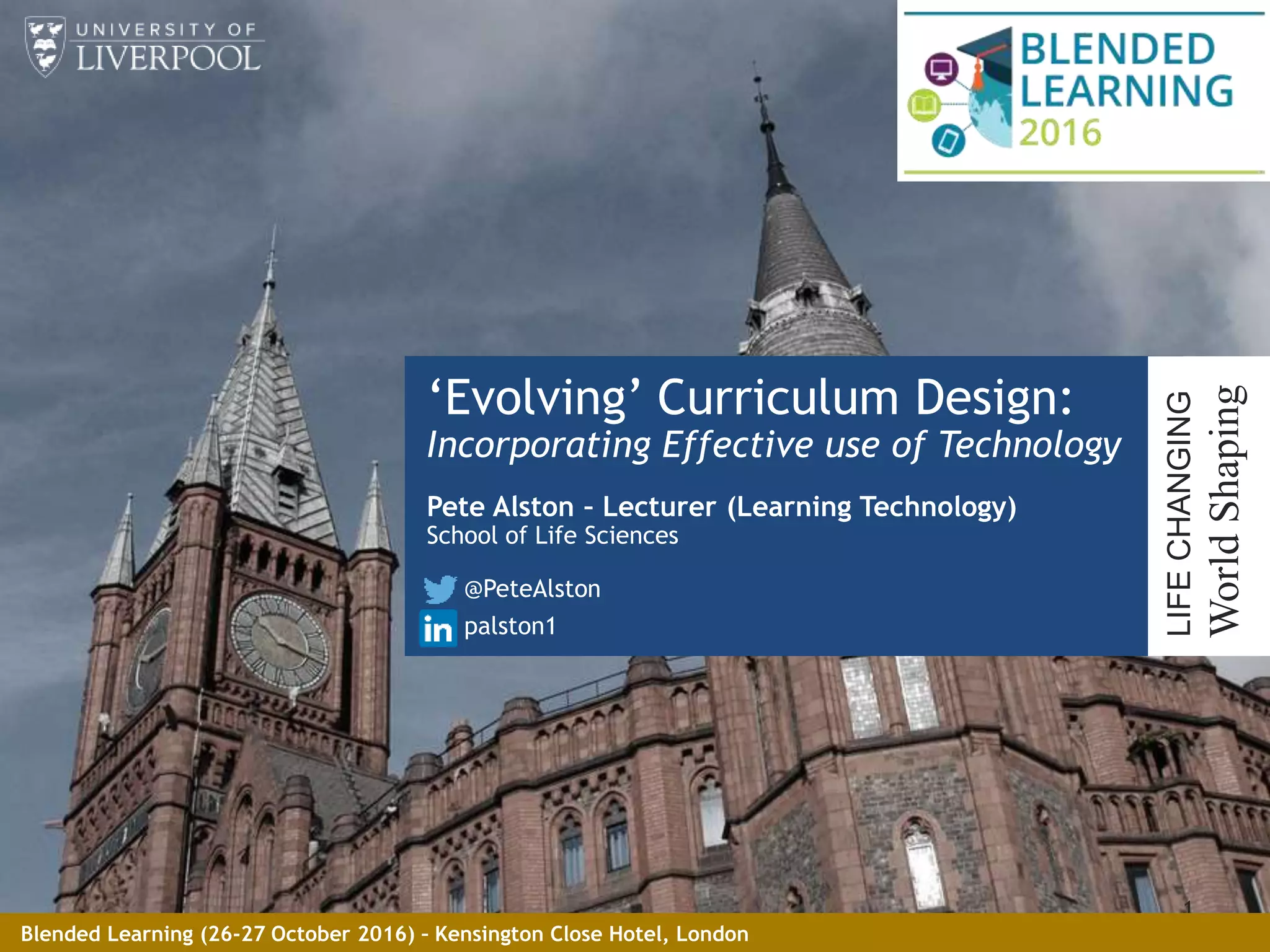
‘Evolving’ Curriculum Design:
Incorporating Effective use of Technology
Pete Alston – Lecturer (Learning Technology)
School of Life Sciences
@PeteAlston
palston1
1
LIFECHANGING
WorldShaping
Blended Learning (26-27 October 2016) – Kensington Close Hotel, London
Overview
What’s coming up …
• Online environment presents an opportunity …
– Transitioning from ‘old’ to ‘new’
• Blended learning (BL)
– The ‘new’ norm(al)?
• ‘Technology-informed course design’
– ‘Getting it right from the start’
• Challenges faced & Lessons learned …
Overview
The context …
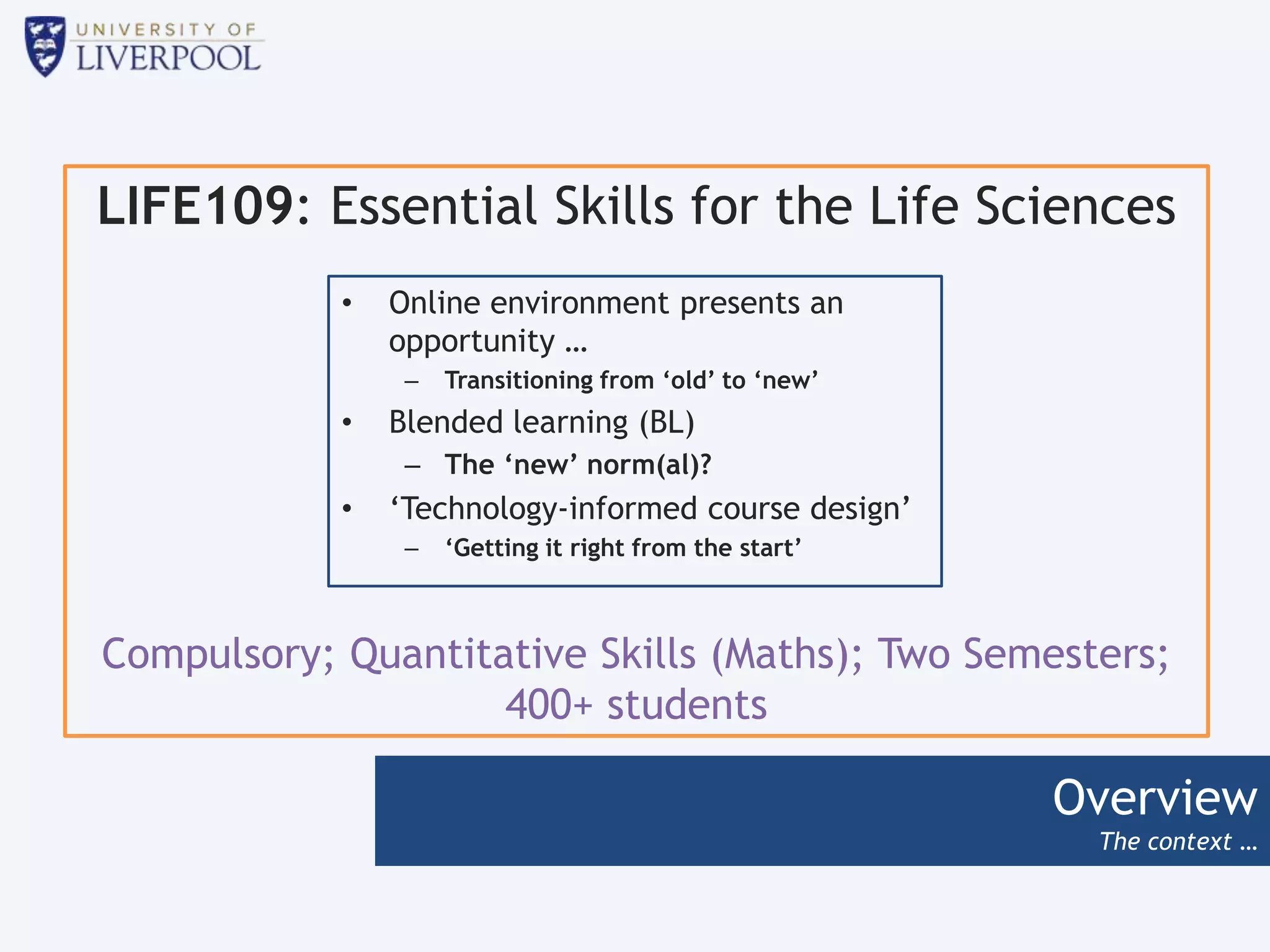
LIFE109: Essential Skills for the Life Sciences
Compulsory; Quantitative Skills (Maths); Two Semesters;
400+ students
• Online environment presents an
opportunity …
– Transitioning from ‘old’ to ‘new’
• Blended learning (BL)
– The ‘new’ norm(al)?
• ‘Technology-informed course design’
– ‘Getting it right from the start’
The ‘online’ environment
Presents an opportunity …
• Impacting on policy and practice and is becoming
common place in higher education (Gikandi, Morrow, & Davis,
2011; Rowley, Lujan, & Dolence, 1998)
• Presents an opportunity to enhance the learning
environment for both tutors and students (Angelo & Cross,
1993; Sujo de Montes & Gonzales, 2000; Whitelock & Brasher, 2006)
• ‘Defining technology’ (Norton & Wiburg, 2003)
– Students ‘expect’ technology as they become more “electrate”
(Ulmer, 2003)
– Demand reaction at the ‘micro-’, ‘meso-’ and ‘macro-’ level
Transitioning from ‘old’ to ‘new’
Where have we come from?
5
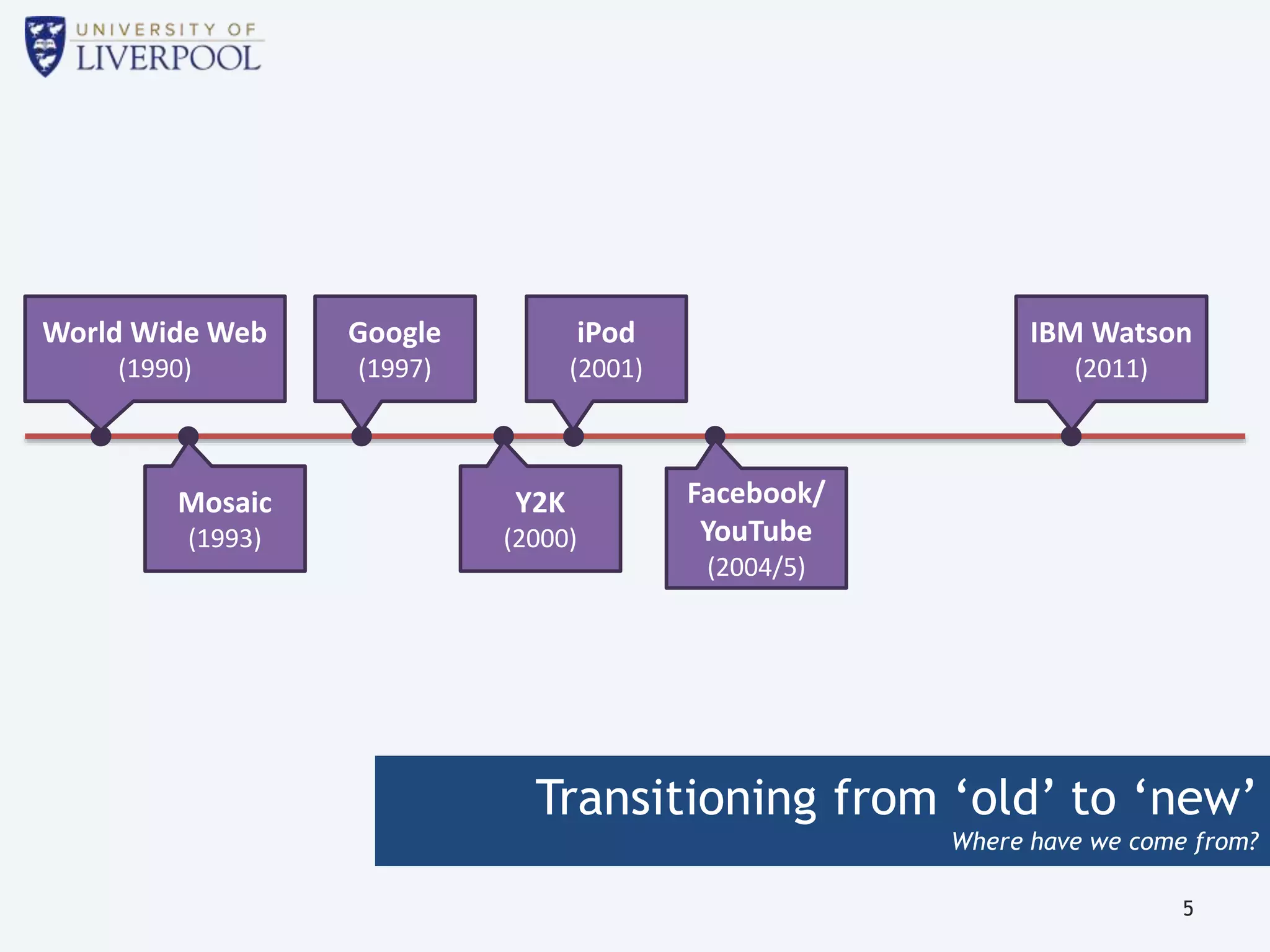
World Wide Web
(1990)
Mosaic
(1993)
Google
(1997)
Y2K
(2000)
iPod
(2001)
Facebook/
YouTube
(2004/5)
IBM Watson
(2011)
Transitioning from ‘old’ to ‘new’
Where have we come from?
6
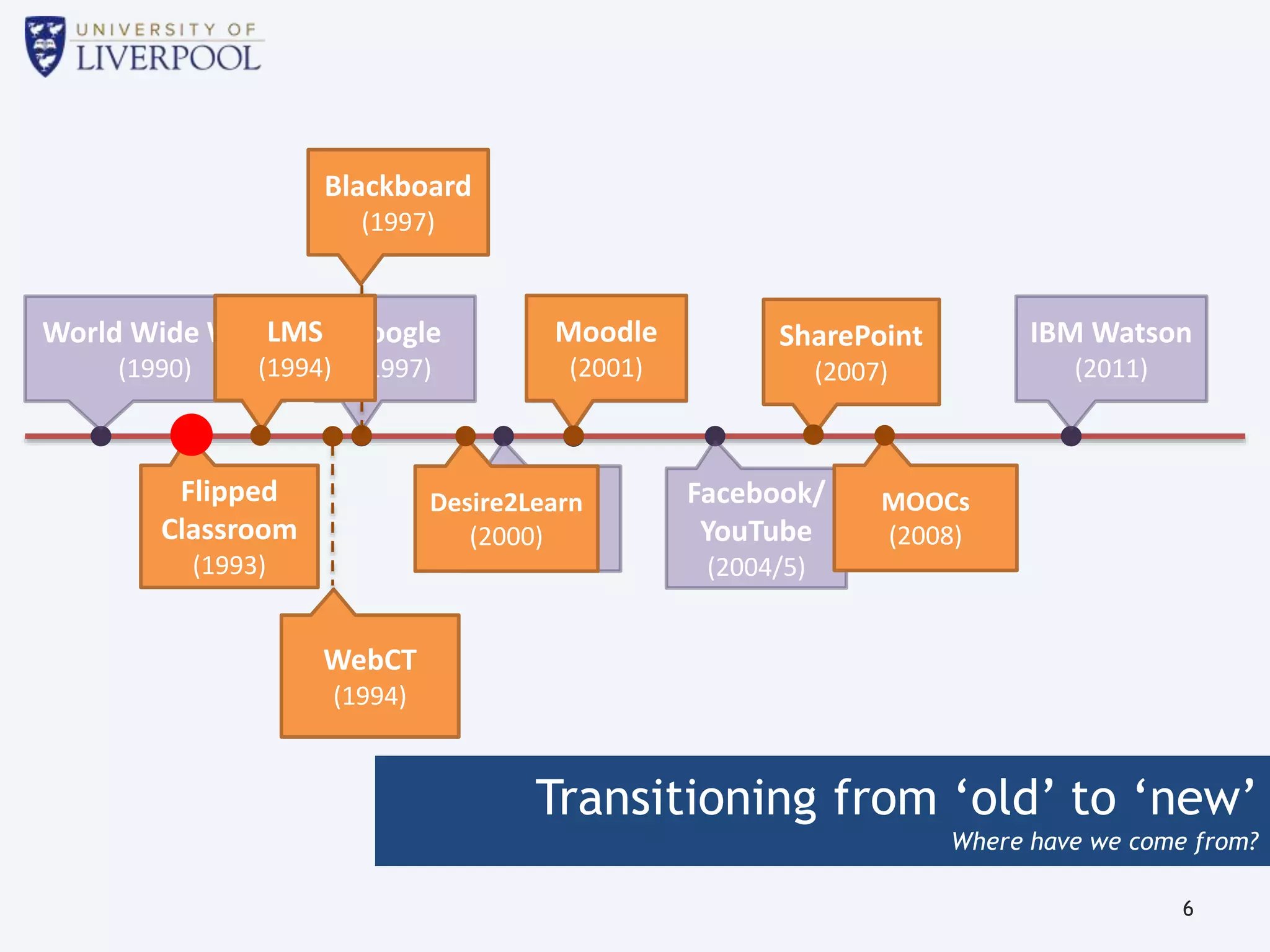
World Wide Web
(1990)
Mosaic
(1993)
Google
(1997)
Y2K
(2000)
iPod
(2001)
Facebook/
YouTube
(2004/5)
IBM Watson
(2011)
Blackboard
(1997)
Flipped
Classroom
(1993)
WebCT
(1994)
LMS
(1994)
Desire2Learn
(2000)
Moodle
(2001)
SharePoint
(2007)
MOOCs
(2008)
Transitioning from ‘old’ to ‘new’
Where have we come from?
7
‘Blended’ learning
What does the literature say?
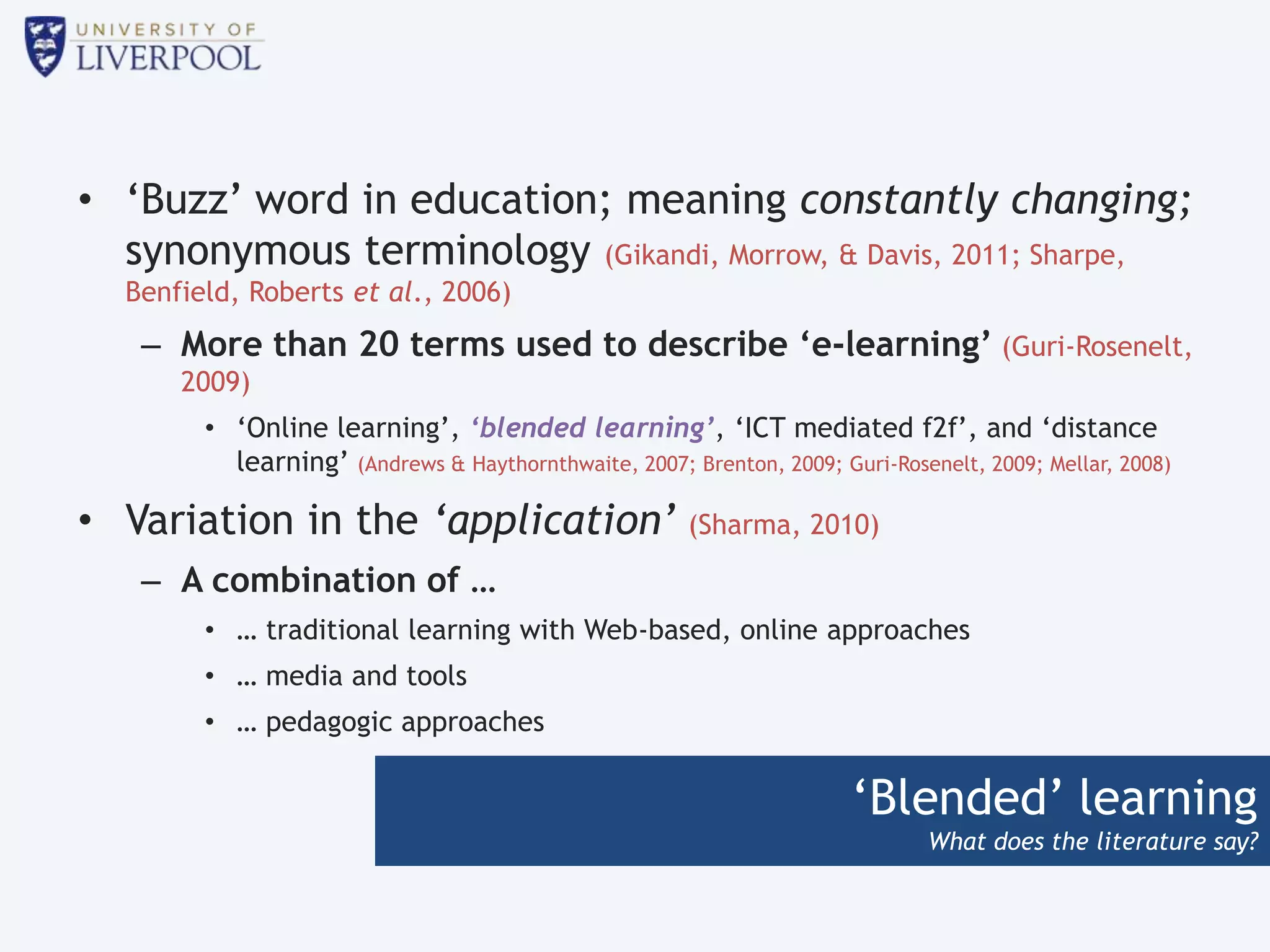
• ‘Buzz’ word in education; meaning constantly changing;
synonymous terminology (Gikandi, Morrow, & Davis, 2011; Sharpe,
Benfield, Roberts et al., 2006)
– More than 20 terms used to describe ‘e-learning’ (Guri-Rosenelt,
2009)
• ‘Online learning’, ‘blended learning’, ‘ICT mediated f2f’, and ‘distance
learning’ (Andrews & Haythornthwaite, 2007; Brenton, 2009; Guri-Rosenelt, 2009; Mellar, 2008)
• Variation in the ‘application’ (Sharma, 2010)
– A combination of …
• … traditional learning with Web-based, online approaches
• … media and tools
• … pedagogic approaches
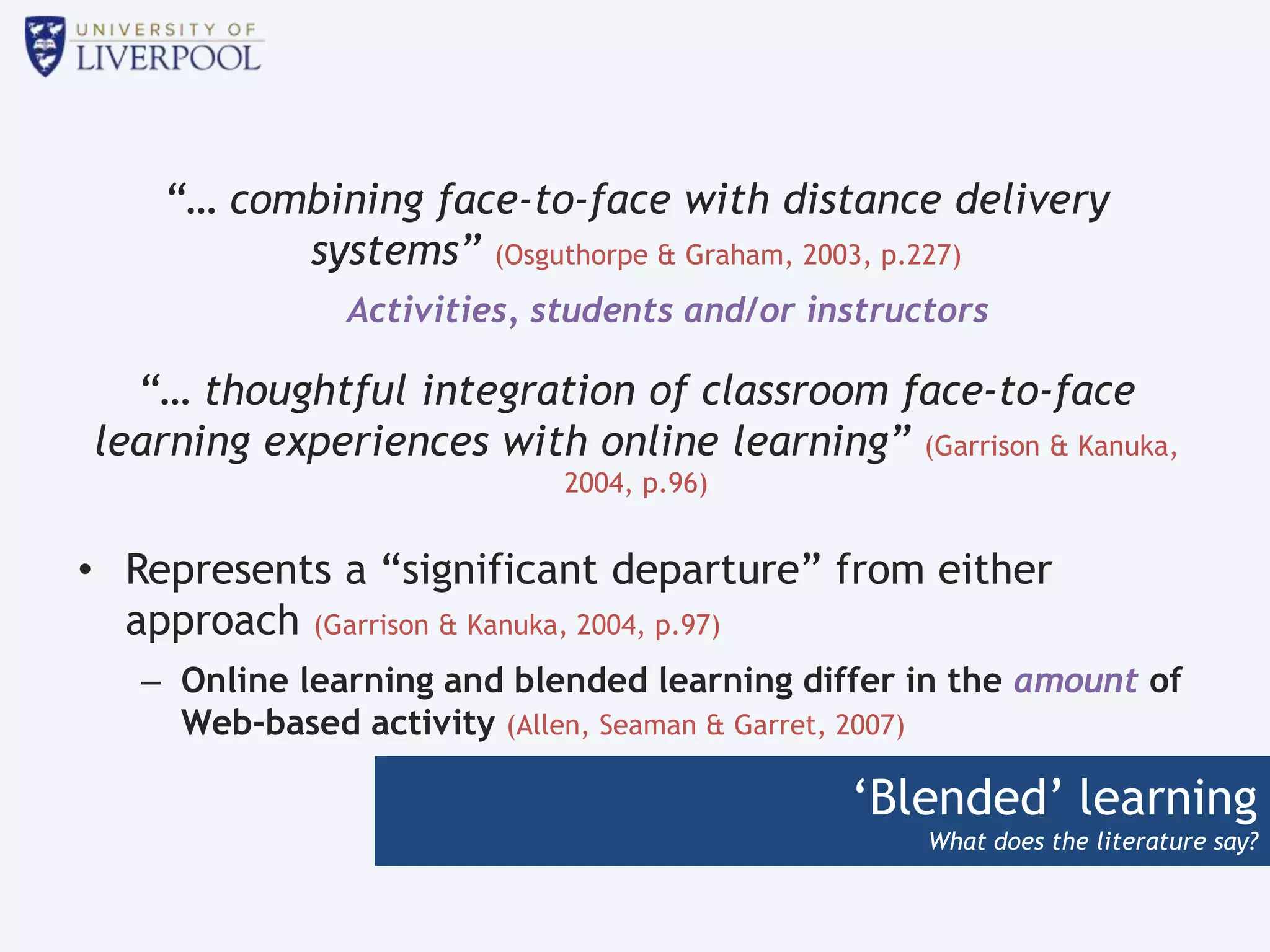
‘Blended’ learning
What does the literature say?
“… combining face-to-face with distance delivery
systems” (Osguthorpe & Graham, 2003, p.227)
Activities, students and/or instructors
“… thoughtful integration of classroom face-to-face
learning experiences with online learning” (Garrison & Kanuka,
2004, p.96)
• Represents a “significant departure” from either
approach (Garrison & Kanuka, 2004, p.97)
– Online learning and blended learning differ in the amount of
Web-based activity (Allen, Seaman & Garret, 2007)
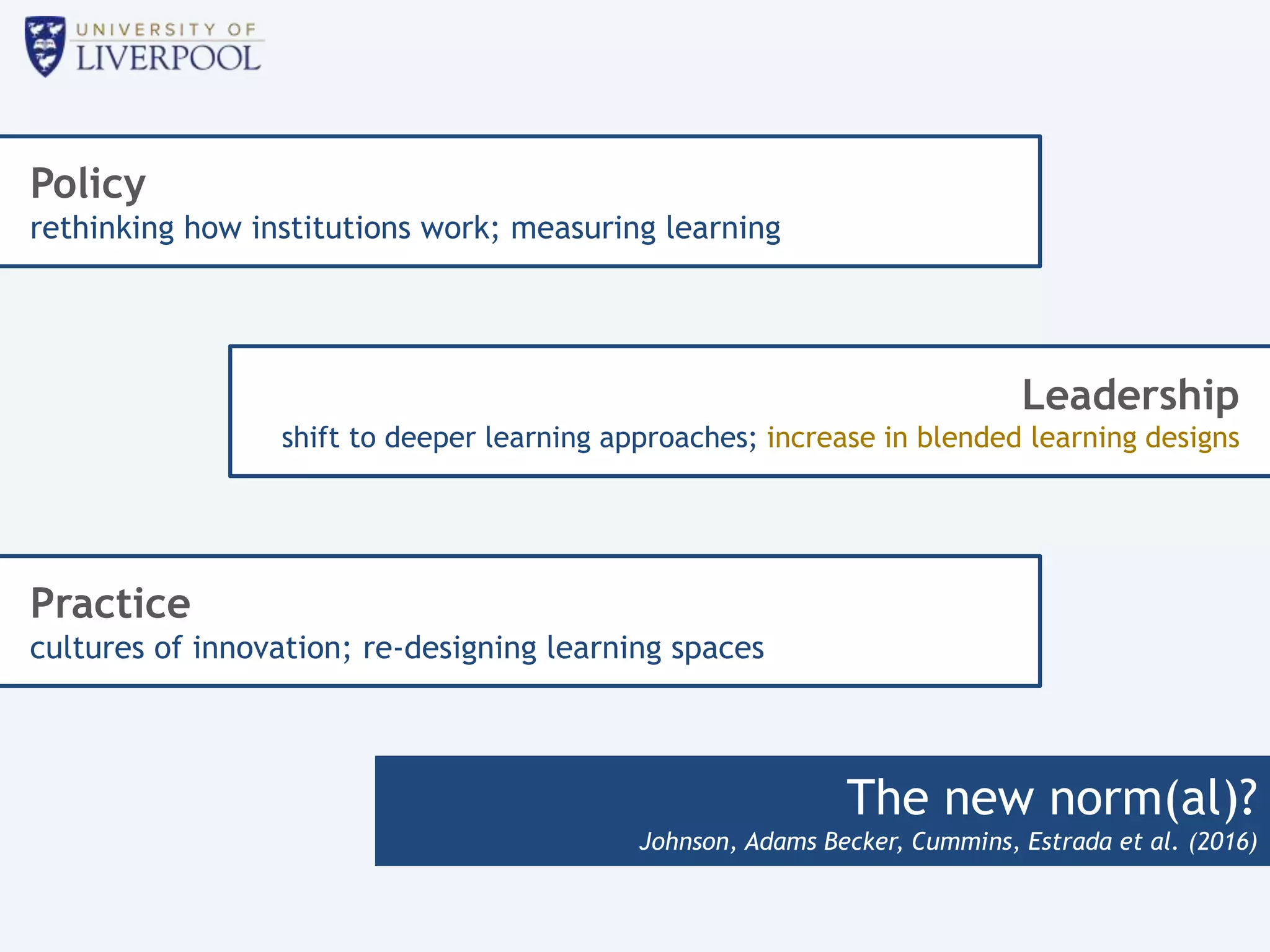
The new norm(al)?
Johnson, Adams Becker, Cummins, Estrada et al. (2016)
Policy
rethinking how institutions work; measuring learning
Leadership
shift to deeper learning approaches; increase in blended learning designs
Practice
cultures of innovation; re-designing learning spaces
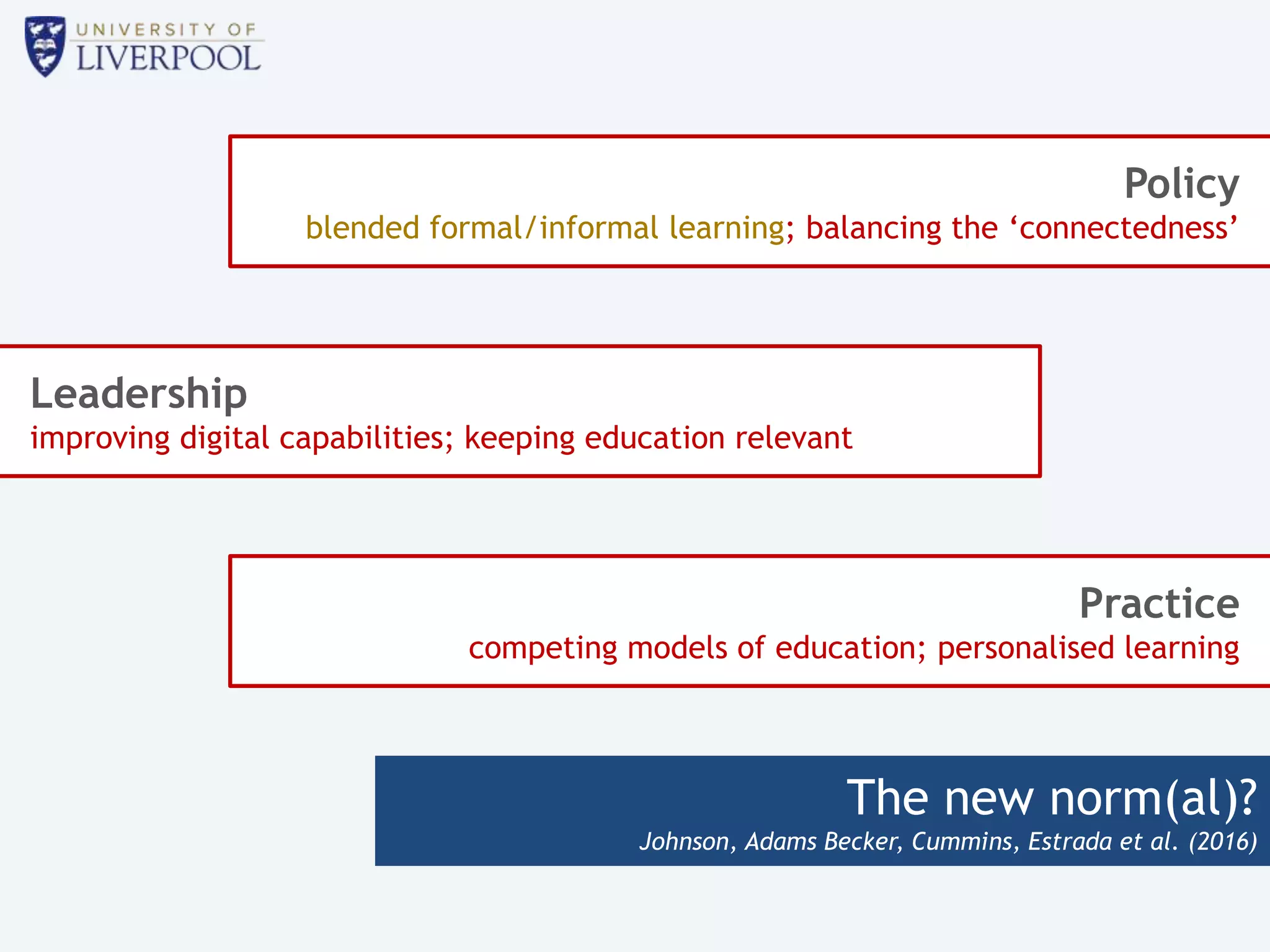
The new norm(al)?
Johnson, Adams Becker, Cummins, Estrada et al. (2016)
Policy
blended formal/informal learning; balancing the ‘connectedness’
Leadership
improving digital capabilities; keeping education relevant
Practice
competing models of education; personalised learning
http://harvardpolitics.com/blog/wp-content/uploads/2012/10/Sanders.jpg
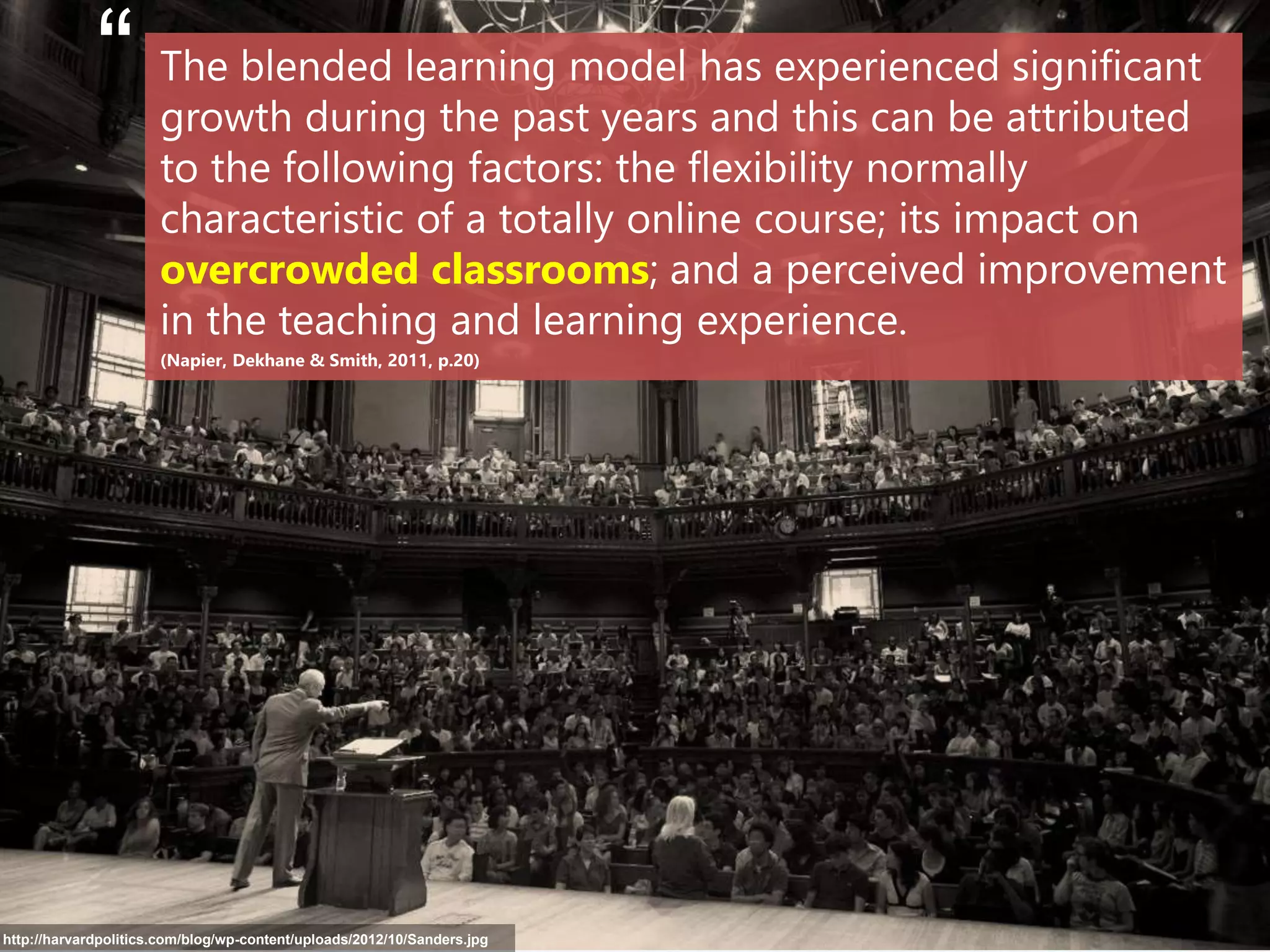
The blended learning model has experienced significant
growth during the past years and this can be attributed
to the following factors: the flexibility normally
characteristic of a totally online course; its impact on
overcrowded classrooms; and a perceived improvement
in the teaching and learning experience.
(Napier, Dekhane & Smith, 2011, p.20)
“
The new norm(al)?
Supplementing students in difficult subjects
https://resplendentjane.files.wordpress.com/2014/10/1340050882014_3068657.png
‘Technology-informed’ course design
Getting it right from the start
• BL perceived as “useful, enjoyable, supportive, flexible
and [a] motivator for learners” (Güzer and Caner, 2014, p.4602)
– But we need to do more …
– Encourage students to participate through social interaction
and collaboration
“… blending of face to face and online learning
environments should be planned precisely in order to
benefit more from this approach” (ibid, emphasis mine)
‘Technology-informed’ course design
Getting it right from the start
• Planning for technology from the start forces us to
think about the delivery
– ‘Bolt-on’/‘afterthought’
– ‘Ignorance’ of the ‘need’ to rethink course design and
pedagogy (Bleed, 2001; Vaughan, 2007)
– Change is ‘difficult’
• Bridging the pedagogy/technology ‘gap’
– Now: 8 x Lecturer (Learning Technology) – TEL Academic
Team
• Variety of subject discipline & institutional backgrounds
– Planned: Course Development Unit – Strategy 2026
‘Technology-informed’ course design
Getting it right from the start
“… blended learning is consistent with the values of
[HEIs] and has the proven potential to enhance both the
effectiveness and efficiency of meaningful learning
experiences” (Garrison & Kanuka, 2004, p.5)
• Specifications consist of aims, objectives, learning
outcomes, assessment strategy
– But what about the use/application of ‘technology’?
– Delivery then becomes an ‘active’ rather than ‘after’
thought (Alston & Brabon, 2014)
– This can be a challenge!
LIFE109 – Quantitative Skills
What am I trying to address?
• ‘Math Anxiety’ (Ashcraft, 2002; Jameson & Fusco, 2014; Richardson &
Suinn, 1972)
– ‘Difficult’ content
• Threshold concepts (Mayer & Land, 2003, 2005; Alston, Walsh &
Westhead, 2015)
– Maths …
– “I’m studying Anatomy, why do I need to do this?”
– Maths …
– …
LIFE109 – Quantitative Skills
The right ‘blend’ …
• Transitioning to the ‘new’ norm(al)
– Then (2014): Predominately face to face (lectures &
workshops); VLE as repository; paper based assessment
– Now (2016): Introductory lecture for topic; ‘flipped’ approach
using VLE; workshop to support; PAL sessions; online
summative assessment
• It’s that easy?!
– Massive energy/time/work to achieve this
• Teaching; research/scholarship; administration; personal tutor; social life(!)
– Students as ‘co-creators’
– Change, evaluate, refine …
Summary
What’s the take home message?
• Online environment presents an opportunity to enhance the
learning environment
– Blended approach can support the ‘best’ of a number of worlds
– Does it always have to be a blend of f2f and online?
• Blended approach is becoming the new norm(al)
– Might not be out of choice(!)
– It needs to be planned for, particularly when it involves the use
of (unreliable) technology
• Giving consideration at the programme/module design stage
– Delivery then becomes an ‘active’ rather than ‘after’ thought
Questions?
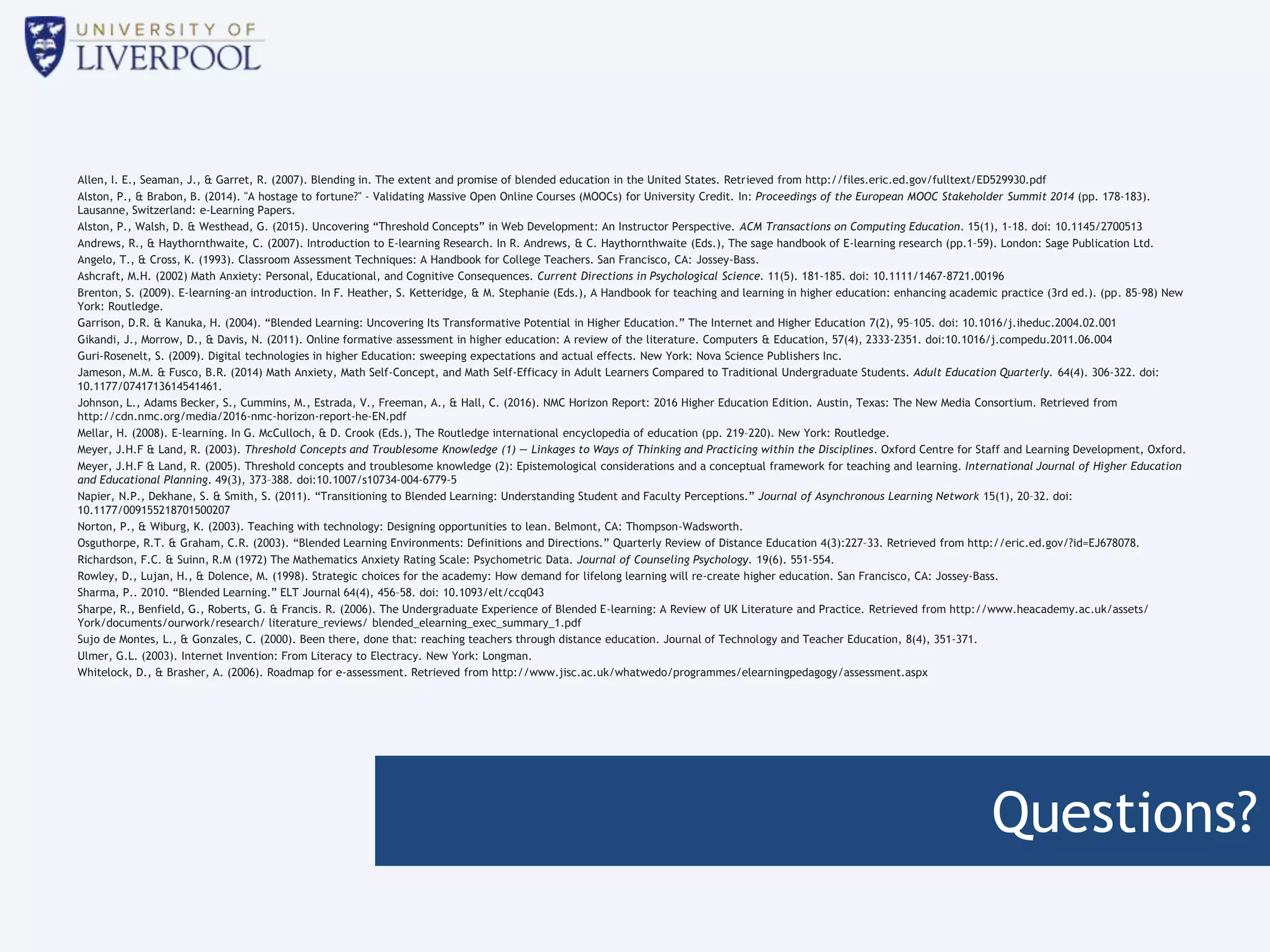
Allen, I. E., Seaman, J., & Garret, R. (2007). Blending in. The extent and promise of blended education in the United States. Retrieved from http://files.eric.ed.gov/fulltext/ED529930.pdf
Alston, P., & Brabon, B. (2014). "A hostage to fortune?" - Validating Massive Open Online Courses (MOOCs) for University Credit. In: Proceedings of the European MOOC Stakeholder Summit 2014 (pp. 178-183).
Lausanne, Switzerland: e-Learning Papers.
Alston, P., Walsh, D. & Westhead, G. (2015). Uncovering “Threshold Concepts” in Web Development: An Instructor Perspective. ACM Transactions on Computing Education. 15(1), 1-18. doi: 10.1145/2700513
Andrews, R., & Haythornthwaite, C. (2007). Introduction to E-learning Research. In R. Andrews, & C. Haythornthwaite (Eds.), The sage handbook of E-learning research (pp.1–59). London: Sage Publication Ltd.
Angelo, T., & Cross, K. (1993). Classroom Assessment Techniques: A Handbook for College Teachers. San Francisco, CA: Jossey-Bass.
Ashcraft, M.H. (2002) Math Anxiety: Personal, Educational, and Cognitive Consequences. Current Directions in Psychological Science. 11(5). 181-185. doi: 10.1111/1467-8721.00196
Brenton, S. (2009). E-learning-an introduction. In F. Heather, S. Ketteridge, & M. Stephanie (Eds.), A Handbook for teaching and learning in higher education: enhancing academic practice (3rd ed.). (pp. 85–98) New
York: Routledge.
Garrison, D.R. & Kanuka, H. (2004). “Blended Learning: Uncovering Its Transformative Potential in Higher Education.” The Internet and Higher Education 7(2), 95–105. doi: 10.1016/j.iheduc.2004.02.001
Gikandi, J., Morrow, D., & Davis, N. (2011). Online formative assessment in higher education: A review of the literature. Computers & Education, 57(4), 2333-2351. doi:10.1016/j.compedu.2011.06.004
Guri-Rosenelt, S. (2009). Digital technologies in higher Education: sweeping expectations and actual effects. New York: Nova Science Publishers Inc.
Jameson, M.M. & Fusco, B.R. (2014) Math Anxiety, Math Self-Concept, and Math Self-Efficacy in Adult Learners Compared to Traditional Undergraduate Students. Adult Education Quarterly. 64(4). 306-322. doi:
10.1177/0741713614541461.
Johnson, L., Adams Becker, S., Cummins, M., Estrada, V., Freeman, A., & Hall, C. (2016). NMC Horizon Report: 2016 Higher Education Edition. Austin, Texas: The New Media Consortium. Retrieved from
http://cdn.nmc.org/media/2016-nmc-horizon-report-he-EN.pdf
Mellar, H. (2008). E-learning. In G. McCulloch, & D. Crook (Eds.), The Routledge international encyclopedia of education (pp. 219–220). New York: Routledge.
Meyer, J.H.F & Land, R. (2003). Threshold Concepts and Troublesome Knowledge (1) — Linkages to Ways of Thinking and Practicing within the Disciplines. Oxford Centre for Staff and Learning Development, Oxford.
Meyer, J.H.F & Land, R. (2005). Threshold concepts and troublesome knowledge (2): Epistemological considerations and a conceptual framework for teaching and learning. International Journal of Higher Education
and Educational Planning. 49(3), 373–388. doi:10.1007/s10734-004-6779-5
Napier, N.P., Dekhane, S. & Smith, S. (2011). “Transitioning to Blended Learning: Understanding Student and Faculty Perceptions.” Journal of Asynchronous Learning Network 15(1), 20–32. doi:
10.1177/009155218701500207
Norton, P., & Wiburg, K. (2003). Teaching with technology: Designing opportunities to lean. Belmont, CA: Thompson-Wadsworth.
Osguthorpe, R.T. & Graham, C.R. (2003). “Blended Learning Environments: Definitions and Directions.” Quarterly Review of Distance Education 4(3):227–33. Retrieved from http://eric.ed.gov/?id=EJ678078.
Richardson, F.C. & Suinn, R.M (1972) The Mathematics Anxiety Rating Scale: Psychometric Data. Journal of Counseling Psychology. 19(6). 551-554.
Rowley, D., Lujan, H., & Dolence, M. (1998). Strategic choices for the academy: How demand for lifelong learning will re-create higher education. San Francisco, CA: Jossey-Bass.
Sharma, P.. 2010. “Blended Learning.” ELT Journal 64(4), 456–58. doi: 10.1093/elt/ccq043
Sharpe, R., Benfield, G., Roberts, G. & Francis. R. (2006). The Undergraduate Experience of Blended E-learning: A Review of UK Literature and Practice. Retrieved from http://www.heacademy.ac.uk/assets/
York/documents/ourwork/research/ literature_reviews/ blended_elearning_exec_summary_1.pdf
Sujo de Montes, L., & Gonzales, C. (2000). Been there, done that: reaching teachers through distance education. Journal of Technology and Teacher Education, 8(4), 351-371.
Ulmer, G.L. (2003). Internet Invention: From Literacy to Electracy. New York: Longman.
Whitelock, D., & Brasher, A. (2006). Roadmap for e-assessment. Retrieved from http://www.jisc.ac.uk/whatwedo/programmes/elearningpedagogy/assessment.aspx

‘Evolving’ Curriculum Design: Incorporating Effective use of Technology

  • 1.
    ‘Evolving’ Curriculum Design: IncorporatingEffective use of Technology Pete Alston – Lecturer (Learning Technology) School of Life Sciences @PeteAlston palston1 1 LIFECHANGING WorldShaping Blended Learning (26-27 October 2016) – Kensington Close Hotel, London
  • 2.
    Overview What’s coming up… • Online environment presents an opportunity … – Transitioning from ‘old’ to ‘new’ • Blended learning (BL) – The ‘new’ norm(al)? • ‘Technology-informed course design’ – ‘Getting it right from the start’ • Challenges faced & Lessons learned …
  • 3.
    Overview The context … LIFE109:Essential Skills for the Life Sciences Compulsory; Quantitative Skills (Maths); Two Semesters; 400+ students • Online environment presents an opportunity … – Transitioning from ‘old’ to ‘new’ • Blended learning (BL) – The ‘new’ norm(al)? • ‘Technology-informed course design’ – ‘Getting it right from the start’
  • 4.
    The ‘online’ environment Presentsan opportunity … • Impacting on policy and practice and is becoming common place in higher education (Gikandi, Morrow, & Davis, 2011; Rowley, Lujan, & Dolence, 1998) • Presents an opportunity to enhance the learning environment for both tutors and students (Angelo & Cross, 1993; Sujo de Montes & Gonzales, 2000; Whitelock & Brasher, 2006) • ‘Defining technology’ (Norton & Wiburg, 2003) – Students ‘expect’ technology as they become more “electrate” (Ulmer, 2003) – Demand reaction at the ‘micro-’, ‘meso-’ and ‘macro-’ level
  • 5.
    Transitioning from ‘old’to ‘new’ Where have we come from? 5 World Wide Web (1990) Mosaic (1993) Google (1997) Y2K (2000) iPod (2001) Facebook/ YouTube (2004/5) IBM Watson (2011)
  • 6.
    Transitioning from ‘old’to ‘new’ Where have we come from? 6 World Wide Web (1990) Mosaic (1993) Google (1997) Y2K (2000) iPod (2001) Facebook/ YouTube (2004/5) IBM Watson (2011) Blackboard (1997) Flipped Classroom (1993) WebCT (1994) LMS (1994) Desire2Learn (2000) Moodle (2001) SharePoint (2007) MOOCs (2008)
  • 7.
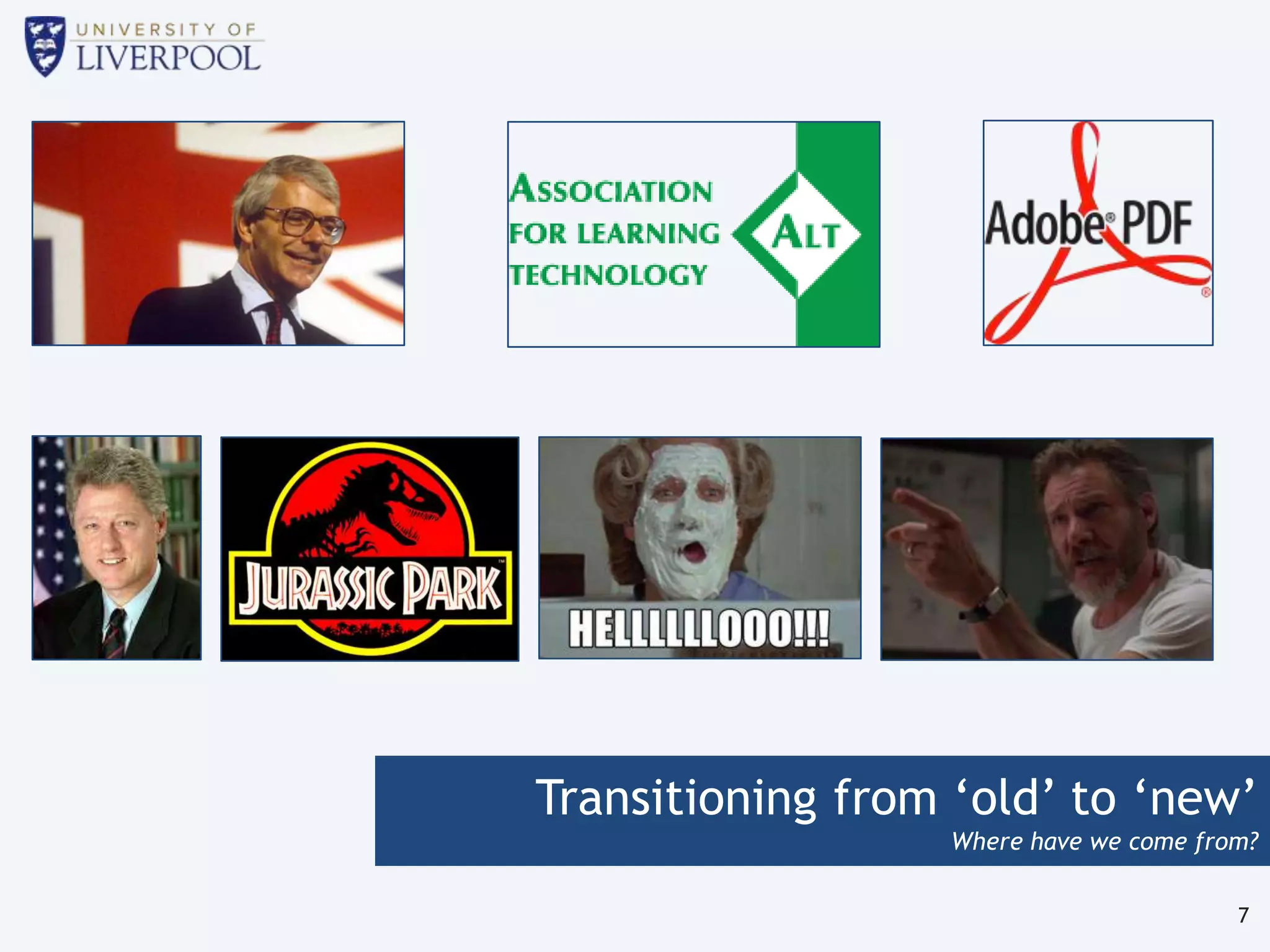
    Transitioning from ‘old’to ‘new’ Where have we come from? 7
  • 8.
    ‘Blended’ learning What doesthe literature say? • ‘Buzz’ word in education; meaning constantly changing; synonymous terminology (Gikandi, Morrow, & Davis, 2011; Sharpe, Benfield, Roberts et al., 2006) – More than 20 terms used to describe ‘e-learning’ (Guri-Rosenelt, 2009) • ‘Online learning’, ‘blended learning’, ‘ICT mediated f2f’, and ‘distance learning’ (Andrews & Haythornthwaite, 2007; Brenton, 2009; Guri-Rosenelt, 2009; Mellar, 2008) • Variation in the ‘application’ (Sharma, 2010) – A combination of … • … traditional learning with Web-based, online approaches • … media and tools • … pedagogic approaches
  • 9.
    ‘Blended’ learning What doesthe literature say? “… combining face-to-face with distance delivery systems” (Osguthorpe & Graham, 2003, p.227) Activities, students and/or instructors “… thoughtful integration of classroom face-to-face learning experiences with online learning” (Garrison & Kanuka, 2004, p.96) • Represents a “significant departure” from either approach (Garrison & Kanuka, 2004, p.97) – Online learning and blended learning differ in the amount of Web-based activity (Allen, Seaman & Garret, 2007)
  • 10.
    The new norm(al)? Johnson,Adams Becker, Cummins, Estrada et al. (2016) Policy rethinking how institutions work; measuring learning Leadership shift to deeper learning approaches; increase in blended learning designs Practice cultures of innovation; re-designing learning spaces
  • 11.
    The new norm(al)? Johnson,Adams Becker, Cummins, Estrada et al. (2016) Policy blended formal/informal learning; balancing the ‘connectedness’ Leadership improving digital capabilities; keeping education relevant Practice competing models of education; personalised learning
  • 12.
    http://harvardpolitics.com/blog/wp-content/uploads/2012/10/Sanders.jpg The blended learningmodel has experienced significant growth during the past years and this can be attributed to the following factors: the flexibility normally characteristic of a totally online course; its impact on overcrowded classrooms; and a perceived improvement in the teaching and learning experience. (Napier, Dekhane & Smith, 2011, p.20) “
  • 13.
    The new norm(al)? Supplementingstudents in difficult subjects https://resplendentjane.files.wordpress.com/2014/10/1340050882014_3068657.png
  • 14.
    ‘Technology-informed’ course design Gettingit right from the start • BL perceived as “useful, enjoyable, supportive, flexible and [a] motivator for learners” (Güzer and Caner, 2014, p.4602) – But we need to do more … – Encourage students to participate through social interaction and collaboration “… blending of face to face and online learning environments should be planned precisely in order to benefit more from this approach” (ibid, emphasis mine)
  • 15.
    ‘Technology-informed’ course design Gettingit right from the start • Planning for technology from the start forces us to think about the delivery – ‘Bolt-on’/‘afterthought’ – ‘Ignorance’ of the ‘need’ to rethink course design and pedagogy (Bleed, 2001; Vaughan, 2007) – Change is ‘difficult’ • Bridging the pedagogy/technology ‘gap’ – Now: 8 x Lecturer (Learning Technology) – TEL Academic Team • Variety of subject discipline & institutional backgrounds – Planned: Course Development Unit – Strategy 2026
  • 16.
    ‘Technology-informed’ course design Gettingit right from the start “… blended learning is consistent with the values of [HEIs] and has the proven potential to enhance both the effectiveness and efficiency of meaningful learning experiences” (Garrison & Kanuka, 2004, p.5) • Specifications consist of aims, objectives, learning outcomes, assessment strategy – But what about the use/application of ‘technology’? – Delivery then becomes an ‘active’ rather than ‘after’ thought (Alston & Brabon, 2014) – This can be a challenge!
  • 17.
    LIFE109 – QuantitativeSkills What am I trying to address? • ‘Math Anxiety’ (Ashcraft, 2002; Jameson & Fusco, 2014; Richardson & Suinn, 1972) – ‘Difficult’ content • Threshold concepts (Mayer & Land, 2003, 2005; Alston, Walsh & Westhead, 2015) – Maths … – “I’m studying Anatomy, why do I need to do this?” – Maths … – …
  • 18.
    LIFE109 – QuantitativeSkills The right ‘blend’ … • Transitioning to the ‘new’ norm(al) – Then (2014): Predominately face to face (lectures & workshops); VLE as repository; paper based assessment – Now (2016): Introductory lecture for topic; ‘flipped’ approach using VLE; workshop to support; PAL sessions; online summative assessment • It’s that easy?! – Massive energy/time/work to achieve this • Teaching; research/scholarship; administration; personal tutor; social life(!) – Students as ‘co-creators’ – Change, evaluate, refine …
  • 19.
    Summary What’s the takehome message? • Online environment presents an opportunity to enhance the learning environment – Blended approach can support the ‘best’ of a number of worlds – Does it always have to be a blend of f2f and online? • Blended approach is becoming the new norm(al) – Might not be out of choice(!) – It needs to be planned for, particularly when it involves the use of (unreliable) technology • Giving consideration at the programme/module design stage – Delivery then becomes an ‘active’ rather than ‘after’ thought
  • 20.
    Questions? Allen, I. E.,Seaman, J., & Garret, R. (2007). Blending in. The extent and promise of blended education in the United States. Retrieved from http://files.eric.ed.gov/fulltext/ED529930.pdf Alston, P., & Brabon, B. (2014). "A hostage to fortune?" - Validating Massive Open Online Courses (MOOCs) for University Credit. In: Proceedings of the European MOOC Stakeholder Summit 2014 (pp. 178-183). Lausanne, Switzerland: e-Learning Papers. Alston, P., Walsh, D. & Westhead, G. (2015). Uncovering “Threshold Concepts” in Web Development: An Instructor Perspective. ACM Transactions on Computing Education. 15(1), 1-18. doi: 10.1145/2700513 Andrews, R., & Haythornthwaite, C. (2007). Introduction to E-learning Research. In R. Andrews, & C. Haythornthwaite (Eds.), The sage handbook of E-learning research (pp.1–59). London: Sage Publication Ltd. Angelo, T., & Cross, K. (1993). Classroom Assessment Techniques: A Handbook for College Teachers. San Francisco, CA: Jossey-Bass. Ashcraft, M.H. (2002) Math Anxiety: Personal, Educational, and Cognitive Consequences. Current Directions in Psychological Science. 11(5). 181-185. doi: 10.1111/1467-8721.00196 Brenton, S. (2009). E-learning-an introduction. In F. Heather, S. Ketteridge, & M. Stephanie (Eds.), A Handbook for teaching and learning in higher education: enhancing academic practice (3rd ed.). (pp. 85–98) New York: Routledge. Garrison, D.R. & Kanuka, H. (2004). “Blended Learning: Uncovering Its Transformative Potential in Higher Education.” The Internet and Higher Education 7(2), 95–105. doi: 10.1016/j.iheduc.2004.02.001 Gikandi, J., Morrow, D., & Davis, N. (2011). Online formative assessment in higher education: A review of the literature. Computers & Education, 57(4), 2333-2351. doi:10.1016/j.compedu.2011.06.004 Guri-Rosenelt, S. (2009). Digital technologies in higher Education: sweeping expectations and actual effects. New York: Nova Science Publishers Inc. Jameson, M.M. & Fusco, B.R. (2014) Math Anxiety, Math Self-Concept, and Math Self-Efficacy in Adult Learners Compared to Traditional Undergraduate Students. Adult Education Quarterly. 64(4). 306-322. doi: 10.1177/0741713614541461. Johnson, L., Adams Becker, S., Cummins, M., Estrada, V., Freeman, A., & Hall, C. (2016). NMC Horizon Report: 2016 Higher Education Edition. Austin, Texas: The New Media Consortium. Retrieved from http://cdn.nmc.org/media/2016-nmc-horizon-report-he-EN.pdf Mellar, H. (2008). E-learning. In G. McCulloch, & D. Crook (Eds.), The Routledge international encyclopedia of education (pp. 219–220). New York: Routledge. Meyer, J.H.F & Land, R. (2003). Threshold Concepts and Troublesome Knowledge (1) — Linkages to Ways of Thinking and Practicing within the Disciplines. Oxford Centre for Staff and Learning Development, Oxford. Meyer, J.H.F & Land, R. (2005). Threshold concepts and troublesome knowledge (2): Epistemological considerations and a conceptual framework for teaching and learning. International Journal of Higher Education and Educational Planning. 49(3), 373–388. doi:10.1007/s10734-004-6779-5 Napier, N.P., Dekhane, S. & Smith, S. (2011). “Transitioning to Blended Learning: Understanding Student and Faculty Perceptions.” Journal of Asynchronous Learning Network 15(1), 20–32. doi: 10.1177/009155218701500207 Norton, P., & Wiburg, K. (2003). Teaching with technology: Designing opportunities to lean. Belmont, CA: Thompson-Wadsworth. Osguthorpe, R.T. & Graham, C.R. (2003). “Blended Learning Environments: Definitions and Directions.” Quarterly Review of Distance Education 4(3):227–33. Retrieved from http://eric.ed.gov/?id=EJ678078. Richardson, F.C. & Suinn, R.M (1972) The Mathematics Anxiety Rating Scale: Psychometric Data. Journal of Counseling Psychology. 19(6). 551-554. Rowley, D., Lujan, H., & Dolence, M. (1998). Strategic choices for the academy: How demand for lifelong learning will re-create higher education. San Francisco, CA: Jossey-Bass. Sharma, P.. 2010. “Blended Learning.” ELT Journal 64(4), 456–58. doi: 10.1093/elt/ccq043 Sharpe, R., Benfield, G., Roberts, G. & Francis. R. (2006). The Undergraduate Experience of Blended E-learning: A Review of UK Literature and Practice. Retrieved from http://www.heacademy.ac.uk/assets/ York/documents/ourwork/research/ literature_reviews/ blended_elearning_exec_summary_1.pdf Sujo de Montes, L., & Gonzales, C. (2000). Been there, done that: reaching teachers through distance education. Journal of Technology and Teacher Education, 8(4), 351-371. Ulmer, G.L. (2003). Internet Invention: From Literacy to Electracy. New York: Longman. Whitelock, D., & Brasher, A. (2006). Roadmap for e-assessment. Retrieved from http://www.jisc.ac.uk/whatwedo/programmes/elearningpedagogy/assessment.aspx