Angelo Baggini, angelo.baggini@unibg.it, Bergamo University - Engineering Department
Via Marconi 5, 24044 Dalmine (BG) – Italy
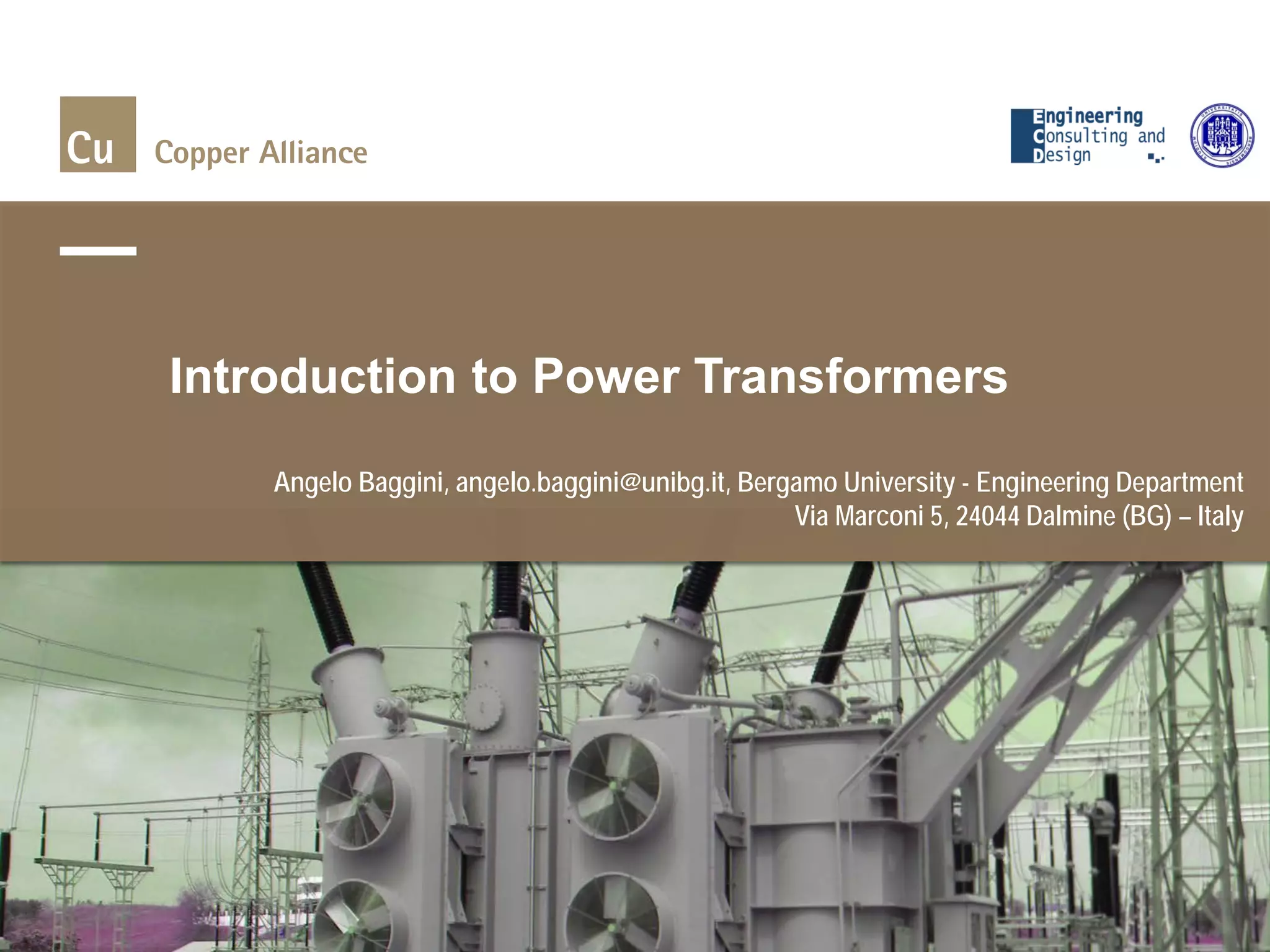
Introduction to Power Transformers
Contents
1. Main Standards
2. Classification
3. Rated values
4. Tolerances
Introduction to Power Transformers
MAIN STANDARDS
Main Standards
IEC 60076 Power transformers
1 - General
2 - Temperature rise for liquid-immersed transformers
3 - Insulation levels, dielectric tests and external clearances in air
5 - Ability to withstand short circuit
10 - Determination of sound levels
11 - Dry-type transformers
Main Standards
Europe
• EN 50464: Three-phase oil-immersed distribution transformers 50
Hz, from 50 kVA to 2 500 kVA with highest voltage for equipment
not exceeding 36 kV
• EN 50541: Three phase dry-type distribution transformers 50 Hz,
from 100 to 3150 kVA, with highest voltage for equipment not
exceeding 36 kV
• PrEN 50588-1: Medium power transformers 50 Hz, with highest
voltage for equipment not exceeding 36 kV - Part 1: General
requirements
• PrEN 50629: Energy performance of large power transformers (Um
> 36 kV or Sr > 40 MVA)
• No 548/2014 COMMISSION REGULATION (EU) of 21 May
2014
Introduction to Power Transformers
CLASSIFICATION
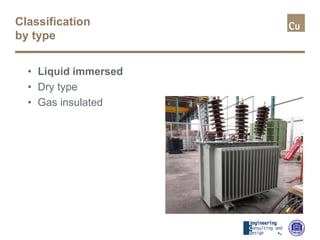
Classification
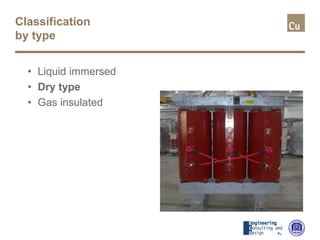
by type
• Liquid immersed
• Dry type
• Gas insulated
Classification
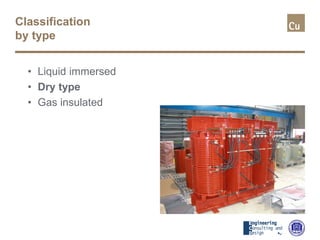
by type
• Liquid immersed
• Dry type
• Gas insulated
Classification
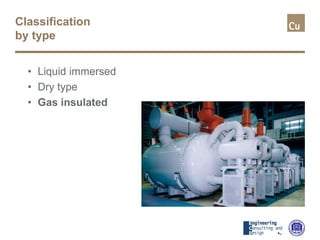
by type
• Liquid immersed
• Dry type
• Gas insulated
Classification
by type
• Liquid immersed
• Dry type
• Gas insulated
Classification
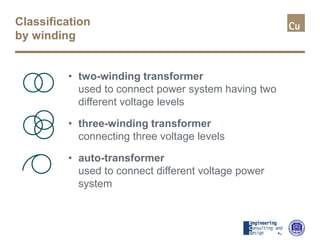
by winding
• two-winding transformer
used to connect power system having two
different voltage levels
• three-winding transformer
connecting three voltage levels
• auto-transformer
used to connect different voltage power
system
Classification
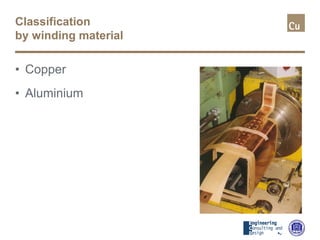
by winding material
• Copper
• Aluminium
Classification
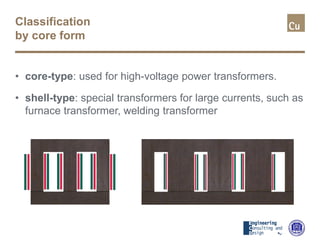
by core form
• core-type: used for high-voltage power transformers.
• shell-type: special transformers for large currents, such as
furnace transformer, welding transformer
Classification
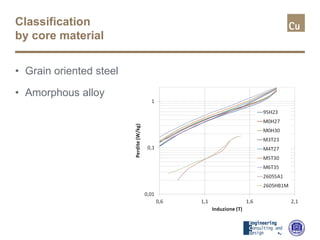
by core material
• Grain oriented steel
• Amorphous alloy
Classification
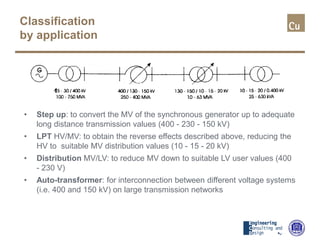
by application
• Step up: to convert the MV of the synchronous generator up to adequate
long distance transmission values (400 - 230 - 150 kV)
• LPT HV/MV: to obtain the reverse effects described above, reducing the
HV to suitable MV distribution values (10 - 15 - 20 kV)
• Distribution MV/LV: to reduce MV down to suitable LV user values (400
- 230 V)
• Auto-transformer: for interconnection between different voltage systems
(i.e. 400 and 150 kV) on large transmission networks
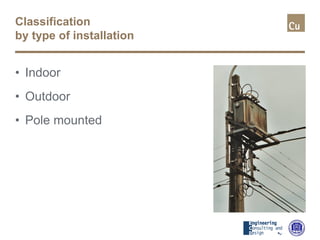
Classification
by type of installation
• Indoor
• Outdoor
• Pole mounted
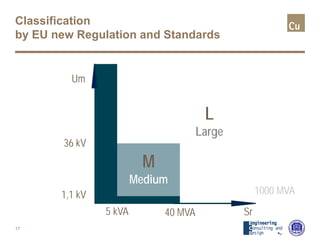
Classification
by EU new Regulation and Standards
5 kVA
17
40 MVA Sr
1,1 kV
36 kV
Um
M
Medium
L
Large
1000 MVA
Introduction to Power Transformers
RATED VALUES
Rated values
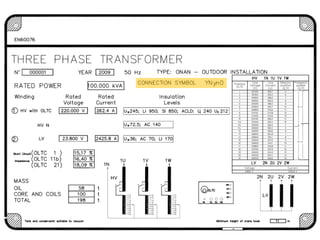
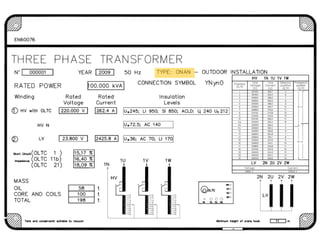
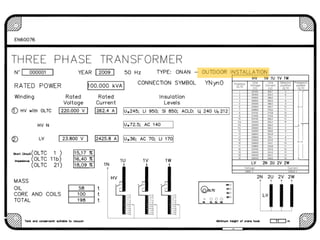
• Manufacturer name, serial number
• Rated frequency (Hz)
• Rated power (kVA)
• Phase number and transformer type
• Rated voltage of each winding (kV)
• Tapped voltage range
• Type of tap-winding and type of tap-changer
• insulation level (kV)
• Maximum voltage of the windings (kV)
• Short-circuit voltage (%)
• Cooling system type
• Environmental, climatic and fire conditions
• Losses
Rated values
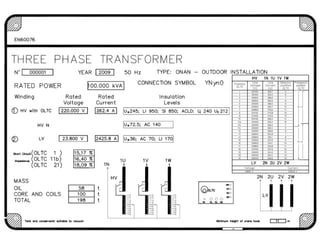
• IEC/EN 60076-1 Art. 8
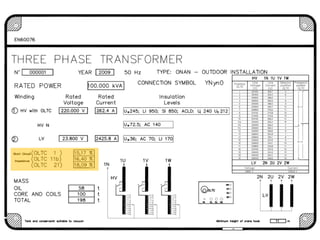
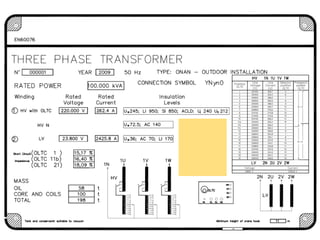
• The transformer shall be provided with a rating plate of
weatherproof material, fitted in a visible position, showing the
appropriate items indicated below. The entries on the plate shall be
indelibly marked.
• COMMISSION REGULATION (EU) No 548/2014
of 21 May 2014
• Additional requirements starting from 1/7/2015
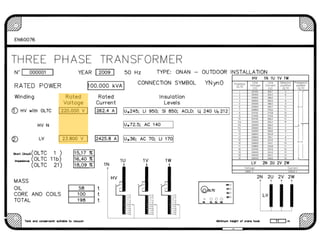
Rated voltage (UR)
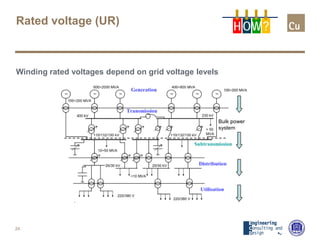
The voltage assigned to be applied, or developed at
no-load, between the terminals of an untapped
winding, or of a tapped winding connected on the
principal tapping
For a three-phase winding it is the voltage
between line terminals
IEC 60076-1 standard
Rated voltage (UR)
Winding rated voltages depend on grid voltage levels
24
H OW?
Rated voltage (UR)
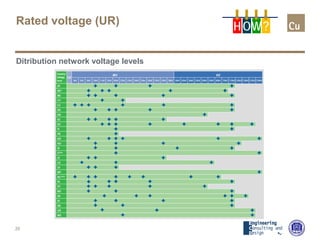
Ditribution network voltage levels
25
H OW?
Rated power (Sr)
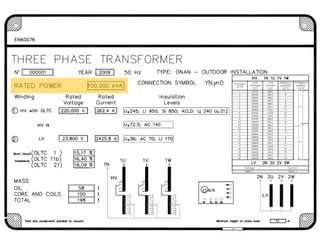
A conventional value of the apparent power assigned to a
winding which, together with the rated voltage of the winding,
determines its rated current
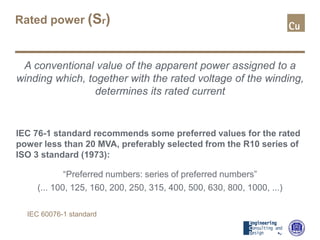
IEC 76-1 standard recommends some preferred values for the rated
power less than 20 MVA, preferably selected from the R10 series of
ISO 3 standard (1973):
“Preferred numbers: series of preferred numbers”
(... 100, 125, 160, 200, 250, 315, 400, 500, 630, 800, 1000, ...)
IEC 60076-1 standard
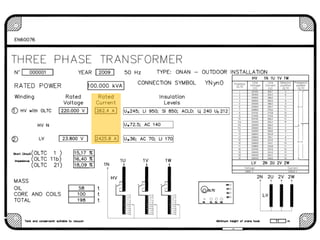
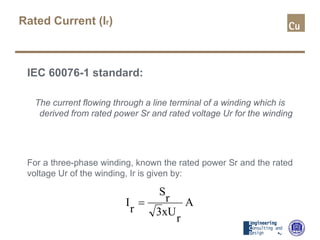
Rated Current (Ir)
IEC 60076-1 standard:
The current flowing through a line terminal of a winding which is
derived from rated power Sr and rated voltage Ur for the winding
For a three-phase winding, known the rated power Sr and the rated
voltage Ur of the winding, Ir is given by:
A
r
xU3
r
S
r
I =
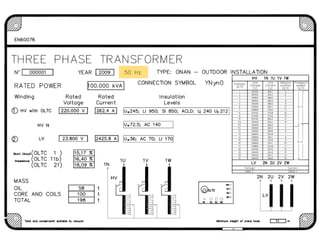
Rated frequency (fr)
The frequency at which the transformer
is designed to operate
IEC 60076-1 standard
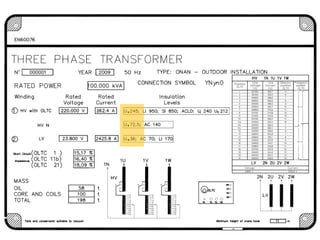
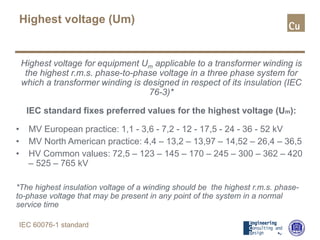
Highest voltage for equipment Um applicable to a transformer winding is
the highest r.m.s. phase-to-phase voltage in a three phase system for
which a transformer winding is designed in respect of its insulation (IEC
76-3)*
IEC standard fixes preferred values for the highest voltage (Um):
• MV European practice: 1,1 - 3,6 - 7,2 - 12 - 17,5 - 24 - 36 - 52 kV
• MV North American practice: 4,4 – 13,2 – 13,97 – 14,52 – 26,4 – 36,5
• HV Common values: 72,5 – 123 – 145 – 170 – 245 – 300 – 362 – 420
– 525 – 765 kV
*The highest insulation voltage of a winding should be the highest r.m.s. phase-
to-phase voltage that may be present in any point of the system in a normal
service time
Highest voltage (Um)
IEC 60076-1 standard
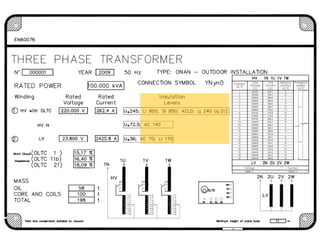
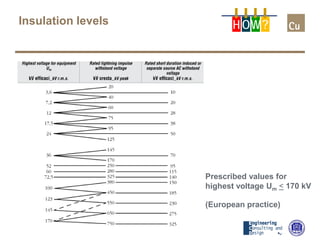
Insulation levels
H OW?
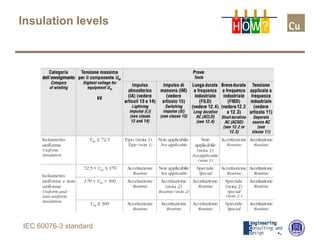
IEC 60076-3 standard
Prescribed values for
highest voltage Um < 170 kV
(European practice)
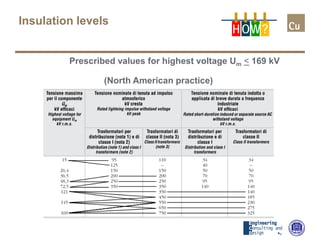
Insulation levels H OW?
Prescribed values for highest voltage Um < 169 kV
(North American practice)
Insulation levels
H OW?
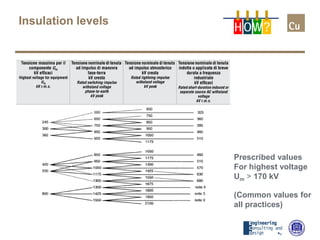
Prescribed values
For highest voltage
Um > 170 kV
(Common values for
all practices)
Insulation levels
H OW?
Short circuit voltage (impedance)
The equivalent series impedance Z =R +jX (Ohms) at rated frequency
and referece temperature, across the teminals of one winding of a pair,
when the terminals of the other winding are short circuited and further
windings, if existing are open circuited. For a three phase transformer
the impedance is expressed as phase impedance (equivalent star
connections).
For transformers with tappings exceeding a voltage variation of ±5
% from the principal tapping, impedance values expressed in terms
of Z or z shall be specified for the principal tapping and the
extreme tapping(s) exceeding 5 %.
Unless otherwise specified the principal tapping applies
IEC 60076-1 standard
Short circuit voltage values
MV/LV
• the values are standardised on the basis of the rated power:
• 4% for Sr ≤ 630 kVA
• 6% for Sr ≥ 630 kVA
• 4 o 6% for Sr = 630 kVA (preferably is chosen the higher value to reduce the
short-circuit current value)
HV/MV
• the values are not standardised but as a practical rule it is possible to consider
that the increment is by an exponent equal to 0,25 in respect on the rated power
value ratio (i.e. for a 63 MVA transformer, 130 kV, the natural value of Vcc may
be about 10-12%)
• the option on this value is mainly with respect of the installation point of view
(short circuit current)
• it is possible to adjust the Vcc natural value varying the dimensions of channel
between windings, height of the windings and coils number
H OW?
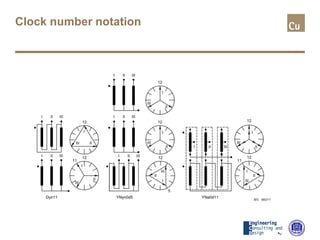
Clock number notation
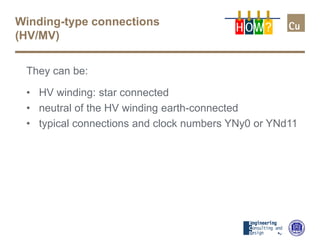
Winding-type connections
(HV/MV)
They can be:
• HV winding: star connected
• neutral of the HV winding earth-connected
• typical connections and clock numbers YNy0 or YNd11
H OW?
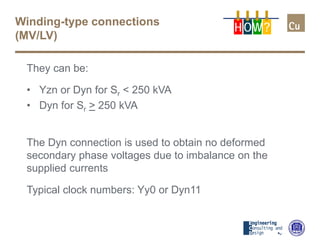
Winding-type connections
(MV/LV)
They can be:
• Yzn or Dyn for Sr < 250 kVA
• Dyn for Sr > 250 kVA
The Dyn connection is used to obtain no deformed
secondary phase voltages due to imbalance on the
supplied currents
Typical clock numbers: Yy0 or Dyn11
H OW?
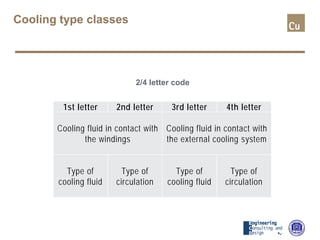
2/4 letter code
Cooling type classes
1st letter 2nd letter 3rd letter 4th letter
Cooling fluid in contact with
the windings
Cooling fluid in contact with
the external cooling system
Type of
cooling fluid
Type of
circulation
Type of
cooling fluid
Type of
circulation
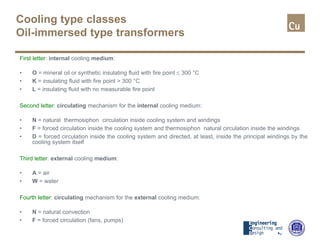
Cooling type classes
Oil-immersed type transformers
First letter: internal cooling medium:
• O = mineral oil or synthetic insulating fluid with fire point ≤ 300 °C
• K = insulating fluid with fire point > 300 °C
• L = insulating fluid with no measurable fire point
Second letter: circulating mechanism for the internal cooling medium:
• N = natural thermosiphon circulation inside cooling system and windings
• F = forced circulation inside the cooling system and thermosiphon natural circulation inside the windings
• D = forced circulation inside the cooling system and directed, at least, inside the principal windings by the
cooling system itself
Third letter: external cooling medium:
• A = air
• W = water
Fourth letter: circulating mechanism for the external cooling medium:
• N = natural convection
• F = forced circulation (fans, pumps)
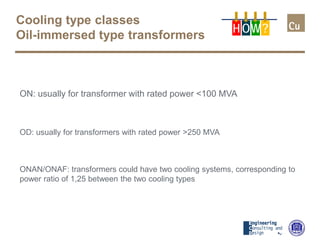
Cooling type classes
Oil-immersed type transformers
ON: usually for transformer with rated power <100 MVA
OD: usually for transformers with rated power >250 MVA
ONAN/ONAF: transformers could have two cooling systems, corresponding to
power ratio of 1,25 between the two cooling types
H OW?
Cooling type classes
Dry type transformers
First letter: cooling medium:
• A = Air
Second letter: circulating mechanism:
• N = natural
• F = forced
H OW?
Cooling type classes
Dry type transformers H OW?
AN: usually for transformer with rated power <2,5 MVA
AN: usually for transformers with rated power >250 MVA
AN/AF: transformers could have two cooling systems, corresponding to power
ratio of 1,25 between the two cooling types
Temperature classes/rise limits
The admissible overtemperature values are fixed for each part of the
transformer concerning the manufacturing characteristics
Overtemperature limits are referred to the following environmental
conditions:
• air-monthly average-temperature: 30 °C
• air-yearly average-temperature: 20 °C
• highest air temperature: 40 °C
• highest water temperature (where applicable): 25 °C
IEC 60076-2 standard
Temperature classes/rise limits
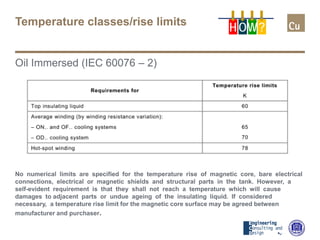
Oil Immersed (IEC 60076 – 2)
No numerical limits are specified for the temperature rise of magnetic core, bare electrical
connections, electrical or magnetic shields and structural parts in the tank. However, a
self-evident requirement is that they shall not reach a temperature which will cause
damages to adjacent parts or undue ageing of the insulating liquid. If considered
necessary, a temperature rise limit for the magnetic core surface may be agreed between
manufacturer and purchaser.
H OW?
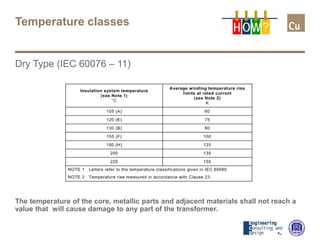
Temperature classes
Dry Type (IEC 60076 – 11)
The temperature of the core, metallic parts and adjacent materials shall not reach a
value that will cause damage to any part of the transformer.
H OW?
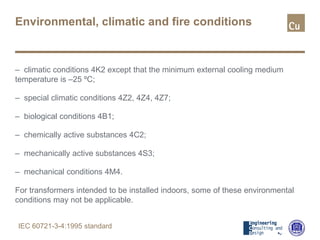
Environmental, climatic and fire conditions
– climatic conditions 4K2 except that the minimum external cooling medium
temperature is –25 ºC;
– special climatic conditions 4Z2, 4Z4, 4Z7;
– biological conditions 4B1;
– chemically active substances 4C2;
– mechanically active substances 4S3;
– mechanical conditions 4M4.
For transformers intended to be installed indoors, some of these environmental
conditions may not be applicable.
IEC 60721-3-4:1995 standard
Environmental, climatic and fire conditions
Dry type transformers
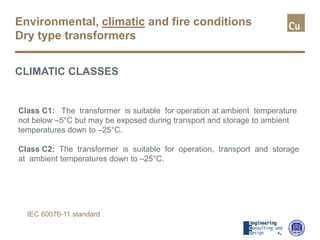
CLIMATIC CLASSES
Class C1: The transformer is suitable for operation at ambient temperature
not below –5°C but may be exposed during transport and storage to ambient
temperatures down to –25°C.
Class C2: The transformer is suitable for operation, transport and storage
at ambient temperatures down to –25°C.
IEC 60076-11 standard
Environmental, climatic and fire conditions
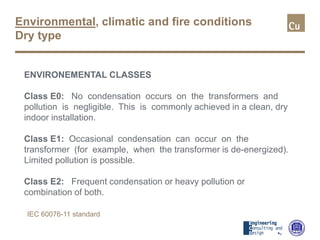
Dry type
ENVIRONEMENTAL CLASSES
Class E0: No condensation occurs on the transformers and
pollution is negligible. This is commonly achieved in a clean, dry
indoor installation.
Class E1: Occasional condensation can occur on the
transformer (for example, when the transformer is de-energized).
Limited pollution is possible.
Class E2: Frequent condensation or heavy pollution or
combination of both.
IEC 60076-11 standard
Environmental, climatic and fire conditions
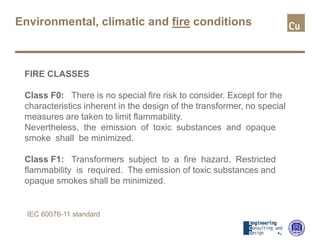
FIRE CLASSES
Class F0: There is no special fire risk to consider. Except for the
characteristics inherent in the design of the transformer, no special
measures are taken to limit flammability.
Nevertheless, the emission of toxic substances and opaque
smoke shall be minimized.
Class F1: Transformers subject to a fire hazard. Restricted
flammability is required. The emission of toxic substances and
opaque smokes shall be minimized.
IEC 60076-11 standard
Other Information
COMMISSION REGULATION (EU) No 548/2014 of 21 May 2014
Additional requirements starting from 1/7/2015:
• information on rated power, load loss and no-load loss and the
electrical power of any cooling system required at no load;
• for dual voltage transformers, the maximum rated power at the lower
voltage
• information on the weight of all the main components of a power
transformer (including at least the conductor, the nature of the
conductor and the core material)
Introduction to Power Transformers
TOLERANCES
Tolerances
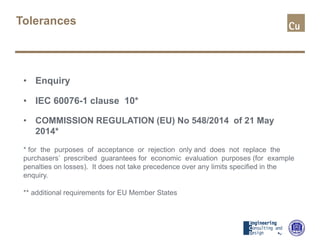
• Enquiry
• IEC 60076-1 clause 10*
• COMMISSION REGULATION (EU) No 548/2014 of 21 May
2014*
* for the purposes of acceptance or rejection only and does not replace the
purchasers’ prescribed guarantees for economic evaluation purposes (for example
penalties on losses). It does not take precedence over any limits specified in the
enquiry.
** additional requirements for EU Member States
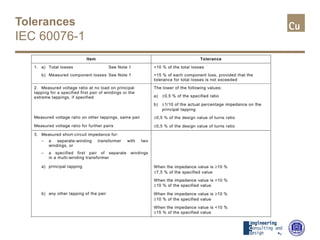
Tolerances
IEC 60076-1
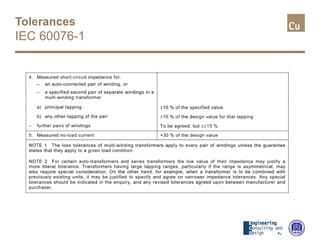
Tolerances
IEC 60076-1
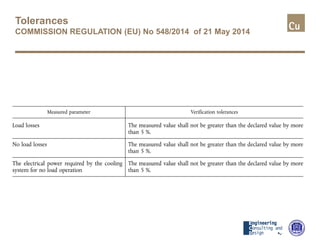
Tolerances
COMMISSION REGULATION (EU) No 548/2014 of 21 May 2014
Thank you
| Presentation title and date
For more information please contact
Angelo Baggini
Università di Bergamo
Dipartimento di Ingegneria
Viale Marconi 5,
24044 Dalmine (BG) Italy
email: angelo.baggini@unibg.it
ECD Engineering Consulting and Design
Via Maffi 21 27100 PAVIA Italy

Introduction to power transformers

  • 1.
    Angelo Baggini, angelo.baggini@unibg.it,Bergamo University - Engineering Department Via Marconi 5, 24044 Dalmine (BG) – Italy Introduction to Power Transformers
  • 2.
    Contents 1. Main Standards 2.Classification 3. Rated values 4. Tolerances
  • 3.
    Introduction to PowerTransformers MAIN STANDARDS
  • 4.
    Main Standards IEC 60076Power transformers 1 - General 2 - Temperature rise for liquid-immersed transformers 3 - Insulation levels, dielectric tests and external clearances in air 5 - Ability to withstand short circuit 10 - Determination of sound levels 11 - Dry-type transformers
  • 5.
    Main Standards Europe • EN50464: Three-phase oil-immersed distribution transformers 50 Hz, from 50 kVA to 2 500 kVA with highest voltage for equipment not exceeding 36 kV • EN 50541: Three phase dry-type distribution transformers 50 Hz, from 100 to 3150 kVA, with highest voltage for equipment not exceeding 36 kV • PrEN 50588-1: Medium power transformers 50 Hz, with highest voltage for equipment not exceeding 36 kV - Part 1: General requirements • PrEN 50629: Energy performance of large power transformers (Um > 36 kV or Sr > 40 MVA) • No 548/2014 COMMISSION REGULATION (EU) of 21 May 2014
  • 6.
    Introduction to PowerTransformers CLASSIFICATION
  • 7.
    Classification by type • Liquidimmersed • Dry type • Gas insulated
  • 8.
    Classification by type • Liquidimmersed • Dry type • Gas insulated
  • 9.
    Classification by type • Liquidimmersed • Dry type • Gas insulated
  • 10.
    Classification by type • Liquidimmersed • Dry type • Gas insulated
  • 11.
    Classification by winding • two-windingtransformer used to connect power system having two different voltage levels • three-winding transformer connecting three voltage levels • auto-transformer used to connect different voltage power system
  • 12.
  • 13.
    Classification by core form •core-type: used for high-voltage power transformers. • shell-type: special transformers for large currents, such as furnace transformer, welding transformer
  • 14.
    Classification by core material •Grain oriented steel • Amorphous alloy
  • 15.
    Classification by application • Stepup: to convert the MV of the synchronous generator up to adequate long distance transmission values (400 - 230 - 150 kV) • LPT HV/MV: to obtain the reverse effects described above, reducing the HV to suitable MV distribution values (10 - 15 - 20 kV) • Distribution MV/LV: to reduce MV down to suitable LV user values (400 - 230 V) • Auto-transformer: for interconnection between different voltage systems (i.e. 400 and 150 kV) on large transmission networks
  • 16.
    Classification by type ofinstallation • Indoor • Outdoor • Pole mounted
  • 17.
    Classification by EU newRegulation and Standards 5 kVA 17 40 MVA Sr 1,1 kV 36 kV Um M Medium L Large 1000 MVA
  • 18.
    Introduction to PowerTransformers RATED VALUES
  • 19.
    Rated values • Manufacturername, serial number • Rated frequency (Hz) • Rated power (kVA) • Phase number and transformer type • Rated voltage of each winding (kV) • Tapped voltage range • Type of tap-winding and type of tap-changer • insulation level (kV) • Maximum voltage of the windings (kV) • Short-circuit voltage (%) • Cooling system type • Environmental, climatic and fire conditions • Losses
  • 20.
    Rated values • IEC/EN60076-1 Art. 8 • The transformer shall be provided with a rating plate of weatherproof material, fitted in a visible position, showing the appropriate items indicated below. The entries on the plate shall be indelibly marked. • COMMISSION REGULATION (EU) No 548/2014 of 21 May 2014 • Additional requirements starting from 1/7/2015
  • 23.
    Rated voltage (UR) Thevoltage assigned to be applied, or developed at no-load, between the terminals of an untapped winding, or of a tapped winding connected on the principal tapping For a three-phase winding it is the voltage between line terminals IEC 60076-1 standard
  • 24.
    Rated voltage (UR) Windingrated voltages depend on grid voltage levels 24 H OW?
  • 25.
    Rated voltage (UR) Ditributionnetwork voltage levels 25 H OW?
  • 27.
    Rated power (Sr) Aconventional value of the apparent power assigned to a winding which, together with the rated voltage of the winding, determines its rated current IEC 76-1 standard recommends some preferred values for the rated power less than 20 MVA, preferably selected from the R10 series of ISO 3 standard (1973): “Preferred numbers: series of preferred numbers” (... 100, 125, 160, 200, 250, 315, 400, 500, 630, 800, 1000, ...) IEC 60076-1 standard
  • 29.
    Rated Current (Ir) IEC60076-1 standard: The current flowing through a line terminal of a winding which is derived from rated power Sr and rated voltage Ur for the winding For a three-phase winding, known the rated power Sr and the rated voltage Ur of the winding, Ir is given by: A r xU3 r S r I =
  • 31.
    Rated frequency (fr) Thefrequency at which the transformer is designed to operate IEC 60076-1 standard
  • 33.
    Highest voltage forequipment Um applicable to a transformer winding is the highest r.m.s. phase-to-phase voltage in a three phase system for which a transformer winding is designed in respect of its insulation (IEC 76-3)* IEC standard fixes preferred values for the highest voltage (Um): • MV European practice: 1,1 - 3,6 - 7,2 - 12 - 17,5 - 24 - 36 - 52 kV • MV North American practice: 4,4 – 13,2 – 13,97 – 14,52 – 26,4 – 36,5 • HV Common values: 72,5 – 123 – 145 – 170 – 245 – 300 – 362 – 420 – 525 – 765 kV *The highest insulation voltage of a winding should be the highest r.m.s. phase- to-phase voltage that may be present in any point of the system in a normal service time Highest voltage (Um) IEC 60076-1 standard
  • 35.
  • 36.
    Prescribed values for highestvoltage Um < 170 kV (European practice) Insulation levels H OW?
  • 37.
    Prescribed values forhighest voltage Um < 169 kV (North American practice) Insulation levels H OW?
  • 38.
    Prescribed values For highestvoltage Um > 170 kV (Common values for all practices) Insulation levels H OW?
  • 40.
    Short circuit voltage(impedance) The equivalent series impedance Z =R +jX (Ohms) at rated frequency and referece temperature, across the teminals of one winding of a pair, when the terminals of the other winding are short circuited and further windings, if existing are open circuited. For a three phase transformer the impedance is expressed as phase impedance (equivalent star connections). For transformers with tappings exceeding a voltage variation of ±5 % from the principal tapping, impedance values expressed in terms of Z or z shall be specified for the principal tapping and the extreme tapping(s) exceeding 5 %. Unless otherwise specified the principal tapping applies IEC 60076-1 standard
  • 41.
    Short circuit voltagevalues MV/LV • the values are standardised on the basis of the rated power: • 4% for Sr ≤ 630 kVA • 6% for Sr ≥ 630 kVA • 4 o 6% for Sr = 630 kVA (preferably is chosen the higher value to reduce the short-circuit current value) HV/MV • the values are not standardised but as a practical rule it is possible to consider that the increment is by an exponent equal to 0,25 in respect on the rated power value ratio (i.e. for a 63 MVA transformer, 130 kV, the natural value of Vcc may be about 10-12%) • the option on this value is mainly with respect of the installation point of view (short circuit current) • it is possible to adjust the Vcc natural value varying the dimensions of channel between windings, height of the windings and coils number H OW?
  • 43.
  • 44.
    Winding-type connections (HV/MV) They canbe: • HV winding: star connected • neutral of the HV winding earth-connected • typical connections and clock numbers YNy0 or YNd11 H OW?
  • 45.
    Winding-type connections (MV/LV) They canbe: • Yzn or Dyn for Sr < 250 kVA • Dyn for Sr > 250 kVA The Dyn connection is used to obtain no deformed secondary phase voltages due to imbalance on the supplied currents Typical clock numbers: Yy0 or Dyn11 H OW?
  • 47.
    2/4 letter code Coolingtype classes 1st letter 2nd letter 3rd letter 4th letter Cooling fluid in contact with the windings Cooling fluid in contact with the external cooling system Type of cooling fluid Type of circulation Type of cooling fluid Type of circulation
  • 48.
    Cooling type classes Oil-immersedtype transformers First letter: internal cooling medium: • O = mineral oil or synthetic insulating fluid with fire point ≤ 300 °C • K = insulating fluid with fire point > 300 °C • L = insulating fluid with no measurable fire point Second letter: circulating mechanism for the internal cooling medium: • N = natural thermosiphon circulation inside cooling system and windings • F = forced circulation inside the cooling system and thermosiphon natural circulation inside the windings • D = forced circulation inside the cooling system and directed, at least, inside the principal windings by the cooling system itself Third letter: external cooling medium: • A = air • W = water Fourth letter: circulating mechanism for the external cooling medium: • N = natural convection • F = forced circulation (fans, pumps)
  • 49.
    Cooling type classes Oil-immersedtype transformers ON: usually for transformer with rated power <100 MVA OD: usually for transformers with rated power >250 MVA ONAN/ONAF: transformers could have two cooling systems, corresponding to power ratio of 1,25 between the two cooling types H OW?
  • 50.
    Cooling type classes Drytype transformers First letter: cooling medium: • A = Air Second letter: circulating mechanism: • N = natural • F = forced H OW?
  • 51.
    Cooling type classes Drytype transformers H OW? AN: usually for transformer with rated power <2,5 MVA AN: usually for transformers with rated power >250 MVA AN/AF: transformers could have two cooling systems, corresponding to power ratio of 1,25 between the two cooling types
  • 52.
    Temperature classes/rise limits Theadmissible overtemperature values are fixed for each part of the transformer concerning the manufacturing characteristics Overtemperature limits are referred to the following environmental conditions: • air-monthly average-temperature: 30 °C • air-yearly average-temperature: 20 °C • highest air temperature: 40 °C • highest water temperature (where applicable): 25 °C IEC 60076-2 standard
  • 53.
    Temperature classes/rise limits OilImmersed (IEC 60076 – 2) No numerical limits are specified for the temperature rise of magnetic core, bare electrical connections, electrical or magnetic shields and structural parts in the tank. However, a self-evident requirement is that they shall not reach a temperature which will cause damages to adjacent parts or undue ageing of the insulating liquid. If considered necessary, a temperature rise limit for the magnetic core surface may be agreed between manufacturer and purchaser. H OW?
  • 54.
    Temperature classes Dry Type(IEC 60076 – 11) The temperature of the core, metallic parts and adjacent materials shall not reach a value that will cause damage to any part of the transformer. H OW?
  • 56.
    Environmental, climatic andfire conditions – climatic conditions 4K2 except that the minimum external cooling medium temperature is –25 ºC; – special climatic conditions 4Z2, 4Z4, 4Z7; – biological conditions 4B1; – chemically active substances 4C2; – mechanically active substances 4S3; – mechanical conditions 4M4. For transformers intended to be installed indoors, some of these environmental conditions may not be applicable. IEC 60721-3-4:1995 standard
  • 57.
    Environmental, climatic andfire conditions Dry type transformers CLIMATIC CLASSES Class C1: The transformer is suitable for operation at ambient temperature not below –5°C but may be exposed during transport and storage to ambient temperatures down to –25°C. Class C2: The transformer is suitable for operation, transport and storage at ambient temperatures down to –25°C. IEC 60076-11 standard
  • 58.
    Environmental, climatic andfire conditions Dry type ENVIRONEMENTAL CLASSES Class E0: No condensation occurs on the transformers and pollution is negligible. This is commonly achieved in a clean, dry indoor installation. Class E1: Occasional condensation can occur on the transformer (for example, when the transformer is de-energized). Limited pollution is possible. Class E2: Frequent condensation or heavy pollution or combination of both. IEC 60076-11 standard
  • 59.
    Environmental, climatic andfire conditions FIRE CLASSES Class F0: There is no special fire risk to consider. Except for the characteristics inherent in the design of the transformer, no special measures are taken to limit flammability. Nevertheless, the emission of toxic substances and opaque smoke shall be minimized. Class F1: Transformers subject to a fire hazard. Restricted flammability is required. The emission of toxic substances and opaque smokes shall be minimized. IEC 60076-11 standard
  • 61.
    Other Information COMMISSION REGULATION(EU) No 548/2014 of 21 May 2014 Additional requirements starting from 1/7/2015: • information on rated power, load loss and no-load loss and the electrical power of any cooling system required at no load; • for dual voltage transformers, the maximum rated power at the lower voltage • information on the weight of all the main components of a power transformer (including at least the conductor, the nature of the conductor and the core material)
  • 62.
    Introduction to PowerTransformers TOLERANCES
  • 63.
    Tolerances • Enquiry • IEC60076-1 clause 10* • COMMISSION REGULATION (EU) No 548/2014 of 21 May 2014* * for the purposes of acceptance or rejection only and does not replace the purchasers’ prescribed guarantees for economic evaluation purposes (for example penalties on losses). It does not take precedence over any limits specified in the enquiry. ** additional requirements for EU Member States
  • 64.
  • 65.
  • 66.
    Tolerances COMMISSION REGULATION (EU)No 548/2014 of 21 May 2014
  • 67.
    Thank you | Presentationtitle and date For more information please contact Angelo Baggini Università di Bergamo Dipartimento di Ingegneria Viale Marconi 5, 24044 Dalmine (BG) Italy email: angelo.baggini@unibg.it ECD Engineering Consulting and Design Via Maffi 21 27100 PAVIA Italy