©
ABB
Power
Technology
1_114Q07-
1
-
Power
Transformers
General
©
ABB
Power
Technology
1_114Q07-
2
-
AGENDA
 INTRODUCTION
 MAIN CHARACTERISTICS OF A POWER TRANSFORMER
 Types of transformers
 Transformation ratio
 Insulation class
 Rated output
 Transformer connections
 VOLTAGE CONTROL
 TYPES OF COOLING
 ACCESSORIES/ PRACTICAL ASPECTS
©
ABB
Power
Technology
1_114Q07-
3
-
AGENDA
 INTRODUCTION
 MAIN CHARACTERISTICS OF A POWER TRANSFORMER
 Types of transformers
 Transformation ratio
 Insulation class
 Rated output
 Transformer connections
 VOLTAGE CONTROL
 TYPES OF COOLING
 ACCESSORIES/ PRACTICAL ASPECTS
©
ABB
Power
Technology
1_114Q07-
4
-
Fundamental considerations
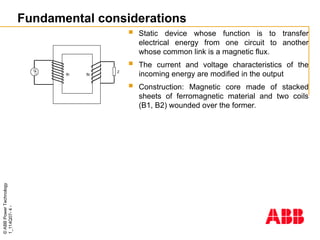
 Static device whose function is to transfer
electrical energy from one circuit to another
whose common link is a magnetic flux.
 The current and voltage characteristics of the
incoming energy are modified in the output
 Construction: Magnetic core made of stacked
sheets of ferromagnetic material and two coils
(B1, B2) wounded over the former.

G Z
B1 B2
©
ABB
Power
Technology
1_114Q07-
5
-
Fundamental considerations

G Z
B1 B2
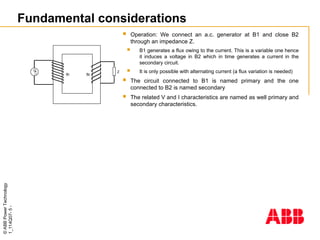
 Operation: We connect an a.c. generator at B1 and close B2
through an impedance Z.
 B1 generates a flux owing to the current. This is a variable one hence
it induces a voltage in B2 which in time generates a current in the
secondary circuit.
 It is only possible with alternating current (a flux variation is needed)
 The circuit connected to B1 is named primary and the one
connected to B2 is named secondary
 The related V and I characteristics are named as well primary and
secondary characteristics.
©
ABB
Power
Technology
1_114Q07-
6
-
Fundamental relationships
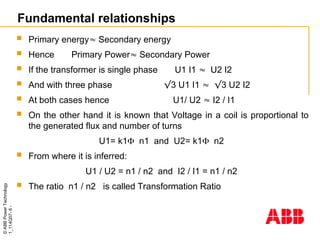
 Primary energy Secondary energy
 Hence Primary Power Secondary Power
 If the transformer is single phase U1 I1  U2 I2
 And with three phase √3 U1 I1  √3 U2 I2
 At both cases hence U1/ U2  I2 / I1
 On the other hand it is known that Voltage in a coil is proportional to
the generated flux and number of turns
U1= k1 n1 and U2= k1 n2
 From where it is inferred:
U1 / U2 = n1 / n2 and I2 / I1 = n1 / n2
 The ratio n1 / n2 is called Transformation Ratio
©
ABB
Power
Technology
1_114Q07-
7
-
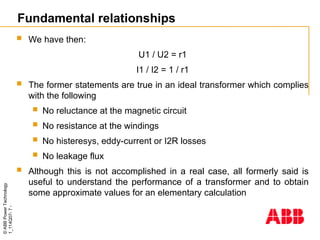
 We have then:
U1 / U2 = r1
I1 / I2 = 1 / r1
 The former statements are true in an ideal transformer which complies
with the following
 No reluctance at the magnetic circuit
 No resistance at the windings
 No histeresys, eddy-current or I2R losses
 No leakage flux
 Although this is not accomplished in a real case, all formerly said is
useful to understand the performance of a transformer and to obtain
some approximate values for an elementary calculation
Fundamental relationships
©
ABB
Power
Technology
1_114Q07-
8
-
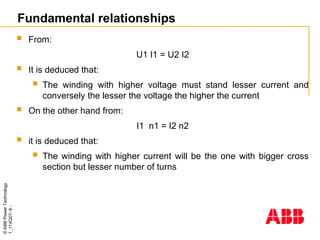
 From:
U1 I1 = U2 I2
 It is deduced that:
 The winding with higher voltage must stand lesser current and
conversely the lesser the voltage the higher the current
 On the other hand from:
I1 n1 = I2 n2
 it is deduced that:
 The winding with higher current will be the one with bigger cross
section but lesser number of turns
Fundamental relationships
©
ABB
Power
Technology
1_114Q07-
9
-
Power transformer function
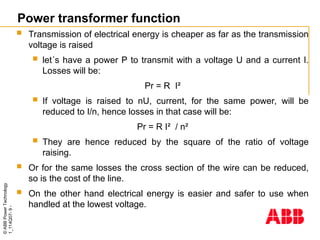
 Transmission of electrical energy is cheaper as far as the transmission
voltage is raised
 let´s have a power P to transmit with a voltage U and a current I.
Losses will be:
Pr = R I²
 If voltage is raised to nU, current, for the same power, will be
reduced to I/n, hence losses in that case will be:
Pr = R I² / n²
 They are hence reduced by the square of the ratio of voltage
raising.
 Or for the same losses the cross section of the wire can be reduced,
so is the cost of the line.
 On the other hand electrical energy is easier and safer to use when
handled at the lowest voltage.
©
ABB
Power
Technology
1_114Q07-
10
-
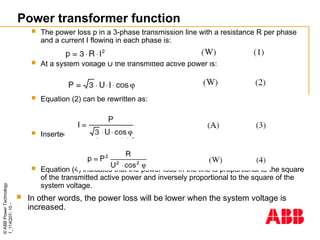
 The power loss p in a 3-phase transmission line with a resistance R per phase
and a current I flowing in each phase is:
 At a system voltage U the transmitted active power is:
 Equation (2) can be rewritten as:
 Inserted in the equation (1) gives:
 Equation (4) indicates that the power loss in the line is proportional to the square
of the transmitted active power and inversely proportional to the square of the
system voltage.
 In other words, the power loss will be lower when the system voltage is
increased.
Power transformer function
©
ABB
Power
Technology
1_114Q07-
11
-
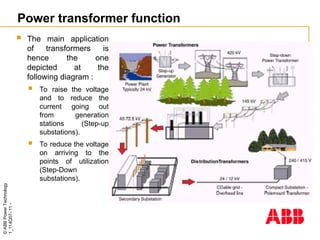
 The main application
of transformers is
hence the one
depicted at the
following diagram :
 To raise the voltage
and to reduce the
current going out
from generation
stations (Step-up
substations).
 To reduce the voltage
on arriving to the
points of utilization
(Step-Down
substations).
Power transformer function
©
ABB
Power
Technology
1_114Q07-
12
-
AGENDA
 INTRODUCTION
 MAIN CHARACTERISTICS OF A POWER TRANSFORMER
 Types of transformers
 Transformation ratio
 Insulation class
 Rated output
 Transformer connections
 VOLTAGE CONTROL
 TYPES OF COOLING
 ACCESSORIES/ PRACTICAL ASPECTS
©
ABB
Power
Technology
1_114Q07-
13
-
Main characteristics of a Power Transformer
 When choosing a transformer it is necessary to define:
 Type of transformer
 Transformation ratio
 Insulation Class
 Rated output
 Connection
 Also it is necessary to establish:
 Voltage regulation
 Type of cooling
 Accessories
©
ABB
Power
Technology
1_114Q07-
14
-
AGENDA
 INTRODUCTION
 MAIN CHARACTERISTICS OF A POWER TRANSFORMER
 Types of transformers
 Transformation ratio
 Insulation class
 Rated output
 Transformer connections
 VOLTAGE CONTROL
 TYPES OF COOLING
 ACCESSORIES/ PRACTICAL ASPECTS
©
ABB
Power
Technology
1_114Q07-
15
-
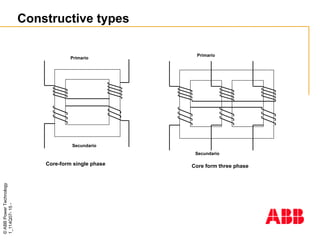
Constructive types
Primario
Core-form single phase
Secundario
Primario
Core form three phase
Secundario
©
ABB
Power
Technology
1_114Q07-
16
-
Constructive types
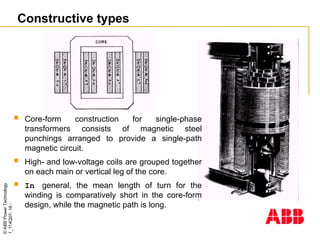
 Core-form construction for single-phase
transformers consists of magnetic steel
punchings arranged to provide a single-path
magnetic circuit.
 High- and low-voltage coils are grouped together
on each main or vertical leg of the core.
 In general, the mean length of turn for the
winding is comparatively short in the core-form
design, while the magnetic path is long.
©
ABB
Power
Technology
1_114Q07-
17
-
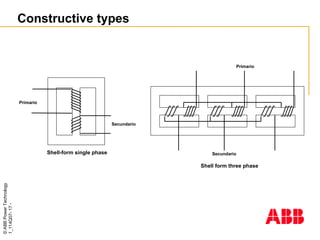
Primario
Shell-form single phase
Secundario
Primario
Shell form three phase
Secundario
Constructive types
©
ABB
Power
Technology
1_114Q07-
18
-
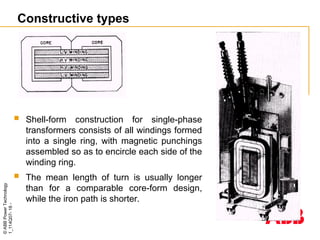
Constructive types
 Shell-form construction for single-phase
transformers consists of all windings formed
into a single ring, with magnetic punchings
assembled so as to encircle each side of the
winding ring.
 The mean length of turn is usually longer
than for a comparable core-form design,
while the iron path is shorter.
©
ABB
Power
Technology
1_114Q07-
19
-
Constructive types
 In the design of a particular transformer many factors such as insulation stress,
mechanical stress, heat distribution, weight and cost must be balanced and
compromised.
 It appears that, for well-balanced design, both core-form and shell-form units have their
respective fields of applicability determined by kva and kv rating.
 In the larger sizes, shell-form construction is quite appropriate; the windings and
magnetic iron can be assembled on a steel base structure, with laminations laid in
horizontally to link and surround the windings.
 A close-fitting tank member is then dropped over the core and coil assembly and welded to
the steel base, completing the tank assembly and also securing the core to the base member.
©
ABB
Power
Technology
1_114Q07-
20
-
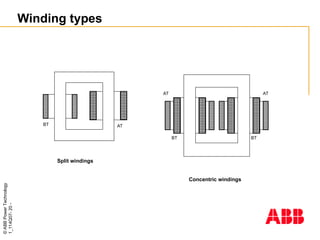
Winding types
AT
BT
Split windings
AT
BT
Concentric windings
AT
BT
©
ABB
Power
Technology
1_114Q07-
21
-
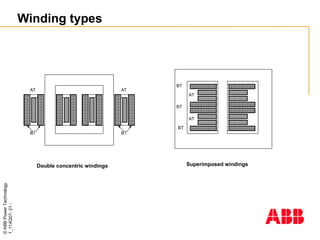
Winding types
AT
BT
Double concentric windings
AT
BT
Superimposed windings
AT
BT
BT
BT
AT
©
ABB
Power
Technology
1_114Q07-
22
-
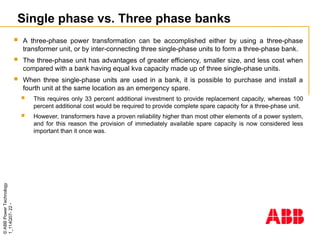
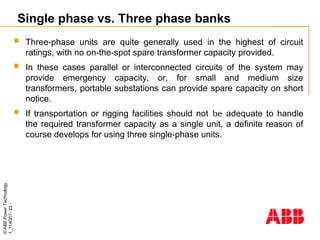
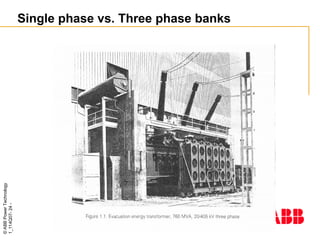
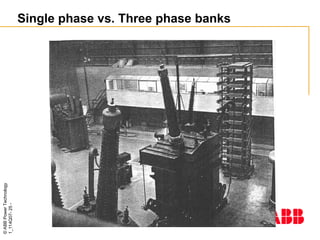
Single phase vs. Three phase banks
 A three-phase power transformation can be accomplished either by using a three-phase
transformer unit, or by inter-connecting three single-phase units to form a three-phase bank.
 The three-phase unit has advantages of greater efficiency, smaller size, and less cost when
compared with a bank having equal kva capacity made up of three single-phase units.
 When three single-phase units are used in a bank, it is possible to purchase and install a
fourth unit at the same location as an emergency spare.
 This requires only 33 percent additional investment to provide replacement capacity, whereas 100
percent additional cost would be required to provide complete spare capacity for a three-phase unit.
 However, transformers have a proven reliability higher than most other elements of a power system,
and for this reason the provision of immediately available spare capacity is now considered less
important than it once was.
©
ABB
Power
Technology
1_114Q07-
23
-
Single phase vs. Three phase banks
 Three-phase units are quite generally used in the highest of circuit
ratings, with no on-the-spot spare transformer capacity provided.
 In these cases parallel or interconnected circuits of the system may
provide emergency capacity, or, for small and medium size
transformers, portable substations can provide spare capacity on short
notice.
 If transportation or rigging facilities should not be adequate to handle
the required transformer capacity as a single unit, a definite reason of
course develops for using three single-phase units.
©
ABB
Power
Technology
1_114Q07-
24
-
Single phase vs. Three phase banks
©
ABB
Power
Technology
1_114Q07-
25
-
Single phase vs. Three phase banks
©
ABB
Power
Technology
1_114Q07-
26
-
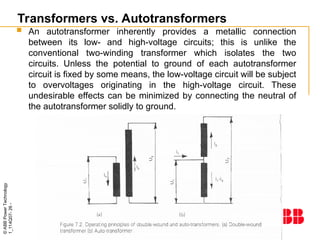
Transformers vs. Autotransformers
 An autotransformer inherently provides a metallic connection
between its low- and high-voltage circuits; this is unlike the
conventional two-winding transformer which isolates the two
circuits. Unless the potential to ground of each autotransformer
circuit is fixed by some means, the low-voltage circuit will be subject
to overvoltages originating in the high-voltage circuit. These
undesirable effects can be minimized by connecting the neutral of
the autotransformer solidly to ground.
©
ABB
Power
Technology
1_114Q07-
27
-
Transformers vs. Autotransformers
 The autotransformer has advantages of:
 lower cost,
 higher efficiency
 better regulation
 It has disadvantages including:
 low reactance which may make it subject to excessive short-circuit currents
 the arrangement of taps is more complicated
 the low- and high-voltage circuits cannot be isolated
 the two circuits must operate with no angular phase displacement unless a zig-zag
connection is introduced.
 The advantages of lower cost and improved efficiency become less apparent as
the transformation ratio increases, so that autotransformers for power purposes
are usually used for low transformation ratios, rarely exceeding 2 to 1.
©
ABB
Power
Technology
1_114Q07-
28
-
Transformers vs. Autotransformers
 Three-phase autotransformers for power service are usually star-star
connected with the neutral grounded, and in most of these cases it is
desirable to have a third winding on the core delta-connected so as to
carry the third harmonic component of exciting current.
 This winding could be very small in capacity if it were required to carry
only harmonic currents, but its size is increased by the requirement that it
carry high currents during system ground faults.
 A widely used rule sets the delta-winding rating at 35 percent of the
autotransformer equivalent two-winding kva rating (not circuit kva rating).
 Since it is necessary in most cases to have a delta-connected tertiary
winding, it is often advantageous to design this winding so that load
can be taken from it. This results in a three-winding autotransformer
with terminals to accommodate three external circuits.
©
ABB
Power
Technology
1_114Q07-
29
-
AGENDA
 INTRODUCTION
 MAIN CHARACTERISTICS OF A POWER TRANSFORMER
 Types of transformers
 Transformation ratio
 Insulation class
 Rated output
 Transformer connections
 VOLTAGE CONTROL
 TYPES OF COOLING
 ACCESSORIES/ PRACTICAL ASPECTS
©
ABB
Power
Technology
1_114Q07-
30
-
Transformation ratio
 Primary voltage : The most usual value of the voltage at the point of
the network where the transformer is going to be connected
 When this voltage is expected to vary it could be necessary that the
transformer is equipped with an on load tap changer
 Secondary voltage: The desired value at the secondary network
where the transformer will be connected.
©
ABB
Power
Technology
1_114Q07-
31
-
Transformation ratio and voltage drop
 The voltage ratio of a transformer is normally specified in no load
condition and is directly proportional to the ratio of the number of
turns in the windings.
 When the transformer is loaded, the voltage on the secondary
terminals changes from that in no load condition, depending on
 the angle φ between the voltage on the secondary terminals of the
transformer U2 and the secondary current I2
 the value of the secondary current I2
 the short-circuit impedance of the transformer Z and its active
and reactive components, r and ±jx respectively
©
ABB
Power
Technology
1_114Q07-
32
-
Transformation ratio and voltage drop
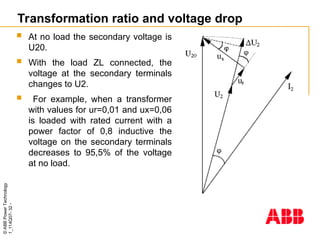
 At no load the secondary voltage is
U20.
 With the load ZL connected, the
voltage at the secondary terminals
changes to U2.
 For example, when a transformer
with values for ur=0,01 and ux=0,06
is loaded with rated current with a
power factor of 0,8 inductive the
voltage on the secondary terminals
decreases to 95,5% of the voltage
at no load.
©
ABB
Power
Technology
1_114Q07-
33
-
Transformation ratio and voltage drop
 Users and installation planners are recommended to take the
variation of the secondary voltage during loading into account when
specifying the transformer data.
 This may be especially important for example in a case where a
large motor represents the main load of the transformer.
 The highly inductive starting current of the motor may then be
considerably higher than the rated current of the transformer.
 Consequently there may be a considerable voltage drop through the
transformer.
 If the feeding power source is weak, this will contribute to an even
lower voltage on the secondary side of the transformer.
©
ABB
Power
Technology
1_114Q07-
34
-
Short circuit impedance
 Users have sometimes particular requirements regarding the short-circuit
impedance. Such requirements may be determined by:
 parallel operation with existing units,
 limitation of voltage drop,
 limitation of short-circuit currents.
 The transformer designer can meet the requirements in different ways:
 The size of the core cross-section. A large cross-section gives a low
impedance and vice versa,
 A tall transformer gives a low impedance and vice versa.
 For each transformer there is, however, a smaller range which gives the
optimum transformer from an economic point of view, that is the lowest
sum of the manufacturing costs and the capitalised value of the losses.
©
ABB
Power
Technology
1_114Q07-
35
-
Short circuit impedance
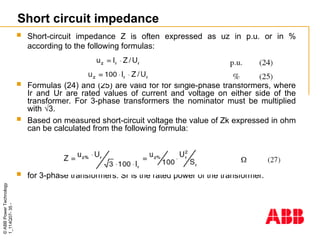
 Short-circuit impedance Z is often expressed as uz in p.u. or in %
according to the following formulas:
 Formulas (24) and (25) are valid for for single-phase transformers, where
Ir and Ur are rated values of current and voltage on either side of the
transformer. For 3-phase transformers the nominator must be multiplied
with √3.
 Based on measured short-circuit voltage the value of Zk expressed in ohm
can be calculated from the following formula:
 for 3-phase transformers. Sr is the rated power of the transformer.
©
ABB
Power
Technology
1_114Q07-
36
-
AGENDA
 INTRODUCTION
 MAIN CHARACTERISTICS OF A POWER TRANSFORMER
 Types of transformers
 Transformation ratio
 Insulation class
 Rated output
 Transformer connections
 VOLTAGE CONTROL
 TYPES OF COOLING
 ACCESSORIES/ PRACTICAL ASPECTS
©
ABB
Power
Technology
1_114Q07-
37
-
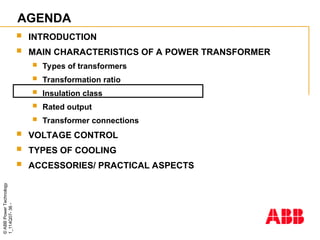
Isolation class
 Defines the capability of the
transformer to withstand
overvoltages without loosing
its functionality or undue
deterioration
 Overvoltages in networks
could be:
 Temporary ov
 Switching ov
 Lightning ov
©
ABB
Power
Technology
1_114Q07-
38
-
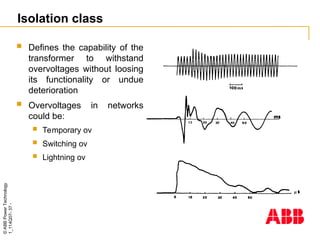
Isolation class
 The standard insulation classes and dielectric tests for power
transformers are given in standards. The insulation class of a
transformer is determined by the dielectric tests which the unit can
withstand, rather than by rated operating voltage.
 The test values are:
 Basic impulse level
(lightning)
 Short time Power
frequency
overvoltage
©
ABB
Power
Technology
1_114Q07-
39
-
AGENDA
 INTRODUCTION
 MAIN CHARACTERISTICS OF A POWER TRANSFORMER
 Types of transformers
 Transformation ratio
 Insulation class
 Rated output
 Transformer connections
 VOLTAGE CONTROL
 TYPES OF COOLING
 ACCESSORIES/ PRACTICAL ASPECTS
©
ABB
Power
Technology
1_114Q07-
40
-
Rated output
 The rated kva output of a transformer is that load which it can deliver continuously at
rated secondary voltage without exceeding a given temperature rise measured
under prescribed test conditions.
 The actual test temperature rise may, in a practical case, be somewhat below the
established limit because of design and manufacturing tolerances.
 The output which a transformer can deliver in service without undue deterioration of
the insulation may be more or less than its rated output, depending upon the
following design characteristics and operating conditions as they exist at a particular
time:
 Ambient temperature.
 Top-oil rise over ambient temperature.
 Hottest-spot rise over top-oil temperature (hottest-spot copper gradient).
 Transformer thermal time constant.
 Ratio of load loss to no-load loss.
©
ABB
Power
Technology
1_114Q07-
41
-
Loading Based on Ambient Temperature
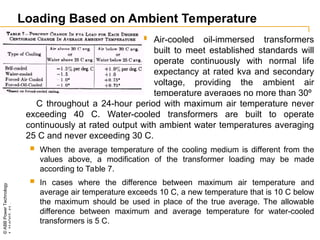
 Air-cooled oil-immersed transformers
built to meet established standards will
operate continuously with normal life
expectancy at rated kva and secondary
voltage, providing the ambient air
temperature averages no more than 30º
C throughout a 24-hour period with maximum air temperature never
exceeding 40 C. Water-cooled transformers are built to operate
continuously at rated output with ambient water temperatures averaging
25 C and never exceeding 30 C.
 When the average temperature of the cooling medium is different from the
values above, a modification of the transformer loading may be made
according to Table 7.
 In cases where the difference between maximum air temperature and
average air temperature exceeds 10 C, a new temperature that is 10 C below
the maximum should be used in place of the true average. The allowable
difference between maximum and average temperature for water-cooled
transformers is 5 C.
©
ABB
Power
Technology
1_114Q07-
42
-
Loading Based on Capacity Factor
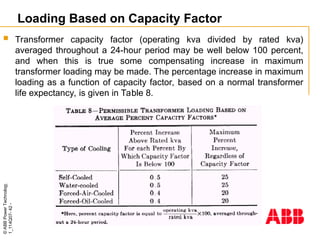
 Transformer capacity factor (operating kva divided by rated kva)
averaged throughout a 24-hour period may be well below 100 percent,
and when this is true some compensating increase in maximum
transformer loading may be made. The percentage increase in maximum
loading as a function of capacity factor, based on a normal transformer
life expectancy, is given in Table 8.
©
ABB
Power
Technology
1_114Q07-
43
-
Loading Based on Short-Time Overloads
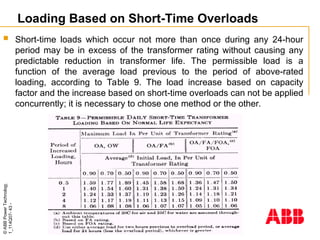
 Short-time loads which occur not more than once during any 24-hour
period may be in excess of the transformer rating without causing any
predictable reduction in transformer life. The permissible load is a
function of the average load previous to the period of above-rated
loading, according to Table 9. The load increase based on capacity
factor and the increase based on short-time overloads can not be applied
concurrently; it is necessary to chose one method or the other.
©
ABB
Power
Technology
1_114Q07-
44
-
Loading Based on Short-Time Overloads
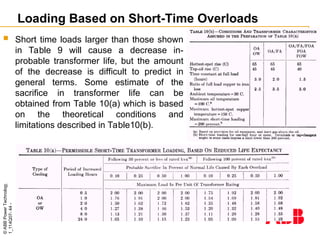
 Short time loads larger than those shown
in Table 9 will cause a decrease in-
probable transformer life, but the amount
of the decrease is difficult to predict in
general terms. Some estimate of the
sacrifice in transformer life can be
obtained from Table 10(a) which is based
on the theoretical conditions and
limitations described in Table10(b).
©
ABB
Power
Technology
1_114Q07-
45
-
Loading Based on Short-Time Overloads
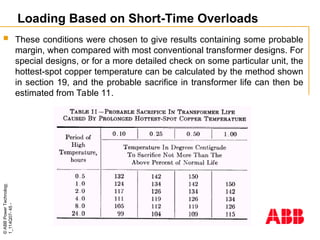
 These conditions were chosen to give results containing some probable
margin, when compared with most conventional transformer designs. For
special designs, or for a more detailed check on some particular unit, the
hottest-spot copper temperature can be calculated by the method shown
in section 19, and the probable sacrifice in transformer life can then be
estimated from Table 11.
©
ABB
Power
Technology
1_114Q07-
46
-
Loading Based on Measured Oil Temperat.
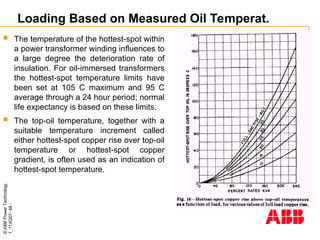
 The temperature of the hottest-spot within
a power transformer winding influences to
a large degree the deterioration rate of
insulation. For oil-immersed transformers
the hottest-spot temperature limits have
been set at 105 C maximum and 95 C
average through a 24 hour period; normal
life expectancy is based on these limits.
 The top-oil temperature, together with a
suitable temperature increment called
either hottest-spot copper rise over top-oil
temperature or hottest-spot copper
gradient, is often used as an indication of
hottest-spot temperature.
©
ABB
Power
Technology
1_114Q07-
47
-
Loading Based on Measured Oil Temperat.
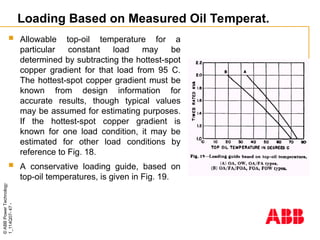
 Allowable top-oil temperature for a
particular constant load may be
determined by subtracting the hottest-spot
copper gradient for that load from 95 C.
The hottest-spot copper gradient must be
known from design information for
accurate results, though typical values
may be assumed for estimating purposes.
If the hottest-spot copper gradient is
known for one load condition, it may be
estimated for other load conditions by
reference to Fig. 18.
 A conservative loading guide, based on
top-oil temperatures, is given in Fig. 19.
©
ABB
Power
Technology
1_114Q07-
48
-
One or several transformers?
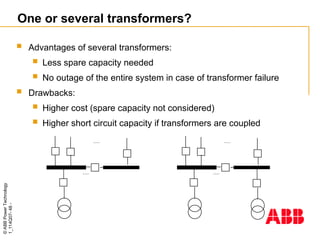
 Advantages of several transformers:
 Less spare capacity needed
 No outage of the entire system in case of transformer failure
 Drawbacks:
 Higher cost (spare capacity not considered)
 Higher short circuit capacity if transformers are coupled
......
......
......
......
©
ABB
Power
Technology
1_114Q07-
49
-
Parallel operation of transformers
 When there are several transformers at the substation it is possible to couple
them or not.
 On the other hand in transmission networks the transformers are always coupled.
 Advantages: No outage when one of the transformers is disconnected
(providing there is capacity enough at the network)
 Drawbacks: Higher short circuit capacity
 Provisions to be taken before coupling:
 Same transformer ratio
 Matching connection group
 Matching phase rotation direction
 Short circuit voltage inversely proportional to rated output
 Tap changing coordination
©
ABB
Power
Technology
1_114Q07-
50
-
AGENDA
 INTRODUCTION
 MAIN CHARACTERISTICS OF A POWER TRANSFORMER
 Types of transformers
 Transformation ratio
 Insulation class
 Rated output
 Transformer connections
 VOLTAGE CONTROL
 TYPES OF COOLING
 ACCESSORIES/ PRACTICAL ASPECTS
©
ABB
Power
Technology
1_114Q07-
51
-
Transformer connections
 Star- Star connection (Y-y):
 It stands badly secondary imbalances
 Neutral connection is possible
 Low cost because of reduced number of turns and lower
isolation needed (phase-ground voltage)
 Bigger cross section of conductors because of higher current
which gives more stiffness to windings and better performance
on short circuits
 Star- Star with tertiary winding:
 It solves the problem of imbalances and third harmonic
 Tertiary winding can be used for ancillary services
©
ABB
Power
Technology
1_114Q07-
52
-
 Delta- Star connection (D-y):
 Very used in distribution systems
 It stands well secondary imbalances
 Third harmonic is not transmitted to low voltage
 Low voltage Neutral connection possible
 High cost because of bigger isolation and HV turns so it is not used at high
voltages
 Star- Delta Connection (Y-d):
 Very used at high voltages because of lower isolation and HV nº of turns needed.
 Low voltage neutral connection not possible so they are not used at distribution
systems.
 The delta connection prevents third harmonic flux because third harmonic current
circulates inside the delta windings.
Transformer connections
©
ABB
Power
Technology
1_114Q07-
53
-
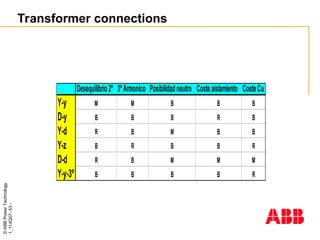
Desequilibrio2º 3ºArmonico Posibilidadneutro Costeaislamiento CosteCu
Y-y M M B B B
D-y B B B R B
Y-d R B M B B
Y-z B R B B R
D-d R B M M M
Y-y-3º B B B B R
Transformer connections
©
ABB
Power
Technology
1_114Q07-
54
-
Power
Transformers
Voltage
Control
©
ABB
Power
Technology
1_114Q07-
55
-
AGENDA
 INTRODUCTION
 MAIN CHARACTERISTICS OF A POWER TRANSFORMER
 Types of transformers
 Transformation ratio
 Insulation class
 Rated output
 Transformer connections
 VOLTAGE CONTROL
 TYPES OF COOLING
 ACCESSORIES/ PRACTICAL ASPECTS
©
ABB
Power
Technology
1_114Q07-
56
-
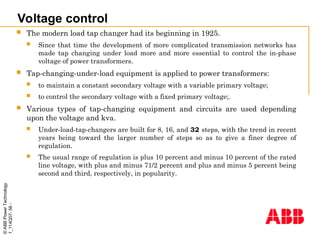
Voltage control
 The modern load tap changer had its beginning in 1925.
 Since that time the development of more complicated transmission networks has
made tap changing under load more and more essential to control the in-phase
voltage of power transformers.
 Tap-changing-under-load equipment is applied to power transformers:
 to maintain a constant secondary voltage with a variable primary voltage;
 to control the secondary voltage with a fixed primary voltage;.
 Various types of tap-changing equipment and circuits are used depending
upon the voltage and kva.
 Under-load-tap-changers are built for 8, 16, and 32 steps, with the trend in recent
years being toward the larger number of steps so as to give a finer degree of
regulation.
 The usual range of regulation is plus 10 percent and minus 10 percent of the rated
line voltage, with plus and minus 71/2 percent and plus and minus 5 percent being
second and third, respectively, in popularity.
©
ABB
Power
Technology
1_114Q07-
57
-
Voltage control
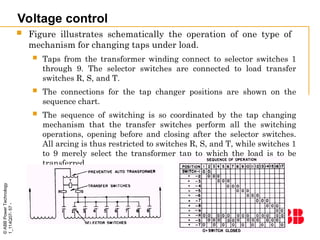
 Figure illustrates schematically the operation of one type of
mechanism for changing taps under load.
 Taps from the transformer winding connect to selector switches 1
through 9. The selector switches are connected to load transfer
switches R, S, and T.
 The connections for the tap changer positions are shown on the
sequence chart.
 The sequence of switching is so coordinated by the tap changing
mechanism that the transfer switches perform all the switching
operations, opening before and closing after the selector switches.
All arcing is thus restricted to switches R, S, and T, while switches 1
to 9 merely select the transformer tap to which the load is to be
transferred.
©
ABB
Power
Technology
1_114Q07-
58
-
Voltage control
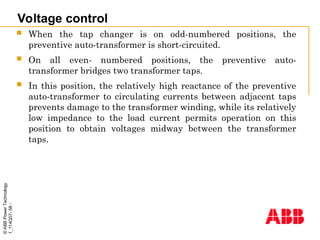
 When the tap changer is on odd-numbered positions, the
preventive auto-transformer is short-circuited.
 On all even- numbered positions, the preventive auto-
transformer bridges two transformer taps.
 In this position, the relatively high reactance of the preventive
auto-transformer to circulating currents between adjacent taps
prevents damage to the transformer winding, while its relatively
low impedance to the load current permits operation on this
position to obtain voltages midway between the transformer
taps.
©
ABB
Power
Technology
1_114Q07-
59
-
Voltage control
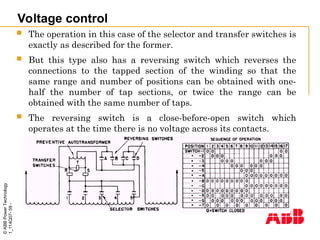
 The operation in this case of the selector and transfer switches is
exactly as described for the former.
 But this type also has a reversing switch which reverses the
connections to the tapped section of the winding so that the
same range and number of positions can be obtained with one-
half the number of tap sections, or twice the range can be
obtained with the same number of taps.
 The reversing switch is a close-before-open switch which
operates at the time there is no voltage across its contacts.
©
ABB
Power
Technology
1_114Q07-
60
-
Voltage control
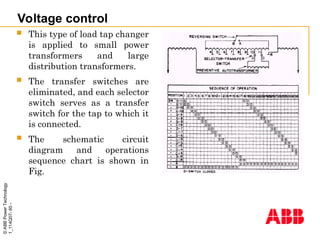
 This type of load tap changer
is applied to small power
transformers and large
distribution transformers.
 The transfer switches are
eliminated, and each selector
switch serves as a transfer
switch for the tap to which it
is connected.
 The schematic circuit
diagram and operations
sequence chart is shown in
Fig.
©
ABB
Power
Technology
1_114Q07-
61
-
Load Tap changing.
3
3
6
5
5
6
4
4
Impar
Par
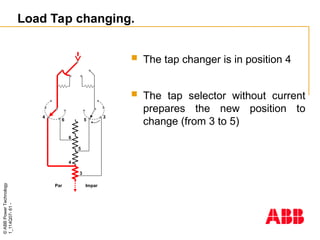
 The tap changer is in position 4
 The tap selector without current
prepares the new position to
change (from 3 to 5)
©
ABB
Power
Technology
1_114Q07-
62
-
3
3
6
5
5
6
4
4
Impar
Par
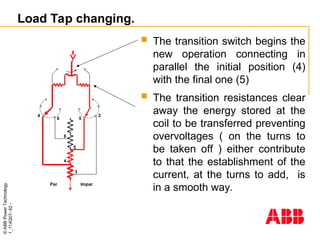
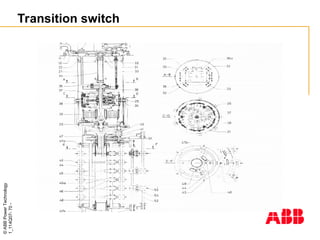
 The transition switch begins the
new operation connecting in
parallel the initial position (4)
with the final one (5)
 The transition resistances clear
away the energy stored at the
coil to be transferred preventing
overvoltages ( on the turns to
be taken off ) either contribute
to that the establishment of the
current, at the turns to add, is
in a smooth way.
Load Tap changing.
©
ABB
Power
Technology
1_114Q07-
63
-
3
3
6
5
5
6
4
4
Impar
Par
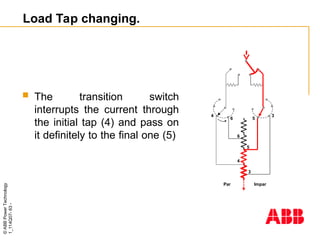
 The transition switch
interrupts the current through
the initial tap (4) and pass on
it definitely to the final one (5)
Load Tap changing.
©
ABB
Power
Technology
1_114Q07-
64
-
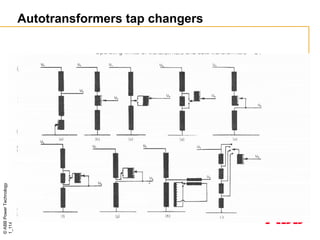
Autotransformers tap changers
©
ABB
Power
Technology
1_114Q07-
65
-
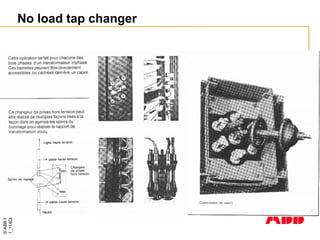
No load tap changer
©
ABB
Power
Technology
1_114Q07-
66
-
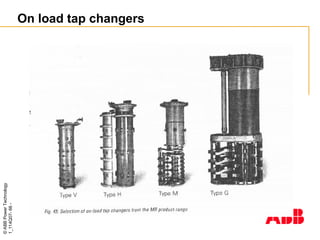
On load tap changers
©
ABB
Power
Technology
1_114Q07-
67
-
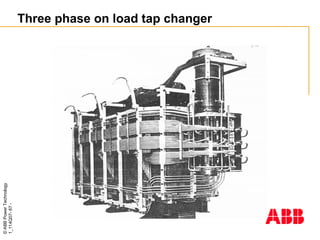
Three phase on load tap changer
©
ABB
Power
Technology
1_114Q07-
68
-
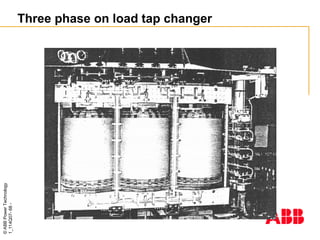
Three phase on load tap changer
©
ABB
Power
Technology
1_114Q07-
69
-
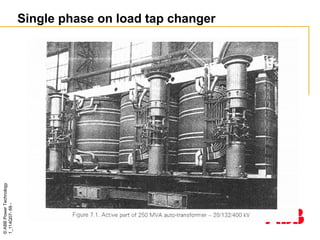
Single phase on load tap changer
©
ABB
Power
Technology
1_114Q07-
70
-
Transition switch
©
ABB
Power
Technology
1_114Q07-
71
-
Power
Transformers
Types of
Cooling
©
ABB
Power
Technology
1_114Q07-
72
-
AGENDA
 INTRODUCTION
 MAIN CHARACTERISTICS OF A POWER TRANSFORMER
 Types of transformers
 Transformation ratio
 Insulation class
 Rated output
 Transformer connections
 VOLTAGE CONTROL
 TYPES OF COOLING
 ACCESSORIES/ PRACTICAL ASPECTS
©
ABB
Power
Technology
1_114Q07-
73
-
Types of cooling
 Cooling is needed to transfer the heat produced by losses so as
not to damage isolation
 Two main types of isolation exist:
 Dry Transformers, air refrigerated
 Oil immersed Transformers
 In Substations the most used is the second one
 Dry type are only used for low output and when fire hazard is a big
concern
©
ABB
Power
Technology
1_114Q07-
74
-
Types of cooling
 Several types of cooling are possible with oil immersed
transformers:
 Oil immersed Self cooled (ONAN)
 Oil Immersed Self Cooled/Forced-Air Cooled (ONAF)
 Oil immersed Forced cooled/Forced air cooled (OFAF)
 Oil immersed Water cooled (ONWN-OFWF)
©
ABB
Power
Technology
1_114Q07-
75
-
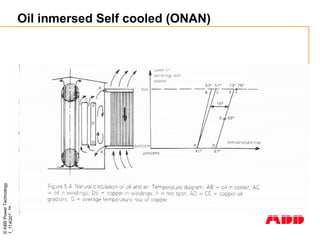
Oil inmersed Self cooled (ONAN)
 In this type of transformer the insulating oil circulates by natural convection
within a tank having either smooth sides, corrugated sides, integral tubular
sides, or detachable radiators.
 Smooth tanks are used for small distribution transformers but because the losses
increase more rapidly than the tank surface area as kva capacity goes up, a smooth
tank transformer larger than 50 kva would have to be abnormally large to provide
sufficient radiating surface.
 Integral tubular-type construction is used up to about 3000 kva and in some cases
to larger capacities, though shipping restrictions usually limit this type of
construction at the larger ratings.
 Above 3000 kva detachable radiators are usually supplied.
 Transformers rated 46 kv and below may also be filled with Inerteen fire-proof
insulating liquid, instead of with oil.
 The ONAN transformer is a basic type, and serves as a standard for rating
and pricing other types.
©
ABB
Power
Technology
1_114Q07-
76
-
Oil inmersed Self cooled (ONAN)
©
ABB
Power
Technology
1_114Q07-
77
-
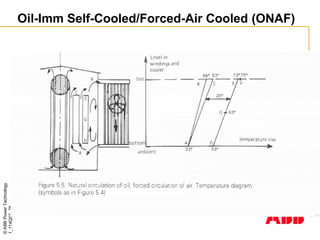
Oil-Imm Self-Cooled/Forced-Air Cooled (ONAF)
 This type of transformer is basically an ONAN unit with the addition of fans to
increase the rate of heat transfer from the cooling surfaces, thereby increasing the
permissible transformer output.
 The ONAF transformer is applicable in situations that require short-time peak loads to
be carried recurrently, without affecting normal expected transformer life.
 This transformer may be purchased with fans already installed, or it may be purchased with
the option of adding fans later.
 The higher kva capacity attained by the use of fans may be calculated as follows :
 For 2500 kva (OA) and below: kva (FA)=l.l5Xkva(OA).
 For 2501 to 9999 kva (OA) single-phase or 11 999 kva (OA) three-phase : kva (FA) = 1.25
X kva (OA).
 For 10 000 kva (OA) single-phase and 12 000 kva (OA) three-phase, and above : kva (FA)
= 1.333Xkva (OA). (22)
 These ratings are standardized, and are based on a hottest-spot copper temperature of 65
degrees C above 30 degrees C average ambient.
©
ABB
Power
Technology
1_114Q07-
78
-
Oil-Imm Self-Cooled/Forced-Air Cooled (ONAF)
©
ABB
Power
Technology
1_114Q07-
79
-
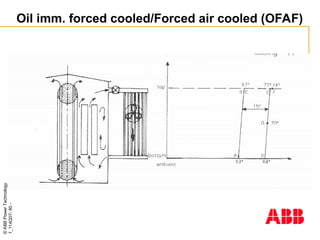
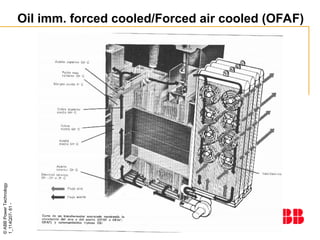
Oil imm. forced cooled/Forced air cooled (OFAF)
 The rating of an oil-immersed transformer may be increased from its OA
rating by the addition of some combination of fans and oil pumps.
 Such transformers are normally built in the range 10 000 kva (OA) single-
phase or 12 000 kva (OA) three-phase, and above.
 Increased ratings are defined as two steps, 1.333 and 1.667 times the OA rating
respectively.
 Automatic controls responsive to oil temperature are normally used to start the
fans and pumps in a selected sequence as transformer loading increases.
 A variation of this is a type of transformer which is intended for use only
when both oil pumps and fans are operating, under which condition any load
up to full rated kva may be carried.
 Some designs are capable of carrying excitation current with no fans or pumps in
operation, but this is not universally true. Heat transfer from oil to air is
accomplished in external oil-to-air heat exchangers.
©
ABB
Power
Technology
1_114Q07-
80
-
Oil imm. forced cooled/Forced air cooled (OFAF)
©
ABB
Power
Technology
1_114Q07-
81
-
Oil imm. forced cooled/Forced air cooled (OFAF)
©
ABB
Power
Technology
1_114Q07-
82
-
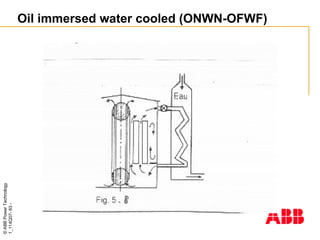
Oil immersed water cooled (ONWN-OFWF)
OW-Oil-Immersed Water-Cooled
 In this type of water-cooled transformer, the cooling water runs
through coils of pipe which are in contact with the insulating oil of
the transformer.
 The oil flows around the outside of these pipe coils by natural
convection, thereby effecting the desired heat transfer to the cooling
water. This type has no self-cooled rating.
FOW-Oil-Immersed Forced-Oil-Cooled With Forced-Water
 Cooler-External oil-to-water heat exchangers are used in this type
of unit to transfer heat from oil to cooling water.
©
ABB
Power
Technology
1_114Q07-
83
-
Oil immersed water cooled (ONWN-OFWF)
©
ABB
Power
Technology
1_114Q07-
84
-
Cooling systems. Radiators
©
ABB
Power
Technology
1_114Q07-
85
-
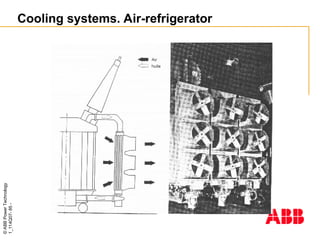
Cooling systems. Air-refrigerator
©
ABB
Power
Technology
1_114Q07-
86
-
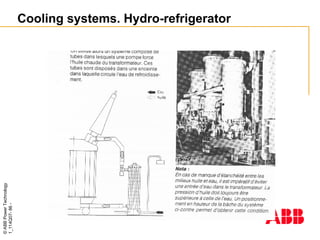
Cooling systems. Hydro-refrigerator
©
ABB
Power
Technology
1_114Q07-
87
-
Power
Transformers
Accessories
Practical aspects
©
ABB
Power
Technology
1_114Q07-
88
-
AGENDA
 INTRODUCTION
 MAIN CHARACTERISTICS OF A POWER TRANSFORMER
 Types of transformers
 Transformation ratio
 Insulation class
 Rated output
 Transformer connections
 VOLTAGE CONTROL
 TYPES OF COOLING
 ACCESSORIES/ PRACTICAL ASPECTS
©
ABB
Power
Technology
1_114Q07-
89
-
Accesories
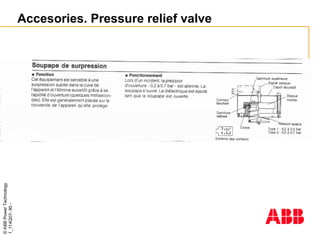
 Pressure relief valve
 Gas detector relay. Buchholz
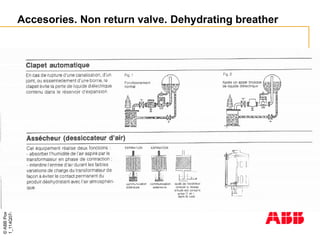
 Non return valve
 Dehydrating breather
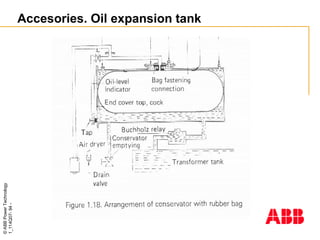
 Oil expansion tank
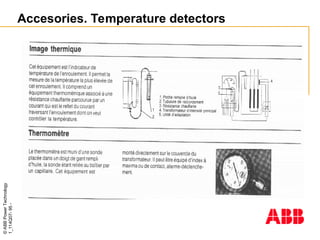
 Temperature detectors
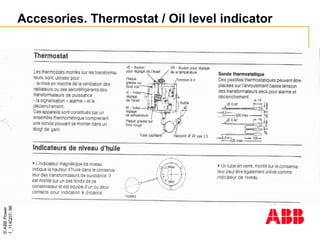
 Thermostat and oil level indicator
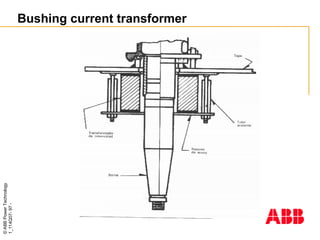
 Bushing current transformer
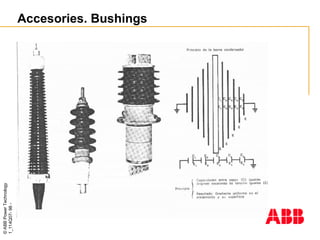
 Bushings
©
ABB
Power
Technology
1_114Q07-
90
-
Accesories. Pressure relief valve
©
ABB
Power
Technology
1_114Q07-
91
-
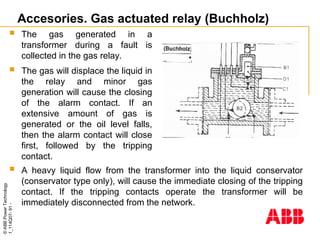
Accesories. Gas actuated relay (Buchholz)
 A heavy liquid flow from the transformer into the liquid conservator
(conservator type only), will cause the immediate closing of the tripping
contact. If the tripping contacts operate the transformer will be
immediately disconnected from the network.
 The gas generated in a
transformer during a fault is
collected in the gas relay.
 The gas will displace the liquid in
the relay and minor gas
generation will cause the closing
of the alarm contact. If an
extensive amount of gas is
generated or the oil level falls,
then the alarm contact will close
first, followed by the tripping
contact.
©
ABB
Power
Technology
1_114Q07-
92
-
Accesories. Gas actuated relay (Buchholz)
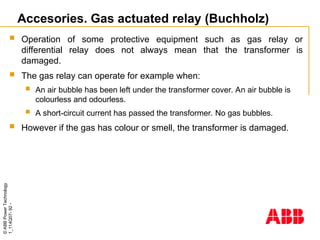
 Operation of some protective equipment such as gas relay or
differential relay does not always mean that the transformer is
damaged.
 The gas relay can operate for example when:
 An air bubble has been left under the transformer cover. An air bubble is
colourless and odourless.
 A short-circuit current has passed the transformer. No gas bubbles.
 However if the gas has colour or smell, the transformer is damaged.
©
ABB
Power
Technology
1_114Q07-
93
-
Accesories. Non return valve. Dehydrating breather
©
ABB
Power
Technology
1_114Q07-
94
-
Accesories. Oil expansion tank
©
ABB
Power
Technology
1_114Q07-
95
-
Accesories. Temperature detectors
©
ABB
Power
Technology
1_114Q07-
96
-
Accesories. Thermostat / Oil level indicator
©
ABB
Power
Technology
1_114Q07-
97
-
Bushing current transformer
©
ABB
Power
Technology
1_114Q07-
98
-
Accesories. Bushings
©
ABB
Power
Technology
1_114Q07-
99
-
Installation. Handling and lifting
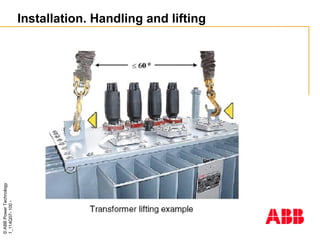
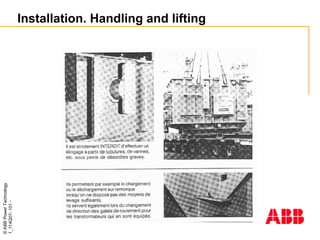
 Only approved and suitable lifting equipment shall be used.
 Use a forklift only on transport pallets or transformer bottom.
 Do not apply load to corrugated fins or radiators and their supports.
 Use the provided lifting lugs only.
 When lifting a transformer with cable boxes on the cover, special
care must be taken.
 When hydraulic jacks are used, only provided jacking points shall
be used, and in such a way that twisting forces on the transformer
tank are avoided.
©
ABB
Power
Technology
1_114Q07-
100
-
Installation. Handling and lifting
©
ABB
Power
Technology
1_114Q07-
101
-
Installation. Handling and lifting
©
ABB
Power
Technology
1_114Q07-
102
-
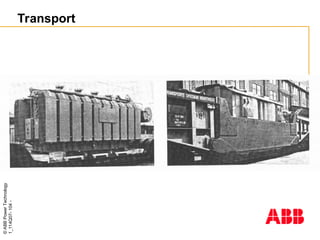
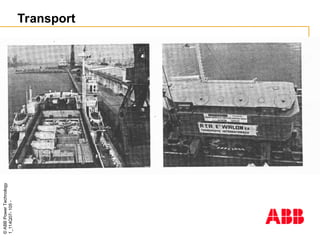
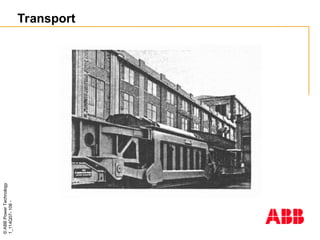
Transport
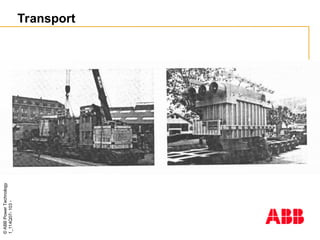
 The transformer is supplied filled with liquid and normally all
accessories fitted, except for the largest units. The radiators may be
dismantled during transport.
 During transport the following should be considered:
 Angle of tilting exceeding 10º must be specified in the contract,
 Prevention of damage to bushings, corrugated panels or
radiators and accessories,
 Larger transformers should preferably be positioned with the
longitudinal axis in the direction of movement,
 Secure against movement by means of e.g. wooden blocks and
lashes,
 Adapt vehicle speed to the road conditions,
 Vehicle capacity shall be adequate for the transport weight of
the transformer,
©
ABB
Power
Technology
1_114Q07-
103
-
Transport
©
ABB
Power
Technology
1_114Q07-
104
-
Transport
©
ABB
Power
Technology
1_114Q07-
105
-
Transport
©
ABB
Power
Technology
1_114Q07-
106
-
Transport
©
ABB
Power
Technology
1_114Q07-
107
-
Maintenance
 Inspection and maintenance during operation
 Inspection during operation shall only be performed after taking
safety measures into consideration:
 If there is a maximum indicator on the thermometer the
maximum temperature should be recorded,
 Inspection for contamination, especially on bushings,
 Inspection of surface condition,
 Dehydrating breather. The silicagel shall be changed when
approx. 2/3 of the silica gel has changed from blue to red colour
(old type), or from pink to white, respectively. (Conservator type
only),
 Inspection for liquid leakages.
 For personal safety reasons, only a limited amount of maintenance
activities should be performed on the transformer when it is in
operation.
©
ABB
Power
Technology
1_114Q07-
108
-
Maintenance
 Inspection and maintenance during downtime
 Before starting maintenance work, the transformer has to be
disconnected from the network and earthed. When the
disconnectors have been opened, they shall be locked in open
position to prevent them inadvertently closing during maintenance
work.
 Items to be considered are:
 Bushing gaskets; if leaks occur, tightening usually will help, if the
gasket has lost its elasticity, it must be replaced. The reason for
loss of elasticity can be excessive heating or aging,
 Cover gaskets, valves and gaskets of the tap changer. If there
are leaks, tightening will usually help,
 Welded joints. Leaking joints can be repaired only by welding. A
skilled welder and a welding instruction are required.,
©
ABB
Power
Technology
1_114Q07-
109
-
Maintenance
 Cleaning contaminated bushings (cleaning agent e.g.
methylated spirit),
 Cleaning glasses on gas relay, thermometer and liquid level
indicator,
 Functional inspection of applicable accessories,
 Move tap changer through all positions a few times, all types of
tap changers,
 Liquid sampling from bottom drain valve for larger units as
required,
 Check drying material in the dehydrating breather. (Conservator
type only),
 Amend surface treatment defects.
 In heavily contaminated installations more frequent inspections may
be needed.
©
ABB
Power
Technology
1_114Q07-
110
-
Maintenance. Transformer liquid and insulation
 The task of liquid in a transformer is to act as an electrical insulation
and to transfer heat from the transformer’s active parts into coolers.
 Liquid acts as a good electrical insulation only as long as it is
satisfactorily dry and clean.
 Humidity balance between the oil and the insulation implies that
most of the humidity will gather in the paper insulation.
 Testing of liquid in transformers should normally be performed 12
months after filling or refilling, subsequently every six years.
 Testing of oil in on load tap changers must be performed according
to the tap changer supplier’s recommendations.
 To take liquid samples from hermetically sealed transformers is
normally not necessary. The liquid in this type of transformers is not
in contact with the atmosphere, and less exposed to moisture.
 Especially for large transformers, liquid regeneration may be
economically motivated. Liquid regeneration implies drying, filtering,
de-gassing and possibly addition of inhibitor.
©
ABB
Power
Technology
1_114Q07-
111
-
Maintenance. Bushings and joints
 The porcelain insulators of transformer bushings ought to be
cleaned during service interruptions as often as necessary. This is
particularly important for places exposed to contamination and
moisture.
 Methylated spirit or easily evaporating cleaning agents can be used
for cleaning.
 The condition of external conductor and bus bar joints of
transformer bushings shall be checked at regular intervals because
reduced contact pressure in the joints leads to overheated bushings
etc. and may cause the adjacent gasket to be destroyed by the
heat.

Abb power transformer detail presentation.ppt

  • 1.
  • 2.
    © ABB Power Technology 1_114Q07- 2 - AGENDA  INTRODUCTION  MAINCHARACTERISTICS OF A POWER TRANSFORMER  Types of transformers  Transformation ratio  Insulation class  Rated output  Transformer connections  VOLTAGE CONTROL  TYPES OF COOLING  ACCESSORIES/ PRACTICAL ASPECTS
  • 3.
    © ABB Power Technology 1_114Q07- 3 - AGENDA  INTRODUCTION  MAINCHARACTERISTICS OF A POWER TRANSFORMER  Types of transformers  Transformation ratio  Insulation class  Rated output  Transformer connections  VOLTAGE CONTROL  TYPES OF COOLING  ACCESSORIES/ PRACTICAL ASPECTS
  • 4.
    © ABB Power Technology 1_114Q07- 4 - Fundamental considerations  Staticdevice whose function is to transfer electrical energy from one circuit to another whose common link is a magnetic flux.  The current and voltage characteristics of the incoming energy are modified in the output  Construction: Magnetic core made of stacked sheets of ferromagnetic material and two coils (B1, B2) wounded over the former.  G Z B1 B2
  • 5.
    © ABB Power Technology 1_114Q07- 5 - Fundamental considerations  G Z B1B2  Operation: We connect an a.c. generator at B1 and close B2 through an impedance Z.  B1 generates a flux owing to the current. This is a variable one hence it induces a voltage in B2 which in time generates a current in the secondary circuit.  It is only possible with alternating current (a flux variation is needed)  The circuit connected to B1 is named primary and the one connected to B2 is named secondary  The related V and I characteristics are named as well primary and secondary characteristics.
  • 6.
    © ABB Power Technology 1_114Q07- 6 - Fundamental relationships  Primaryenergy Secondary energy  Hence Primary Power Secondary Power  If the transformer is single phase U1 I1  U2 I2  And with three phase √3 U1 I1  √3 U2 I2  At both cases hence U1/ U2  I2 / I1  On the other hand it is known that Voltage in a coil is proportional to the generated flux and number of turns U1= k1 n1 and U2= k1 n2  From where it is inferred: U1 / U2 = n1 / n2 and I2 / I1 = n1 / n2  The ratio n1 / n2 is called Transformation Ratio
  • 7.
    © ABB Power Technology 1_114Q07- 7 -  We havethen: U1 / U2 = r1 I1 / I2 = 1 / r1  The former statements are true in an ideal transformer which complies with the following  No reluctance at the magnetic circuit  No resistance at the windings  No histeresys, eddy-current or I2R losses  No leakage flux  Although this is not accomplished in a real case, all formerly said is useful to understand the performance of a transformer and to obtain some approximate values for an elementary calculation Fundamental relationships
  • 8.
    © ABB Power Technology 1_114Q07- 8 -  From: U1 I1= U2 I2  It is deduced that:  The winding with higher voltage must stand lesser current and conversely the lesser the voltage the higher the current  On the other hand from: I1 n1 = I2 n2  it is deduced that:  The winding with higher current will be the one with bigger cross section but lesser number of turns Fundamental relationships
  • 9.
    © ABB Power Technology 1_114Q07- 9 - Power transformer function Transmission of electrical energy is cheaper as far as the transmission voltage is raised  let´s have a power P to transmit with a voltage U and a current I. Losses will be: Pr = R I²  If voltage is raised to nU, current, for the same power, will be reduced to I/n, hence losses in that case will be: Pr = R I² / n²  They are hence reduced by the square of the ratio of voltage raising.  Or for the same losses the cross section of the wire can be reduced, so is the cost of the line.  On the other hand electrical energy is easier and safer to use when handled at the lowest voltage.
  • 10.
    © ABB Power Technology 1_114Q07- 10 -  The powerloss p in a 3-phase transmission line with a resistance R per phase and a current I flowing in each phase is:  At a system voltage U the transmitted active power is:  Equation (2) can be rewritten as:  Inserted in the equation (1) gives:  Equation (4) indicates that the power loss in the line is proportional to the square of the transmitted active power and inversely proportional to the square of the system voltage.  In other words, the power loss will be lower when the system voltage is increased. Power transformer function
  • 11.
    © ABB Power Technology 1_114Q07- 11 -  The mainapplication of transformers is hence the one depicted at the following diagram :  To raise the voltage and to reduce the current going out from generation stations (Step-up substations).  To reduce the voltage on arriving to the points of utilization (Step-Down substations). Power transformer function
  • 12.
    © ABB Power Technology 1_114Q07- 12 - AGENDA  INTRODUCTION  MAINCHARACTERISTICS OF A POWER TRANSFORMER  Types of transformers  Transformation ratio  Insulation class  Rated output  Transformer connections  VOLTAGE CONTROL  TYPES OF COOLING  ACCESSORIES/ PRACTICAL ASPECTS
  • 13.
    © ABB Power Technology 1_114Q07- 13 - Main characteristics ofa Power Transformer  When choosing a transformer it is necessary to define:  Type of transformer  Transformation ratio  Insulation Class  Rated output  Connection  Also it is necessary to establish:  Voltage regulation  Type of cooling  Accessories
  • 14.
    © ABB Power Technology 1_114Q07- 14 - AGENDA  INTRODUCTION  MAINCHARACTERISTICS OF A POWER TRANSFORMER  Types of transformers  Transformation ratio  Insulation class  Rated output  Transformer connections  VOLTAGE CONTROL  TYPES OF COOLING  ACCESSORIES/ PRACTICAL ASPECTS
  • 15.
    © ABB Power Technology 1_114Q07- 15 - Constructive types Primario Core-form singlephase Secundario Primario Core form three phase Secundario
  • 16.
    © ABB Power Technology 1_114Q07- 16 - Constructive types  Core-formconstruction for single-phase transformers consists of magnetic steel punchings arranged to provide a single-path magnetic circuit.  High- and low-voltage coils are grouped together on each main or vertical leg of the core.  In general, the mean length of turn for the winding is comparatively short in the core-form design, while the magnetic path is long.
  • 17.
  • 18.
    © ABB Power Technology 1_114Q07- 18 - Constructive types  Shell-formconstruction for single-phase transformers consists of all windings formed into a single ring, with magnetic punchings assembled so as to encircle each side of the winding ring.  The mean length of turn is usually longer than for a comparable core-form design, while the iron path is shorter.
  • 19.
    © ABB Power Technology 1_114Q07- 19 - Constructive types  Inthe design of a particular transformer many factors such as insulation stress, mechanical stress, heat distribution, weight and cost must be balanced and compromised.  It appears that, for well-balanced design, both core-form and shell-form units have their respective fields of applicability determined by kva and kv rating.  In the larger sizes, shell-form construction is quite appropriate; the windings and magnetic iron can be assembled on a steel base structure, with laminations laid in horizontally to link and surround the windings.  A close-fitting tank member is then dropped over the core and coil assembly and welded to the steel base, completing the tank assembly and also securing the core to the base member.
  • 20.
  • 21.
    © ABB Power Technology 1_114Q07- 21 - Winding types AT BT Double concentricwindings AT BT Superimposed windings AT BT BT BT AT
  • 22.
    © ABB Power Technology 1_114Q07- 22 - Single phase vs.Three phase banks  A three-phase power transformation can be accomplished either by using a three-phase transformer unit, or by inter-connecting three single-phase units to form a three-phase bank.  The three-phase unit has advantages of greater efficiency, smaller size, and less cost when compared with a bank having equal kva capacity made up of three single-phase units.  When three single-phase units are used in a bank, it is possible to purchase and install a fourth unit at the same location as an emergency spare.  This requires only 33 percent additional investment to provide replacement capacity, whereas 100 percent additional cost would be required to provide complete spare capacity for a three-phase unit.  However, transformers have a proven reliability higher than most other elements of a power system, and for this reason the provision of immediately available spare capacity is now considered less important than it once was.
  • 23.
    © ABB Power Technology 1_114Q07- 23 - Single phase vs.Three phase banks  Three-phase units are quite generally used in the highest of circuit ratings, with no on-the-spot spare transformer capacity provided.  In these cases parallel or interconnected circuits of the system may provide emergency capacity, or, for small and medium size transformers, portable substations can provide spare capacity on short notice.  If transportation or rigging facilities should not be adequate to handle the required transformer capacity as a single unit, a definite reason of course develops for using three single-phase units.
  • 24.
  • 25.
  • 26.
    © ABB Power Technology 1_114Q07- 26 - Transformers vs. Autotransformers An autotransformer inherently provides a metallic connection between its low- and high-voltage circuits; this is unlike the conventional two-winding transformer which isolates the two circuits. Unless the potential to ground of each autotransformer circuit is fixed by some means, the low-voltage circuit will be subject to overvoltages originating in the high-voltage circuit. These undesirable effects can be minimized by connecting the neutral of the autotransformer solidly to ground.
  • 27.
    © ABB Power Technology 1_114Q07- 27 - Transformers vs. Autotransformers The autotransformer has advantages of:  lower cost,  higher efficiency  better regulation  It has disadvantages including:  low reactance which may make it subject to excessive short-circuit currents  the arrangement of taps is more complicated  the low- and high-voltage circuits cannot be isolated  the two circuits must operate with no angular phase displacement unless a zig-zag connection is introduced.  The advantages of lower cost and improved efficiency become less apparent as the transformation ratio increases, so that autotransformers for power purposes are usually used for low transformation ratios, rarely exceeding 2 to 1.
  • 28.
    © ABB Power Technology 1_114Q07- 28 - Transformers vs. Autotransformers Three-phase autotransformers for power service are usually star-star connected with the neutral grounded, and in most of these cases it is desirable to have a third winding on the core delta-connected so as to carry the third harmonic component of exciting current.  This winding could be very small in capacity if it were required to carry only harmonic currents, but its size is increased by the requirement that it carry high currents during system ground faults.  A widely used rule sets the delta-winding rating at 35 percent of the autotransformer equivalent two-winding kva rating (not circuit kva rating).  Since it is necessary in most cases to have a delta-connected tertiary winding, it is often advantageous to design this winding so that load can be taken from it. This results in a three-winding autotransformer with terminals to accommodate three external circuits.
  • 29.
    © ABB Power Technology 1_114Q07- 29 - AGENDA  INTRODUCTION  MAINCHARACTERISTICS OF A POWER TRANSFORMER  Types of transformers  Transformation ratio  Insulation class  Rated output  Transformer connections  VOLTAGE CONTROL  TYPES OF COOLING  ACCESSORIES/ PRACTICAL ASPECTS
  • 30.
    © ABB Power Technology 1_114Q07- 30 - Transformation ratio  Primaryvoltage : The most usual value of the voltage at the point of the network where the transformer is going to be connected  When this voltage is expected to vary it could be necessary that the transformer is equipped with an on load tap changer  Secondary voltage: The desired value at the secondary network where the transformer will be connected.
  • 31.
    © ABB Power Technology 1_114Q07- 31 - Transformation ratio andvoltage drop  The voltage ratio of a transformer is normally specified in no load condition and is directly proportional to the ratio of the number of turns in the windings.  When the transformer is loaded, the voltage on the secondary terminals changes from that in no load condition, depending on  the angle φ between the voltage on the secondary terminals of the transformer U2 and the secondary current I2  the value of the secondary current I2  the short-circuit impedance of the transformer Z and its active and reactive components, r and ±jx respectively
  • 32.
    © ABB Power Technology 1_114Q07- 32 - Transformation ratio andvoltage drop  At no load the secondary voltage is U20.  With the load ZL connected, the voltage at the secondary terminals changes to U2.  For example, when a transformer with values for ur=0,01 and ux=0,06 is loaded with rated current with a power factor of 0,8 inductive the voltage on the secondary terminals decreases to 95,5% of the voltage at no load.
  • 33.
    © ABB Power Technology 1_114Q07- 33 - Transformation ratio andvoltage drop  Users and installation planners are recommended to take the variation of the secondary voltage during loading into account when specifying the transformer data.  This may be especially important for example in a case where a large motor represents the main load of the transformer.  The highly inductive starting current of the motor may then be considerably higher than the rated current of the transformer.  Consequently there may be a considerable voltage drop through the transformer.  If the feeding power source is weak, this will contribute to an even lower voltage on the secondary side of the transformer.
  • 34.
    © ABB Power Technology 1_114Q07- 34 - Short circuit impedance Users have sometimes particular requirements regarding the short-circuit impedance. Such requirements may be determined by:  parallel operation with existing units,  limitation of voltage drop,  limitation of short-circuit currents.  The transformer designer can meet the requirements in different ways:  The size of the core cross-section. A large cross-section gives a low impedance and vice versa,  A tall transformer gives a low impedance and vice versa.  For each transformer there is, however, a smaller range which gives the optimum transformer from an economic point of view, that is the lowest sum of the manufacturing costs and the capitalised value of the losses.
  • 35.
    © ABB Power Technology 1_114Q07- 35 - Short circuit impedance Short-circuit impedance Z is often expressed as uz in p.u. or in % according to the following formulas:  Formulas (24) and (25) are valid for for single-phase transformers, where Ir and Ur are rated values of current and voltage on either side of the transformer. For 3-phase transformers the nominator must be multiplied with √3.  Based on measured short-circuit voltage the value of Zk expressed in ohm can be calculated from the following formula:  for 3-phase transformers. Sr is the rated power of the transformer.
  • 36.
    © ABB Power Technology 1_114Q07- 36 - AGENDA  INTRODUCTION  MAINCHARACTERISTICS OF A POWER TRANSFORMER  Types of transformers  Transformation ratio  Insulation class  Rated output  Transformer connections  VOLTAGE CONTROL  TYPES OF COOLING  ACCESSORIES/ PRACTICAL ASPECTS
  • 37.
    © ABB Power Technology 1_114Q07- 37 - Isolation class  Definesthe capability of the transformer to withstand overvoltages without loosing its functionality or undue deterioration  Overvoltages in networks could be:  Temporary ov  Switching ov  Lightning ov
  • 38.
    © ABB Power Technology 1_114Q07- 38 - Isolation class  Thestandard insulation classes and dielectric tests for power transformers are given in standards. The insulation class of a transformer is determined by the dielectric tests which the unit can withstand, rather than by rated operating voltage.  The test values are:  Basic impulse level (lightning)  Short time Power frequency overvoltage
  • 39.
    © ABB Power Technology 1_114Q07- 39 - AGENDA  INTRODUCTION  MAINCHARACTERISTICS OF A POWER TRANSFORMER  Types of transformers  Transformation ratio  Insulation class  Rated output  Transformer connections  VOLTAGE CONTROL  TYPES OF COOLING  ACCESSORIES/ PRACTICAL ASPECTS
  • 40.
    © ABB Power Technology 1_114Q07- 40 - Rated output  Therated kva output of a transformer is that load which it can deliver continuously at rated secondary voltage without exceeding a given temperature rise measured under prescribed test conditions.  The actual test temperature rise may, in a practical case, be somewhat below the established limit because of design and manufacturing tolerances.  The output which a transformer can deliver in service without undue deterioration of the insulation may be more or less than its rated output, depending upon the following design characteristics and operating conditions as they exist at a particular time:  Ambient temperature.  Top-oil rise over ambient temperature.  Hottest-spot rise over top-oil temperature (hottest-spot copper gradient).  Transformer thermal time constant.  Ratio of load loss to no-load loss.
  • 41.
    © ABB Power Technology 1_114Q07- 41 - Loading Based onAmbient Temperature  Air-cooled oil-immersed transformers built to meet established standards will operate continuously with normal life expectancy at rated kva and secondary voltage, providing the ambient air temperature averages no more than 30º C throughout a 24-hour period with maximum air temperature never exceeding 40 C. Water-cooled transformers are built to operate continuously at rated output with ambient water temperatures averaging 25 C and never exceeding 30 C.  When the average temperature of the cooling medium is different from the values above, a modification of the transformer loading may be made according to Table 7.  In cases where the difference between maximum air temperature and average air temperature exceeds 10 C, a new temperature that is 10 C below the maximum should be used in place of the true average. The allowable difference between maximum and average temperature for water-cooled transformers is 5 C.
  • 42.
    © ABB Power Technology 1_114Q07- 42 - Loading Based onCapacity Factor  Transformer capacity factor (operating kva divided by rated kva) averaged throughout a 24-hour period may be well below 100 percent, and when this is true some compensating increase in maximum transformer loading may be made. The percentage increase in maximum loading as a function of capacity factor, based on a normal transformer life expectancy, is given in Table 8.
  • 43.
    © ABB Power Technology 1_114Q07- 43 - Loading Based onShort-Time Overloads  Short-time loads which occur not more than once during any 24-hour period may be in excess of the transformer rating without causing any predictable reduction in transformer life. The permissible load is a function of the average load previous to the period of above-rated loading, according to Table 9. The load increase based on capacity factor and the increase based on short-time overloads can not be applied concurrently; it is necessary to chose one method or the other.
  • 44.
    © ABB Power Technology 1_114Q07- 44 - Loading Based onShort-Time Overloads  Short time loads larger than those shown in Table 9 will cause a decrease in- probable transformer life, but the amount of the decrease is difficult to predict in general terms. Some estimate of the sacrifice in transformer life can be obtained from Table 10(a) which is based on the theoretical conditions and limitations described in Table10(b).
  • 45.
    © ABB Power Technology 1_114Q07- 45 - Loading Based onShort-Time Overloads  These conditions were chosen to give results containing some probable margin, when compared with most conventional transformer designs. For special designs, or for a more detailed check on some particular unit, the hottest-spot copper temperature can be calculated by the method shown in section 19, and the probable sacrifice in transformer life can then be estimated from Table 11.
  • 46.
    © ABB Power Technology 1_114Q07- 46 - Loading Based onMeasured Oil Temperat.  The temperature of the hottest-spot within a power transformer winding influences to a large degree the deterioration rate of insulation. For oil-immersed transformers the hottest-spot temperature limits have been set at 105 C maximum and 95 C average through a 24 hour period; normal life expectancy is based on these limits.  The top-oil temperature, together with a suitable temperature increment called either hottest-spot copper rise over top-oil temperature or hottest-spot copper gradient, is often used as an indication of hottest-spot temperature.
  • 47.
    © ABB Power Technology 1_114Q07- 47 - Loading Based onMeasured Oil Temperat.  Allowable top-oil temperature for a particular constant load may be determined by subtracting the hottest-spot copper gradient for that load from 95 C. The hottest-spot copper gradient must be known from design information for accurate results, though typical values may be assumed for estimating purposes. If the hottest-spot copper gradient is known for one load condition, it may be estimated for other load conditions by reference to Fig. 18.  A conservative loading guide, based on top-oil temperatures, is given in Fig. 19.
  • 48.
    © ABB Power Technology 1_114Q07- 48 - One or severaltransformers?  Advantages of several transformers:  Less spare capacity needed  No outage of the entire system in case of transformer failure  Drawbacks:  Higher cost (spare capacity not considered)  Higher short circuit capacity if transformers are coupled ...... ...... ...... ......
  • 49.
    © ABB Power Technology 1_114Q07- 49 - Parallel operation oftransformers  When there are several transformers at the substation it is possible to couple them or not.  On the other hand in transmission networks the transformers are always coupled.  Advantages: No outage when one of the transformers is disconnected (providing there is capacity enough at the network)  Drawbacks: Higher short circuit capacity  Provisions to be taken before coupling:  Same transformer ratio  Matching connection group  Matching phase rotation direction  Short circuit voltage inversely proportional to rated output  Tap changing coordination
  • 50.
    © ABB Power Technology 1_114Q07- 50 - AGENDA  INTRODUCTION  MAINCHARACTERISTICS OF A POWER TRANSFORMER  Types of transformers  Transformation ratio  Insulation class  Rated output  Transformer connections  VOLTAGE CONTROL  TYPES OF COOLING  ACCESSORIES/ PRACTICAL ASPECTS
  • 51.
    © ABB Power Technology 1_114Q07- 51 - Transformer connections  Star-Star connection (Y-y):  It stands badly secondary imbalances  Neutral connection is possible  Low cost because of reduced number of turns and lower isolation needed (phase-ground voltage)  Bigger cross section of conductors because of higher current which gives more stiffness to windings and better performance on short circuits  Star- Star with tertiary winding:  It solves the problem of imbalances and third harmonic  Tertiary winding can be used for ancillary services
  • 52.
    © ABB Power Technology 1_114Q07- 52 -  Delta- Starconnection (D-y):  Very used in distribution systems  It stands well secondary imbalances  Third harmonic is not transmitted to low voltage  Low voltage Neutral connection possible  High cost because of bigger isolation and HV turns so it is not used at high voltages  Star- Delta Connection (Y-d):  Very used at high voltages because of lower isolation and HV nº of turns needed.  Low voltage neutral connection not possible so they are not used at distribution systems.  The delta connection prevents third harmonic flux because third harmonic current circulates inside the delta windings. Transformer connections
  • 53.
    © ABB Power Technology 1_114Q07- 53 - Desequilibrio2º 3ºArmonico PosibilidadneutroCosteaislamiento CosteCu Y-y M M B B B D-y B B B R B Y-d R B M B B Y-z B R B B R D-d R B M M M Y-y-3º B B B B R Transformer connections
  • 54.
  • 55.
    © ABB Power Technology 1_114Q07- 55 - AGENDA  INTRODUCTION  MAINCHARACTERISTICS OF A POWER TRANSFORMER  Types of transformers  Transformation ratio  Insulation class  Rated output  Transformer connections  VOLTAGE CONTROL  TYPES OF COOLING  ACCESSORIES/ PRACTICAL ASPECTS
  • 56.
    © ABB Power Technology 1_114Q07- 56 - Voltage control  Themodern load tap changer had its beginning in 1925.  Since that time the development of more complicated transmission networks has made tap changing under load more and more essential to control the in-phase voltage of power transformers.  Tap-changing-under-load equipment is applied to power transformers:  to maintain a constant secondary voltage with a variable primary voltage;  to control the secondary voltage with a fixed primary voltage;.  Various types of tap-changing equipment and circuits are used depending upon the voltage and kva.  Under-load-tap-changers are built for 8, 16, and 32 steps, with the trend in recent years being toward the larger number of steps so as to give a finer degree of regulation.  The usual range of regulation is plus 10 percent and minus 10 percent of the rated line voltage, with plus and minus 71/2 percent and plus and minus 5 percent being second and third, respectively, in popularity.
  • 57.
    © ABB Power Technology 1_114Q07- 57 - Voltage control  Figureillustrates schematically the operation of one type of mechanism for changing taps under load.  Taps from the transformer winding connect to selector switches 1 through 9. The selector switches are connected to load transfer switches R, S, and T.  The connections for the tap changer positions are shown on the sequence chart.  The sequence of switching is so coordinated by the tap changing mechanism that the transfer switches perform all the switching operations, opening before and closing after the selector switches. All arcing is thus restricted to switches R, S, and T, while switches 1 to 9 merely select the transformer tap to which the load is to be transferred.
  • 58.
    © ABB Power Technology 1_114Q07- 58 - Voltage control  Whenthe tap changer is on odd-numbered positions, the preventive auto-transformer is short-circuited.  On all even- numbered positions, the preventive auto- transformer bridges two transformer taps.  In this position, the relatively high reactance of the preventive auto-transformer to circulating currents between adjacent taps prevents damage to the transformer winding, while its relatively low impedance to the load current permits operation on this position to obtain voltages midway between the transformer taps.
  • 59.
    © ABB Power Technology 1_114Q07- 59 - Voltage control  Theoperation in this case of the selector and transfer switches is exactly as described for the former.  But this type also has a reversing switch which reverses the connections to the tapped section of the winding so that the same range and number of positions can be obtained with one- half the number of tap sections, or twice the range can be obtained with the same number of taps.  The reversing switch is a close-before-open switch which operates at the time there is no voltage across its contacts.
  • 60.
    © ABB Power Technology 1_114Q07- 60 - Voltage control  Thistype of load tap changer is applied to small power transformers and large distribution transformers.  The transfer switches are eliminated, and each selector switch serves as a transfer switch for the tap to which it is connected.  The schematic circuit diagram and operations sequence chart is shown in Fig.
  • 61.
    © ABB Power Technology 1_114Q07- 61 - Load Tap changing. 3 3 6 5 5 6 4 4 Impar Par The tap changer is in position 4  The tap selector without current prepares the new position to change (from 3 to 5)
  • 62.
    © ABB Power Technology 1_114Q07- 62 - 3 3 6 5 5 6 4 4 Impar Par  The transitionswitch begins the new operation connecting in parallel the initial position (4) with the final one (5)  The transition resistances clear away the energy stored at the coil to be transferred preventing overvoltages ( on the turns to be taken off ) either contribute to that the establishment of the current, at the turns to add, is in a smooth way. Load Tap changing.
  • 63.
    © ABB Power Technology 1_114Q07- 63 - 3 3 6 5 5 6 4 4 Impar Par  The transitionswitch interrupts the current through the initial tap (4) and pass on it definitely to the final one (5) Load Tap changing.
  • 64.
  • 65.
  • 66.
  • 67.
  • 68.
  • 69.
  • 70.
  • 71.
  • 72.
    © ABB Power Technology 1_114Q07- 72 - AGENDA  INTRODUCTION  MAINCHARACTERISTICS OF A POWER TRANSFORMER  Types of transformers  Transformation ratio  Insulation class  Rated output  Transformer connections  VOLTAGE CONTROL  TYPES OF COOLING  ACCESSORIES/ PRACTICAL ASPECTS
  • 73.
    © ABB Power Technology 1_114Q07- 73 - Types of cooling Cooling is needed to transfer the heat produced by losses so as not to damage isolation  Two main types of isolation exist:  Dry Transformers, air refrigerated  Oil immersed Transformers  In Substations the most used is the second one  Dry type are only used for low output and when fire hazard is a big concern
  • 74.
    © ABB Power Technology 1_114Q07- 74 - Types of cooling Several types of cooling are possible with oil immersed transformers:  Oil immersed Self cooled (ONAN)  Oil Immersed Self Cooled/Forced-Air Cooled (ONAF)  Oil immersed Forced cooled/Forced air cooled (OFAF)  Oil immersed Water cooled (ONWN-OFWF)
  • 75.
    © ABB Power Technology 1_114Q07- 75 - Oil inmersed Selfcooled (ONAN)  In this type of transformer the insulating oil circulates by natural convection within a tank having either smooth sides, corrugated sides, integral tubular sides, or detachable radiators.  Smooth tanks are used for small distribution transformers but because the losses increase more rapidly than the tank surface area as kva capacity goes up, a smooth tank transformer larger than 50 kva would have to be abnormally large to provide sufficient radiating surface.  Integral tubular-type construction is used up to about 3000 kva and in some cases to larger capacities, though shipping restrictions usually limit this type of construction at the larger ratings.  Above 3000 kva detachable radiators are usually supplied.  Transformers rated 46 kv and below may also be filled with Inerteen fire-proof insulating liquid, instead of with oil.  The ONAN transformer is a basic type, and serves as a standard for rating and pricing other types.
  • 76.
  • 77.
    © ABB Power Technology 1_114Q07- 77 - Oil-Imm Self-Cooled/Forced-Air Cooled(ONAF)  This type of transformer is basically an ONAN unit with the addition of fans to increase the rate of heat transfer from the cooling surfaces, thereby increasing the permissible transformer output.  The ONAF transformer is applicable in situations that require short-time peak loads to be carried recurrently, without affecting normal expected transformer life.  This transformer may be purchased with fans already installed, or it may be purchased with the option of adding fans later.  The higher kva capacity attained by the use of fans may be calculated as follows :  For 2500 kva (OA) and below: kva (FA)=l.l5Xkva(OA).  For 2501 to 9999 kva (OA) single-phase or 11 999 kva (OA) three-phase : kva (FA) = 1.25 X kva (OA).  For 10 000 kva (OA) single-phase and 12 000 kva (OA) three-phase, and above : kva (FA) = 1.333Xkva (OA). (22)  These ratings are standardized, and are based on a hottest-spot copper temperature of 65 degrees C above 30 degrees C average ambient.
  • 78.
  • 79.
    © ABB Power Technology 1_114Q07- 79 - Oil imm. forcedcooled/Forced air cooled (OFAF)  The rating of an oil-immersed transformer may be increased from its OA rating by the addition of some combination of fans and oil pumps.  Such transformers are normally built in the range 10 000 kva (OA) single- phase or 12 000 kva (OA) three-phase, and above.  Increased ratings are defined as two steps, 1.333 and 1.667 times the OA rating respectively.  Automatic controls responsive to oil temperature are normally used to start the fans and pumps in a selected sequence as transformer loading increases.  A variation of this is a type of transformer which is intended for use only when both oil pumps and fans are operating, under which condition any load up to full rated kva may be carried.  Some designs are capable of carrying excitation current with no fans or pumps in operation, but this is not universally true. Heat transfer from oil to air is accomplished in external oil-to-air heat exchangers.
  • 80.
  • 81.
  • 82.
    © ABB Power Technology 1_114Q07- 82 - Oil immersed watercooled (ONWN-OFWF) OW-Oil-Immersed Water-Cooled  In this type of water-cooled transformer, the cooling water runs through coils of pipe which are in contact with the insulating oil of the transformer.  The oil flows around the outside of these pipe coils by natural convection, thereby effecting the desired heat transfer to the cooling water. This type has no self-cooled rating. FOW-Oil-Immersed Forced-Oil-Cooled With Forced-Water  Cooler-External oil-to-water heat exchangers are used in this type of unit to transfer heat from oil to cooling water.
  • 83.
  • 84.
  • 85.
  • 86.
  • 87.
  • 88.
    © ABB Power Technology 1_114Q07- 88 - AGENDA  INTRODUCTION  MAINCHARACTERISTICS OF A POWER TRANSFORMER  Types of transformers  Transformation ratio  Insulation class  Rated output  Transformer connections  VOLTAGE CONTROL  TYPES OF COOLING  ACCESSORIES/ PRACTICAL ASPECTS
  • 89.
    © ABB Power Technology 1_114Q07- 89 - Accesories  Pressure reliefvalve  Gas detector relay. Buchholz  Non return valve  Dehydrating breather  Oil expansion tank  Temperature detectors  Thermostat and oil level indicator  Bushing current transformer  Bushings
  • 90.
  • 91.
    © ABB Power Technology 1_114Q07- 91 - Accesories. Gas actuatedrelay (Buchholz)  A heavy liquid flow from the transformer into the liquid conservator (conservator type only), will cause the immediate closing of the tripping contact. If the tripping contacts operate the transformer will be immediately disconnected from the network.  The gas generated in a transformer during a fault is collected in the gas relay.  The gas will displace the liquid in the relay and minor gas generation will cause the closing of the alarm contact. If an extensive amount of gas is generated or the oil level falls, then the alarm contact will close first, followed by the tripping contact.
  • 92.
    © ABB Power Technology 1_114Q07- 92 - Accesories. Gas actuatedrelay (Buchholz)  Operation of some protective equipment such as gas relay or differential relay does not always mean that the transformer is damaged.  The gas relay can operate for example when:  An air bubble has been left under the transformer cover. An air bubble is colourless and odourless.  A short-circuit current has passed the transformer. No gas bubbles.  However if the gas has colour or smell, the transformer is damaged.
  • 93.
  • 94.
  • 95.
  • 96.
  • 97.
  • 98.
  • 99.
    © ABB Power Technology 1_114Q07- 99 - Installation. Handling andlifting  Only approved and suitable lifting equipment shall be used.  Use a forklift only on transport pallets or transformer bottom.  Do not apply load to corrugated fins or radiators and their supports.  Use the provided lifting lugs only.  When lifting a transformer with cable boxes on the cover, special care must be taken.  When hydraulic jacks are used, only provided jacking points shall be used, and in such a way that twisting forces on the transformer tank are avoided.
  • 100.
  • 101.
  • 102.
    © ABB Power Technology 1_114Q07- 102 - Transport  The transformeris supplied filled with liquid and normally all accessories fitted, except for the largest units. The radiators may be dismantled during transport.  During transport the following should be considered:  Angle of tilting exceeding 10º must be specified in the contract,  Prevention of damage to bushings, corrugated panels or radiators and accessories,  Larger transformers should preferably be positioned with the longitudinal axis in the direction of movement,  Secure against movement by means of e.g. wooden blocks and lashes,  Adapt vehicle speed to the road conditions,  Vehicle capacity shall be adequate for the transport weight of the transformer,
  • 103.
  • 104.
  • 105.
  • 106.
  • 107.
    © ABB Power Technology 1_114Q07- 107 - Maintenance  Inspection andmaintenance during operation  Inspection during operation shall only be performed after taking safety measures into consideration:  If there is a maximum indicator on the thermometer the maximum temperature should be recorded,  Inspection for contamination, especially on bushings,  Inspection of surface condition,  Dehydrating breather. The silicagel shall be changed when approx. 2/3 of the silica gel has changed from blue to red colour (old type), or from pink to white, respectively. (Conservator type only),  Inspection for liquid leakages.  For personal safety reasons, only a limited amount of maintenance activities should be performed on the transformer when it is in operation.
  • 108.
    © ABB Power Technology 1_114Q07- 108 - Maintenance  Inspection andmaintenance during downtime  Before starting maintenance work, the transformer has to be disconnected from the network and earthed. When the disconnectors have been opened, they shall be locked in open position to prevent them inadvertently closing during maintenance work.  Items to be considered are:  Bushing gaskets; if leaks occur, tightening usually will help, if the gasket has lost its elasticity, it must be replaced. The reason for loss of elasticity can be excessive heating or aging,  Cover gaskets, valves and gaskets of the tap changer. If there are leaks, tightening will usually help,  Welded joints. Leaking joints can be repaired only by welding. A skilled welder and a welding instruction are required.,
  • 109.
    © ABB Power Technology 1_114Q07- 109 - Maintenance  Cleaning contaminatedbushings (cleaning agent e.g. methylated spirit),  Cleaning glasses on gas relay, thermometer and liquid level indicator,  Functional inspection of applicable accessories,  Move tap changer through all positions a few times, all types of tap changers,  Liquid sampling from bottom drain valve for larger units as required,  Check drying material in the dehydrating breather. (Conservator type only),  Amend surface treatment defects.  In heavily contaminated installations more frequent inspections may be needed.
  • 110.
    © ABB Power Technology 1_114Q07- 110 - Maintenance. Transformer liquidand insulation  The task of liquid in a transformer is to act as an electrical insulation and to transfer heat from the transformer’s active parts into coolers.  Liquid acts as a good electrical insulation only as long as it is satisfactorily dry and clean.  Humidity balance between the oil and the insulation implies that most of the humidity will gather in the paper insulation.  Testing of liquid in transformers should normally be performed 12 months after filling or refilling, subsequently every six years.  Testing of oil in on load tap changers must be performed according to the tap changer supplier’s recommendations.  To take liquid samples from hermetically sealed transformers is normally not necessary. The liquid in this type of transformers is not in contact with the atmosphere, and less exposed to moisture.  Especially for large transformers, liquid regeneration may be economically motivated. Liquid regeneration implies drying, filtering, de-gassing and possibly addition of inhibitor.
  • 111.
    © ABB Power Technology 1_114Q07- 111 - Maintenance. Bushings andjoints  The porcelain insulators of transformer bushings ought to be cleaned during service interruptions as often as necessary. This is particularly important for places exposed to contamination and moisture.  Methylated spirit or easily evaporating cleaning agents can be used for cleaning.  The condition of external conductor and bus bar joints of transformer bushings shall be checked at regular intervals because reduced contact pressure in the joints leads to overheated bushings etc. and may cause the adjacent gasket to be destroyed by the heat.