Operation and maintenance of electrical machine in
thermal power station
M. G. Morshad , ADGM / Electrical
TPS II ( 7 x 210MW) NLC India Ltd
1. Electrical System
2. Generator
3. Transformer
4. Motor
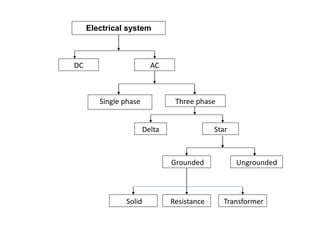
Electrical system
DC AC
Single phase Three phase
Delta Star
Grounded Ungrounded
Solid Resistance Transformer
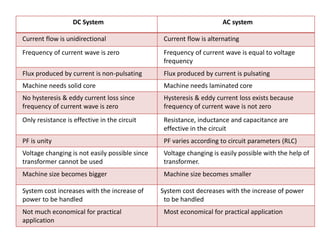
DC System AC system
Current flow is unidirectional Current flow is alternating
Frequency of current wave is zero Frequency of current wave is equal to voltage
frequency
Flux produced by current is non-pulsating Flux produced by current is pulsating
Machine needs solid core Machine needs laminated core
No hysteresis & eddy current loss since
frequency of current wave is zero
Hysteresis & eddy current loss exists because
frequency of current wave is not zero
Only resistance is effective in the circuit Resistance, inductance and capacitance are
effective in the circuit
PF is unity PF varies according to circuit parameters (RLC)
Voltage changing is not easily possible since
transformer cannot be used
Voltage changing is easily possible with the help of
transformer.
Machine size becomes bigger Machine size becomes smaller
System cost increases with the increase of
power to be handled
System cost decreases with the increase of power
to be handled
Not much economical for practical
application
Most economical for practical application
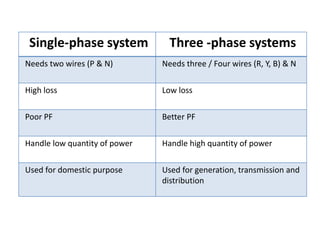
Single-phase system Three -phase systems
Needs two wires (P & N) Needs three / Four wires (R, Y, B) & N
High loss Low loss
Poor PF Better PF
Handle low quantity of power Handle high quantity of power
Used for domestic purpose Used for generation, transmission and
distribution
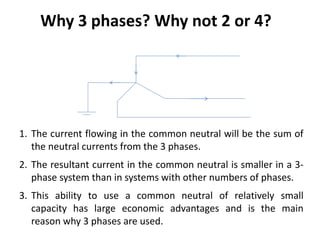
1. The current flowing in the common neutral will be the sum of
the neutral currents from the 3 phases.
2. The resultant current in the common neutral is smaller in a 3-
phase system than in systems with other numbers of phases.
3. This ability to use a common neutral of relatively small
capacity has large economic advantages and is the main
reason why 3 phases are used.
Why 3 phases? Why not 2 or 4?
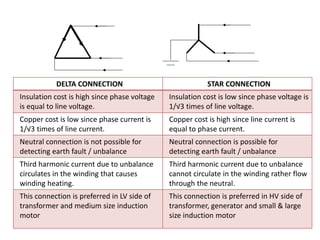
DELTA CONNECTION STAR CONNECTION
Insulation cost is high since phase voltage
is equal to line voltage.
Insulation cost is low since phase voltage is
1/√3 times of line voltage.
Copper cost is low since phase current is
1/√3 times of line current.
Copper cost is high since line current is
equal to phase current.
Neutral connection is not possible for
detecting earth fault / unbalance
Neutral connection is possible for
detecting earth fault / unbalance
Third harmonic current due to unbalance
circulates in the winding that causes
winding heating.
Third harmonic current due to unbalance
cannot circulate in the winding rather flow
through the neutral.
This connection is preferred in LV side of
transformer and medium size induction
motor
This connection is preferred in HV side of
transformer, generator and small & large
size induction motor
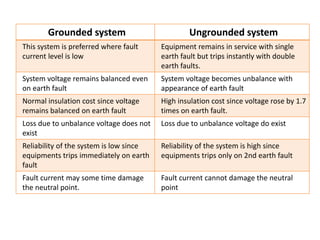
Grounded system Ungrounded system
This system is preferred where fault
current level is low
Equipment remains in service with single
earth fault but trips instantly with double
earth faults.
System voltage remains balanced even
on earth fault
System voltage becomes unbalance with
appearance of earth fault
Normal insulation cost since voltage
remains balanced on earth fault
High insulation cost since voltage rose by 1.7
times on earth fault.
Loss due to unbalance voltage does not
exist
Loss due to unbalance voltage do exist
Reliability of the system is low since
equipments trips immediately on earth
fault
Reliability of the system is high since
equipments trips only on 2nd earth fault
Fault current may some time damage
the neutral point.
Fault current cannot damage the neutral
point
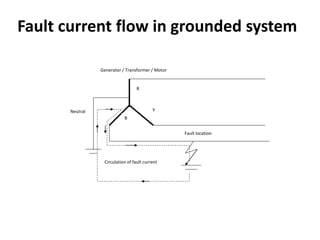
Fault location
Circulation of fault current
Neutral
R
Y
B
Generator / Transformer / Motor
Fault current flow in grounded system
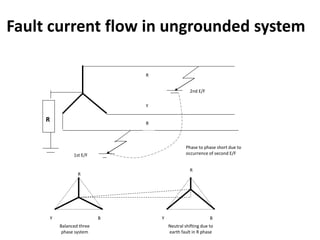
Y
B
1st E/F
R
R
2nd E/F
Phase to phase short due to
occurrence of second E/F
R
Y B
R
Y B
Balanced three
phase system
Neutral shifting due to
earth fault in R phase
Fault current flow in ungrounded system
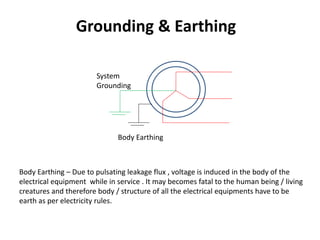
Body Earthing
System
Grounding
Body Earthing – Due to pulsating leakage flux , voltage is induced in the body of the
electrical equipment while in service . It may becomes fatal to the human being / living
creatures and therefore body / structure of all the electrical equipments have to be
earth as per electricity rules.
Grounding & Earthing
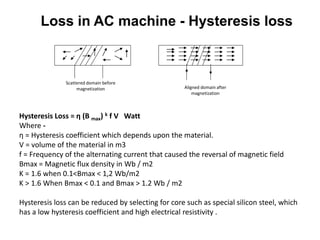
Scattered domain before
magnetization Aligned domain after
magnetization
Hysteresis Loss = η (B max) k f V Watt
Where -
η = Hysteresis coefficient which depends upon the material.
V = volume of the material in m3
f = Frequency of the alternating current that caused the reversal of magnetic field
Bmax = Magnetic flux density in Wb / m2
K = 1.6 when 0.1<Bmax < 1,2 Wb/m2
K > 1.6 When Bmax < 0.1 and Bmax > 1.2 Wb / m2
Hysteresis loss can be reduced by selecting for core such as special silicon steel, which
has a low hysteresis coefficient and high electrical resistivity .
Loss in AC machine - Hysteresis loss
A
B
N
S
A
B
N
S
CORE
FLUX
FLUX
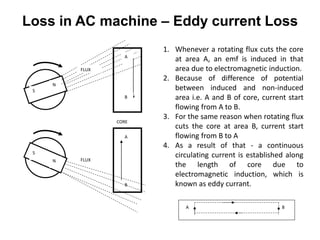
1. Whenever a rotating flux cuts the core
at area A, an emf is induced in that
area due to electromagnetic induction.
2. Because of difference of potential
between induced and non-induced
area i.e. A and B of core, current start
flowing from A to B.
3. For the same reason when rotating flux
cuts the core at area B, current start
flowing from B to A
4. As a result of that - a continuous
circulating current is established along
the length of core due to
electromagnetic induction, which is
known as eddy currant.
A B
Loss in AC machine – Eddy current Loss
Since the electrical resistance of core material is high, circulation of eddy current
through the high resistance path causes losses (I2R) in the form of heat and this loss is
known as the eddy current loss -
Eddy current Loss = η (B max) k f V Watt
Where -
η = Hysteresis coefficient which depends upon the material.
V = volume of the material in m3
f = Frequency of the alternating current that caused the reversal of magnetic field
Bmax = Magnetic flux density in Wb / m2
K = 1.6 when 0.1<Bmax < 1,2 Wb/m2
K > 1.6 When Bmax < 0.1 and Bmax > 1.2 Wb / m2
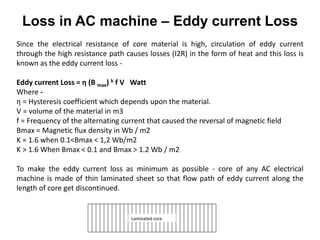
To make the eddy current loss as minimum as possible - core of any AC electrical
machine is made of thin laminated sheet so that flow path of eddy current along the
length of core get discontinued.
Laminated core
Loss in AC machine – Eddy current Loss
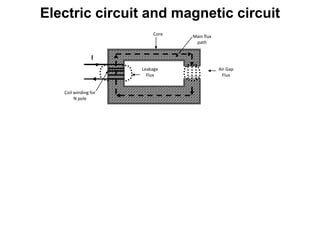
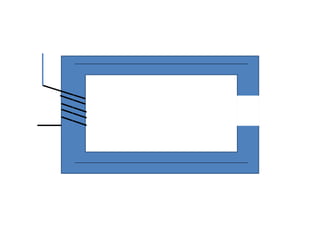
Air Gap
Flux
Leakage
Flux
Main flux
path
Core
Coil winding for
N pole
I
Electric circuit and magnetic circuit
Transmission system
Transmission line
I. Generated power from a power station is evacuated through transmission line.
II. The line may be single (one three phase line) or double (two three phase line) circuit depending
on the MW to be evacuated.
III. The economical transmission voltage in KV for which annual cost (transmission loss + interest +
depreciation) becomes minimum is calculated from the formula –
KV = 5.5√ {(L / 1.6) + (KVA /150)} ( Where L is the distance in Km )
The Standard transmission voltages in India are : 800 KV, 400KV, 230KV, 220KV, 110KV,
The Standard Distribution voltages in India are : 66KV, 33KV, 22KV, and 11KV
The Standard Utilization voltages in India are : 440 V ( 3- Phase) , 254V ( 1- Phase)
Substation
The station where transmission lines are terminated for distribution or interconnected / isolated for
forming regional power grid are known as Substations. It is designed based on MVA and voltage
handling capacity.
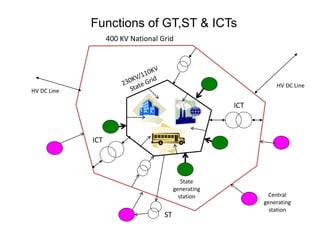
Functions of GT,ST & ICTs
400 KV National Grid
ICT
ICT
ST
State
generating
station Central
generating
station
HV DC Line
HV DC Line
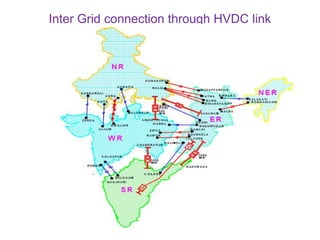
Inter Grid connection through HVDC link
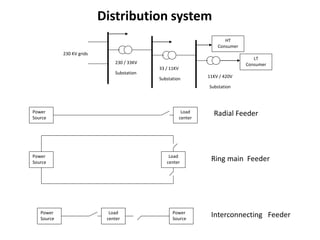
230 / 33KV
Substation
33 / 11KV
Substation 11KV / 420V
Substation
230 KV grids
LT
Consumer
HT
Consumer
Power
Source
Load
center
Power
Source
Load
center
Load
center
Power
Source
Power
Source
Radial Feeder
Ring main Feeder
Interconnecting Feeder
Distribution system
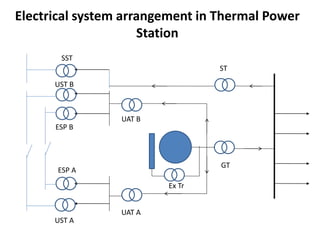
GT
ST
UAT A
UAT B
Ex Tr
UST A
UST B
SST
ESP A
ESP B
Electrical system arrangement in Thermal Power
Station

electrical system

  • 1.
    Operation and maintenanceof electrical machine in thermal power station M. G. Morshad , ADGM / Electrical TPS II ( 7 x 210MW) NLC India Ltd
  • 2.
    1. Electrical System 2.Generator 3. Transformer 4. Motor
  • 3.
    Electrical system DC AC Singlephase Three phase Delta Star Grounded Ungrounded Solid Resistance Transformer
  • 4.
    DC System ACsystem Current flow is unidirectional Current flow is alternating Frequency of current wave is zero Frequency of current wave is equal to voltage frequency Flux produced by current is non-pulsating Flux produced by current is pulsating Machine needs solid core Machine needs laminated core No hysteresis & eddy current loss since frequency of current wave is zero Hysteresis & eddy current loss exists because frequency of current wave is not zero Only resistance is effective in the circuit Resistance, inductance and capacitance are effective in the circuit PF is unity PF varies according to circuit parameters (RLC) Voltage changing is not easily possible since transformer cannot be used Voltage changing is easily possible with the help of transformer. Machine size becomes bigger Machine size becomes smaller System cost increases with the increase of power to be handled System cost decreases with the increase of power to be handled Not much economical for practical application Most economical for practical application
  • 5.
    Single-phase system Three-phase systems Needs two wires (P & N) Needs three / Four wires (R, Y, B) & N High loss Low loss Poor PF Better PF Handle low quantity of power Handle high quantity of power Used for domestic purpose Used for generation, transmission and distribution
  • 6.
    1. The currentflowing in the common neutral will be the sum of the neutral currents from the 3 phases. 2. The resultant current in the common neutral is smaller in a 3- phase system than in systems with other numbers of phases. 3. This ability to use a common neutral of relatively small capacity has large economic advantages and is the main reason why 3 phases are used. Why 3 phases? Why not 2 or 4?
  • 7.
    DELTA CONNECTION STARCONNECTION Insulation cost is high since phase voltage is equal to line voltage. Insulation cost is low since phase voltage is 1/√3 times of line voltage. Copper cost is low since phase current is 1/√3 times of line current. Copper cost is high since line current is equal to phase current. Neutral connection is not possible for detecting earth fault / unbalance Neutral connection is possible for detecting earth fault / unbalance Third harmonic current due to unbalance circulates in the winding that causes winding heating. Third harmonic current due to unbalance cannot circulate in the winding rather flow through the neutral. This connection is preferred in LV side of transformer and medium size induction motor This connection is preferred in HV side of transformer, generator and small & large size induction motor
  • 8.
    Grounded system Ungroundedsystem This system is preferred where fault current level is low Equipment remains in service with single earth fault but trips instantly with double earth faults. System voltage remains balanced even on earth fault System voltage becomes unbalance with appearance of earth fault Normal insulation cost since voltage remains balanced on earth fault High insulation cost since voltage rose by 1.7 times on earth fault. Loss due to unbalance voltage does not exist Loss due to unbalance voltage do exist Reliability of the system is low since equipments trips immediately on earth fault Reliability of the system is high since equipments trips only on 2nd earth fault Fault current may some time damage the neutral point. Fault current cannot damage the neutral point
  • 9.
    Fault location Circulation offault current Neutral R Y B Generator / Transformer / Motor Fault current flow in grounded system
  • 10.
    Y B 1st E/F R R 2nd E/F Phaseto phase short due to occurrence of second E/F R Y B R Y B Balanced three phase system Neutral shifting due to earth fault in R phase Fault current flow in ungrounded system
  • 11.
    Body Earthing System Grounding Body Earthing– Due to pulsating leakage flux , voltage is induced in the body of the electrical equipment while in service . It may becomes fatal to the human being / living creatures and therefore body / structure of all the electrical equipments have to be earth as per electricity rules. Grounding & Earthing
  • 12.
    Scattered domain before magnetizationAligned domain after magnetization Hysteresis Loss = η (B max) k f V Watt Where - η = Hysteresis coefficient which depends upon the material. V = volume of the material in m3 f = Frequency of the alternating current that caused the reversal of magnetic field Bmax = Magnetic flux density in Wb / m2 K = 1.6 when 0.1<Bmax < 1,2 Wb/m2 K > 1.6 When Bmax < 0.1 and Bmax > 1.2 Wb / m2 Hysteresis loss can be reduced by selecting for core such as special silicon steel, which has a low hysteresis coefficient and high electrical resistivity . Loss in AC machine - Hysteresis loss
  • 13.
    A B N S A B N S CORE FLUX FLUX 1. Whenever arotating flux cuts the core at area A, an emf is induced in that area due to electromagnetic induction. 2. Because of difference of potential between induced and non-induced area i.e. A and B of core, current start flowing from A to B. 3. For the same reason when rotating flux cuts the core at area B, current start flowing from B to A 4. As a result of that - a continuous circulating current is established along the length of core due to electromagnetic induction, which is known as eddy currant. A B Loss in AC machine – Eddy current Loss
  • 14.
    Since the electricalresistance of core material is high, circulation of eddy current through the high resistance path causes losses (I2R) in the form of heat and this loss is known as the eddy current loss - Eddy current Loss = η (B max) k f V Watt Where - η = Hysteresis coefficient which depends upon the material. V = volume of the material in m3 f = Frequency of the alternating current that caused the reversal of magnetic field Bmax = Magnetic flux density in Wb / m2 K = 1.6 when 0.1<Bmax < 1,2 Wb/m2 K > 1.6 When Bmax < 0.1 and Bmax > 1.2 Wb / m2 To make the eddy current loss as minimum as possible - core of any AC electrical machine is made of thin laminated sheet so that flow path of eddy current along the length of core get discontinued. Laminated core Loss in AC machine – Eddy current Loss
  • 15.
    Air Gap Flux Leakage Flux Main flux path Core Coilwinding for N pole I Electric circuit and magnetic circuit
  • 17.
    Transmission system Transmission line I.Generated power from a power station is evacuated through transmission line. II. The line may be single (one three phase line) or double (two three phase line) circuit depending on the MW to be evacuated. III. The economical transmission voltage in KV for which annual cost (transmission loss + interest + depreciation) becomes minimum is calculated from the formula – KV = 5.5√ {(L / 1.6) + (KVA /150)} ( Where L is the distance in Km ) The Standard transmission voltages in India are : 800 KV, 400KV, 230KV, 220KV, 110KV, The Standard Distribution voltages in India are : 66KV, 33KV, 22KV, and 11KV The Standard Utilization voltages in India are : 440 V ( 3- Phase) , 254V ( 1- Phase) Substation The station where transmission lines are terminated for distribution or interconnected / isolated for forming regional power grid are known as Substations. It is designed based on MVA and voltage handling capacity.
  • 18.
    Functions of GT,ST& ICTs 400 KV National Grid ICT ICT ST State generating station Central generating station HV DC Line HV DC Line
  • 19.
    Inter Grid connectionthrough HVDC link
  • 20.
    230 / 33KV Substation 33/ 11KV Substation 11KV / 420V Substation 230 KV grids LT Consumer HT Consumer Power Source Load center Power Source Load center Load center Power Source Power Source Radial Feeder Ring main Feeder Interconnecting Feeder Distribution system
  • 21.
    GT ST UAT A UAT B ExTr UST A UST B SST ESP A ESP B Electrical system arrangement in Thermal Power Station