Power System Protection
Dr. Ibrahim El-Amin
Protective Device Coordination
Definition
 Overcurrent Coordination
 A systematic study of current responsive devices
in an electrical power system.
Objective
 To determine the ratings and settings of
fuses, breakers, relay, etc.
 To isolate the fault or overloads.
Criteria
 Economics
 Available Measures of Fault
 Operating Practices
 Previous Experience
Design
 Open only PD upstream of the fault or overload
 Provide satisfactory protection for overloads
 Interrupt SC as rapidly (instantaneously) as
possible
 Comply with all applicable standards and codes
 Plot the Time Current Characteristics of
different PDs
Analysis
When:
 New electrical systems
 Plant electrical system expansion/retrofits
 Coordination failure in an existing plant
Protection vs. Coordination
 Coordination is not an exact science
 Compromise between protection and
coordination
 Reliability
 Speed
 Performance
 Economics
 Simplicity
Protection
 Prevent injury to personnel
 Minimize damage to components
 Quickly isolate the affected portion of the system
 Minimize the magnitude of available short-circuit
Spectrum Of Currents
 Load Current
 Up to 100% of full-load
 115-125% (mild overload)
 Overcurrent
 Abnormal loading condition (Locked-Rotor)
 Fault Current
 Fault condition
 Ten times the full-load current and higher
Coordination
 Limit the extend and duration of service
interruption
 Selective fault isolation
 Provide alternate circuits
Coordination
t
I
C B A
C
D
D B
A
Equipment
 Motor
 Transformer
 Generator
 Cable
 Busway
Capability / Damage Curves
t
I
I2
2
t
Gen
I2
t
Motor
Xfmr
I2
t
Cable
I2
t
Transformer Category
ANSI/IEEE C-57.109
Minimum nameplate (kVA)
Category Single-phase Three-phase
I 5-500 15-500
II 501-1667 501-5000
III 1668-10,000 5001-30,000
IV above 1000 above 30,000
Infrequent Fault Incidence Zones for Category II & III Transformers
* Should be selected by reference to the frequent-fault-incidence protection curve or for
transformers serving industrial, commercial and institutional power systems with secondary-side
conductors enclosed in conduit, bus duct, etc., the feeder protective device may be selected by
reference to the infrequent-fault-incidence protection curve.
Source: IEEE C57
Source
Transformer primary-side protective device
(fuses, relayed circuit breakers, etc.) may be
selected by reference to the infrequent-fault-
incidence protection curve
Category II or III Transformer
Fault will be cleared by transformer
primary-side protective device
Optional main secondary –side protective device.
May be selected by reference to the infrequent-fault-
incidence protection curve
Feeder protective device
Fault will be cleared by transformer primary-side
protective device or by optional main secondary-
side protection device
Fault will be cleared by
feeder protective device
Infrequent-Fault
Incidence Zone*
Feeders
Frequent-Fault
Incidence Zone*
Transformer
t
(sec)
I (pu)
Thermal
200
2.5
I
2
t = 1250
2
25
Isc
Mechanical
K=(1/Z)
2
t
(D-D LL) 0.87
(D-R LG) 0.58
Frequent Fault
Infrequent Fault
Inrush
FLA
Transformer Protection
MAXIMUM RATING OR SETTING FOR OVERCURRENT DEVICE
PRIMARY SECONDARY
Over 600 Volts Over 600 Volts 600 Volts or Below
Transformer
Rated
Impedance
Circuit
Breaker
Setting
Fuse
Rating
Circuit
Breaker
Setting
Fuse
Rating
Circuit Breaker
Setting or Fuse
Rating
Not more than
6%
600 % 300 % 300 % 250% 125%
(250% supervised)
More than 6%
and not more
than 10%
400 % 300 % 250% 225% 125%
(250% supervised)
Table 450-3(a) source: NEC
Protective Devices
 Fuse
 Relay (50/51 P, N, G, SG, 51V, 67, 46, 79, 21, …)
 Thermal Magnetic
 Low Voltage Solid State Trip
 Electro-Mechanical
 MCP
 Overload Heater
Fuse
 Non Adjustable Device
 Continuous and Interrupting Rating
 Voltage Levels
 Characteristic Curves
 Min. Melting
 Total Clearing
 Application
Minimum Melting
Time Curve
Total Clearing
Time Curve
Current Limiting Fuse
(CLF)
 Limits the peak current of short-circuit
 Reduces magnetic stresses (mechanical
damage)
 Reduces thermal energy
Symmetrical RMS Amperes
Peak
Let-Through
Amperes
100 A
60 A
15% PF (X/R = 6.6)
12,500
5,200
230,000
300 A
100,000
Let-Through Chart
Fuse
Generally:
 CLF is a better short-circuit protection
 Non-CLF (expulsion fuse) is a better Overload
protection
Selectivity Criteria
Typically:
 Non-CLF: 140% of full load
 CLF: 150% of full load
Molder Case CB
 Thermal-Magnetic
 Magnetic Only
 Integrally Fused
 Current Limiting
 High Interrupting
Capacity
Types
 Frame Size
 Trip Rating
 Interrupting Capability
 Voltage
Thermal Minimum
Thermal Maximum
Magnetic
(instantaneous)
LVPCB
 Voltage and Frequency Ratings
 Continuous Current / Frame Size
 Override (12 times cont. current)
 Interrupting Rating
 Short-Time Rating (30 cycle)
 Fairly Simple to Coordinate
480 kV
CB 2
CB 1
CB 2
CB 1
IT
ST PU
ST Band
LT PU
LT Band
If =30 kA
Motor Protection
 Motor Starting Curve
 Thermal Protection
 Locked Rotor Protection
 Fault Protection
Motor Overload Protection
(NEC Art 430-32)
 Thermal O/L (Device 49)
 Motors with SF not less than 1.15
 125% of FLA
 Motors with temp. rise not over 40
 125% of FLA
 All other motors
 115% of FLA
Locked Rotor Protection
 Thermal Locked Rotor (Device 51)
 Starting Time (TS < TLR)
 LRA
 LRA sym
 LRA asym (1.5-1.6 x LRA sym) + 10% margin
Fault Protection
(NEC Art 430-52)
 Non-Time Delay Fuses
 300% of FLA
 Dual Element (Time-Delay Fuses)
 175% of FLA
 Instantaneous Trip Breaker
 800% of FLA*
 Inverse Time Breakers
 250% of FLA
*MCPs can be set higher
200 HP
MCP
O/L
Starting Curve
I
2
T
(49)
MCP (50)
(51)
ts
tLR
LRAs LRAasym
Overcurrent Relay
 Time-Delay (51 – I>)
 Short-Time Instantaneous ( I>>)
 Instantaneous (50 – I>>>)
 Electromagnetic (induction Disc)
 Solid State (Multi Function / Multi Level)
 Application
Time-Overcurrent Unit
 Ampere Tap Calculation
 Ampere Pickup (P.U.) = CT Ratio x A.T. Setting
 Relay Current (IR) = Actual Line Current (IL) / CT
Ratio
 Multiples of A.T. = IR/A.T. Setting
= IL/(CT Ratio x A.T. Setting)
IL
IR
CT
51
Instantaneous Unit
 Instantaneous Calculation
 Ampere Pickup (P.U.) = CT Ratio x IT Setting
 Relay Current (IR) = Actual Line Current (IL) / CT
Ratio
 Multiples of IT= IR/IT Setting
= IL/(CT Ratio x IT Setting)
IL
IR
CT
50
41
Relay Coordination
 Time margins should be maintained between T/C
curves
 Adjustment should be made for CB opening time
 Shorter time intervals may be used for solid state
relays
 Upstream relay should have the same inverse T/C
characteristic as the downstream relay (CO-8 to CO-8)
or be less inverse (CO-8 upstream to CO-6
downstream)
 Extremely inverse relays coordinates very well with
CLFs
Fixed Points
 Motor starting curves
 Transformer damage curves & inrush
points
 Cable damage curves
 SC maximum fault points
 Cable ampacities
Points or curves which do not change
regardless of protective device settings:
Situation
Calculate Relay Setting (Tap, Inst. Tap & Time Dial)
For This System
4.16 kV
DS 5 MVA
Cable
1-3/C 500 kcmil
CU - EPR
CB
Isc = 30,000 A
6 %
50/51 Relay: IFC 53
CT 800:5
Solution
A
Inrsuh 328
,
8
694
12
I 


A
338
.
4
800
5
I
I L
R 


Transformer: A
kV
kVA
L 694
16
.
4
3
000
,
5
I 


IL
CT
R
IR
Set Relay:
A
55
1
.
52
800
5
328
,
8
)
50
(
1
)
38
.
1
(6/4.338
0
.
6
4
.
5
338
.
4
%
125









A
Inst
TD
A
TAP
A
Question
What is ANSI Shift Curve?
Answer
 For delta-delta connected transformers, with
line-to-line faults on the secondary side, the
curve must be reduced to 87% (shift to the left
by a factor of 0.87)
 For delta-wye connection, with single line-to-
ground faults on the secondary side, the curve
values must be reduced to 58% (shift to the left
by a factor of 0.58)
Question
What is meant by Frequent and
Infrequent for transformers?
Answer
Infrequent Fault Incidence Zones for Category II & III Transformers
Source
Transformer primary-side protective device
(fuses, relayed circuit breakers, etc.) May be
selected by reference to the infrequent-fault-
incidence protection curve
Category II or III Transformer
Fault will be cleared by transformer
primary-side protective device
Optional main secondary –side protective device.
May be selected by reference to the infrequent-fault-
incidence protection curve
Feeder protective device
Fault will be cleared by transformer primary-side
protective device or by optional main secondary-
side protection device
Fault will be cleared by
feeder protective device
Infrequent-Fault
Incidence Zone*
Feeders
Frequent-Fault
Incidence Zone*
Question
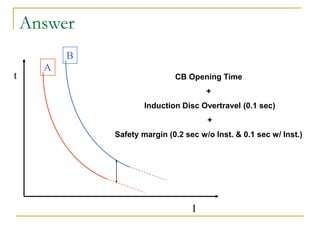
What T/C Coordination interval should be
maintained between relays?
Answer
A
t
I
B
CB Opening Time
+
Induction Disc Overtravel (0.1 sec)
+
Safety margin (0.2 sec w/o Inst. & 0.1 sec w/ Inst.)
Question
What is Class 10 and Class 20
Thermal OLR curves?
Answer
 Class 10 for fast trip, 10 seconds or less
 Class 20 for, 20 seconds or less
 There is also a Class 30 for long trip time
Answer

5010566.ppt

  • 1.
  • 2.
  • 3.
    Definition  Overcurrent Coordination A systematic study of current responsive devices in an electrical power system.
  • 4.
    Objective  To determinethe ratings and settings of fuses, breakers, relay, etc.  To isolate the fault or overloads.
  • 5.
    Criteria  Economics  AvailableMeasures of Fault  Operating Practices  Previous Experience
  • 6.
    Design  Open onlyPD upstream of the fault or overload  Provide satisfactory protection for overloads  Interrupt SC as rapidly (instantaneously) as possible  Comply with all applicable standards and codes  Plot the Time Current Characteristics of different PDs
  • 7.
    Analysis When:  New electricalsystems  Plant electrical system expansion/retrofits  Coordination failure in an existing plant
  • 8.
    Protection vs. Coordination Coordination is not an exact science  Compromise between protection and coordination  Reliability  Speed  Performance  Economics  Simplicity
  • 9.
    Protection  Prevent injuryto personnel  Minimize damage to components  Quickly isolate the affected portion of the system  Minimize the magnitude of available short-circuit
  • 10.
    Spectrum Of Currents Load Current  Up to 100% of full-load  115-125% (mild overload)  Overcurrent  Abnormal loading condition (Locked-Rotor)  Fault Current  Fault condition  Ten times the full-load current and higher
  • 11.
    Coordination  Limit theextend and duration of service interruption  Selective fault isolation  Provide alternate circuits
  • 12.
  • 13.
    Equipment  Motor  Transformer Generator  Cable  Busway
  • 14.
    Capability / DamageCurves t I I2 2 t Gen I2 t Motor Xfmr I2 t Cable I2 t
  • 15.
    Transformer Category ANSI/IEEE C-57.109 Minimumnameplate (kVA) Category Single-phase Three-phase I 5-500 15-500 II 501-1667 501-5000 III 1668-10,000 5001-30,000 IV above 1000 above 30,000
  • 16.
    Infrequent Fault IncidenceZones for Category II & III Transformers * Should be selected by reference to the frequent-fault-incidence protection curve or for transformers serving industrial, commercial and institutional power systems with secondary-side conductors enclosed in conduit, bus duct, etc., the feeder protective device may be selected by reference to the infrequent-fault-incidence protection curve. Source: IEEE C57 Source Transformer primary-side protective device (fuses, relayed circuit breakers, etc.) may be selected by reference to the infrequent-fault- incidence protection curve Category II or III Transformer Fault will be cleared by transformer primary-side protective device Optional main secondary –side protective device. May be selected by reference to the infrequent-fault- incidence protection curve Feeder protective device Fault will be cleared by transformer primary-side protective device or by optional main secondary- side protection device Fault will be cleared by feeder protective device Infrequent-Fault Incidence Zone* Feeders Frequent-Fault Incidence Zone*
  • 17.
    Transformer t (sec) I (pu) Thermal 200 2.5 I 2 t =1250 2 25 Isc Mechanical K=(1/Z) 2 t (D-D LL) 0.87 (D-R LG) 0.58 Frequent Fault Infrequent Fault Inrush FLA
  • 19.
    Transformer Protection MAXIMUM RATINGOR SETTING FOR OVERCURRENT DEVICE PRIMARY SECONDARY Over 600 Volts Over 600 Volts 600 Volts or Below Transformer Rated Impedance Circuit Breaker Setting Fuse Rating Circuit Breaker Setting Fuse Rating Circuit Breaker Setting or Fuse Rating Not more than 6% 600 % 300 % 300 % 250% 125% (250% supervised) More than 6% and not more than 10% 400 % 300 % 250% 225% 125% (250% supervised) Table 450-3(a) source: NEC
  • 20.
    Protective Devices  Fuse Relay (50/51 P, N, G, SG, 51V, 67, 46, 79, 21, …)  Thermal Magnetic  Low Voltage Solid State Trip  Electro-Mechanical  MCP  Overload Heater
  • 21.
    Fuse  Non AdjustableDevice  Continuous and Interrupting Rating  Voltage Levels  Characteristic Curves  Min. Melting  Total Clearing  Application
  • 22.
  • 23.
    Current Limiting Fuse (CLF) Limits the peak current of short-circuit  Reduces magnetic stresses (mechanical damage)  Reduces thermal energy
  • 25.
    Symmetrical RMS Amperes Peak Let-Through Amperes 100A 60 A 15% PF (X/R = 6.6) 12,500 5,200 230,000 300 A 100,000 Let-Through Chart
  • 26.
    Fuse Generally:  CLF isa better short-circuit protection  Non-CLF (expulsion fuse) is a better Overload protection
  • 27.
    Selectivity Criteria Typically:  Non-CLF:140% of full load  CLF: 150% of full load
  • 28.
    Molder Case CB Thermal-Magnetic  Magnetic Only  Integrally Fused  Current Limiting  High Interrupting Capacity Types  Frame Size  Trip Rating  Interrupting Capability  Voltage
  • 29.
  • 30.
    LVPCB  Voltage andFrequency Ratings  Continuous Current / Frame Size  Override (12 times cont. current)  Interrupting Rating  Short-Time Rating (30 cycle)  Fairly Simple to Coordinate
  • 31.
    480 kV CB 2 CB1 CB 2 CB 1 IT ST PU ST Band LT PU LT Band If =30 kA
  • 32.
    Motor Protection  MotorStarting Curve  Thermal Protection  Locked Rotor Protection  Fault Protection
  • 33.
    Motor Overload Protection (NECArt 430-32)  Thermal O/L (Device 49)  Motors with SF not less than 1.15  125% of FLA  Motors with temp. rise not over 40  125% of FLA  All other motors  115% of FLA
  • 34.
    Locked Rotor Protection Thermal Locked Rotor (Device 51)  Starting Time (TS < TLR)  LRA  LRA sym  LRA asym (1.5-1.6 x LRA sym) + 10% margin
  • 35.
    Fault Protection (NEC Art430-52)  Non-Time Delay Fuses  300% of FLA  Dual Element (Time-Delay Fuses)  175% of FLA  Instantaneous Trip Breaker  800% of FLA*  Inverse Time Breakers  250% of FLA *MCPs can be set higher
  • 36.
    200 HP MCP O/L Starting Curve I 2 T (49) MCP(50) (51) ts tLR LRAs LRAasym
  • 37.
    Overcurrent Relay  Time-Delay(51 – I>)  Short-Time Instantaneous ( I>>)  Instantaneous (50 – I>>>)  Electromagnetic (induction Disc)  Solid State (Multi Function / Multi Level)  Application
  • 39.
    Time-Overcurrent Unit  AmpereTap Calculation  Ampere Pickup (P.U.) = CT Ratio x A.T. Setting  Relay Current (IR) = Actual Line Current (IL) / CT Ratio  Multiples of A.T. = IR/A.T. Setting = IL/(CT Ratio x A.T. Setting) IL IR CT 51
  • 40.
    Instantaneous Unit  InstantaneousCalculation  Ampere Pickup (P.U.) = CT Ratio x IT Setting  Relay Current (IR) = Actual Line Current (IL) / CT Ratio  Multiples of IT= IR/IT Setting = IL/(CT Ratio x IT Setting) IL IR CT 50
  • 41.
    41 Relay Coordination  Timemargins should be maintained between T/C curves  Adjustment should be made for CB opening time  Shorter time intervals may be used for solid state relays  Upstream relay should have the same inverse T/C characteristic as the downstream relay (CO-8 to CO-8) or be less inverse (CO-8 upstream to CO-6 downstream)  Extremely inverse relays coordinates very well with CLFs
  • 42.
    Fixed Points  Motorstarting curves  Transformer damage curves & inrush points  Cable damage curves  SC maximum fault points  Cable ampacities Points or curves which do not change regardless of protective device settings:
  • 43.
    Situation Calculate Relay Setting(Tap, Inst. Tap & Time Dial) For This System 4.16 kV DS 5 MVA Cable 1-3/C 500 kcmil CU - EPR CB Isc = 30,000 A 6 % 50/51 Relay: IFC 53 CT 800:5
  • 44.
    Solution A Inrsuh 328 , 8 694 12 I    A 338 . 4 800 5 I IL R    Transformer: A kV kVA L 694 16 . 4 3 000 , 5 I    IL CT R IR Set Relay: A 55 1 . 52 800 5 328 , 8 ) 50 ( 1 ) 38 . 1 (6/4.338 0 . 6 4 . 5 338 . 4 % 125          A Inst TD A TAP A
  • 45.
  • 46.
    Answer  For delta-deltaconnected transformers, with line-to-line faults on the secondary side, the curve must be reduced to 87% (shift to the left by a factor of 0.87)  For delta-wye connection, with single line-to- ground faults on the secondary side, the curve values must be reduced to 58% (shift to the left by a factor of 0.58)
  • 47.
    Question What is meantby Frequent and Infrequent for transformers?
  • 48.
    Answer Infrequent Fault IncidenceZones for Category II & III Transformers Source Transformer primary-side protective device (fuses, relayed circuit breakers, etc.) May be selected by reference to the infrequent-fault- incidence protection curve Category II or III Transformer Fault will be cleared by transformer primary-side protective device Optional main secondary –side protective device. May be selected by reference to the infrequent-fault- incidence protection curve Feeder protective device Fault will be cleared by transformer primary-side protective device or by optional main secondary- side protection device Fault will be cleared by feeder protective device Infrequent-Fault Incidence Zone* Feeders Frequent-Fault Incidence Zone*
  • 49.
    Question What T/C Coordinationinterval should be maintained between relays?
  • 50.
    Answer A t I B CB Opening Time + InductionDisc Overtravel (0.1 sec) + Safety margin (0.2 sec w/o Inst. & 0.1 sec w/ Inst.)
  • 51.
    Question What is Class10 and Class 20 Thermal OLR curves?
  • 52.
    Answer  Class 10for fast trip, 10 seconds or less  Class 20 for, 20 seconds or less  There is also a Class 30 for long trip time
  • 53.