Transformations
of Functions
Mr. Johnson
Algebra 1
California Content Standard – Building Functions
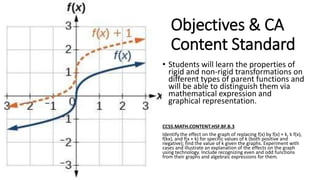
Objectives & CA
Content Standard
• Students will learn the properties of
rigid and non-rigid transformations on
different types of parent functions and
will be able to distinguish them via
mathematical expression and
graphical representation.
CCSS.MATH.CONTENT.HSF.BF.B.3
Identify the effect on the graph of replacing f(x) by f(x) + k, k f(x),
f(kx), and f(x + k) for specific values of k (both positive and
negative); find the value of k given the graphs. Experiment with
cases and illustrate an explanation of the effects on the graph
using technology. Include recognizing even and odd functions
from their graphs and algebraic expressions for them.
Before We Begin, Let’s Recap
What do we know about
functions?
Spend 2-3 minutes
discussing with your
classmates in groups of 4
EVERYTHING you can think
about regarding functions.
We will then write down
one thing from each group
together as a class.
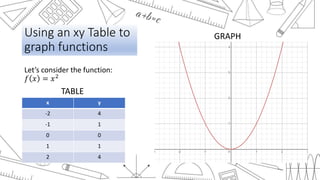
Using an xy Table to
graph functions
Let’s consider the function:
𝑓 𝑥 = 𝑥2
TABLE
x y
-2 4
-1 1
0 0
1 1
2 4
GRAPH
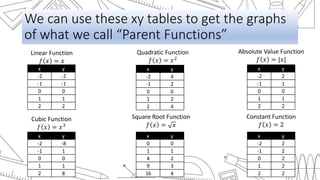
We can use these xy tables to get the graphs
of what we call “Parent Functions”
x y
-2 -2
-1 -1
0 0
1 1
2 2
x y
-2 4
-1 2
0 0
1 2
2 4
x y
-2 2
-1 1
0 0
1 1
2 2
x y
-2 -8
-1 1
0 0
1 1
2 8
x y
0 0
1 1
4 2
9 3
16 4
x y
-2 2
-1 2
0 2
1 2
2 2
Linear Function
𝑓 𝑥 = 𝑥
Quadratic Function
𝑓 𝑥 = 𝑥2
Absolute Value Function
𝑓 𝑥 = |𝑥|
Cubic Function
𝑓 𝑥 = 𝑥3
Square Root Function
𝑓 𝑥 = 𝑥
Constant Function
𝑓 𝑥 = 2
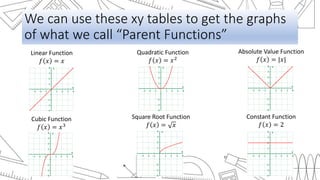
We can use these xy tables to get the graphs
of what we call “Parent Functions”
Linear Function
𝑓 𝑥 = 𝑥
Quadratic Function
𝑓 𝑥 = 𝑥2
Absolute Value Function
𝑓 𝑥 = |𝑥|
Cubic Function
𝑓 𝑥 = 𝑥3
Square Root Function
𝑓 𝑥 = 𝑥
Constant Function
𝑓 𝑥 = 2
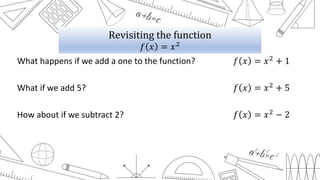
What happens if we add a one to the function? 𝑓 𝑥 = 𝑥2 + 1
What if we add 5? 𝑓 𝑥 = 𝑥2 + 5
How about if we subtract 2? 𝑓 𝑥 = 𝑥2
− 2
Revisiting the function
𝑓 𝑥 = 𝑥2
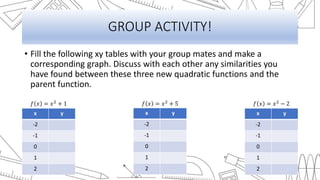
GROUP ACTIVITY!
• Fill the following xy tables with your group mates and make a
corresponding graph. Discuss with each other any similarities you
have found between these three new quadratic functions and the
parent function.
x y
-2
-1
0
1
2
x y
-2
-1
0
1
2
x y
-2
-1
0
1
2
𝑓 𝑥 = 𝑥2 + 1 𝑓 𝑥 = 𝑥2 + 5 𝑓 𝑥 = 𝑥2 − 2
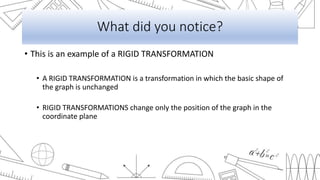
What did you notice?
• This is an example of a RIGID TRANSFORMATION
• A RIGID TRANSFORMATION is a transformation in which the basic shape of
the graph is unchanged
• RIGID TRANSFORMATIONS change only the position of the graph in the
coordinate plane
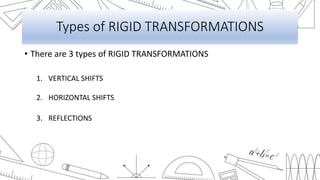
Types of RIGID TRANSFORMATIONS
• There are 3 types of RIGID TRANSFORMATIONS
1. VERTICAL SHIFTS
2. HORIZONTAL SHIFTS
3. REFLECTIONS
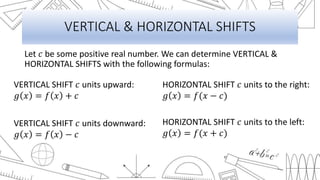
VERTICAL & HORIZONTAL SHIFTS
Let 𝑐 be some positive real number. We can determine VERTICAL &
HORIZONTAL SHIFTS with the following formulas:
VERTICAL SHIFT 𝑐 units upward:
𝑔 𝑥 = 𝑓 𝑥 + 𝑐
VERTICAL SHIFT 𝑐 units downward:
𝑔 𝑥 = 𝑓 𝑥 − 𝑐
HORIZONTAL SHIFT 𝑐 units to the right:
𝑔 𝑥 = 𝑓(𝑥 − 𝑐)
HORIZONTAL SHIFT 𝑐 units to the left:
𝑔 𝑥 = 𝑓(𝑥 + 𝑐)

Transformations of functions

  • 1.
    Transformations of Functions Mr. Johnson Algebra1 California Content Standard – Building Functions
  • 2.
    Objectives & CA ContentStandard • Students will learn the properties of rigid and non-rigid transformations on different types of parent functions and will be able to distinguish them via mathematical expression and graphical representation. CCSS.MATH.CONTENT.HSF.BF.B.3 Identify the effect on the graph of replacing f(x) by f(x) + k, k f(x), f(kx), and f(x + k) for specific values of k (both positive and negative); find the value of k given the graphs. Experiment with cases and illustrate an explanation of the effects on the graph using technology. Include recognizing even and odd functions from their graphs and algebraic expressions for them.
  • 3.
    Before We Begin,Let’s Recap What do we know about functions? Spend 2-3 minutes discussing with your classmates in groups of 4 EVERYTHING you can think about regarding functions. We will then write down one thing from each group together as a class.
  • 4.
    Using an xyTable to graph functions Let’s consider the function: 𝑓 𝑥 = 𝑥2 TABLE x y -2 4 -1 1 0 0 1 1 2 4 GRAPH
  • 5.
    We can usethese xy tables to get the graphs of what we call “Parent Functions” x y -2 -2 -1 -1 0 0 1 1 2 2 x y -2 4 -1 2 0 0 1 2 2 4 x y -2 2 -1 1 0 0 1 1 2 2 x y -2 -8 -1 1 0 0 1 1 2 8 x y 0 0 1 1 4 2 9 3 16 4 x y -2 2 -1 2 0 2 1 2 2 2 Linear Function 𝑓 𝑥 = 𝑥 Quadratic Function 𝑓 𝑥 = 𝑥2 Absolute Value Function 𝑓 𝑥 = |𝑥| Cubic Function 𝑓 𝑥 = 𝑥3 Square Root Function 𝑓 𝑥 = 𝑥 Constant Function 𝑓 𝑥 = 2
  • 6.
    We can usethese xy tables to get the graphs of what we call “Parent Functions” Linear Function 𝑓 𝑥 = 𝑥 Quadratic Function 𝑓 𝑥 = 𝑥2 Absolute Value Function 𝑓 𝑥 = |𝑥| Cubic Function 𝑓 𝑥 = 𝑥3 Square Root Function 𝑓 𝑥 = 𝑥 Constant Function 𝑓 𝑥 = 2
  • 7.
    What happens ifwe add a one to the function? 𝑓 𝑥 = 𝑥2 + 1 What if we add 5? 𝑓 𝑥 = 𝑥2 + 5 How about if we subtract 2? 𝑓 𝑥 = 𝑥2 − 2 Revisiting the function 𝑓 𝑥 = 𝑥2
  • 8.
    GROUP ACTIVITY! • Fillthe following xy tables with your group mates and make a corresponding graph. Discuss with each other any similarities you have found between these three new quadratic functions and the parent function. x y -2 -1 0 1 2 x y -2 -1 0 1 2 x y -2 -1 0 1 2 𝑓 𝑥 = 𝑥2 + 1 𝑓 𝑥 = 𝑥2 + 5 𝑓 𝑥 = 𝑥2 − 2
  • 9.
    What did younotice? • This is an example of a RIGID TRANSFORMATION • A RIGID TRANSFORMATION is a transformation in which the basic shape of the graph is unchanged • RIGID TRANSFORMATIONS change only the position of the graph in the coordinate plane
  • 10.
    Types of RIGIDTRANSFORMATIONS • There are 3 types of RIGID TRANSFORMATIONS 1. VERTICAL SHIFTS 2. HORIZONTAL SHIFTS 3. REFLECTIONS
  • 11.
    VERTICAL & HORIZONTALSHIFTS Let 𝑐 be some positive real number. We can determine VERTICAL & HORIZONTAL SHIFTS with the following formulas: VERTICAL SHIFT 𝑐 units upward: 𝑔 𝑥 = 𝑓 𝑥 + 𝑐 VERTICAL SHIFT 𝑐 units downward: 𝑔 𝑥 = 𝑓 𝑥 − 𝑐 HORIZONTAL SHIFT 𝑐 units to the right: 𝑔 𝑥 = 𝑓(𝑥 − 𝑐) HORIZONTAL SHIFT 𝑐 units to the left: 𝑔 𝑥 = 𝑓(𝑥 + 𝑐)