Functions and their
Graphs
Instr. Eljon Tabulinar
Representation of Function
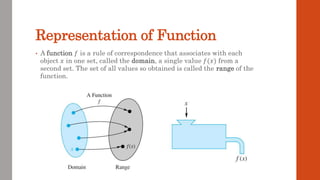
• A function 𝑓 is a rule of correspondence that associates with each
object 𝑥 in one set, called the domain, a single value 𝑓(𝑥) from a
second set. The set of all values so obtained is called the range of the
function.
Function Notation
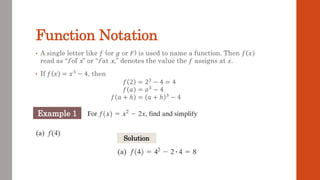
• A single letter like 𝑓 (or 𝑔 or 𝐹) is used to name a function. Then 𝑓 𝑥
read as “f of x” or “f at x,” denotes the value the 𝑓 assigns at 𝑥.
• If 𝑓 𝑥 = 𝑥3 − 4, then
𝑓 2 = 23 − 4 = 4
𝑓 𝑎 = 𝑎3 − 4
𝑓 𝑎 + ℎ = 𝑎 + ℎ 3 − 4
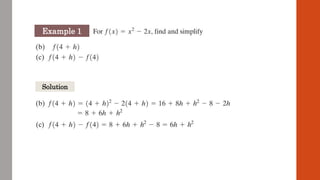
Example 1
Solution
Solution
Example 1
Domain and Range
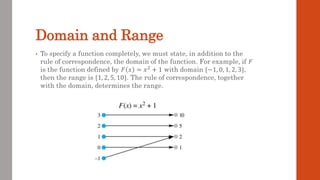
• To specify a function completely, we must state, in addition to the
rule of correspondence, the domain of the function. For example, if 𝐹
is the function defined by 𝐹 𝑥 = 𝑥2
+ 1 with domain {−1, 0, 1, 2, 3},
then the range is {1, 2, 5, 10}. The rule of correspondence, together
with the domain, determines the range.
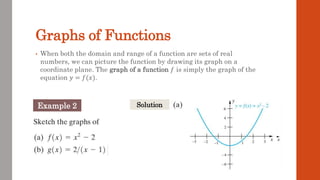
Graphs of Functions
• When both the domain and range of a function are sets of real
numbers, we can picture the function by drawing its graph on a
coordinate plane. The graph of a function 𝑓 is simply the graph of the
equation 𝑦 = 𝑓(𝑥).
Example 2 Solution
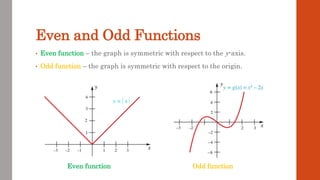
Even and Odd Functions
• Even function – the graph is symmetric with respect to the y-axis.
• Odd function – the graph is symmetric with respect to the origin.
Even function Odd function
Even and Odd Functions
• A function 𝑓 is an even function if 𝑓 −𝑥 = 𝑓(𝑥)
• A function 𝑓 is an odd function if 𝑓 −𝑥 = −𝑓(𝑥)
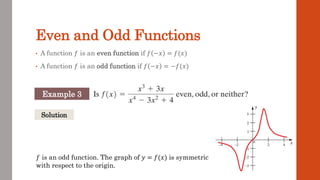
Example 3
Solution
𝑓 is an odd function. The graph of 𝑦 = 𝑓(𝑥) is symmetric
with respect to the origin.
Operations on Functions
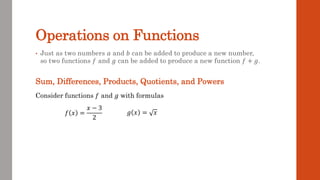
• Just as two numbers 𝑎 and 𝑏 can be added to produce a new number,
so two functions 𝑓 and 𝑔 can be added to produce a new function 𝑓 + 𝑔.
Sum, Differences, Products, Quotients, and Powers
Consider functions 𝑓 and 𝑔 with formulas
𝑓 𝑥 =
𝑥 − 3
2
𝑔 𝑥 = 𝑥
Operations on Functions
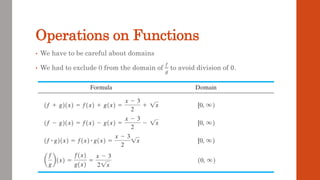
• We have to be careful about domains
• We had to exclude 0 from the domain of
𝑓
𝑔
to avoid division of 0.
Composition of Functions
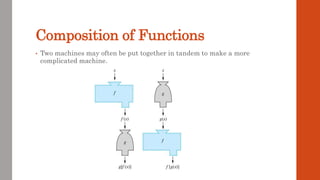
• Two machines may often be put together in tandem to make a more
complicated machine.
Composition of Function
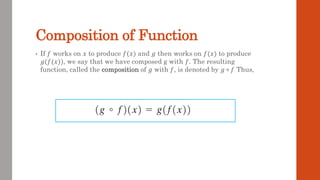
• If 𝑓 works on 𝑥 to produce 𝑓(𝑥) and 𝑔 then works on 𝑓(𝑥) to produce
𝑔(𝑓(𝑥)), we say that we have composed g with 𝑓. The resulting
function, called the composition of 𝑔 with 𝑓, is denoted by 𝑔 ∘ 𝑓 Thus,
Composition of Function
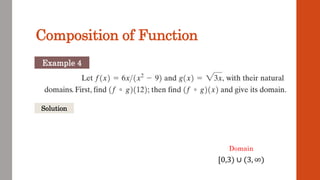
Example 4
Solution
[0,3) ∪ (3, ∞)
Domain
Inverse of a Function
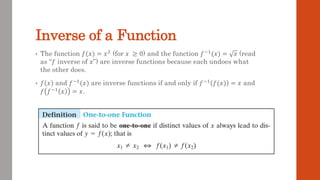
• The function 𝑓(𝑥) = 𝑥2 (for 𝑥 ≥ 0) and the function 𝑓−1(𝑥) = 𝑥 (read
as “𝑓 inverse of 𝑥”) are inverse functions because each undoes what
the other does.
• 𝑓 𝑥 and 𝑓−1(𝑥) are inverse functions if and only if 𝑓−1 𝑓(𝑥) = 𝑥 and
𝑓 𝑓−1 𝑥 = 𝑥.
Finding the Inverse of a Function
Algebraically
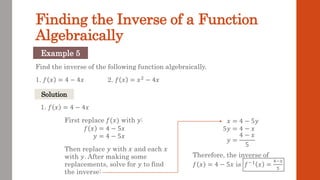
Find the inverse of the following function algebraically.
1. 𝑓 𝑥 = 4 − 4𝑥 2. 𝑓 𝑥 = 𝑥2
− 4𝑥
Example 5
Solution
1. 𝑓 𝑥 = 4 − 4𝑥
First replace 𝑓(𝑥) with 𝑦:
𝑓 𝑥 = 4 − 5𝑥
𝑦 = 4 − 5𝑥
Then replace 𝑦 with 𝑥 and each 𝑥
with 𝑦. After making some
replacements, solve for 𝑦 to find
the inverse:
𝑥 = 4 − 5𝑦
5𝑦 = 4 − 𝑥
𝑦 =
4 − 𝑥
5
Therefore, the inverse of
𝑓 𝑥 = 4 − 5𝑥 is 𝑓−1 𝑥 =
4−𝑥
5
Elementary Functions, their
Properties and Graphs
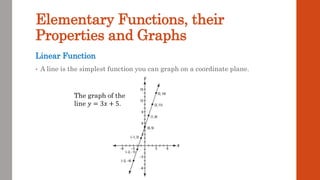
• A line is the simplest function you can graph on a coordinate plane.
Linear Function
The graph of the
line 𝑦 = 3𝑥 + 5.
Elementary Functions, their
Properties and Graphs
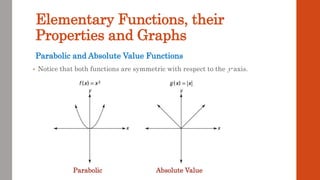
• Notice that both functions are symmetric with respect to the y-axis.
Parabolic and Absolute Value Functions
Parabolic Absolute Value
Elementary Functions, their
Properties and Graphs
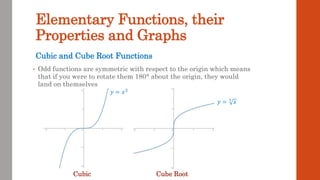
• Odd functions are symmetric with respect to the origin which means
that if you were to rotate them 180° about the origin, they would
land on themselves
Cubic and Cube Root Functions
Cubic Cube Root
𝑦 = 𝑥3
𝑦 = 3
𝑥
Elementary Functions, their
Properties and Graphs
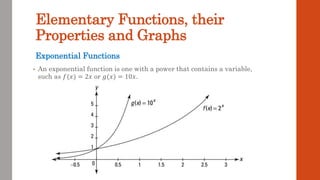
• An exponential function is one with a power that contains a variable,
such as 𝑓(𝑥) = 2𝑥 or 𝑔(𝑥) = 10𝑥.
Exponential Functions
Elementary Functions, their
Properties and Graphs
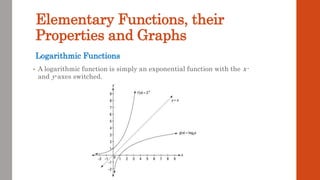
• A logarithmic function is simply an exponential function with the x-
and y-axes switched.
Logarithmic Functions
The Simplest Transformation of the
Function Graphs
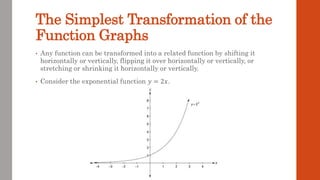
• Any function can be transformed into a related function by shifting it
horizontally or vertically, flipping it over horizontally or vertically, or
stretching or shrinking it horizontally or vertically.
• Consider the exponential function 𝑦 = 2𝑥.
The Simplest Transformation of the
Function Graphs
Horizontal Transformation
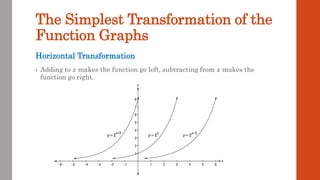
• Adding to 𝑥 makes the function go left, subtracting from 𝑥 makes the
function go right.
The Simplest Transformation of the
Function Graphs
Horizontal Transformation
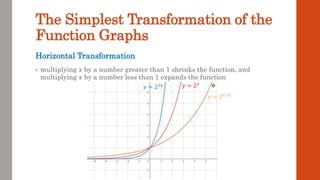
• multiplying 𝑥 by a number greater than 1 shrinks the function, and
multiplying 𝑥 by a number less than 1 expands the function
𝑦 = 2𝑥
𝑦 = 22𝑥
𝑦 = 20.5𝑥
The Simplest Transformation of the
Function Graphs
Horizontal Transformation
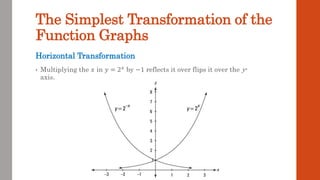
• Multiplying the 𝑥 in 𝑦 = 2𝑥 by −1 reflects it over flips it over the y-
axis.
The Simplest Transformation of the
Function Graphs
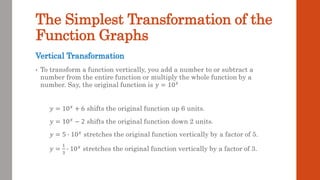
Vertical Transformation
• To transform a function vertically, you add a number to or subtract a
number from the entire function or multiply the whole function by a
number. Say, the original function is 𝑦 = 10𝑥
𝑦 = 10𝑥
+ 6 shifts the original function up 6 units.
𝑦 = 10𝑥
− 2 shifts the original function down 2 units.
𝑦 = 5 ∙ 10𝑥 stretches the original function vertically by a factor of 5.
𝑦 =
1
3
∙ 10𝑥 stretches the original function vertically by a factor of 3.

01 Functions and their Graphs.pptx

  • 1.
  • 2.
    Representation of Function •A function 𝑓 is a rule of correspondence that associates with each object 𝑥 in one set, called the domain, a single value 𝑓(𝑥) from a second set. The set of all values so obtained is called the range of the function.
  • 3.
    Function Notation • Asingle letter like 𝑓 (or 𝑔 or 𝐹) is used to name a function. Then 𝑓 𝑥 read as “f of x” or “f at x,” denotes the value the 𝑓 assigns at 𝑥. • If 𝑓 𝑥 = 𝑥3 − 4, then 𝑓 2 = 23 − 4 = 4 𝑓 𝑎 = 𝑎3 − 4 𝑓 𝑎 + ℎ = 𝑎 + ℎ 3 − 4 Example 1 Solution
  • 4.
  • 5.
    Domain and Range •To specify a function completely, we must state, in addition to the rule of correspondence, the domain of the function. For example, if 𝐹 is the function defined by 𝐹 𝑥 = 𝑥2 + 1 with domain {−1, 0, 1, 2, 3}, then the range is {1, 2, 5, 10}. The rule of correspondence, together with the domain, determines the range.
  • 6.
    Graphs of Functions •When both the domain and range of a function are sets of real numbers, we can picture the function by drawing its graph on a coordinate plane. The graph of a function 𝑓 is simply the graph of the equation 𝑦 = 𝑓(𝑥). Example 2 Solution
  • 7.
    Even and OddFunctions • Even function – the graph is symmetric with respect to the y-axis. • Odd function – the graph is symmetric with respect to the origin. Even function Odd function
  • 8.
    Even and OddFunctions • A function 𝑓 is an even function if 𝑓 −𝑥 = 𝑓(𝑥) • A function 𝑓 is an odd function if 𝑓 −𝑥 = −𝑓(𝑥) Example 3 Solution 𝑓 is an odd function. The graph of 𝑦 = 𝑓(𝑥) is symmetric with respect to the origin.
  • 9.
    Operations on Functions •Just as two numbers 𝑎 and 𝑏 can be added to produce a new number, so two functions 𝑓 and 𝑔 can be added to produce a new function 𝑓 + 𝑔. Sum, Differences, Products, Quotients, and Powers Consider functions 𝑓 and 𝑔 with formulas 𝑓 𝑥 = 𝑥 − 3 2 𝑔 𝑥 = 𝑥
  • 10.
    Operations on Functions •We have to be careful about domains • We had to exclude 0 from the domain of 𝑓 𝑔 to avoid division of 0.
  • 11.
    Composition of Functions •Two machines may often be put together in tandem to make a more complicated machine.
  • 12.
    Composition of Function •If 𝑓 works on 𝑥 to produce 𝑓(𝑥) and 𝑔 then works on 𝑓(𝑥) to produce 𝑔(𝑓(𝑥)), we say that we have composed g with 𝑓. The resulting function, called the composition of 𝑔 with 𝑓, is denoted by 𝑔 ∘ 𝑓 Thus,
  • 13.
    Composition of Function Example4 Solution [0,3) ∪ (3, ∞) Domain
  • 14.
    Inverse of aFunction • The function 𝑓(𝑥) = 𝑥2 (for 𝑥 ≥ 0) and the function 𝑓−1(𝑥) = 𝑥 (read as “𝑓 inverse of 𝑥”) are inverse functions because each undoes what the other does. • 𝑓 𝑥 and 𝑓−1(𝑥) are inverse functions if and only if 𝑓−1 𝑓(𝑥) = 𝑥 and 𝑓 𝑓−1 𝑥 = 𝑥.
  • 15.
    Finding the Inverseof a Function Algebraically Find the inverse of the following function algebraically. 1. 𝑓 𝑥 = 4 − 4𝑥 2. 𝑓 𝑥 = 𝑥2 − 4𝑥 Example 5 Solution 1. 𝑓 𝑥 = 4 − 4𝑥 First replace 𝑓(𝑥) with 𝑦: 𝑓 𝑥 = 4 − 5𝑥 𝑦 = 4 − 5𝑥 Then replace 𝑦 with 𝑥 and each 𝑥 with 𝑦. After making some replacements, solve for 𝑦 to find the inverse: 𝑥 = 4 − 5𝑦 5𝑦 = 4 − 𝑥 𝑦 = 4 − 𝑥 5 Therefore, the inverse of 𝑓 𝑥 = 4 − 5𝑥 is 𝑓−1 𝑥 = 4−𝑥 5
  • 16.
    Elementary Functions, their Propertiesand Graphs • A line is the simplest function you can graph on a coordinate plane. Linear Function The graph of the line 𝑦 = 3𝑥 + 5.
  • 17.
    Elementary Functions, their Propertiesand Graphs • Notice that both functions are symmetric with respect to the y-axis. Parabolic and Absolute Value Functions Parabolic Absolute Value
  • 18.
    Elementary Functions, their Propertiesand Graphs • Odd functions are symmetric with respect to the origin which means that if you were to rotate them 180° about the origin, they would land on themselves Cubic and Cube Root Functions Cubic Cube Root 𝑦 = 𝑥3 𝑦 = 3 𝑥
  • 19.
    Elementary Functions, their Propertiesand Graphs • An exponential function is one with a power that contains a variable, such as 𝑓(𝑥) = 2𝑥 or 𝑔(𝑥) = 10𝑥. Exponential Functions
  • 20.
    Elementary Functions, their Propertiesand Graphs • A logarithmic function is simply an exponential function with the x- and y-axes switched. Logarithmic Functions
  • 21.
    The Simplest Transformationof the Function Graphs • Any function can be transformed into a related function by shifting it horizontally or vertically, flipping it over horizontally or vertically, or stretching or shrinking it horizontally or vertically. • Consider the exponential function 𝑦 = 2𝑥.
  • 22.
    The Simplest Transformationof the Function Graphs Horizontal Transformation • Adding to 𝑥 makes the function go left, subtracting from 𝑥 makes the function go right.
  • 23.
    The Simplest Transformationof the Function Graphs Horizontal Transformation • multiplying 𝑥 by a number greater than 1 shrinks the function, and multiplying 𝑥 by a number less than 1 expands the function 𝑦 = 2𝑥 𝑦 = 22𝑥 𝑦 = 20.5𝑥
  • 24.
    The Simplest Transformationof the Function Graphs Horizontal Transformation • Multiplying the 𝑥 in 𝑦 = 2𝑥 by −1 reflects it over flips it over the y- axis.
  • 25.
    The Simplest Transformationof the Function Graphs Vertical Transformation • To transform a function vertically, you add a number to or subtract a number from the entire function or multiply the whole function by a number. Say, the original function is 𝑦 = 10𝑥 𝑦 = 10𝑥 + 6 shifts the original function up 6 units. 𝑦 = 10𝑥 − 2 shifts the original function down 2 units. 𝑦 = 5 ∙ 10𝑥 stretches the original function vertically by a factor of 5. 𝑦 = 1 3 ∙ 10𝑥 stretches the original function vertically by a factor of 3.

Editor's Notes

  • #17 You’re going to see hundreds of functions in your study of calculus, so it wouldn’t be a bad idea to familiarize yourself with the basic ones in this section: the line, the parabola, the absolute value function, the cubing and cube root functions, and the exponential and logarithmic functions. Lines are important in calculus because you often study lines that are tangent to curves and because when you zoom in far enough on a curve, it looks and behaves like a line.
  • #18 In other words, the left and right sides of each graph are mirror images of each other. This makes them even functions.
  • #19 In other words, the left and right sides of each graph are mirror images of each other. This makes them even functions.
  • #20 In other words, the left and right sides of each graph are mirror images of each other. This makes them even functions.
  • #21 In other words, the left and right sides of each graph are mirror images of each other. This makes them even functions.