Chapter 3: Transformations of Graphs and Data 
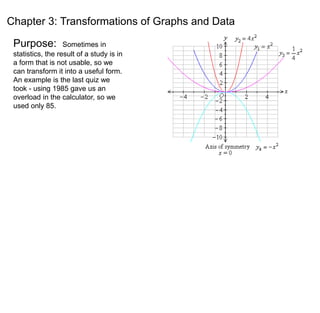
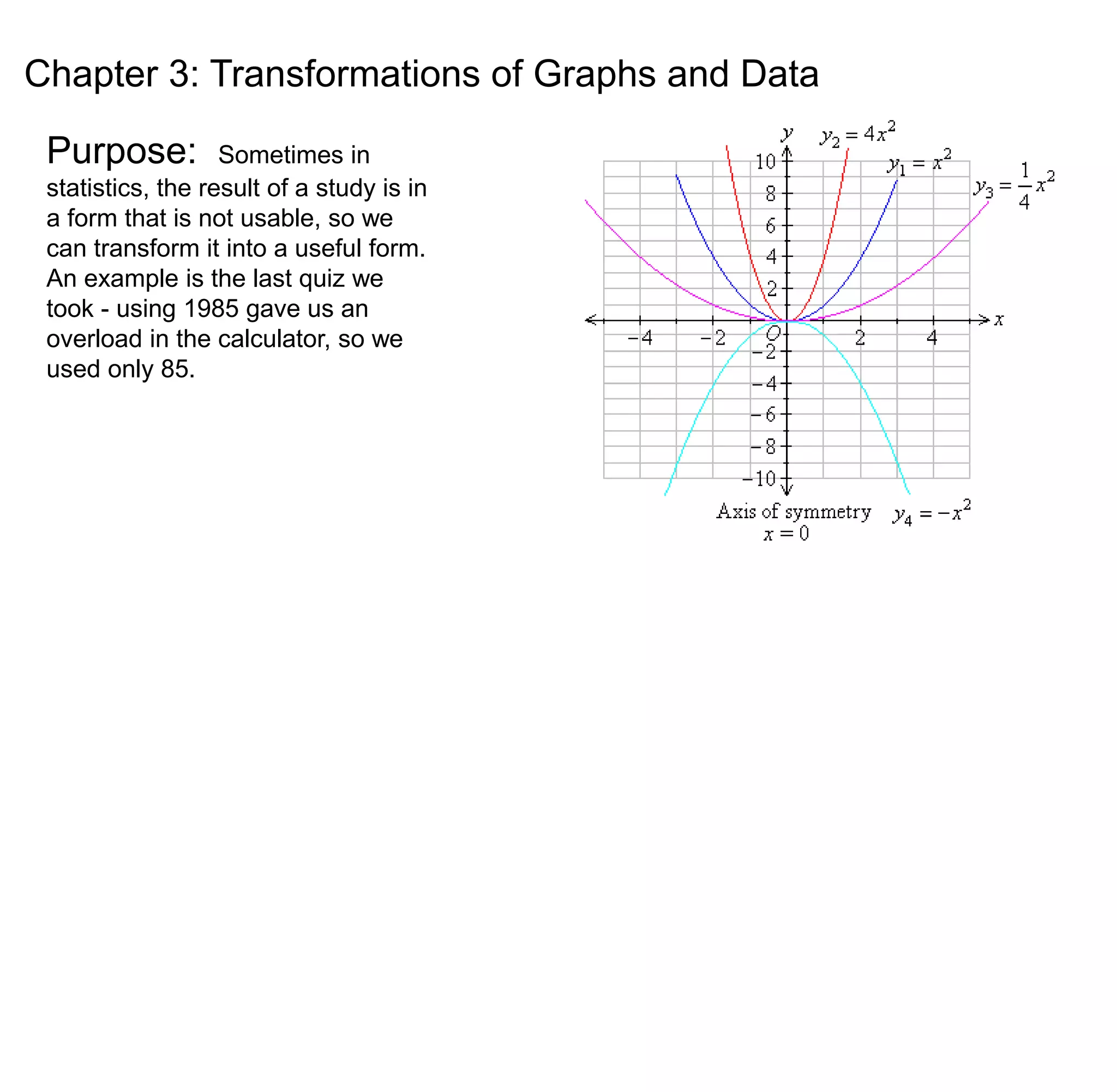
Purpose: Sometimes in 
statistics, the result of a study is in 
a form that is not usable, so we 
can transform it into a useful form. 
An example is the last quiz we 
took - using 1985 gave us an 
overload in the calculator, so we 
used only 85.
3.1 I can adjust the window to view critical points on 
graphs
Definitions: 
Transformation: a one-to-one correspondence between sets of points. 
Types of transformations: 
Translation: Shift left/right/up/down 
Scale change: Dilations in regards to the x or y axis.
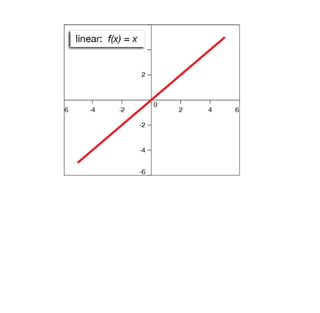
Parent Functions: non-transformed functions.
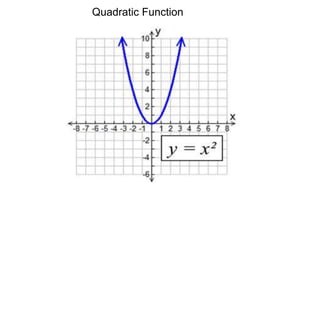
Quadratic Function
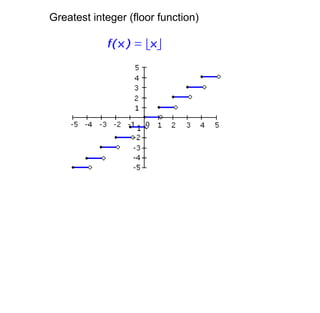
Greatest integer (floor function)
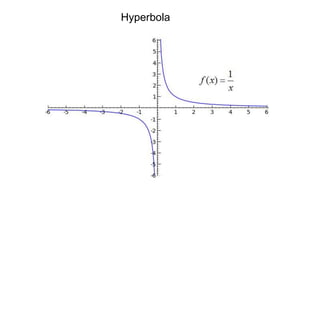
Hyperbola
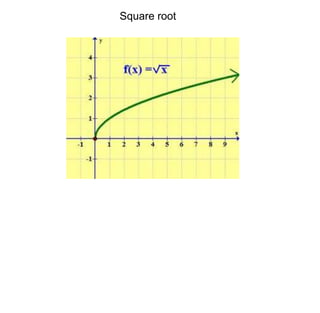
Square root
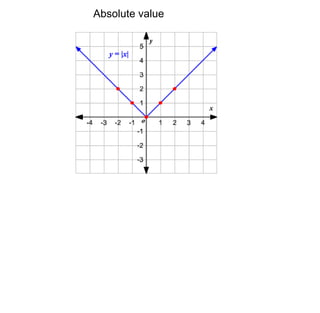
Absolute value
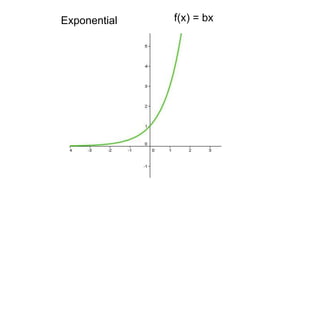
Exponential f(x) = bx
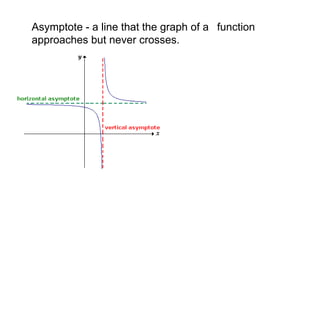
Asymptote - a line that the graph of a function 
approaches but never crosses.
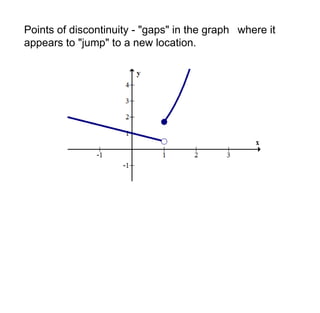
Points of discontinuity - "gaps" in the graph where it 
appears to "jump" to a new location.
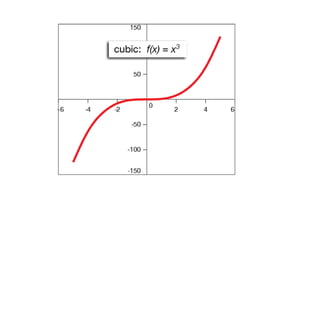
Parent functions you are expected to know are on p. 162 
Examples: 
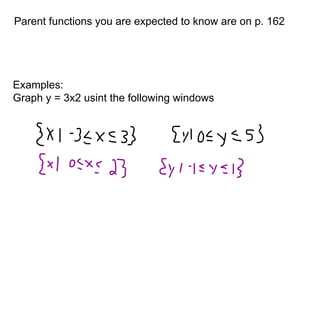
Graph y = 3x2 usint the following windows
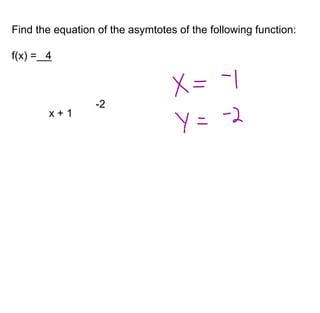
Find the equation of the asymtotes of the following function: 
f(x) = 4 
x + 1 
-2
3.2 I can translate functions along the x and y 
axis.
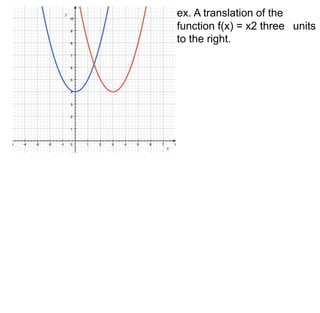
ex. A translation of the 
function f(x) = x2 three units 
to the right.
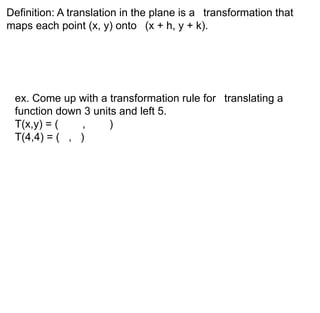
Definition: A translation in the plane is a transformation that 
maps each point (x, y) onto (x + h, y + k). 
ex. Come up with a transformation rule for translating a 
function down 3 units and left 5. 
T(x,y) = ( , ) 
T(4,4) = ( , )
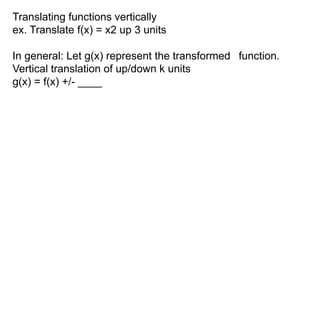
Translating functions vertically 
ex. Translate f(x) = x2 up 3 units 
In general: Let g(x) represent the transformed function. 
Vertical translation of up/down k units 
g(x) = f(x) +/- ____
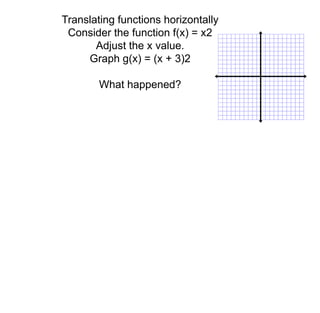
Translating functions horizontally 
Consider the function f(x) = x2 
Adjust the x value. 
Graph g(x) = (x + 3)2 
What happened?
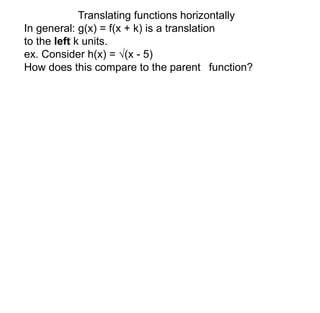
Translating functions horizontally 
In general: g(x) = f(x + k) is a translation 
to the left k units. 
ex. Consider h(x) = √(x - 5) 
How does this compare to the parent function?
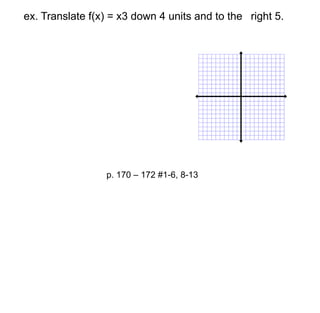
ex. Translate f(x) = x3 down 4 units and to the right 5. 
p. 170 – 172 #1-6, 8-13
3.3 I can understand and apply symmetries of graphs to functions 
There are 2 types of symmetry that we will discuss: 
reflective and rotational 
Any type of symmetry implies that one part of a graph is congruent to another 
- that makes it easier to draw.
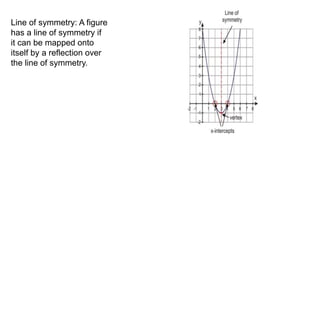
Line of symmetry: A figure 
has a line of symmetry if 
it can be mapped onto 
itself by a reflection over 
the line of symmetry.
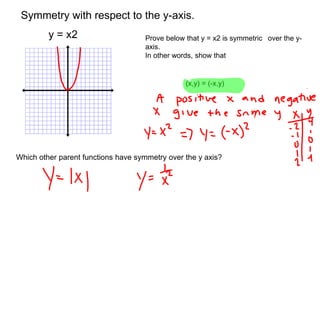
Symmetry with respect to the y-axis. 
y = x2 Prove below that y = x2 is symmetric over the y-axis. 
In other words, show that 
(x,y) = (-x,y) 
Which other parent functions have symmetry over the y axis?
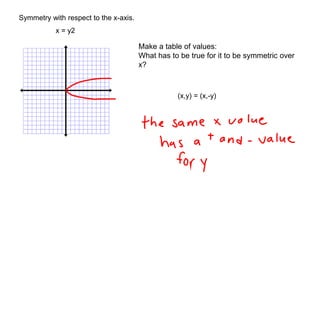
Symmetry with respect to the x-axis. 
x = y2 
Make a table of values: 
What has to be true for it to be symmetric over 
x? 
(x,y) = (x,-y)
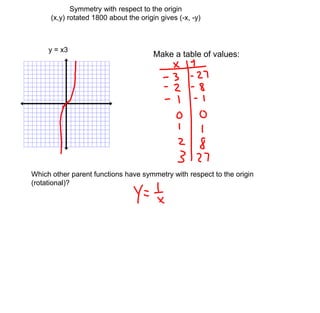
Symmetry with respect to the origin 
(x,y) rotated 1800 about the origin gives (-x, -y) 
y = x3 
Make a table of values: 
Which other parent functions have symmetry with respect to the origin 
(rotational)?
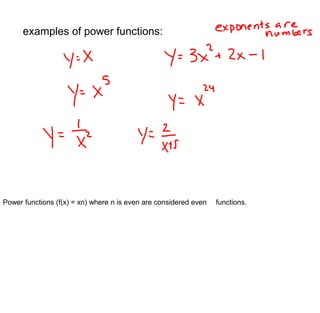
examples of power functions: 
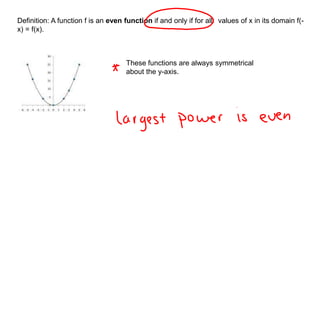
Power functions (f(x) = xn) where n is even are considered even functions.
Definition: A function f is an even function if and only if for all values of x in its domain f(- 
x) = f(x). 
These functions are always symmetrical 
about the y-axis.
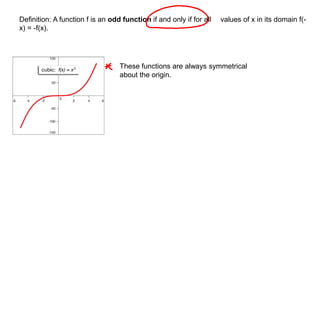
Definition: A function f is an odd function if and only if for all values of x in its domain f(- 
x) = -f(x). 
These functions are always symmetrical 
about the origin.
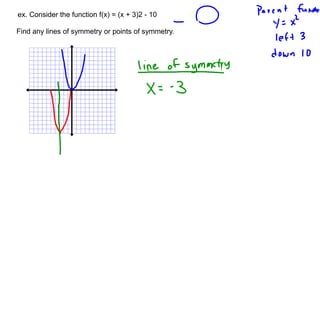
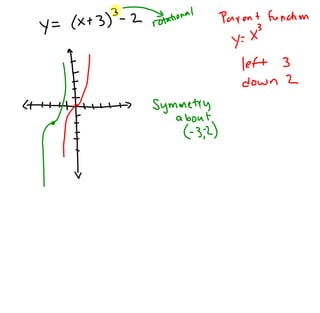
ex. Consider the function f(x) = (x + 3)2 - 10 
Find any lines of symmetry or points of symmetry.
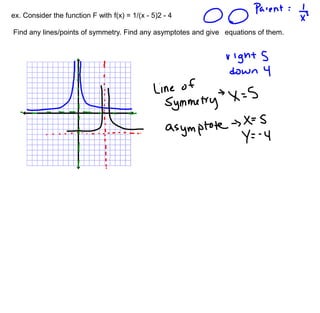
ex. Consider the function F with f(x) = 1/(x - 5)2 - 4 
Find any lines/points of symmetry. Find any asymptotes and give equations of them.
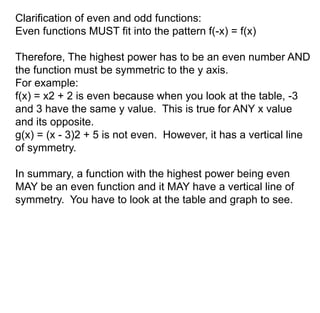
Clarification of even and odd functions: 
Even functions MUST fit into the pattern f(-x) = f(x) 
Therefore, The highest power has to be an even number AND 
the function must be symmetric to the y axis. 
For example: 
f(x) = x2 + 2 is even because when you look at the table, -3 
and 3 have the same y value. This is true for ANY x value 
and its opposite. 
g(x) = (x - 3)2 + 5 is not even. However, it has a vertical line 
of symmetry. 
In summary, a function with the highest power being even 
MAY be an even function and it MAY have a vertical line of 
symmetry. You have to look at the table and graph to see.
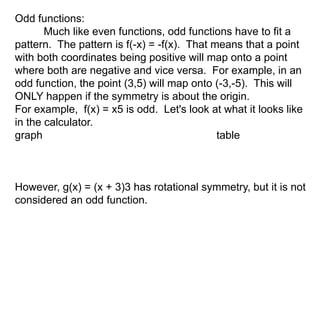
Odd functions: 
Much like even functions, odd functions have to fit a 
pattern. The pattern is f(-x) = -f(x). That means that a point 
with both coordinates being positive will map onto a point 
where both are negative and vice versa. For example, in an 
odd function, the point (3,5) will map onto (-3,-5). This will 
ONLY happen if the symmetry is about the origin. 
For example, f(x) = x5 is odd. Let's look at what it looks like 
in the calculator. 
graph table 
However, g(x) = (x + 3)3 has rotational symmetry, but it is not 
considered an odd function.
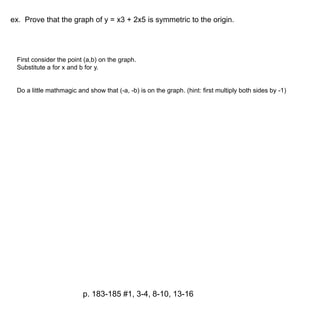
ex. Prove that the graph of y = x3 + 2x5 is symmetric to the origin. 
First consider the point (a,b) on the graph. 
Substitute a for x and b for y. 
Do a little mathmagic and show that (-a, -b) is on the graph. (hint: first multiply both sides by -1) 
p. 183-185 #1, 3-4, 8-10, 13-16
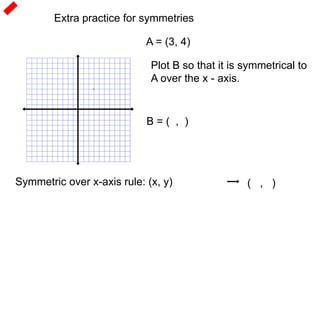
Extra practice for symmetries 
A = (3, 4) 
Plot B so that it is symmetrical to 
A over the x - axis. 
B = ( , ) 
Symmetric over x-axis rule: (x, y) ( , )
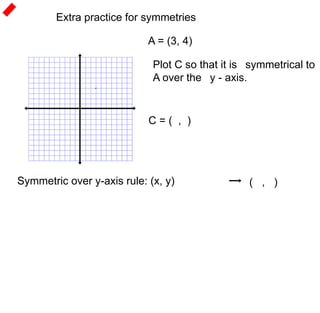
Extra practice for symmetries 
A = (3, 4) 
Plot C so that it is symmetrical to 
A over the y - axis. 
C = ( , ) 
Symmetric over y-axis rule: (x, y) ( , )
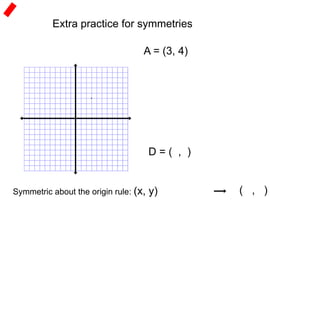
Extra practice for symmetries 
A = (3, 4) 
D = ( , ) 
Symmetric about the origin rule: (x, y) ( , )
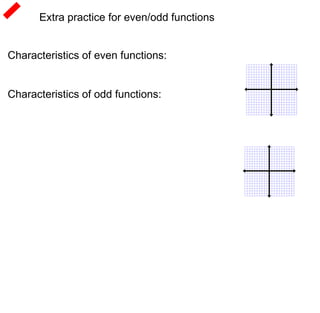
Extra practice for even/odd functions 
Characteristics of even functions: 
Characteristics of odd functions:
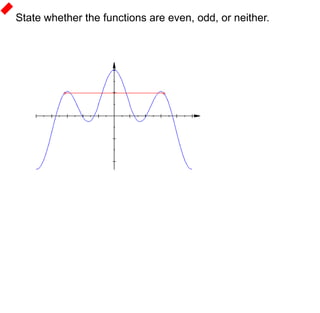
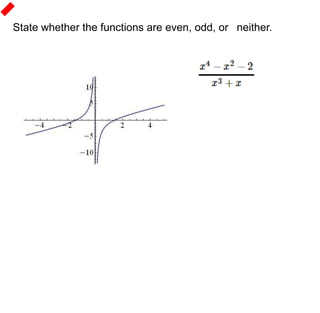
State whether the functions are even, odd, or neither.
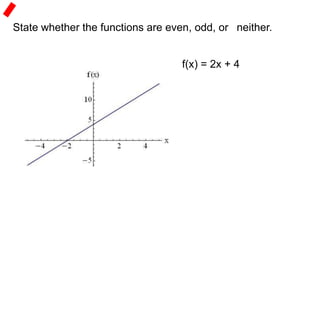
State whether the functions are even, odd, or neither. 
f(x) = 2x + 4
3.4 I can dilate functions along the x and y axis. 
p. 186 in class activity
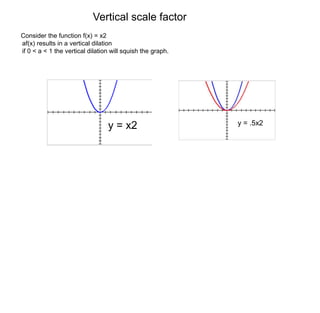
Vertical scale factor 
Consider the function f(x) = x2 
af(x) results in a vertical dilation 
if 0 < a < 1 the vertical dilation will squish the graph. 
y = x2 y = .5x2
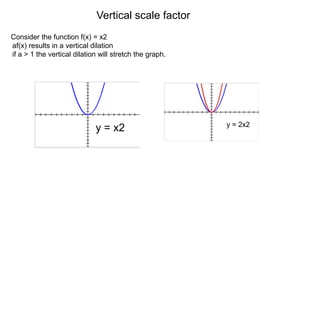
Vertical scale factor 
Consider the function f(x) = x2 
af(x) results in a vertical dilation 
if a > 1 the vertical dilation will stretch the graph. 
y = x2 y = 2x2
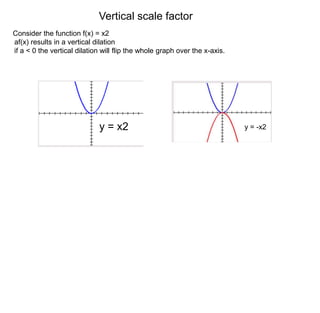
Vertical scale factor 
Consider the function f(x) = x2 
af(x) results in a vertical dilation 
if a < 0 the vertical dilation will flip the whole graph over the x-axis. 
y = x2 y = -x2
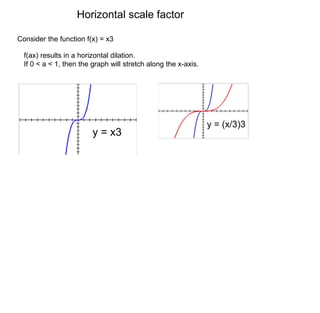
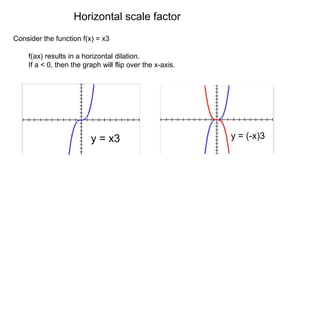
Horizontal scale factor 
Consider the function f(x) = x3 
f(ax) results in a horizontal dilation. 
If 0 < a < 1, then the graph will stretch along the x-axis. 
y = x3 
y = (x/3)3
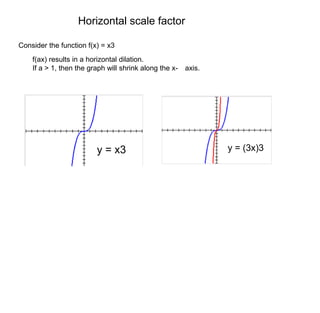
Horizontal scale factor 
Consider the function f(x) = x3 
f(ax) results in a horizontal dilation. 
If a > 1, then the graph will shrink along the x- axis. 
y = x3 
y = (3x)3
Horizontal scale factor 
Consider the function f(x) = x3 
f(ax) results in a horizontal dilation. 
If a < 0, then the graph will flip over the x-axis. 
y = x3 
y = (-x)3
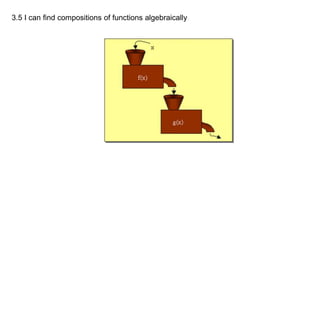
3.5 I can find compositions of functions algebraically
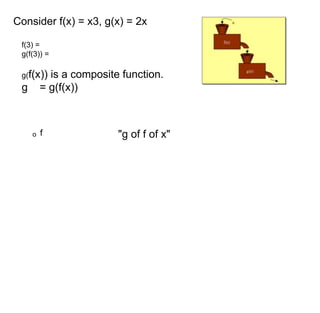
Consider f(x) = x3, g(x) = 2x 
f(3) = 
g(f(3)) = 
g(f(x)) is a composite function. 
g = g(f(x)) 
o f "g of f of x"
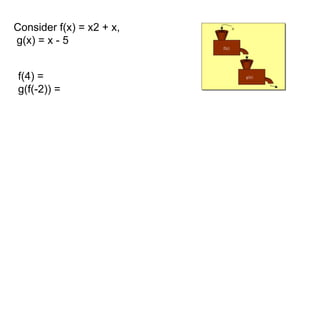
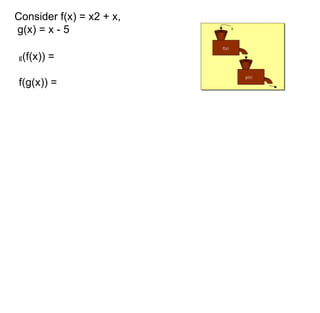
Consider f(x) = x2 + x, 
g(x) = x - 5 
f(4) = 
g(f(-2)) =
Consider f(x) = x2 + x, 
g(x) = x - 5 
g(f(x)) = 
f(g(x)) =
Does g(f(x)) = f(g(x))? 
Using the functions in the previous example, find f(g(2)) and g(f(2)) 
p. 205-207 #5, 8, 9a, 10-12
3.6 I can find inverse functions algebraically
Inverse of a function: Switching the coordinates in the set 
of ordered pairs defined by a function.
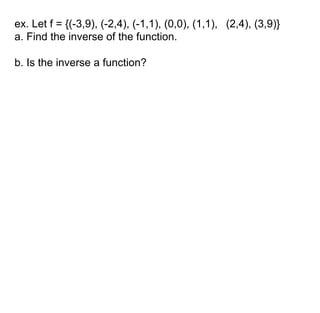
ex. Let f = {(-3,9), (-2,4), (-1,1), (0,0), (1,1), (2,4), (3,9)} 
a. Find the inverse of the function. 
b. Is the inverse a function?
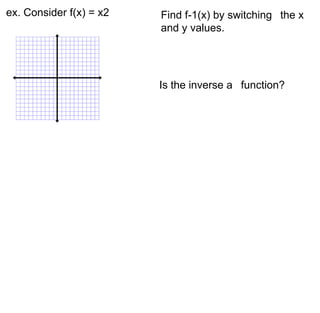
ex. Consider f(x) = x2 Find f-1(x) by switching the x 
and y values. 
Is the inverse a function?
Notice: Taking the inverse of a function reflects 
it over the y=x line.
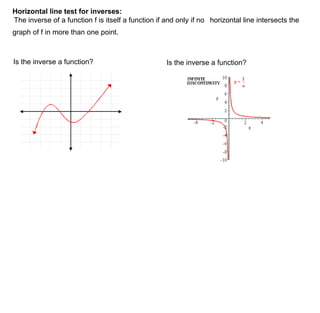
Horizontal line test for inverses: 
The inverse of a function f is itself a function if and only if no horizontal line intersects the 
graph of f in more than one point. 
Is the inverse a function? Is the inverse a function?
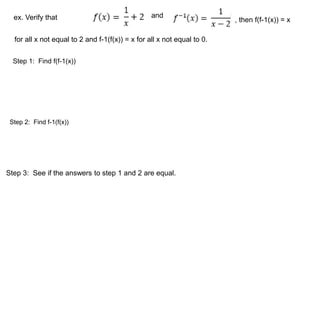
ex. Verify that and 
, then f(f-1(x)) = x 
for all x not equal to 2 and f-1(f(x)) = x for all x not equal to 0. 
Step 1: Find f(f-1(x)) 
Step 2: Find f-1(f(x)) 
Step 3: See if the answers to step 1 and 2 are equal.
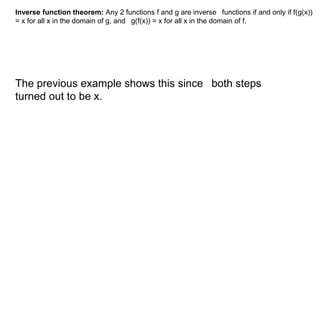
Inverse function theorem: Any 2 functions f and g are inverse functions if and only if f(g(x)) 
= x for all x in the domain of g, and g(f(x)) = x for all x in the domain of f. 
The previous example shows this since both steps 
turned out to be x.
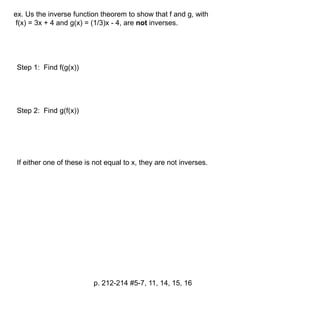
ex. Us the inverse function theorem to show that f and g, with 
f(x) = 3x + 4 and g(x) = (1/3)x - 4, are not inverses. 
p. 212-214 #5-7, 11, 14, 15, 16 
Step 1: Find f(g(x)) 
Step 2: Find g(f(x)) 
If either one of these is not equal to x, they are not inverses.
Ch  3 lessons

Ch 3 lessons

  • 1.
    Chapter 3: Transformationsof Graphs and Data Purpose: Sometimes in statistics, the result of a study is in a form that is not usable, so we can transform it into a useful form. An example is the last quiz we took - using 1985 gave us an overload in the calculator, so we used only 85.
  • 2.
    3.1 I canadjust the window to view critical points on graphs
  • 3.
    Definitions: Transformation: aone-to-one correspondence between sets of points. Types of transformations: Translation: Shift left/right/up/down Scale change: Dilations in regards to the x or y axis.
  • 4.
  • 6.
  • 8.
  • 9.
  • 10.
  • 11.
  • 12.
  • 13.
    Asymptote - aline that the graph of a function approaches but never crosses.
  • 14.
    Points of discontinuity- "gaps" in the graph where it appears to "jump" to a new location.
  • 15.
    Parent functions youare expected to know are on p. 162 Examples: Graph y = 3x2 usint the following windows
  • 16.
    Find the equationof the asymtotes of the following function: f(x) = 4 x + 1 -2
  • 17.
    3.2 I cantranslate functions along the x and y axis.
  • 18.
    ex. A translationof the function f(x) = x2 three units to the right.
  • 19.
    Definition: A translationin the plane is a transformation that maps each point (x, y) onto (x + h, y + k). ex. Come up with a transformation rule for translating a function down 3 units and left 5. T(x,y) = ( , ) T(4,4) = ( , )
  • 20.
    Translating functions vertically ex. Translate f(x) = x2 up 3 units In general: Let g(x) represent the transformed function. Vertical translation of up/down k units g(x) = f(x) +/- ____
  • 21.
    Translating functions horizontally Consider the function f(x) = x2 Adjust the x value. Graph g(x) = (x + 3)2 What happened?
  • 22.
    Translating functions horizontally In general: g(x) = f(x + k) is a translation to the left k units. ex. Consider h(x) = √(x - 5) How does this compare to the parent function?
  • 23.
    ex. Translate f(x)= x3 down 4 units and to the right 5. p. 170 – 172 #1-6, 8-13
  • 24.
    3.3 I canunderstand and apply symmetries of graphs to functions There are 2 types of symmetry that we will discuss: reflective and rotational Any type of symmetry implies that one part of a graph is congruent to another - that makes it easier to draw.
  • 25.
    Line of symmetry:A figure has a line of symmetry if it can be mapped onto itself by a reflection over the line of symmetry.
  • 26.
    Symmetry with respectto the y-axis. y = x2 Prove below that y = x2 is symmetric over the y-axis. In other words, show that (x,y) = (-x,y) Which other parent functions have symmetry over the y axis?
  • 27.
    Symmetry with respectto the x-axis. x = y2 Make a table of values: What has to be true for it to be symmetric over x? (x,y) = (x,-y)
  • 28.
    Symmetry with respectto the origin (x,y) rotated 1800 about the origin gives (-x, -y) y = x3 Make a table of values: Which other parent functions have symmetry with respect to the origin (rotational)?
  • 29.
    examples of powerfunctions: Power functions (f(x) = xn) where n is even are considered even functions.
  • 30.
    Definition: A functionf is an even function if and only if for all values of x in its domain f(- x) = f(x). These functions are always symmetrical about the y-axis.
  • 31.
    Definition: A functionf is an odd function if and only if for all values of x in its domain f(- x) = -f(x). These functions are always symmetrical about the origin.
  • 32.
    ex. Consider thefunction f(x) = (x + 3)2 - 10 Find any lines of symmetry or points of symmetry.
  • 33.
    ex. Consider thefunction F with f(x) = 1/(x - 5)2 - 4 Find any lines/points of symmetry. Find any asymptotes and give equations of them.
  • 35.
    Clarification of evenand odd functions: Even functions MUST fit into the pattern f(-x) = f(x) Therefore, The highest power has to be an even number AND the function must be symmetric to the y axis. For example: f(x) = x2 + 2 is even because when you look at the table, -3 and 3 have the same y value. This is true for ANY x value and its opposite. g(x) = (x - 3)2 + 5 is not even. However, it has a vertical line of symmetry. In summary, a function with the highest power being even MAY be an even function and it MAY have a vertical line of symmetry. You have to look at the table and graph to see.
  • 36.
    Odd functions: Muchlike even functions, odd functions have to fit a pattern. The pattern is f(-x) = -f(x). That means that a point with both coordinates being positive will map onto a point where both are negative and vice versa. For example, in an odd function, the point (3,5) will map onto (-3,-5). This will ONLY happen if the symmetry is about the origin. For example, f(x) = x5 is odd. Let's look at what it looks like in the calculator. graph table However, g(x) = (x + 3)3 has rotational symmetry, but it is not considered an odd function.
  • 37.
    ex. Prove thatthe graph of y = x3 + 2x5 is symmetric to the origin. First consider the point (a,b) on the graph. Substitute a for x and b for y. Do a little mathmagic and show that (-a, -b) is on the graph. (hint: first multiply both sides by -1) p. 183-185 #1, 3-4, 8-10, 13-16
  • 38.
    Extra practice forsymmetries A = (3, 4) Plot B so that it is symmetrical to A over the x - axis. B = ( , ) Symmetric over x-axis rule: (x, y) ( , )
  • 39.
    Extra practice forsymmetries A = (3, 4) Plot C so that it is symmetrical to A over the y - axis. C = ( , ) Symmetric over y-axis rule: (x, y) ( , )
  • 40.
    Extra practice forsymmetries A = (3, 4) D = ( , ) Symmetric about the origin rule: (x, y) ( , )
  • 41.
    Extra practice foreven/odd functions Characteristics of even functions: Characteristics of odd functions:
  • 42.
    State whether thefunctions are even, odd, or neither.
  • 43.
    State whether thefunctions are even, odd, or neither.
  • 44.
    State whether thefunctions are even, odd, or neither. f(x) = 2x + 4
  • 45.
    3.4 I candilate functions along the x and y axis. p. 186 in class activity
  • 46.
    Vertical scale factor Consider the function f(x) = x2 af(x) results in a vertical dilation if 0 < a < 1 the vertical dilation will squish the graph. y = x2 y = .5x2
  • 47.
    Vertical scale factor Consider the function f(x) = x2 af(x) results in a vertical dilation if a > 1 the vertical dilation will stretch the graph. y = x2 y = 2x2
  • 48.
    Vertical scale factor Consider the function f(x) = x2 af(x) results in a vertical dilation if a < 0 the vertical dilation will flip the whole graph over the x-axis. y = x2 y = -x2
  • 49.
    Horizontal scale factor Consider the function f(x) = x3 f(ax) results in a horizontal dilation. If 0 < a < 1, then the graph will stretch along the x-axis. y = x3 y = (x/3)3
  • 50.
    Horizontal scale factor Consider the function f(x) = x3 f(ax) results in a horizontal dilation. If a > 1, then the graph will shrink along the x- axis. y = x3 y = (3x)3
  • 51.
    Horizontal scale factor Consider the function f(x) = x3 f(ax) results in a horizontal dilation. If a < 0, then the graph will flip over the x-axis. y = x3 y = (-x)3
  • 52.
    3.5 I canfind compositions of functions algebraically
  • 53.
    Consider f(x) =x3, g(x) = 2x f(3) = g(f(3)) = g(f(x)) is a composite function. g = g(f(x)) o f "g of f of x"
  • 54.
    Consider f(x) =x2 + x, g(x) = x - 5 f(4) = g(f(-2)) =
  • 55.
    Consider f(x) =x2 + x, g(x) = x - 5 g(f(x)) = f(g(x)) =
  • 56.
    Does g(f(x)) =f(g(x))? Using the functions in the previous example, find f(g(2)) and g(f(2)) p. 205-207 #5, 8, 9a, 10-12
  • 57.
    3.6 I canfind inverse functions algebraically
  • 58.
    Inverse of afunction: Switching the coordinates in the set of ordered pairs defined by a function.
  • 59.
    ex. Let f= {(-3,9), (-2,4), (-1,1), (0,0), (1,1), (2,4), (3,9)} a. Find the inverse of the function. b. Is the inverse a function?
  • 60.
    ex. Consider f(x)= x2 Find f-1(x) by switching the x and y values. Is the inverse a function?
  • 61.
    Notice: Taking theinverse of a function reflects it over the y=x line.
  • 62.
    Horizontal line testfor inverses: The inverse of a function f is itself a function if and only if no horizontal line intersects the graph of f in more than one point. Is the inverse a function? Is the inverse a function?
  • 63.
    ex. Verify thatand , then f(f-1(x)) = x for all x not equal to 2 and f-1(f(x)) = x for all x not equal to 0. Step 1: Find f(f-1(x)) Step 2: Find f-1(f(x)) Step 3: See if the answers to step 1 and 2 are equal.
  • 64.
    Inverse function theorem:Any 2 functions f and g are inverse functions if and only if f(g(x)) = x for all x in the domain of g, and g(f(x)) = x for all x in the domain of f. The previous example shows this since both steps turned out to be x.
  • 65.
    ex. Us theinverse function theorem to show that f and g, with f(x) = 3x + 4 and g(x) = (1/3)x - 4, are not inverses. p. 212-214 #5-7, 11, 14, 15, 16 Step 1: Find f(g(x)) Step 2: Find g(f(x)) If either one of these is not equal to x, they are not inverses.