General Mathematics
Quarter 1 – Module 2:
Evaluating Functions
After going through this
module, you are expected to:
1. recall the process of substitution;
2. identify the various types of
functions; and
3. evaluate functions.
Means replacing the
variable in the
function, in his case x,
with a value from the
function’s domain and
computing for the result.
To denote that we are
evaluating f at a for
Evaluating
Functions
1. Replace each letter
in the expression with
the assigned value.
2. Perform the operations
in the expression using
the correct order of
operations.
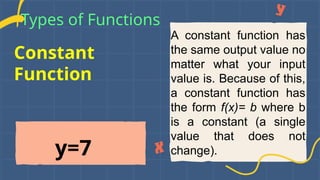
A constant function has
the same output value no
matter what your input
value is. Because of this,
a constant function has
the form f(x)= b where b
is a constant (a single
value that does not
change).
Constant
Function
Types of Functions
y=7
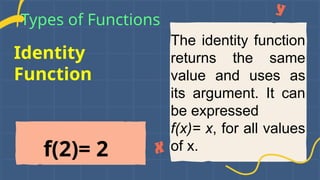
The identity function
returns the same
value and uses as
its argument. It can
be expressed
f(x)= x, for all values
of x.
Identity
Function
Types of Functions
f(2)= 2
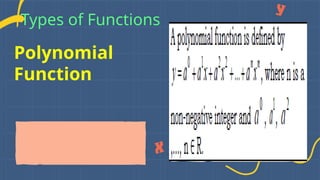
Polynomial
Function
Types of Functions
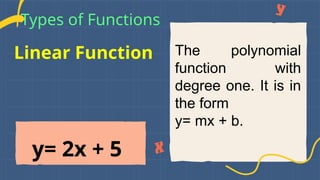
Linear Function
Types of Functions
y= 2x + 5
The polynomial
function with
degree one. It is in
the form
y= mx + b.
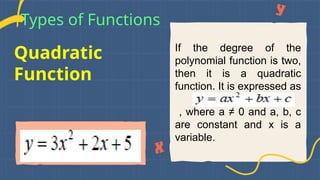
Quadratic
Function
Types of Functions
If the degree of the
polynomial function is two,
then it is a quadratic
function. It is expressed as
, where a ≠ 0 and a, b, c
are constant and x is a
variable.
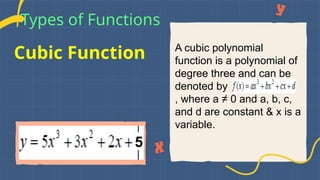
Cubic Function
Types of Functions
A cubic polynomial
function is a polynomial of
degree three and can be
denoted by
, where a ≠ 0 and a, b, c,
and d are constant & x is a
variable.
5
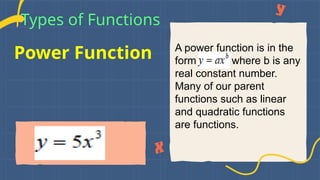
Power Function
Types of Functions
A power function is in the
form where b is any
real constant number.
Many of our parent
functions such as linear
and quadratic functions
are functions.
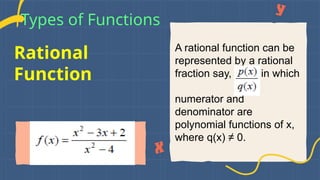
Rational
Function
Types of Functions
A rational function can be
represented by a rational
fraction say, in which
numerator and
denominator are
polynomial functions of x,
where q(x) ≠ 0.
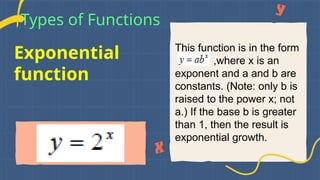
Exponential
function
Types of Functions
This function is in the form
,where x is an
exponent and a and b are
constants. (Note: only b is
raised to the power x; not
a.) If the base b is greater
than 1, then the result is
exponential growth.
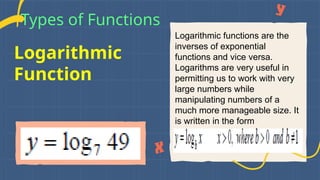
Logarithmic
Function
Types of Functions
Logarithmic functions are the
inverses of exponential
functions and vice versa.
Logarithms are very useful in
permitting us to work with very
large numbers while
manipulating numbers of a
much more manageable size. It
is written in the form
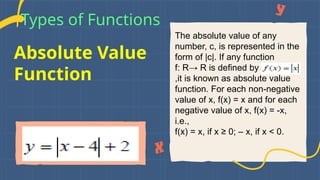
Absolute Value
Function
Types of Functions
The absolute value of any
number, c, is represented in the
form of |c|. If any function
f: R→ R is defined by
,it is known as absolute value
function. For each non-negative
value of x, f(x) = x and for each
negative value of x, f(x) = -x,
i.e.,
f(x) = x, if x ≥ 0; – x, if x < 0.
Greatest Integer
Function
Types of Functions
If a function f: R→ R is
defined by f(x) = [x], x ∈
X, round-off it to the
integer less than the
number. Suppose that the
given interval is in the
form of
(x, x+1), the value of
greatest integer function is
x which is an integer.
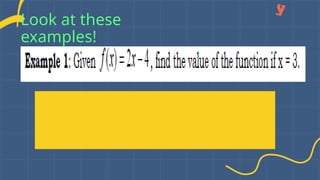
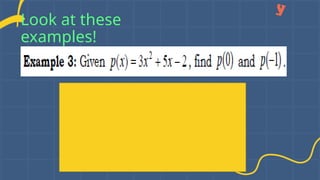
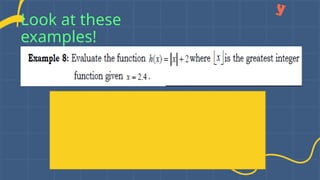
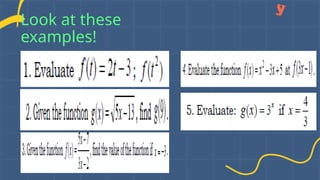
Look at these
examples!
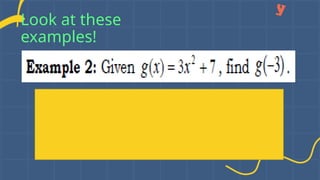
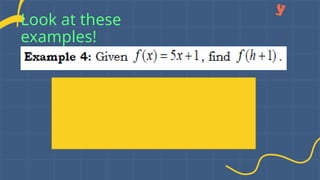
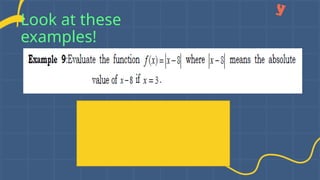
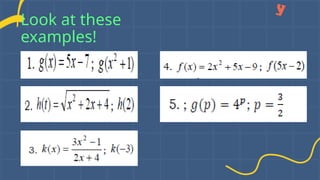
Look at these
examples!
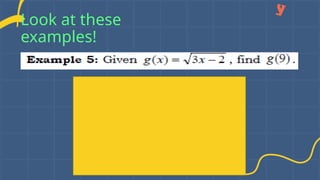
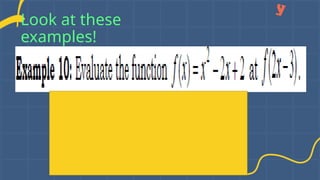
Look at these
examples!
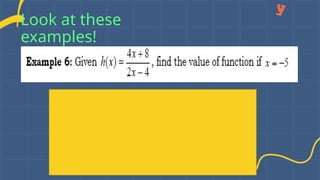
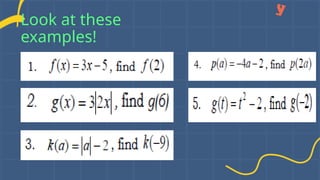
Look at these
examples!
Look at these
examples!
Look at these
examples!
Look at these
examples!
Look at these
examples!
Look at these
examples!
Look at these
examples!
Look at these
examples!
Look at these
examples!

MODULE 2 (Evaluating Functions and Word Problems).pptx