TRANSFORMATIONALTRANSFORMATIONAL
LEADERSHIP IILEADERSHIP II
BYBY
DR SATYANARAYANA DASHDR SATYANARAYANA DASH
EX-ACTG CHAIRMAN, STATEEX-ACTG CHAIRMAN, STATE
ADMINISTRATIVE TRIBUNAL,ADMINISTRATIVE TRIBUNAL,
ODISHAODISHA
TRANSFORMATIONALTRANSFORMATIONAL
LEADERSHIPLEADERSHIP
Transformational Leadership isTransformational Leadership is
the processes that transformsthe processes that transforms
individuals & Societies.individuals & Societies.
TRANSFORMATIONALTRANSFORMATIONAL
LEADERSHIPLEADERSHIP
• Leaders are truly transformational, whenLeaders are truly transformational, when
they increase awareness of what is right,they increase awareness of what is right,
good, important and beautiful, when theygood, important and beautiful, when they
help to elevate followers’ need forhelp to elevate followers’ need for
achievement and self-actualisation, whenachievement and self-actualisation, when
they foster in followers high moral maturitythey foster in followers high moral maturity
and when they move followers to goand when they move followers to go
beyond their self interest for the good ofbeyond their self interest for the good of
their group, organisation and society.their group, organisation and society.
TRANSFORMATIONALTRANSFORMATIONAL
LEADERSHIPLEADERSHIP
• Concerned with emotions, values. Ethics,Concerned with emotions, values. Ethics,
standards and long term goals andstandards and long term goals and
involves assessing followers’ motives andinvolves assessing followers’ motives and
satisfying their needssatisfying their needs
• Exceptional form of influence thatExceptional form of influence that
motivates followers to do more than ismotivates followers to do more than is
expected of themexpected of them
• Often linked to visionary & charismaticOften linked to visionary & charismatic
leadershipleadership
LEADERSHIP FORMSLEADERSHIP FORMS
* Transactional Leadership:- is the most* Transactional Leadership:- is the most
common form and involves exchangescommon form and involves exchanges
between leaders and followersbetween leaders and followers
* Transformational Leadership:- refers to a* Transformational Leadership:- refers to a
process whereby an individual engagesprocess whereby an individual engages
with others & creates a connection thatwith others & creates a connection that
raises the level of motivation & morality inraises the level of motivation & morality in
both the leader and the follower.both the leader and the follower.
JAMES MACGREGOR BURNSJAMES MACGREGOR BURNS
(1978)(1978)
Introduced the concept of “TransformingIntroduced the concept of “Transforming
Leadership”Leadership”
• Not based on give and take relationshipNot based on give and take relationship
• Depends on Leader’s traits, personality,Depends on Leader’s traits, personality,
energizing vision & challenging goalsenergizing vision & challenging goals
• Tries to change organizational cultureTries to change organizational culture
BERNARD M. BASS (1985)BERNARD M. BASS (1985)
• ““Transforming Leadership” to “TransformationalTransforming Leadership” to “Transformational
Leadership”Leadership”
• Measurement of Transformational LeadershipMeasurement of Transformational Leadership
and how it impacts follower motivation andand how it impacts follower motivation and
performanceperformance
• Followers feel trust, admiration and loyalty forFollowers feel trust, admiration and loyalty for
the leader.Willing to work more than expectationthe leader.Willing to work more than expectation
• Non-exclusivity with Transactional LeadershipNon-exclusivity with Transactional Leadership
FOUR ELEMENTS OFFOUR ELEMENTS OF
TRANSFORMATIONALTRANSFORMATIONAL
LEADERSHIPLEADERSHIP
(1)(1) Individualized ConsiderationIndividualized Consideration: Empathy,: Empathy,
support, keeping communication lines opensupport, keeping communication lines open
(2)(2) Intellectual StimulationIntellectual Stimulation: Challenges: Challenges
assumptions, encourages creativity andassumptions, encourages creativity and
nurtures independent thinkingnurtures independent thinking
(3)(3) Inspirational MotivationInspirational Motivation: Articulating Vision,: Articulating Vision,
optimism and creating strong sense of purposeoptimism and creating strong sense of purpose
(4)(4) Idealized InfluenceIdealized Influence: Role Model of Ethical: Role Model of Ethical
Behaviour. Instils pride, gain, respect and trustBehaviour. Instils pride, gain, respect and trust
APPLICATIONS OFAPPLICATIONS OF
TRANSFORMATIONALTRANSFORMATIONAL
LEADERSHIPLEADERSHIP
• Finnish Defence Forces: Deep LeadFinnish Defence Forces: Deep Lead
Model for Leadership Training &Model for Leadership Training &
DevelopmentDevelopment
• MLQ Form 5X: 45 point questionnaire forMLQ Form 5X: 45 point questionnaire for
measuring the levels of transformationalmeasuring the levels of transformational
and transactional leadership on a fiveand transactional leadership on a five
point scalepoint scale
BASS LEADERSHIP CONTINUUMBASS LEADERSHIP CONTINUUM
BASS LEADERSHIP
CONTINUUM
LAISSEZ FAIRE
LEADERSHIP
TRANSACTIONAL
LEADERSHIP
TRANSFORMATIONAL
LEADERSHIP
LEADERSHIP FACTORSLEADERSHIP FACTORS
• LAISSEZ FAIRE LEADERSHIP --- Non-LAISSEZ FAIRE LEADERSHIP --- Non-
TransformationalTransformational
• TRANSACTIONAL LEADERSHIP --- ContingentTRANSACTIONAL LEADERSHIP --- Contingent
Reward (Constructive Transactions)Reward (Constructive Transactions)
------Management By Exception (Active &Management By Exception (Active &
Passive) -Passive) - Corrective Transactions --Corrective Transactions --
Expected PerformanceExpected Performance
• TRANSFORMATIONAL LEADERSHIP ---TRANSFORMATIONAL LEADERSHIP ---
Individualized Consideration + IntellectualIndividualized Consideration + Intellectual
Stimulation + Inspirational Motivation + IdealizedStimulation + Inspirational Motivation + Idealized
Influence ----> Beyond Expected PerformanceInfluence ----> Beyond Expected Performance
CHARACTERISTICS OFCHARACTERISTICS OF
TRANSFORMATIONALTRANSFORMATIONAL
LEADERSHIPLEADERSHIP
• Transformational Leadership is a LeadershipTransformational Leadership is a Leadership
Style involving “Change”Style involving “Change”
• Is it oriented towards greater good of theIs it oriented towards greater good of the
Community, Organization or the Society?Community, Organization or the Society?
• Is the Type of Influence always wholesome forIs the Type of Influence always wholesome for
the Individual, Community, Organization &the Individual, Community, Organization &
SocietySociety
• Consider the cases of Adolf Hitler, Mussolini, PolConsider the cases of Adolf Hitler, Mussolini, Pol
Pot, Muammar Gaddafi, Saddam HussainPot, Muammar Gaddafi, Saddam Hussain
TRANSFORMATIONAL LEADERSTRANSFORMATIONAL LEADERS
IN EVERYDAY LIFEIN EVERYDAY LIFE
• ParentsParents
• TeachersTeachers
• Religious LeadersReligious Leaders
• CoachesCoaches
• Community LeadersCommunity Leaders
• Civil Society LeadersCivil Society Leaders
A Transformational Leader is one Who knows theA Transformational Leader is one Who knows the
way, goes the way and shows the way.way, goes the way and shows the way.
EFFECTIVENESS OFEFFECTIVENESS OF
TRANSFORMATIONALTRANSFORMATIONAL
LEADERSHIPLEADERSHIP
• Effective Leadership with Status Quo --Effective Leadership with Status Quo -- TheThe
Way Things are done ---Way Things are done --- TransactionalTransactional
LeadershipLeadership
• Effective Leadership going beyond Status QuoEffective Leadership going beyond Status Quo
------ the Way Things should be done --the Way Things should be done --
Transformational LeadershipTransformational Leadership
• A Transactional Leader can rearrange a deck ofA Transactional Leader can rearrange a deck of
chairs on the Titanic, but can not save the shipchairs on the Titanic, but can not save the ship
from sinking. Transformational Leadershipfrom sinking. Transformational Leadership
requires Courage & Wisdomrequires Courage & Wisdom
CATEGORIES OFCATEGORIES OF
TRANSFORMATIONAL LEADERSTRANSFORMATIONAL LEADERS
• Religious Leaders --- Christ, Buddha, Mahavir Jain, AdiReligious Leaders --- Christ, Buddha, Mahavir Jain, Adi
ShankaracharyaShankaracharya
• Political & Social Thinkers --- Plato, Aristotle, Karl Marx, AdamPolitical & Social Thinkers --- Plato, Aristotle, Karl Marx, Adam
SmithSmith
• Heads of State --- George Washington, Abraham Lincoln, RajendraHeads of State --- George Washington, Abraham Lincoln, Rajendra
Prasad, APJ Abdul Kalam, Lee Kuan YewPrasad, APJ Abdul Kalam, Lee Kuan Yew
• Political Leaders --- Winston Churchill, Ronald Reagan, Aung SaanPolitical Leaders --- Winston Churchill, Ronald Reagan, Aung Saan
Suu KyiSuu Kyi
• Scientists ---- Isaac Newton, Albert Einstein, Stephen HawkingScientists ---- Isaac Newton, Albert Einstein, Stephen Hawking
• Industry Leaders & CEOs --- J.N. Tata, G.D. Birla, Jack Welch, LeeIndustry Leaders & CEOs --- J.N. Tata, G.D. Birla, Jack Welch, Lee
Iacocca, Steve Jobs, Bill GatesIacocca, Steve Jobs, Bill Gates
These lists are not ExhaustiveThese lists are not Exhaustive
TRANSFORMATIONALTRANSFORMATIONAL
LEADERSHIP IN INDIALEADERSHIP IN INDIA
• Study By Niti Singh & Venkat R. KrishnanStudy By Niti Singh & Venkat R. Krishnan
(2005) on Cultural effects on attributes of(2005) on Cultural effects on attributes of
Transformational Leadership. India has aTransformational Leadership. India has a
curious mix of Traditional & Westerncurious mix of Traditional & Western
Culture, whose social Values are:--- (a)Culture, whose social Values are:--- (a)
Preferences for Hierarchy (b)Preferences for Hierarchy (b)
Personalized rather than ContractualPersonalized rather than Contractual
Relationship (c) Harmony rather thanRelationship (c) Harmony rather than
ConfrontationConfrontation
ATTRIBUTES OFATTRIBUTES OF
TRANSFORMATIONALTRANSFORMATIONAL
LEADERSHIP IN INDIALEADERSHIP IN INDIA
• Universal Attributes as per Bass --- 44%Universal Attributes as per Bass --- 44%
• India- Specific Attributes ---- 56%India- Specific Attributes ---- 56%
* Nurturant (20%)* Nurturant (20%)
* Personal Touch ---- (13%)* Personal Touch ---- (13%)
* Expertise ---- (7%)* Expertise ---- (7%)
* Simple Living – High Thinking ---- (7%)* Simple Living – High Thinking ---- (7%)
* Loyalty ---- (4%)* Loyalty ---- (4%)
* Self Sacrifice ---- (3%)* Self Sacrifice ---- (3%)
* Giving Mode ---- (2%)* Giving Mode ---- (2%)
TRANSFORMATIONAL &TRANSFORMATIONAL &
ETHICAL LEADERSHIPETHICAL LEADERSHIP
• Process of Ethical Decision Making:--Process of Ethical Decision Making:--
(1) Look at issues Objectively and(1) Look at issues Objectively and
DispassionatelyDispassionately
(2) Strive for fairness(2) Strive for fairness
(3) Appreciate the impact of the Decision(3) Appreciate the impact of the Decision
on other peoples’ feelings and situationson other peoples’ feelings and situations
(4) Look out for similar Past Precedents(4) Look out for similar Past Precedents
and the impact they had causedand the impact they had caused
TRANSFORMATIONAL &TRANSFORMATIONAL &
ETHICAL LEADERSHIP (CONTD)ETHICAL LEADERSHIP (CONTD)
(5) Look at all views closely ---- (a) Your View (b)(5) Look at all views closely ---- (a) Your View (b)
Alternative Views (c) Do Nothing --- in the RightAlternative Views (c) Do Nothing --- in the Right
Way for the Right ReasonsWay for the Right Reasons
(6) Check the Laws & Guidelines on the matter(6) Check the Laws & Guidelines on the matter
(7) Make Wider Consultations, if necessary(7) Make Wider Consultations, if necessary
(8) Understand Long Term Consequences of your(8) Understand Long Term Consequences of your
DecisionsDecisions
(9) Check the sensitivity of the Decision to the(9) Check the sensitivity of the Decision to the
EnvironmentEnvironment
TRANSFORMATIONAL &TRANSFORMATIONAL &
ETHICAL LEADERSHIP (CONTD)ETHICAL LEADERSHIP (CONTD)
(10) Resist Delusion/ Arrogance of(10) Resist Delusion/ Arrogance of
Power/AuthorityPower/Authority
(11) Decision should not be based on(11) Decision should not be based on
Religious FaithReligious Faith
(12) Decision should be Harmonious &(12) Decision should be Harmonious &
made Dispassionatelymade Dispassionately
TESTS OF ETHICAL DECISIONTESTS OF ETHICAL DECISION
MAKINGMAKING
• Apply TEF Rule -----Apply TEF Rule -----
* Transparency --- Answer the Question – Am I* Transparency --- Answer the Question – Am I
Happy to make my Decision public?Happy to make my Decision public?
* Effects --- Answer the Question --- Have I* Effects --- Answer the Question --- Have I
avoided Harmful effects of my Decision?avoided Harmful effects of my Decision?
* Fairness ---- Answer the Question---* Fairness ---- Answer the Question---
Is the Decision fair to Everybody?Is the Decision fair to Everybody?
If the Answer to all the above Questions is anIf the Answer to all the above Questions is an
unconstrained “Yes”, then the Decision isunconstrained “Yes”, then the Decision is
Ethical.Ethical.
ALLAN CHAPMAN’S 4Ps OFALLAN CHAPMAN’S 4Ps OF
SUSTAINABLE ORGANIZATIONSSUSTAINABLE ORGANIZATIONS
• 4Ps of Sustainability Quadruple4Ps of Sustainability Quadruple
BottomlineBottomline
--------- Purpose (Profit, Charity,--------- Purpose (Profit, Charity,
Development)Development)
---------- People (Employees,Customers,---------- People (Employees,Customers,
Suppliers, Stakeholders, PeripheralSuppliers, Stakeholders, Peripheral
Dwellers)Dwellers)
---------- Planet ( Environment---------- Planet ( Environment
Consequences)Consequences)
---------- Probity (Integrity)---------- Probity (Integrity)
PROF CHRISTPOPHERPROF CHRISTPOPHER
McCUSKER’S PRESCRPTIONMcCUSKER’S PRESCRPTION
• Swim in the Blue Ocean Not Red OceanSwim in the Blue Ocean Not Red Ocean
• Create Entrepreneurial CultureCreate Entrepreneurial Culture
• Give Best Tools for the TeamGive Best Tools for the Team
• ListenListen
• Continuous ImprovementContinuous Improvement
• Cure Mistakes Fast – Hire Fast Fire FastCure Mistakes Fast – Hire Fast Fire Fast
• Hire Great People– Grant Freedom ofHire Great People– Grant Freedom of
ActionAction
PROF CHRISTPOPHERPROF CHRISTPOPHER
McCUSKER’S PRESCRPTIONMcCUSKER’S PRESCRPTION
• Mentor, Not BullyMentor, Not Bully
• Failure is the Leader’s FaultFailure is the Leader’s Fault
• Success is Due to the TeamSuccess is Due to the Team
• Be TransparentBe Transparent
• Uphold IntegrityUphold Integrity
• Be CoolBe Cool
PHIL HARKIN’S ACTIONABLEPHIL HARKIN’S ACTIONABLE
POINTSPOINTS
• Define Clear Vision for the FutureDefine Clear Vision for the Future
• Be Genuine even if it lowers your guardBe Genuine even if it lowers your guard
• Ask Good Questions: 70-20-10 RuleAsk Good Questions: 70-20-10 Rule
• Talk about issues even the hardest onesTalk about issues even the hardest ones
• Follow through the CommitmentsFollow through the Commitments
• Let Others Speak FirstLet Others Speak First
• ListenListen
PHIL HARKIN’S ACTIONABLEPHIL HARKIN’S ACTIONABLE
POINTSPOINTS
• Face Up to Non-Performing PlayersFace Up to Non-Performing Players
• Have Fun, but not at other’s expenseHave Fun, but not at other’s expense
• Be Confident & DependableBe Confident & Dependable
C2E MODEL OFC2E MODEL OF
TRANSFORMATIONALTRANSFORMATIONAL
LEADERSHIPLEADERSHIP
• Strategist: (i) Tactical Specialist (ii) StructuredStrategist: (i) Tactical Specialist (ii) Structured
Deliverer (iii) Strategic ThinkerDeliverer (iii) Strategic Thinker
• Facilitator: (i) Collaboration Builder (ii) AltruisticFacilitator: (i) Collaboration Builder (ii) Altruistic
Champion (iii) Behavioural Role ModelChampion (iii) Behavioural Role Model
• Engager: (i) Empathic Supporter (ii) EmpoweredEngager: (i) Empathic Supporter (ii) Empowered
Coach (iii) Charismatic NetworksCoach (iii) Charismatic Networks
• Achiever: (i) Inspiring Visionary (ii) ResilientAchiever: (i) Inspiring Visionary (ii) Resilient
Deliverer (iii) Proactive EngagerDeliverer (iii) Proactive Engager
• This model gives primacy to followers --- thereThis model gives primacy to followers --- there
can not be a leader without a followercan not be a leader without a follower
GLIMPSES FROMGLIMPSES FROM
TRANSFORMATIONAL LEADERSTRANSFORMATIONAL LEADERS
• MAHATMA GANDHI – The Father of the Nation, Apostle of Truth &MAHATMA GANDHI – The Father of the Nation, Apostle of Truth &
Non-ViolenceNon-Violence
• LEE KUAN YEW – Ex-Prime Minister of SingaporeLEE KUAN YEW – Ex-Prime Minister of Singapore
* Transformed Singapore from Corrupt, Inefficient City State to the* Transformed Singapore from Corrupt, Inefficient City State to the
front ranks of first Worldfront ranks of first World
* Universalization of Primary & Secondary Education (Literacy Rate* Universalization of Primary & Secondary Education (Literacy Rate
92%)92%)
* Per Capita GNP increased from US$ 920=00 (1965) to US$* Per Capita GNP increased from US$ 920=00 (1965) to US$
23300=00 (1990)23300=00 (1990)
* His Objective Function ---- Maximization of the Wealth & Reputation* His Objective Function ---- Maximization of the Wealth & Reputation
of Singapore. Not Personal Wealth or Political Position for Relativesof Singapore. Not Personal Wealth or Political Position for Relatives
* Singapore is one of the least Corrupt Country in the World (Point 8* Singapore is one of the least Corrupt Country in the World (Point 8
on the Transparency Scale)on the Transparency Scale)
* Best Model Airport (Changi Airport) and Best Judicial system in the* Best Model Airport (Changi Airport) and Best Judicial system in the
World --- Criminal Cases get disposed off in six monthsWorld --- Criminal Cases get disposed off in six months
* Singapore Civil Servants are the Best Paid in the World* Singapore Civil Servants are the Best Paid in the World
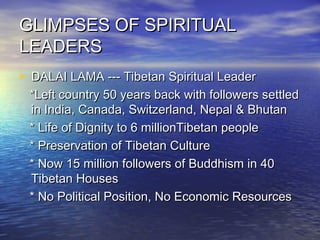
GLIMPSES OF SPIRITUALGLIMPSES OF SPIRITUAL
LEADERSLEADERS
• DALAI LAMA --- Tibetan Spiritual LeaderDALAI LAMA --- Tibetan Spiritual Leader
*Left country 50 years back with followers settled*Left country 50 years back with followers settled
in India, Canada, Switzerland, Nepal & Bhutanin India, Canada, Switzerland, Nepal & Bhutan
* Life of Dignity to 6 millionTibetan people* Life of Dignity to 6 millionTibetan people
* Preservation of Tibetan Culture* Preservation of Tibetan Culture
* Now 15 million followers of Buddhism in 40* Now 15 million followers of Buddhism in 40
Tibetan HousesTibetan Houses
* No Political Position, No Economic Resources* No Political Position, No Economic Resources
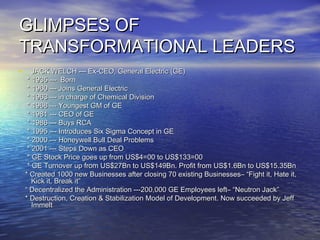
GLIMPSES OFGLIMPSES OF
TRANSFORMATIONAL LEADERSTRANSFORMATIONAL LEADERS
• JACK WELCH --- Ex-CEO, General Electric (GE)JACK WELCH --- Ex-CEO, General Electric (GE)
* 1935 --- Born* 1935 --- Born
* 1960 --- Joins General Electric* 1960 --- Joins General Electric
* 1963 --- in charge of Chemical Division* 1963 --- in charge of Chemical Division
* 1968 --- Youngest GM of GE* 1968 --- Youngest GM of GE
* 1981 --- CEO of GE* 1981 --- CEO of GE
* 1986 --- Buys RCA* 1986 --- Buys RCA
* 1995 --- Introduces Six Sigma Concept in GE* 1995 --- Introduces Six Sigma Concept in GE
* 2000 --- Honeywell Bull Deal Problems* 2000 --- Honeywell Bull Deal Problems
* 2001 --- Steps Down as CEO* 2001 --- Steps Down as CEO
* GE Stock Price goes up from US$4=00 to US$133=00* GE Stock Price goes up from US$4=00 to US$133=00
* GE Turnover up from US$27Bn to US$149Bn. Profit from US$1.6Bn to US$15.35Bn* GE Turnover up from US$27Bn to US$149Bn. Profit from US$1.6Bn to US$15.35Bn
* Created 1000 new Businesses after closing 70 existing Businesses– “Fight it, Hate it,* Created 1000 new Businesses after closing 70 existing Businesses– “Fight it, Hate it,
Kick it, Break it”Kick it, Break it”
““ Decentralized the Administration ---200,000 GE Employees left– “Neutron Jack”Decentralized the Administration ---200,000 GE Employees left– “Neutron Jack”
* Destruction, Creation & Stabilization Model of Development. Now succeeded by Jeff* Destruction, Creation & Stabilization Model of Development. Now succeeded by Jeff
ImmeltImmelt
GLIMPSES OFGLIMPSES OF
TRANSFORMATIONAL LEADERSTRANSFORMATIONAL LEADERS
• Akio Morita --- Ex- Sony ChairmanAkio Morita --- Ex- Sony Chairman
* 1921 ---- Born* 1921 ---- Born
* 1946 ---- Co-founds Tokyo Tsushin* 1946 ---- Co-founds Tokyo Tsushin
Kyogu (TTK) with Masaru IbukaKyogu (TTK) with Masaru Ibuka
* 1953 ---- Travels to USA to get Transistor* 1953 ---- Travels to USA to get Transistor
TechnologyTechnology
* 1958 ---- Changes Company Name to* 1958 ---- Changes Company Name to
SonySony
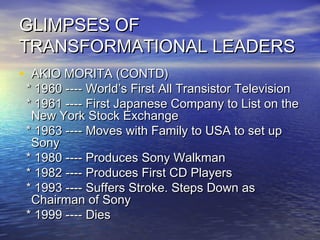
GLIMPSES OFGLIMPSES OF
TRANSFORMATIONAL LEADERSTRANSFORMATIONAL LEADERS
• AKIO MORITA (CONTD)AKIO MORITA (CONTD)
* 1960 ---- World’s First All Transistor Television* 1960 ---- World’s First All Transistor Television
* 1961 ---- First Japanese Company to List on the* 1961 ---- First Japanese Company to List on the
New York Stock ExchangeNew York Stock Exchange
* 1963 ---- Moves with Family to USA to set up* 1963 ---- Moves with Family to USA to set up
SonySony
* 1980 ---- Produces Sony Walkman* 1980 ---- Produces Sony Walkman
* 1982 ---- Produces First CD Players* 1982 ---- Produces First CD Players
* 1993 ---- Suffers Stroke. Steps Down as* 1993 ---- Suffers Stroke. Steps Down as
Chairman of SonyChairman of Sony
* 1999 ---- Dies* 1999 ---- Dies
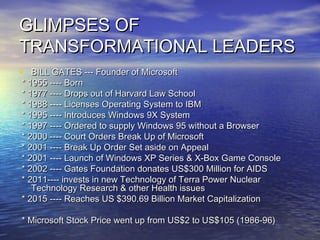
GLIMPSES OFGLIMPSES OF
TRANSFORMATIONAL LEADERSTRANSFORMATIONAL LEADERS
• BILL GATES --- Founder of MicrosoftBILL GATES --- Founder of Microsoft
* 1955 ---- Born* 1955 ---- Born
* 1977 ---- Drops out of Harvard Law School* 1977 ---- Drops out of Harvard Law School
* 1988 ---- Licenses Operating System to IBM* 1988 ---- Licenses Operating System to IBM
* 1995 ---- Introduces Windows 9X System* 1995 ---- Introduces Windows 9X System
* 1997 ---- Ordered to supply Windows 95 without a Browser* 1997 ---- Ordered to supply Windows 95 without a Browser
* 2000 ---- Court Orders Break Up of Microsoft* 2000 ---- Court Orders Break Up of Microsoft
* 2001 ---- Break Up Order Set aside on Appeal* 2001 ---- Break Up Order Set aside on Appeal
* 2001 ---- Launch of Windows XP Series & X-Box Game Console* 2001 ---- Launch of Windows XP Series & X-Box Game Console
* 2002 ---- Gates Foundation donates US$300 Million for AIDS* 2002 ---- Gates Foundation donates US$300 Million for AIDS
* 2011---- invests in new Technology of Terra Power Nuclear* 2011---- invests in new Technology of Terra Power Nuclear
Technology Research & other Health issuesTechnology Research & other Health issues
* 2015 ---- Reaches US $390.69 Billion Market Capitalization* 2015 ---- Reaches US $390.69 Billion Market Capitalization
* Microsoft Stock Price went up from US$2 to US$105 (1986-96)* Microsoft Stock Price went up from US$2 to US$105 (1986-96)
GLIMPSES OFGLIMPSES OF
TRANSFORMATIONAL LEADERSTRANSFORMATIONAL LEADERS
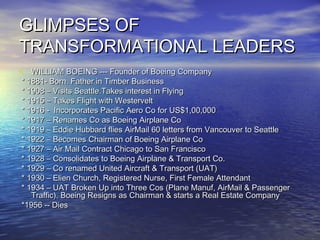
• WILLIAM BOEING --- Founder of Boeing CompanyWILLIAM BOEING --- Founder of Boeing Company
* 1881- Born. Father in Timber Business* 1881- Born. Father in Timber Business
* 1908 – Visits Seattle.Takes interest in Flying* 1908 – Visits Seattle.Takes interest in Flying
* 1915 – Takes Flight with Westervelt* 1915 – Takes Flight with Westervelt
* 1916 - Incorporates Pacific Aero Co for US$1,00,000* 1916 - Incorporates Pacific Aero Co for US$1,00,000
* 1917 – Renames Co as Boeing Airplane Co* 1917 – Renames Co as Boeing Airplane Co
* 1919 – Eddie Hubbard flies AirMail 60 letters from Vancouver to Seattle* 1919 – Eddie Hubbard flies AirMail 60 letters from Vancouver to Seattle
* 1922 – Becomes Chairman of Boeing Airplane Co* 1922 – Becomes Chairman of Boeing Airplane Co
* 1927 – Air Mail Contract Chicago to San Francisco* 1927 – Air Mail Contract Chicago to San Francisco
* 1928 – Consolidates to Boeing Airplane & Transport Co.* 1928 – Consolidates to Boeing Airplane & Transport Co.
* 1929 – Co renamed United Aircraft & Transport (UAT)* 1929 – Co renamed United Aircraft & Transport (UAT)
* 1930 – Elien Church, Registered Nurse, First Female Attendant* 1930 – Elien Church, Registered Nurse, First Female Attendant
* 1934 – UAT Broken Up into Three Cos (Plane Manuf, AirMail & Passenger* 1934 – UAT Broken Up into Three Cos (Plane Manuf, AirMail & Passenger
Traffic). Boeing Resigns as Chairman & starts a Real Estate CompanyTraffic). Boeing Resigns as Chairman & starts a Real Estate Company
*1956 -- Dies*1956 -- Dies
GLIMPSES OFGLIMPSES OF
TRANSFORMATIONAL LEADERSTRANSFORMATIONAL LEADERS
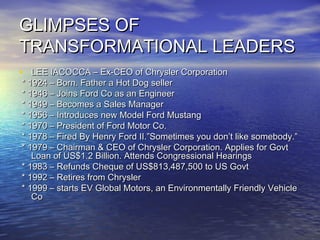
• LEE IACOCCA – Ex-CEO of Chrysler CorporationLEE IACOCCA – Ex-CEO of Chrysler Corporation
* 1924 – Born. Father a Hot Dog seller* 1924 – Born. Father a Hot Dog seller
* 1946 – Joins Ford Co as an Engineer* 1946 – Joins Ford Co as an Engineer
* 1949 – Becomes a Sales Manager* 1949 – Becomes a Sales Manager
* 1956 – Introduces new Model Ford Mustang* 1956 – Introduces new Model Ford Mustang
* 1970 – President of Ford Motor Co.* 1970 – President of Ford Motor Co.
* 1978 – Fired By Henry Ford II.”Sometimes you don’t like somebody.”* 1978 – Fired By Henry Ford II.”Sometimes you don’t like somebody.”
* 1979 – Chairman & CEO of Chrysler Corporation. Applies for Govt* 1979 – Chairman & CEO of Chrysler Corporation. Applies for Govt
Loan of US$1.2 Billion. Attends Congressional HearingsLoan of US$1.2 Billion. Attends Congressional Hearings
* 1983 – Refunds Cheque of US$813,487,500 to US Govt* 1983 – Refunds Cheque of US$813,487,500 to US Govt
* 1992 – Retires from Chrysler* 1992 – Retires from Chrysler
* 1999 – starts EV Global Motors, an Environmentally Friendly Vehicle* 1999 – starts EV Global Motors, an Environmentally Friendly Vehicle
CoCo
GLIMPSES OFGLIMPSES OF
TRANSFORMATIONAL LEADERSTRANSFORMATIONAL LEADERS
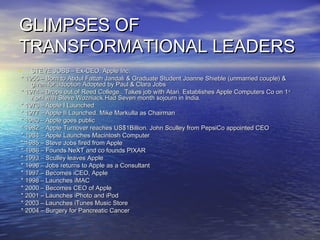
• STEVE JOBS – Ex-CEO, Apple Inc.STEVE JOBS – Ex-CEO, Apple Inc.
* 1955 – Born to Abdul Fattah Jandali & Graduate Student Joanne Shieble (unmarried couple) &* 1955 – Born to Abdul Fattah Jandali & Graduate Student Joanne Shieble (unmarried couple) &
given for adoption.Adopted by Paul & Clara Jobsgiven for adoption.Adopted by Paul & Clara Jobs
* 1974 – Drops out of Reed College.. Takes job with Atari. Establishes Apple Computers Co on 1* 1974 – Drops out of Reed College.. Takes job with Atari. Establishes Apple Computers Co on 1stst
April with Steve Wozniack.Had Seven month sojourn in India.April with Steve Wozniack.Had Seven month sojourn in India.
* 1976 – Apple I Launched* 1976 – Apple I Launched
* 1977 – Apple II Launched. Mike Markulla as Chairman* 1977 – Apple II Launched. Mike Markulla as Chairman
* 1980 – Apple goes public* 1980 – Apple goes public
* 1982 – Apple Turnover reaches US$1Billion. John Sculley from PepsiCo appointed CEO* 1982 – Apple Turnover reaches US$1Billion. John Sculley from PepsiCo appointed CEO
* 1984 – Apple Launches Macintosh Computer* 1984 – Apple Launches Macintosh Computer
* 1985 – Steve Jobs fired from Apple* 1985 – Steve Jobs fired from Apple
* 1986 – Founds NeXT and co founds PIXAR* 1986 – Founds NeXT and co founds PIXAR
* 1993 – Sculley leaves Apple* 1993 – Sculley leaves Apple
* 1996 – Jobs returns to Apple as a Consultant* 1996 – Jobs returns to Apple as a Consultant
* 1997 – Becomes iCEO, Apple* 1997 – Becomes iCEO, Apple
* 1998 – Launches iMAC* 1998 – Launches iMAC
* 2000 – Becomes CEO of Apple* 2000 – Becomes CEO of Apple
* 2001 – Launches iPhoto and iPod* 2001 – Launches iPhoto and iPod
* 2003 – Launches iTunes Music Store* 2003 – Launches iTunes Music Store
* 2004 – Surgery for Pancreatic Cancer* 2004 – Surgery for Pancreatic Cancer
GLIMPSES OFGLIMPSES OF
TRANSFORMATIONAL LEADERSTRANSFORMATIONAL LEADERS
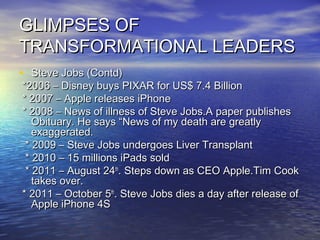
• Steve Jobs (Contd)Steve Jobs (Contd)
*2006 – Disney buys PIXAR for US$ 7.4 Billion*2006 – Disney buys PIXAR for US$ 7.4 Billion
* 2007 – Apple releases iPhone* 2007 – Apple releases iPhone
* 2008 – News of illness of Steve Jobs.A paper publishes* 2008 – News of illness of Steve Jobs.A paper publishes
Obituary. He says “News of my death are greatlyObituary. He says “News of my death are greatly
exaggerated.exaggerated.
* 2009 – Steve Jobs undergoes Liver Transplant* 2009 – Steve Jobs undergoes Liver Transplant
* 2010 – 15 millions iPads sold* 2010 – 15 millions iPads sold
* 2011 – August 24* 2011 – August 24thth
. Steps down as CEO Apple.Tim Cook. Steps down as CEO Apple.Tim Cook
takes over.takes over.
* 2011 – October 5* 2011 – October 5thth
. Steve Jobs dies a day after release of. Steve Jobs dies a day after release of
Apple iPhone 4SApple iPhone 4S
BOBLIOGRAPHYBOBLIOGRAPHY
• James MacGregor Burns (1978) – Leadership,James MacGregor Burns (1978) – Leadership,
NY Harper & Row, Pulitzer Prize Winning BookNY Harper & Row, Pulitzer Prize Winning Book
• Bernard M. Bass (1985) --- Leadership &Bernard M. Bass (1985) --- Leadership &
Performance, NY Free PressPerformance, NY Free Press
• B.M.Bass & B.J. Avolio (1994) – ImprovingB.M.Bass & B.J. Avolio (1994) – Improving
Organizational Effectiveness throughOrganizational Effectiveness through
Transformational LeadershipTransformational Leadership
• Harvard Business Review (2011) – OnHarvard Business Review (2011) – On
Leadership, HBR Press, Boston, MassachusettsLeadership, HBR Press, Boston, Massachusetts
THANKSTHANKS
THE ENDTHE END

Transformational leadership II

  • 1.
    TRANSFORMATIONALTRANSFORMATIONAL LEADERSHIP IILEADERSHIP II BYBY DRSATYANARAYANA DASHDR SATYANARAYANA DASH EX-ACTG CHAIRMAN, STATEEX-ACTG CHAIRMAN, STATE ADMINISTRATIVE TRIBUNAL,ADMINISTRATIVE TRIBUNAL, ODISHAODISHA
  • 2.
    TRANSFORMATIONALTRANSFORMATIONAL LEADERSHIPLEADERSHIP Transformational Leadership isTransformationalLeadership is the processes that transformsthe processes that transforms individuals & Societies.individuals & Societies.
  • 3.
    TRANSFORMATIONALTRANSFORMATIONAL LEADERSHIPLEADERSHIP • Leaders aretruly transformational, whenLeaders are truly transformational, when they increase awareness of what is right,they increase awareness of what is right, good, important and beautiful, when theygood, important and beautiful, when they help to elevate followers’ need forhelp to elevate followers’ need for achievement and self-actualisation, whenachievement and self-actualisation, when they foster in followers high moral maturitythey foster in followers high moral maturity and when they move followers to goand when they move followers to go beyond their self interest for the good ofbeyond their self interest for the good of their group, organisation and society.their group, organisation and society.
  • 4.
    TRANSFORMATIONALTRANSFORMATIONAL LEADERSHIPLEADERSHIP • Concerned withemotions, values. Ethics,Concerned with emotions, values. Ethics, standards and long term goals andstandards and long term goals and involves assessing followers’ motives andinvolves assessing followers’ motives and satisfying their needssatisfying their needs • Exceptional form of influence thatExceptional form of influence that motivates followers to do more than ismotivates followers to do more than is expected of themexpected of them • Often linked to visionary & charismaticOften linked to visionary & charismatic leadershipleadership
  • 5.
    LEADERSHIP FORMSLEADERSHIP FORMS *Transactional Leadership:- is the most* Transactional Leadership:- is the most common form and involves exchangescommon form and involves exchanges between leaders and followersbetween leaders and followers * Transformational Leadership:- refers to a* Transformational Leadership:- refers to a process whereby an individual engagesprocess whereby an individual engages with others & creates a connection thatwith others & creates a connection that raises the level of motivation & morality inraises the level of motivation & morality in both the leader and the follower.both the leader and the follower.
  • 6.
    JAMES MACGREGOR BURNSJAMESMACGREGOR BURNS (1978)(1978) Introduced the concept of “TransformingIntroduced the concept of “Transforming Leadership”Leadership” • Not based on give and take relationshipNot based on give and take relationship • Depends on Leader’s traits, personality,Depends on Leader’s traits, personality, energizing vision & challenging goalsenergizing vision & challenging goals • Tries to change organizational cultureTries to change organizational culture
  • 7.
    BERNARD M. BASS(1985)BERNARD M. BASS (1985) • ““Transforming Leadership” to “TransformationalTransforming Leadership” to “Transformational Leadership”Leadership” • Measurement of Transformational LeadershipMeasurement of Transformational Leadership and how it impacts follower motivation andand how it impacts follower motivation and performanceperformance • Followers feel trust, admiration and loyalty forFollowers feel trust, admiration and loyalty for the leader.Willing to work more than expectationthe leader.Willing to work more than expectation • Non-exclusivity with Transactional LeadershipNon-exclusivity with Transactional Leadership
  • 8.
    FOUR ELEMENTS OFFOURELEMENTS OF TRANSFORMATIONALTRANSFORMATIONAL LEADERSHIPLEADERSHIP (1)(1) Individualized ConsiderationIndividualized Consideration: Empathy,: Empathy, support, keeping communication lines opensupport, keeping communication lines open (2)(2) Intellectual StimulationIntellectual Stimulation: Challenges: Challenges assumptions, encourages creativity andassumptions, encourages creativity and nurtures independent thinkingnurtures independent thinking (3)(3) Inspirational MotivationInspirational Motivation: Articulating Vision,: Articulating Vision, optimism and creating strong sense of purposeoptimism and creating strong sense of purpose (4)(4) Idealized InfluenceIdealized Influence: Role Model of Ethical: Role Model of Ethical Behaviour. Instils pride, gain, respect and trustBehaviour. Instils pride, gain, respect and trust
  • 9.
    APPLICATIONS OFAPPLICATIONS OF TRANSFORMATIONALTRANSFORMATIONAL LEADERSHIPLEADERSHIP •Finnish Defence Forces: Deep LeadFinnish Defence Forces: Deep Lead Model for Leadership Training &Model for Leadership Training & DevelopmentDevelopment • MLQ Form 5X: 45 point questionnaire forMLQ Form 5X: 45 point questionnaire for measuring the levels of transformationalmeasuring the levels of transformational and transactional leadership on a fiveand transactional leadership on a five point scalepoint scale
  • 10.
    BASS LEADERSHIP CONTINUUMBASSLEADERSHIP CONTINUUM BASS LEADERSHIP CONTINUUM LAISSEZ FAIRE LEADERSHIP TRANSACTIONAL LEADERSHIP TRANSFORMATIONAL LEADERSHIP
  • 11.
    LEADERSHIP FACTORSLEADERSHIP FACTORS •LAISSEZ FAIRE LEADERSHIP --- Non-LAISSEZ FAIRE LEADERSHIP --- Non- TransformationalTransformational • TRANSACTIONAL LEADERSHIP --- ContingentTRANSACTIONAL LEADERSHIP --- Contingent Reward (Constructive Transactions)Reward (Constructive Transactions) ------Management By Exception (Active &Management By Exception (Active & Passive) -Passive) - Corrective Transactions --Corrective Transactions -- Expected PerformanceExpected Performance • TRANSFORMATIONAL LEADERSHIP ---TRANSFORMATIONAL LEADERSHIP --- Individualized Consideration + IntellectualIndividualized Consideration + Intellectual Stimulation + Inspirational Motivation + IdealizedStimulation + Inspirational Motivation + Idealized Influence ----> Beyond Expected PerformanceInfluence ----> Beyond Expected Performance
  • 12.
    CHARACTERISTICS OFCHARACTERISTICS OF TRANSFORMATIONALTRANSFORMATIONAL LEADERSHIPLEADERSHIP •Transformational Leadership is a LeadershipTransformational Leadership is a Leadership Style involving “Change”Style involving “Change” • Is it oriented towards greater good of theIs it oriented towards greater good of the Community, Organization or the Society?Community, Organization or the Society? • Is the Type of Influence always wholesome forIs the Type of Influence always wholesome for the Individual, Community, Organization &the Individual, Community, Organization & SocietySociety • Consider the cases of Adolf Hitler, Mussolini, PolConsider the cases of Adolf Hitler, Mussolini, Pol Pot, Muammar Gaddafi, Saddam HussainPot, Muammar Gaddafi, Saddam Hussain
  • 13.
    TRANSFORMATIONAL LEADERSTRANSFORMATIONAL LEADERS INEVERYDAY LIFEIN EVERYDAY LIFE • ParentsParents • TeachersTeachers • Religious LeadersReligious Leaders • CoachesCoaches • Community LeadersCommunity Leaders • Civil Society LeadersCivil Society Leaders A Transformational Leader is one Who knows theA Transformational Leader is one Who knows the way, goes the way and shows the way.way, goes the way and shows the way.
  • 14.
    EFFECTIVENESS OFEFFECTIVENESS OF TRANSFORMATIONALTRANSFORMATIONAL LEADERSHIPLEADERSHIP •Effective Leadership with Status Quo --Effective Leadership with Status Quo -- TheThe Way Things are done ---Way Things are done --- TransactionalTransactional LeadershipLeadership • Effective Leadership going beyond Status QuoEffective Leadership going beyond Status Quo ------ the Way Things should be done --the Way Things should be done -- Transformational LeadershipTransformational Leadership • A Transactional Leader can rearrange a deck ofA Transactional Leader can rearrange a deck of chairs on the Titanic, but can not save the shipchairs on the Titanic, but can not save the ship from sinking. Transformational Leadershipfrom sinking. Transformational Leadership requires Courage & Wisdomrequires Courage & Wisdom
  • 15.
    CATEGORIES OFCATEGORIES OF TRANSFORMATIONALLEADERSTRANSFORMATIONAL LEADERS • Religious Leaders --- Christ, Buddha, Mahavir Jain, AdiReligious Leaders --- Christ, Buddha, Mahavir Jain, Adi ShankaracharyaShankaracharya • Political & Social Thinkers --- Plato, Aristotle, Karl Marx, AdamPolitical & Social Thinkers --- Plato, Aristotle, Karl Marx, Adam SmithSmith • Heads of State --- George Washington, Abraham Lincoln, RajendraHeads of State --- George Washington, Abraham Lincoln, Rajendra Prasad, APJ Abdul Kalam, Lee Kuan YewPrasad, APJ Abdul Kalam, Lee Kuan Yew • Political Leaders --- Winston Churchill, Ronald Reagan, Aung SaanPolitical Leaders --- Winston Churchill, Ronald Reagan, Aung Saan Suu KyiSuu Kyi • Scientists ---- Isaac Newton, Albert Einstein, Stephen HawkingScientists ---- Isaac Newton, Albert Einstein, Stephen Hawking • Industry Leaders & CEOs --- J.N. Tata, G.D. Birla, Jack Welch, LeeIndustry Leaders & CEOs --- J.N. Tata, G.D. Birla, Jack Welch, Lee Iacocca, Steve Jobs, Bill GatesIacocca, Steve Jobs, Bill Gates These lists are not ExhaustiveThese lists are not Exhaustive
  • 16.
    TRANSFORMATIONALTRANSFORMATIONAL LEADERSHIP IN INDIALEADERSHIPIN INDIA • Study By Niti Singh & Venkat R. KrishnanStudy By Niti Singh & Venkat R. Krishnan (2005) on Cultural effects on attributes of(2005) on Cultural effects on attributes of Transformational Leadership. India has aTransformational Leadership. India has a curious mix of Traditional & Westerncurious mix of Traditional & Western Culture, whose social Values are:--- (a)Culture, whose social Values are:--- (a) Preferences for Hierarchy (b)Preferences for Hierarchy (b) Personalized rather than ContractualPersonalized rather than Contractual Relationship (c) Harmony rather thanRelationship (c) Harmony rather than ConfrontationConfrontation
  • 17.
    ATTRIBUTES OFATTRIBUTES OF TRANSFORMATIONALTRANSFORMATIONAL LEADERSHIPIN INDIALEADERSHIP IN INDIA • Universal Attributes as per Bass --- 44%Universal Attributes as per Bass --- 44% • India- Specific Attributes ---- 56%India- Specific Attributes ---- 56% * Nurturant (20%)* Nurturant (20%) * Personal Touch ---- (13%)* Personal Touch ---- (13%) * Expertise ---- (7%)* Expertise ---- (7%) * Simple Living – High Thinking ---- (7%)* Simple Living – High Thinking ---- (7%) * Loyalty ---- (4%)* Loyalty ---- (4%) * Self Sacrifice ---- (3%)* Self Sacrifice ---- (3%) * Giving Mode ---- (2%)* Giving Mode ---- (2%)
  • 18.
    TRANSFORMATIONAL &TRANSFORMATIONAL & ETHICALLEADERSHIPETHICAL LEADERSHIP • Process of Ethical Decision Making:--Process of Ethical Decision Making:-- (1) Look at issues Objectively and(1) Look at issues Objectively and DispassionatelyDispassionately (2) Strive for fairness(2) Strive for fairness (3) Appreciate the impact of the Decision(3) Appreciate the impact of the Decision on other peoples’ feelings and situationson other peoples’ feelings and situations (4) Look out for similar Past Precedents(4) Look out for similar Past Precedents and the impact they had causedand the impact they had caused
  • 19.
    TRANSFORMATIONAL &TRANSFORMATIONAL & ETHICALLEADERSHIP (CONTD)ETHICAL LEADERSHIP (CONTD) (5) Look at all views closely ---- (a) Your View (b)(5) Look at all views closely ---- (a) Your View (b) Alternative Views (c) Do Nothing --- in the RightAlternative Views (c) Do Nothing --- in the Right Way for the Right ReasonsWay for the Right Reasons (6) Check the Laws & Guidelines on the matter(6) Check the Laws & Guidelines on the matter (7) Make Wider Consultations, if necessary(7) Make Wider Consultations, if necessary (8) Understand Long Term Consequences of your(8) Understand Long Term Consequences of your DecisionsDecisions (9) Check the sensitivity of the Decision to the(9) Check the sensitivity of the Decision to the EnvironmentEnvironment
  • 20.
    TRANSFORMATIONAL &TRANSFORMATIONAL & ETHICALLEADERSHIP (CONTD)ETHICAL LEADERSHIP (CONTD) (10) Resist Delusion/ Arrogance of(10) Resist Delusion/ Arrogance of Power/AuthorityPower/Authority (11) Decision should not be based on(11) Decision should not be based on Religious FaithReligious Faith (12) Decision should be Harmonious &(12) Decision should be Harmonious & made Dispassionatelymade Dispassionately
  • 21.
    TESTS OF ETHICALDECISIONTESTS OF ETHICAL DECISION MAKINGMAKING • Apply TEF Rule -----Apply TEF Rule ----- * Transparency --- Answer the Question – Am I* Transparency --- Answer the Question – Am I Happy to make my Decision public?Happy to make my Decision public? * Effects --- Answer the Question --- Have I* Effects --- Answer the Question --- Have I avoided Harmful effects of my Decision?avoided Harmful effects of my Decision? * Fairness ---- Answer the Question---* Fairness ---- Answer the Question--- Is the Decision fair to Everybody?Is the Decision fair to Everybody? If the Answer to all the above Questions is anIf the Answer to all the above Questions is an unconstrained “Yes”, then the Decision isunconstrained “Yes”, then the Decision is Ethical.Ethical.
  • 22.
    ALLAN CHAPMAN’S 4PsOFALLAN CHAPMAN’S 4Ps OF SUSTAINABLE ORGANIZATIONSSUSTAINABLE ORGANIZATIONS • 4Ps of Sustainability Quadruple4Ps of Sustainability Quadruple BottomlineBottomline --------- Purpose (Profit, Charity,--------- Purpose (Profit, Charity, Development)Development) ---------- People (Employees,Customers,---------- People (Employees,Customers, Suppliers, Stakeholders, PeripheralSuppliers, Stakeholders, Peripheral Dwellers)Dwellers) ---------- Planet ( Environment---------- Planet ( Environment Consequences)Consequences) ---------- Probity (Integrity)---------- Probity (Integrity)
  • 23.
    PROF CHRISTPOPHERPROF CHRISTPOPHER McCUSKER’SPRESCRPTIONMcCUSKER’S PRESCRPTION • Swim in the Blue Ocean Not Red OceanSwim in the Blue Ocean Not Red Ocean • Create Entrepreneurial CultureCreate Entrepreneurial Culture • Give Best Tools for the TeamGive Best Tools for the Team • ListenListen • Continuous ImprovementContinuous Improvement • Cure Mistakes Fast – Hire Fast Fire FastCure Mistakes Fast – Hire Fast Fire Fast • Hire Great People– Grant Freedom ofHire Great People– Grant Freedom of ActionAction
  • 24.
    PROF CHRISTPOPHERPROF CHRISTPOPHER McCUSKER’SPRESCRPTIONMcCUSKER’S PRESCRPTION • Mentor, Not BullyMentor, Not Bully • Failure is the Leader’s FaultFailure is the Leader’s Fault • Success is Due to the TeamSuccess is Due to the Team • Be TransparentBe Transparent • Uphold IntegrityUphold Integrity • Be CoolBe Cool
  • 25.
    PHIL HARKIN’S ACTIONABLEPHILHARKIN’S ACTIONABLE POINTSPOINTS • Define Clear Vision for the FutureDefine Clear Vision for the Future • Be Genuine even if it lowers your guardBe Genuine even if it lowers your guard • Ask Good Questions: 70-20-10 RuleAsk Good Questions: 70-20-10 Rule • Talk about issues even the hardest onesTalk about issues even the hardest ones • Follow through the CommitmentsFollow through the Commitments • Let Others Speak FirstLet Others Speak First • ListenListen
  • 26.
    PHIL HARKIN’S ACTIONABLEPHILHARKIN’S ACTIONABLE POINTSPOINTS • Face Up to Non-Performing PlayersFace Up to Non-Performing Players • Have Fun, but not at other’s expenseHave Fun, but not at other’s expense • Be Confident & DependableBe Confident & Dependable
  • 27.
    C2E MODEL OFC2EMODEL OF TRANSFORMATIONALTRANSFORMATIONAL LEADERSHIPLEADERSHIP • Strategist: (i) Tactical Specialist (ii) StructuredStrategist: (i) Tactical Specialist (ii) Structured Deliverer (iii) Strategic ThinkerDeliverer (iii) Strategic Thinker • Facilitator: (i) Collaboration Builder (ii) AltruisticFacilitator: (i) Collaboration Builder (ii) Altruistic Champion (iii) Behavioural Role ModelChampion (iii) Behavioural Role Model • Engager: (i) Empathic Supporter (ii) EmpoweredEngager: (i) Empathic Supporter (ii) Empowered Coach (iii) Charismatic NetworksCoach (iii) Charismatic Networks • Achiever: (i) Inspiring Visionary (ii) ResilientAchiever: (i) Inspiring Visionary (ii) Resilient Deliverer (iii) Proactive EngagerDeliverer (iii) Proactive Engager • This model gives primacy to followers --- thereThis model gives primacy to followers --- there can not be a leader without a followercan not be a leader without a follower
  • 28.
    GLIMPSES FROMGLIMPSES FROM TRANSFORMATIONALLEADERSTRANSFORMATIONAL LEADERS • MAHATMA GANDHI – The Father of the Nation, Apostle of Truth &MAHATMA GANDHI – The Father of the Nation, Apostle of Truth & Non-ViolenceNon-Violence • LEE KUAN YEW – Ex-Prime Minister of SingaporeLEE KUAN YEW – Ex-Prime Minister of Singapore * Transformed Singapore from Corrupt, Inefficient City State to the* Transformed Singapore from Corrupt, Inefficient City State to the front ranks of first Worldfront ranks of first World * Universalization of Primary & Secondary Education (Literacy Rate* Universalization of Primary & Secondary Education (Literacy Rate 92%)92%) * Per Capita GNP increased from US$ 920=00 (1965) to US$* Per Capita GNP increased from US$ 920=00 (1965) to US$ 23300=00 (1990)23300=00 (1990) * His Objective Function ---- Maximization of the Wealth & Reputation* His Objective Function ---- Maximization of the Wealth & Reputation of Singapore. Not Personal Wealth or Political Position for Relativesof Singapore. Not Personal Wealth or Political Position for Relatives * Singapore is one of the least Corrupt Country in the World (Point 8* Singapore is one of the least Corrupt Country in the World (Point 8 on the Transparency Scale)on the Transparency Scale) * Best Model Airport (Changi Airport) and Best Judicial system in the* Best Model Airport (Changi Airport) and Best Judicial system in the World --- Criminal Cases get disposed off in six monthsWorld --- Criminal Cases get disposed off in six months * Singapore Civil Servants are the Best Paid in the World* Singapore Civil Servants are the Best Paid in the World
  • 29.
    GLIMPSES OF SPIRITUALGLIMPSESOF SPIRITUAL LEADERSLEADERS • DALAI LAMA --- Tibetan Spiritual LeaderDALAI LAMA --- Tibetan Spiritual Leader *Left country 50 years back with followers settled*Left country 50 years back with followers settled in India, Canada, Switzerland, Nepal & Bhutanin India, Canada, Switzerland, Nepal & Bhutan * Life of Dignity to 6 millionTibetan people* Life of Dignity to 6 millionTibetan people * Preservation of Tibetan Culture* Preservation of Tibetan Culture * Now 15 million followers of Buddhism in 40* Now 15 million followers of Buddhism in 40 Tibetan HousesTibetan Houses * No Political Position, No Economic Resources* No Political Position, No Economic Resources
  • 30.
    GLIMPSES OFGLIMPSES OF TRANSFORMATIONALLEADERSTRANSFORMATIONAL LEADERS • JACK WELCH --- Ex-CEO, General Electric (GE)JACK WELCH --- Ex-CEO, General Electric (GE) * 1935 --- Born* 1935 --- Born * 1960 --- Joins General Electric* 1960 --- Joins General Electric * 1963 --- in charge of Chemical Division* 1963 --- in charge of Chemical Division * 1968 --- Youngest GM of GE* 1968 --- Youngest GM of GE * 1981 --- CEO of GE* 1981 --- CEO of GE * 1986 --- Buys RCA* 1986 --- Buys RCA * 1995 --- Introduces Six Sigma Concept in GE* 1995 --- Introduces Six Sigma Concept in GE * 2000 --- Honeywell Bull Deal Problems* 2000 --- Honeywell Bull Deal Problems * 2001 --- Steps Down as CEO* 2001 --- Steps Down as CEO * GE Stock Price goes up from US$4=00 to US$133=00* GE Stock Price goes up from US$4=00 to US$133=00 * GE Turnover up from US$27Bn to US$149Bn. Profit from US$1.6Bn to US$15.35Bn* GE Turnover up from US$27Bn to US$149Bn. Profit from US$1.6Bn to US$15.35Bn * Created 1000 new Businesses after closing 70 existing Businesses– “Fight it, Hate it,* Created 1000 new Businesses after closing 70 existing Businesses– “Fight it, Hate it, Kick it, Break it”Kick it, Break it” ““ Decentralized the Administration ---200,000 GE Employees left– “Neutron Jack”Decentralized the Administration ---200,000 GE Employees left– “Neutron Jack” * Destruction, Creation & Stabilization Model of Development. Now succeeded by Jeff* Destruction, Creation & Stabilization Model of Development. Now succeeded by Jeff ImmeltImmelt
  • 31.
    GLIMPSES OFGLIMPSES OF TRANSFORMATIONALLEADERSTRANSFORMATIONAL LEADERS • Akio Morita --- Ex- Sony ChairmanAkio Morita --- Ex- Sony Chairman * 1921 ---- Born* 1921 ---- Born * 1946 ---- Co-founds Tokyo Tsushin* 1946 ---- Co-founds Tokyo Tsushin Kyogu (TTK) with Masaru IbukaKyogu (TTK) with Masaru Ibuka * 1953 ---- Travels to USA to get Transistor* 1953 ---- Travels to USA to get Transistor TechnologyTechnology * 1958 ---- Changes Company Name to* 1958 ---- Changes Company Name to SonySony
  • 32.
    GLIMPSES OFGLIMPSES OF TRANSFORMATIONALLEADERSTRANSFORMATIONAL LEADERS • AKIO MORITA (CONTD)AKIO MORITA (CONTD) * 1960 ---- World’s First All Transistor Television* 1960 ---- World’s First All Transistor Television * 1961 ---- First Japanese Company to List on the* 1961 ---- First Japanese Company to List on the New York Stock ExchangeNew York Stock Exchange * 1963 ---- Moves with Family to USA to set up* 1963 ---- Moves with Family to USA to set up SonySony * 1980 ---- Produces Sony Walkman* 1980 ---- Produces Sony Walkman * 1982 ---- Produces First CD Players* 1982 ---- Produces First CD Players * 1993 ---- Suffers Stroke. Steps Down as* 1993 ---- Suffers Stroke. Steps Down as Chairman of SonyChairman of Sony * 1999 ---- Dies* 1999 ---- Dies
  • 33.
    GLIMPSES OFGLIMPSES OF TRANSFORMATIONALLEADERSTRANSFORMATIONAL LEADERS • BILL GATES --- Founder of MicrosoftBILL GATES --- Founder of Microsoft * 1955 ---- Born* 1955 ---- Born * 1977 ---- Drops out of Harvard Law School* 1977 ---- Drops out of Harvard Law School * 1988 ---- Licenses Operating System to IBM* 1988 ---- Licenses Operating System to IBM * 1995 ---- Introduces Windows 9X System* 1995 ---- Introduces Windows 9X System * 1997 ---- Ordered to supply Windows 95 without a Browser* 1997 ---- Ordered to supply Windows 95 without a Browser * 2000 ---- Court Orders Break Up of Microsoft* 2000 ---- Court Orders Break Up of Microsoft * 2001 ---- Break Up Order Set aside on Appeal* 2001 ---- Break Up Order Set aside on Appeal * 2001 ---- Launch of Windows XP Series & X-Box Game Console* 2001 ---- Launch of Windows XP Series & X-Box Game Console * 2002 ---- Gates Foundation donates US$300 Million for AIDS* 2002 ---- Gates Foundation donates US$300 Million for AIDS * 2011---- invests in new Technology of Terra Power Nuclear* 2011---- invests in new Technology of Terra Power Nuclear Technology Research & other Health issuesTechnology Research & other Health issues * 2015 ---- Reaches US $390.69 Billion Market Capitalization* 2015 ---- Reaches US $390.69 Billion Market Capitalization * Microsoft Stock Price went up from US$2 to US$105 (1986-96)* Microsoft Stock Price went up from US$2 to US$105 (1986-96)
  • 34.
    GLIMPSES OFGLIMPSES OF TRANSFORMATIONALLEADERSTRANSFORMATIONAL LEADERS • WILLIAM BOEING --- Founder of Boeing CompanyWILLIAM BOEING --- Founder of Boeing Company * 1881- Born. Father in Timber Business* 1881- Born. Father in Timber Business * 1908 – Visits Seattle.Takes interest in Flying* 1908 – Visits Seattle.Takes interest in Flying * 1915 – Takes Flight with Westervelt* 1915 – Takes Flight with Westervelt * 1916 - Incorporates Pacific Aero Co for US$1,00,000* 1916 - Incorporates Pacific Aero Co for US$1,00,000 * 1917 – Renames Co as Boeing Airplane Co* 1917 – Renames Co as Boeing Airplane Co * 1919 – Eddie Hubbard flies AirMail 60 letters from Vancouver to Seattle* 1919 – Eddie Hubbard flies AirMail 60 letters from Vancouver to Seattle * 1922 – Becomes Chairman of Boeing Airplane Co* 1922 – Becomes Chairman of Boeing Airplane Co * 1927 – Air Mail Contract Chicago to San Francisco* 1927 – Air Mail Contract Chicago to San Francisco * 1928 – Consolidates to Boeing Airplane & Transport Co.* 1928 – Consolidates to Boeing Airplane & Transport Co. * 1929 – Co renamed United Aircraft & Transport (UAT)* 1929 – Co renamed United Aircraft & Transport (UAT) * 1930 – Elien Church, Registered Nurse, First Female Attendant* 1930 – Elien Church, Registered Nurse, First Female Attendant * 1934 – UAT Broken Up into Three Cos (Plane Manuf, AirMail & Passenger* 1934 – UAT Broken Up into Three Cos (Plane Manuf, AirMail & Passenger Traffic). Boeing Resigns as Chairman & starts a Real Estate CompanyTraffic). Boeing Resigns as Chairman & starts a Real Estate Company *1956 -- Dies*1956 -- Dies
  • 35.
    GLIMPSES OFGLIMPSES OF TRANSFORMATIONALLEADERSTRANSFORMATIONAL LEADERS • LEE IACOCCA – Ex-CEO of Chrysler CorporationLEE IACOCCA – Ex-CEO of Chrysler Corporation * 1924 – Born. Father a Hot Dog seller* 1924 – Born. Father a Hot Dog seller * 1946 – Joins Ford Co as an Engineer* 1946 – Joins Ford Co as an Engineer * 1949 – Becomes a Sales Manager* 1949 – Becomes a Sales Manager * 1956 – Introduces new Model Ford Mustang* 1956 – Introduces new Model Ford Mustang * 1970 – President of Ford Motor Co.* 1970 – President of Ford Motor Co. * 1978 – Fired By Henry Ford II.”Sometimes you don’t like somebody.”* 1978 – Fired By Henry Ford II.”Sometimes you don’t like somebody.” * 1979 – Chairman & CEO of Chrysler Corporation. Applies for Govt* 1979 – Chairman & CEO of Chrysler Corporation. Applies for Govt Loan of US$1.2 Billion. Attends Congressional HearingsLoan of US$1.2 Billion. Attends Congressional Hearings * 1983 – Refunds Cheque of US$813,487,500 to US Govt* 1983 – Refunds Cheque of US$813,487,500 to US Govt * 1992 – Retires from Chrysler* 1992 – Retires from Chrysler * 1999 – starts EV Global Motors, an Environmentally Friendly Vehicle* 1999 – starts EV Global Motors, an Environmentally Friendly Vehicle CoCo
  • 36.
    GLIMPSES OFGLIMPSES OF TRANSFORMATIONALLEADERSTRANSFORMATIONAL LEADERS • STEVE JOBS – Ex-CEO, Apple Inc.STEVE JOBS – Ex-CEO, Apple Inc. * 1955 – Born to Abdul Fattah Jandali & Graduate Student Joanne Shieble (unmarried couple) &* 1955 – Born to Abdul Fattah Jandali & Graduate Student Joanne Shieble (unmarried couple) & given for adoption.Adopted by Paul & Clara Jobsgiven for adoption.Adopted by Paul & Clara Jobs * 1974 – Drops out of Reed College.. Takes job with Atari. Establishes Apple Computers Co on 1* 1974 – Drops out of Reed College.. Takes job with Atari. Establishes Apple Computers Co on 1stst April with Steve Wozniack.Had Seven month sojourn in India.April with Steve Wozniack.Had Seven month sojourn in India. * 1976 – Apple I Launched* 1976 – Apple I Launched * 1977 – Apple II Launched. Mike Markulla as Chairman* 1977 – Apple II Launched. Mike Markulla as Chairman * 1980 – Apple goes public* 1980 – Apple goes public * 1982 – Apple Turnover reaches US$1Billion. John Sculley from PepsiCo appointed CEO* 1982 – Apple Turnover reaches US$1Billion. John Sculley from PepsiCo appointed CEO * 1984 – Apple Launches Macintosh Computer* 1984 – Apple Launches Macintosh Computer * 1985 – Steve Jobs fired from Apple* 1985 – Steve Jobs fired from Apple * 1986 – Founds NeXT and co founds PIXAR* 1986 – Founds NeXT and co founds PIXAR * 1993 – Sculley leaves Apple* 1993 – Sculley leaves Apple * 1996 – Jobs returns to Apple as a Consultant* 1996 – Jobs returns to Apple as a Consultant * 1997 – Becomes iCEO, Apple* 1997 – Becomes iCEO, Apple * 1998 – Launches iMAC* 1998 – Launches iMAC * 2000 – Becomes CEO of Apple* 2000 – Becomes CEO of Apple * 2001 – Launches iPhoto and iPod* 2001 – Launches iPhoto and iPod * 2003 – Launches iTunes Music Store* 2003 – Launches iTunes Music Store * 2004 – Surgery for Pancreatic Cancer* 2004 – Surgery for Pancreatic Cancer
  • 37.
    GLIMPSES OFGLIMPSES OF TRANSFORMATIONALLEADERSTRANSFORMATIONAL LEADERS • Steve Jobs (Contd)Steve Jobs (Contd) *2006 – Disney buys PIXAR for US$ 7.4 Billion*2006 – Disney buys PIXAR for US$ 7.4 Billion * 2007 – Apple releases iPhone* 2007 – Apple releases iPhone * 2008 – News of illness of Steve Jobs.A paper publishes* 2008 – News of illness of Steve Jobs.A paper publishes Obituary. He says “News of my death are greatlyObituary. He says “News of my death are greatly exaggerated.exaggerated. * 2009 – Steve Jobs undergoes Liver Transplant* 2009 – Steve Jobs undergoes Liver Transplant * 2010 – 15 millions iPads sold* 2010 – 15 millions iPads sold * 2011 – August 24* 2011 – August 24thth . Steps down as CEO Apple.Tim Cook. Steps down as CEO Apple.Tim Cook takes over.takes over. * 2011 – October 5* 2011 – October 5thth . Steve Jobs dies a day after release of. Steve Jobs dies a day after release of Apple iPhone 4SApple iPhone 4S
  • 38.
    BOBLIOGRAPHYBOBLIOGRAPHY • James MacGregorBurns (1978) – Leadership,James MacGregor Burns (1978) – Leadership, NY Harper & Row, Pulitzer Prize Winning BookNY Harper & Row, Pulitzer Prize Winning Book • Bernard M. Bass (1985) --- Leadership &Bernard M. Bass (1985) --- Leadership & Performance, NY Free PressPerformance, NY Free Press • B.M.Bass & B.J. Avolio (1994) – ImprovingB.M.Bass & B.J. Avolio (1994) – Improving Organizational Effectiveness throughOrganizational Effectiveness through Transformational LeadershipTransformational Leadership • Harvard Business Review (2011) – OnHarvard Business Review (2011) – On Leadership, HBR Press, Boston, MassachusettsLeadership, HBR Press, Boston, Massachusetts
  • 39.