
PREVENTION OF
CORRUPTION ACT, 1988
BY
DR SATYANARAYANA DASH,
INDEPENDENT MANAGEMENT
PROFESSIONAL
RETD ACTG CHAIRMAN
ODISHA ADMINISTRATIVE TRIBUNAL
EVOLUTION OF LAWEVOLUTION OF LAW
 INDIAN PENAL CODEINDIAN PENAL CODE was brought into forcewas brought into force
fromfrom 01.01.186201.01.1862, though it received assent of, though it received assent of
Governor General of India onGovernor General of India on 6th October6th October
18601860..
 Indian Penal CodeIndian Penal Code Chapter-IXChapter-IX deals with alldeals with all
offences by or relating to public servant. Thisoffences by or relating to public servant. This
Chapter does not deal with misconduct andChapter does not deal with misconduct and
abuse of power by the public servant.abuse of power by the public servant.
 Section 161 to 165Section 161 to 165 of IPCof IPC deals with variousdeals with various
offences of corruption and this is the first step tooffences of corruption and this is the first step to
fight against corruption committed by the publicfight against corruption committed by the public
servants.servants.
 Section 161 of IPCSection 161 of IPC deals with a publicdeals with a public
servant who accepts or obtains or agrees toservant who accepts or obtains or agrees to
accept from any person for himself or for anyaccept from any person for himself or for any
other person any gratification other than theother person any gratification other than the
legal remuneration.legal remuneration.
 Section 162 of IPCSection 162 of IPC deals with a person whodeals with a person who
accepts or obtains or agrees to accept oraccepts or obtains or agrees to accept or
attempts to obtain for himself or for any otherattempts to obtain for himself or for any other
person any gratification by corrupt or illegalperson any gratification by corrupt or illegal
means to influence a public servant.means to influence a public servant.
 Section 163 of IPCSection 163 of IPC deals with a person whodeals with a person who
accepts or obtains or agrees to accept oraccepts or obtains or agrees to accept or
attempts to obtain for himself or for any otherattempts to obtain for himself or for any other
person any gratification for inducing and byperson any gratification for inducing and by
exercise of personal influence with any publicexercise of personal influence with any public
servant.servant.
 Section 164 of IPCSection 164 of IPC deals with abetment ofdeals with abetment of
offence of sec.162 and 163 IPC.offence of sec.162 and 163 IPC.
 Section 165 of IPCSection 165 of IPC deals with a publicdeals with a public
servant who accepts or obtains or agrees toservant who accepts or obtains or agrees to
accept or attempts to obtain for himself or foraccept or attempts to obtain for himself or for
any other person any valuable thing without anyany other person any valuable thing without any
consideration or less consideration.consideration or less consideration.
 There was no offence till 1952 forThere was no offence till 1952 for
abetment of any offence u/sec.161 or 165.abetment of any offence u/sec.161 or 165.
Hence, in 1952, by way of Criminal LawHence, in 1952, by way of Criminal Law
Amendment, 165-A was inserted to makeAmendment, 165-A was inserted to make
abettor of sec.161 or 165 of IPC asabettor of sec.161 or 165 of IPC as
offenders.offenders.
What amounts to a bribe?What amounts to a bribe?
I.I. The receiver must be a public servant.The receiver must be a public servant.
II.II. He must solicit or receive illegal gratification.He must solicit or receive illegal gratification.
III.III. He must have received the same as a motiveHe must have received the same as a motive
or reward.or reward.
IV.IV. It should be other than legal remuneration.It should be other than legal remuneration.
 Motive is for doing a future act.Motive is for doing a future act.
 Reward is for a past act.Reward is for a past act.
 Mere demand of bribe by a public servant is anMere demand of bribe by a public servant is an
offence u/sec. 161 IPC (offence u/sec. 161 IPC (Mubarak Ali v/s StateMubarak Ali v/s State
AIR 1958 MP page-157AIR 1958 MP page-157 ).).
 Gratification is not restricted to pecuniaryGratification is not restricted to pecuniary
gratification or estimable in money (gratification or estimable in money (C.I. EmdenC.I. Emden
v/s State of UP AIR 1960 SC 548v/s State of UP AIR 1960 SC 548 ).).
 DuringDuring 2nd World War2nd World War, there was large scale of, there was large scale of
corruption in War Dept. which necessitated forcorruption in War Dept. which necessitated for
creation of acreation of a Special Police EstablishmentSpecial Police Establishment toto
curb corruption.curb corruption.
 Later the Special Police Establishment becameLater the Special Police Establishment became
the Central Bureau of Investigation.the Central Bureau of Investigation.
 There was no special act forThere was no special act for Prevention ofPrevention of
Corruption till 11th March 1947.Corruption till 11th March 1947.
 A Special Act i.e. Prevention of CorruptionA Special Act i.e. Prevention of Corruption
Act, 1947 came into existence fromAct, 1947 came into existence from 11th11th
March 1947March 1947 to make more effectiveto make more effective
provision for the prevention of bribery andprovision for the prevention of bribery and
corruption.corruption.
 By enacting the Special Act, in addition toBy enacting the Special Act, in addition to
IPC provisions (Sec.161 to 165)IPC provisions (Sec.161 to 165) CriminalCriminal
MisconductMisconduct was made as an offence aswas made as an offence as
per Sec.5 of PC Act, 1947.per Sec.5 of PC Act, 1947.
Provisions of PC Act 1988Provisions of PC Act 1988
 Section 7:Public Servant taking bribeSection 7:Public Servant taking bribe
 Section 8:Person/Public Servant takingSection 8:Person/Public Servant taking
bribe to induce a Public Servantbribe to induce a Public Servant
 Section 9:Person/Public Servant takingSection 9:Person/Public Servant taking
bribe for personally influencing a Publicbribe for personally influencing a Public
ServantServant
 Section 10:Public Servant abetting SectionSection 10:Public Servant abetting Section
8 & 9 offence8 & 9 offence
Provisions of PC Act 1988Provisions of PC Act 1988
 Section 11:Public Servant AcceptingSection 11:Public Servant Accepting
Valuable thing from a person forValuable thing from a person for
nil/inadequate considerationnil/inadequate consideration
 Section 12:Persons/Public ServantsSection 12:Persons/Public Servants
abetting offences under Sections 7 & 11abetting offences under Sections 7 & 11
 Section 14:Habitual Offenders of offencesSection 14:Habitual Offenders of offences
under Sections 8,9 & 12under Sections 8,9 & 12
 Section 15:Attempting offences underSection 15:Attempting offences under
Sections 13(1)(c) & 13(1)(d)Sections 13(1)(c) & 13(1)(d)
Criminal MisconductCriminal Misconduct
1.1. If a public servantIf a public servant habituallyhabitually accepts anyaccepts any
bribe. This offence is aggravated form of 161bribe. This offence is aggravated form of 161
IPC. Section 13(1)(a) –habitual Section 7IPC. Section 13(1)(a) –habitual Section 7
2.2. If a public servantIf a public servant habituallyhabitually accepts anyaccepts any
valuable thing without consideration or for lessvaluable thing without consideration or for less
consideration with whom he transactedconsideration with whom he transacted
business or about to be transacted. It isbusiness or about to be transacted. It is
aggravated form of sec. 165 IPC. Sectionaggravated form of sec. 165 IPC. Section
13(1)(b)- habitual Section 1113(1)(b)- habitual Section 11
3.3. FraudulentlyFraudulently misappropriates or convertsmisappropriates or converts
for his own use any property entrusted to himfor his own use any property entrusted to him
or under his control or allows any otheror under his control or allows any other
person. Section 13(1)(c)person. Section 13(1)(c)
4.4. ByBy corruptcorrupt andand illegalillegal means ormeans or
otherwise by abusing his official positionotherwise by abusing his official position
as public servant obtains any valuableas public servant obtains any valuable
thing or pecuniary advantage. Sectionthing or pecuniary advantage. Section
13(1)(d)(i) & Section 13(1)(d)(ii)13(1)(d)(i) & Section 13(1)(d)(ii)
5.5. Possession of Disproportionate Assets.Possession of Disproportionate Assets.
Section 13(1)(e)Section 13(1)(e)
 To consolidate the law relating to theTo consolidate the law relating to the
Prevention of Corruption, the old PC ActPrevention of Corruption, the old PC Act
is repealed, and the provisions ofis repealed, and the provisions of
Section 161 to 165-A IPC were alsoSection 161 to 165-A IPC were also
repealed by introducing PC Act, 1988repealed by introducing PC Act, 1988
which came into effect fromwhich came into effect from
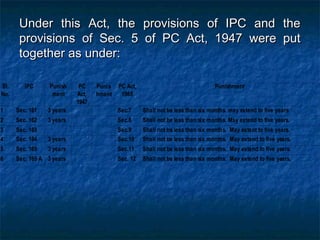
Under this Act, the provisions of IPC and theUnder this Act, the provisions of IPC and the
provisions of Sec. 5 of PC Act, 1947 were putprovisions of Sec. 5 of PC Act, 1947 were put
together as under:together as under:
Shall not be less than six months. May extend to five years.Sec. 123 yearsSec. 165 A6
Shall not be less than six months. May extend to five years.Sec.113 yearsSec. 1655
Shall not be less than six months. May extend to five years.Sec.103 yearsSec. 1644
Shall not be less than six months. May extent to five years.Sec.9Sec. 1633
Shall not be less than six months. May extend to five years.Sec.83 yearsSec. 1622
Shall not be less than six months. may extend to five yearsSec.73 yearsSec. 1611
PunishmentPC Act,
1988
Punis
hment
PC
Act,
1947
Punish
ment
IPCSl.
No.
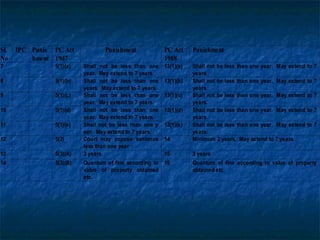
Quantum of fine according to value of property
obtained etc.
16Quantum of fine according to
value of property obtained
etc.
5(3)(B)14
3 years153 years5(3)(A)13
Minimum 2 years. May extend to 7 years.14Court may impose sentence
less than one year
5(3)12
Shall not be less than one year. May extend to 7
years.
13(1)(e)Shall not be less than one y
ear. May extend to 7 years.
5(1)(e)11
Shall not be less than one year. May extend to 7
years.
13(1)(d)Shall not be less than one
year. May extend to 7 years.
5(1)(d)10
Shall not be less than one year. May extend to 7
years.
13(1)(c)Shall not be less than one
year. May extend to 7 years
5(1)(c)9
Shall not be less than one year. May extend to 7
years.
13(1)(b)Shall not be less than one
years. May extend to 7 years
5(1)(b)8
Shall not be less than one year. May extend to 7
years.
13(1)(a)Shall not be less than one
year. May extend to 7 years
5(1)(a)7
PunishmentPC Act
1988
PunishmentPC Act
1947
Punis
hment
IPCSl.
No
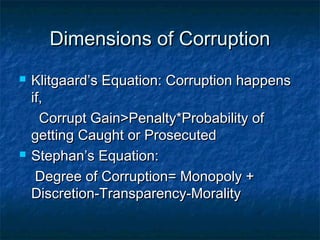
Dimensions of CorruptionDimensions of Corruption
 Klitgaard’s Equation: Corruption happensKlitgaard’s Equation: Corruption happens
if,if,
Corrupt Gain>Penalty*Probability ofCorrupt Gain>Penalty*Probability of
getting Caught or Prosecutedgetting Caught or Prosecuted
 Stephan’s Equation:Stephan’s Equation:
Degree of Corruption= Monopoly +Degree of Corruption= Monopoly +
Discretion-Transparency-MoralityDiscretion-Transparency-Morality
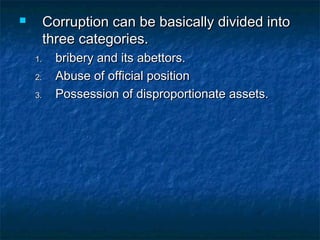
 Corruption can be basically divided intoCorruption can be basically divided into
three categories.three categories.
1.1. bribery and its abettors.bribery and its abettors.
2.2. Abuse of official positionAbuse of official position
3.3. Possession of disproportionate assets.Possession of disproportionate assets.
CONTENTIOUS SECTIONCONTENTIOUS SECTION
13(1)(d)(iii)13(1)(d)(iii)
 Section 13(1)(d)(iii) states that a PublicSection 13(1)(d)(iii) states that a Public
Servant commits misconduct when he,Servant commits misconduct when he,
while holding office as a Public Servant,while holding office as a Public Servant,
obtains for any other person any valuableobtains for any other person any valuable
thing or pecuniary advantage withoutthing or pecuniary advantage without
Public Interest . This means that withoutPublic Interest . This means that without
any quid pro quo, any decision takenany quid pro quo, any decision taken
benefitting a Private Party can be termedbenefitting a Private Party can be termed
as criminal misconductas criminal misconduct
CONTENTIOUS SECTIONCONTENTIOUS SECTION
13(1)(d)(iii)13(1)(d)(iii)
 It may be seen that it will be difficult toIt may be seen that it will be difficult to
show Public Interest when Private Party isshow Public Interest when Private Party is
benefitted by a Government Decision. It isbenefitted by a Government Decision. It is
precisely the reason why decision makingprecisely the reason why decision making
has been affected in Government . In thehas been affected in Government . In the
Odisha Talabira II Coal block allocation toOdisha Talabira II Coal block allocation to
Hindalco, CBI has charged Ex-PrimeHindalco, CBI has charged Ex-Prime
Minister Manmohan Singh, Ex-CoalMinister Manmohan Singh, Ex-Coal
Secretary P.C.Parakh & HindalcoSecretary P.C.Parakh & Hindalco
Chairman Kumaramangalam Birla underChairman Kumaramangalam Birla under
Actions to amend the PC ActActions to amend the PC Act
19881988
 The following Decisions have been takenThe following Decisions have been taken
to amend the Provisions of PC Actto amend the Provisions of PC Act
1988.The Bill has been introduced in1988.The Bill has been introduced in
Parliament and Cabinet has cleared theParliament and Cabinet has cleared the
same:-same:-
 (i) Minimum-Maximum Punishment(i) Minimum-Maximum Punishment
prescribed under Sections 7,8,9,10,11 andprescribed under Sections 7,8,9,10,11 and
12 which was 6months-5 years has been12 which was 6months-5 years has been
increased to 3 years-7 yearsincreased to 3 years-7 years
Actions to amend the PC ActActions to amend the PC Act
19881988
(ii) Trial under PC Act to complete in 2(ii) Trial under PC Act to complete in 2
years. Now it is taking about 8 years.years. Now it is taking about 8 years.
(iii) Prior sanction for prosecution under(iii) Prior sanction for prosecution under
Section 19 of the PC Act will be requiredSection 19 of the PC Act will be required
in case of Retired Officers. Earlier it wasin case of Retired Officers. Earlier it was
covering Serving Officers onlycovering Serving Officers only
(iv) Prior Sanction of Lokpal/Lokayukta will(iv) Prior Sanction of Lokpal/Lokayukta will
be required for inquiry/investigation intobe required for inquiry/investigation into
offences relatable to recommendationsoffences relatable to recommendations
Actions to amend the PC ActActions to amend the PC Act
19881988
(iv) Contd: made or decisions taken by(iv) Contd: made or decisions taken by
Public ServantsPublic Servants
(v) Intentional Enrichment of Public Servants(v) Intentional Enrichment of Public Servants
will be Criminal Misconduct andwill be Criminal Misconduct and
Disproportionate Assets will be proof of itDisproportionate Assets will be proof of it
(vi) Trial Court instead of District Court , will(vi) Trial Court instead of District Court , will
have power of attachment of disputedhave power of attachment of disputed
properties of accusedproperties of accused
Actions to amend the PC ActActions to amend the PC Act
19881988
(vii) Both Bribe Giver and Bribe taker will be(vii) Both Bribe Giver and Bribe taker will be
treated as Accused.treated as Accused.
(viii) PC (Amendment) Bill,2013 will be(viii) PC (Amendment) Bill,2013 will be
consistent with provisions of Unitedconsistent with provisions of United
Nations Convention Against CorruptionNations Convention Against Corruption
(UNCAC)(UNCAC)
(ix) Ambit of inducement of Public Servants(ix) Ambit of inducement of Public Servants
expanded from individuals to commercialexpanded from individuals to commercial
entities alsoentities also
Actions to amend the PC ActActions to amend the PC Act
19881988
 (x) Non-monetary Gratification has been(x) Non-monetary Gratification has been
covered under the definition ofcovered under the definition of
gratification.gratification.
 (xi) Issue of Guidelines for Commercial(xi) Issue of Guidelines for Commercial
Organizations to prevent their associatedOrganizations to prevent their associated
persons from bribing Public Servants.persons from bribing Public Servants.
 (xii) Corruption to be treated as a heinous(xii) Corruption to be treated as a heinous
crime with maximum punishment of Sevencrime with maximum punishment of Seven
YearsYears
Bribery and its AbettorsBribery and its Abettors
 Just as fish moving under water cannot possiblyJust as fish moving under water cannot possibly
be found either as drinking or not drinking water.be found either as drinking or not drinking water.
(Kautilya) Similarly, public servants cannot be(Kautilya) Similarly, public servants cannot be
found out while taking money.found out while taking money.
 Sec. 7 of PC Act 1988 deals with public servantSec. 7 of PC Act 1988 deals with public servant
taking gratification other than legaltaking gratification other than legal
remuneration.remuneration.
 The public servant becomesThe public servant becomes functus officiofunctus officio
when money offered to him as a bribe.when money offered to him as a bribe.
 Payment of a sum to a public servant whetherPayment of a sum to a public servant whether
paid before or after the act would constitutepaid before or after the act would constitute
bribe (bribe (Mohinder Lal Bagai v/s DelhiMohinder Lal Bagai v/s Delhi
Administration 1970 Cr LJ 793Administration 1970 Cr LJ 793 ))
 The practice of laying traps employing spies andThe practice of laying traps employing spies and
trap witnesses for detection of offences hastrap witnesses for detection of offences has
been recognized in this country (been recognized in this country (In reIn re
Ambujam Ammal, AIR 1954 Madras 326Ambujam Ammal, AIR 1954 Madras 326 ).).
 Sting operation by a private television channelSting operation by a private television channel
for detection of crime was also accepted (for detection of crime was also accepted (SriSri
Bharadwaj Media Pvt. Ltd. v/s State 2008Bharadwaj Media Pvt. Ltd. v/s State 2008
(2) Crimes 244 Delhi(2) Crimes 244 Delhi ). In this case, a telecast). In this case, a telecast
programme was shown from MPs receivingprogramme was shown from MPs receiving
money for raising question in Parliament. Themoney for raising question in Parliament. The
Delhi High Court observed that FIR could beDelhi High Court observed that FIR could be
quashed only if all facts stated when consideredquashed only if all facts stated when considered
true did not disclose cognizable offence.true did not disclose cognizable offence.
 Section 8 and 9 of PC ActSection 8 and 9 of PC Act areare
complimentary to sec.7 of the PC Act andcomplimentary to sec.7 of the PC Act and
are intended to reach to the aiders andare intended to reach to the aiders and
abettors of the offence.abettors of the offence.
 Section 8 and 9 of the PC ActSection 8 and 9 of the PC Act areare
applicable to public servants as well as toapplicable to public servants as well as to
private persons.private persons.
 TheThe abettorsabettors of the offences ofof the offences of sec.7sec.7
and 11and 11 are dealt underare dealt under sec.12sec.12 of the PCof the PC
Act for the abetment.Act for the abetment.
 The abettors of the offences u/The abettors of the offences u/sec. 8sec. 8 andand
99 are dealt u/are dealt u/sec.10sec.10 of the PC Act.of the PC Act.
 TheThe habitualhabitual abettors for the offencesabettors for the offences
u/sec.u/sec. 8, 9 and 12 of PC Act8, 9 and 12 of PC Act are dealtare dealt
under sec.under sec. 14 of the PC Act14 of the PC Act..
 The aggravated form of bribe i.e. habitualThe aggravated form of bribe i.e. habitual
acceptance of bribe is a criminalacceptance of bribe is a criminal
misconduct.misconduct.
 The habitual acceptance of valuable thingThe habitual acceptance of valuable thing
without consideration or inadequatewithout consideration or inadequate
consideration is also criminal misconduct.consideration is also criminal misconduct.
 The above forms are falling under theThe above forms are falling under the
category of bribery.category of bribery.
Provisions of PC Act 1988Provisions of PC Act 1988
 Section 16:Fines to take into account theSection 16:Fines to take into account the
pecuniary resources/property involved inpecuniary resources/property involved in
all cases including DA Casesall cases including DA Cases
 Section 17:Investiating Officers–Section 17:Investiating Officers–
Inspectors of CBI, ACPs in Metros & DyInspectors of CBI, ACPs in Metros & Dy
SPs in other placesSPs in other places
 Section 18:Inspetion of Bank Records ofSection 18:Inspetion of Bank Records of
accused by Investigating officers of SPaccused by Investigating officers of SP
rankrank
Abuse of official positionAbuse of official position
 Abuse means misuse i.e. using hisAbuse means misuse i.e. using his
position for something for which it is notposition for something for which it is not
intended.intended.
 The abuse of official position is wider thanThe abuse of official position is wider than
the offence of bribery.the offence of bribery.
 The abuse may be by corrupt or illegalThe abuse may be by corrupt or illegal
means .means .
 To obtain pecuniary advantage or anyTo obtain pecuniary advantage or any
valuable thing for himself or for any othervaluable thing for himself or for any other
person .person .
 To obtain pecuniary advantage or any valuableTo obtain pecuniary advantage or any valuable
thing for himself or for any other person withoutthing for himself or for any other person without
any public interest .any public interest .
 All bribery cases squarely fall under “obtaining anyAll bribery cases squarely fall under “obtaining any
pecuniary advantage “ in addition to sectionpecuniary advantage “ in addition to section 7 of7 of
the PC Act, 1988the PC Act, 1988 ..
 Causing wrongful loss to the Govt to obtainCausing wrongful loss to the Govt to obtain
pecuniary advantage for a third party falls underpecuniary advantage for a third party falls under
abuse of Powerabuse of Power (M Narayanan Nambiar Vs(M Narayanan Nambiar Vs
State of Kerala AIR 1963 SC 1116 ).State of Kerala AIR 1963 SC 1116 ).
 Issue of contracts to the bidders at higher ratesIssue of contracts to the bidders at higher rates
would also fall under abuse of powerswould also fall under abuse of powers
((Narbahadur Bhandari Vs State 2003 Cr.LJNarbahadur Bhandari Vs State 2003 Cr.LJ
2799 Sikkim, Ghulam Din Butch Vs State2799 Sikkim, Ghulam Din Butch Vs State
of J& K AIR 1996 SC 1568 ) .of J& K AIR 1996 SC 1568 ) .
Possession of disproportionatePossession of disproportionate
assetsassets
 Large numbers of public servants indulge inLarge numbers of public servants indulge in
corrupt activities on regular basis and somecorrupt activities on regular basis and some
times it would be difficult to catch them whiletimes it would be difficult to catch them while
accepting the bribe by laying a trap and the ill-accepting the bribe by laying a trap and the ill-
gotten money so colleted by them are convertedgotten money so colleted by them are converted
into assets. Hence, to detect such officer,into assets. Hence, to detect such officer,
disproportionate asset was made as an offencedisproportionate asset was made as an offence
in PC Act.in PC Act.
 In K. Veera Swami v/s Union of IndiaIn K. Veera Swami v/s Union of India
(1991) 3 SCC(1991) 3 SCC, the Hon’ble Supreme Court, the Hon’ble Supreme Court
observed that if one possesses assets beyondobserved that if one possesses assets beyond
his legitimate means, it goes without saying thathis legitimate means, it goes without saying that
the excess is out of ill-gotten gain. The assetsthe excess is out of ill-gotten gain. The assets
are not drawn like Nitrogen from the air.are not drawn like Nitrogen from the air.
 In P. Nallamal v/s State 1999 Cr LJ 3967In P. Nallamal v/s State 1999 Cr LJ 3967 ,,
the Hon’ble Supreme Court held that the abettorthe Hon’ble Supreme Court held that the abettor
can also be prosecuted for aiding to acquirecan also be prosecuted for aiding to acquire
disproportionate assets by the public servant.disproportionate assets by the public servant.
Every public servant is legally bound to inform theEvery public servant is legally bound to inform the
receipt of income otherwise the same cannot bereceipt of income otherwise the same cannot be
treated as income.treated as income.
 The above are only certain illustrations of briberyThe above are only certain illustrations of bribery
and corruption and the media may keep the sameand corruption and the media may keep the same
in mind while reporting any corruption relatedin mind while reporting any corruption related
matter .matter .
 If you shut your doors to all errors , truth will beIf you shut your doors to all errors , truth will be
shut out (Rabindra Nath Tagore).shut out (Rabindra Nath Tagore).
Sanction Under Section 19Sanction Under Section 19
 No court shall take cognizance of anNo court shall take cognizance of an
offence under sectionsoffence under sections 7, 10, 11, 13 and7, 10, 11, 13 and
15 of PC Act except with prior15 of PC Act except with prior
sanction.sanction.
 Sanction not required for the offences underSanction not required for the offences under
secsec 8, 9, 12 and 14 of PC Act8, 9, 12 and 14 of PC Act ..
 In case of Group-A officers, sanction isIn case of Group-A officers, sanction is
accorded by the Central Govt/State Govt.accorded by the Central Govt/State Govt.
 In case of others, viz., Public SectorIn case of others, viz., Public Sector
undertakings and Non Group-A officers,undertakings and Non Group-A officers,
sanction is accorded by the competentsanction is accorded by the competent
authority.authority.
 High court cannot give direction to theHigh court cannot give direction to the
sanctioning authority to grant sanction.sanctioning authority to grant sanction.
(Mansukh Lal Vithal Das Chauhan Vs.(Mansukh Lal Vithal Das Chauhan Vs.
State of Gujarat 1997 Crl.L.J 4059 SC)State of Gujarat 1997 Crl.L.J 4059 SC)
 Sanction for retired employees notSanction for retired employees not
necessary.necessary.
 Time limit of 3 months for issuing sanctionTime limit of 3 months for issuing sanction
order fixed by Hon’ble Supreme courtorder fixed by Hon’ble Supreme court
(Vineet Naraian Vs. Union of India AIR(Vineet Naraian Vs. Union of India AIR
1998 SC 889)1998 SC 889)
Provisions of PC Act 1988Provisions of PC Act 1988
 Section 20:Presumption of illegalSection 20:Presumption of illegal
gratifications by Public Servants undergratifications by Public Servants under
Sections 7,11 & 12Sections 7,11 & 12
 Section 21:Accused a Competent WitnessSection 21:Accused a Competent Witness
to defend himselfto defend himself
 Section 22:Cr.P.C. 1973 to apply withSection 22:Cr.P.C. 1973 to apply with
certain modificationscertain modifications
Provisions of PC Act 1988Provisions of PC Act 1988
 Section 23:In Misappropriation of PropertySection 23:In Misappropriation of Property
cases under Section 13(1)(c) of PC Actcases under Section 13(1)(c) of PC Act
dates between which such propertiesdates between which such properties
were misappropriated are required to bewere misappropriated are required to be
indicated and duration should not exceedindicated and duration should not exceed
One YearOne Year
 Section 24:Bribe Giver protected fromSection 24:Bribe Giver protected from
prosecution for his statementprosecution for his statement
 Section 25:Spl Judge under Act 46/1952Section 25:Spl Judge under Act 46/1952
Provisions of PC Act 1988Provisions of PC Act 1988
 Section 27:High Court to haveSection 27:High Court to have
Appeal/Revision powers over orders of SplAppeal/Revision powers over orders of Spl
JudgeJudge
 Section 28:Act to be in addition to anySection 28:Act to be in addition to any
other lawother law
 Section 29:Amendment to Criminal LawSection 29:Amendment to Criminal Law
Amendment Ordinance of 1944Amendment Ordinance of 1944
Provisions of PC Act 1988Provisions of PC Act 1988
 Section 30: Repeal & Saving of PC ActSection 30: Repeal & Saving of PC Act
19471947
 Section 31:Omission of Sections 161 toSection 31:Omission of Sections 161 to
165A of IPC 1861165A of IPC 1861
Amendments to PC Act 1988 (Bill ofAmendments to PC Act 1988 (Bill of
2013) is pending consideration of2013) is pending consideration of
Parliament to be in tune with UnitedParliament to be in tune with United
Nations Framework against Corruption.Nations Framework against Corruption.
Ethical Issues in Health SectorEthical Issues in Health Sector
of Indiaof India
 Bribes/Kickbacks like for false certificatesBribes/Kickbacks like for false certificates
 Theft/Embezzlement Instruments ,Theft/Embezzlement Instruments ,
MedicineMedicine
 Intentional Damage of Public Goods forIntentional Damage of Public Goods for
Private Gain Not working UG/X-RayPrivate Gain Not working UG/X-Ray
Machines Refer to Private Labs for gainMachines Refer to Private Labs for gain
 Large Scale AbsenteeismLarge Scale Absenteeism
 Informal Payments Bribes for giving BedInformal Payments Bribes for giving Bed
Ethical Issues in Health SectorEthical Issues in Health Sector
of Indiaof India
 Use Human Guinea pigs for Private Gain:Use Human Guinea pigs for Private Gain:
Clinical Trials & Research:2868 deaths inClinical Trials & Research:2868 deaths in
2005-2012 only 45 compensated2005-2012 only 45 compensated
 Institutionalized Corruption : DirectInstitutionalized Corruption : Direct
Patients to conduct Unnecessary tests atPatients to conduct Unnecessary tests at
Private Diagnostics Labs for commissionsPrivate Diagnostics Labs for commissions
as high as 30% to 60%as high as 30% to 60%
 The Art of “Healing” has turned into aThe Art of “Healing” has turned into a
Science of “Stealing”Science of “Stealing”
Ethical Issues in Health SectorEthical Issues in Health Sector
of Indiaof India
Areas of Concern (i) Patient CareAreas of Concern (i) Patient Care
(ii)Biomedical Research (iii)Medical(ii)Biomedical Research (iii)Medical
EducationEducation
Necessary Steps (i) Adopt Zero ToleranceNecessary Steps (i) Adopt Zero Tolerance
Policy for Unethical/Corrupt PracticesPolicy for Unethical/Corrupt Practices
(ii)Whole Hearted Support for Anti-(ii)Whole Hearted Support for Anti-
Corruption Measures (iii) Protection ofCorruption Measures (iii) Protection of
Whistleblowers (iv) Legislation (v)Whistleblowers (iv) Legislation (v)
EducationEducation
NRHM ScamNRHM Scam
 A Rs.10000 Crore Scam-5 PersonsA Rs.10000 Crore Scam-5 Persons
murdered/Committed Suicide -2murdered/Committed Suicide -2
CDMOs,2Deputy CDMOs, One ProjectCDMOs,2Deputy CDMOs, One Project
Manager and one clerkManager and one clerk
 Corruption in awarding work of repair ofCorruption in awarding work of repair of
134 district Hospitals, Supply of Medical134 district Hospitals, Supply of Medical
Equipments and supply of Computer &Equipments and supply of Computer &
PeripheralsPeripherals
 Chargesheet filed by CBI on 3Chargesheet filed by CBI on 3rdrd
,4,4thth
and 5and 5thth
NRHM ScamNRHM Scam
 Of April 2012Of April 2012
Works were awarded by nomination andWorks were awarded by nomination and
equipments were purchased at ten timesequipments were purchased at ten times
the Market Price.the Market Price.
 71 cases filed by CBI involving large71 cases filed by CBI involving large
number of Health Department officersnumber of Health Department officers
 Principal Secretary Health and MinisterPrincipal Secretary Health and Minister
(Family Welfare) chargesheeted. It is 10(Family Welfare) chargesheeted. It is 10
times the Fodder Scam of Rs.950 Crorestimes the Fodder Scam of Rs.950 Crores
NRHM ScamNRHM Scam
 State PSUs, UP Jal Nigam & UPSIC wereState PSUs, UP Jal Nigam & UPSIC were
fronting for the Private Parties. Partiesfronting for the Private Parties. Parties
Furnish Bogus & Forged DocumentsFurnish Bogus & Forged Documents
 Artificial Division of Department intoArtificial Division of Department into
Family Welfare & Health at State & DistrictFamily Welfare & Health at State & District
Levels against NRHM NormsLevels against NRHM Norms
 Minister’s Favourites appointed asMinister’s Favourites appointed as
CDMOs(FW) in the DistrictsCDMOs(FW) in the Districts
 Central Vigilance Commission (CVC) is aCentral Vigilance Commission (CVC) is a
commission established under CVC Actcommission established under CVC Act
20032003..
 According to sec 8(g) of CVC Act, it tendersAccording to sec 8(g) of CVC Act, it tenders
advice to the Central Govt., corporationsadvice to the Central Govt., corporations
established under any central act.established under any central act.
 CVC advices whether there is a prima facieCVC advices whether there is a prima facie
case against a Group-A officer/ Middlecase against a Group-A officer/ Middle
Management officer of a Corporation toManagement officer of a Corporation to
accord sanction or not.accord sanction or not.
 In case of difference of opinion between theIn case of difference of opinion between the
organisation and CBI, CVC resolves theorganisation and CBI, CVC resolves the
difference of opinion.difference of opinion.
 In case of difference of opinion betweenIn case of difference of opinion between
the organisation and CVC, a committeethe organisation and CVC, a committee
will resolve the difference of opinion.will resolve the difference of opinion.
 If commission’s advice to grant of sanctionIf commission’s advice to grant of sanction
is not accepted then the matter is referredis not accepted then the matter is referred
to DOPT for final decision.to DOPT for final decision.
 The object of sanction is to save publicThe object of sanction is to save public
servants for frivolous prosecution.servants for frivolous prosecution.
 Sanction order is an administrative act.Sanction order is an administrative act.
Pcactppt
Pcactppt

Pcactppt

  • 1.
    PREVENTION OF CORRUPTION ACT,1988 BY DR SATYANARAYANA DASH, INDEPENDENT MANAGEMENT PROFESSIONAL RETD ACTG CHAIRMAN ODISHA ADMINISTRATIVE TRIBUNAL
  • 2.
    EVOLUTION OF LAWEVOLUTIONOF LAW  INDIAN PENAL CODEINDIAN PENAL CODE was brought into forcewas brought into force fromfrom 01.01.186201.01.1862, though it received assent of, though it received assent of Governor General of India onGovernor General of India on 6th October6th October 18601860..  Indian Penal CodeIndian Penal Code Chapter-IXChapter-IX deals with alldeals with all offences by or relating to public servant. Thisoffences by or relating to public servant. This Chapter does not deal with misconduct andChapter does not deal with misconduct and abuse of power by the public servant.abuse of power by the public servant.
  • 3.
     Section 161to 165Section 161 to 165 of IPCof IPC deals with variousdeals with various offences of corruption and this is the first step tooffences of corruption and this is the first step to fight against corruption committed by the publicfight against corruption committed by the public servants.servants.  Section 161 of IPCSection 161 of IPC deals with a publicdeals with a public servant who accepts or obtains or agrees toservant who accepts or obtains or agrees to accept from any person for himself or for anyaccept from any person for himself or for any other person any gratification other than theother person any gratification other than the legal remuneration.legal remuneration.  Section 162 of IPCSection 162 of IPC deals with a person whodeals with a person who accepts or obtains or agrees to accept oraccepts or obtains or agrees to accept or attempts to obtain for himself or for any otherattempts to obtain for himself or for any other person any gratification by corrupt or illegalperson any gratification by corrupt or illegal means to influence a public servant.means to influence a public servant.
  • 4.
     Section 163of IPCSection 163 of IPC deals with a person whodeals with a person who accepts or obtains or agrees to accept oraccepts or obtains or agrees to accept or attempts to obtain for himself or for any otherattempts to obtain for himself or for any other person any gratification for inducing and byperson any gratification for inducing and by exercise of personal influence with any publicexercise of personal influence with any public servant.servant.  Section 164 of IPCSection 164 of IPC deals with abetment ofdeals with abetment of offence of sec.162 and 163 IPC.offence of sec.162 and 163 IPC.  Section 165 of IPCSection 165 of IPC deals with a publicdeals with a public servant who accepts or obtains or agrees toservant who accepts or obtains or agrees to accept or attempts to obtain for himself or foraccept or attempts to obtain for himself or for any other person any valuable thing without anyany other person any valuable thing without any consideration or less consideration.consideration or less consideration.
  • 5.
     There wasno offence till 1952 forThere was no offence till 1952 for abetment of any offence u/sec.161 or 165.abetment of any offence u/sec.161 or 165. Hence, in 1952, by way of Criminal LawHence, in 1952, by way of Criminal Law Amendment, 165-A was inserted to makeAmendment, 165-A was inserted to make abettor of sec.161 or 165 of IPC asabettor of sec.161 or 165 of IPC as offenders.offenders.
  • 6.
    What amounts toa bribe?What amounts to a bribe? I.I. The receiver must be a public servant.The receiver must be a public servant. II.II. He must solicit or receive illegal gratification.He must solicit or receive illegal gratification. III.III. He must have received the same as a motiveHe must have received the same as a motive or reward.or reward. IV.IV. It should be other than legal remuneration.It should be other than legal remuneration.  Motive is for doing a future act.Motive is for doing a future act.  Reward is for a past act.Reward is for a past act.
  • 7.
     Mere demandof bribe by a public servant is anMere demand of bribe by a public servant is an offence u/sec. 161 IPC (offence u/sec. 161 IPC (Mubarak Ali v/s StateMubarak Ali v/s State AIR 1958 MP page-157AIR 1958 MP page-157 ).).  Gratification is not restricted to pecuniaryGratification is not restricted to pecuniary gratification or estimable in money (gratification or estimable in money (C.I. EmdenC.I. Emden v/s State of UP AIR 1960 SC 548v/s State of UP AIR 1960 SC 548 ).).  DuringDuring 2nd World War2nd World War, there was large scale of, there was large scale of corruption in War Dept. which necessitated forcorruption in War Dept. which necessitated for creation of acreation of a Special Police EstablishmentSpecial Police Establishment toto curb corruption.curb corruption.  Later the Special Police Establishment becameLater the Special Police Establishment became the Central Bureau of Investigation.the Central Bureau of Investigation.  There was no special act forThere was no special act for Prevention ofPrevention of Corruption till 11th March 1947.Corruption till 11th March 1947.
  • 8.
     A SpecialAct i.e. Prevention of CorruptionA Special Act i.e. Prevention of Corruption Act, 1947 came into existence fromAct, 1947 came into existence from 11th11th March 1947March 1947 to make more effectiveto make more effective provision for the prevention of bribery andprovision for the prevention of bribery and corruption.corruption.  By enacting the Special Act, in addition toBy enacting the Special Act, in addition to IPC provisions (Sec.161 to 165)IPC provisions (Sec.161 to 165) CriminalCriminal MisconductMisconduct was made as an offence aswas made as an offence as per Sec.5 of PC Act, 1947.per Sec.5 of PC Act, 1947.
  • 9.
    Provisions of PCAct 1988Provisions of PC Act 1988  Section 7:Public Servant taking bribeSection 7:Public Servant taking bribe  Section 8:Person/Public Servant takingSection 8:Person/Public Servant taking bribe to induce a Public Servantbribe to induce a Public Servant  Section 9:Person/Public Servant takingSection 9:Person/Public Servant taking bribe for personally influencing a Publicbribe for personally influencing a Public ServantServant  Section 10:Public Servant abetting SectionSection 10:Public Servant abetting Section 8 & 9 offence8 & 9 offence
  • 10.
    Provisions of PCAct 1988Provisions of PC Act 1988  Section 11:Public Servant AcceptingSection 11:Public Servant Accepting Valuable thing from a person forValuable thing from a person for nil/inadequate considerationnil/inadequate consideration  Section 12:Persons/Public ServantsSection 12:Persons/Public Servants abetting offences under Sections 7 & 11abetting offences under Sections 7 & 11  Section 14:Habitual Offenders of offencesSection 14:Habitual Offenders of offences under Sections 8,9 & 12under Sections 8,9 & 12  Section 15:Attempting offences underSection 15:Attempting offences under Sections 13(1)(c) & 13(1)(d)Sections 13(1)(c) & 13(1)(d)
  • 11.
    Criminal MisconductCriminal Misconduct 1.1.If a public servantIf a public servant habituallyhabitually accepts anyaccepts any bribe. This offence is aggravated form of 161bribe. This offence is aggravated form of 161 IPC. Section 13(1)(a) –habitual Section 7IPC. Section 13(1)(a) –habitual Section 7 2.2. If a public servantIf a public servant habituallyhabitually accepts anyaccepts any valuable thing without consideration or for lessvaluable thing without consideration or for less consideration with whom he transactedconsideration with whom he transacted business or about to be transacted. It isbusiness or about to be transacted. It is aggravated form of sec. 165 IPC. Sectionaggravated form of sec. 165 IPC. Section 13(1)(b)- habitual Section 1113(1)(b)- habitual Section 11 3.3. FraudulentlyFraudulently misappropriates or convertsmisappropriates or converts for his own use any property entrusted to himfor his own use any property entrusted to him or under his control or allows any otheror under his control or allows any other person. Section 13(1)(c)person. Section 13(1)(c)
  • 12.
    4.4. ByBy corruptcorruptandand illegalillegal means ormeans or otherwise by abusing his official positionotherwise by abusing his official position as public servant obtains any valuableas public servant obtains any valuable thing or pecuniary advantage. Sectionthing or pecuniary advantage. Section 13(1)(d)(i) & Section 13(1)(d)(ii)13(1)(d)(i) & Section 13(1)(d)(ii) 5.5. Possession of Disproportionate Assets.Possession of Disproportionate Assets. Section 13(1)(e)Section 13(1)(e)  To consolidate the law relating to theTo consolidate the law relating to the Prevention of Corruption, the old PC ActPrevention of Corruption, the old PC Act is repealed, and the provisions ofis repealed, and the provisions of Section 161 to 165-A IPC were alsoSection 161 to 165-A IPC were also repealed by introducing PC Act, 1988repealed by introducing PC Act, 1988 which came into effect fromwhich came into effect from
  • 13.
    Under this Act,the provisions of IPC and theUnder this Act, the provisions of IPC and the provisions of Sec. 5 of PC Act, 1947 were putprovisions of Sec. 5 of PC Act, 1947 were put together as under:together as under: Shall not be less than six months. May extend to five years.Sec. 123 yearsSec. 165 A6 Shall not be less than six months. May extend to five years.Sec.113 yearsSec. 1655 Shall not be less than six months. May extend to five years.Sec.103 yearsSec. 1644 Shall not be less than six months. May extent to five years.Sec.9Sec. 1633 Shall not be less than six months. May extend to five years.Sec.83 yearsSec. 1622 Shall not be less than six months. may extend to five yearsSec.73 yearsSec. 1611 PunishmentPC Act, 1988 Punis hment PC Act, 1947 Punish ment IPCSl. No.
  • 14.
    Quantum of fineaccording to value of property obtained etc. 16Quantum of fine according to value of property obtained etc. 5(3)(B)14 3 years153 years5(3)(A)13 Minimum 2 years. May extend to 7 years.14Court may impose sentence less than one year 5(3)12 Shall not be less than one year. May extend to 7 years. 13(1)(e)Shall not be less than one y ear. May extend to 7 years. 5(1)(e)11 Shall not be less than one year. May extend to 7 years. 13(1)(d)Shall not be less than one year. May extend to 7 years. 5(1)(d)10 Shall not be less than one year. May extend to 7 years. 13(1)(c)Shall not be less than one year. May extend to 7 years 5(1)(c)9 Shall not be less than one year. May extend to 7 years. 13(1)(b)Shall not be less than one years. May extend to 7 years 5(1)(b)8 Shall not be less than one year. May extend to 7 years. 13(1)(a)Shall not be less than one year. May extend to 7 years 5(1)(a)7 PunishmentPC Act 1988 PunishmentPC Act 1947 Punis hment IPCSl. No
  • 15.
    Dimensions of CorruptionDimensionsof Corruption  Klitgaard’s Equation: Corruption happensKlitgaard’s Equation: Corruption happens if,if, Corrupt Gain>Penalty*Probability ofCorrupt Gain>Penalty*Probability of getting Caught or Prosecutedgetting Caught or Prosecuted  Stephan’s Equation:Stephan’s Equation: Degree of Corruption= Monopoly +Degree of Corruption= Monopoly + Discretion-Transparency-MoralityDiscretion-Transparency-Morality
  • 16.
     Corruption canbe basically divided intoCorruption can be basically divided into three categories.three categories. 1.1. bribery and its abettors.bribery and its abettors. 2.2. Abuse of official positionAbuse of official position 3.3. Possession of disproportionate assets.Possession of disproportionate assets.
  • 17.
    CONTENTIOUS SECTIONCONTENTIOUS SECTION 13(1)(d)(iii)13(1)(d)(iii) Section 13(1)(d)(iii) states that a PublicSection 13(1)(d)(iii) states that a Public Servant commits misconduct when he,Servant commits misconduct when he, while holding office as a Public Servant,while holding office as a Public Servant, obtains for any other person any valuableobtains for any other person any valuable thing or pecuniary advantage withoutthing or pecuniary advantage without Public Interest . This means that withoutPublic Interest . This means that without any quid pro quo, any decision takenany quid pro quo, any decision taken benefitting a Private Party can be termedbenefitting a Private Party can be termed as criminal misconductas criminal misconduct
  • 18.
    CONTENTIOUS SECTIONCONTENTIOUS SECTION 13(1)(d)(iii)13(1)(d)(iii) It may be seen that it will be difficult toIt may be seen that it will be difficult to show Public Interest when Private Party isshow Public Interest when Private Party is benefitted by a Government Decision. It isbenefitted by a Government Decision. It is precisely the reason why decision makingprecisely the reason why decision making has been affected in Government . In thehas been affected in Government . In the Odisha Talabira II Coal block allocation toOdisha Talabira II Coal block allocation to Hindalco, CBI has charged Ex-PrimeHindalco, CBI has charged Ex-Prime Minister Manmohan Singh, Ex-CoalMinister Manmohan Singh, Ex-Coal Secretary P.C.Parakh & HindalcoSecretary P.C.Parakh & Hindalco Chairman Kumaramangalam Birla underChairman Kumaramangalam Birla under
  • 19.
    Actions to amendthe PC ActActions to amend the PC Act 19881988  The following Decisions have been takenThe following Decisions have been taken to amend the Provisions of PC Actto amend the Provisions of PC Act 1988.The Bill has been introduced in1988.The Bill has been introduced in Parliament and Cabinet has cleared theParliament and Cabinet has cleared the same:-same:-  (i) Minimum-Maximum Punishment(i) Minimum-Maximum Punishment prescribed under Sections 7,8,9,10,11 andprescribed under Sections 7,8,9,10,11 and 12 which was 6months-5 years has been12 which was 6months-5 years has been increased to 3 years-7 yearsincreased to 3 years-7 years
  • 20.
    Actions to amendthe PC ActActions to amend the PC Act 19881988 (ii) Trial under PC Act to complete in 2(ii) Trial under PC Act to complete in 2 years. Now it is taking about 8 years.years. Now it is taking about 8 years. (iii) Prior sanction for prosecution under(iii) Prior sanction for prosecution under Section 19 of the PC Act will be requiredSection 19 of the PC Act will be required in case of Retired Officers. Earlier it wasin case of Retired Officers. Earlier it was covering Serving Officers onlycovering Serving Officers only (iv) Prior Sanction of Lokpal/Lokayukta will(iv) Prior Sanction of Lokpal/Lokayukta will be required for inquiry/investigation intobe required for inquiry/investigation into offences relatable to recommendationsoffences relatable to recommendations
  • 21.
    Actions to amendthe PC ActActions to amend the PC Act 19881988 (iv) Contd: made or decisions taken by(iv) Contd: made or decisions taken by Public ServantsPublic Servants (v) Intentional Enrichment of Public Servants(v) Intentional Enrichment of Public Servants will be Criminal Misconduct andwill be Criminal Misconduct and Disproportionate Assets will be proof of itDisproportionate Assets will be proof of it (vi) Trial Court instead of District Court , will(vi) Trial Court instead of District Court , will have power of attachment of disputedhave power of attachment of disputed properties of accusedproperties of accused
  • 22.
    Actions to amendthe PC ActActions to amend the PC Act 19881988 (vii) Both Bribe Giver and Bribe taker will be(vii) Both Bribe Giver and Bribe taker will be treated as Accused.treated as Accused. (viii) PC (Amendment) Bill,2013 will be(viii) PC (Amendment) Bill,2013 will be consistent with provisions of Unitedconsistent with provisions of United Nations Convention Against CorruptionNations Convention Against Corruption (UNCAC)(UNCAC) (ix) Ambit of inducement of Public Servants(ix) Ambit of inducement of Public Servants expanded from individuals to commercialexpanded from individuals to commercial entities alsoentities also
  • 23.
    Actions to amendthe PC ActActions to amend the PC Act 19881988  (x) Non-monetary Gratification has been(x) Non-monetary Gratification has been covered under the definition ofcovered under the definition of gratification.gratification.  (xi) Issue of Guidelines for Commercial(xi) Issue of Guidelines for Commercial Organizations to prevent their associatedOrganizations to prevent their associated persons from bribing Public Servants.persons from bribing Public Servants.  (xii) Corruption to be treated as a heinous(xii) Corruption to be treated as a heinous crime with maximum punishment of Sevencrime with maximum punishment of Seven YearsYears
  • 24.
    Bribery and itsAbettorsBribery and its Abettors  Just as fish moving under water cannot possiblyJust as fish moving under water cannot possibly be found either as drinking or not drinking water.be found either as drinking or not drinking water. (Kautilya) Similarly, public servants cannot be(Kautilya) Similarly, public servants cannot be found out while taking money.found out while taking money.  Sec. 7 of PC Act 1988 deals with public servantSec. 7 of PC Act 1988 deals with public servant taking gratification other than legaltaking gratification other than legal remuneration.remuneration.  The public servant becomesThe public servant becomes functus officiofunctus officio when money offered to him as a bribe.when money offered to him as a bribe.
  • 25.
     Payment ofa sum to a public servant whetherPayment of a sum to a public servant whether paid before or after the act would constitutepaid before or after the act would constitute bribe (bribe (Mohinder Lal Bagai v/s DelhiMohinder Lal Bagai v/s Delhi Administration 1970 Cr LJ 793Administration 1970 Cr LJ 793 ))  The practice of laying traps employing spies andThe practice of laying traps employing spies and trap witnesses for detection of offences hastrap witnesses for detection of offences has been recognized in this country (been recognized in this country (In reIn re Ambujam Ammal, AIR 1954 Madras 326Ambujam Ammal, AIR 1954 Madras 326 ).).  Sting operation by a private television channelSting operation by a private television channel for detection of crime was also accepted (for detection of crime was also accepted (SriSri Bharadwaj Media Pvt. Ltd. v/s State 2008Bharadwaj Media Pvt. Ltd. v/s State 2008 (2) Crimes 244 Delhi(2) Crimes 244 Delhi ). In this case, a telecast). In this case, a telecast programme was shown from MPs receivingprogramme was shown from MPs receiving money for raising question in Parliament. Themoney for raising question in Parliament. The Delhi High Court observed that FIR could beDelhi High Court observed that FIR could be quashed only if all facts stated when consideredquashed only if all facts stated when considered true did not disclose cognizable offence.true did not disclose cognizable offence.
  • 26.
     Section 8and 9 of PC ActSection 8 and 9 of PC Act areare complimentary to sec.7 of the PC Act andcomplimentary to sec.7 of the PC Act and are intended to reach to the aiders andare intended to reach to the aiders and abettors of the offence.abettors of the offence.  Section 8 and 9 of the PC ActSection 8 and 9 of the PC Act areare applicable to public servants as well as toapplicable to public servants as well as to private persons.private persons.  TheThe abettorsabettors of the offences ofof the offences of sec.7sec.7 and 11and 11 are dealt underare dealt under sec.12sec.12 of the PCof the PC Act for the abetment.Act for the abetment.  The abettors of the offences u/The abettors of the offences u/sec. 8sec. 8 andand 99 are dealt u/are dealt u/sec.10sec.10 of the PC Act.of the PC Act.
  • 27.
     TheThe habitualhabitualabettors for the offencesabettors for the offences u/sec.u/sec. 8, 9 and 12 of PC Act8, 9 and 12 of PC Act are dealtare dealt under sec.under sec. 14 of the PC Act14 of the PC Act..  The aggravated form of bribe i.e. habitualThe aggravated form of bribe i.e. habitual acceptance of bribe is a criminalacceptance of bribe is a criminal misconduct.misconduct.  The habitual acceptance of valuable thingThe habitual acceptance of valuable thing without consideration or inadequatewithout consideration or inadequate consideration is also criminal misconduct.consideration is also criminal misconduct.  The above forms are falling under theThe above forms are falling under the category of bribery.category of bribery.
  • 28.
    Provisions of PCAct 1988Provisions of PC Act 1988  Section 16:Fines to take into account theSection 16:Fines to take into account the pecuniary resources/property involved inpecuniary resources/property involved in all cases including DA Casesall cases including DA Cases  Section 17:Investiating Officers–Section 17:Investiating Officers– Inspectors of CBI, ACPs in Metros & DyInspectors of CBI, ACPs in Metros & Dy SPs in other placesSPs in other places  Section 18:Inspetion of Bank Records ofSection 18:Inspetion of Bank Records of accused by Investigating officers of SPaccused by Investigating officers of SP rankrank
  • 29.
    Abuse of officialpositionAbuse of official position  Abuse means misuse i.e. using hisAbuse means misuse i.e. using his position for something for which it is notposition for something for which it is not intended.intended.  The abuse of official position is wider thanThe abuse of official position is wider than the offence of bribery.the offence of bribery.  The abuse may be by corrupt or illegalThe abuse may be by corrupt or illegal means .means .  To obtain pecuniary advantage or anyTo obtain pecuniary advantage or any valuable thing for himself or for any othervaluable thing for himself or for any other person .person .
  • 30.
     To obtainpecuniary advantage or any valuableTo obtain pecuniary advantage or any valuable thing for himself or for any other person withoutthing for himself or for any other person without any public interest .any public interest .  All bribery cases squarely fall under “obtaining anyAll bribery cases squarely fall under “obtaining any pecuniary advantage “ in addition to sectionpecuniary advantage “ in addition to section 7 of7 of the PC Act, 1988the PC Act, 1988 ..  Causing wrongful loss to the Govt to obtainCausing wrongful loss to the Govt to obtain pecuniary advantage for a third party falls underpecuniary advantage for a third party falls under abuse of Powerabuse of Power (M Narayanan Nambiar Vs(M Narayanan Nambiar Vs State of Kerala AIR 1963 SC 1116 ).State of Kerala AIR 1963 SC 1116 ).  Issue of contracts to the bidders at higher ratesIssue of contracts to the bidders at higher rates would also fall under abuse of powerswould also fall under abuse of powers ((Narbahadur Bhandari Vs State 2003 Cr.LJNarbahadur Bhandari Vs State 2003 Cr.LJ 2799 Sikkim, Ghulam Din Butch Vs State2799 Sikkim, Ghulam Din Butch Vs State of J& K AIR 1996 SC 1568 ) .of J& K AIR 1996 SC 1568 ) .
  • 31.
    Possession of disproportionatePossessionof disproportionate assetsassets  Large numbers of public servants indulge inLarge numbers of public servants indulge in corrupt activities on regular basis and somecorrupt activities on regular basis and some times it would be difficult to catch them whiletimes it would be difficult to catch them while accepting the bribe by laying a trap and the ill-accepting the bribe by laying a trap and the ill- gotten money so colleted by them are convertedgotten money so colleted by them are converted into assets. Hence, to detect such officer,into assets. Hence, to detect such officer, disproportionate asset was made as an offencedisproportionate asset was made as an offence in PC Act.in PC Act.  In K. Veera Swami v/s Union of IndiaIn K. Veera Swami v/s Union of India (1991) 3 SCC(1991) 3 SCC, the Hon’ble Supreme Court, the Hon’ble Supreme Court observed that if one possesses assets beyondobserved that if one possesses assets beyond his legitimate means, it goes without saying thathis legitimate means, it goes without saying that the excess is out of ill-gotten gain. The assetsthe excess is out of ill-gotten gain. The assets are not drawn like Nitrogen from the air.are not drawn like Nitrogen from the air.
  • 32.
     In P.Nallamal v/s State 1999 Cr LJ 3967In P. Nallamal v/s State 1999 Cr LJ 3967 ,, the Hon’ble Supreme Court held that the abettorthe Hon’ble Supreme Court held that the abettor can also be prosecuted for aiding to acquirecan also be prosecuted for aiding to acquire disproportionate assets by the public servant.disproportionate assets by the public servant. Every public servant is legally bound to inform theEvery public servant is legally bound to inform the receipt of income otherwise the same cannot bereceipt of income otherwise the same cannot be treated as income.treated as income.  The above are only certain illustrations of briberyThe above are only certain illustrations of bribery and corruption and the media may keep the sameand corruption and the media may keep the same in mind while reporting any corruption relatedin mind while reporting any corruption related matter .matter .  If you shut your doors to all errors , truth will beIf you shut your doors to all errors , truth will be shut out (Rabindra Nath Tagore).shut out (Rabindra Nath Tagore).
  • 33.
    Sanction Under Section19Sanction Under Section 19  No court shall take cognizance of anNo court shall take cognizance of an offence under sectionsoffence under sections 7, 10, 11, 13 and7, 10, 11, 13 and 15 of PC Act except with prior15 of PC Act except with prior sanction.sanction.  Sanction not required for the offences underSanction not required for the offences under secsec 8, 9, 12 and 14 of PC Act8, 9, 12 and 14 of PC Act ..  In case of Group-A officers, sanction isIn case of Group-A officers, sanction is accorded by the Central Govt/State Govt.accorded by the Central Govt/State Govt.  In case of others, viz., Public SectorIn case of others, viz., Public Sector undertakings and Non Group-A officers,undertakings and Non Group-A officers, sanction is accorded by the competentsanction is accorded by the competent authority.authority.
  • 34.
     High courtcannot give direction to theHigh court cannot give direction to the sanctioning authority to grant sanction.sanctioning authority to grant sanction. (Mansukh Lal Vithal Das Chauhan Vs.(Mansukh Lal Vithal Das Chauhan Vs. State of Gujarat 1997 Crl.L.J 4059 SC)State of Gujarat 1997 Crl.L.J 4059 SC)  Sanction for retired employees notSanction for retired employees not necessary.necessary.  Time limit of 3 months for issuing sanctionTime limit of 3 months for issuing sanction order fixed by Hon’ble Supreme courtorder fixed by Hon’ble Supreme court (Vineet Naraian Vs. Union of India AIR(Vineet Naraian Vs. Union of India AIR 1998 SC 889)1998 SC 889)
  • 35.
    Provisions of PCAct 1988Provisions of PC Act 1988  Section 20:Presumption of illegalSection 20:Presumption of illegal gratifications by Public Servants undergratifications by Public Servants under Sections 7,11 & 12Sections 7,11 & 12  Section 21:Accused a Competent WitnessSection 21:Accused a Competent Witness to defend himselfto defend himself  Section 22:Cr.P.C. 1973 to apply withSection 22:Cr.P.C. 1973 to apply with certain modificationscertain modifications
  • 36.
    Provisions of PCAct 1988Provisions of PC Act 1988  Section 23:In Misappropriation of PropertySection 23:In Misappropriation of Property cases under Section 13(1)(c) of PC Actcases under Section 13(1)(c) of PC Act dates between which such propertiesdates between which such properties were misappropriated are required to bewere misappropriated are required to be indicated and duration should not exceedindicated and duration should not exceed One YearOne Year  Section 24:Bribe Giver protected fromSection 24:Bribe Giver protected from prosecution for his statementprosecution for his statement  Section 25:Spl Judge under Act 46/1952Section 25:Spl Judge under Act 46/1952
  • 37.
    Provisions of PCAct 1988Provisions of PC Act 1988  Section 27:High Court to haveSection 27:High Court to have Appeal/Revision powers over orders of SplAppeal/Revision powers over orders of Spl JudgeJudge  Section 28:Act to be in addition to anySection 28:Act to be in addition to any other lawother law  Section 29:Amendment to Criminal LawSection 29:Amendment to Criminal Law Amendment Ordinance of 1944Amendment Ordinance of 1944
  • 38.
    Provisions of PCAct 1988Provisions of PC Act 1988  Section 30: Repeal & Saving of PC ActSection 30: Repeal & Saving of PC Act 19471947  Section 31:Omission of Sections 161 toSection 31:Omission of Sections 161 to 165A of IPC 1861165A of IPC 1861 Amendments to PC Act 1988 (Bill ofAmendments to PC Act 1988 (Bill of 2013) is pending consideration of2013) is pending consideration of Parliament to be in tune with UnitedParliament to be in tune with United Nations Framework against Corruption.Nations Framework against Corruption.
  • 39.
    Ethical Issues inHealth SectorEthical Issues in Health Sector of Indiaof India  Bribes/Kickbacks like for false certificatesBribes/Kickbacks like for false certificates  Theft/Embezzlement Instruments ,Theft/Embezzlement Instruments , MedicineMedicine  Intentional Damage of Public Goods forIntentional Damage of Public Goods for Private Gain Not working UG/X-RayPrivate Gain Not working UG/X-Ray Machines Refer to Private Labs for gainMachines Refer to Private Labs for gain  Large Scale AbsenteeismLarge Scale Absenteeism  Informal Payments Bribes for giving BedInformal Payments Bribes for giving Bed
  • 40.
    Ethical Issues inHealth SectorEthical Issues in Health Sector of Indiaof India  Use Human Guinea pigs for Private Gain:Use Human Guinea pigs for Private Gain: Clinical Trials & Research:2868 deaths inClinical Trials & Research:2868 deaths in 2005-2012 only 45 compensated2005-2012 only 45 compensated  Institutionalized Corruption : DirectInstitutionalized Corruption : Direct Patients to conduct Unnecessary tests atPatients to conduct Unnecessary tests at Private Diagnostics Labs for commissionsPrivate Diagnostics Labs for commissions as high as 30% to 60%as high as 30% to 60%  The Art of “Healing” has turned into aThe Art of “Healing” has turned into a Science of “Stealing”Science of “Stealing”
  • 41.
    Ethical Issues inHealth SectorEthical Issues in Health Sector of Indiaof India Areas of Concern (i) Patient CareAreas of Concern (i) Patient Care (ii)Biomedical Research (iii)Medical(ii)Biomedical Research (iii)Medical EducationEducation Necessary Steps (i) Adopt Zero ToleranceNecessary Steps (i) Adopt Zero Tolerance Policy for Unethical/Corrupt PracticesPolicy for Unethical/Corrupt Practices (ii)Whole Hearted Support for Anti-(ii)Whole Hearted Support for Anti- Corruption Measures (iii) Protection ofCorruption Measures (iii) Protection of Whistleblowers (iv) Legislation (v)Whistleblowers (iv) Legislation (v) EducationEducation
  • 42.
    NRHM ScamNRHM Scam A Rs.10000 Crore Scam-5 PersonsA Rs.10000 Crore Scam-5 Persons murdered/Committed Suicide -2murdered/Committed Suicide -2 CDMOs,2Deputy CDMOs, One ProjectCDMOs,2Deputy CDMOs, One Project Manager and one clerkManager and one clerk  Corruption in awarding work of repair ofCorruption in awarding work of repair of 134 district Hospitals, Supply of Medical134 district Hospitals, Supply of Medical Equipments and supply of Computer &Equipments and supply of Computer & PeripheralsPeripherals  Chargesheet filed by CBI on 3Chargesheet filed by CBI on 3rdrd ,4,4thth and 5and 5thth
  • 43.
    NRHM ScamNRHM Scam Of April 2012Of April 2012 Works were awarded by nomination andWorks were awarded by nomination and equipments were purchased at ten timesequipments were purchased at ten times the Market Price.the Market Price.  71 cases filed by CBI involving large71 cases filed by CBI involving large number of Health Department officersnumber of Health Department officers  Principal Secretary Health and MinisterPrincipal Secretary Health and Minister (Family Welfare) chargesheeted. It is 10(Family Welfare) chargesheeted. It is 10 times the Fodder Scam of Rs.950 Crorestimes the Fodder Scam of Rs.950 Crores
  • 44.
    NRHM ScamNRHM Scam State PSUs, UP Jal Nigam & UPSIC wereState PSUs, UP Jal Nigam & UPSIC were fronting for the Private Parties. Partiesfronting for the Private Parties. Parties Furnish Bogus & Forged DocumentsFurnish Bogus & Forged Documents  Artificial Division of Department intoArtificial Division of Department into Family Welfare & Health at State & DistrictFamily Welfare & Health at State & District Levels against NRHM NormsLevels against NRHM Norms  Minister’s Favourites appointed asMinister’s Favourites appointed as CDMOs(FW) in the DistrictsCDMOs(FW) in the Districts
  • 45.
     Central VigilanceCommission (CVC) is aCentral Vigilance Commission (CVC) is a commission established under CVC Actcommission established under CVC Act 20032003..  According to sec 8(g) of CVC Act, it tendersAccording to sec 8(g) of CVC Act, it tenders advice to the Central Govt., corporationsadvice to the Central Govt., corporations established under any central act.established under any central act.  CVC advices whether there is a prima facieCVC advices whether there is a prima facie case against a Group-A officer/ Middlecase against a Group-A officer/ Middle Management officer of a Corporation toManagement officer of a Corporation to accord sanction or not.accord sanction or not.  In case of difference of opinion between theIn case of difference of opinion between the organisation and CBI, CVC resolves theorganisation and CBI, CVC resolves the difference of opinion.difference of opinion.
  • 46.
     In caseof difference of opinion betweenIn case of difference of opinion between the organisation and CVC, a committeethe organisation and CVC, a committee will resolve the difference of opinion.will resolve the difference of opinion.  If commission’s advice to grant of sanctionIf commission’s advice to grant of sanction is not accepted then the matter is referredis not accepted then the matter is referred to DOPT for final decision.to DOPT for final decision.  The object of sanction is to save publicThe object of sanction is to save public servants for frivolous prosecution.servants for frivolous prosecution.  Sanction order is an administrative act.Sanction order is an administrative act.