(8.5)TRANSFORMATIONAL LEADERSHIP
ALI TAHA OLEIWI
ROY HAIZAL BIN ABDELLAH
MUHAMMAD ZAKWAN BIN ABU HUSSIN
MOHAMMED HAYDER NADHIM
ALI MUGAHED ALI AL-RAHMI
GP170033
GP170081
GP170096
GP170097
GP170108
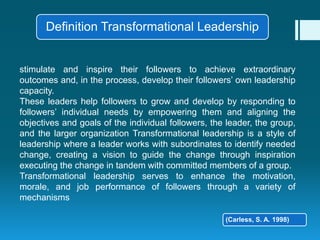
Definition Transformational Leadership
stimulate and inspire their followers to achieve extraordinary
outcomes and, in the process, develop their followers’ own leadership
capacity.
These leaders help followers to grow and develop by responding to
followers’ individual needs by empowering them and aligning the
objectives and goals of the individual followers, the leader, the group,
and the larger organization Transformational leadership is a style of
leadership where a leader works with subordinates to identify needed
change, creating a vision to guide the change through inspiration
executing the change in tandem with committed members of a group.
Transformational leadership serves to enhance the motivation,
morale, and job performance of followers through a variety of
mechanisms
(Carless, S. A. 1998)
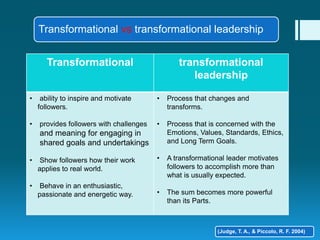
Transformational transformational
leadership
• ability to inspire and motivate
followers.
• provides followers with challenges
and meaning for engaging in
shared goals and undertakings
• Show followers how their work
applies to real world.
• Behave in an enthusiastic,
passionate and energetic way.
• Process that changes and
transforms.
• Process that is concerned with the
Emotions, Values, Standards, Ethics,
and Long Term Goals.
• A transformational leader motivates
followers to accomplish more than
what is usually expected.
• The sum becomes more powerful
than its Parts.
Transformational vs transformational leadership
(Judge, T. A., & Piccolo, R. F. 2004)
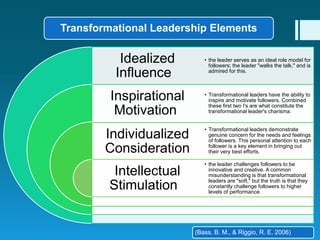
Transformational Leadership Elements
Idealized
Influence
Inspirational
Motivation
Individualized
Consideration
Intellectual
Stimulation
• the leader serves as an ideal role model for
followers; the leader "walks the talk," and is
admired for this.
• Transformational leaders have the ability to
inspire and motivate followers. Combined
these first two I's are what constitute the
transformational leader's charisma.
• Transformational leaders demonstrate
genuine concern for the needs and feelings
of followers. This personal attention to each
follower is a key element in bringing out
their very best efforts.
• the leader challenges followers to be
innovative and creative. A common
misunderstanding is that transformational
leaders are "soft," but the truth is that they
constantly challenge followers to higher
levels of performance.
(Bass, B. M., & Riggio, R. E. 2006)
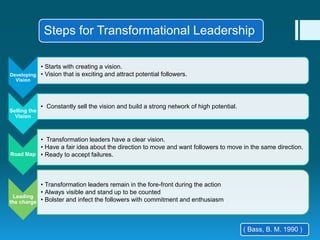
Steps for Transformational Leadership
Developing
Vision
• Starts with creating a vision.
• Vision that is exciting and attract potential followers.
Selling the
Vision
• Constantly sell the vision and build a strong network of high potential.
Road Map
• Transformation leaders have a clear vision.
• Have a fair idea about the direction to move and want followers to move in the same direction.
• Ready to accept failures.
Leading
the charge
• Transformation leaders remain in the fore-front during the action
• Always visible and stand up to be counted
• Bolster and infect the followers with commitment and enthusiasm
( Bass, B. M. 1990 )
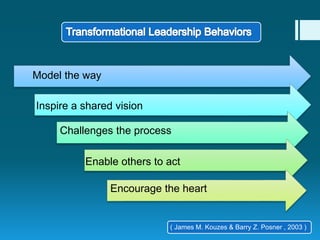
Model the way
Inspire a shared vision
Challenges the process
Enable others to act
Encourage the heart
( James M. Kouzes & Barry Z. Posner , 2003 )
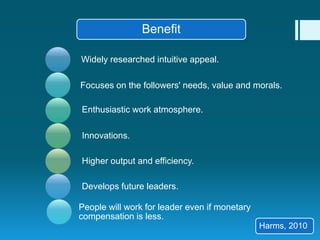
Widely researched intuitive appeal.
Focuses on the followers' needs, value and morals.
Enthusiastic work atmosphere.
Innovations.
Higher output and efficiency.
Develops future leaders.
People will work for leader even if monetary
compensation is less.
Benefit
Harms, 2010
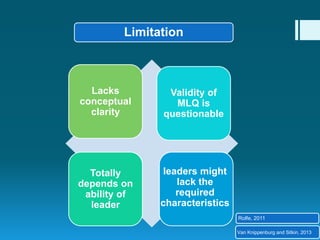
Limitation
Lacks
conceptual
clarity
Validity of
MLQ is
questionable
Totally
depends on
ability of
leader
leaders might
lack the
required
characteristics
Rolfe, 2011
Van Knippenburg and Sitkin, 2013
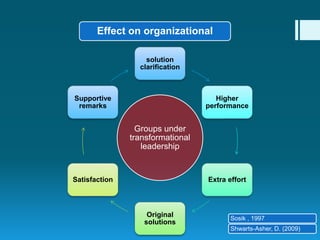
Effect on organizational
solution
clarification
Higher
performance
Extra effort
Original
solutions
Satisfaction
Supportive
remarks
Sosik , 1997
Shwarts-Asher, D. (2009)
Groups under
transformational
leadership
Transformational leadership goals
inspire
followers
develop staff
solve
problems
Bass & Riggio, 2006
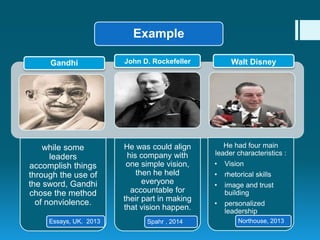
Example
while some
leaders
accomplish things
through the use of
the sword, Gandhi
chose the method
of nonviolence.
He was could align
his company with
one simple vision,
then he held
everyone
accountable for
their part in making
that vision happen.
He had four main
leader characteristics :
• Vision
• rhetorical skills
• image and trust
building
• personalized
leadership
Essays, UK. 2013
Gandhi John D. Rockefeller Walt Disney
Spahr , 2014 Northouse, 2013
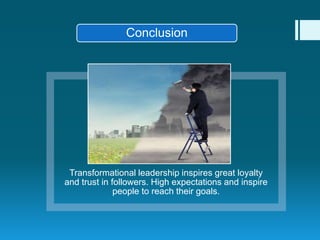
Conclusion
Transformational leadership inspires great loyalty
and trust in followers. High expectations and inspire
people to reach their goals.

Transformational leadership

  • 1.
    (8.5)TRANSFORMATIONAL LEADERSHIP ALI TAHAOLEIWI ROY HAIZAL BIN ABDELLAH MUHAMMAD ZAKWAN BIN ABU HUSSIN MOHAMMED HAYDER NADHIM ALI MUGAHED ALI AL-RAHMI GP170033 GP170081 GP170096 GP170097 GP170108
  • 2.
    Definition Transformational Leadership stimulateand inspire their followers to achieve extraordinary outcomes and, in the process, develop their followers’ own leadership capacity. These leaders help followers to grow and develop by responding to followers’ individual needs by empowering them and aligning the objectives and goals of the individual followers, the leader, the group, and the larger organization Transformational leadership is a style of leadership where a leader works with subordinates to identify needed change, creating a vision to guide the change through inspiration executing the change in tandem with committed members of a group. Transformational leadership serves to enhance the motivation, morale, and job performance of followers through a variety of mechanisms (Carless, S. A. 1998)
  • 3.
    Transformational transformational leadership • abilityto inspire and motivate followers. • provides followers with challenges and meaning for engaging in shared goals and undertakings • Show followers how their work applies to real world. • Behave in an enthusiastic, passionate and energetic way. • Process that changes and transforms. • Process that is concerned with the Emotions, Values, Standards, Ethics, and Long Term Goals. • A transformational leader motivates followers to accomplish more than what is usually expected. • The sum becomes more powerful than its Parts. Transformational vs transformational leadership (Judge, T. A., & Piccolo, R. F. 2004)
  • 4.
    Transformational Leadership Elements Idealized Influence Inspirational Motivation Individualized Consideration Intellectual Stimulation •the leader serves as an ideal role model for followers; the leader "walks the talk," and is admired for this. • Transformational leaders have the ability to inspire and motivate followers. Combined these first two I's are what constitute the transformational leader's charisma. • Transformational leaders demonstrate genuine concern for the needs and feelings of followers. This personal attention to each follower is a key element in bringing out their very best efforts. • the leader challenges followers to be innovative and creative. A common misunderstanding is that transformational leaders are "soft," but the truth is that they constantly challenge followers to higher levels of performance. (Bass, B. M., & Riggio, R. E. 2006)
  • 5.
    Steps for TransformationalLeadership Developing Vision • Starts with creating a vision. • Vision that is exciting and attract potential followers. Selling the Vision • Constantly sell the vision and build a strong network of high potential. Road Map • Transformation leaders have a clear vision. • Have a fair idea about the direction to move and want followers to move in the same direction. • Ready to accept failures. Leading the charge • Transformation leaders remain in the fore-front during the action • Always visible and stand up to be counted • Bolster and infect the followers with commitment and enthusiasm ( Bass, B. M. 1990 )
  • 6.
    Model the way Inspirea shared vision Challenges the process Enable others to act Encourage the heart ( James M. Kouzes & Barry Z. Posner , 2003 )
  • 7.
    Widely researched intuitiveappeal. Focuses on the followers' needs, value and morals. Enthusiastic work atmosphere. Innovations. Higher output and efficiency. Develops future leaders. People will work for leader even if monetary compensation is less. Benefit Harms, 2010
  • 8.
    Limitation Lacks conceptual clarity Validity of MLQ is questionable Totally dependson ability of leader leaders might lack the required characteristics Rolfe, 2011 Van Knippenburg and Sitkin, 2013
  • 9.
    Effect on organizational solution clarification Higher performance Extraeffort Original solutions Satisfaction Supportive remarks Sosik , 1997 Shwarts-Asher, D. (2009) Groups under transformational leadership
  • 10.
    Transformational leadership goals inspire followers developstaff solve problems Bass & Riggio, 2006
  • 11.
    Example while some leaders accomplish things throughthe use of the sword, Gandhi chose the method of nonviolence. He was could align his company with one simple vision, then he held everyone accountable for their part in making that vision happen. He had four main leader characteristics : • Vision • rhetorical skills • image and trust building • personalized leadership Essays, UK. 2013 Gandhi John D. Rockefeller Walt Disney Spahr , 2014 Northouse, 2013
  • 12.
    Conclusion Transformational leadership inspiresgreat loyalty and trust in followers. High expectations and inspire people to reach their goals.