1

Developing Leadership Skills


Topic One: Management vs. Leadership




Topic Two: Communication Process and Leadership
Theories





Traits
Attending to Tasks & Relationships

Topic Three: Leadership Theories





Defining Leadership

LMX Theory
Leadership Making

Topic Four: Leadership Skills




Leadership Skills
Emotional Intelligence
Overcoming Obstacles
2

Developing Leadership Skills


Topic Five: Leadership Skills (no class meeting)







Team Presentations (delayed)
Creating a vision
Setting the Tone
Handling Conflict

Topic Six: Transformational & Servant Leadership



Team Presentations
Transformational & Servant Leadership



Topic Seven: Authentic Leadership & Women in
Leadership



Topic Eight: Ethics in Leadership
Transformational Leadership
&
Servant Leadership
Transformational Leadership
5

Transformational Leadership
Description


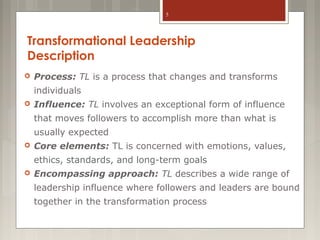
Process: TL is a process that changes and transforms
individuals



Influence: TL involves an exceptional form of influence
that moves followers to accomplish more than what is
usually expected



Core elements: TL is concerned with emotions, values,
ethics, standards, and long-term goals



Encompassing approach: TL describes a wide range of
leadership influence where followers and leaders are bound
together in the transformation process
6

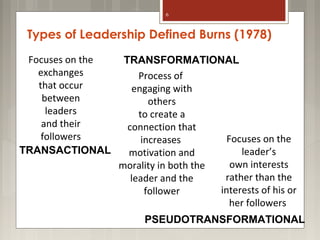
Types of Leadership Defined Burns (1978)
Focuses on the
exchanges
that occur
between
leaders
and their
followers
TRANSACTIONAL

TRANSFORMATIONAL
Process of
engaging with
others
to create a
connection that
Focuses on the
increases
leader’s
motivation and
own interests
morality in both the
rather than the
leader and the
interests of his or
follower
her followers
PSEUDOTRANSFORMATIONAL
7

Types of Leadership Defined
Burns (1978)
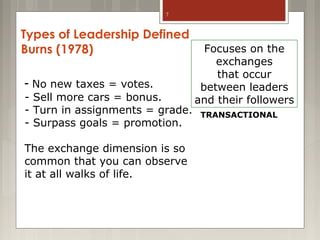
- No new taxes = votes.
- Sell more cars = bonus.
- Turn in assignments = grade.
- Surpass goals = promotion.
The exchange dimension is so
common that you can observe
it at all walks of life.

Focuses on the
exchanges
that occur
between leaders
and their followers
TRANSACTIONAL
8

Types of Leadership Defined
Burns (1978)

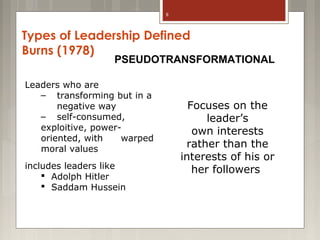
PSEUDOTRANSFORMATIONAL

Leaders who are
– transforming but in a
negative way
– self-consumed,
exploitive, poweroriented, with
warped
moral values
includes leaders like
 Adolph Hitler
 Saddam Hussein

Focuses on the
leader’s
own interests
rather than the
interests of his or
her followers
9

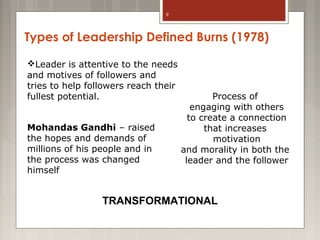
Types of Leadership Defined Burns (1978)
Leader is attentive to the needs
and motives of followers and
tries to help followers reach their
fullest potential.
Mohandas Gandhi – raised
the hopes and demands of
millions of his people and in
the process was changed
himself

Process of
engaging with others
to create a connection
that increases
motivation
and morality in both the
leader and the follower

TRANSFORMATIONAL
10

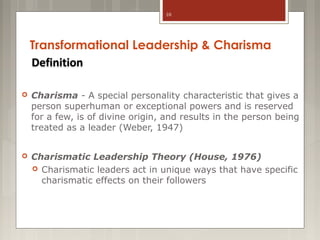
Transformational Leadership & Charisma
Definition


Charisma - A special personality characteristic that gives a
person superhuman or exceptional powers and is reserved
for a few, is of divine origin, and results in the person being
treated as a leader (Weber, 1947)



Charismatic Leadership Theory (House, 1976)
 Charismatic leaders act in unique ways that have specific
charismatic effects on their followers
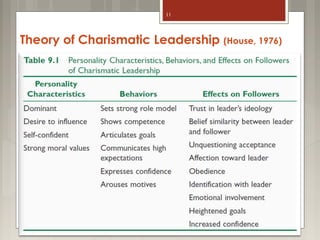
11

Theory of Charismatic Leadership (House, 1976)

Northouse - Leadership Theory and Practice, Sixth
Edition © 2012 SAGE Publications, Inc.
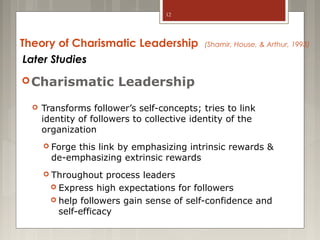
12

Theory of Charismatic Leadership
Later Studies
 Charismatic


(Shamir, House, & Arthur, 1993)

Leadership

Transforms follower’s self-concepts; tries to link
identity of followers to collective identity of the
organization
 Forge

this link by emphasizing intrinsic rewards &
de-emphasizing extrinsic rewards

 Throughout

process leaders
 Express high expectations for followers
 help followers gain sense of self-confidence and
self-efficacy
13

Model of Transformational Leadership Bass (1985)


Expanded and refined version of work done by Burns
and House. It included:






More attention to followers’ rather than leader’s needs
Suggested TL could apply to outcomes that were not
positive
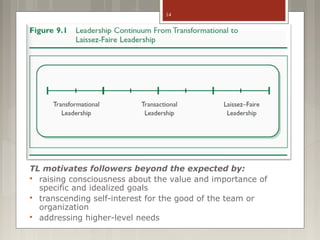
Described transactional and transformational
leadership as a continuum

Extended House’s work by:



Giving more attention to emotional elements & origins
of charisma
Suggested charisma is a necessary but not sufficient
condition for TL
14

TL motivates followers beyond the expected by:
 raising consciousness about the value and importance of
specific and idealized goals
 transcending self-interest for the good of the team or
organization
 addressing higher-level needs
15

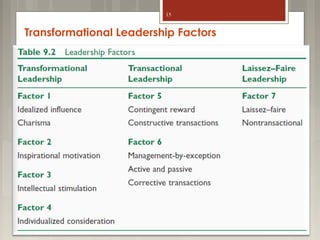
Transformational Leadership Factors

Northouse - Leadership Theory and Practice, Sixth
Edition © 2012 SAGE Publications, Inc.
16

Transformational Leadership Factors The 4 “I”s
 Idealized

Influence

- Acting as strong role models
- High standards of moral and ethical conduct
- Making others want to follow the leader’s vision
 Inspirational

Motivation

- Communicating high expectations
- Inspiring followers to commitment and engagement in
shared vision
- Using symbols & emotional appeals to focus group
members to achieve more than self-interest
17

Transformational Leadership Factors The 4 “I”s
 Intellectual

Stimulation

Stimulating followers to be creative and innovative
Challenging their own beliefs and valuing those of leader and
organization
Supporting followers to
 try new approaches
 develop innovative ways of dealing with organization issues

 Individualized

Consideration

Listening carefully to the needs of followers
Acting as coaches to assist followers in becoming fully
actualized
Helping followers grow through personal challenges
Ex. Showing optimism helps employees become more engaged in
their work (Tims et al., 2011)
18

Transactional Leadership Factors
Contingent Reward
The exchange process between leaders and followers in
which effort by followers is exchanged for specified
rewards

Management by Exception
Leadership that involves corrective criticism, negative
feedback, and negative reinforcement
Two forms
 Active - Watches follower closely to identify
mistakes/rule violations
 Passive - Intervenes only after standards have not
been met or problems have arisen
19

Nonleadership Factor
Laissez-Faire
The absence of leadership

o A hands-off, let-things-ride approach
o Refers to a leader who
o abdicates responsibility
o delays decisions
o gives no feedback, and
o makes little effort to help followers satisfy their
needs
20

Bennis & Nanus (1985)
Four Leader Strategies in Transforming
Organizations
 Clear
 TL’s

vision of organization’s future state

social architect of organization

 Create

trust by making their position known
and standing by it

 Creatively

deploy themselves through
positive self-regard
21

Kouzes & Pozner (1987, 2002)
Model consists of 5 fundamental practices


Model the Way



Inspire a Shared Vision



Challenge the Process



Enable Others to Act



Encourage the Heart
Northouse - Leadership Theory and Practice, Sixth
Edition © 2012 SAGE Publications, Inc.
How Does the Transformational
Leadership Approach Work?


Focus of Transformational Leadership



Strengths



Criticisms



Application
23

Transformational Leadership
Overall Scope


Describes how leaders
can initiate, develop,
and carry out
significant changes in
organizations

Focus of Transformational
Leaders







TLs empower and nurture
followers
TLs stimulate change by
becoming strong role models for
followers
TLs commonly create a vision
TLs require leaders to become
social architects
TLs build trust & foster
collaboration
24

Strengths









Broadly researched. TL has been widely researched,
including a large body of qualitative research centering
on prominent leaders and CEOs in major firms.
Intuitive appeal. People are attracted to TL because it
makes sense to them.
Process-focused. TL treats leadership as a process
occurring between followers and leaders.
Expansive leadership view. TL provides a broader
view of leadership that augments other leadership
models.
Emphasizes follower. TL emphasizes followers’ needs,
values, and morals.
Effectiveness. Evidence supports that TL is an effective
form of leadership.
25

Criticisms


Lacks conceptual clarity





Measurement questioned









Dimensions are not clearly delimited
Parameters of TL overlap with similar conceptualizations of
leadership
Validity of MLQ not fully established
Some transformational factors are not unique solely to the
transformational model

TL treats leadership more as a personality trait or
predisposition than a behavior that can be taught
No causal link shown between transformational
leaders and changes in followers or organizations
TL is elitist and antidemocratic
Suffers from heroic leadership bias
Has the potential to be abused
26

Application








Provides a general way of thinking about leadership
that stresses ideals, inspiration, innovations, and
individual concerns
Can be taught to individuals at all levels of the
organization
Able to positively impact a firm’s performance
May be used as a tool in recruitment, selection,
promotion, and training development
Can be used to improve team development, decisionmaking groups, quality initiatives, and reorganizations
The MLQ and Sosik and Jung (2010) guide help leaders
to target areas of leadership improvement
Servant Leadership
28

Servant Leader Description


Servant Leadership – is a paradox: both service and
influence



Interest in Servant Leadership
 Most scholarship has been prescriptive, until recently


Past 10 years have clarified the concept and its
assumptions



Focuses on leadership from the point of view of the
leader and his/her behaviors



Servant leaders put followers first
29

Servant Leader Description


Greenleaf Definition:
“Servant leadership begins with the natural feeling that
one wants to serve, to serve first. Then conscious
choice brings one to aspire to lead…The difference
manifests itself in the care taken by the servant –
first to make sure that other people’s highest priority
needs are being served. The best test…is: do those
served grow as persons; do they, while being served,
become healthier, wiser, freer, more autonomous,
more likely themselves to become servant? And,
what is the effect on the least privileged in society;
will they benefit, or, at least, will they not be further
deprived?”
Sometimes treated as a trait, but viewed as a
behavior in this chapter
30

Greenleaf Center for Servant Leadership


Advocating for building consensus in groups
rather than using coercive leadership



Inspired by Hesse’s novel, Journey to the East,
where the travelers discovered the true leader of
their group was the servant



Leaders have a social responsibility for the
“have-nots”



Leaders shift authority to those who are being
led
31

10 Characteristics of a Servant Leader
1.

Listening - acknowledging the viewpoint of followers
and validating these perspectives.

2.

Empathy – “standing in the shoes” of another person
and attempting to see the world from that person’s
point of view.

3.

Healing – in helping followers become whole, servant
leaders are themselves healed.

4.

Awareness – understanding oneself and the impact
one has on others.
32

10 Characteristics of a Servant Leader
5. Persuasion – creates change through gentle,
nonjudgmental argument.
6. Conceptualization – the ability to be a visionary for
an organization.
7. Foresight – the ability to predict what is coming based
on what is occurring in the present and what has
happened in the past.
33

10 Characteristics of a Servant Leader
8. Stewardship – carefully managing the people and
organization one has been given to lead. Holding the
organization in trust for the greater good of society.
9. Commitment to the Growth of People – treating
each follower as a unique person with intrinsic value
beyond what he/she contributes to the organization.
10. Building Community – allowing followers to identify
with something greater than themselves that they
value.
34

10 Characteristics of a Servant Leader
8. Stewardship – carefully managing the people and
organization one has been given to lead. Holding the
organization in trust for the greater good of society.
9. Commitment to the Growth of People – treating
each follower as a unique person with intrinsic value
beyond what he/she contributes to the organization.
10. Building Community – allowing followers to identify
with something greater than themselves that they
value.
35

Model of Servant Leadership


Servant Leader Behaviors (7)
1. Conceptualizing
 Thorough

understanding of the organization

2. Emotional healing
 Recognizing

others’ problems and taking the time
to address them

3. Putting followers first
36

Model of Servant Leadership


Servant Leader Behaviors (7)
4. Helping followers grow and succeed
 Knowing

followers’ professional or personal goals

5. Behaving ethically
 Doing

the right thing in the right way

6. Empowering
 Allowing

followers the freedom to be independent,
make decisions on their own, and be self-sufficient
37

Model of Servant Leadership


Servant Leader Behaviors (7)

7. Creating value for the community
 Intentionally
 Encourage

giving back to the community

followers to volunteer for
community service
38

Model of Servant Leadership


Outcomes (3)

-

Follower performance and growth
 Recognizing followers’ contributions and helping them
realize their human potential
 Favorable impact on subordinate in-role performance
 Followers themselves may become servant leaders

-

Organizational performance
 Positive relationship between servant leadership and
OCB
 Team effectiveness enhanced by increasing members’
shared confidence they could be effective

-

Societal impact
 Ex. Mother Teresa and Sisters of Charity
 Ex. Southwest Airlines
39

How does Servant Leadership work?




Strengths
Criticisms
Application
40

How does Servant Leadership work?


SL is different from many other leadership theories.



It is concerned with putting followers first and the
outcomes that are likely to emerge.



SL works best when leaders are altruistic and have a
strong motivation to help others.



It is important for followers to be receptive to this style
of leadership.



SL results in community and societal change.
41

Strengths


Makes altruism the central component of the leadership
process.



Provides a counterintuitive approach to the use of
influence. Leaders should share control.



SL is not a panacea. It may not be effective when
subordinates are not open to being guided, supported,
and empowered.



Research has resulted in a sound measure of SL – the
SLQ.
42

Criticisms


Because the name appears contradictory, SL may be
seen as whimsical, or not really “leadership.”



Researchers are unable to reach consensus on a
common definition or theoretical framework for SL.



The prescriptive overtone suggests that good leaders
“put others first” and conflicts with other principles of
leadership such as directing, concern for production,
etc. It can also sound moralistic, which may deter
some researchers.



Conceptualizing is not unique to servant leaders. It is
unclear why it is included in this model.
43

Application


SL can be applied at all levels of management and in all
types of organizations.


SL has been used extensively in a variety of
organizations for more than 30 years.



Organizations should be careful to select employees
who (a) are interested in building long term
relationships with followers and (b) have strong ethics.



SL is taught at many colleges and universities and is
used by numerous independent coaches, trainers, and
consultants.

MSMC BUS3180 Topic 6 ppt lecture 2.12.14

  • 1.
    1 Developing Leadership Skills  TopicOne: Management vs. Leadership   Topic Two: Communication Process and Leadership Theories    Traits Attending to Tasks & Relationships Topic Three: Leadership Theories    Defining Leadership LMX Theory Leadership Making Topic Four: Leadership Skills    Leadership Skills Emotional Intelligence Overcoming Obstacles
  • 2.
    2 Developing Leadership Skills  TopicFive: Leadership Skills (no class meeting)      Team Presentations (delayed) Creating a vision Setting the Tone Handling Conflict Topic Six: Transformational & Servant Leadership   Team Presentations Transformational & Servant Leadership  Topic Seven: Authentic Leadership & Women in Leadership  Topic Eight: Ethics in Leadership
  • 3.
  • 4.
  • 5.
    5 Transformational Leadership Description  Process: TLis a process that changes and transforms individuals  Influence: TL involves an exceptional form of influence that moves followers to accomplish more than what is usually expected  Core elements: TL is concerned with emotions, values, ethics, standards, and long-term goals  Encompassing approach: TL describes a wide range of leadership influence where followers and leaders are bound together in the transformation process
  • 6.
    6 Types of LeadershipDefined Burns (1978) Focuses on the exchanges that occur between leaders and their followers TRANSACTIONAL TRANSFORMATIONAL Process of engaging with others to create a connection that Focuses on the increases leader’s motivation and own interests morality in both the rather than the leader and the interests of his or follower her followers PSEUDOTRANSFORMATIONAL
  • 7.
    7 Types of LeadershipDefined Burns (1978) - No new taxes = votes. - Sell more cars = bonus. - Turn in assignments = grade. - Surpass goals = promotion. The exchange dimension is so common that you can observe it at all walks of life. Focuses on the exchanges that occur between leaders and their followers TRANSACTIONAL
  • 8.
    8 Types of LeadershipDefined Burns (1978) PSEUDOTRANSFORMATIONAL Leaders who are – transforming but in a negative way – self-consumed, exploitive, poweroriented, with warped moral values includes leaders like  Adolph Hitler  Saddam Hussein Focuses on the leader’s own interests rather than the interests of his or her followers
  • 9.
    9 Types of LeadershipDefined Burns (1978) Leader is attentive to the needs and motives of followers and tries to help followers reach their fullest potential. Mohandas Gandhi – raised the hopes and demands of millions of his people and in the process was changed himself Process of engaging with others to create a connection that increases motivation and morality in both the leader and the follower TRANSFORMATIONAL
  • 10.
    10 Transformational Leadership &Charisma Definition  Charisma - A special personality characteristic that gives a person superhuman or exceptional powers and is reserved for a few, is of divine origin, and results in the person being treated as a leader (Weber, 1947)  Charismatic Leadership Theory (House, 1976)  Charismatic leaders act in unique ways that have specific charismatic effects on their followers
  • 11.
    11 Theory of CharismaticLeadership (House, 1976) Northouse - Leadership Theory and Practice, Sixth Edition © 2012 SAGE Publications, Inc.
  • 12.
    12 Theory of CharismaticLeadership Later Studies  Charismatic  (Shamir, House, & Arthur, 1993) Leadership Transforms follower’s self-concepts; tries to link identity of followers to collective identity of the organization  Forge this link by emphasizing intrinsic rewards & de-emphasizing extrinsic rewards  Throughout process leaders  Express high expectations for followers  help followers gain sense of self-confidence and self-efficacy
  • 13.
    13 Model of TransformationalLeadership Bass (1985)  Expanded and refined version of work done by Burns and House. It included:     More attention to followers’ rather than leader’s needs Suggested TL could apply to outcomes that were not positive Described transactional and transformational leadership as a continuum Extended House’s work by:   Giving more attention to emotional elements & origins of charisma Suggested charisma is a necessary but not sufficient condition for TL
  • 14.
    14 TL motivates followersbeyond the expected by:  raising consciousness about the value and importance of specific and idealized goals  transcending self-interest for the good of the team or organization  addressing higher-level needs
  • 15.
    15 Transformational Leadership Factors Northouse- Leadership Theory and Practice, Sixth Edition © 2012 SAGE Publications, Inc.
  • 16.
    16 Transformational Leadership FactorsThe 4 “I”s  Idealized Influence - Acting as strong role models - High standards of moral and ethical conduct - Making others want to follow the leader’s vision  Inspirational Motivation - Communicating high expectations - Inspiring followers to commitment and engagement in shared vision - Using symbols & emotional appeals to focus group members to achieve more than self-interest
  • 17.
    17 Transformational Leadership FactorsThe 4 “I”s  Intellectual Stimulation Stimulating followers to be creative and innovative Challenging their own beliefs and valuing those of leader and organization Supporting followers to  try new approaches  develop innovative ways of dealing with organization issues  Individualized Consideration Listening carefully to the needs of followers Acting as coaches to assist followers in becoming fully actualized Helping followers grow through personal challenges Ex. Showing optimism helps employees become more engaged in their work (Tims et al., 2011)
  • 18.
    18 Transactional Leadership Factors ContingentReward The exchange process between leaders and followers in which effort by followers is exchanged for specified rewards Management by Exception Leadership that involves corrective criticism, negative feedback, and negative reinforcement Two forms  Active - Watches follower closely to identify mistakes/rule violations  Passive - Intervenes only after standards have not been met or problems have arisen
  • 19.
    19 Nonleadership Factor Laissez-Faire The absenceof leadership o A hands-off, let-things-ride approach o Refers to a leader who o abdicates responsibility o delays decisions o gives no feedback, and o makes little effort to help followers satisfy their needs
  • 20.
    20 Bennis & Nanus(1985) Four Leader Strategies in Transforming Organizations  Clear  TL’s vision of organization’s future state social architect of organization  Create trust by making their position known and standing by it  Creatively deploy themselves through positive self-regard
  • 21.
    21 Kouzes & Pozner(1987, 2002) Model consists of 5 fundamental practices  Model the Way  Inspire a Shared Vision  Challenge the Process  Enable Others to Act  Encourage the Heart Northouse - Leadership Theory and Practice, Sixth Edition © 2012 SAGE Publications, Inc.
  • 22.
    How Does theTransformational Leadership Approach Work?  Focus of Transformational Leadership  Strengths  Criticisms  Application
  • 23.
    23 Transformational Leadership Overall Scope  Describeshow leaders can initiate, develop, and carry out significant changes in organizations Focus of Transformational Leaders      TLs empower and nurture followers TLs stimulate change by becoming strong role models for followers TLs commonly create a vision TLs require leaders to become social architects TLs build trust & foster collaboration
  • 24.
    24 Strengths       Broadly researched. TLhas been widely researched, including a large body of qualitative research centering on prominent leaders and CEOs in major firms. Intuitive appeal. People are attracted to TL because it makes sense to them. Process-focused. TL treats leadership as a process occurring between followers and leaders. Expansive leadership view. TL provides a broader view of leadership that augments other leadership models. Emphasizes follower. TL emphasizes followers’ needs, values, and morals. Effectiveness. Evidence supports that TL is an effective form of leadership.
  • 25.
    25 Criticisms  Lacks conceptual clarity    Measurementquestioned        Dimensions are not clearly delimited Parameters of TL overlap with similar conceptualizations of leadership Validity of MLQ not fully established Some transformational factors are not unique solely to the transformational model TL treats leadership more as a personality trait or predisposition than a behavior that can be taught No causal link shown between transformational leaders and changes in followers or organizations TL is elitist and antidemocratic Suffers from heroic leadership bias Has the potential to be abused
  • 26.
    26 Application       Provides a generalway of thinking about leadership that stresses ideals, inspiration, innovations, and individual concerns Can be taught to individuals at all levels of the organization Able to positively impact a firm’s performance May be used as a tool in recruitment, selection, promotion, and training development Can be used to improve team development, decisionmaking groups, quality initiatives, and reorganizations The MLQ and Sosik and Jung (2010) guide help leaders to target areas of leadership improvement
  • 27.
  • 28.
    28 Servant Leader Description  ServantLeadership – is a paradox: both service and influence  Interest in Servant Leadership  Most scholarship has been prescriptive, until recently  Past 10 years have clarified the concept and its assumptions  Focuses on leadership from the point of view of the leader and his/her behaviors  Servant leaders put followers first
  • 29.
    29 Servant Leader Description  GreenleafDefinition: “Servant leadership begins with the natural feeling that one wants to serve, to serve first. Then conscious choice brings one to aspire to lead…The difference manifests itself in the care taken by the servant – first to make sure that other people’s highest priority needs are being served. The best test…is: do those served grow as persons; do they, while being served, become healthier, wiser, freer, more autonomous, more likely themselves to become servant? And, what is the effect on the least privileged in society; will they benefit, or, at least, will they not be further deprived?” Sometimes treated as a trait, but viewed as a behavior in this chapter
  • 30.
    30 Greenleaf Center forServant Leadership  Advocating for building consensus in groups rather than using coercive leadership  Inspired by Hesse’s novel, Journey to the East, where the travelers discovered the true leader of their group was the servant  Leaders have a social responsibility for the “have-nots”  Leaders shift authority to those who are being led
  • 31.
    31 10 Characteristics ofa Servant Leader 1. Listening - acknowledging the viewpoint of followers and validating these perspectives. 2. Empathy – “standing in the shoes” of another person and attempting to see the world from that person’s point of view. 3. Healing – in helping followers become whole, servant leaders are themselves healed. 4. Awareness – understanding oneself and the impact one has on others.
  • 32.
    32 10 Characteristics ofa Servant Leader 5. Persuasion – creates change through gentle, nonjudgmental argument. 6. Conceptualization – the ability to be a visionary for an organization. 7. Foresight – the ability to predict what is coming based on what is occurring in the present and what has happened in the past.
  • 33.
    33 10 Characteristics ofa Servant Leader 8. Stewardship – carefully managing the people and organization one has been given to lead. Holding the organization in trust for the greater good of society. 9. Commitment to the Growth of People – treating each follower as a unique person with intrinsic value beyond what he/she contributes to the organization. 10. Building Community – allowing followers to identify with something greater than themselves that they value.
  • 34.
    34 10 Characteristics ofa Servant Leader 8. Stewardship – carefully managing the people and organization one has been given to lead. Holding the organization in trust for the greater good of society. 9. Commitment to the Growth of People – treating each follower as a unique person with intrinsic value beyond what he/she contributes to the organization. 10. Building Community – allowing followers to identify with something greater than themselves that they value.
  • 35.
    35 Model of ServantLeadership  Servant Leader Behaviors (7) 1. Conceptualizing  Thorough understanding of the organization 2. Emotional healing  Recognizing others’ problems and taking the time to address them 3. Putting followers first
  • 36.
    36 Model of ServantLeadership  Servant Leader Behaviors (7) 4. Helping followers grow and succeed  Knowing followers’ professional or personal goals 5. Behaving ethically  Doing the right thing in the right way 6. Empowering  Allowing followers the freedom to be independent, make decisions on their own, and be self-sufficient
  • 37.
    37 Model of ServantLeadership  Servant Leader Behaviors (7) 7. Creating value for the community  Intentionally  Encourage giving back to the community followers to volunteer for community service
  • 38.
    38 Model of ServantLeadership  Outcomes (3) - Follower performance and growth  Recognizing followers’ contributions and helping them realize their human potential  Favorable impact on subordinate in-role performance  Followers themselves may become servant leaders - Organizational performance  Positive relationship between servant leadership and OCB  Team effectiveness enhanced by increasing members’ shared confidence they could be effective - Societal impact  Ex. Mother Teresa and Sisters of Charity  Ex. Southwest Airlines
  • 39.
    39 How does ServantLeadership work?    Strengths Criticisms Application
  • 40.
    40 How does ServantLeadership work?  SL is different from many other leadership theories.  It is concerned with putting followers first and the outcomes that are likely to emerge.  SL works best when leaders are altruistic and have a strong motivation to help others.  It is important for followers to be receptive to this style of leadership.  SL results in community and societal change.
  • 41.
    41 Strengths  Makes altruism thecentral component of the leadership process.  Provides a counterintuitive approach to the use of influence. Leaders should share control.  SL is not a panacea. It may not be effective when subordinates are not open to being guided, supported, and empowered.  Research has resulted in a sound measure of SL – the SLQ.
  • 42.
    42 Criticisms  Because the nameappears contradictory, SL may be seen as whimsical, or not really “leadership.”  Researchers are unable to reach consensus on a common definition or theoretical framework for SL.  The prescriptive overtone suggests that good leaders “put others first” and conflicts with other principles of leadership such as directing, concern for production, etc. It can also sound moralistic, which may deter some researchers.  Conceptualizing is not unique to servant leaders. It is unclear why it is included in this model.
  • 43.
    43 Application  SL can beapplied at all levels of management and in all types of organizations.  SL has been used extensively in a variety of organizations for more than 30 years.  Organizations should be careful to select employees who (a) are interested in building long term relationships with followers and (b) have strong ethics.  SL is taught at many colleges and universities and is used by numerous independent coaches, trainers, and consultants.