TOPIC OUTLINE
2
TransformationalLeadership (TL) Perspective
A Model of Transformational Leadership
Transformational Leadership Factors
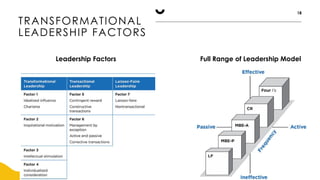
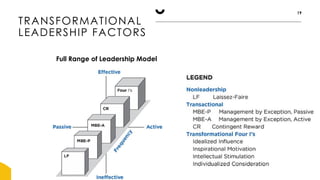
Full Range of Leadership Model
The Additive Effects of TL
Other Transformational Leadership Perspectives
How Does the Transformational Approach Work?
TRANSFORMATIONAL
LEADERSHIP
DESCRIPTION
4
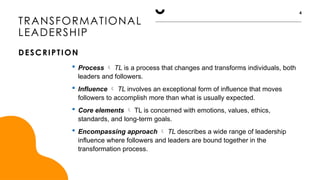
Process TL is a process that changes and transforms individuals, both
leaders and followers.
Influence TL involves an exceptional form of influence that moves
followers to accomplish more than what is usually expected.
Core elements TL is concerned with emotions, values, ethics,
standards, and long-term goals.
Encompassing approach TL describes a wide range of leadership
influence where followers and leaders are bound together in the
transformation process.
5.
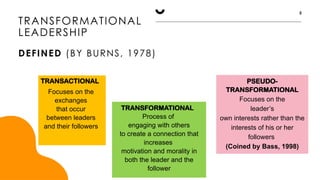
TRANSFORMATIONAL
Process of
engaging withothers
to create a connection that
increases
motivation and morality in
both the leader and the
follower
TRANSACTIONAL
Focuses on the
exchanges
that occur
between leaders
and their followers
TRANSFORMATIONAL
LEADERSHIP
DEFINED (BY BURNS, 1978)
5
PSEUDO-
TRANSFORMATIONAL
Focuses on the
leader’s
own interests rather than the
interests of his or her
followers
(Coined by Bass, 1998)
6.
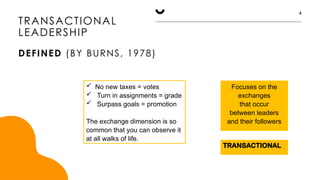
TRANSACTIONAL
Focuses on the
exchanges
thatoccur
between leaders
and their followers
TRANSACTIONAL
LEADERSHIP
DEFINED (BY BURNS, 1978)
6
No new taxes = votes
Turn in assignments = grade
Surpass goals = promotion
The exchange dimension is so
common that you can observe it
at all walks of life.
7.
PSEUDO-
TRANSFORMATIONAL
Focuses on the
leader’s
owninterests rather
than the interests of
his or her followers
PSEUDO-
TRANSFORMATIONAL
LEADERSHIP
DEFINED (BY BURNS, 1978)
7
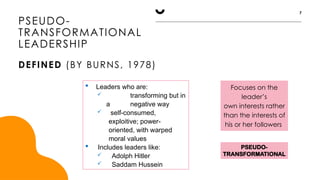
Leaders who are:
transforming but in
a negative way
self-consumed,
exploitive; power-
oriented, with warped
moral values
Includes leaders like:
Adolph Hitler
Saddam Hussein
8.
PSEUDOTRANSFORMATIONAL
(C H RIS TIE , BA RL IN G & T UR N E R, 2 0 11 )
8
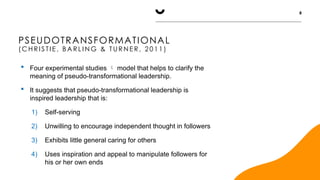
Four experimental studies model that helps to clarify the
meaning of pseudo-transformational leadership.
It suggests that pseudo-transformational leadership is
inspired leadership that is:
1) Self-serving
2) Unwilling to encourage independent thought in followers
3) Exhibits little general caring for others
4) Uses inspiration and appeal to manipulate followers for
his or her own ends
9.
TRANSFORMATIONAL
Process of
engaging withothers
to create a
connection that
increases
motivation and
morality in both the
leader and the
follower
TRANSFORMATIONAL
LEADERSHIP
DEFINED (BY BURNS, 1978)
9
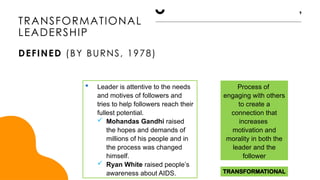
Leader is attentive to the needs
and motives of followers and
tries to help followers reach their
fullest potential.
Mohandas Gandhi raised
the hopes and demands of
millions of his people and in
the process was changed
himself.
Ryan White raised people’s
awareness about AIDS.
10.
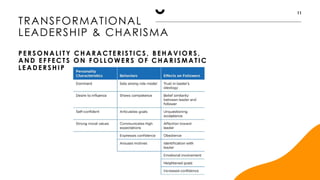
TRANSFORMATIONAL
LEADERSHIP & CHARISMA
DEFINITION
10
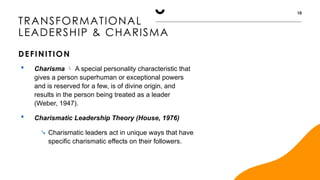
Charisma A special personality characteristic that
gives a person superhuman or exceptional powers
and is reserved for a few, is of divine origin, and
results in the person being treated as a leader
(Weber, 1947).
Charismatic Leadership Theory (House, 1976)
Charismatic leaders act in unique ways that have
specific charismatic effects on their followers.
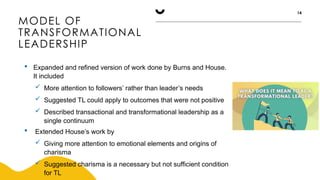
MODEL OF
TRANSFORMATIONAL
LEADERSHIP
14
Expandedand refined version of work done by Burns and House.
It included
More attention to followers’ rather than leader’s needs
Suggested TL could apply to outcomes that were not positive
Described transactional and transformational leadership as a
single continuum
Extended House’s work by
Giving more attention to emotional elements and origins of
charisma
Suggested charisma is a necessary but not sufficient condition
for TL
14.
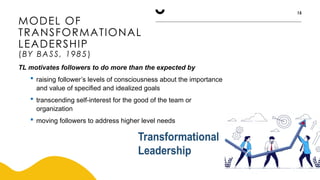
MODEL OF
TRANSFORMATIONAL
LEADERSHIP
(BY BASS,1985)
15
TL motivates followers to do more than the expected by
raising follower’s levels of consciousness about the importance
and value of specified and idealized goals
transcending self-interest for the good of the team or
organization
moving followers to address higher level needs
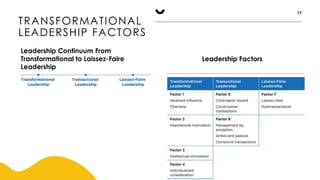
TRANSFORMATIONAL
LEADERSHIP FACTORS
20
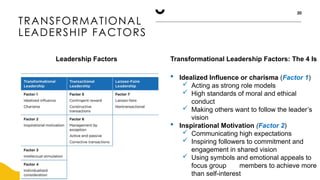
Leadership FactorsTransformational Leadership Factors: The 4 Is
Idealized Influence or charisma (Factor 1)
Acting as strong role models
High standards of moral and ethical
conduct
Making others want to follow the leader’s
vision
Inspirational Motivation (Factor 2)
Communicating high expectations
Inspiring followers to commitment and
engagement in shared vision
Using symbols and emotional appeals to
focus group members to achieve more
than self-interest
20.
TRANSFORMATIONAL
LEADERSHIP FACTORS
21
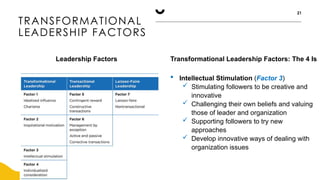
Leadership FactorsTransformational Leadership Factors: The 4 Is
Intellectual Stimulation (Factor 3)
Stimulating followers to be creative and
innovative
Challenging their own beliefs and valuing
those of leader and organization
Supporting followers to try new
approaches
Develop innovative ways of dealing with
organization issues
21.
TRANSFORMATIONAL
LEADERSHIP FACTORS
22
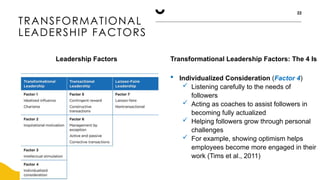
Leadership FactorsTransformational Leadership Factors: The 4 Is
Individualized Consideration (Factor 4)
Listening carefully to the needs of
followers
Acting as coaches to assist followers in
becoming fully actualized
Helping followers grow through personal
challenges
For example, showing optimism helps
employees become more engaged in their
work (Tims et al., 2011)
22.
THE ADDITIVE EFFECTOF
TRANSFORMATIONAL
LEADERSHIP
23
Augments impact on employee’s performance and
company profit (Rowald & Heinitz, 2007)
Positively related to job satisfaction and performance
(Nemanich & Keller, 2007)
Boosts employee engagement and optimism (Tims,
et. al., 2011)
TL leaders more likely to promote employee’s
achieving their mastery goals (Hamstra, et.al.,2014)
23.
TRANSFORMATIONAL
LEADERSHIP FACTORS
24
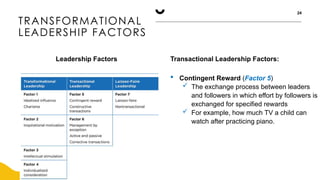
Leadership FactorsTransactional Leadership Factors:
Contingent Reward (Factor 5)
The exchange process between leaders
and followers in which effort by followers is
exchanged for specified rewards
For example, how much TV a child can
watch after practicing piano.
24.
TRANSACTIONAL
LEADERSHIP FACTORS
25
Leadership FactorsTransactional Leadership Factors:
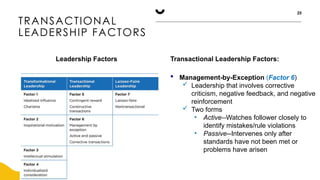
Management-by-Exception (Factor 6)
Leadership that involves corrective
criticism, negative feedback, and negative
reinforcement
Two forms
• Active--Watches follower closely to
identify mistakes/rule violations
• Passive--Intervenes only after
standards have not been met or
problems have arisen
25.
TRANSFORMATIONAL
LEADERSHIP FACTORS
26
Leadership FactorsNonLeadership Factor:
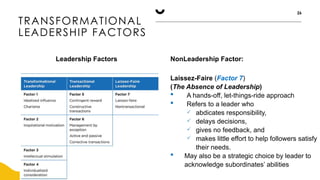
Laissez-Faire (Factor 7)
(The Absence of Leadership)
A hands-off, let-things-ride approach
Refers to a leader who
abdicates responsibility,
delays decisions,
gives no feedback, and
makes little effort to help followers satisfy
their needs.
May also be a strategic choice by leader to
acknowledge subordinates’ abilities
26.
OTHER
TRANSFORMATIONAL
PERSPECTIVES
27
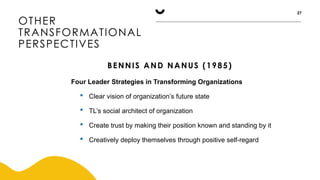
BENNIS AND NANUS(1985)
Four Leader Strategies in Transforming Organizations
Clear vision of organization’s future state
TL’s social architect of organization
Create trust by making their position known and standing by it
Creatively deploy themselves through positive self-regard
27.
28
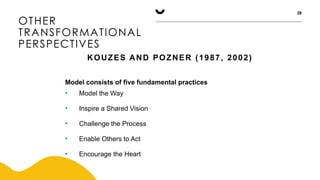
KOUZES AND POZNER(1987, 2002)
Model consists of five fundamental practices
• Model the Way
• Inspire a Shared Vision
• Challenge the Process
• Enable Others to Act
• Encourage the Heart
OTHER
TRANSFORMATIONAL
PERSPECTIVES
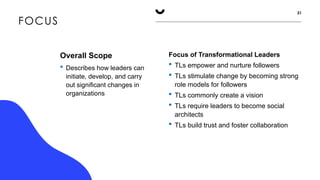
FOCUS
31
Focus of TransformationalLeaders
TLs empower and nurture followers
TLs stimulate change by becoming strong
role models for followers
TLs commonly create a vision
TLs require leaders to become social
architects
TLs build trust and foster collaboration
Overall Scope
Describes how leaders can
initiate, develop, and carry
out significant changes in
organizations
31.
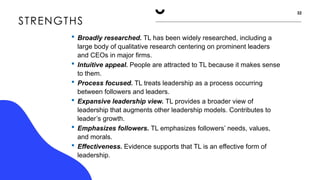
STRENGTHS
32
Broadly researched.TL has been widely researched, including a
large body of qualitative research centering on prominent leaders
and CEOs in major firms.
Intuitive appeal. People are attracted to TL because it makes sense
to them.
Process focused. TL treats leadership as a process occurring
between followers and leaders.
Expansive leadership view. TL provides a broader view of
leadership that augments other leadership models. Contributes to
leader’s growth.
Emphasizes followers. TL emphasizes followers’ needs, values,
and morals.
Effectiveness. Evidence supports that TL is an effective form of
leadership.
32.
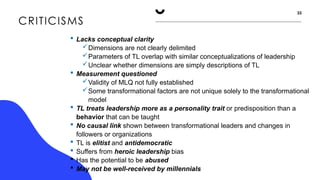
CRITICISMS
33
Lacks conceptualclarity
Dimensions are not clearly delimited
Parameters of TL overlap with similar conceptualizations of leadership
Unclear whether dimensions are simply descriptions of TL
Measurement questioned
Validity of MLQ not fully established
Some transformational factors are not unique solely to the transformational
model
TL treats leadership more as a personality trait or predisposition than a
behavior that can be taught
No causal link shown between transformational leaders and changes in
followers or organizations
TL is elitist and antidemocratic
Suffers from heroic leadership bias
Has the potential to be abused
May not be well-received by millennials
33.
APPLICATIONS
34
Provides ageneral way of thinking about leadership that stresses
ideals, inspiration, innovations, and individual concerns
Can be taught to individuals at all levels of the organization
Able to positively impact a firm’s performance
May be used as a tool in recruitment, selection, promotion, and
training development
Can be used to improve team development, decision-making groups,
quality initiatives, and reorganizations
The MLQ and Sosik and Jung (2010) guide help leaders to target areas
of leadership improvement
#4 It includes assessing followers’ motives, satisfying their needs, and treating them as full human beings.
#5 Burns distinguished between two types of leadership: transactional and transformational.
Because the conceptualization of transformational leadership set forth by Burns (1978) includes raising the level of morality in others, it is difficult to use this term when describing a leader such as Adolf Hitler, who was transforming but in a negative way. To deal with this problem, Bass (1998) coined the term pseudotransformational leadership.
#6 While exchanges or transactions between leader and member are a natural component of employment contracts, research suggests that employees do not necessarily perceive transactional leaders as those most capable of creating trusting, mutually beneficial leader–member relationships (Notgrass, 2014).
Instead, employees prefer managers to perform transformational leadership behaviors such as encouraging creativity, recognizing accomplishments, building trust, and inspiring a collective vision (Notgrass, 2014).
#7 Pseudotransformational leadership is considered personalized leadership, which focuses on the leader’s own interests rather than on the interests of others (Bass & Steidlmeier, 1999).
Authentic transformational leadership is socialized leadership, which is concerned with the collective good. Socialized transformational leaders transcend their own interests for the sake of others (Howell & Avolio, 1993).
#8 This type of leadership is threatening to the welfare of followers because it ignores the common good.
#9 As mentioned earlier, authentic transformational leadership is socialized leadership, which is concerned with the collective good. Socialized transformational leaders transcend their own interests for the sake of others (Howell & Avolio, 1993).
#11 First, they are strong role models for the beliefs and values they want their followers to adopt. For example, Gandhi advocated nonviolence and was an exemplary role model of civil disobedience.
Second, charismatic leaders appear competent to followers.
Third, they articulate ideological goals that have moral overtones. Martin Luther King Jr.’s famous “I Have a Dream” speech is an example of this type of charismatic behavior.
Fourth, charismatic leaders communicate high expectations for followers, and they exhibit confidence in followers’ abilities to meet these expectations. The impact of this behavior is to increase followers’ sense of competence and self-efficacy (Avolio & Gibbons, 1988), which in turn improves their performance.
Fifth, charismatic leaders arouse task-relevant motives in followers that may include affiliation, power, or esteem. For example, former U.S. president John F. Kennedy appealed to the human values of the American people when he stated, “Ask not what your country can do for you; ask what you can do for your country.”
#15 In the succeeding slides, it shows the model of transformational and transactional leadership that incorporates seven (7) different factors.
#20 EXAMPLES:
Factor 1: A person whose leadership exemplifies the charisma factor is Nelson Mandela, the first Black president of South Africa. Mandela is viewed as a leader with high moral standards and a vision for South Africa that resulted in monumental change in how the people of South Africa would be governed. His charismatic qualities and the people’s response to them transformed an entire nation.
Factor 2: A sales manager who motivates members of the sales force to excel in their work through encouraging words and pep talks that clearly communicate the integral role they play in the future growth of the company.
#21 Factor 3: An example of this type of leadership is a plant manager who promotes workers’ individual efforts to develop unique ways to solve problems that have caused slowdowns in production.
#22 Factor 4: An example of this type of leadership is a manager who spends time treating each employee in a caring and unique way. To some employees, the leader may give strong affiliation; to others, the leader may give specific directives with a high degree of structure.
#24 Factor 5: Another example often occurs in the academic setting: A dean negotiates with a college professor about the number and quality of published works the professor needs to have written in order to receive tenure and promotion.
#25 Factor 6: An example of passive management by exception is illustrated in the leadership of a supervisor who gives employees poor performance evaluations without ever talking with them about their prior work performance. In essence, both the active and passive management types use more negative reinforcement patterns than the positive reinforcement pattern described in Factor 5 under contingent reward.
#26 Factor 7: An example of a laissez-faire leader is the president of a small manufacturing firm who calls no meetings with plant supervisors, has no long-range plan for the firm, acts detached, and makes little contact with employees.
#27 Clear Vision: It was an image of an attractive, realistic, and believable future (Bennis & Nanus, 2007, p. 89). The vision usually was simple, understandable, beneficial, and energy creating.
Social architect: these leaders were able to mobilize people to accept a new group identity or a new philosophy for their organizations.
Coach Fleck created a culture for these programs that emphasized athletes’ growth in four areas: academic, athletic, social, and spiritual. He was insistent that players assume leadership roles and consistently model the desired culture of the team.
Trust has to do with being predictable or reliable, even in situations that are uncertain.
Positive self-regard: Leaders knew their strengths and weaknesses, and they emphasized their strengths rather than dwelled on their weaknesses.
#28 Model the Way. To model the way, leaders need to be clear about their own values and philosophy. They need to find their own voice and express it to others. Exemplary leaders set a personal example for others by their own behaviors. They also follow through on their promises and commitments and affirm the common values they share with others
Inspire a Shared Vision. Effective leaders create compelling visions that can guide people’s behavior. They are able to visualize positive outcomes in the future and communicate them to others. Leaders also listen to the dreams of others and show them how their dreams can be realized. Through inspiring visions, leaders challenge others to transcend the status quo to do something for others.
Challenge the Process. Challenging the process means being willing to change the status quo and step into the unknown. It includes being willing to innovate, grow, and improve. Exemplary leaders are like pioneers: They want to experiment and try new things. They are willing to take risks to make things better. When exemplary leaders take risks, they do it one step at a time, learning from their mistakes as they go.
Enable Others to Act. Outstanding leaders are effective at working with people. They build trust with others and promote collaboration. Teamwork and cooperation are highly valued by these leaders. They listen closely to diverse points of view and treat others with dignity and respect. They also allow others to make choices, and they support the decisions that others make. In short, they create environments where people can feel good about their work and how it contributes to the greater community
Encourage the Heart. Leaders encourage the heart by rewarding others for their accomplishments. It is natural for people to want support and recognition. Effective leaders are attentive to this need and are willing to give praise to workers for jobs well done. They use authentic celebrations and rituals to show appreciation and encouragement to others. The outcome of this kind of support is greater collective identity and community spirit.