LEADERSHIP
Dr. James Malce Alo, RN,
MAN, MAPsych, PHD
Learning Outcomes
 1. Explain why every nurse is a manager &can be a
leader.
 2. Differentiate between leaders and managers.
 3. Discuss how different theories explain leadership
and management.
 4. Describe what management roles nurses fill in
practice.
 5. Discuss how followership is essential to leadership.
 6. Describe what makes a leader successful.
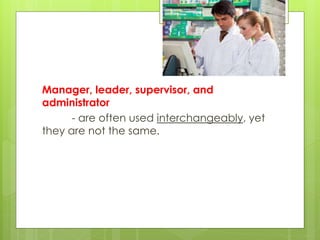
Manager, leader, supervisor, and
administrator
- are often used interchangeably, yet
they are not the same.
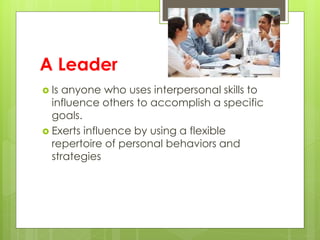
A Leader
 Is anyone who uses interpersonal skills to
influence others to accomplish a specific
goals.
 Exerts influence by using a flexible
repertoire of personal behaviors and
strategies
The Leader is Important in:
 Forging links
 Creating connections – among an
organization’s members
 -to promote high levels of performance and
quality outcomes
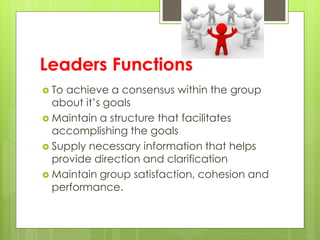
Leaders Functions
 To achieve a consensus within the group
about it’s goals
 Maintain a structure that facilitates
accomplishing the goals
 Supply necessary information that helps
provide direction and clarification
 Maintain group satisfaction, cohesion and
performance.
A Manager
 Individual employed by an organization
who is responsible and accountable for
efficiently accomplishing the goals of the
organization
Managers Focus on:
 Coordinating and integrating resources
 Using the function of planning, organizing,
supervising, staffing, evaluating,
negotiating, and representing.
 Also, has the authority, responsibility,
accountability, and power defined by the
organization
Manager’s Job
 Clarify the organizational structure
 Choose the means by which to achieve
goals
 Assign and coordinate tasks, developing
and motivating as needed
 Evaluate outcomes and provide
feedback
 All good managers are also good leaders
– the two go hand in hand
 However, one may be a good manager
of resources and not be much of a leader
of people.
 Likewise, a person who is a good leader
may not manage well
 Both, roles can be learned; skills gained
can enhance either role.
LEADERSHIP
 May be:
 1. Formal – when practice by a nurse with
legitimate authority conferred by the
organization and described in a job description
 Ex: nurse manger, supervisor, coordinator
 - depends on personal skills
 2. Informal – exercised by a staff member who
does not have a specified management role
 - depends primarily on ones knowledge, status
 Ex: APN, quality mgt coordinator, education
specialist, medical director
 -personal skills in ; persuading and guiding
others.
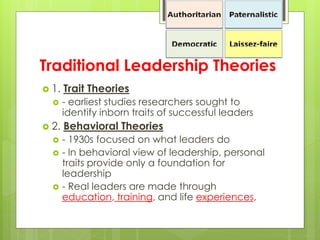
Traditional Leadership Theories
 1. Trait Theories
 - earliest studies researchers sought to
identify inborn traits of successful leaders
 2. Behavioral Theories
 - 1930s focused on what leaders do
 - In behavioral view of leadership, personal
traits provide only a foundation for
leadership
 - Real leaders are made through
education, training, and life experiences,
 3. Contingency Theories
 - Managers adapt their leadership styles in
relation to changing situation
 - Leadership behavior range from authoritarian to
permissive and vary in relation to current needs
and future probabilities.
 Ex: A nurse manager may use authoritarian style
when responding to emergency situation
(cardiac arrest) such as cardiac arrest but use a
participative style to encourage development of
a team strategy to care for patient multiple
system failure
The most effective leadership
style for a Nurse Manager
 Is the one that best complements the:
 1. Organizational development
 2. Task to be accomplished
 3. Personal characteristic of the people
involved in each situation.
CONTEMPORARY THEORIES
 Leaders in today’s health care
environment place increasing value on
collaboration and teamwork in all aspects
of the organization.
Leaders in today’s health care
 They recognize that;
 1. health systems become more complex and
require integration
 2. personnel who perform the managerial and
clinical work must cooperate
 3. coordinate their efforts
 4. produce joint results.
 5. Must use additional skills; esp. group & political
leadership skills, to create collegial work envi.
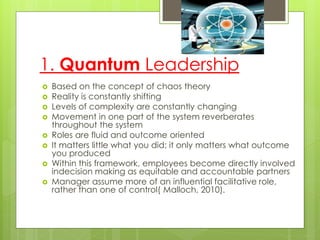
1. Quantum Leadership
 Based on the concept of chaos theory
 Reality is constantly shifting
 Levels of complexity are constantly changing
 Movement in one part of the system reverberates
throughout the system
 Roles are fluid and outcome oriented
 It matters little what you did; it only matters what outcome
you produced
 Within this framework, employees become directly involved
indecision making as equitable and accountable partners
 Manager assume more of an influential facilitative role,
rather than one of control( Malloch, 2010).
2. Transactional Leadership
 Based on the principles of social
exchange theory
 The premise;
 1. individuals engage in social interactions
expecting to give and receive social,
political, and psychological benefits or
rewards
 Exchange process bet. Leaders &
followers is viewed as essentially
economic
 The nature of these transactions is determined
by the participating parties assessments of
what is in their best interest;
 Ex: staff respond affirmatively to a nurse manger
request to work overtime in exchange for
granting special request for time off.
 Leaders are successful to the extent that they
understand & meet the needs of followers &
use incentives to enhance employee loyalty
& performance.
Transactional Leadership is
aimed at:
 1. Maintaining equilibrium or status quo,
by performing work according to policy &
procedures
 2. Maximizing self-interest and personal
rewards
 3. emphasizing interpersonal
dependence
 4. Routinizing performance (Weston, 2008)
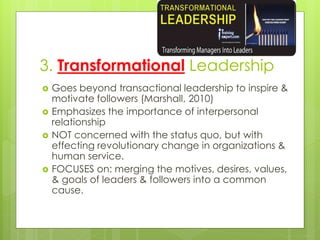
3. Transformational Leadership
 Goes beyond transactional leadership to inspire &
motivate followers (Marshall, 2010)
 Emphasizes the importance of interpersonal
relationship
 NOT concerned with the status quo, but with
effecting revolutionary change in organizations &
human service.
 FOCUSES on: merging the motives, desires, values,
& goals of leaders & followers into a common
cause.
 GOAL to: generate employees commitment to
the vision or ideal rather than to themselves.
 They foster followers inborn desires to pursue
higher values, humanitarian ideals, moral
missions and causes.
 Encourage others to exercise leadership
 Inspires followers and uses power to instill a
belief that followers also have the ability to do
exceptional things.
 T.L. may be a natural model for nursing
managers, because nursing has traditionally
been driven by its social mandate & it’s ethic
of human service.
4. Shared Leadership
 Reorganization, decentralization, and the
increasing complexity of problem solving
in health care have forced administrators
to recognize the value of S.L.
 Based on the empowerment principles of
participative & transformational
leadership. (Everett, 2011).
Essential elements of S.L.
 1. Relationships
 2. Dialogues
 3. Partnerships
 4. Understanding boundaries
Application of S.L. Assumes
that:
 1. A well educated, highly professional,
dedicated workforce is comprised of
many leaders.
 2. The notion of a single nurse as the wise
and heroic leader is unrealistic & that
many individuals@ various levels in the
org. must be responsible for the
organization’s fate & performance.
Examples of S.L. in nursing
include:
 1. Self-directed work teams – work groups
manage their own
 planning,
 organizing,
 scheduling, &
 day to day work activities.
 2. Shared governance –
 the nursing staff are formally organized at the
service area & organizational levels to make key
decisions about clinical practice standards,
 quality assurance & improvement,
 staff development,
 professional development,
 aspects of unit operation & research.
 3. Co- Leadership
 - Two people work together to execute a l. role
 - Common in service-line management, where
the skills of both a clinical and administrative
leader are needed to successfully direct the
operations of a multidisciplinary service.
 Ex: Nurse manager provides administrative
leadership in collaboration w/ a clinical nurse
specialist, who provides clinical leadership.
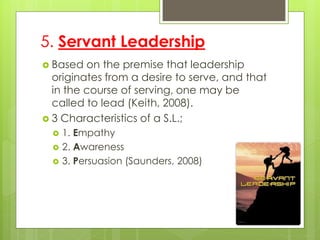
5. Servant Leadership
 Based on the premise that leadership
originates from a desire to serve, and that
in the course of serving, one may be
called to lead (Keith, 2008).
 3 Characteristics of a S.L.;
 1. Empathy
 2. Awareness
 3. Persuasion (Saunders, 2008)
S.L. appeals to nurses for 2
reasons:
 1. Our profession is founded on principles of
caring, service, & the growth & health of
others
 2. Nurses serve many constituencies, often
quite selflessly, & consequently bring about
change in individuals, systems, &
organizations.
6. Emotional Leadership
 Emotional intelligence involves;
 1. Personal competence w/c includes;
 Self-awareness & self management
 2. Social competence includes;
 Social awareness
 Relationship mgt that begins w/ authenticity
 Nurses w. their well-honed skills as
compassionate caregivers are aptly suited to
this direction in leadership that emphasizes
emotions and relationship with others as
primary attribute for success.
Ref: Eleanor J. Sullivan. (2013). Effective
Leadership & Mgt in Nsg. 8th
Ed.(International Edition)
- http://nursing,pearsonhighered.com
- THANK YOU! – Dr. James Malce Alo

Leadership.drjma

  • 1.
    LEADERSHIP Dr. James MalceAlo, RN, MAN, MAPsych, PHD
  • 2.
    Learning Outcomes  1.Explain why every nurse is a manager &can be a leader.  2. Differentiate between leaders and managers.  3. Discuss how different theories explain leadership and management.  4. Describe what management roles nurses fill in practice.  5. Discuss how followership is essential to leadership.  6. Describe what makes a leader successful.
  • 3.
    Manager, leader, supervisor,and administrator - are often used interchangeably, yet they are not the same.
  • 4.
    A Leader  Isanyone who uses interpersonal skills to influence others to accomplish a specific goals.  Exerts influence by using a flexible repertoire of personal behaviors and strategies
  • 5.
    The Leader isImportant in:  Forging links  Creating connections – among an organization’s members  -to promote high levels of performance and quality outcomes
  • 6.
    Leaders Functions  Toachieve a consensus within the group about it’s goals  Maintain a structure that facilitates accomplishing the goals  Supply necessary information that helps provide direction and clarification  Maintain group satisfaction, cohesion and performance.
  • 7.
    A Manager  Individualemployed by an organization who is responsible and accountable for efficiently accomplishing the goals of the organization
  • 8.
    Managers Focus on: Coordinating and integrating resources  Using the function of planning, organizing, supervising, staffing, evaluating, negotiating, and representing.  Also, has the authority, responsibility, accountability, and power defined by the organization
  • 9.
    Manager’s Job  Clarifythe organizational structure  Choose the means by which to achieve goals  Assign and coordinate tasks, developing and motivating as needed  Evaluate outcomes and provide feedback
  • 10.
     All goodmanagers are also good leaders – the two go hand in hand  However, one may be a good manager of resources and not be much of a leader of people.  Likewise, a person who is a good leader may not manage well  Both, roles can be learned; skills gained can enhance either role.
  • 11.
    LEADERSHIP  May be: 1. Formal – when practice by a nurse with legitimate authority conferred by the organization and described in a job description  Ex: nurse manger, supervisor, coordinator  - depends on personal skills  2. Informal – exercised by a staff member who does not have a specified management role  - depends primarily on ones knowledge, status  Ex: APN, quality mgt coordinator, education specialist, medical director  -personal skills in ; persuading and guiding others.
  • 12.
    Traditional Leadership Theories 1. Trait Theories  - earliest studies researchers sought to identify inborn traits of successful leaders  2. Behavioral Theories  - 1930s focused on what leaders do  - In behavioral view of leadership, personal traits provide only a foundation for leadership  - Real leaders are made through education, training, and life experiences,
  • 13.
     3. ContingencyTheories  - Managers adapt their leadership styles in relation to changing situation  - Leadership behavior range from authoritarian to permissive and vary in relation to current needs and future probabilities.  Ex: A nurse manager may use authoritarian style when responding to emergency situation (cardiac arrest) such as cardiac arrest but use a participative style to encourage development of a team strategy to care for patient multiple system failure
  • 14.
    The most effectiveleadership style for a Nurse Manager  Is the one that best complements the:  1. Organizational development  2. Task to be accomplished  3. Personal characteristic of the people involved in each situation.
  • 15.
    CONTEMPORARY THEORIES  Leadersin today’s health care environment place increasing value on collaboration and teamwork in all aspects of the organization.
  • 16.
    Leaders in today’shealth care  They recognize that;  1. health systems become more complex and require integration  2. personnel who perform the managerial and clinical work must cooperate  3. coordinate their efforts  4. produce joint results.  5. Must use additional skills; esp. group & political leadership skills, to create collegial work envi.
  • 17.
    1. Quantum Leadership Based on the concept of chaos theory  Reality is constantly shifting  Levels of complexity are constantly changing  Movement in one part of the system reverberates throughout the system  Roles are fluid and outcome oriented  It matters little what you did; it only matters what outcome you produced  Within this framework, employees become directly involved indecision making as equitable and accountable partners  Manager assume more of an influential facilitative role, rather than one of control( Malloch, 2010).
  • 18.
    2. Transactional Leadership Based on the principles of social exchange theory  The premise;  1. individuals engage in social interactions expecting to give and receive social, political, and psychological benefits or rewards  Exchange process bet. Leaders & followers is viewed as essentially economic
  • 19.
     The natureof these transactions is determined by the participating parties assessments of what is in their best interest;  Ex: staff respond affirmatively to a nurse manger request to work overtime in exchange for granting special request for time off.  Leaders are successful to the extent that they understand & meet the needs of followers & use incentives to enhance employee loyalty & performance.
  • 20.
    Transactional Leadership is aimedat:  1. Maintaining equilibrium or status quo, by performing work according to policy & procedures  2. Maximizing self-interest and personal rewards  3. emphasizing interpersonal dependence  4. Routinizing performance (Weston, 2008)
  • 21.
    3. Transformational Leadership Goes beyond transactional leadership to inspire & motivate followers (Marshall, 2010)  Emphasizes the importance of interpersonal relationship  NOT concerned with the status quo, but with effecting revolutionary change in organizations & human service.  FOCUSES on: merging the motives, desires, values, & goals of leaders & followers into a common cause.
  • 22.
     GOAL to:generate employees commitment to the vision or ideal rather than to themselves.  They foster followers inborn desires to pursue higher values, humanitarian ideals, moral missions and causes.  Encourage others to exercise leadership  Inspires followers and uses power to instill a belief that followers also have the ability to do exceptional things.  T.L. may be a natural model for nursing managers, because nursing has traditionally been driven by its social mandate & it’s ethic of human service.
  • 23.
    4. Shared Leadership Reorganization, decentralization, and the increasing complexity of problem solving in health care have forced administrators to recognize the value of S.L.  Based on the empowerment principles of participative & transformational leadership. (Everett, 2011).
  • 24.
    Essential elements ofS.L.  1. Relationships  2. Dialogues  3. Partnerships  4. Understanding boundaries
  • 25.
    Application of S.L.Assumes that:  1. A well educated, highly professional, dedicated workforce is comprised of many leaders.  2. The notion of a single nurse as the wise and heroic leader is unrealistic & that many individuals@ various levels in the org. must be responsible for the organization’s fate & performance.
  • 26.
    Examples of S.L.in nursing include:  1. Self-directed work teams – work groups manage their own  planning,  organizing,  scheduling, &  day to day work activities.
  • 27.
     2. Sharedgovernance –  the nursing staff are formally organized at the service area & organizational levels to make key decisions about clinical practice standards,  quality assurance & improvement,  staff development,  professional development,  aspects of unit operation & research.
  • 28.
     3. Co-Leadership  - Two people work together to execute a l. role  - Common in service-line management, where the skills of both a clinical and administrative leader are needed to successfully direct the operations of a multidisciplinary service.  Ex: Nurse manager provides administrative leadership in collaboration w/ a clinical nurse specialist, who provides clinical leadership.
  • 29.
    5. Servant Leadership Based on the premise that leadership originates from a desire to serve, and that in the course of serving, one may be called to lead (Keith, 2008).  3 Characteristics of a S.L.;  1. Empathy  2. Awareness  3. Persuasion (Saunders, 2008)
  • 30.
    S.L. appeals tonurses for 2 reasons:  1. Our profession is founded on principles of caring, service, & the growth & health of others  2. Nurses serve many constituencies, often quite selflessly, & consequently bring about change in individuals, systems, & organizations.
  • 31.
    6. Emotional Leadership Emotional intelligence involves;  1. Personal competence w/c includes;  Self-awareness & self management  2. Social competence includes;  Social awareness  Relationship mgt that begins w/ authenticity  Nurses w. their well-honed skills as compassionate caregivers are aptly suited to this direction in leadership that emphasizes emotions and relationship with others as primary attribute for success.
  • 33.
    Ref: Eleanor J.Sullivan. (2013). Effective Leadership & Mgt in Nsg. 8th Ed.(International Edition) - http://nursing,pearsonhighered.com - THANK YOU! – Dr. James Malce Alo