Sumeet Wadibhasme
What is TRANSFORMER ? C-CUBE 
 
Group of Engineers 
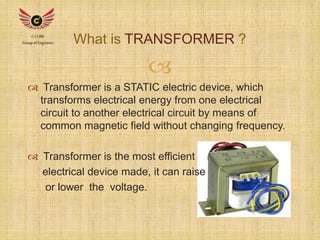
 Transformer is a STATIC electric device, which 
transforms electrical energy from one electrical 
circuit to another electrical circuit by means of 
common magnetic field without changing frequency. 
 Transformer is the most efficient 
electrical device made, it can raise 
or lower the voltage.
How transformer works? C-CUBE 
 
Group of Engineers 
 The transformer works on the two main basic 
principle of electricity . 
 FARADAY’s 1st law : Whenever flux linking with the 
conductor changes emf is induced 
in the conductor. 
 FARADAY’s 2nd law: The magnitude of the emf induced is 
directly proportional to the rate of 
change of flux. 
Togetherly we call is as “MUTUAL INDUCTANCE”
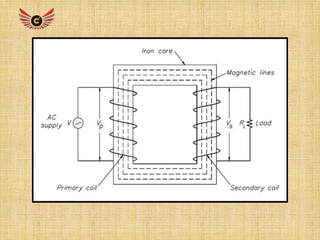
1. The changing current 
in the primary coil, is 
usually achieved by applying 
an alternating voltage, 
resulting in an alternating 
current (AC) 
AC input 
3. The field from the primary coil is 
intensified and concentrated (also 
referred to as increasing the “flux 
linkage”) through the 
secondary coil by an iron core 
AC output 
4.The changing flux through the 
secondary coil, induces a 
potential difference across the 
secondary coil 
2. As the alternating current changes 
magnitude and direction, a magnetic 
field is produced, which changes in a 
corresponding manner 
C-CUBE 
Group of Engineers
What is transformation ratio? 
 
C-CUBE 
Group of Engineers 
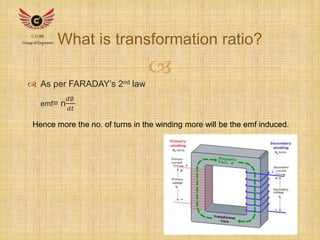
 As per FARADAY’s 2nd law 
emf= n 
푑∅ 
푑푡 
Hence more the no. of turns in the winding more will be the emf induced.
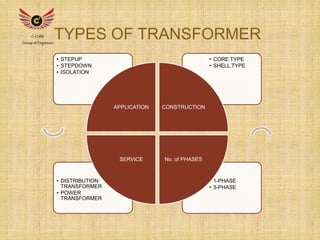
TYPES OF TRANSFORMER 
• 1-PHASE 
• 3-PHASE 
• DISTRIBUTION 
TRANSFORMER 
• POWER 
TRANSFORMER 
• CORE TYPE 
• SHELL TYPE 
• STEPUP 
• STEPDOWN 
• ISOLATION 
APPLICATION CONSTRUCTION 
SERVICE No. of PHASES 
C-CUBE 
Group of Engineers
CLASSIFICATION ON BASIS OF APPLICATION 
C-CUBE 
Group of Engineers 
Stepup & stepdown tranformers. Isolation transformer
CLASSIFICATION ON BASIS OF SERVICE 
POWER TRANSFORMER 
DISTRIBUTION TRANSFORMER 
C-CUBE 
Group of Engineers
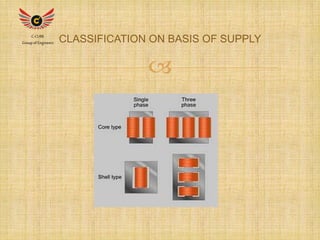
CLASSIFICATION ON BASIS OF SUPPLY C-CUBE 
 
Group of Engineers
APPLICATION OF TRANSFORMER C-CUBE 
 
Group of Engineers 
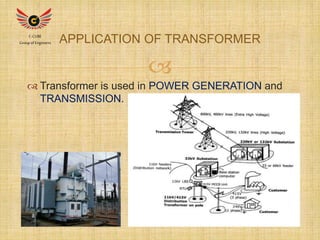
 Transformer is used in POWER GENERATION and 
TRANSMISSION.
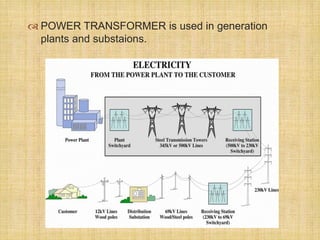
 POWER TRANSFORMER is used in generation 
 
plants and substaions.
 
C-CUBE 
Group of Engineers 
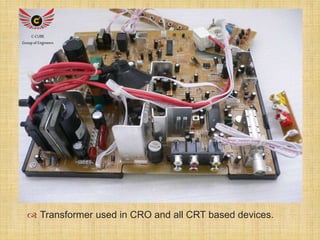
 Transformer used in CRO and all CRT based devices.
 
C-CUBE 
Group of Engineers 
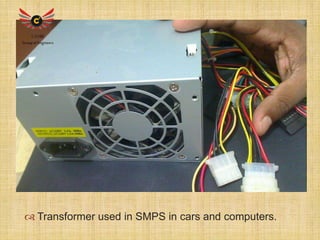
 Transformer used in SMPS in cars and computers.
 TRANSFORMER used in power supplies. 
 STEP DOWN transformer is used to lower the 230V - 
3 V in mobile and laptop chargers. 
 
C-CUBE 
Group of Engineers
 Even transformer principle is used in working of 
 
INDUCTION motor. 
ROTATING MAGNETIC FIELD 
C-CUBE 
Group of Engineers
REFERENCES 
 
 www.slideshare.net/kilobytesumeet/ 
 www.en.wikipedia.com
THANK YOU! C-CUBE 
 
Group of Engineers

Transformer ppt

  • 1.
  • 2.
    What is TRANSFORMER? C-CUBE  Group of Engineers  Transformer is a STATIC electric device, which transforms electrical energy from one electrical circuit to another electrical circuit by means of common magnetic field without changing frequency.  Transformer is the most efficient electrical device made, it can raise or lower the voltage.
  • 3.
    How transformer works?C-CUBE  Group of Engineers  The transformer works on the two main basic principle of electricity .  FARADAY’s 1st law : Whenever flux linking with the conductor changes emf is induced in the conductor.  FARADAY’s 2nd law: The magnitude of the emf induced is directly proportional to the rate of change of flux. Togetherly we call is as “MUTUAL INDUCTANCE”
  • 5.
    1. The changingcurrent in the primary coil, is usually achieved by applying an alternating voltage, resulting in an alternating current (AC) AC input 3. The field from the primary coil is intensified and concentrated (also referred to as increasing the “flux linkage”) through the secondary coil by an iron core AC output 4.The changing flux through the secondary coil, induces a potential difference across the secondary coil 2. As the alternating current changes magnitude and direction, a magnetic field is produced, which changes in a corresponding manner C-CUBE Group of Engineers
  • 6.
    What is transformationratio?  C-CUBE Group of Engineers  As per FARADAY’s 2nd law emf= n 푑∅ 푑푡 Hence more the no. of turns in the winding more will be the emf induced.
  • 7.
    TYPES OF TRANSFORMER • 1-PHASE • 3-PHASE • DISTRIBUTION TRANSFORMER • POWER TRANSFORMER • CORE TYPE • SHELL TYPE • STEPUP • STEPDOWN • ISOLATION APPLICATION CONSTRUCTION SERVICE No. of PHASES C-CUBE Group of Engineers
  • 8.
    CLASSIFICATION ON BASISOF APPLICATION C-CUBE Group of Engineers Stepup & stepdown tranformers. Isolation transformer
  • 9.
    CLASSIFICATION ON BASISOF SERVICE POWER TRANSFORMER DISTRIBUTION TRANSFORMER C-CUBE Group of Engineers
  • 10.
    CLASSIFICATION ON BASISOF SUPPLY C-CUBE  Group of Engineers
  • 11.
    APPLICATION OF TRANSFORMERC-CUBE  Group of Engineers  Transformer is used in POWER GENERATION and TRANSMISSION.
  • 12.
     POWER TRANSFORMERis used in generation  plants and substaions.
  • 13.
     C-CUBE Groupof Engineers  Transformer used in CRO and all CRT based devices.
  • 14.
     C-CUBE Groupof Engineers  Transformer used in SMPS in cars and computers.
  • 15.
     TRANSFORMER usedin power supplies.  STEP DOWN transformer is used to lower the 230V - 3 V in mobile and laptop chargers.  C-CUBE Group of Engineers
  • 16.
     Even transformerprinciple is used in working of  INDUCTION motor. ROTATING MAGNETIC FIELD C-CUBE Group of Engineers
  • 17.
    REFERENCES  www.slideshare.net/kilobytesumeet/  www.en.wikipedia.com
  • 18.
    THANK YOU! C-CUBE  Group of Engineers