Transducers
for
Instrumentation Engineering
By
www.thegateacademy.com
Content Transducers
THE GATE ACADEMY PVT.LTD. H.O.: #74, Keshava Krupa (third Floor), 30th
Cross, 10th
Main, Jayanagar 4th
Block, Bangalore-11
: 080-65700750,  info@thegateacademy.com © Copyright reserved. Web: www.thegateacadem
Syllabus for Transducers
Resistive, Capacitive, Inductive and piezoelectric transducers and their signal conditioning. Measurement of
displacement, velocity and acceleration (translational and rotational), force, torque, vibration and shock.
Measurement of pressure, flow, temperature and liquid level. Measurement of pH, conductivity, viscosity and
humidity.
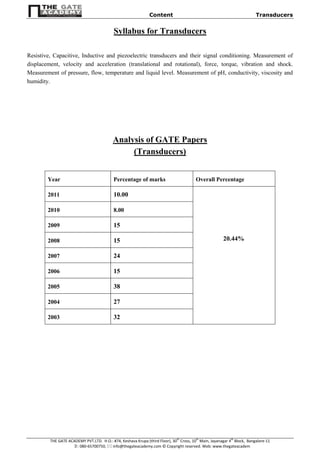
Analysis of GATE Papers
(Transducers)
Year Percentage of marks Overall Percentage
2011 10.00
20.44%
2010 8.00
2009 15
2008 15
2007 24
2006 15
2005 38
2004 27
2003 32
Content Transducers
THE GATE ACADEMY PVT.LTD. H.O.: #74, Keshava Krupa (third Floor), 30th
Cross, 10th
Main, Jayanagar 4th
Block, Bangalore-11
: 080-65700750,  info@thegateacademy.com © Copyright reserved. Web: www.thegateacademy.com Page | i
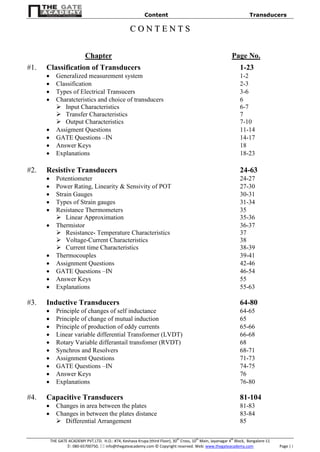
CC OO NN TT EE NN TT SS
Chapter Page No.
#1. Classification of Transducers 1-23
 Generalized measurement system 1-2
 Classification 2-3
 Types of Electrical Transucers 3-6
 Charatcteristics and choice of transducers 6
 Input Characteristics 6-7
 Transfer Characteristics 7
 Output Characteristics 7-10
 Assigment Questions 11-14
 GATE Questions –IN 14-17
 Answer Keys 18
 Explanations 18-23
#2. Resistive Transducers 24-63
 Potentiometer 24-27
 Power Rating, Linearity & Sensivity of POT 27-30
 Strain Gauges 30-31
 Types of Strain gauges 31-34
 Resistance Thermometers 35
 Linear Approximation 35-36
 Thermistor 36-37
 Resistance- Temperature Characteristics 37
 Voltage-Current Characteristics 38
 Current time Characteristics 38-39
 Thermocouples 39-41
 Assignment Questions 42-46
 GATE Questions –IN 46-54
 Answer Keys 55
 Explanations 55-63
#3. Inductive Transducers 64-80
 Principle of changes of self inductance 64-65
 Principle of change of mutual induction 65
 Principle of production of eddy currents 65-66
 Linear variable differential Transformer (LVDT) 66-68
 Rotary Variable differantail transfomer (RVDT) 68
 Synchros and Resolvers 68-71
 Assignment Questions 71-73
 GATE Questions –IN 74-75
 Answer Keys 76
 Explanations 76-80
#4. Capacitive Transducers 81-104
 Changes in area between the plates 81-83
 Changes in between the plates distance 83-84
 Differential Arrangement 85
Content Transducers
THE GATE ACADEMY PVT.LTD. H.O.: #74, Keshava Krupa (third Floor), 30th
Cross, 10th
Main, Jayanagar 4th
Block, Bangalore-11
: 080-65700750,  info@thegateacademy.com © Copyright reserved. Web: www.thegateacademy.com Page | ii
 Variation of dielectric constant for measurement of displacement 86-91
 Assignment Questions 92-94
 GATE Questions –IN 94-98
 Answer Keys 99
 Explanations 99-104
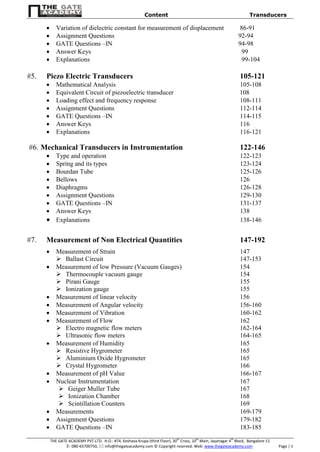
#5. Piezo Electric Transducers 105-121
 Mathematical Analysis 105-108
 Equivalent Circuit of piezoelectric transducer 108
 Loading effect and frequency response 108-111
 Assignment Questions 112-114
 GATE Questions –IN 114-115
 Answer Keys 116
 Explanations 116-121
#6. Mechanical Transducers in Instrumentation 122-146
 Type and operation 122-123
 Spring and its types 123-124
 Bourdan Tube 125-126
 Bellows 126
 Diaphragms 126-128
 Assignment Questions 129-130
 GATE Questions –IN 131-137
 Answer Keys 138
 Explanations 138-146
#7. Measurement of Non Electrical Quantities 147-192
 Measurement of Strain 147
 Ballast Circuit 147-153
 Measurement of low Pressure (Vacuum Gauges) 154
 Thermocouple vacuum gauge 154
 Pirani Gauge 155
 Ionization gauge 155
 Measurement of linear velocity 156
 Measurement of Angular velocity 156-160
 Measurement of Vibration 160-162
 Measurement of Flow 162
 Electro magnetic flow meters 162-164
 Ultrasonic flow meters 164-165
 Measurement of Humidity 165
 Resistive Hygrometer 165
 Aluminium Oxide Hygrometer 165
 Crystal Hygrometer 166
 Measurement of pH Value 166-167
 Nuclear Instrumentation 167
 Geiger Muller Tube 167
 Ionization Chamber 168
 Scintillation Counters 169
 Measurements 169-179
 Assignment Questions 179-182
 GATE Questions –IN 183-185
Content Transducers
THE GATE ACADEMY PVT.LTD. H.O.: #74, Keshava Krupa (third Floor), 30th
Cross, 10th
Main, Jayanagar 4th
Block, Bangalore-11
: 080-65700750,  info@thegateacademy.com © Copyright reserved. Web: www.thegateacademy.com Page | iii
 Answer Keys 186
 Explanations 186-192
Module Test 193-203
 Test Questions 193-197
 Answer Keys 198
 Explanations 198-203
Reference Books 204
Chapter 1 Transducers
THE GATE ACADEMY PVT.LTD. H.O.: #74, Keshava Krupa (third Floor), 30th
Cross, 10th
Main, Jayanagar 4th
Block, Bangalore-11
: 080-65700750,  info@thegateacademy.com © Copyright reserved. Web: www.thegateacademy.com Page 1
CHAPTER 1
Classification of Transducers
Introduction
The measuring process is one in which the property of an object or system under consideration
is compared to an accepted standard unit, a standard defined for that particular property.
It is important to have a systematic organization and analysis of measurement systems. An
instrument may be defined as a device or a system which is designed to maintain a functional
relationship between prescribed properties of physical variables and must include ways and
means of communication to a human observer.
Generalized Measurement system
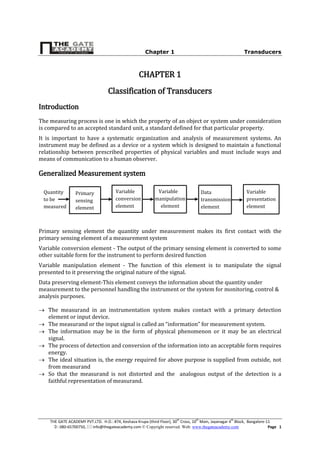
Primary sensing element the quantity under measurement makes its first contact with the
primary sensing element of a measurement system
Variable conversion element - The output of the primary sensing element is converted to some
other suitable form for the instrument to perform desired function
Variable manipulation element - The function of this element is to manipulate the signal
presented to it preserving the original nature of the signal.
Data preserving element-This element conveys the information about the quantity under
measurement to the personnel handling the instrument or the system for monitoring, control &
analysis purposes.
 The measurand in an instrumentation system makes contact with a primary detection
element or input device.
 The measurand or the input signal is called an “information” for measurement system.
 The information may be in the form of physical phenomenon or it may be an electrical
signal.
 The process of detection and conversion of the information into an acceptable form requires
energy.
 The ideal situation is, the energy required for above purpose is supplied from outside, not
from measurand
 So that the measurand is not distorted and the analogous output of the detection is a
faithful representation of measurand.
Primary
sensing
element
Variable
conversion
element
Variable
manipulation
element
Data
transmission
element
Variable
presentation
element
Quantity
to be
measured
Chapter 1 Transducers
THE GATE ACADEMY PVT.LTD. H.O.: #74, Keshava Krupa (third Floor), 30th
Cross, 10th
Main, Jayanagar 4th
Block, Bangalore-11
: 080-65700750,  info@thegateacademy.com © Copyright reserved. Web: www.thegateacademy.com Page 2
Example 1
A ___________ element is that Part of a Transducer which responds to a physical phenomenon or
change in a physical phenomenon.
(A) Sensing
(B) Transduction
(C) Resistive
(D) Inductive
Solution
[Ans. A]
Primary sensing element The quantity under measurement (any physical phenomenon)
makes its first contact with the sensing element of a measurement system, thus it responds to a
physical phenomenon.
Example 2
Some of the Functional Building Blocks of the measurement System are: PSE (Primary Sensing
Element), VCE (Variable Conversion Element), DTE (Data Transmission Element), VME
(Variable Manipulation Element), DPE (Data Presentation Element).
The Correct Sequential Connection of the functional Building Blocks for an electronic Pressure
gauge will be:
(A) PSE, VME, VCE, DPE, DTE.
(B) PSE, VCE, VME, DTE, DPE
(C) DTE, DPE, VCE, PSE, VME
(D)PSE, VCE, DTE, DPE, VME
Solution
[Ans. B]
A generalized measurement system should have a systematic organization for the measurement
of given physical phenomenon and building blocks should have a correct sequential connections
for an electronic pressure gauge.
Transducers
1. The input quantity for the most instrumentation system is a non electrical quantity. In order
to use electrical methods and techniques for measurements, manipulation, or control, non
electrical quantity is generally converted into an electrical form by a device called
Transducer.
2. We can define Transducer as a device which, accurately transforms energy from one form to
another.
3. Another name for Transducer is ‘PICK – UP’.
4. The reason for Transforming a physical phenomenon into an electrical form is that the
electrical output can be easily used, transmitted and processed for the purpose of
measurement.
5. The relationship between the physical parameter and its resulting electrical signal must be a
Linear one.
6. Transducers mainly consists of two parts :-
a) Sensing Element.
b) Transduction Element
Chapter 1 Transducers
THE GATE ACADEMY PVT.LTD. H.O.: #74, Keshava Krupa (third Floor), 30th
Cross, 10th
Main, Jayanagar 4th
Block, Bangalore-11
: 080-65700750,  info@thegateacademy.com © Copyright reserved. Web: www.thegateacademy.com Page 3
a) Sensing Element It is that part of a transducer which responds to a physical
phenomenon or a change in a physical phenomenon.
b) Transduction Element It Transforms the output of a sensing element to an electrical
output.
Classification of Transducers
The transducers can be classified as:
(i) Based upon transduction principle
(ii) As primary and secondary transducers
(iii) As passive and active transducers
(iv) As analog and digital transducers
(v) As transducers and inverse transducers
(i) Based Upon Transduction Principle
The transducers can be classified on the basis of principle of transduction as resistive,
inductive, capacitive etc., depending upon how they convert the input quantity into
resistance, inductance or capacitance respectively.
(ii) Primary and Secondary Transducers
 The first transducer which converts physical phenomenon into displacement,
pressure, velocity etc. which is to be accepted by next stage is known as “Primary
Transducer”.
 The output of the primary transducer is converted subsequently into a usable output
by a device called “Secondary Transducer”
(iii) Passive and Active Transducers
Passive Transducers: They derive the power required for transduction from an auxillary
power source.
Eg: Resistive, inductive and capacitive transducers.
Active Transducers: They do not require an auxillary power source to produce their
output. They are also known as self – generating type since they develop their own
voltage or current output.
Eg: piezoelectric, photovoltaic etc.
(iv) Analog and Digital Transducers
Analog Transducers: These Transducers convert the input quantity into an analog output
which is a continuous function of time.
Eg: LVDT, thermocouple etc.
Digital Transducers: These transducers convert the input quantity into an electrical output
which is in the form of pulses.
(v) Transducers & Inverse Transducers
Transducer: A transducer can be broadly defined as a device which converts a non –
electrical quantity into an electrical quantity.
Chapter 1 Transducers
THE GATE ACADEMY PVT.LTD. H.O.: #74, Keshava Krupa (third Floor), 30th
Cross, 10th
Main, Jayanagar 4th
Block, Bangalore-11
: 080-65700750,  info@thegateacademy.com © Copyright reserved. Web: www.thegateacademy.com Page 4
Example: L.V.D.T, Resistive and Capacitive Transducers as well.
Inverse Transducer: An inverse transducer is defined as a device which converts an
electrical quantity into a non – electrical quantity.
Note: Generally a inverse transducer is a output transducer.
Example: Indicating Instruments, Pen Recorders, Oscilloscope.
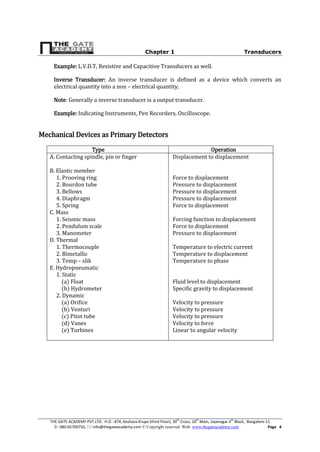
Mechanical Devices as Primary Detectors
Type Operation
A. Contacting spindle, pin or finger
B. Elastic member
1. Prooving ring
2. Bourdon tube
3. Bellows
4. Diaphragm
5. Spring
C. Mass
1. Seismic mass
2. Pendulum scale
3. Manometer
D. Thermal
1. Thermocouple
2. Bimetallic
3. Temp – slik
E. Hydropneumatic
1. Static
(a) Float
(b) Hydrometer
2. Dynamic
(a) Orifice
(b) Venturi
(c) Pitot tube
(d) Vanes
(e) Turbines
Displacement to displacement
Force to displacement
Pressure to displacement
Force to displacement
Forcing function to displacement
Force to displacement
Pressure to displacement
Temperature to electric current
Temperature to displacement
Temperature to phase
Fluid level to displacement
Specific gravity to displacement
Velocity to pressure
Velocity to force
Linear to angular velocity
Chapter 1 Transducers
THE GATE ACADEMY PVT.LTD. H.O.: #74, Keshava Krupa (third Floor), 30th
Cross, 10th
Main, Jayanagar 4th
Block, Bangalore-11
: 080-65700750,  info@thegateacademy.com © Copyright reserved. Web: www.thegateacademy.com Page 5
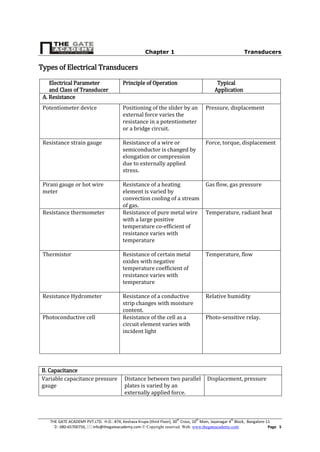
Types of Electrical Transducers
Electrical Parameter
and Class of Transducer
Principle of Operation Typical
Application
A. Resistance
Potentiometer device Positioning of the slider by an
external force varies the
resistance in a potentiometer
or a bridge circuit.
Pressure, displacement
Resistance strain gauge Resistance of a wire or
semiconductor is changed by
elongation or compression
due to externally applied
stress.
Force, torque, displacement
Pirani gauge or hot wire
meter
Resistance of a heating
element is varied by
convection cooling of a stream
of gas.
Gas flow, gas pressure
Resistance thermometer Resistance of pure metal wire
with a large positive
temperature co-efficient of
resistance varies with
temperature
Temperature, radiant heat
Thermistor Resistance of certain metal
oxides with negative
temperature coefficient of
resistance varies with
temperature
Temperature, flow
Resistance Hydrometer Resistance of a conductive
strip changes with moisture
content.
Relative humidity
Photoconductive cell Resistance of the cell as a
circuit element varies with
incident light
Photo-sensitive relay.
B. Capacitance
Variable capacitance pressure
gauge
Distance between two parallel
plates is varied by an
externally applied force.
Displacement, pressure
 Instrumentation Engineering : Transducers, THE GATE ACADEMY

Instrumentation Engineering : Transducers, THE GATE ACADEMY

  • 2.
  • 3.
    Content Transducers THE GATEACADEMY PVT.LTD. H.O.: #74, Keshava Krupa (third Floor), 30th Cross, 10th Main, Jayanagar 4th Block, Bangalore-11 : 080-65700750,  info@thegateacademy.com © Copyright reserved. Web: www.thegateacadem Syllabus for Transducers Resistive, Capacitive, Inductive and piezoelectric transducers and their signal conditioning. Measurement of displacement, velocity and acceleration (translational and rotational), force, torque, vibration and shock. Measurement of pressure, flow, temperature and liquid level. Measurement of pH, conductivity, viscosity and humidity. Analysis of GATE Papers (Transducers) Year Percentage of marks Overall Percentage 2011 10.00 20.44% 2010 8.00 2009 15 2008 15 2007 24 2006 15 2005 38 2004 27 2003 32
  • 4.
    Content Transducers THE GATEACADEMY PVT.LTD. H.O.: #74, Keshava Krupa (third Floor), 30th Cross, 10th Main, Jayanagar 4th Block, Bangalore-11 : 080-65700750,  info@thegateacademy.com © Copyright reserved. Web: www.thegateacademy.com Page | i CC OO NN TT EE NN TT SS Chapter Page No. #1. Classification of Transducers 1-23  Generalized measurement system 1-2  Classification 2-3  Types of Electrical Transucers 3-6  Charatcteristics and choice of transducers 6  Input Characteristics 6-7  Transfer Characteristics 7  Output Characteristics 7-10  Assigment Questions 11-14  GATE Questions –IN 14-17  Answer Keys 18  Explanations 18-23 #2. Resistive Transducers 24-63  Potentiometer 24-27  Power Rating, Linearity & Sensivity of POT 27-30  Strain Gauges 30-31  Types of Strain gauges 31-34  Resistance Thermometers 35  Linear Approximation 35-36  Thermistor 36-37  Resistance- Temperature Characteristics 37  Voltage-Current Characteristics 38  Current time Characteristics 38-39  Thermocouples 39-41  Assignment Questions 42-46  GATE Questions –IN 46-54  Answer Keys 55  Explanations 55-63 #3. Inductive Transducers 64-80  Principle of changes of self inductance 64-65  Principle of change of mutual induction 65  Principle of production of eddy currents 65-66  Linear variable differential Transformer (LVDT) 66-68  Rotary Variable differantail transfomer (RVDT) 68  Synchros and Resolvers 68-71  Assignment Questions 71-73  GATE Questions –IN 74-75  Answer Keys 76  Explanations 76-80 #4. Capacitive Transducers 81-104  Changes in area between the plates 81-83  Changes in between the plates distance 83-84  Differential Arrangement 85
  • 5.
    Content Transducers THE GATEACADEMY PVT.LTD. H.O.: #74, Keshava Krupa (third Floor), 30th Cross, 10th Main, Jayanagar 4th Block, Bangalore-11 : 080-65700750,  info@thegateacademy.com © Copyright reserved. Web: www.thegateacademy.com Page | ii  Variation of dielectric constant for measurement of displacement 86-91  Assignment Questions 92-94  GATE Questions –IN 94-98  Answer Keys 99  Explanations 99-104 #5. Piezo Electric Transducers 105-121  Mathematical Analysis 105-108  Equivalent Circuit of piezoelectric transducer 108  Loading effect and frequency response 108-111  Assignment Questions 112-114  GATE Questions –IN 114-115  Answer Keys 116  Explanations 116-121 #6. Mechanical Transducers in Instrumentation 122-146  Type and operation 122-123  Spring and its types 123-124  Bourdan Tube 125-126  Bellows 126  Diaphragms 126-128  Assignment Questions 129-130  GATE Questions –IN 131-137  Answer Keys 138  Explanations 138-146 #7. Measurement of Non Electrical Quantities 147-192  Measurement of Strain 147  Ballast Circuit 147-153  Measurement of low Pressure (Vacuum Gauges) 154  Thermocouple vacuum gauge 154  Pirani Gauge 155  Ionization gauge 155  Measurement of linear velocity 156  Measurement of Angular velocity 156-160  Measurement of Vibration 160-162  Measurement of Flow 162  Electro magnetic flow meters 162-164  Ultrasonic flow meters 164-165  Measurement of Humidity 165  Resistive Hygrometer 165  Aluminium Oxide Hygrometer 165  Crystal Hygrometer 166  Measurement of pH Value 166-167  Nuclear Instrumentation 167  Geiger Muller Tube 167  Ionization Chamber 168  Scintillation Counters 169  Measurements 169-179  Assignment Questions 179-182  GATE Questions –IN 183-185
  • 6.
    Content Transducers THE GATEACADEMY PVT.LTD. H.O.: #74, Keshava Krupa (third Floor), 30th Cross, 10th Main, Jayanagar 4th Block, Bangalore-11 : 080-65700750,  info@thegateacademy.com © Copyright reserved. Web: www.thegateacademy.com Page | iii  Answer Keys 186  Explanations 186-192 Module Test 193-203  Test Questions 193-197  Answer Keys 198  Explanations 198-203 Reference Books 204
  • 7.
    Chapter 1 Transducers THEGATE ACADEMY PVT.LTD. H.O.: #74, Keshava Krupa (third Floor), 30th Cross, 10th Main, Jayanagar 4th Block, Bangalore-11 : 080-65700750,  info@thegateacademy.com © Copyright reserved. Web: www.thegateacademy.com Page 1 CHAPTER 1 Classification of Transducers Introduction The measuring process is one in which the property of an object or system under consideration is compared to an accepted standard unit, a standard defined for that particular property. It is important to have a systematic organization and analysis of measurement systems. An instrument may be defined as a device or a system which is designed to maintain a functional relationship between prescribed properties of physical variables and must include ways and means of communication to a human observer. Generalized Measurement system Primary sensing element the quantity under measurement makes its first contact with the primary sensing element of a measurement system Variable conversion element - The output of the primary sensing element is converted to some other suitable form for the instrument to perform desired function Variable manipulation element - The function of this element is to manipulate the signal presented to it preserving the original nature of the signal. Data preserving element-This element conveys the information about the quantity under measurement to the personnel handling the instrument or the system for monitoring, control & analysis purposes.  The measurand in an instrumentation system makes contact with a primary detection element or input device.  The measurand or the input signal is called an “information” for measurement system.  The information may be in the form of physical phenomenon or it may be an electrical signal.  The process of detection and conversion of the information into an acceptable form requires energy.  The ideal situation is, the energy required for above purpose is supplied from outside, not from measurand  So that the measurand is not distorted and the analogous output of the detection is a faithful representation of measurand. Primary sensing element Variable conversion element Variable manipulation element Data transmission element Variable presentation element Quantity to be measured
  • 8.
    Chapter 1 Transducers THEGATE ACADEMY PVT.LTD. H.O.: #74, Keshava Krupa (third Floor), 30th Cross, 10th Main, Jayanagar 4th Block, Bangalore-11 : 080-65700750,  info@thegateacademy.com © Copyright reserved. Web: www.thegateacademy.com Page 2 Example 1 A ___________ element is that Part of a Transducer which responds to a physical phenomenon or change in a physical phenomenon. (A) Sensing (B) Transduction (C) Resistive (D) Inductive Solution [Ans. A] Primary sensing element The quantity under measurement (any physical phenomenon) makes its first contact with the sensing element of a measurement system, thus it responds to a physical phenomenon. Example 2 Some of the Functional Building Blocks of the measurement System are: PSE (Primary Sensing Element), VCE (Variable Conversion Element), DTE (Data Transmission Element), VME (Variable Manipulation Element), DPE (Data Presentation Element). The Correct Sequential Connection of the functional Building Blocks for an electronic Pressure gauge will be: (A) PSE, VME, VCE, DPE, DTE. (B) PSE, VCE, VME, DTE, DPE (C) DTE, DPE, VCE, PSE, VME (D)PSE, VCE, DTE, DPE, VME Solution [Ans. B] A generalized measurement system should have a systematic organization for the measurement of given physical phenomenon and building blocks should have a correct sequential connections for an electronic pressure gauge. Transducers 1. The input quantity for the most instrumentation system is a non electrical quantity. In order to use electrical methods and techniques for measurements, manipulation, or control, non electrical quantity is generally converted into an electrical form by a device called Transducer. 2. We can define Transducer as a device which, accurately transforms energy from one form to another. 3. Another name for Transducer is ‘PICK – UP’. 4. The reason for Transforming a physical phenomenon into an electrical form is that the electrical output can be easily used, transmitted and processed for the purpose of measurement. 5. The relationship between the physical parameter and its resulting electrical signal must be a Linear one. 6. Transducers mainly consists of two parts :- a) Sensing Element. b) Transduction Element
  • 9.
    Chapter 1 Transducers THEGATE ACADEMY PVT.LTD. H.O.: #74, Keshava Krupa (third Floor), 30th Cross, 10th Main, Jayanagar 4th Block, Bangalore-11 : 080-65700750,  info@thegateacademy.com © Copyright reserved. Web: www.thegateacademy.com Page 3 a) Sensing Element It is that part of a transducer which responds to a physical phenomenon or a change in a physical phenomenon. b) Transduction Element It Transforms the output of a sensing element to an electrical output. Classification of Transducers The transducers can be classified as: (i) Based upon transduction principle (ii) As primary and secondary transducers (iii) As passive and active transducers (iv) As analog and digital transducers (v) As transducers and inverse transducers (i) Based Upon Transduction Principle The transducers can be classified on the basis of principle of transduction as resistive, inductive, capacitive etc., depending upon how they convert the input quantity into resistance, inductance or capacitance respectively. (ii) Primary and Secondary Transducers  The first transducer which converts physical phenomenon into displacement, pressure, velocity etc. which is to be accepted by next stage is known as “Primary Transducer”.  The output of the primary transducer is converted subsequently into a usable output by a device called “Secondary Transducer” (iii) Passive and Active Transducers Passive Transducers: They derive the power required for transduction from an auxillary power source. Eg: Resistive, inductive and capacitive transducers. Active Transducers: They do not require an auxillary power source to produce their output. They are also known as self – generating type since they develop their own voltage or current output. Eg: piezoelectric, photovoltaic etc. (iv) Analog and Digital Transducers Analog Transducers: These Transducers convert the input quantity into an analog output which is a continuous function of time. Eg: LVDT, thermocouple etc. Digital Transducers: These transducers convert the input quantity into an electrical output which is in the form of pulses. (v) Transducers & Inverse Transducers Transducer: A transducer can be broadly defined as a device which converts a non – electrical quantity into an electrical quantity.
  • 10.
    Chapter 1 Transducers THEGATE ACADEMY PVT.LTD. H.O.: #74, Keshava Krupa (third Floor), 30th Cross, 10th Main, Jayanagar 4th Block, Bangalore-11 : 080-65700750,  info@thegateacademy.com © Copyright reserved. Web: www.thegateacademy.com Page 4 Example: L.V.D.T, Resistive and Capacitive Transducers as well. Inverse Transducer: An inverse transducer is defined as a device which converts an electrical quantity into a non – electrical quantity. Note: Generally a inverse transducer is a output transducer. Example: Indicating Instruments, Pen Recorders, Oscilloscope. Mechanical Devices as Primary Detectors Type Operation A. Contacting spindle, pin or finger B. Elastic member 1. Prooving ring 2. Bourdon tube 3. Bellows 4. Diaphragm 5. Spring C. Mass 1. Seismic mass 2. Pendulum scale 3. Manometer D. Thermal 1. Thermocouple 2. Bimetallic 3. Temp – slik E. Hydropneumatic 1. Static (a) Float (b) Hydrometer 2. Dynamic (a) Orifice (b) Venturi (c) Pitot tube (d) Vanes (e) Turbines Displacement to displacement Force to displacement Pressure to displacement Pressure to displacement Pressure to displacement Force to displacement Forcing function to displacement Force to displacement Pressure to displacement Temperature to electric current Temperature to displacement Temperature to phase Fluid level to displacement Specific gravity to displacement Velocity to pressure Velocity to pressure Velocity to pressure Velocity to force Linear to angular velocity
  • 11.
    Chapter 1 Transducers THEGATE ACADEMY PVT.LTD. H.O.: #74, Keshava Krupa (third Floor), 30th Cross, 10th Main, Jayanagar 4th Block, Bangalore-11 : 080-65700750,  info@thegateacademy.com © Copyright reserved. Web: www.thegateacademy.com Page 5 Types of Electrical Transducers Electrical Parameter and Class of Transducer Principle of Operation Typical Application A. Resistance Potentiometer device Positioning of the slider by an external force varies the resistance in a potentiometer or a bridge circuit. Pressure, displacement Resistance strain gauge Resistance of a wire or semiconductor is changed by elongation or compression due to externally applied stress. Force, torque, displacement Pirani gauge or hot wire meter Resistance of a heating element is varied by convection cooling of a stream of gas. Gas flow, gas pressure Resistance thermometer Resistance of pure metal wire with a large positive temperature co-efficient of resistance varies with temperature Temperature, radiant heat Thermistor Resistance of certain metal oxides with negative temperature coefficient of resistance varies with temperature Temperature, flow Resistance Hydrometer Resistance of a conductive strip changes with moisture content. Relative humidity Photoconductive cell Resistance of the cell as a circuit element varies with incident light Photo-sensitive relay. B. Capacitance Variable capacitance pressure gauge Distance between two parallel plates is varied by an externally applied force. Displacement, pressure