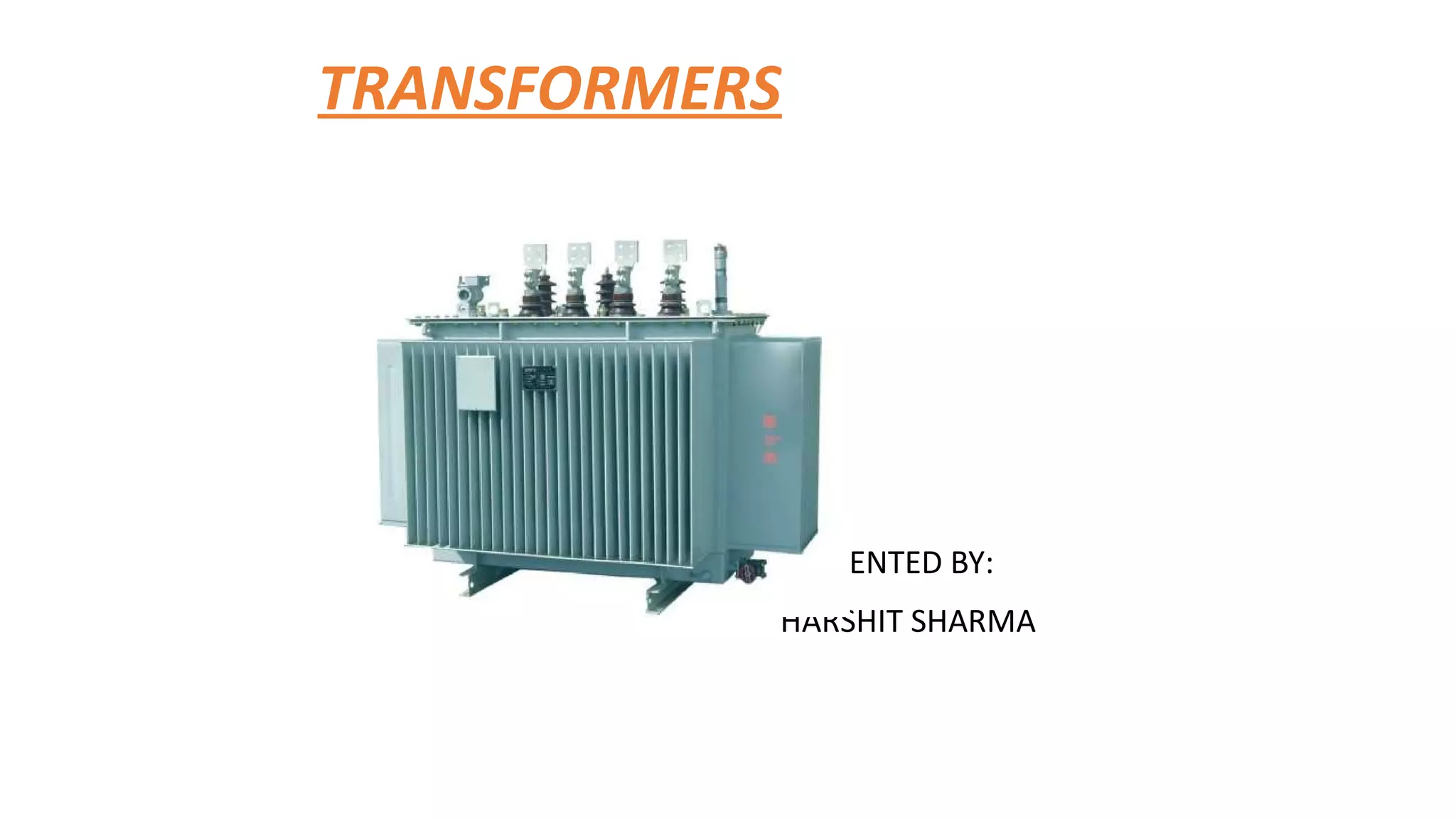
TRANSFORMERS
PRESENTED BY:
HARSHIT SHARMA
CONTENTS
• What is transformer?
• History
• Construction
• Principle
• Working
• Types of transformers
• Applications
One of greatest advantage of alternating current over direct current is that
the alternating currents can be easily transferable from lowest voltage to
high or high voltage to low voltage. . Alternating voltage can be raised or
lowered as per requirements in the different stages of electrical network as
Generation ,transmission, distribution and utilization. This is possible with a
device known as transformer.
INTRODUCTION
What is Transformer?
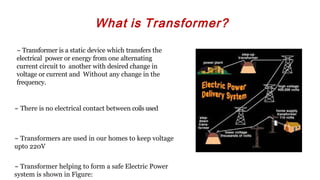
~ Transformer is a static device which transfers the
electrical power or energy from one alternating
current circuit to another with desired change in
voltage or current and Without any change in the
frequency.
~ There is no electrical contact between coils used
~ Transformers are used in our homes to keep voltage
upto 220V
~ Transformer helping to form a safe Electric Power
system is shown in Figure:
HISTORY
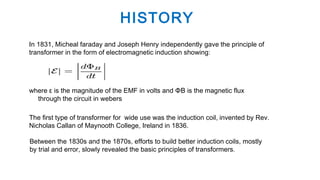
In 1831, Micheal faraday and Joseph Henry independently gave the principle of
transformer in the form of electromagnetic induction showing:
where ε is the magnitude of the EMF in volts and ΦB is the magnetic flux
through the circuit in webers
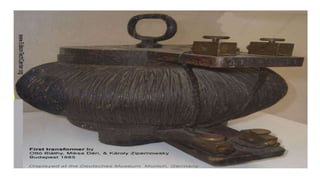
The first type of transformer for wide use was the induction coil, invented by Rev.
Nicholas Callan of Maynooth College, Ireland in 1836.
Between the 1830s and the 1870s, efforts to build better induction coils, mostly
by trial and error, slowly revealed the basic principles of transformers.
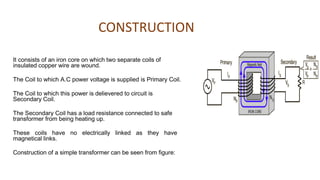
It consists of an iron core on which two separate coils of
insulated copper wire are wound.
The Coil to which A.C power voltage is supplied is Primary Coil.
The Coil to which this power is delievered to circuit is
Secondary Coil.
The Secondary Coil has a load resistance connected to safe
transformer from being heating up.
These coils have no electrically linked as they have
magnetical links.
Construction of a simple transformer can be seen from figure:
CONSTRUCTION
The Transformer works on the principle of Mutual
Induction that changing Current in Primary coil induces
an emf in Secondary Coil
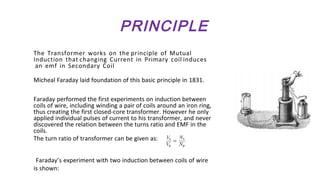
Micheal Faraday laid foundation of this basic principle in 1831.
Faraday performed the first experiments on induction between
coils of wire, including winding a pair of coils around an iron ring,
thus creating the first closed-core transformer. However he only
applied individual pulses of current to his transformer, and never
discovered the relation between the turns ratio and EMF in the
coils.
The turn ratio of transformer can be given as:
Faraday’s experiment with two induction between coils of wire
is shown:
PRINCIPLE
 When the alternating current flows in the primary coils, a
changing magnetic flux is generated around the primary coil.
 The changing magnetic flux is transferred to the secondary coil through the iron
core
 The changing magnetic flux is cut by the secondary coil, hence
induces an e.m.f in the secondary coil
 Now if load is connected to a secondary winding, this e.m.f
drives a current through it
 The magnitude of the output voltage can be controlled by the ratio of the no. of
primary coil and secondary coil
Working
NOTE: The frequency of mutually induced e.m.f is same as that of the
alternating source which supplying to the primary winding
Types of
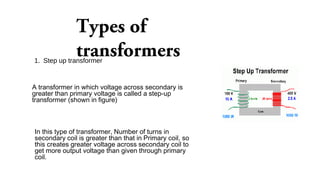
transformers1. Step up transformer
A transformer in which voltage across secondary is
greater than primary voltage is called a step-up
transformer (shown in figure)
In this type of transformer, Number of turns in
secondary coil is greater than that in Primary coil, so
this creates greater voltage across secondary coil to
get more output voltage than given through primary
coil.
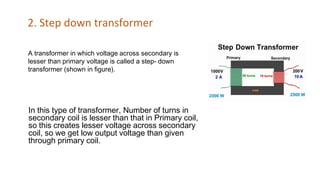
2. Step down transformer
A transformer in which voltage across secondary is
lesser than primary voltage is called a step- down
transformer (shown in figure).
In this type of transformer, Number of turns in
secondary coil is lesser than that in Primary coil,
so this creates lesser voltage across secondary
coil, so we get low output voltage than given
through primary coil.
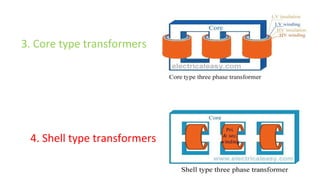
3. Core type transformers
4. Shell type transformers
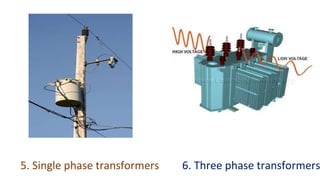
5. Single phase transformers 6. Three phase transformers
IDEAL VS PRACTICAL TRANSFORMERS
A transformer is said to be ideal if it satisfies the
following properties ,
It has no losses.
Winding resistance has zero.
There is no flux leakage.
Efficiency is 100 %.
But in practical ,there are some losses in
transformer.
Losses in transformers
 Copper losses :
It is due to power wasted in the form of I2R due to resistance of primary
and secondary. The magnitude of copper losses depend upon the current
flowing through these coils.
Hysteresis loss :
During magnetization and demagnetization ,due to hysteresis effect some
energy losses in the core called hysteresis loss
Eddy current loss :
The leakage magnetic flux generates the E.M.F in the core produces
current is called of eddy current loss.
applications
 The transformer used in television and photocopy
machines
 The transmission and distribution of alternating power is possible by
transformer
 Simple camera flash uses fly back transformer
 Signal and audio transformer are used for coupling in amplifier
Transformer help us in making a safe electric power
system which is used to transfer electricity over
long distances.
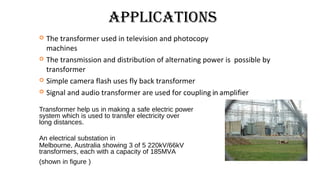
An electrical substation in
Melbourne, Australia showing 3 of 5 220kV/66kV
transformers, each with a capacity of 185MVA
(shown in figure )
Transformers

Transformers

  • 1.
  • 2.
    CONTENTS • What istransformer? • History • Construction • Principle • Working • Types of transformers • Applications
  • 3.
    One of greatestadvantage of alternating current over direct current is that the alternating currents can be easily transferable from lowest voltage to high or high voltage to low voltage. . Alternating voltage can be raised or lowered as per requirements in the different stages of electrical network as Generation ,transmission, distribution and utilization. This is possible with a device known as transformer. INTRODUCTION
  • 4.
    What is Transformer? ~Transformer is a static device which transfers the electrical power or energy from one alternating current circuit to another with desired change in voltage or current and Without any change in the frequency. ~ There is no electrical contact between coils used ~ Transformers are used in our homes to keep voltage upto 220V ~ Transformer helping to form a safe Electric Power system is shown in Figure:
  • 5.
    HISTORY In 1831, Michealfaraday and Joseph Henry independently gave the principle of transformer in the form of electromagnetic induction showing: where ε is the magnitude of the EMF in volts and ΦB is the magnetic flux through the circuit in webers The first type of transformer for wide use was the induction coil, invented by Rev. Nicholas Callan of Maynooth College, Ireland in 1836. Between the 1830s and the 1870s, efforts to build better induction coils, mostly by trial and error, slowly revealed the basic principles of transformers.
  • 7.
    It consists ofan iron core on which two separate coils of insulated copper wire are wound. The Coil to which A.C power voltage is supplied is Primary Coil. The Coil to which this power is delievered to circuit is Secondary Coil. The Secondary Coil has a load resistance connected to safe transformer from being heating up. These coils have no electrically linked as they have magnetical links. Construction of a simple transformer can be seen from figure: CONSTRUCTION
  • 8.
    The Transformer workson the principle of Mutual Induction that changing Current in Primary coil induces an emf in Secondary Coil Micheal Faraday laid foundation of this basic principle in 1831. Faraday performed the first experiments on induction between coils of wire, including winding a pair of coils around an iron ring, thus creating the first closed-core transformer. However he only applied individual pulses of current to his transformer, and never discovered the relation between the turns ratio and EMF in the coils. The turn ratio of transformer can be given as: Faraday’s experiment with two induction between coils of wire is shown: PRINCIPLE
  • 9.
     When thealternating current flows in the primary coils, a changing magnetic flux is generated around the primary coil.  The changing magnetic flux is transferred to the secondary coil through the iron core  The changing magnetic flux is cut by the secondary coil, hence induces an e.m.f in the secondary coil  Now if load is connected to a secondary winding, this e.m.f drives a current through it  The magnitude of the output voltage can be controlled by the ratio of the no. of primary coil and secondary coil Working NOTE: The frequency of mutually induced e.m.f is same as that of the alternating source which supplying to the primary winding
  • 11.
    Types of transformers1. Stepup transformer A transformer in which voltage across secondary is greater than primary voltage is called a step-up transformer (shown in figure) In this type of transformer, Number of turns in secondary coil is greater than that in Primary coil, so this creates greater voltage across secondary coil to get more output voltage than given through primary coil.
  • 12.
    2. Step downtransformer A transformer in which voltage across secondary is lesser than primary voltage is called a step- down transformer (shown in figure). In this type of transformer, Number of turns in secondary coil is lesser than that in Primary coil, so this creates lesser voltage across secondary coil, so we get low output voltage than given through primary coil.
  • 13.
    3. Core typetransformers 4. Shell type transformers
  • 14.
    5. Single phasetransformers 6. Three phase transformers
  • 15.
    IDEAL VS PRACTICALTRANSFORMERS A transformer is said to be ideal if it satisfies the following properties , It has no losses. Winding resistance has zero. There is no flux leakage. Efficiency is 100 %. But in practical ,there are some losses in transformer.
  • 16.
    Losses in transformers Copper losses : It is due to power wasted in the form of I2R due to resistance of primary and secondary. The magnitude of copper losses depend upon the current flowing through these coils. Hysteresis loss : During magnetization and demagnetization ,due to hysteresis effect some energy losses in the core called hysteresis loss Eddy current loss : The leakage magnetic flux generates the E.M.F in the core produces current is called of eddy current loss.
  • 17.
    applications  The transformerused in television and photocopy machines  The transmission and distribution of alternating power is possible by transformer  Simple camera flash uses fly back transformer  Signal and audio transformer are used for coupling in amplifier Transformer help us in making a safe electric power system which is used to transfer electricity over long distances. An electrical substation in Melbourne, Australia showing 3 of 5 220kV/66kV transformers, each with a capacity of 185MVA (shown in figure )