PHYSICS – Thermal processes
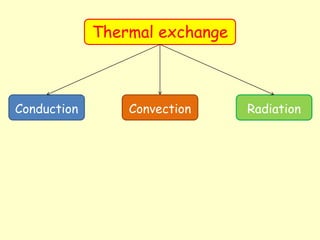
Thermal exchange
Conduction Convection Radiation
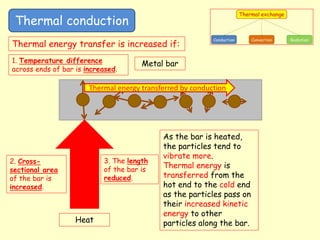
Thermal conduction
Metal bar
As the bar is heated,
the particles tend to
vibrate more.
Thermal energy is
transferred from the
hot end to the cold end
as the particles pass on
their increased kinetic
energy to other
particles along the bar.
Heat
Thermal energy transferred by conduction
Thermal energy transfer is increased if:
1. Temperature difference
across ends of bar is increased.
2. Cross-
sectional area
of the bar is
increased.
3. The length
of the bar is
reduced.
Thermal conduction
Conductors and insulators
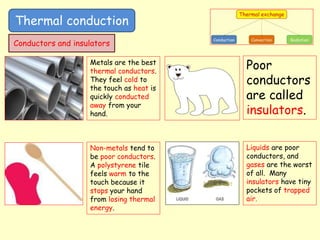
Metals are the best
thermal conductors.
They feel cold to
the touch as heat is
quickly conducted
away from your
hand.
Non-metals tend to
be poor conductors.
A polystyrene tile
feels warm to the
touch because it
stops your hand
from losing thermal
energy.
Poor
conductors
are called
insulators.
Liquids are poor
conductors, and
gases are the worst
of all. Many
insulators have tiny
pockets of trapped
air.
Thermal conduction
Comparing conductors
HEAT
Drawing pin held
on with vaseline.
Aluminium
Steel
Brass
copper
Material Time for pin
to fall (secs)
Aluminium 125
Brass 189
Copper 73
Steel 340
Conclusion:
Copper is the best conductor
of thermal energy, steel is
the worst.
Material
Textbook relative conductivity
values.
Aluminium 204
Brass 109
Copper 385
Steel 16
Thermal conduction
Comparing conductors
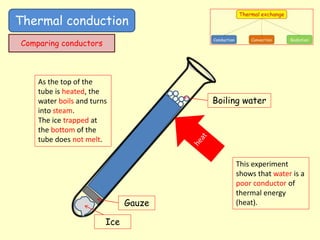
Boiling water
Gauze
Ice
As the top of the
tube is heated, the
water boils and turns
into steam.
The ice trapped at
the bottom of the
tube does not melt.
This experiment
shows that water is a
poor conductor of
thermal energy
(heat).
Thermal conduction
Using insulating materials
http://www.tameside.gov.uk/toptips/august
http://www.scienceaid.co.uk/physics/electricity/energy.html
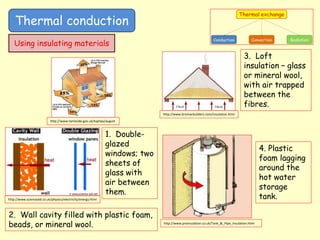
2. Wall cavity filled with plastic foam,
beads, or mineral wool.
1. Double-
glazed
windows; two
sheets of
glass with
air between
them.
http://www.bromacbuilders.com/insulation.html
3. Loft
insulation – glass
or mineral wool,
with air trapped
between the
fibres.
http://www.proinsulation.co.uk/Tank_&_Pipe_Insulation.html
4. Plastic
foam lagging
around the
hot water
storage
tank.
Thermal conduction
Explaining conduction
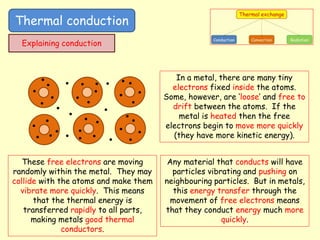
In a metal, there are many tiny
electrons fixed inside the atoms.
Some, however, are ‘loose’ and free to
drift between the atoms. If the
metal is heated then the free
electrons begin to move more quickly
(they have more kinetic energy).
These free electrons are moving
randomly within the metal. They may
collide with the atoms and make them
vibrate more quickly. This means
that the thermal energy is
transferred rapidly to all parts,
making metals good thermal
conductors.
Any material that conducts will have
particles vibrating and pushing on
neighbouring particles. But in metals,
this energy transfer through the
movement of free electrons means
that they conduct energy much more
quickly.
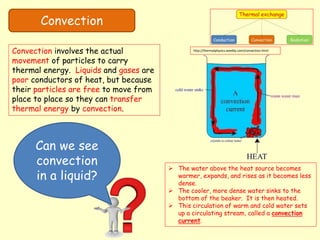
Convection involves the actual
movement of particles to carry
thermal energy. Liquids and gases are
poor conductors of heat, but because
their particles are free to move from
place to place so they can transfer
thermal energy by convection.
Can we see
convection
in a liquid?
http://thermalphysics.weebly.com/convection.html
 The water above the heat source becomes
warmer, expands, and rises as it becomes less
dense.
 The cooler, more dense water sinks to the
bottom of the beaker. It is then heated.
 This circulation of warm and cold water sets
up a circulating stream, called a convection
current.
Convection
Convection
in gases
Convection
http://www.pinterest.com/pin/452400725040236330/
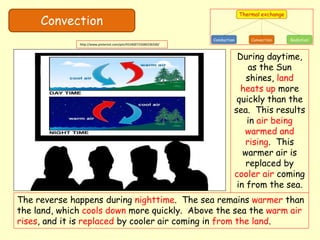
During daytime,
as the Sun
shines, land
heats up more
quickly than the
sea. This results
in air being
warmed and
rising. This
warmer air is
replaced by
cooler air coming
in from the sea.
The reverse happens during nighttime. The sea remains warmer than
the land, which cools down more quickly. Above the sea the warm air
rises, and it is replaced by cooler air coming in from the land.
Convection
Convection
Convection in the home
http://imgarcade.com/1/air-convection-currents/
1. As the convector
heater gets warmer,
it heats air
immediately above
it.
2. The warm air rises,
carrying thermal
energy all around
the room.
3. As the air cools, so
it falls towards the
floor before being
heated again.
1
2
3
Convection
Convection in the home
In the refrigerator, the cool air sinks below the freezer
compartment. This sets up a circulating current of air which
cools all food in the refrigerator.
http://chowlaiwan-physicsproject2009.blogspot.co.uk/
Radiation
http://www.nasatech.com/PTB/features/2009/feat1_0909.html
Energy travels to us
from the Sun in the
form of
electromagnetic
radiation. These waves
can travel through the
vacuum of space.
Thermal radiation includes the
invisible infrared waves as well as
visible light.
All objects
give out
some
thermal
(heat)
radiation.
Warm objects give out infrared
radiation. As objects become hotter,
so they begin to give out shorter
wavelengths such as light. This is why
hot objects, such as grills, glow as
they continue to heat up.
Radiation
Emitters and absorbers
Give out
thermal
radiation
Take in
thermal
radiation
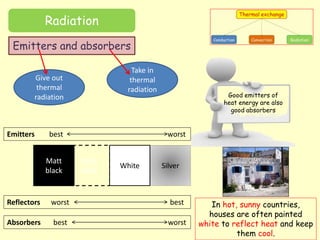
Good emitters of
heat energy are also
good absorbers
Matt
black
Matt
black
White Silver
Emitters best worst
Reflectors worst best
Absorbers best worst
In hot, sunny countries,
houses are often painted
white to reflect heat and keep
them cool.
Radiation
Emitters and absorbers
Leslie’s cube
Meter
White face
Silver face
Black face
Metal cube filled with
very hot water
Thermal radiation
detector
The thermal radiation detector
compares the amount of heat
energy emitted from the
different faces.
Equal
distance
Radiation
Emitters and absorbers
Radiant
heater
Matt
black
surface
Silver
surface
Thermometer
Thermometers are attached
to the rear of metal plates
which are placed at equal
distances from the radiant
heater. Thermal energy
from the radiant heater is
absorbed by the two plates,
and the thermometers help
us to assess which colour is
the best absorber.
Radiation
Thermal Radiation and the
Greenhouse Effect.
However, additional carbon dioxide
from the combustion of fuels may be
adding to this effect and causing
global warming.
In a greenhouse the Sun’s
thermal energy passes
through the glass panels,
warms the ground inside and
heats the air, but the hot air
then becomes trapped.
Solar panels use the Sun’s
thermal radiation to warm up
water for the house. A
blackened layer behind the
pipes absorbs the radiant
energy, heating the water in
the pipes. http://imgarcade.com/1/heater-clip-art/
1. Plastic cap (stopper)
reduces conduction and
convection.
2. Vacuum in the gap reduces
conduction and convection.
3. Walls with silvery surfaces
reduce thermal radiation.
http://www.cyberphysics.co.uk/Q&A/KS4/heat/A5.html
PHYSICS – Thermal processes

Physics 16 - Thermal processes.pptx

  • 1.
  • 2.
  • 3.
    Thermal conduction Metal bar Asthe bar is heated, the particles tend to vibrate more. Thermal energy is transferred from the hot end to the cold end as the particles pass on their increased kinetic energy to other particles along the bar. Heat Thermal energy transferred by conduction Thermal energy transfer is increased if: 1. Temperature difference across ends of bar is increased. 2. Cross- sectional area of the bar is increased. 3. The length of the bar is reduced.
  • 4.
    Thermal conduction Conductors andinsulators Metals are the best thermal conductors. They feel cold to the touch as heat is quickly conducted away from your hand. Non-metals tend to be poor conductors. A polystyrene tile feels warm to the touch because it stops your hand from losing thermal energy. Poor conductors are called insulators. Liquids are poor conductors, and gases are the worst of all. Many insulators have tiny pockets of trapped air.
  • 5.
    Thermal conduction Comparing conductors HEAT Drawingpin held on with vaseline. Aluminium Steel Brass copper Material Time for pin to fall (secs) Aluminium 125 Brass 189 Copper 73 Steel 340 Conclusion: Copper is the best conductor of thermal energy, steel is the worst. Material Textbook relative conductivity values. Aluminium 204 Brass 109 Copper 385 Steel 16
  • 6.
    Thermal conduction Comparing conductors Boilingwater Gauze Ice As the top of the tube is heated, the water boils and turns into steam. The ice trapped at the bottom of the tube does not melt. This experiment shows that water is a poor conductor of thermal energy (heat).
  • 7.
    Thermal conduction Using insulatingmaterials http://www.tameside.gov.uk/toptips/august http://www.scienceaid.co.uk/physics/electricity/energy.html 2. Wall cavity filled with plastic foam, beads, or mineral wool. 1. Double- glazed windows; two sheets of glass with air between them. http://www.bromacbuilders.com/insulation.html 3. Loft insulation – glass or mineral wool, with air trapped between the fibres. http://www.proinsulation.co.uk/Tank_&_Pipe_Insulation.html 4. Plastic foam lagging around the hot water storage tank.
  • 8.
    Thermal conduction Explaining conduction Ina metal, there are many tiny electrons fixed inside the atoms. Some, however, are ‘loose’ and free to drift between the atoms. If the metal is heated then the free electrons begin to move more quickly (they have more kinetic energy). These free electrons are moving randomly within the metal. They may collide with the atoms and make them vibrate more quickly. This means that the thermal energy is transferred rapidly to all parts, making metals good thermal conductors. Any material that conducts will have particles vibrating and pushing on neighbouring particles. But in metals, this energy transfer through the movement of free electrons means that they conduct energy much more quickly.
  • 9.
    Convection involves theactual movement of particles to carry thermal energy. Liquids and gases are poor conductors of heat, but because their particles are free to move from place to place so they can transfer thermal energy by convection. Can we see convection in a liquid? http://thermalphysics.weebly.com/convection.html  The water above the heat source becomes warmer, expands, and rises as it becomes less dense.  The cooler, more dense water sinks to the bottom of the beaker. It is then heated.  This circulation of warm and cold water sets up a circulating stream, called a convection current. Convection
  • 10.
  • 11.
    http://www.pinterest.com/pin/452400725040236330/ During daytime, as theSun shines, land heats up more quickly than the sea. This results in air being warmed and rising. This warmer air is replaced by cooler air coming in from the sea. The reverse happens during nighttime. The sea remains warmer than the land, which cools down more quickly. Above the sea the warm air rises, and it is replaced by cooler air coming in from the land. Convection
  • 12.
    Convection Convection in thehome http://imgarcade.com/1/air-convection-currents/ 1. As the convector heater gets warmer, it heats air immediately above it. 2. The warm air rises, carrying thermal energy all around the room. 3. As the air cools, so it falls towards the floor before being heated again. 1 2 3
  • 13.
    Convection Convection in thehome In the refrigerator, the cool air sinks below the freezer compartment. This sets up a circulating current of air which cools all food in the refrigerator. http://chowlaiwan-physicsproject2009.blogspot.co.uk/
  • 14.
    Radiation http://www.nasatech.com/PTB/features/2009/feat1_0909.html Energy travels tous from the Sun in the form of electromagnetic radiation. These waves can travel through the vacuum of space. Thermal radiation includes the invisible infrared waves as well as visible light. All objects give out some thermal (heat) radiation. Warm objects give out infrared radiation. As objects become hotter, so they begin to give out shorter wavelengths such as light. This is why hot objects, such as grills, glow as they continue to heat up.
  • 15.
    Radiation Emitters and absorbers Giveout thermal radiation Take in thermal radiation Good emitters of heat energy are also good absorbers Matt black Matt black White Silver Emitters best worst Reflectors worst best Absorbers best worst In hot, sunny countries, houses are often painted white to reflect heat and keep them cool.
  • 16.
    Radiation Emitters and absorbers Leslie’scube Meter White face Silver face Black face Metal cube filled with very hot water Thermal radiation detector The thermal radiation detector compares the amount of heat energy emitted from the different faces. Equal distance
  • 17.
    Radiation Emitters and absorbers Radiant heater Matt black surface Silver surface Thermometer Thermometersare attached to the rear of metal plates which are placed at equal distances from the radiant heater. Thermal energy from the radiant heater is absorbed by the two plates, and the thermometers help us to assess which colour is the best absorber.
  • 18.
    Radiation Thermal Radiation andthe Greenhouse Effect. However, additional carbon dioxide from the combustion of fuels may be adding to this effect and causing global warming. In a greenhouse the Sun’s thermal energy passes through the glass panels, warms the ground inside and heats the air, but the hot air then becomes trapped. Solar panels use the Sun’s thermal radiation to warm up water for the house. A blackened layer behind the pipes absorbs the radiant energy, heating the water in the pipes. http://imgarcade.com/1/heater-clip-art/ 1. Plastic cap (stopper) reduces conduction and convection. 2. Vacuum in the gap reduces conduction and convection. 3. Walls with silvery surfaces reduce thermal radiation. http://www.cyberphysics.co.uk/Q&A/KS4/heat/A5.html
  • 19.