Transfection
Basics & Optimization Tips
Bio-Resource
www.technologyinscience.blogspot.com
What is Transfection??
Transfection means :
• Transfer of exogenous DNA into a cell.
Transfectants means:
• The cells which has incorporated the
exogenous (foreign) DNA
www.technologyinscience.blogspot.com
Types of Transfection
• There are two types of transfection
• Transient &
• Stable Transfection
www.technologyinscience.blogspot.com
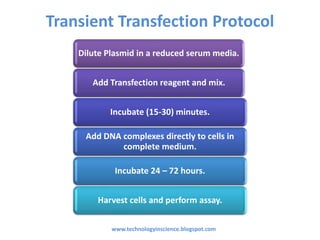
Transient Transfection Protocol
www.technologyinscience.blogspot.com
Dilute Plasmid in a reduced serum media.
Add Transfection reagent and mix.
Incubate (15-30) minutes.
Add DNA complexes directly to cells in
complete medium.
Incubate 24 – 72 hours.
Harvest cells and perform assay.
Transfection Methodologies
• Reagent Based
• Instrument Based
• Viral Mediated
www.technologyinscience.blogspot.com
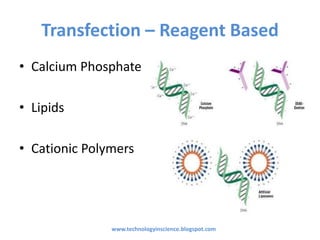
Transfection – Reagent Based
• Calcium Phosphate
• Lipids
• Cationic Polymers
www.technologyinscience.blogspot.com
Reagent Based Method
• Simple Method.
• The reagent used, neutralizes the negative
charge and condenses the DNA for effective
uptake
www.technologyinscience.blogspot.com
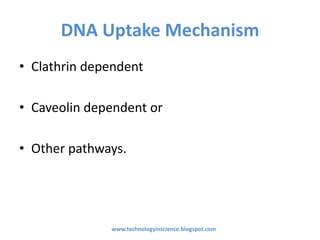
DNA Uptake Mechanism
• Clathrin dependent
• Caveolin dependent or
• Other pathways.
www.technologyinscience.blogspot.com
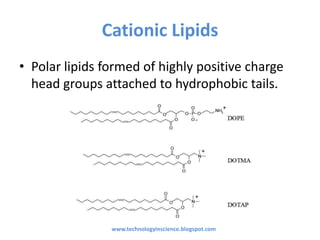
Cationic Lipids
• Polar lipids formed of highly positive charge
head groups attached to hydrophobic tails.
www.technologyinscience.blogspot.com
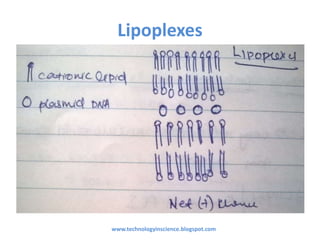
Lipoplexes
www.technologyinscience.blogspot.com
Helper Lipids in Transfection Reagent
• Reagents for Transfection are also made of
helper lipids.
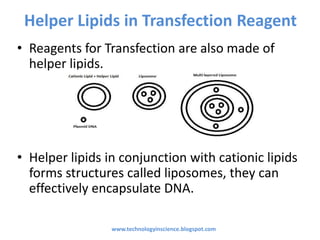
• Helper lipids in conjunction with cationic lipids
forms structures called liposomes, they can
effectively encapsulate DNA.
www.technologyinscience.blogspot.com
DNA Uptake by Cell
www.technologyinscience.blogspot.com
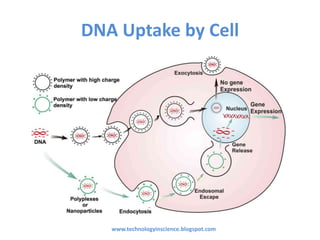
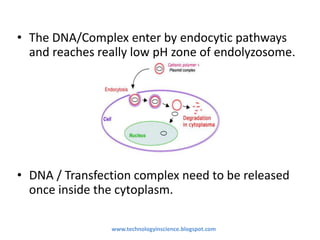
• The DNA/Complex enter by endocytic pathways
and reaches really low pH zone of endolyzosome.
• DNA / Transfection complex need to be released
once inside the cytoplasm.
www.technologyinscience.blogspot.com
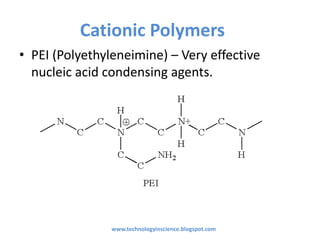
Cationic Polymers
• PEI (Polyethyleneimine) – Very effective
nucleic acid condensing agents.
www.technologyinscience.blogspot.com
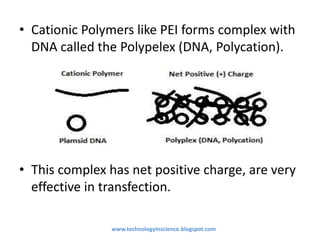
• Cationic Polymers like PEI forms complex with
DNA called the Polypelex (DNA, Polycation).
• This complex has net positive charge, are very
effective in transfection.
www.technologyinscience.blogspot.com
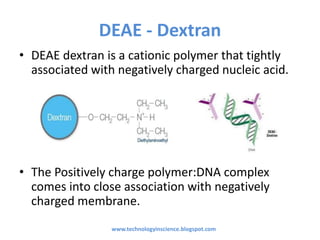
DEAE - Dextran
• DEAE dextran is a cationic polymer that tightly
associated with negatively charged nucleic acid.
• The Positively charge polymer:DNA complex
comes into close association with negatively
charged membrane.
www.technologyinscience.blogspot.com
Lipid & Polymer Combination -
Lipopolyplex
www.technologyinscience.blogspot.com
Ideal Features of Transfection
Complex
• Size – 40 – 1000 nm.
• Charge – Transfection complex should have a net
cationic (+) charge.
• Positive surface charge density – Zeta Potential
(+mV).
• Charge ratio.
www.technologyinscience.blogspot.com
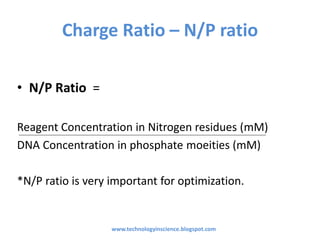
Charge Ratio – N/P ratio
• N/P Ratio =
Reagent Concentration in Nitrogen residues (mM)
DNA Concentration in phosphate moeities (mM)
*N/P ratio is very important for optimization.
www.technologyinscience.blogspot.com
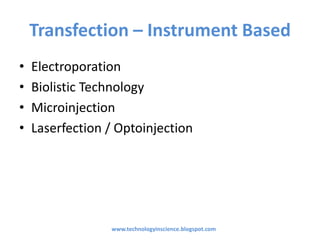
Transfection – Instrument Based
• Electroporation
• Biolistic Technology
• Microinjection
• Laserfection / Optoinjection
www.technologyinscience.blogspot.com
Electroporation
www.technologyinscience.blogspot.com
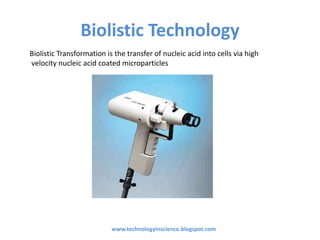
Biolistic Technology
www.technologyinscience.blogspot.com
Biolistic Transformation is the transfer of nucleic acid into cells via high
velocity nucleic acid coated microparticles
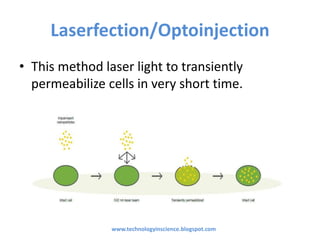
Laserfection/Optoinjection
• This method laser light to transiently
permeabilize cells in very short time.
www.technologyinscience.blogspot.com
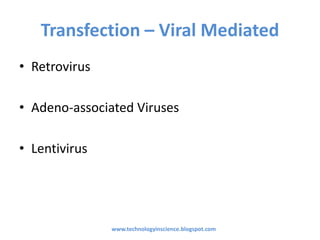
Transfection – Viral Mediated
• Retrovirus
• Adeno-associated Viruses
• Lentivirus
www.technologyinscience.blogspot.com
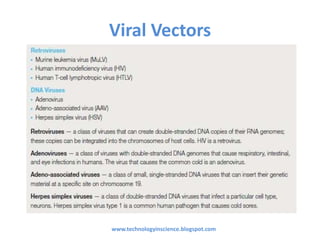
Viral Vectors
www.technologyinscience.blogspot.com
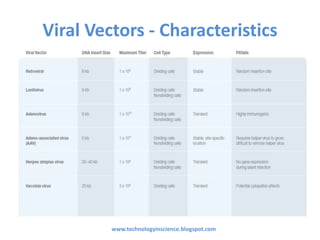
Viral Vectors - Characteristics
www.technologyinscience.blogspot.com
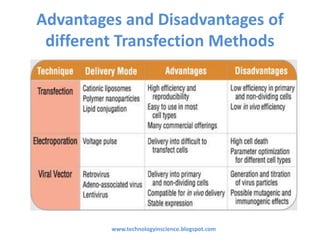
Advantages and Disadvantages of
different Transfection Methods
www.technologyinscience.blogspot.com
Evaluating Transfection Performance
Reporter systems
• Green Fluorescent Protein
• Luciferase Reporter
• Beta – Galactosidase
• Secreted Alkaline Phosphatase
www.technologyinscience.blogspot.com
Direct Visualization of Nucleic acid
delivery
• Nucelic Acid Labelling
• Fluorescent labels – Cyanine Dyes, Fluorescein
• Epitope Tags
• Covalent linkage of dye to the DNA.
www.technologyinscience.blogspot.com
Factors affecting Transfection
• Media
• Nucleic Acid
• Complexing Time
• Cell Culture condition / Confluency
• Harvesting Time
www.technologyinscience.blogspot.com
Transfection - Optimization
Media
• Transfection complex should be made in
serum free media.
• Serum has nucleases, which will chew up the
DNA.
• Antibiotics should be avoided in the
transfection complex formation media, as the
antibiotics are charged, they interfere in
complex formation.
www.technologyinscience.blogspot.com
Transfection - Optimization
Nucleic Acid
• Level of Purity: Plasmid purity 260/280 ratio
should be >1.8.
• Endotoxin contaminated DNA inhibits
transfection or yield low transfection
efficiency.
• Endotoxin is toxic to the cells.
www.technologyinscience.blogspot.com
Transfection - Optimization
Complexing Time
• Complex time formation is also important.
• Too much time – too big complex.
• Recommended incubation time for complex
formation is 15-30 mins. (Not more than 30
mins).
• For mRNA 5 – 10 mins.(Not more than 10
mins).
www.technologyinscience.blogspot.com
Cell Culture Conditions
• Adherent cell confluency affects transfection.
• Low confluency – 25% - Not good.
• 50 – 70% confluency is good for transfection.
• At >90% confluency, cells will not take up DNA to nuclei
because of the dissociation of nuclear membrane.
Transfection - Optimization
www.technologyinscience.blogspot.com
Refernces
• Life Technologies , Technical Resources
• Biorad, Technical Resources
• Qiagen, Technical Resources
www.technologyinscience.blogspot.com
Thank You
www.technologyinscience.blogspot.com

Transfection – basics & optimization tips

  • 1.
    Transfection Basics & OptimizationTips Bio-Resource www.technologyinscience.blogspot.com
  • 2.
    What is Transfection?? Transfectionmeans : • Transfer of exogenous DNA into a cell. Transfectants means: • The cells which has incorporated the exogenous (foreign) DNA www.technologyinscience.blogspot.com
  • 3.
    Types of Transfection •There are two types of transfection • Transient & • Stable Transfection www.technologyinscience.blogspot.com
  • 4.
    Transient Transfection Protocol www.technologyinscience.blogspot.com DilutePlasmid in a reduced serum media. Add Transfection reagent and mix. Incubate (15-30) minutes. Add DNA complexes directly to cells in complete medium. Incubate 24 – 72 hours. Harvest cells and perform assay.
  • 5.
    Transfection Methodologies • ReagentBased • Instrument Based • Viral Mediated www.technologyinscience.blogspot.com
  • 6.
    Transfection – ReagentBased • Calcium Phosphate • Lipids • Cationic Polymers www.technologyinscience.blogspot.com
  • 7.
    Reagent Based Method •Simple Method. • The reagent used, neutralizes the negative charge and condenses the DNA for effective uptake www.technologyinscience.blogspot.com
  • 8.
    DNA Uptake Mechanism •Clathrin dependent • Caveolin dependent or • Other pathways. www.technologyinscience.blogspot.com
  • 9.
    Cationic Lipids • Polarlipids formed of highly positive charge head groups attached to hydrophobic tails. www.technologyinscience.blogspot.com
  • 10.
  • 11.
    Helper Lipids inTransfection Reagent • Reagents for Transfection are also made of helper lipids. • Helper lipids in conjunction with cationic lipids forms structures called liposomes, they can effectively encapsulate DNA. www.technologyinscience.blogspot.com
  • 12.
    DNA Uptake byCell www.technologyinscience.blogspot.com
  • 13.
    • The DNA/Complexenter by endocytic pathways and reaches really low pH zone of endolyzosome. • DNA / Transfection complex need to be released once inside the cytoplasm. www.technologyinscience.blogspot.com
  • 14.
    Cationic Polymers • PEI(Polyethyleneimine) – Very effective nucleic acid condensing agents. www.technologyinscience.blogspot.com
  • 15.
    • Cationic Polymerslike PEI forms complex with DNA called the Polypelex (DNA, Polycation). • This complex has net positive charge, are very effective in transfection. www.technologyinscience.blogspot.com
  • 16.
    DEAE - Dextran •DEAE dextran is a cationic polymer that tightly associated with negatively charged nucleic acid. • The Positively charge polymer:DNA complex comes into close association with negatively charged membrane. www.technologyinscience.blogspot.com
  • 17.
    Lipid & PolymerCombination - Lipopolyplex www.technologyinscience.blogspot.com
  • 18.
    Ideal Features ofTransfection Complex • Size – 40 – 1000 nm. • Charge – Transfection complex should have a net cationic (+) charge. • Positive surface charge density – Zeta Potential (+mV). • Charge ratio. www.technologyinscience.blogspot.com
  • 19.
    Charge Ratio –N/P ratio • N/P Ratio = Reagent Concentration in Nitrogen residues (mM) DNA Concentration in phosphate moeities (mM) *N/P ratio is very important for optimization. www.technologyinscience.blogspot.com
  • 20.
    Transfection – InstrumentBased • Electroporation • Biolistic Technology • Microinjection • Laserfection / Optoinjection www.technologyinscience.blogspot.com
  • 21.
  • 22.
    Biolistic Technology www.technologyinscience.blogspot.com Biolistic Transformationis the transfer of nucleic acid into cells via high velocity nucleic acid coated microparticles
  • 23.
    Laserfection/Optoinjection • This methodlaser light to transiently permeabilize cells in very short time. www.technologyinscience.blogspot.com
  • 24.
    Transfection – ViralMediated • Retrovirus • Adeno-associated Viruses • Lentivirus www.technologyinscience.blogspot.com
  • 25.
  • 26.
    Viral Vectors -Characteristics www.technologyinscience.blogspot.com
  • 27.
    Advantages and Disadvantagesof different Transfection Methods www.technologyinscience.blogspot.com
  • 28.
    Evaluating Transfection Performance Reportersystems • Green Fluorescent Protein • Luciferase Reporter • Beta – Galactosidase • Secreted Alkaline Phosphatase www.technologyinscience.blogspot.com
  • 29.
    Direct Visualization ofNucleic acid delivery • Nucelic Acid Labelling • Fluorescent labels – Cyanine Dyes, Fluorescein • Epitope Tags • Covalent linkage of dye to the DNA. www.technologyinscience.blogspot.com
  • 30.
    Factors affecting Transfection •Media • Nucleic Acid • Complexing Time • Cell Culture condition / Confluency • Harvesting Time www.technologyinscience.blogspot.com
  • 31.
    Transfection - Optimization Media •Transfection complex should be made in serum free media. • Serum has nucleases, which will chew up the DNA. • Antibiotics should be avoided in the transfection complex formation media, as the antibiotics are charged, they interfere in complex formation. www.technologyinscience.blogspot.com
  • 32.
    Transfection - Optimization NucleicAcid • Level of Purity: Plasmid purity 260/280 ratio should be >1.8. • Endotoxin contaminated DNA inhibits transfection or yield low transfection efficiency. • Endotoxin is toxic to the cells. www.technologyinscience.blogspot.com
  • 33.
    Transfection - Optimization ComplexingTime • Complex time formation is also important. • Too much time – too big complex. • Recommended incubation time for complex formation is 15-30 mins. (Not more than 30 mins). • For mRNA 5 – 10 mins.(Not more than 10 mins). www.technologyinscience.blogspot.com
  • 34.
    Cell Culture Conditions •Adherent cell confluency affects transfection. • Low confluency – 25% - Not good. • 50 – 70% confluency is good for transfection. • At >90% confluency, cells will not take up DNA to nuclei because of the dissociation of nuclear membrane. Transfection - Optimization www.technologyinscience.blogspot.com
  • 35.
    Refernces • Life Technologies, Technical Resources • Biorad, Technical Resources • Qiagen, Technical Resources www.technologyinscience.blogspot.com
  • 36.