CHEMICAL AGENTS USED IN CELL 
TRANSFORMATION 
Aden Razaq
Overview 
 Termionology 
 Factors affecting transfection 
• HOST CELL 
• cell health 
cell culture 
• GENETIC MATERIAL 
DNA quantity and quality 
 Transfection workflow 
 Common transfection methods 
Reagent based 
Instrument based 
Virus based
What is cell transformation? 
 The insertion of foreign DNA or exogenous genetic material into a 
cell. 
 The cell can be a bacterium, a virus, plant or animal cell.
Transfection 
 Introduction of foreign DNA into the nucleus of Eukaryotic cells. 
 Cells that have incorporated the foreign DNA are called 
transfectants. 
 Stable transfectants ni AND ngierof detargetni evah taht sllec : 
.emoneg rieht 
 Transient transfectants eht ni etargetni ton seod AND ngierof : 
96-24(emti detimil a rof desserpxe era seneg tub emoneghours(.
FACTORS AFFECTING 
TRANSFECTION
 CELL HEALTH: 
Cells should be grown in appropriate medium with all 
necessary factors. 
Culture should be free of contamination and cells should 
be maintained in log phase growth. 
 CELL CULTURE: 
Cells should be transfected at 40-80% confluency (cell 
type dependent). 
The number of passages should be low (< 50) 
 DNA QUALITY AND QUANTITY: 
Use of high quality plasmid DNA that is free of proteins , 
RNA and chemicals for transfection. 
The optimal amount of DNA vary widely depending 
upon the type of DNA, transfection method , target cell line and No of 
cells.
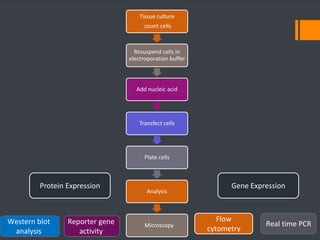
TRANSFECTION WORKFLOW
Tissue culture 
count cells 
Resuspend cells in 
electroporation buffer 
Add nucleic acid 
Transfect cells 
Plate cells 
Protein Expression Gene Expression 
Analysis 
Flow 
Microscopy Real time PCR 
cytometry 
Reporter gene 
activity 
Western blot 
analysis
COMMON TRANSFECTION 
METHODS
Cationic Lipids : Liposome/Lipoplexes 
 Cationic lipids are ampiphilic molecules that have a positively 
charged polar head group linked, via an anchor to an apolar 
hydrophobic domain generally comprising two alkyl chains. 
 Electrostatic interactions b/w the positive charges of cationic lipid 
head groups and the negatively charged phosphates of the DNA 
backbone are the main forces that allow DNA to spontaneously 
associate with cationic lipids.
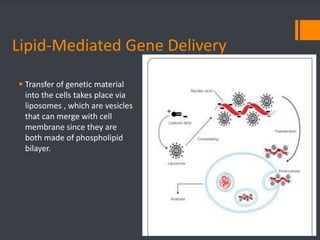
Lipid-Mediated Gene Delivery 
 Transfer of genetic material 
into the cells takes place via 
liposomes , which are vesicles 
that can merge with cell 
membrane since they are 
both made of phospholipid 
bilayer.
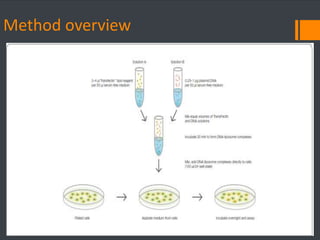
Method overview
Pros and cons 
ADVANTAGES OF LIPIDS: 
• Deliver nucleic acids to the cells in culture dish with high 
efficiency. 
• Easy to use, minimal steps required. 
DISADVANTAGES: 
• Not applicable to all cell types.
Calcium phosphate 
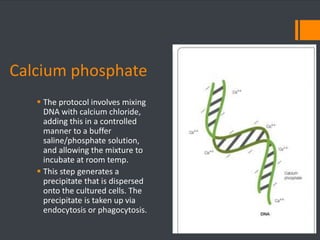
 The protocol involves mixing 
DNA with calcium chloride, 
adding this in a controlled 
manner to a buffer 
saline/phosphate solution, 
and allowing the mixture to 
incubate at room temp. 
 This step generates a 
precipitate that is dispersed 
onto the cultured cells. The 
precipitate is taken up via 
endocytosis or phagocytosis.
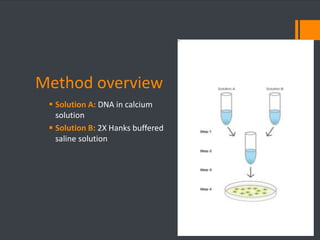
Method overview 
 Solution A: DNA in calcium 
solution 
 Solution B: 2X Hanks buffered 
saline solution
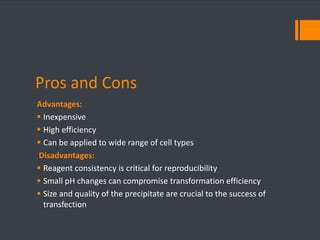
Pros and Cons 
Advantages: 
 Inexpensive 
 High efficiency 
 Can be applied to wide range of cell types 
Disadvantages: 
 Reagent consistency is critical for reproducibility 
 Small pH changes can compromise transformation efficiency 
 Size and quality of the precipitate are crucial to the success of 
transfection
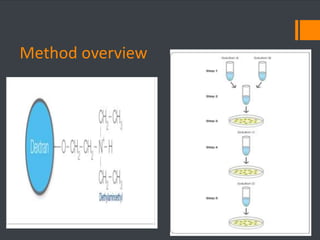
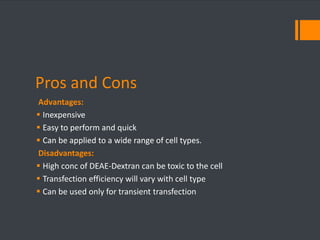
DEAE-Dextran 
 DEAE-Dextran is a cationic polymer that tightly associates with the 
negatively charges nucleic acids. 
 The positively charged DNA-polymer complex comes in close 
association with negatively charged cell membrane. 
 DNA-polymer complex uptake into the cell is presumed to occur 
via endocytosis.
Method overview
Pros and Cons 
Advantages: 
 Inexpensive 
 Easy to perform and quick 
 Can be applied to a wide range of cell types. 
Disadvantages: 
 High conc of DEAE-Dextran can be toxic to the cell 
 Transfection efficiency will vary with cell type 
 Can be used only for transient transfection
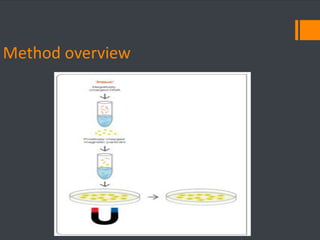
Magnet-mediated transfection 
 Magnet-mediated method uses magnetic force to deliver DNA into 
the target cells. 
 Nucleic acids are first associated with magnetic nanoparticles . 
Then ,application of magnetic force drives the nucleic acid-particle 
complex toward and into the target cells, where the cargo is 
released.
Method overview
Pros and cons 
Advantages 
 Rapid 
 Increased transfection efficiency by direct transport, esp for low 
amount of nucleic acid 
 High transfection rates for adherent mammalian cell lines and 
primary cell cultures 
 Mild treatment of cells 
Disadvantages 
 Relatively new method 
 Require adherent cells; suspension cells need to be immobilized or 
centrifuged.
Thank you

Transfection

  • 1.
    CHEMICAL AGENTS USEDIN CELL TRANSFORMATION Aden Razaq
  • 2.
    Overview  Termionology  Factors affecting transfection • HOST CELL • cell health cell culture • GENETIC MATERIAL DNA quantity and quality  Transfection workflow  Common transfection methods Reagent based Instrument based Virus based
  • 3.
    What is celltransformation?  The insertion of foreign DNA or exogenous genetic material into a cell.  The cell can be a bacterium, a virus, plant or animal cell.
  • 4.
    Transfection  Introductionof foreign DNA into the nucleus of Eukaryotic cells.  Cells that have incorporated the foreign DNA are called transfectants.  Stable transfectants ni AND ngierof detargetni evah taht sllec : .emoneg rieht  Transient transfectants eht ni etargetni ton seod AND ngierof : 96-24(emti detimil a rof desserpxe era seneg tub emoneghours(.
  • 5.
  • 6.
     CELL HEALTH: Cells should be grown in appropriate medium with all necessary factors. Culture should be free of contamination and cells should be maintained in log phase growth.  CELL CULTURE: Cells should be transfected at 40-80% confluency (cell type dependent). The number of passages should be low (< 50)  DNA QUALITY AND QUANTITY: Use of high quality plasmid DNA that is free of proteins , RNA and chemicals for transfection. The optimal amount of DNA vary widely depending upon the type of DNA, transfection method , target cell line and No of cells.
  • 7.
  • 8.
    Tissue culture countcells Resuspend cells in electroporation buffer Add nucleic acid Transfect cells Plate cells Protein Expression Gene Expression Analysis Flow Microscopy Real time PCR cytometry Reporter gene activity Western blot analysis
  • 9.
  • 10.
    Cationic Lipids :Liposome/Lipoplexes  Cationic lipids are ampiphilic molecules that have a positively charged polar head group linked, via an anchor to an apolar hydrophobic domain generally comprising two alkyl chains.  Electrostatic interactions b/w the positive charges of cationic lipid head groups and the negatively charged phosphates of the DNA backbone are the main forces that allow DNA to spontaneously associate with cationic lipids.
  • 11.
    Lipid-Mediated Gene Delivery  Transfer of genetic material into the cells takes place via liposomes , which are vesicles that can merge with cell membrane since they are both made of phospholipid bilayer.
  • 12.
  • 13.
    Pros and cons ADVANTAGES OF LIPIDS: • Deliver nucleic acids to the cells in culture dish with high efficiency. • Easy to use, minimal steps required. DISADVANTAGES: • Not applicable to all cell types.
  • 14.
    Calcium phosphate The protocol involves mixing DNA with calcium chloride, adding this in a controlled manner to a buffer saline/phosphate solution, and allowing the mixture to incubate at room temp.  This step generates a precipitate that is dispersed onto the cultured cells. The precipitate is taken up via endocytosis or phagocytosis.
  • 15.
    Method overview Solution A: DNA in calcium solution  Solution B: 2X Hanks buffered saline solution
  • 16.
    Pros and Cons Advantages:  Inexpensive  High efficiency  Can be applied to wide range of cell types Disadvantages:  Reagent consistency is critical for reproducibility  Small pH changes can compromise transformation efficiency  Size and quality of the precipitate are crucial to the success of transfection
  • 17.
    DEAE-Dextran  DEAE-Dextranis a cationic polymer that tightly associates with the negatively charges nucleic acids.  The positively charged DNA-polymer complex comes in close association with negatively charged cell membrane.  DNA-polymer complex uptake into the cell is presumed to occur via endocytosis.
  • 18.
  • 19.
    Pros and Cons Advantages:  Inexpensive  Easy to perform and quick  Can be applied to a wide range of cell types. Disadvantages:  High conc of DEAE-Dextran can be toxic to the cell  Transfection efficiency will vary with cell type  Can be used only for transient transfection
  • 20.
    Magnet-mediated transfection Magnet-mediated method uses magnetic force to deliver DNA into the target cells.  Nucleic acids are first associated with magnetic nanoparticles . Then ,application of magnetic force drives the nucleic acid-particle complex toward and into the target cells, where the cargo is released.
  • 21.
  • 22.
    Pros and cons Advantages  Rapid  Increased transfection efficiency by direct transport, esp for low amount of nucleic acid  High transfection rates for adherent mammalian cell lines and primary cell cultures  Mild treatment of cells Disadvantages  Relatively new method  Require adherent cells; suspension cells need to be immobilized or centrifuged.
  • 23.