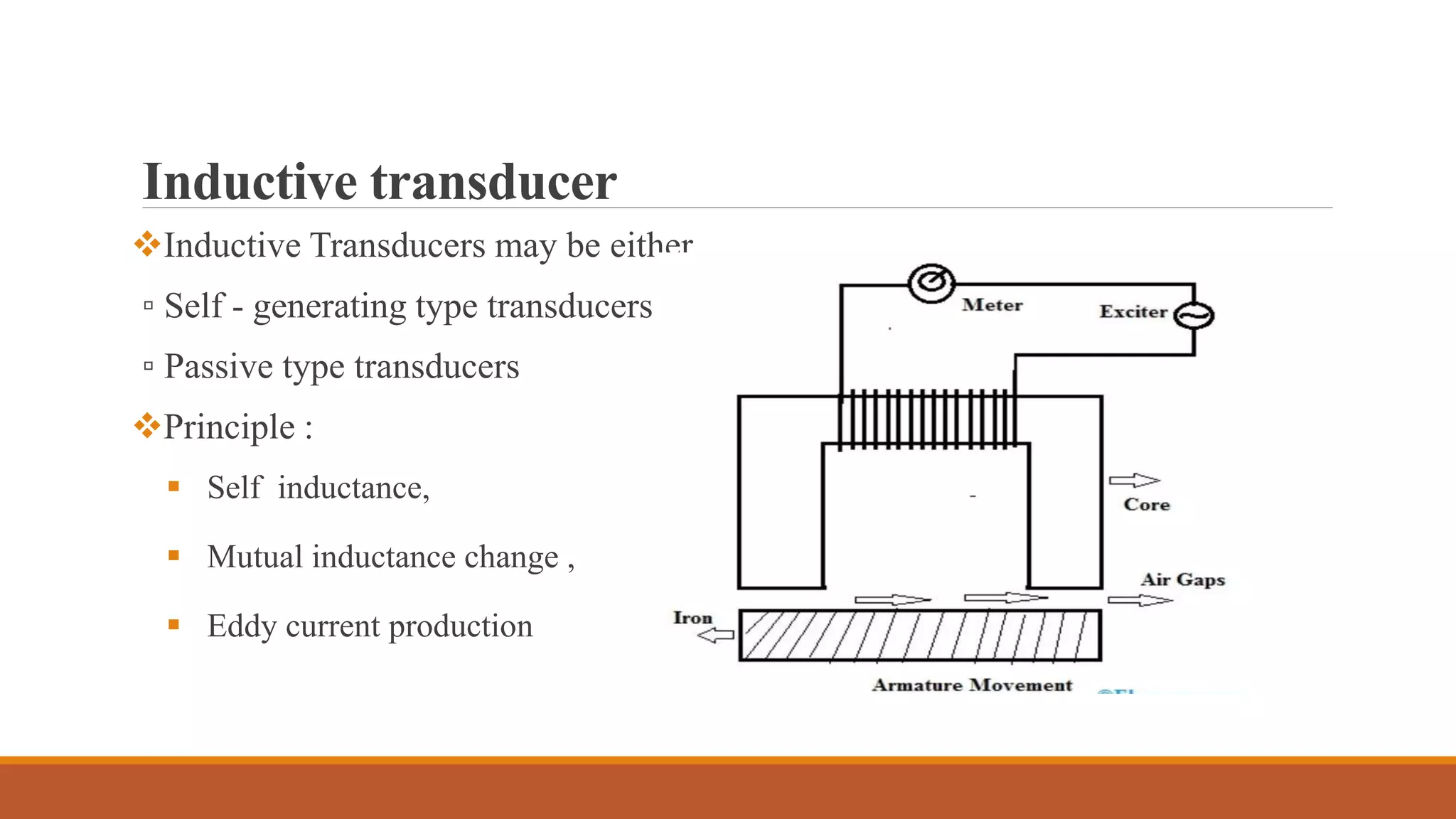
Inductive transducer
Inductive Transducers may be either
▫ Self - generating type transducers
▫ Passive type transducers
Principle :
 Self inductance,
 Mutual inductance change ,
 Eddy current production
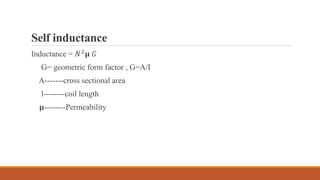
Self inductance
Inductance = 𝑁2𝛍 𝐺
G= geometric form factor , G=A/I
A-------cross sectional area
l--------coil length
𝛍--------Permeability
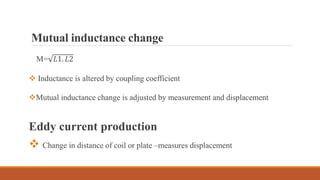
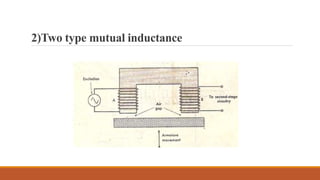
Mutual inductance change
M= 𝐿1. 𝐿2
 Inductance is altered by coupling coefficient
Mutual inductance change is adjusted by measurement and displacement
Eddy current production
 Change in distance of coil or plate –measures displacement
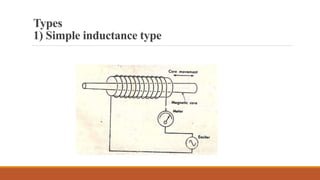
Types
1) Simple inductance type
2)Two type mutual inductance
Advantages
 Responsivity is high
Load effects will be reduced
Strong against ecological quantities
Disadvantages
Operating range reduced by side
effects
Working temp should be under curie
temp
Sensitive to magnetic field
Applications
Detection of metals
Touch pad
Measure position
Dynamic motion
Missing parts
Counting the no: of objects
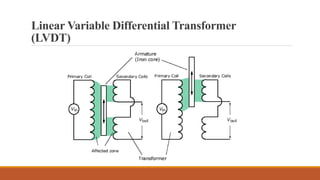
Linear Variable Differential Transformer
(LVDT)
Linear Variable Differential Transformer
(LVDT)
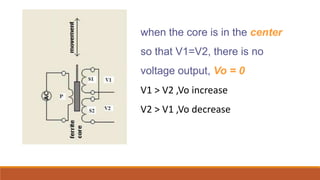
when the core is in the center
so that V1=V2, there is no
voltage output, Vo = 0
V1 > V2 ,Vo increase
V2 > V1 ,Vo decrease
Advantages
High sensitivity
Excellent repeatability
Simple, Easy to maintain
Low cost
Disadvantages
Sensitive to stray magnetic field
Temperature affects the performance
Inherently low in power output
Applications
Power turbines
Hydraulics
Automation
Aircraft
Satellites
Nuclear reactors
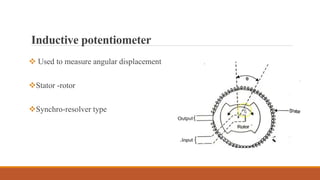
Inductive potentiometer
 Used to measure angular displacement
Stator -rotor
Synchro-resolver type
Electromagnetic sensor
 A moving magnetic field causes an current to flow
through conductive material.
Sensor measures the induced electrical currents
Eg . Hall sensor
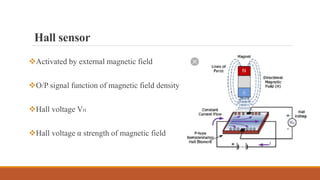
Hall sensor
Activated by external magnetic field
O/P signal function of magnetic field density
Hall voltage VH
Hall voltage α strength of magnetic field

Transducer ppt