
Group 1-
 Tania Akter Sweety
 Sefat Ul Alom
 Saraban Tohura
1
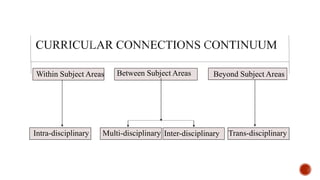
Within Subject Areas Between Subject Areas Beyond Subject Areas
Intra-disciplinary Inter-disciplinary Trans-disciplinary
Multi-disciplinary
Intra-disciplinary approach
Intra means underneath or within
It is a Latin word
It used as a prefix
Intra-disciplinary means within the discipline or subject
One of the oldest method of teaching learning process
Traditional
One subject area
Ongoing
Integration of subject area knowledge and skills as a
coherent whole within the grade
Integration of knowledge and skills as a coherent whole
from grade-to-grade
Development of new knowledge
Practical application
Critical thinking
Deep learning
Collaborative learning
Integration of knowledge
Fully respects subject area's way of knowing, distinct
conceptual structures, and methods of inquiry
Focuses on big ideas, concepts, learning outcomes, not just
isolated facts or superficially related content
Cognitive, affective, and social domains integrated with
subject-based knowledge and skills to enhance personal
meaning and social relevancy
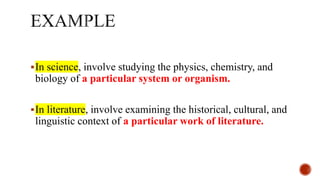
In science, involve studying the physics, chemistry, and
biology of a particular system or organism.
In literature, involve examining the historical, cultural, and
linguistic context of a particular work of literature.
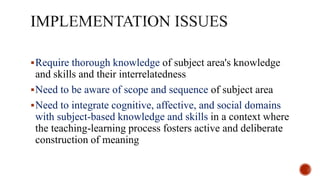
Require thorough knowledge of subject area's knowledge
and skills and their interrelatedness
Need to be aware of scope and sequence of subject area
Need to integrate cognitive, affective, and social domains
with subject-based knowledge and skills in a context where
the teaching-learning process fosters active and deliberate
construction of meaning
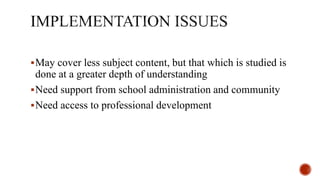
May cover less subject content, but that which is studied is
done at a greater depth of understanding
Need support from school administration and community
Need access to professional development
Intra-Disciplinary Approaches in Education

Intra-Disciplinary Approaches in Education

  • 1.
    Group 1-  TaniaAkter Sweety  Sefat Ul Alom  Saraban Tohura 1
  • 2.
    Within Subject AreasBetween Subject Areas Beyond Subject Areas Intra-disciplinary Inter-disciplinary Trans-disciplinary Multi-disciplinary
  • 3.
  • 4.
    Intra means underneathor within It is a Latin word It used as a prefix Intra-disciplinary means within the discipline or subject One of the oldest method of teaching learning process Traditional
  • 5.
    One subject area Ongoing Integrationof subject area knowledge and skills as a coherent whole within the grade Integration of knowledge and skills as a coherent whole from grade-to-grade
  • 6.
    Development of newknowledge Practical application Critical thinking Deep learning Collaborative learning Integration of knowledge
  • 7.
    Fully respects subjectarea's way of knowing, distinct conceptual structures, and methods of inquiry Focuses on big ideas, concepts, learning outcomes, not just isolated facts or superficially related content Cognitive, affective, and social domains integrated with subject-based knowledge and skills to enhance personal meaning and social relevancy
  • 8.
    In science, involvestudying the physics, chemistry, and biology of a particular system or organism. In literature, involve examining the historical, cultural, and linguistic context of a particular work of literature.
  • 9.
    Require thorough knowledgeof subject area's knowledge and skills and their interrelatedness Need to be aware of scope and sequence of subject area Need to integrate cognitive, affective, and social domains with subject-based knowledge and skills in a context where the teaching-learning process fosters active and deliberate construction of meaning
  • 10.
    May cover lesssubject content, but that which is studied is done at a greater depth of understanding Need support from school administration and community Need access to professional development