Characteristics and
Educational
Programme of CWSN
with specific
reference to Hearing
and Speech
Impairment
Submitted to: Submitted by:
Dr. Amit Singh Atul K. Singh
Assistant Professor Roll no.- 221829
Dept. of Teacher Education Sec.- A
CUH Course-B.Ed. 1
Meaning and definition of Hearing Impairment
• A person who is not able to hear as well as someone
with normal hearing hearing thresholds of 25dB or
better in both ears - is said to have hearing loss.
• 'Hard of hearing' refers to people with hearing loss
ranging from mild to severe.
• 'Deaf' people mostly have profound hearing loss, which
implies very little or no hearing.
2
Definition of Hearing Impairment
Person with disability act- (PWD, 1995)
Definition of disability in pwd act includes hearing impairment-
Hearing impairment means loss of 60 decibel or more in the better ear
in speech conversation frequencies.
Idea- individual education act, 2004
Defines hearing impairment as impairment in hearing, whether
permanent or fluctuating that adversely affects a child’s educational
performancebut is not included under the definition of deafness.
World Health Organisation (WHO) –
A person who is not able to hear as well as someone with normal
hearing – hearing threshold of 25db or better in both ears is said to
have hearing loss.
3
Types of hearing loss
According to place of impairment-
• Conductive hearing loss-
Hearing loss due to the interference in the transmission of sound
to and through the sense organ (outer or middle ear)
• Sensory-neural hearing loss-
due to the abnormality of the inner ear or the auditory nerve, or
both
• Mixed hearing loss-
combination of both; sometimes called a flat loss
4
Types of hearing loss
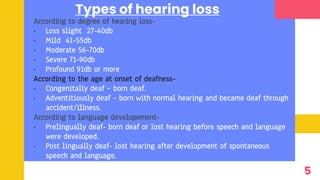
According to degree of hearing loss-
• Loss slight 27-40db
• Mild 41-55db
• Moderate 56-70db
• Severe 71-90db
• Profound 91db or more
According to the age at onset of deafness-
• Congenitally deaf – born deaf.
• Adventitiously deaf – born with normal hearing and became deaf through
accident/illness.
According to language developement-
• Prelingually deaf- born deaf or lost hearing before speech and language
were developed.
• Post lingually deaf- lost hearing after development of spontaneous
speech and language.
5
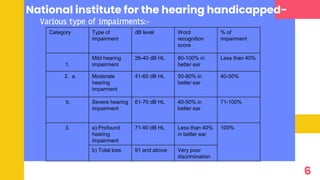
National institute for the hearing handicapped-
Various type of impairments:-
6
Category Type of
impairment
dB level Word
recognition
score
% of
impairment
1.
Mild hearing
impairment
26-40 dB HL 80-100% in
better ear
Less than 40%
2. a. Moderate
hearing
imparment
41-60 dB HL 50-80% in
better ear
40-50%
b. Severe hearing
impairment
61-70 dB HL 40-50% in
better ear
71-100%
3. a) Profound
hearing
impairment
71-90 dB HL Less than 40%
in better ear
100%
b) Total loss 91 and above Very poor
discrimination
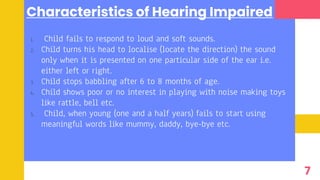
Characteristics of Hearing Impaired
1. Child fails to respond to loud and soft sounds.
2. Child turns his head to localise (locate the direction) the sound
only when it is presented on one particular side of the ear i.e.
either left or right.
3. Child stops babbling after 6 to 8 months of age.
4. Child shows poor or no interest in playing with noise making toys
like rattle, bell etc.
5. Child, when young (one and a half years) fails to start using
meaningful words like mummy, daddy, bye-bye etc.
7
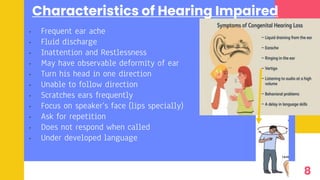
Characteristics of Hearing Impaired
• Frequent ear ache
• Fluid discharge
• Inattention and Restlessness
• May have observable deformity of ear
• Turn his head in one direction
• Unable to follow direction
• Scratches ears frequently
• Focus on speaker’s face (lips specially)
• Ask for repetition
• Does not respond when called
• Under developed language
8
Educational Programme
• Use of hearing aids
• Vocational placement
• Classroom arrangement (seating arrangement)
• Speech reading/ lip reading
• Sign language
• Special classes & regular class combination
• Special Schools
• Integrated Classroom/ home based programme
• Individualized Education Plans (IEPs)
• Social and Emotional Support
9
Meaning of Speech Impairment(Language)
• A speech disorder is a condition in which a person has problems
creating or forming the speech sounds needed to communicate
with others.
• According to Tinter, “Speech may be considered defective when it
is not easily audible to the listener.
• Speech is defective if it is vocally unpleasant, finally speech is
defective if it is inappropriate to the individual in regard to
his/her mental and chronological age, sex and physical
development.
10
Types of Speech Impairment
1. Articulation disorder :– problem due to lips, teeth, tongue,
throat, vocal cords, lungs.
2. De-fluency disorder :- De-fluency disorder is speech disorder
in which a normal flow of speech is disrupted by frequent
repetition prolongations of speech sounds.
3. Voice disorder :- Voice is the feature of speech production
that impacts tonal quality, pitch, loudness of speech.
4. delay in language development:- language delay is a
Condition where child's language is significantly below his
chronical age.
11
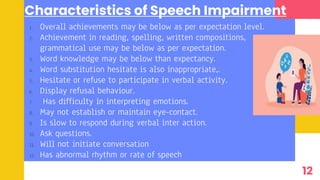
Characteristics of Speech Impairment
1. Overall achievements may be below as per expectation level.
2. Achievement in reading, spelling, written compositions,
grammatical use may be below as per expectation.
3. Word knowledge may be below than expectancy.
4. Word substitution hesitate is also inappropriate,.
5. Hesitate or refuse to participate in verbal activity.
6. Display refusal behaviour.
7. Has difficulty in interpreting emotions.
8. May not establish or maintain eye-contact.
9. Is slow to respond during verbal inter action.
10. Ask questions.
11. Will not initiate conversation
12. Has abnormal rhythm or rate of speech
12
Educational Programme for Speech Impairment
1. Assessment and Individualized Education Plan (IEP)
2. Get help from Speech and Language Therapist
3. Augmentative and Alternative Communication (AAC)
4. Language and Communication Skills Development
5. Social Skills Training
6. Collaboration and consultation with Parents and Caregivers
7. A teacher should be very careful when listening to speech
impaired child/should not stop the speech of SI child
8. Ongoing Evaluation and Progress Monitoring
9. Professional Engagement
10. Regular & special educators
11. Integrated education in same classroom
13
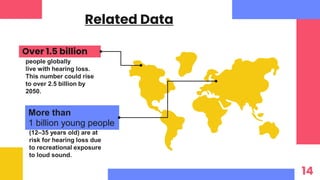
Related Data
14
Over 1.5 billion
people globally
live with hearing loss.
This number could rise
to over 2.5 billion by
2050.
More than
1 billion young people
(12–35 years old) are at
risk for hearing loss due
to recreational exposure
to loud sound.
15

Characteristics and Educational programme for Hearing And Speech Impairment.pptx

  • 1.
    Characteristics and Educational Programme ofCWSN with specific reference to Hearing and Speech Impairment Submitted to: Submitted by: Dr. Amit Singh Atul K. Singh Assistant Professor Roll no.- 221829 Dept. of Teacher Education Sec.- A CUH Course-B.Ed. 1
  • 2.
    Meaning and definitionof Hearing Impairment • A person who is not able to hear as well as someone with normal hearing hearing thresholds of 25dB or better in both ears - is said to have hearing loss. • 'Hard of hearing' refers to people with hearing loss ranging from mild to severe. • 'Deaf' people mostly have profound hearing loss, which implies very little or no hearing. 2
  • 3.
    Definition of HearingImpairment Person with disability act- (PWD, 1995) Definition of disability in pwd act includes hearing impairment- Hearing impairment means loss of 60 decibel or more in the better ear in speech conversation frequencies. Idea- individual education act, 2004 Defines hearing impairment as impairment in hearing, whether permanent or fluctuating that adversely affects a child’s educational performancebut is not included under the definition of deafness. World Health Organisation (WHO) – A person who is not able to hear as well as someone with normal hearing – hearing threshold of 25db or better in both ears is said to have hearing loss. 3
  • 4.
    Types of hearingloss According to place of impairment- • Conductive hearing loss- Hearing loss due to the interference in the transmission of sound to and through the sense organ (outer or middle ear) • Sensory-neural hearing loss- due to the abnormality of the inner ear or the auditory nerve, or both • Mixed hearing loss- combination of both; sometimes called a flat loss 4
  • 5.
    Types of hearingloss According to degree of hearing loss- • Loss slight 27-40db • Mild 41-55db • Moderate 56-70db • Severe 71-90db • Profound 91db or more According to the age at onset of deafness- • Congenitally deaf – born deaf. • Adventitiously deaf – born with normal hearing and became deaf through accident/illness. According to language developement- • Prelingually deaf- born deaf or lost hearing before speech and language were developed. • Post lingually deaf- lost hearing after development of spontaneous speech and language. 5
  • 6.
    National institute forthe hearing handicapped- Various type of impairments:- 6 Category Type of impairment dB level Word recognition score % of impairment 1. Mild hearing impairment 26-40 dB HL 80-100% in better ear Less than 40% 2. a. Moderate hearing imparment 41-60 dB HL 50-80% in better ear 40-50% b. Severe hearing impairment 61-70 dB HL 40-50% in better ear 71-100% 3. a) Profound hearing impairment 71-90 dB HL Less than 40% in better ear 100% b) Total loss 91 and above Very poor discrimination
  • 7.
    Characteristics of HearingImpaired 1. Child fails to respond to loud and soft sounds. 2. Child turns his head to localise (locate the direction) the sound only when it is presented on one particular side of the ear i.e. either left or right. 3. Child stops babbling after 6 to 8 months of age. 4. Child shows poor or no interest in playing with noise making toys like rattle, bell etc. 5. Child, when young (one and a half years) fails to start using meaningful words like mummy, daddy, bye-bye etc. 7
  • 8.
    Characteristics of HearingImpaired • Frequent ear ache • Fluid discharge • Inattention and Restlessness • May have observable deformity of ear • Turn his head in one direction • Unable to follow direction • Scratches ears frequently • Focus on speaker’s face (lips specially) • Ask for repetition • Does not respond when called • Under developed language 8
  • 9.
    Educational Programme • Useof hearing aids • Vocational placement • Classroom arrangement (seating arrangement) • Speech reading/ lip reading • Sign language • Special classes & regular class combination • Special Schools • Integrated Classroom/ home based programme • Individualized Education Plans (IEPs) • Social and Emotional Support 9
  • 10.
    Meaning of SpeechImpairment(Language) • A speech disorder is a condition in which a person has problems creating or forming the speech sounds needed to communicate with others. • According to Tinter, “Speech may be considered defective when it is not easily audible to the listener. • Speech is defective if it is vocally unpleasant, finally speech is defective if it is inappropriate to the individual in regard to his/her mental and chronological age, sex and physical development. 10
  • 11.
    Types of SpeechImpairment 1. Articulation disorder :– problem due to lips, teeth, tongue, throat, vocal cords, lungs. 2. De-fluency disorder :- De-fluency disorder is speech disorder in which a normal flow of speech is disrupted by frequent repetition prolongations of speech sounds. 3. Voice disorder :- Voice is the feature of speech production that impacts tonal quality, pitch, loudness of speech. 4. delay in language development:- language delay is a Condition where child's language is significantly below his chronical age. 11
  • 12.
    Characteristics of SpeechImpairment 1. Overall achievements may be below as per expectation level. 2. Achievement in reading, spelling, written compositions, grammatical use may be below as per expectation. 3. Word knowledge may be below than expectancy. 4. Word substitution hesitate is also inappropriate,. 5. Hesitate or refuse to participate in verbal activity. 6. Display refusal behaviour. 7. Has difficulty in interpreting emotions. 8. May not establish or maintain eye-contact. 9. Is slow to respond during verbal inter action. 10. Ask questions. 11. Will not initiate conversation 12. Has abnormal rhythm or rate of speech 12
  • 13.
    Educational Programme forSpeech Impairment 1. Assessment and Individualized Education Plan (IEP) 2. Get help from Speech and Language Therapist 3. Augmentative and Alternative Communication (AAC) 4. Language and Communication Skills Development 5. Social Skills Training 6. Collaboration and consultation with Parents and Caregivers 7. A teacher should be very careful when listening to speech impaired child/should not stop the speech of SI child 8. Ongoing Evaluation and Progress Monitoring 9. Professional Engagement 10. Regular & special educators 11. Integrated education in same classroom 13
  • 14.
    Related Data 14 Over 1.5billion people globally live with hearing loss. This number could rise to over 2.5 billion by 2050. More than 1 billion young people (12–35 years old) are at risk for hearing loss due to recreational exposure to loud sound.
  • 15.