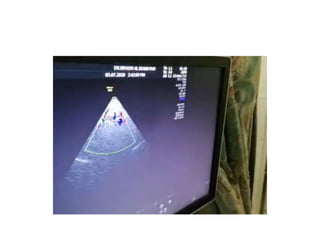
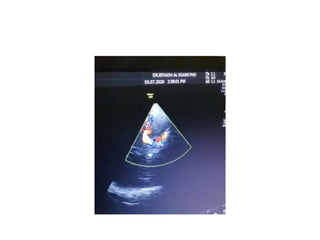
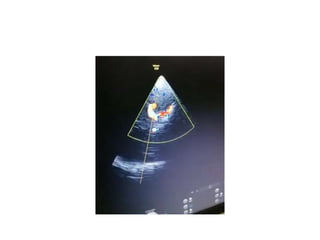
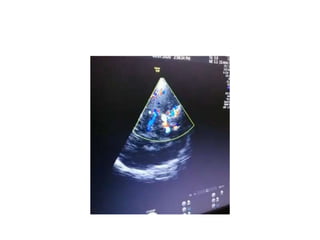
Trans-Cranial Doppler (TCD)
Dr.Riyadh W. Al Esawi
DMRD, MSc, PhD
Assist. Prof in Diagnostic radiology
Faculty of medicine/Kufa University
Types of Transcranial Doppler Devices
1- non-duplex, (non-imaging).
2-Duplex (imaging) devices.
In non-duplex devices, the arteries are identified “blindly”
based on the audible Doppler shift and the spectral
display.
Specific vessel identification is based on standard criteria,
which includes the cranial window used, orientation of
the probe, depth of sample volume, direction of blood
flow, relationship to the terminal internal carotid artery,
and response to various maneuvers such as the common
carotid artery compression and eye opening and closing.
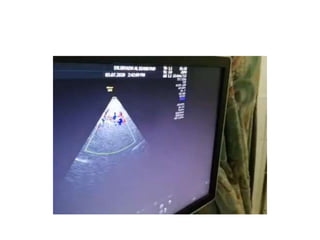
The imaging B-mode trans cranial color-coded duplex
(TCCD)
Combines pulsed wave Doppler ultrasound with a cross-
sectional view of the area of insonation, which allows
identification of the arteries in relation to various anatomic
locations. The color-coded Doppler also depicts the
direction of the flow in relation to the probe, while
recording blood flow velocities. In TCD, the angle of
insonation is assumed < 30 degrees (as close to zero as
possible) to minimize the Doppler shift measurement error.
power motion-mode TCD (PMD/TCD), has also become
available that provides multigate flow information
simultaneously in the power M-mode Display.
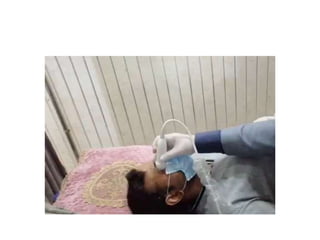
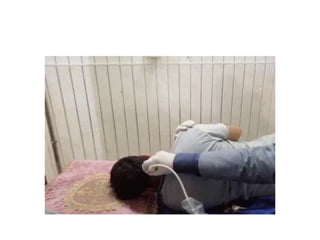
1-Transtemporal(MCA, ACA , ICA and proximal PCA)
2-Submandibular ( ICA)
3-trasnorbital(Ophth, intracavernous and supraclinoid ICA)
4-suboccipital (VA, BA)
Distal arteries become vertically oriented, so beyond scope of TCD.
TCD
windows
General Applications of TCD
• Ischaemic cerebrovascular disease Sickle cell disease
• Right to left cardiac shunts Intra and extra-cranial arterial stenosis
AVM and AV fistulas Peri-procedural/operative
Cerebral thrombolysis in acute stroke Carotid endarterectomy
Carotid angioplasty and stenting Coronary artery bypass surgery
Coronary angioplasty Prosthetic heart valves
Neurological/Neurosurgical intensive care
• Vasospasm after SAH Raised intracranial pressure
• Head injury Cerebral circulatory arrest and brain
death
• Intracerebral aneurysm and hematoma Pharmacologic vasomotor testing
• Cerebral pressure autoregulation Liver failure/Hepatic encephalopathy
• Preeclampsia
COMMON CLINICALAPPLICATIONS
1- Intracranial Steno-Occlusive Disease.
2- Subarachnoid hemorrhage and cerebral
vasospasm.
3.Aneurysm.
3- Acute Ischemic Stroke.
4- Collateral Flow.
5- Micro emboli Detection.
6- Sickle Cell Disease.
7- Cerebral Circulatory Arrest.
Advantages and disadvantages
*Advantages
non-invasive
quick and easily repeatable
performed at the bedside
can be used to monitor spasm post-treatment
*Disadvantages
sensitivity 80% compared to angiography
operator dependent
poor for distal vessels (i.e. other than MCA and ICA)
potential confounders include hypo/hypercapnia, haematocrit, BP
edema and vasospasm may be difficult to distinguish post-op
difficult views in some patients (e.g. thick skulls!)
- Inadequate acoustic windows and/or poor patient
positioning.
- Restless or uncooperative patients.
- U.State . Food and Drug Administration (FDA)
recommends the power output of the transducer
be reduced to the lowest power that allows a
complete orbital examination.
CONTRAINDICATIONS AND LIMITATIONS
C.I and limitations- conti
-Remove contact lenses prior to the exam
-Output power must not exceed 10% of
maximum emitted power or 17mW per cm2 or
equivalent
-In emergent or critical care situations, it may be
difficult to perform a complete exam
-TCD/TCDI performance during interventional
procedures requires additional precautions for
the examiner, due to the presence of radiation.
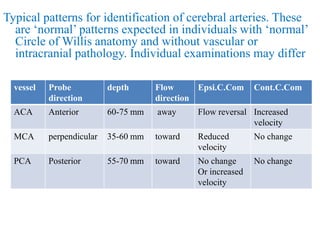
Typical patterns for identification of cerebral arteries. These
are ‘normal’ patterns expected in individuals with ‘normal’
Circle of Willis anatomy and without vascular or
intracranial pathology. Individual examinations may differ
vessel Probe
direction
depth Flow
direction
Epsi.C.Com Cont.C.Com
ACA Anterior 60-75 mm away Flow reversal Increased
velocity
MCA perpendicular 35-60 mm toward Reduced
velocity
No change
PCA Posterior 55-70 mm toward No change
Or increased
velocity
No change
STROKE
-Characteristic waveforms
-Gentle broadening in down ward slope of systolic
peak and early diastolic
–moderate reduction in diameter <50%.
-Spectral broadening increases with increasing
stenosis.
-Severe stenosis > 90%, blood flow limited despite
compensation, result in decrease in magnitude
Stenosis Severity
Peak systolic frequency
Peak diastolic frequency
End diastolic frequency
Ratio of systolic frequency between ICA and
CCA
Ratio of diastolic frequency between ICA and
CCA.
Peak systolic and end diastolic velocities are
most important .
all these raise the sensitivity from 84% to 99%.
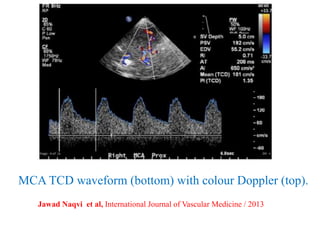
MCA TCD waveform (bottom) with colour Doppler (top).
Jawad Naqvi et al, International Journal of Vascular Medicine / 2013
MEAN FLOW VELOCITY
Mean flow velocity (MFV) is a central parameter in
TCD and is equal to [PSV + (EDV x 2)]/3.
When MFV is increased, it may indicate stenosis,
vasospasm, or hyper dynamic flow.
A decreased value may indicate hypotension, decreased
CBF, ICP, or brain stem death.
Focal arterial stenosis or vasospasm is represented by an
increased MFV within a 5–10 mm segment, usually
by 30 cm/s compared with the asymptomatic side.
Factors influencing MFV
Factor Change in MFV
• Age Increases up to 6–10 years of age then decreases
• Sex Higher MFV in women than men.
• Pregnancy Decreased in the 3rd trimester
• PCO2 Increases with increasing PCO2
• Mean arterial Pressure (MAP) Increases with increasing
MAP (CBF auto regulates between CPP 50–150 mmHg)
• Haematocrit Increases with decreasing haematocrit
MEAN FLOW VELOCITY OF INTRACRANIAL
ARTERIES MFV CM/S
MCA 40-80 cm/s
ACA 35-60
ICA (C1) VARIABLE
SIPHON (C4) 40-70
PCA (P1) 30-55
OPH.A 5-30
VA 25-50
BA 25-60
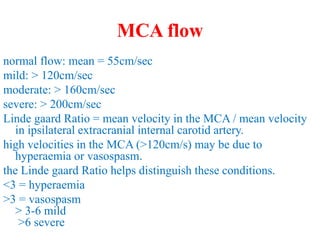
MCA flow
normal flow: mean = 55cm/sec
mild: > 120cm/sec
moderate: > 160cm/sec
severe: > 200cm/sec
Linde gaard Ratio = mean velocity in the MCA / mean velocity
in ipsilateral extracranial internal carotid artery.
high velocities in the MCA (>120cm/s) may be due to
hyperaemia or vasospasm.
the Linde gaard Ratio helps distinguish these conditions.
<3 = hyperaemia
>3 = vasospasm
> 3-6 mild
>6 severe
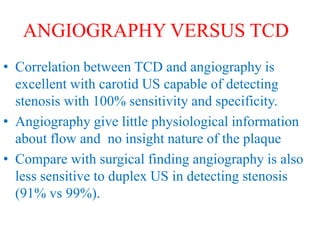
ANGIOGRAPHY VERSUS TCD
• Correlation between TCD and angiography is
excellent with carotid US capable of detecting
stenosis with 100% sensitivity and specificity.
• Angiography give little physiological information
about flow and no insight nature of the plaque
• Compare with surgical finding angiography is also
less sensitive to duplex US in detecting stenosis
(91% vs 99%).
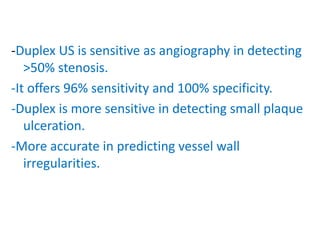
-Duplex US is sensitive as angiography in detecting
>50% stenosis.
-It offers 96% sensitivity and 100% specificity.
-Duplex is more sensitive in detecting small plaque
ulceration.
-More accurate in predicting vessel wall
irregularities.
Intracranial stenosis, causes
-Main cause – Atherosclerosis
-Other
-Moyamoya
-Arterial dissection
-Vasculitis
-Sickle cell disease
-Arterial emboli
-Accuracy of TCD for diagnosing stenosis revealed a
sensitivity of 73% and specificity of 95%
-It is worth performing TCD in patients with cerebro-vascular
symptoms without any extra cranial disease.
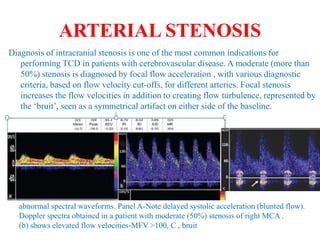
ARTERIAL STENOSIS
Diagnosis of intracranial stenosis is one of the most common indications for
performing TCD in patients with cerebrovascular disease. A moderate (more than
50%) stenosis is diagnosed by focal flow acceleration , with various diagnostic
criteria, based on flow velocity cut-offs, for different arteries. Focal stenosis
increases the flow velocities in addition to creating flow turbulence, represented by
the ‘bruit’, seen as a symmetrical artifact on either side of the baseline.
abnormal spectral waveforms. Panel A-Note delayed systolic acceleration (blunted flow).
Doppler spectra obtained in a patient with moderate (50%) stenosis of right MCA .
(b) shows elevated flow velocities-MFV >100, C , bruit
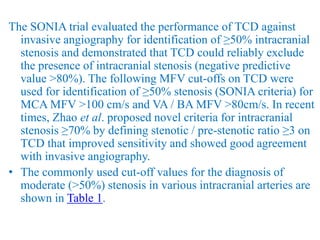
The SONIA trial evaluated the performance of TCD against
invasive angiography for identification of ≥50% intracranial
stenosis and demonstrated that TCD could reliably exclude
the presence of intracranial stenosis (negative predictive
value >80%). The following MFV cut-offs on TCD were
used for identification of ≥50% stenosis (SONIA criteria) for
MCA MFV >100 cm/s and VA / BA MFV >80cm/s. In recent
times, Zhao et al. proposed novel criteria for intracranial
stenosis ≥70% by defining stenotic / pre-stenotic ratio ≥3 on
TCD that improved sensitivity and showed good agreement
with invasive angiography.
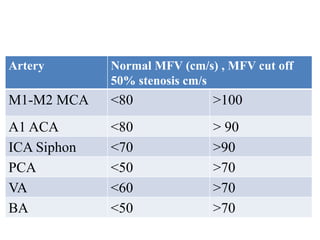
• The commonly used cut-off values for the diagnosis of
moderate (>50%) stenosis in various intracranial arteries are
shown in Table 1.
Artery Normal MFV (cm/s) , MFV cut off
50% stenosis cm/s
M1-M2 MCA <80 >100
A1 ACA <80 > 90
ICA Siphon <70 >90
PCA <50 >70
VA <60 >70
BA <50 >70
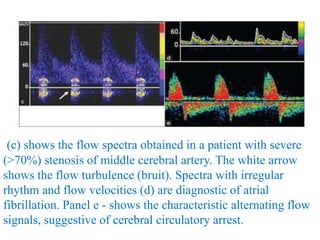
(c) shows the flow spectra obtained in a patient with severe
(>70%) stenosis of middle cerebral artery. The white arrow
shows the flow turbulence (bruit). Spectra with irregular
rhythm and flow velocities (d) are diagnostic of atrial
fibrillation. Panel e - shows the characteristic alternating flow
signals, suggestive of cerebral circulatory arrest.
Sickle Cell Disease
• Patients with sickle cell disease are at risk from a spectrum of brain injuries that
include subclinical infarction, acute stroke and hemorrhage;
• the prevalence of acute stroke in sickle cell disease is 600 per 100,000 patient-years.
• The underlying pathology involves distal ICA, proximal MCA and ACA stenosis,
and occlusion as a result of an increasing circulation of irreversibly sickled cells and
their adherence to the vascular endothelium.
• CBF-V >200 cm/s in asymptomatic children with sickle cell disease is associated
with an increased risk of stroke of 10,000 per 100,000 patients-year.
• Treatment with blood transfusion in such children can reduce the risk of stroke
by 90%.
• Therefore, TCD screening of children between 2- and 6-years old is recommended
on a 6–12 monthly basis, involving measurement of the time-averaged mean
maximum CBF-V in bilateral MCA, bifurcation, distal ICA, ACA, PCA, and BA.
Patients with a time averaged mean maximum CBF-V in all arteries of 170 cm/sec
are consiered normal .
• If a value 200 cm/s in any artery is observed, then blood transfusion is
recommended to reduce sickle haemoglobin to less than 30% of total haemoglobin
and prevent stroke .
Moyamoya Disease
• Moyamoya disease is a progressive vasculopathy leading
to stenosis of the main intracranial arteries. The incidence
of Moyamoya disease is high in Asian countries; in
Europe and North America, the prevalence of the disease
is considerably lower. Clinically, the disease may be of
ischaemic, haemorrhagic and epileptic type. Cognitive
dysfunction and behavioral disturbance are atypical
symptoms of Moyamoya disease.
• Characteristic angiographic features of the disease include
stenosis or occlusion of the arteries of the circle of Willis,
as well as the development of collateral vasculature.
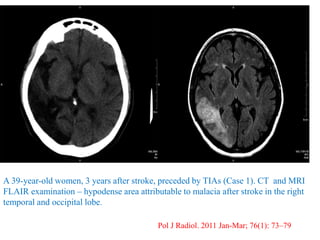
A 39-year-old women, 3 years after stroke, preceded by TIAs (Case 1). CT and MRI
FLAIR examination – hypodense area attributable to malacia after stroke in the right
temporal and occipital lobe.
Pol J Radiol. 2011 Jan-Mar; 76(1): 73–79
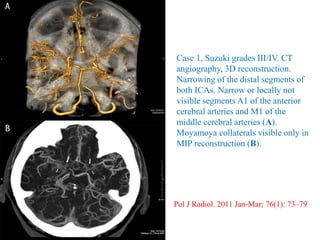
Case 1, Suzuki grades III/IV. CT
angiography, 3D reconstruction.
Narrowing of the distal segments of
both ICAs. Narrow or locally not
visible segments A1 of the anterior
cerebral arteries and M1 of the
middle cerebral arteries (A).
Moyamoya collaterals visible only in
MIP reconstruction (B).
Pol J Radiol. 2011 Jan-Mar; 76(1): 73–79
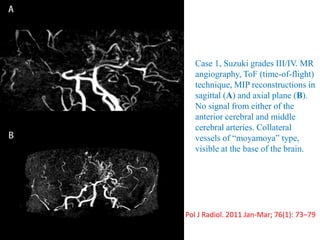
Case 1, Suzuki grades III/IV. MR
angiography, ToF (time-of-flight)
technique, MIP reconstructions in
sagittal (A) and axial plane (B).
No signal from either of the
anterior cerebral and middle
cerebral arteries. Collateral
vessels of “moyamoya” type,
visible at the base of the brain.
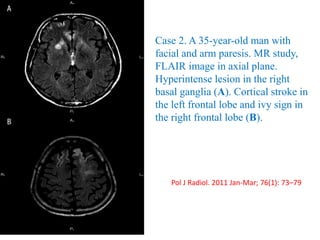
Case 2. A 35-year-old man with
facial and arm paresis. MR study,
FLAIR image in axial plane.
Hyperintense lesion in the right
basal ganglia (A). Cortical stroke in
the left frontal lobe and ivy sign in
the right frontal lobe (B).
Pol J Radiol. 2011 Jan-Mar; 76(1): 73–79
• The ivy sign refers to the MRI appearance of
patients with moyamoya disease or moyamoya
syndrome. Prominent leptomeningeal
collaterals result in vivid contrast enhancement
and high signal on FLAIR due to slow flow.
The appearance is reminiscent of the brain
having been covered with ivy.
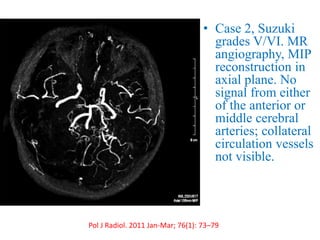
• Case 2, Suzuki
grades V/VI. MR
angiography, MIP
reconstruction in
axial plane. No
signal from either
of the anterior or
middle cerebral
arteries; collateral
circulation vessels
not visible.
Pol J Radiol. 2011 Jan-Mar; 76(1): 73–79
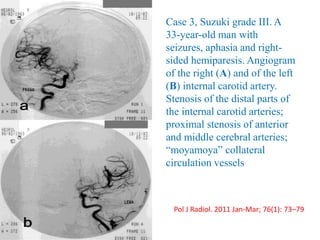
Case 3, Suzuki grade III. A
33-year-old man with
seizures, aphasia and right-
sided hemiparesis. Angiogram
of the right (A) and of the left
(B) internal carotid artery.
Stenosis of the distal parts of
the internal carotid arteries;
proximal stenosis of anterior
and middle cerebral arteries;
“moyamoya” collateral
circulation vessels
Pol J Radiol. 2011 Jan-Mar; 76(1): 73–79
Intracranial hemodynamics
In occlusive disease. TCD helps in determination of
Collateral patterns
-Hemodynamic changes in distal vascular territories
-Evaluation of vasomotor reserve VMR
Changes in velocity through a vessel in proportional to
changes in flow provided, the vessel diameter is normal.
-Changes in blood flow velocity through the MCA can reflect
relative changes in blood flow in that artery as a result of
alteration in CO2 concentration or acetazolomide
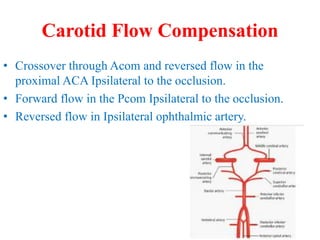
Carotid Flow Compensation
• Crossover through Acom and reversed flow in the
proximal ACA Ipsilateral to the occlusion.
• Forward flow in the Pcom Ipsilateral to the occlusion.
• Reversed flow in Ipsilateral ophthalmic artery.
Cerebral Autoregulation
• TCD can be used to determine autoregulation
noninvasively in the MCA perfusion in territories
• Autoregulation is absent in patients with impaired
CO2 reactivity.
Positional Vertebral Artery Occlusion
• Impaired collateral path ways from anterior
circulation with positional obstruction of one or
both VAs.
• MC due to cervical spondylosis
• TCD monitoring of PCA bilaterally in various
head positioning can be useful.
• Diagnostic finding is transient drop in PCA
velocity with head turning and rebound
hyperemia on return.
Intracranial Emboli
• Causes
• Atrial fibrillation, prosthetic valve, carotid stenosis,
fibromuscular dysplasia, arterial dissection,
intracranial stenosis, invasive procedure like
angiography, angioplasty, vascular and heart
surgery, Aneurysmal treatment.
• TCD can identified the site of active embolization
in the arterial system in patients with transient
ischemic attack or recent stroke, distinguishing
embolic versus hemodynamic causes of stroke and
transient ischemic attack
Cerebral Vasospasm
• TCD and cerebral blood flow measurements
are useful to determine the state of contraction
of the basal intracranial vessels, as well as
response of cerebral blood flow.
• The peak incidence of vasospasm occurs
initially 4 days after SAH and appeared to be
maximum at 6-8 days and reduced by day 12.
• TCD can be used to monitor the effect of
treatment on vasospasm.
Transcranial Doppler demonstrates pulsatile flow in the right-middle cerebral artery in a 40-
year-old patient following subarachnoid hemorrhage and vasospasm. At a depth of 58 mm
(near the origin of the middle cerebral artery [MCA]), a markedly elevated peak systolic
flow velocity of approximately 251 cm/s and a mean velocity of approximately 164 cm/s
indicates severe MCA stenosis. Normal peak and mean MCA flow velocities are
approximately 100 cm/s and 50 cm/s, respectively.
Effect of Vessel Narrowing on Blood Flow Velocity
Average normal velocity of MCA is 62 cm/s.
velocity > 120 cm/s indicates vasospasm.
Those > 200 cm/s correlate with severe vasospasm
on angiography .
degree of vasospasm with TCD velocities are best
correlated with MCA and distal ICA.
approximately 25% of SAH patients developing delayed ischemic
deficits due to vasospasm.
TCD identifies MCA and BA vasospasm with a high sensitivity and
specificity [39]. A systematic review of 26 studies comparing TCD
with angiography found that MCA MFV >120 cm/s was 99%
specific and 67% sensitive to angiographic vasospasm of ≥25%
[64]. In a retrospective study of 101 patients, MCA MFV
>120 cm/s was 72% specific and 88% sensitive for ≥33%
angiographic vasospasm with a negative predictive value (NPV) of
94% for MFV <120 cm/s [65]. In the same study, MFV >200 cm/s
was 98% specific and 27% sensitive with a positive predictive
value (PPV) of 87% for angiographic vasospasm of ≥33% [65].
Therefore, MFV <120 cm/s and >200 cm/s may accurately predict
absence and presence of angiographic MCA, vasospasm,
respectively
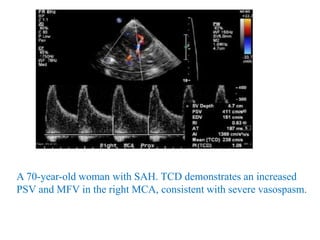
A 70-year-old woman with SAH. TCD demonstrates an increased
PSV and MFV in the right MCA, consistent with severe vasospasm.
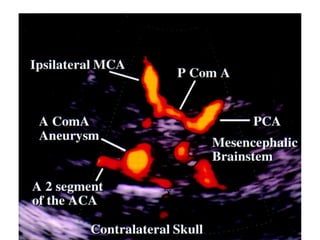
Intracranial Aneurysm
• 2D color TCD can detect cerebral
aneurysm in rage of 3-16 mm.
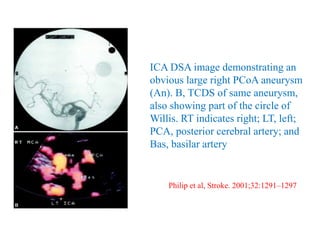
ICA DSA image demonstrating an
obvious large right PCoA aneurysm
(An). B, TCDS of same aneurysm,
also showing part of the circle of
Willis. RT indicates right; LT, left;
PCA, posterior cerebral artery; and
Bas, basilar artery
Philip et al, Stroke. 2001;32:1291–1297
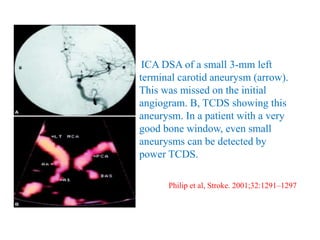
ICA DSA of a small 3-mm left
terminal carotid aneurysm (arrow).
This was missed on the initial
angiogram. B, TCDS showing this
aneurysm. In a patient with a very
good bone window, even small
aneurysms can be detected by
power TCDS.
Philip et al, Stroke. 2001;32:1291–1297
RAISED ICP
-In early rise of ICP- the pulsatility index
increased with progressive reduction in
diastolic flow and no change in mean velocity.
-More increase ICP- reduction in mean velocity
and increased pulsatility index.
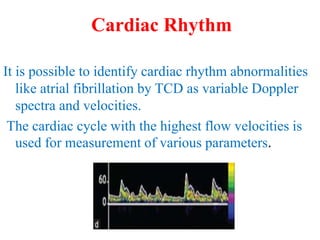
It is possible to identify cardiac rhythm abnormalities
like atrial fibrillation by TCD as variable Doppler
spectra and velocities.
The cardiac cycle with the highest flow velocities is
used for measurement of various parameters.
Cardiac Rhythm
Cardiac Shunts
• Paradoxical embolism through right to left
cardiopulmonary shunts (e.g., patent foramen ovale) is an
important cause of stroke in those under 55 years of age.
• TCD offers a noninvasive method to assess and classify
the grade of shunting via an micro-embolic signal MES
grading scheme, which can also help stratify patients
according to risk of stroke.
• A peripheral injection of agitated saline or Echovist
(Schering AG, Germany; a microparticle contrast agent) is
administered and the patient is asked to perform a Valsalva
manoeuvre, with the TCD probe place over the MCA.
• The number of microembolic signals (MES) observed up
to 40 seconds after the end of the injection are counted .
Grade of Cardiac Shunt
• Grade of shunt Number of microembolic signals (MES)
• No shunt 0
• Low grade shunt 1–10
• Medium grade shunt 11–25
• High grade shunt >25 (shower) or uncountable .
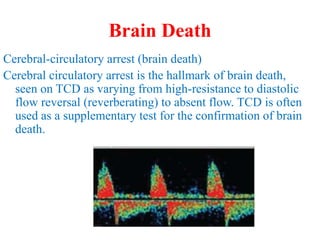
Brain Death
Cerebral-circulatory arrest (brain death)
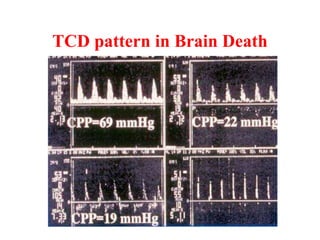
Cerebral circulatory arrest is the hallmark of brain death,
seen on TCD as varying from high-resistance to diastolic
flow reversal (reverberating) to absent flow. TCD is often
used as a supplementary test for the confirmation of brain
death.
Brain Stem Death
It shows 100% specificity and 96% sensitivity. Typical
flow patterns are
1- Reduced or absent diastolic flow.
2- Reverberant flow
3-Short systolic spikes
However, these patterns may also be seen temporarily
following bolus administration
of sedatives.
PI is high with markedly reduced systolic flows
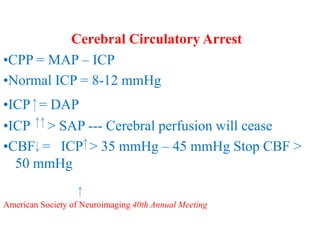
Cerebral Circulatory Arrest
•CPP = MAP – ICP
•Normal ICP = 8-12 mmHg
•ICP = DAP
•ICP > SAP --- Cerebral perfusion will cease
•CBF = ICP > 35 mmHg – 45 mmHg Stop CBF >
50 mmHg
American Society of Neuroimaging 40th Annual Meeting
TCD pattern in Brain Death
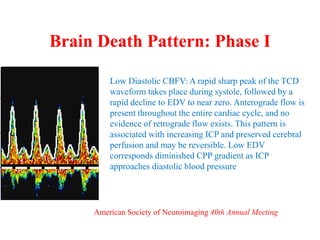
Brain Death Pattern: Phase I
Low Diastolic CBFV: A rapid sharp peak of the TCD
waveform takes place during systole, followed by a
rapid decline to EDV to near zero. Anterograde flow is
present throughout the entire cardiac cycle, and no
evidence of retrograde flow exists. This pattern is
associated with increasing ICP and preserved cerebral
perfusion and may be reversible. Low EDV
corresponds diminished CPP gradient as ICP
approaches diastolic blood pressure
American Society of Neuroimaging 40th Annual Meeting
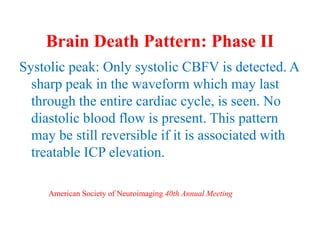
Brain Death Pattern: Phase II
Systolic peak: Only systolic CBFV is detected. A
sharp peak in the waveform which may last
through the entire cardiac cycle, is seen. No
diastolic blood flow is present. This pattern
may be still reversible if it is associated with
treatable ICP elevation.
American Society of Neuroimaging 40th Annual Meeting
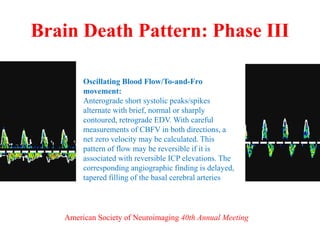
Brain Death Pattern: Phase III
Oscillating Blood Flow/To-and-Fro
movement:
Anterograde short systolic peaks/spikes
alternate with brief, normal or sharply
contoured, retrograde EDV. With careful
measurements of CBFV in both directions, a
net zero velocity may be calculated. This
pattern of flow may be reversible if it is
associated with reversible ICP elevations. The
corresponding angiographic finding is delayed,
tapered filling of the basal cerebral arteries
American Society of Neuroimaging 40th Annual Meeting
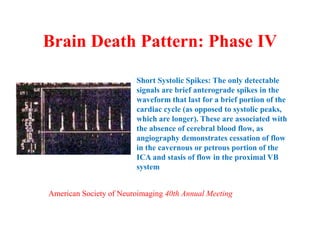
Brain Death Pattern: Phase IV
Short Systolic Spikes: The only detectable
signals are brief anterograde spikes in the
waveform that last for a brief portion of the
cardiac cycle (as opposed to systolic peaks,
which are longer). These are associated with
the absence of cerebral blood flow, as
angiography demonstrates cessation of flow
in the cavernous or petrous portion of the
ICA and stasis of flow in the proximal VB
system
American Society of Neuroimaging 40th Annual Meeting
Brain Death Pattern: Phase V
• Absence of TCD signal: No intracranial TCD signal is detectable.
Oscillating blood flow in the extracranial ICA is usually detectable
with submandibular insonation. This pattern, or actually absence of
any pattern, has been associated with extracranial angiographic
arrest of flow in all vessels. Use of the absence of TCD signal to
confirm intracranial circulatory arrest should be restricted to patients
who previously have had demonstrated TCD waveforms. Otherwise,
the absence of TCD signal could be result of a thickened skull and
inadequate cranial windows
• American Society of Neuroimaging 40th Annual Meeting
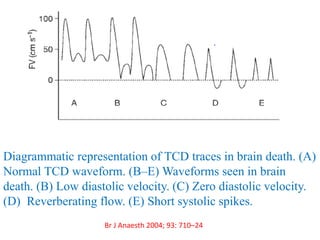
Diagrammatic representation of TCD traces in brain death. (A)
Normal TCD waveform. (B–E) Waveforms seen in brain
death. (B) Low diastolic velocity. (C) Zero diastolic velocity.
(D) Reverberating flow. (E) Short systolic spikes.
Br J Anaesth 2004; 93: 710–24
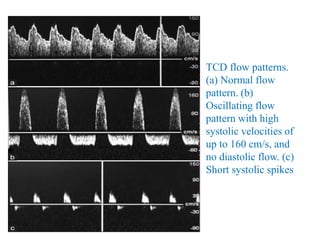
TCD flow patterns.
(a) Normal flow
pattern. (b)
Oscillating flow
pattern with high
systolic velocities of
up to 160 cm/s, and
no diastolic flow. (c)
Short systolic spikes
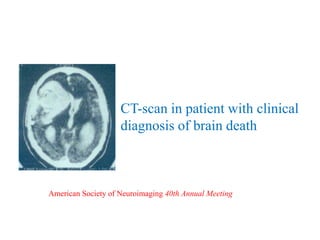
CT-scan in patient with clinical
diagnosis of brain death
American Society of Neuroimaging 40th Annual Meeting
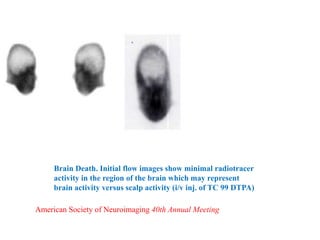
Brain Death. Initial flow images show minimal radiotracer
activity in the region of the brain which may represent
brain activity versus scalp activity (i/v inj. of TC 99 DTPA)
American Society of Neuroimaging 40th Annual Meeting
Great thanks for your attention

TRANS-CRANIAL DOPPLER

  • 1.
    Trans-Cranial Doppler (TCD) Dr.RiyadhW. Al Esawi DMRD, MSc, PhD Assist. Prof in Diagnostic radiology Faculty of medicine/Kufa University
  • 2.
    Types of TranscranialDoppler Devices 1- non-duplex, (non-imaging). 2-Duplex (imaging) devices. In non-duplex devices, the arteries are identified “blindly” based on the audible Doppler shift and the spectral display. Specific vessel identification is based on standard criteria, which includes the cranial window used, orientation of the probe, depth of sample volume, direction of blood flow, relationship to the terminal internal carotid artery, and response to various maneuvers such as the common carotid artery compression and eye opening and closing.
  • 3.
    The imaging B-modetrans cranial color-coded duplex (TCCD) Combines pulsed wave Doppler ultrasound with a cross- sectional view of the area of insonation, which allows identification of the arteries in relation to various anatomic locations. The color-coded Doppler also depicts the direction of the flow in relation to the probe, while recording blood flow velocities. In TCD, the angle of insonation is assumed < 30 degrees (as close to zero as possible) to minimize the Doppler shift measurement error. power motion-mode TCD (PMD/TCD), has also become available that provides multigate flow information simultaneously in the power M-mode Display.
  • 4.
    1-Transtemporal(MCA, ACA ,ICA and proximal PCA) 2-Submandibular ( ICA) 3-trasnorbital(Ophth, intracavernous and supraclinoid ICA) 4-suboccipital (VA, BA) Distal arteries become vertically oriented, so beyond scope of TCD. TCD windows
  • 13.
    General Applications ofTCD • Ischaemic cerebrovascular disease Sickle cell disease • Right to left cardiac shunts Intra and extra-cranial arterial stenosis AVM and AV fistulas Peri-procedural/operative Cerebral thrombolysis in acute stroke Carotid endarterectomy Carotid angioplasty and stenting Coronary artery bypass surgery Coronary angioplasty Prosthetic heart valves Neurological/Neurosurgical intensive care • Vasospasm after SAH Raised intracranial pressure • Head injury Cerebral circulatory arrest and brain death • Intracerebral aneurysm and hematoma Pharmacologic vasomotor testing • Cerebral pressure autoregulation Liver failure/Hepatic encephalopathy • Preeclampsia
  • 14.
    COMMON CLINICALAPPLICATIONS 1- IntracranialSteno-Occlusive Disease. 2- Subarachnoid hemorrhage and cerebral vasospasm. 3.Aneurysm. 3- Acute Ischemic Stroke. 4- Collateral Flow. 5- Micro emboli Detection. 6- Sickle Cell Disease. 7- Cerebral Circulatory Arrest.
  • 15.
    Advantages and disadvantages *Advantages non-invasive quickand easily repeatable performed at the bedside can be used to monitor spasm post-treatment *Disadvantages sensitivity 80% compared to angiography operator dependent poor for distal vessels (i.e. other than MCA and ICA) potential confounders include hypo/hypercapnia, haematocrit, BP edema and vasospasm may be difficult to distinguish post-op difficult views in some patients (e.g. thick skulls!)
  • 16.
    - Inadequate acousticwindows and/or poor patient positioning. - Restless or uncooperative patients. - U.State . Food and Drug Administration (FDA) recommends the power output of the transducer be reduced to the lowest power that allows a complete orbital examination. CONTRAINDICATIONS AND LIMITATIONS
  • 17.
    C.I and limitations-conti -Remove contact lenses prior to the exam -Output power must not exceed 10% of maximum emitted power or 17mW per cm2 or equivalent -In emergent or critical care situations, it may be difficult to perform a complete exam -TCD/TCDI performance during interventional procedures requires additional precautions for the examiner, due to the presence of radiation.
  • 18.
    Typical patterns foridentification of cerebral arteries. These are ‘normal’ patterns expected in individuals with ‘normal’ Circle of Willis anatomy and without vascular or intracranial pathology. Individual examinations may differ vessel Probe direction depth Flow direction Epsi.C.Com Cont.C.Com ACA Anterior 60-75 mm away Flow reversal Increased velocity MCA perpendicular 35-60 mm toward Reduced velocity No change PCA Posterior 55-70 mm toward No change Or increased velocity No change
  • 19.
    STROKE -Characteristic waveforms -Gentle broadeningin down ward slope of systolic peak and early diastolic –moderate reduction in diameter <50%. -Spectral broadening increases with increasing stenosis. -Severe stenosis > 90%, blood flow limited despite compensation, result in decrease in magnitude
  • 20.
    Stenosis Severity Peak systolicfrequency Peak diastolic frequency End diastolic frequency Ratio of systolic frequency between ICA and CCA Ratio of diastolic frequency between ICA and CCA.
  • 21.
    Peak systolic andend diastolic velocities are most important . all these raise the sensitivity from 84% to 99%.
  • 22.
    MCA TCD waveform(bottom) with colour Doppler (top). Jawad Naqvi et al, International Journal of Vascular Medicine / 2013
  • 23.
    MEAN FLOW VELOCITY Meanflow velocity (MFV) is a central parameter in TCD and is equal to [PSV + (EDV x 2)]/3. When MFV is increased, it may indicate stenosis, vasospasm, or hyper dynamic flow. A decreased value may indicate hypotension, decreased CBF, ICP, or brain stem death. Focal arterial stenosis or vasospasm is represented by an increased MFV within a 5–10 mm segment, usually by 30 cm/s compared with the asymptomatic side.
  • 24.
    Factors influencing MFV FactorChange in MFV • Age Increases up to 6–10 years of age then decreases • Sex Higher MFV in women than men. • Pregnancy Decreased in the 3rd trimester • PCO2 Increases with increasing PCO2 • Mean arterial Pressure (MAP) Increases with increasing MAP (CBF auto regulates between CPP 50–150 mmHg) • Haematocrit Increases with decreasing haematocrit
  • 25.
    MEAN FLOW VELOCITYOF INTRACRANIAL ARTERIES MFV CM/S MCA 40-80 cm/s ACA 35-60 ICA (C1) VARIABLE SIPHON (C4) 40-70 PCA (P1) 30-55 OPH.A 5-30 VA 25-50 BA 25-60
  • 26.
    MCA flow normal flow:mean = 55cm/sec mild: > 120cm/sec moderate: > 160cm/sec severe: > 200cm/sec Linde gaard Ratio = mean velocity in the MCA / mean velocity in ipsilateral extracranial internal carotid artery. high velocities in the MCA (>120cm/s) may be due to hyperaemia or vasospasm. the Linde gaard Ratio helps distinguish these conditions. <3 = hyperaemia >3 = vasospasm > 3-6 mild >6 severe
  • 27.
    ANGIOGRAPHY VERSUS TCD •Correlation between TCD and angiography is excellent with carotid US capable of detecting stenosis with 100% sensitivity and specificity. • Angiography give little physiological information about flow and no insight nature of the plaque • Compare with surgical finding angiography is also less sensitive to duplex US in detecting stenosis (91% vs 99%).
  • 28.
    -Duplex US issensitive as angiography in detecting >50% stenosis. -It offers 96% sensitivity and 100% specificity. -Duplex is more sensitive in detecting small plaque ulceration. -More accurate in predicting vessel wall irregularities.
  • 29.
    Intracranial stenosis, causes -Maincause – Atherosclerosis -Other -Moyamoya -Arterial dissection -Vasculitis -Sickle cell disease -Arterial emboli -Accuracy of TCD for diagnosing stenosis revealed a sensitivity of 73% and specificity of 95% -It is worth performing TCD in patients with cerebro-vascular symptoms without any extra cranial disease.
  • 30.
    ARTERIAL STENOSIS Diagnosis ofintracranial stenosis is one of the most common indications for performing TCD in patients with cerebrovascular disease. A moderate (more than 50%) stenosis is diagnosed by focal flow acceleration , with various diagnostic criteria, based on flow velocity cut-offs, for different arteries. Focal stenosis increases the flow velocities in addition to creating flow turbulence, represented by the ‘bruit’, seen as a symmetrical artifact on either side of the baseline. abnormal spectral waveforms. Panel A-Note delayed systolic acceleration (blunted flow). Doppler spectra obtained in a patient with moderate (50%) stenosis of right MCA . (b) shows elevated flow velocities-MFV >100, C , bruit
  • 31.
    The SONIA trialevaluated the performance of TCD against invasive angiography for identification of ≥50% intracranial stenosis and demonstrated that TCD could reliably exclude the presence of intracranial stenosis (negative predictive value >80%). The following MFV cut-offs on TCD were used for identification of ≥50% stenosis (SONIA criteria) for MCA MFV >100 cm/s and VA / BA MFV >80cm/s. In recent times, Zhao et al. proposed novel criteria for intracranial stenosis ≥70% by defining stenotic / pre-stenotic ratio ≥3 on TCD that improved sensitivity and showed good agreement with invasive angiography. • The commonly used cut-off values for the diagnosis of moderate (>50%) stenosis in various intracranial arteries are shown in Table 1.
  • 32.
    Artery Normal MFV(cm/s) , MFV cut off 50% stenosis cm/s M1-M2 MCA <80 >100 A1 ACA <80 > 90 ICA Siphon <70 >90 PCA <50 >70 VA <60 >70 BA <50 >70
  • 33.
    (c) shows theflow spectra obtained in a patient with severe (>70%) stenosis of middle cerebral artery. The white arrow shows the flow turbulence (bruit). Spectra with irregular rhythm and flow velocities (d) are diagnostic of atrial fibrillation. Panel e - shows the characteristic alternating flow signals, suggestive of cerebral circulatory arrest.
  • 34.
    Sickle Cell Disease •Patients with sickle cell disease are at risk from a spectrum of brain injuries that include subclinical infarction, acute stroke and hemorrhage; • the prevalence of acute stroke in sickle cell disease is 600 per 100,000 patient-years. • The underlying pathology involves distal ICA, proximal MCA and ACA stenosis, and occlusion as a result of an increasing circulation of irreversibly sickled cells and their adherence to the vascular endothelium. • CBF-V >200 cm/s in asymptomatic children with sickle cell disease is associated with an increased risk of stroke of 10,000 per 100,000 patients-year. • Treatment with blood transfusion in such children can reduce the risk of stroke by 90%. • Therefore, TCD screening of children between 2- and 6-years old is recommended on a 6–12 monthly basis, involving measurement of the time-averaged mean maximum CBF-V in bilateral MCA, bifurcation, distal ICA, ACA, PCA, and BA. Patients with a time averaged mean maximum CBF-V in all arteries of 170 cm/sec are consiered normal . • If a value 200 cm/s in any artery is observed, then blood transfusion is recommended to reduce sickle haemoglobin to less than 30% of total haemoglobin and prevent stroke .
  • 35.
    Moyamoya Disease • Moyamoyadisease is a progressive vasculopathy leading to stenosis of the main intracranial arteries. The incidence of Moyamoya disease is high in Asian countries; in Europe and North America, the prevalence of the disease is considerably lower. Clinically, the disease may be of ischaemic, haemorrhagic and epileptic type. Cognitive dysfunction and behavioral disturbance are atypical symptoms of Moyamoya disease. • Characteristic angiographic features of the disease include stenosis or occlusion of the arteries of the circle of Willis, as well as the development of collateral vasculature.
  • 36.
    A 39-year-old women,3 years after stroke, preceded by TIAs (Case 1). CT and MRI FLAIR examination – hypodense area attributable to malacia after stroke in the right temporal and occipital lobe. Pol J Radiol. 2011 Jan-Mar; 76(1): 73–79
  • 37.
    Case 1, Suzukigrades III/IV. CT angiography, 3D reconstruction. Narrowing of the distal segments of both ICAs. Narrow or locally not visible segments A1 of the anterior cerebral arteries and M1 of the middle cerebral arteries (A). Moyamoya collaterals visible only in MIP reconstruction (B). Pol J Radiol. 2011 Jan-Mar; 76(1): 73–79
  • 38.
    Pol J Radiol.2011 Jan-Mar; 76(1): 73–79 Case 1, Suzuki grades III/IV. MR angiography, ToF (time-of-flight) technique, MIP reconstructions in sagittal (A) and axial plane (B). No signal from either of the anterior cerebral and middle cerebral arteries. Collateral vessels of “moyamoya” type, visible at the base of the brain.
  • 39.
    Case 2. A35-year-old man with facial and arm paresis. MR study, FLAIR image in axial plane. Hyperintense lesion in the right basal ganglia (A). Cortical stroke in the left frontal lobe and ivy sign in the right frontal lobe (B). Pol J Radiol. 2011 Jan-Mar; 76(1): 73–79
  • 40.
    • The ivysign refers to the MRI appearance of patients with moyamoya disease or moyamoya syndrome. Prominent leptomeningeal collaterals result in vivid contrast enhancement and high signal on FLAIR due to slow flow. The appearance is reminiscent of the brain having been covered with ivy.
  • 41.
    • Case 2,Suzuki grades V/VI. MR angiography, MIP reconstruction in axial plane. No signal from either of the anterior or middle cerebral arteries; collateral circulation vessels not visible. Pol J Radiol. 2011 Jan-Mar; 76(1): 73–79
  • 42.
    Case 3, Suzukigrade III. A 33-year-old man with seizures, aphasia and right- sided hemiparesis. Angiogram of the right (A) and of the left (B) internal carotid artery. Stenosis of the distal parts of the internal carotid arteries; proximal stenosis of anterior and middle cerebral arteries; “moyamoya” collateral circulation vessels Pol J Radiol. 2011 Jan-Mar; 76(1): 73–79
  • 43.
    Intracranial hemodynamics In occlusivedisease. TCD helps in determination of Collateral patterns -Hemodynamic changes in distal vascular territories -Evaluation of vasomotor reserve VMR Changes in velocity through a vessel in proportional to changes in flow provided, the vessel diameter is normal. -Changes in blood flow velocity through the MCA can reflect relative changes in blood flow in that artery as a result of alteration in CO2 concentration or acetazolomide
  • 44.
    Carotid Flow Compensation •Crossover through Acom and reversed flow in the proximal ACA Ipsilateral to the occlusion. • Forward flow in the Pcom Ipsilateral to the occlusion. • Reversed flow in Ipsilateral ophthalmic artery.
  • 45.
    Cerebral Autoregulation • TCDcan be used to determine autoregulation noninvasively in the MCA perfusion in territories • Autoregulation is absent in patients with impaired CO2 reactivity.
  • 46.
    Positional Vertebral ArteryOcclusion • Impaired collateral path ways from anterior circulation with positional obstruction of one or both VAs. • MC due to cervical spondylosis • TCD monitoring of PCA bilaterally in various head positioning can be useful. • Diagnostic finding is transient drop in PCA velocity with head turning and rebound hyperemia on return.
  • 47.
    Intracranial Emboli • Causes •Atrial fibrillation, prosthetic valve, carotid stenosis, fibromuscular dysplasia, arterial dissection, intracranial stenosis, invasive procedure like angiography, angioplasty, vascular and heart surgery, Aneurysmal treatment. • TCD can identified the site of active embolization in the arterial system in patients with transient ischemic attack or recent stroke, distinguishing embolic versus hemodynamic causes of stroke and transient ischemic attack
  • 48.
    Cerebral Vasospasm • TCDand cerebral blood flow measurements are useful to determine the state of contraction of the basal intracranial vessels, as well as response of cerebral blood flow. • The peak incidence of vasospasm occurs initially 4 days after SAH and appeared to be maximum at 6-8 days and reduced by day 12. • TCD can be used to monitor the effect of treatment on vasospasm.
  • 49.
    Transcranial Doppler demonstratespulsatile flow in the right-middle cerebral artery in a 40- year-old patient following subarachnoid hemorrhage and vasospasm. At a depth of 58 mm (near the origin of the middle cerebral artery [MCA]), a markedly elevated peak systolic flow velocity of approximately 251 cm/s and a mean velocity of approximately 164 cm/s indicates severe MCA stenosis. Normal peak and mean MCA flow velocities are approximately 100 cm/s and 50 cm/s, respectively.
  • 50.
    Effect of VesselNarrowing on Blood Flow Velocity Average normal velocity of MCA is 62 cm/s. velocity > 120 cm/s indicates vasospasm. Those > 200 cm/s correlate with severe vasospasm on angiography . degree of vasospasm with TCD velocities are best correlated with MCA and distal ICA.
  • 51.
    approximately 25% ofSAH patients developing delayed ischemic deficits due to vasospasm. TCD identifies MCA and BA vasospasm with a high sensitivity and specificity [39]. A systematic review of 26 studies comparing TCD with angiography found that MCA MFV >120 cm/s was 99% specific and 67% sensitive to angiographic vasospasm of ≥25% [64]. In a retrospective study of 101 patients, MCA MFV >120 cm/s was 72% specific and 88% sensitive for ≥33% angiographic vasospasm with a negative predictive value (NPV) of 94% for MFV <120 cm/s [65]. In the same study, MFV >200 cm/s was 98% specific and 27% sensitive with a positive predictive value (PPV) of 87% for angiographic vasospasm of ≥33% [65]. Therefore, MFV <120 cm/s and >200 cm/s may accurately predict absence and presence of angiographic MCA, vasospasm, respectively
  • 52.
    A 70-year-old womanwith SAH. TCD demonstrates an increased PSV and MFV in the right MCA, consistent with severe vasospasm.
  • 53.
    Intracranial Aneurysm • 2Dcolor TCD can detect cerebral aneurysm in rage of 3-16 mm.
  • 54.
    ICA DSA imagedemonstrating an obvious large right PCoA aneurysm (An). B, TCDS of same aneurysm, also showing part of the circle of Willis. RT indicates right; LT, left; PCA, posterior cerebral artery; and Bas, basilar artery Philip et al, Stroke. 2001;32:1291–1297
  • 55.
    ICA DSA ofa small 3-mm left terminal carotid aneurysm (arrow). This was missed on the initial angiogram. B, TCDS showing this aneurysm. In a patient with a very good bone window, even small aneurysms can be detected by power TCDS. Philip et al, Stroke. 2001;32:1291–1297
  • 57.
    RAISED ICP -In earlyrise of ICP- the pulsatility index increased with progressive reduction in diastolic flow and no change in mean velocity. -More increase ICP- reduction in mean velocity and increased pulsatility index.
  • 58.
    It is possibleto identify cardiac rhythm abnormalities like atrial fibrillation by TCD as variable Doppler spectra and velocities. The cardiac cycle with the highest flow velocities is used for measurement of various parameters. Cardiac Rhythm
  • 59.
    Cardiac Shunts • Paradoxicalembolism through right to left cardiopulmonary shunts (e.g., patent foramen ovale) is an important cause of stroke in those under 55 years of age. • TCD offers a noninvasive method to assess and classify the grade of shunting via an micro-embolic signal MES grading scheme, which can also help stratify patients according to risk of stroke. • A peripheral injection of agitated saline or Echovist (Schering AG, Germany; a microparticle contrast agent) is administered and the patient is asked to perform a Valsalva manoeuvre, with the TCD probe place over the MCA. • The number of microembolic signals (MES) observed up to 40 seconds after the end of the injection are counted .
  • 60.
    Grade of CardiacShunt • Grade of shunt Number of microembolic signals (MES) • No shunt 0 • Low grade shunt 1–10 • Medium grade shunt 11–25 • High grade shunt >25 (shower) or uncountable .
  • 61.
    Brain Death Cerebral-circulatory arrest(brain death) Cerebral circulatory arrest is the hallmark of brain death, seen on TCD as varying from high-resistance to diastolic flow reversal (reverberating) to absent flow. TCD is often used as a supplementary test for the confirmation of brain death.
  • 62.
    Brain Stem Death Itshows 100% specificity and 96% sensitivity. Typical flow patterns are 1- Reduced or absent diastolic flow. 2- Reverberant flow 3-Short systolic spikes However, these patterns may also be seen temporarily following bolus administration of sedatives. PI is high with markedly reduced systolic flows
  • 63.
    Cerebral Circulatory Arrest •CPP= MAP – ICP •Normal ICP = 8-12 mmHg •ICP = DAP •ICP > SAP --- Cerebral perfusion will cease •CBF = ICP > 35 mmHg – 45 mmHg Stop CBF > 50 mmHg American Society of Neuroimaging 40th Annual Meeting
  • 64.
    TCD pattern inBrain Death
  • 65.
    Brain Death Pattern:Phase I Low Diastolic CBFV: A rapid sharp peak of the TCD waveform takes place during systole, followed by a rapid decline to EDV to near zero. Anterograde flow is present throughout the entire cardiac cycle, and no evidence of retrograde flow exists. This pattern is associated with increasing ICP and preserved cerebral perfusion and may be reversible. Low EDV corresponds diminished CPP gradient as ICP approaches diastolic blood pressure American Society of Neuroimaging 40th Annual Meeting
  • 66.
    Brain Death Pattern:Phase II Systolic peak: Only systolic CBFV is detected. A sharp peak in the waveform which may last through the entire cardiac cycle, is seen. No diastolic blood flow is present. This pattern may be still reversible if it is associated with treatable ICP elevation. American Society of Neuroimaging 40th Annual Meeting
  • 67.
    Brain Death Pattern:Phase III Oscillating Blood Flow/To-and-Fro movement: Anterograde short systolic peaks/spikes alternate with brief, normal or sharply contoured, retrograde EDV. With careful measurements of CBFV in both directions, a net zero velocity may be calculated. This pattern of flow may be reversible if it is associated with reversible ICP elevations. The corresponding angiographic finding is delayed, tapered filling of the basal cerebral arteries American Society of Neuroimaging 40th Annual Meeting
  • 68.
    Brain Death Pattern:Phase IV Short Systolic Spikes: The only detectable signals are brief anterograde spikes in the waveform that last for a brief portion of the cardiac cycle (as opposed to systolic peaks, which are longer). These are associated with the absence of cerebral blood flow, as angiography demonstrates cessation of flow in the cavernous or petrous portion of the ICA and stasis of flow in the proximal VB system American Society of Neuroimaging 40th Annual Meeting
  • 69.
    Brain Death Pattern:Phase V • Absence of TCD signal: No intracranial TCD signal is detectable. Oscillating blood flow in the extracranial ICA is usually detectable with submandibular insonation. This pattern, or actually absence of any pattern, has been associated with extracranial angiographic arrest of flow in all vessels. Use of the absence of TCD signal to confirm intracranial circulatory arrest should be restricted to patients who previously have had demonstrated TCD waveforms. Otherwise, the absence of TCD signal could be result of a thickened skull and inadequate cranial windows • American Society of Neuroimaging 40th Annual Meeting
  • 70.
    Diagrammatic representation ofTCD traces in brain death. (A) Normal TCD waveform. (B–E) Waveforms seen in brain death. (B) Low diastolic velocity. (C) Zero diastolic velocity. (D) Reverberating flow. (E) Short systolic spikes. Br J Anaesth 2004; 93: 710–24
  • 71.
    TCD flow patterns. (a)Normal flow pattern. (b) Oscillating flow pattern with high systolic velocities of up to 160 cm/s, and no diastolic flow. (c) Short systolic spikes
  • 72.
    CT-scan in patientwith clinical diagnosis of brain death American Society of Neuroimaging 40th Annual Meeting
  • 73.
    Brain Death. Initialflow images show minimal radiotracer activity in the region of the brain which may represent brain activity versus scalp activity (i/v inj. of TC 99 DTPA) American Society of Neuroimaging 40th Annual Meeting
  • 74.
    Great thanks foryour attention

Editor's Notes

  • #41 Ivy sign اللبلاب Reminiscent يذكرنا